The audio version of this story is AI generated and is not human reviewed. It may contain errors or inaccuracies.
The seven current members of the Mississippi Supreme Court on Tuesday quizzed attorneys for State Auditor Shad White and Attorney General Lynn Fitch over which statewide official can bring a lawsuit to recoup misspent taxpayer money.
During oral arguments in a case involving Mississippi’s massive welfare scandal, justices Josiah Coleman and Kenny Griffis appeared vexed that the two agencies, which should be working on behalf of state taxpayers, were arguing in court over the issue.
“So, what are we fighting about?” Griffis asked at one point.
The issue is over a section of Mississippi law stating that the auditor is “to institute suit, and the attorney general shall prosecute the same in any court of the state,” when recovering misspent tax dollars.
Fitch first took White to court when the auditor attempted to sue Pro Football Hall of Fame athlete Brett Favre to recoup a portion of allegedly misspent welfare money.
Fitch, as the state’s top legal officer, believes she has the exclusive right to file a civil lawsuit on behalf of the state, and it would be unrealistic to compel the attorney general to file litigation she doesn’t believe is legitimate.
White believes the plain reading of the state law clearly gives him the authority to initiate lawsuits and requires the attorney general to follow through and prosecute on his behalf.
A Hinds County chancery judge sided with White, so the attorney general appealed to the state’s highest court.
However, if White were to prevail, Justice Coleman questioned how the auditor and attorney general scenario would work in reality, especially in situations where the attorney general and state auditor disagree on how litigation should proceed.
Lawyers have an ethical and professional responsibility to tell the truth in court and in court filings, so Coleman asked, in a hypothetical situation, if the attorney general was supposed to forsake those obligations simply because a state auditor wanted to pursue a claim.
Mississippi Supreme Court Justice Josiah Coleman asks questions of attorneys representing Attorney General Lynn Fitch’s office and State Auditor Shad White, Tuesday, Jan. 20, 2026 in Jackson. Credit: Vickie D. King/Mississippi Today
“If we reduce everything to the absurd, we can always find the limits,” Clay Baldwin, an attorney for White, answered.
“It’s not absurd that a lawyer would have a client or a potential client come to them and ask them to pursue a case that, in that lawyer’s judgment, has no merit and is frivolous,” Coleman responded.
Baldwin then argued that if the attorney general’s office refused, state law allows an agency to seek outside counsel.
The money at the center of the legal fight between the two statewide officials is about $730,000 that White claims Favre owes the state because of unpaid interest.
Fitch’s office, on behalf of the Mississippi Department of Human Services, sued dozens of defendants, including Favre, to try to recoup allegedly misspent welfare money. But it did not include funds that White’s office is pursuing.
Griffis asked Scott Stewart, Mississippi’s solicitor general, who argued on behalf of Fitch, whether the attorney general’s office ever planned to file a suit to claw back the money White is trying to recover. Stewart did not answer the question directly and said the office would have to make a “final determination” on the matter.
“When this court is deciding things, it’s not just about this case,” Stewart argued. “It’s about many, many cases. It’s about the rule of law that is going to control in many, many cases.”
Stewart’s response highlighted how little information and how few updates the public has received on the massive scandal that auditors said resulted in the loss of at least $100 million in federal funds meant to assist the needy, reduce poverty or feed the hungry from 2016 to 2020.
Mississippi Supreme Court Justice Kenny Griffis asks questions of attorneys representing Attorney General Lynn Fitch’s office and State Auditor Shad White, Tuesday, Jan. 20, 2026 in Jackson. Credit: Vickie D. King/Mississippi Today
For the last two weeks, former wrestler Teddy DiBiase has been standing trial for his alleged role in the scandal.
Neither Fitch nor White was in the courtroom on Tuesday. The two officials have said they’re considering running for governor and have clashed in recent years over the handling of the scandal.
Fitch also withdrew her office’s representation of the auditor in two defamation lawsuits, including one filed by Favre, after determining a book White wrote about the welfare scandal cast her office in a negative light and created a conflict of interest.
Tuesday’s arguments were somewhat unusual, as a full court participated. But only seven justices are currently on the usual nine-member court because the U.S. Senate recently confirmed two of the former members as federal judges in northern Mississippi.
It’s unclear when the justices will deliver a ruling in the case, but the court typically issues rulings on Thursdays.
The audio version of this story is AI generated and is not human reviewed. It may contain errors or inaccuracies.
An attorney for the only defendant yet to face a criminal trial in the seemingly never-ending Mississippi welfare fraud case has asked a federal judge for a mistrial after the team’s lead lawyer fell ill last week.
The trial for Ted “Teddy” DiBiase Jr. was in the middle of its second week when the lead defense attorney, Scott Gilbert, experienced a health issue halfway through the day Jan. 14. Gilbert was in the middle of cross examining former Mississippi Department of Human Services Director John Davis – the former director’s fourth day on the witness stand – but never faltered in his questions before court stopped for a lunch break.
Scott Gilbert, Ted “Teddy” DiBiase Jr.’s lead attorney, exits the Thad Cochran United States Courthouse in Jackson, Miss., on Thursday, Jan. 8, 2026. Credit: Richard Lake/Mississippi Today
U.S. District Court Judge Carlton Reeves did not immediately make a decision Tuesday on how to proceed with the case, opting to ask each juror whether they are available in February and how a pause in the trial may affect them. He said he will make a ruling on the motion for a mistrial shortly. If granted, the parties acknowledged that a new trial would be scheduled, possibly several months from now.
DiBiase is facing 13 criminal counts including conspiracy, wire fraud, theft of federal funds and money laundering in a broader alleged scheme to raid the state’s federal public assistance agency. He received roughly $3 million in federal funds from the agency through what prosecutors call “sham contracts,” while DiBiase argues he was a lawful contractor.
Another lawyer added to DiBiase’s defense shortly before trial, Eric Herschmann, made the case for a mistrial.
He argued that DiBiase has a constitutional right to choose his own counsel and that the defendant has been working with Gilbert for nearly six years. The federal government first moved to seize DiBiase’s million-dollar Madison mansion – which it alleges was purchased with welfare funds – in 2020, though he was not indicted until 2023.
Herschmann said DiBiase chose well by selecting Gilbert.
“Mr. Gilbert’s cross examination of the government’s star witness was so outstanding that in the midst of the cross examination, the government indicated it was going to treat the star witness as a hostile witness on redirect,” Herschmann said.
When a party to a case treats its own witness as hostile, it generally means the witness gave testimony that was unfavorable or unexpected to that party’s case, and in turn, counsel may use strategies to get the witness to contradict or even impeach himself or herself on the stand.
Herschmann was referring to Davis. The prosecution first called Davis on Jan. 9 in its effort to build a case – using many long, sentimental text messages between Davis and DiBiase – alleging the wrestler ingratiated himself with the then-welfare director in an attempt to strike it rich off the federal public assistance program.
The defense began questioning Davis on Jan. 12, displaying documents and social media posts to assert that DiBiase intended to carry out the services he was contracted to provide. Davis’ testimony supported many of Gilbert’s points, such as the fact that the men did not try to conceal what they were doing.
Former Mississippi Department of Human Services director John Davis walks to the Thad Cochran United States Courthouse, Tuesday, Jan. 13, 2026, in Jackson. Credit: Vickie D. King/Mississippi Today
Herschmann told the judge Tuesday that he observed Gilbert’s condition during trial last week and recommended the team take a break. He said Gilbert soon visited a hospital. Herschmann said the team doesn’t expect to learn more about Gilbert’s outlook for roughly four weeks.
DiBiase is also represented by Sidney Lampton, whom Herschmann argued does not have the jury trial experience required to lead the case. Only Gilbert currently has the experience and knowledge to adequately lead the case that involves 6 million pages of records, Herschmann argued. He said preparing a new attorney could take months.
The government argued against the request for mistrial, saying DiBiase’s remaining lawyers are capable of trying the case and delays could jeopardize the testimony if witnesses become unavailable. It was divulged that Davis, for example, is currently undergoing treatment for cancer.
Herschmann, a former senior advisor to President Donald Trump, is involved in the Mississippi welfare fraud case by way of former NFL quarterback Brett Favre.
Herschmann is representing Favre in a broader civil case that the state welfare department is bringing against dozens of people or entities that improperly doled out or received federal funds. Favre has not been charged criminally.
That litigation has dragged on since 2022. In recent months, Herschmann and the lawyers for other defendants in the case took a deposition from a former deputy state auditor, Stephanie Palmertree, who conducted the original audit exposing the misspending. There is a gag order in the civil case that many parties to that litigation have said prevents them from speaking to the media about the case.
Palmertree left the auditor’s office to form her own accounting and consulting firm in early 2024 and DHS hired Palmertree in her new capacity to be the expert witness in the civil suit. After the deposition, and just before DiBiase’s trial, DHS filed to withdraw her as its expert witness.
Herschmann said during his argument Tuesday that he, in Gilbert’s recent absence, worked throughout the weekend to sift through discovery in the DiBiase case.
He alleged he found conflicting information within the materials, such as transcripts, produced in the criminal case, which he recently joined, versus the civil case he’s been immersed in for years.
Without any more detail, and referring to Palmertree, Herschmann said, “She swore under oath that she fabricated evidence to the federal government.”
In the DiBiase trial, Herschmann was expected to call Palmertree to the stand to question her handling of the audit – a long point of contention for Favre’s camp. Favre has denied the auditor’s office’s claim that Favre entered an agreement to give speeches in exchange for $1.1 million in payments from a nonprofit at the center of the scandal. Mississippi Today obtained and analyzed the agreement in 2022.
Palmertree’s attorney Melvin Priester Jr. said that because Palmertree has been called as a witness in the case, she cannot comment on Herschmann’s remarks other than that she stands by her audit.
“Any implication that she has somehow made a material misrepresentation is a mischaracterization of the evidence,” Priester said.
Herschmann also said the auditor’s office had admitted to destroying recordings. He suggested to Reeves that the criminal case requires a probe into these matters.
Reeves asked the lawyer why this type of analysis hadn’t been conducted in DiBiase’s case up to this point. Herschmann said another lawyer is representing DiBiase in the civil case and the attorney had not requested a transcript of Palmertree’s deposition.
Reached for comment, auditor’s office spokesperson Jacob Walters said in a text, “OSA does everything by the book and Eric Herschmann will say anything to deflect from the fact that millions of dollars in welfare funds were misspent.”
The audio version of this story is AI generated and is not human reviewed. It may contain errors or inaccuracies.
The man accused of setting fire to Mississippi’s largest synagogue because of its “Jewish ties” will remain in jail as he awaits trial, a federal judge ruled Tuesday.
This photo provided to Mississippi Today, of a Snapchat account labeled “Spencer,” shows Stephen Spencer Pittman, 19, who has been indicted on state and federal arson charges in the Jan. 10, 2026, fire that heavily damaged Mississippi’s largest synagogue.
Stephen Spencer Pittman, 19, of Madison, pleaded not guilty to an arson charge Tuesday during his first in-person appearance in court.
An investigator testified that Pittman’s parents – who were not named in court – had become afraid of their son in the weeks leading up to the attack, even considering locking their bedroom doors at night.
Pittman was living at his parents’ house while on break from college but had made antisemitic comments, including telling a person he knew at a gym that he wanted to burn a synagogue the day before the alleged attack, the investigator testified.
The Beth Israel Congregation synagogue in northeast Jackson was heavily damaged in the Jan. 10 predawn fire. Pittman was indicted five days later on the federal charge of using fire to maliciously damage or destroy a building involved in interstate commerce.
Pittman – who usually goes by his middle name – made his first appearance in federal court on Jan. 12 after authorities filed a sworn statement about charges he could face. He appeared then by video conference from a hospital where he was being treated for burns.
Attorneys went back and forth Tuesday over whether Pittman committed a “crime of violence,” a legal standard permitting the government to detain a defendant pre-trial, when he allegedly burned the synagogue.
U.S. Magistrate Court Judge LaKeysha Greer Isaac did not rule on that argument, but she found the prosecution had shown that Pittman posed a threat to prospective witnesses, particularly his parents. The judge did not deem Pittman a flight risk, due to his third-degree burns and lack of discernable income.
Though his name does not appear on the docket, the U.S. Marshals Service is holding Pittman at the Madison County detention center, where federal defendants are typically held, a spokesperson told Mississippi Today. He appeared in court Tuesday wearing an orange jumpsuit, with both hands heavily bandaged except for his right thumb.
Pittman was indicted on state and federal arson charges last week after he allegedly broke into the synagogue, doused the lobby in gasoline and set it on fire.
Despite his alleged confession, Pittman has not been charged with a federal hate crime. In Hinds County Circuit Court, he is facing an enhanced first-degree arson charge under a Mississippi law punishing “offenses committed for discriminatory reasons.”
If convicted, Pittman’s federal charges carry up to 20 years in prison and a $250,000 fine. It is not clear when he will make an initial appearance in state circuit court, nor has one been scheduled, according to a court administrator.
As the federal judge considered whether Pittman should remain jailed, the prosecution introduced a witness, FBI Special Agent Ariel Williams, who testified about the circumstances leading up to the synagogue fire.
Williams said the FBI had interviewed two people Pittman knew from a gym. Pittman had allegedly expressed antisemitic views, including telling one of the people “that he wanted to burn a synagogue” he day before the attack.
This was not the only red flag the government said Pittman made in the lead up to his alleged attack. In an affidavit, the federal government previously described text messages that Pittman sent his father as he was on his way to the synagogue, including “there’s a furnace in the back,” “Btw my plate is off,” “Hoodie is on” and “and they have the best cameras.”
Later that day, Williams testified that Pittman’s father confronted him about the “somewhat erratic messages” after noticing burns on Pittman’s hands and ankles. The government alleged the son then confessed to his father.
But his parents were afraid of how Pittman would react if he was home while they contacted law enforcement, so they “devised a plan,” Williams testified. She said Pittman’s mother took him to the University of Mississippi Medical Center so his father could contact law enforcement separately.
Williams testified the mother told law enforcement that they had recently noticed a change in their son: He began making antisemitic statements, the “family pets were afraid” of Pittman and his mother was considering “locking their bedroom doors at night.”
In one incident, Williams said Pittman nearly “got up and jumped at” his parents after making an offensive remark to his mother, but Williams did not describe the remark.
Though Pittman claimed in a pretrial services report that he was employed as a day trader, the court could not substantiate his income, with his federal public defender, Mike Scott, telling the judge: “There is no income.”
A friend of Pittman told Mississippi Today that Pittman made social media posts flaunting screenshots of his bank account that appeared to show hundreds of thousands of dollars.
Pittman’s detention comes as the Beth Israel Congregation has seen an outpouring of local support after of the fire. The blaze charred parts of the synagogue, left smoke damage throughout and destroyed two Torahs. The fire was set in the same part of the one-story brick building that Ku Klux Klan members bombed in 1967 because the congregation’s rabbi supported civil rights.
Last week, dozens of people attended the city of Jackson’s prayer service with time allotted to uplift the congregation.
Update 1/20/2026: This article has been updated to show the suspect’s parents considered locking their bedroom doors for safety. Mina Corpuz contributed to the reporting.
The audio version of this story is AI generated and is not human reviewed. It may contain errors or inaccuracies.
Affordable Care Act Marketplace enrollments in Mississippi are down about 8% compared to the same time last year following the expiration of enhanced subsidies that made health insurance more affordable for millions of Americans, according to initial data from the federal government published last week.
As of Jan. 3, over 307,000 Mississippi had made selections for Marketplace health plans, which primarily insure small business owners, employees, farmers or people who are self-employed, according to Centers for Medicare and Medicaid Services data. That figure trends down from 330,000 people enrolled at about the same time last year — a year that marked an all-time high for enrollments in Mississippi. Open enrollment closed Jan. 15.
“This dip is alarming, but we don’t have all the data needed to give us the real picture of the impact of the enhanced premium tax credits going away,” said Kimberly Hughes, government relations director for the American Cancer Society Cancer Action Network in Mississippi, in a statement.
Experts told Mississippi Today they expect enrollments to fall further, because people may disenroll from coverage when they receive their first bill reflecting a higher monthly premium.
The enhanced subsidies, which made coverage more affordable for over 22 million Americans, were an added boost authorized by Congress in 2021 to raise the income ceiling for eligibility and allow low-income households to access insurance without paying premiums during the COVID-19 pandemic.
During that time, the number of Mississippians enrolled in Marketplace health insurance tripled. That increase amounted to over 200,000 people between 2021 and 2025, according to enrollment data from the Centers for Medicare and Medicaid Services. During the same period, the rate of people without insurance – one of the highest rates in the country – dropped by over 65,000 people.
But without the enhanced subsidies, the cost of premiums for Marketplace plans will more than double on average this year, according to KFF, though the rate changes will vary based on age, income and location.
Republicans and Democrats in Congress have tussled for months over whether or not to extend the subsidies, but have not yet reached a deal. The House of Representatives passed a three-year extension of the subsidies on Jan. 13 after over a dozen Republicans broke with their party to support their renewal. The Senate rejected a similar proposal in December, with Sens. Roger Wicker and Cindy Hyde-Smith voting against extending the subsidies.
Because Mississippi has opted not to expand Medicaid coverage, more low-income people depend on the Marketplace for health coverage, said Khaylah Scott, program manager for the Mississippi Health Advocacy Program.
“For a lot of Mississippians, this is their only option,” she said.
The drop in plan selections in Mississippi is twice as high as the country as a whole. Nationwide, Americans saw a 4% decrease based on initial numbers. U.S. enrollment declined by about 800,000 people compared to the same time period last year and about 1.5 million people from last year’s total enrollment.
Scott said her organization has clearly seen the effects of the expiring subsidies in a surge of calls to its free helpline, Health Help Mississippi.
The nonprofit logged about 1,000 intakes last year, up from 400 the year before. Just two weeks into the new year, the program had already performed over 100 intakes.
Among the callers, Scott said, was a woman calling on behalf of her brother, who has congestive heart failure. His premium for Marketplace insurance last year was $25, but this year, he was quoted at over $300 a month. He doesn’t have the option to let his coverage lapse, and plans to be more frugal and cut back on unnecessary spending in order to save up for the higher premium.
A 63-year-old woman who called the help line saw her premiums increase from $70 to $540 a month. She will go without health insurance for a year and a half, when she becomes eligible for Medicare. Her 25-year-old son, whose premiums rose $395 a month, will also go without coverage.
Scott said it’s been difficult for her organization to listen to Mississippians share their struggles accessing affordable health insurance coverage, knowing there is little they can do to help lower costs.
“It’s been really tough telling people there’s nothing we can do…. It’s really in Congress’ hands right now.”
The Urban Institute, a policy think tank, predicted in September that about 150,000 people in Mississippi would drop their Marketplace coverage if the increased subsidies were not extended — one of the steepest dropoffs in the country. The organization also estimated that uninsurance rates in Mississippi would rise by 65%.
Initial data shows a less steep drop off in coverage, but there is no evidence to suggest that the estimates should be adjusted at this point, said Matthew Buettgens, one of the authors of the study.
Buettgens said he expects to see a more clear picture of how the expired subsidies have influenced enrollment when data showing the number of people who have paid their initial premium payments is released. This data is typically released in the summer.
CMS data shows that more than half of Mississippians insured through the Marketplace were automatically re-enrolled last year, suggesting many people may not have reviewed their premiums or actively updated their coverage this year.
Though open enrollment has now ended, Congress could opt to create an additional enrollment period, he said. But even so, many people will still experience a gap in coverage or pay higher premiums in order to maintain their insurance.
Several states, including Connecticut and Pennsylvania, have extended their open enrollment period through the end of the month to give people more time to sign up.
The expiration of Marketplace subsidies is also not the only factor expected to affect health insurance coverage rates, Buettgens said, pointing to changes in the One Big Beautiful Bill Act passed by Congress and signed into law by President Donald J. Trump this summer.
The law requires more frequent eligibility determinations for Medicaid beginning at the end of this year, which is expected to result in fewer people with health insurance. Fewer lawfully present immigrants, including refugees, people granted political asylum and victims of domestic violence and trafficking will be eligible for Medicaid or Marketplace financial assistance beginning in 2026.
“The declines that we see this year, that’s not the end of it,” Buettgens said.
Michael La Sasso, the reigning NCAA men’s golf individual champion, announced Tuesday he will forego his senior spring season of golf at Ole Miss to turn professional and join the Saudi-backed LIV Golf League.
La Sasso’s decision takes him out of the 2026 Masters. He had earned an invitation to Augusta National based on the NCAA championship, but only if he had retained his amateur status through the Masters, April 9-12.
La Sasso will join World Golf Hall of Famer Phil Mickelson’s Hy Flyers GC on the LIV tour.
“It’s a rare opportunity to learn from one of the greatest players in the history of the game, and I don’t take that lightly,” La Sasso said in a statement. “LIV Golf allows me to compete at the highest level on a global stage, and I thrive in a team environment, especially one with the camaraderie and support that defines HyFlyers GC. My focus is on learning, continuing to improve, and doing everything I can to help our team succeed.”
Ole Miss begins its spring golf season Jan. 31 in the Thomas Sharkey Individual Collegiate at Statesboro, Georgia, a two-day event. The first full-team event will be the Water Sound Invitational Feb. 16-18 at Shark’s Tooth Golf Course in Inlet Beach, Florida.
“Clearly, it’s not ideal timing from a team standpoint,” Ole Miss golf coach Chris Malloy said in a phone interview. “But I am happy for Michael. Financially, this was a no-brainer for him. Still, he struggled with the decision because he is such a team guy.”
Michael La Sasso takes a selfie after winning the NCAA Division 1 Men’s Golf Championship at The Omni La Costa Golf Course in Carlsbad, California, on May 26, 2025.
Financial terms of La Sasso’s LIV deal were not made available, but Malloy called it “certainly life-changing money.”
La Sasso, 21, is a Raleigh, North Carolina, native who transferred to Ole Miss from North Carolina State after his freshman season. Last year, he set the Ole Miss season scoring record, averaging 69.46 strokes per round. He was a consensus All-American.
Mickelson called La Sasso “one of the most exciting young players in the game today, bringing a competitive fire that’s evident every time he tee it up.
“He combines tremendous power and speed with an exceptional feel for the game,” Mickelson said in a statement. “Beyond his talent, his personality, work ethic, and commitment to being a great teammate make him a terrific addition to HyFlyers GC. We’re excited to support his development, accelerate his learning curve, and help him achieve his goals—while he, in turn, makes our team even stronger.”
Ole Miss was to enter the spring golf season as one of the favorites to win the NCAA team championship. Losing La Sasso clearly hurts the Rebels’ chances.
“It’s a blow and we’d be kidding ourselves if we said it wasn’t,” Malloy said. “I mean, we’re losing an NCAA champion and a first team All-American, but we’ve got three other All-Americans sitting in that locker room. We’ve still got firepower. We’ve still got a damned good team, and we’ve got some other guys in that locker room who will have a chance to step up and make a difference.”
After beating Miami in the College Football Playoff title game to cap a 16-0 season that was unprecedented in the modern era, the Hoosiers on Tuesday became the third straight Big Ten team to finish on top of the rankings. Indiana’s championship and No. 1 final ranking followed those of fellow Big Ten teams Ohio State in 2024 and Michigan in 2023.
Miami offensive lineman Markel Bell, who grew up in Mississippi, celebrates after winning the Fiesta Bowl NCAA college football playoff semifinal game against Mississippi, Thursday, Jan. 8, 2026, in Glendale, Ariz. Credit: AP Photo/Ross D. Franklin
No. 2 Miami (13-3) moved up eight spots and ended with its highest ranking since the 2002 season, when it was second behind Ohio State. The 2003 Miami team had been the most recent to finish in the top 10.
Mississippi (13-2), which lost to Miami in the CFP semifinals after it beat Tulane in Oxford and Georgia in the Sugar Bowl in New Orleans following under new head coach Pete Golding after Lane Kiffin’s departure for LSU, was No. 3, its highest final ranking since 1962.
Mississippi quarterback Trinidad Chambliss, center, offensive lineman Patrick Kutas (75) and Mississippi running back Kewan Lacy (5) pick up the Sugar Bowl trophy after defeating Georgia in the Sugar Bowl NCAA college football playoff quarterfinal game, Thursday, Jan. 1, 2026, in New Orleans. Credit: AP Photo/Matthew Hinton
No. 4 Oregon (13-2) finished in the top 10 for a third straight year and No. 5 Ohio State was in the final top 10 for the 12th straight year. The Big Ten had three teams in the final top five for the second straight year.
Georgia (12-2), Texas Tech (12-2), Texas A&M (11-2), Alabama (11-4) and Notre Dame (10-2) rounded out the top 10.
The Bulldogs were No. 6 in the final poll for the second straight season and have ended in the top 10 every since since 2017. Texas Tech is a season-ending top-10 team for the first time. Texas A&M hadn’t been ranked in a final poll season since Jimbo Fisher’s 2020 team was No. 4. Alabama, which had ended every season between 2008-23 in the top 10, was back after slipping to No. 17 last year.
Notre Dame won 10 straight games following an 0-2 start, was left out of the playoff and opted to not play in a bowl game. The Irish slipped one spot and were ranked in a ninth straight final poll.
The Hoosiers were No. 20 in the preseason poll after going 11-2 in Curt Cignetti’s first season. They earned their then-highest ranking ever at No. 3 after they won at Oregon to go 6-0. They moved up to No. 2 the following week and stayed there for seven straight polls. Their 13-10 win over Ohio State in the Big Ten championship game pushed them to No. 1 heading into the playoff.
Poll points
— No. 17 Iowa was ranked for the first time this season after winning three straight, including a bowl win over Vanderbilt. No. 22 Houston beat Baylor and LSU to end the season and was ranked for the first time in four polls. No. 25 TCU, which had been 18 spots out of the Top 25, was ranked for the first time since September after beating Houston, Cincinnati and USC.
The audio version of this story is AI generated and is not human reviewed. It may contain errors or inaccuracies.
Mississippi will soon be able to get a break on their taxes for contributing to private-school scholarships, thanks to a federal program.
Gov. Tate Reeves announced Monday that he had opted the state into the program. It’s a win for school-choice proponents, as Mississippi lawmakers continue to debate the policy on the state level.
School choice — policies aimed at giving families more educational options, often funding those choices with public money — is the top issue of the current legislative session, led by House Speaker Jason White. Both chambers have passed school-choice bills, but Senate leaders have firmly taken a stance against programs that send public dollars to private schools, as the federal tax-credit program does.
School-choice proponents say the policies give parents more control over their children’s education. Opponents argue that they siphon money away from the public education system, which is required to serve every child.
“Mississippi believes that parents – not government – know what’s best for their children’s education,” Reeves said in his announcement.
The federal tax-credit program, created by President Donald Trump’s “big, beautiful bill,” allows Mississippians to contribute up to $1,700 to an organization that awards scholarships to private-school students, starting in federal tax year 2027. Donors will be given a break on their taxes equal to the amount they contribute — that’s called a dollar-for-dollar tax credit, and it’s about three times as much as people receive from donating to a children’s hospital or other causes.
To qualify for these scholarships, one can earn up to 300% of the area’s median income. That’s six-figures in Mississippi, or about $150,000, according to U.S. Census Bureau data.
Research shows a majority of private-school vouchers across the country go to students who could already afford and were attending private schools.
In the coming months, Reeves’ office will designate eligible scholarship-granting organizations — groups that will disburse these vouchers, whose sole purpose must be doing so — to participate in the program.
The audio version of this story is AI generated and is not human reviewed. It may contain errors or inaccuracies.
Mississippi Today Jackson Editor Anna Wolfe, who won a Pulitzer Prize for her investigative reporting on Mississippi’s massive welfare scandal, provides insight on the first – perhaps only – criminal trial from the federal investigation into misspending of millions of dollars meant to help the needy, fight poverty and feed the hungry as it enters its third week in court.
The audio version of this story is AI generated and is not human reviewed. It may contain errors or inaccuracies.
As the U.S. Supreme Court weighs a case that could further weaken the federal Voting Rights Act, some Mississippi lawmakers are moving to write their own version.
State lawmakers in the the Legislative Black Caucus on Martin Luther King Jr. Day filed legislation to create a state-level version of the Voting Rights Act. They said their act is designed to safeguard minority voting rights, as the nation’s highest court has indicated it’s open to revisit provisions of the Civil Rights era federal law and has already overturned some.
The state legislation would prohibit dilution of minority voters, create a Mississippi Voting Rights Commission and require some jurisdictions to obtain preclearance approval from the newly created commission.
Rep. Zakiya Summers, a Democrat from Jackson and author of the legislation, said at a press conference in front of the state Capitol on Monday that the bill is not about one party or one race, but about protecting the voting rights of future generations.
“I’m a mother of three sons, and what we do today determines what we do with their future,” Summers said.
The bill would be named the Robert G. Clark Jr. Voting Rights Act, in honor of Clark, who in 1967 became the first Black Mississippian elected to the state Legislature in the modern era. Clark was ostracized when first elected to the House and sat at a desk by himself without the traditional deskmates that other House members had. But he became a respected legislative leader.
Clark later held some of the highest positions in the Legislature. He served 10 years as chairman of the House Education Committee, including during the period when the historic Education Reform Act of 1982 was passed.
Clark later served as speaker pro tempore of the House, the second-highest position in the chamber. Clark died last year at age 96.
Rep. Bryant Clark, a Democrat from Pickens and son of Robert Clark, said his father would be horrified to know that the U.S. Supreme Court is considering rolling back the protections that he and so many civil rights pioneers fought for so heavily.
“But my daddy taught me one thing,” Clark said. “He taught me when democracy is threatened, you don’t give up. You fight harder.”
In a Legislature dominated by Republican politics, it’s doubtful that the legislation will gain major traction.
In 2024, a federal three-judge panel ruled the Legislature violated the Voting Rights Act when it redistricted itself and it ordered the lawmakers to redraw some legislative seats to give Black voters in certain areas of the state a fair shot at electing a candidate.
Republican leaders largely complied with the order, though many of them complained that the judges, who were appointed by Republican President George W. Bush, were forcing them to redraw the districts and disagreed with the rulings.
Last year, another federal judge, also appointed by Bush, ruled the state violated the Voting Rights Act by diluting Black voting strength in Mississippi’s state Supreme Court district lines and ordered the Legislature to redraw them.
In each of these instances, Black voters were able to file such a suit because of protections in the Voting Rights Act — the same federal law the U.S. Supreme Court is considering dismantling.
Amir Badat, an attorney with Fair Fight Action, encouraged hundreds of people at a rally on Monday to call legislators and urge them to pass the voting rights legislation and to signal to the U.S. Supreme Court that overturning federal voting protections would be a grave mistake.
“Justice does not move on its own,” Badat said. “People move it. So today we are choosing to move. We are choosing to fight.”
The audio version of this story is AI generated and is not human reviewed. It may contain errors or inaccuracies.
Editor’s note: The following is part of a series examining how the success of the Ole Mis football team could provide some solutions to Mississippi’s brain drain.
College football fans in Mississippi will be talking about the 2025-26 season for a long time, no matter what team they support. Ole Miss’s record-setting 13-2 season came to an end in the semifinals of the College Football Playoff.
In a state where potential has historically outstripped performance, the Rebels accomplished what few imagined was possible at the beginning of the season – if ever. The first playoff appearance for a team from Mississippi. The most wins in a season. The highest final regular season ranking since 1962. And – one can only assume – the most Trinidad and Tobago flags ever sold outside of the Caribbean.
But this season will also be remembered for the topic that has dominated conversation for months among fans and non-fans alike: Mississippi’s brain drain.
Two days after the Egg Bowl win against rival Mississippi State, Ole Miss coach Lane Kiffin left Mississippi to take the head job at LSU. Despite six years of tweeting #ComeToTheSip, Kiffin felt that Baton Rouge, Louisiana, offered him more opportunity and prestige than Oxford, Mississippi. Nobody has ever departed the state with so much sound and fury, but plenty before him have moved away for similar reasons. In the past 12 years, Mississippi has lost more people to other states than the 68,251 who filled Vaught-Hemingway Stadium for the first-round playoff game against Tulane.
Kiffin’s departure dramatized the relationship that has always existed between college football and the brain drain. The state’s first intercollegiate game was played in 1893, around the time that Mississippi began losing population to other states. Since that time, Mississippi’s migration history includes long stretches of losing years, punctuated by a few brief periods of success – similar to the records of Mississippi’s major football programs.
Like the brain drain, college football is a prism for a place’s people, culture and economy. It is a national sport built on local pride, and its symbols and traditions are expressions of communal identity. Cowbells, the Grove, the Sonic Boom and the Fighting Okra encapsulate Mississippi culture as well as whole books written on the subject.
But beneath the pageantry, college football boils down to a multibillion-dollar competition for talent. The best teams at the end of the season are almost always the teams that recruited the most talent before the season. It is an open competition, but it is not an equal one. Each school’s recruiting ability is determined by the economic and social structures that surround the university: schools with large fanbases and wealthy donors located in talent-rich regions usually draw the best players.
Mississippi is a small state that produces prodigious football talent, but it is divided between two SEC programs and another in the Sun Belt, as well as a trio of SWAC programs. Schools in Mississippi have rarely been able to amass as much talent as their larger and wealthier rivals from more populous states.
In other words, college football is the brain drain in microcosm. Since most Mississippians follow college football as a matter of birthright, it is the best way to understand why Mississippi loses the talent competition with other states – and what it will take to win.
Top programs and places corner the market on talent
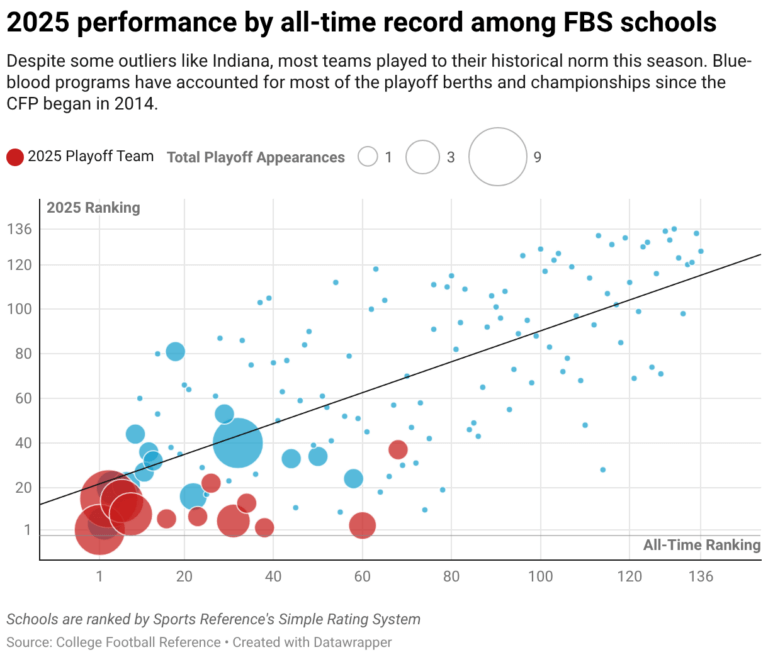
The 136 schools that play at the highest Division I-FBS level work year-round to recruit and retain as much talent as possible from a limited pool of 18-to-22-year-old players. It is not uncommon for teams to replace half their rosters between seasons while most coaches last only three to four years at the same school. Despite the rapid personnel turnover, college football is the most hierarchical major American sport. Every program has good and bad years, but most have stayed in the same echelon since the era of leather helmets.
Places are similarly stratified, even as the people who live in them are changing constantly. Almost two in three people live in a different city than where they grew up, and roughly one-third live in a different state.
Yet most of the wealthiest places half a century ago sit atop of the economic hierarchy today, while most of the poorest places remain on the bottom today. The distribution of places by past and present per capita income resembles the ranking of college football programs.
a
The top programs and places maintain their preeminence – and prevent the rise of rivals from lower tiers – because the competition for talent is biased in their favor. Five-star prospects go to Ohio State and Alabama for the same reason that the top financiers go to New York and computer scientists go to Silicon Valley: that’s where the best in their fields have always gone. Over time, they have accumulated institutional advantages – more wealth, higher professional ceilings, greater national recognition – that make them attractive destinations for the next generation.
You don’t have to like Kiffin’s decision to acknowledge that it is easier to follow the well-worn path to success than to try to create it where it has not previously existed.
Mississippi excels at producing talent, not recruiting it
You’ll find Mississippians in the top ranks of nearly every profession, but most had to leave the state to get there.
Football is the clearest example, in part because it affords us the most complete data. Mississippi produces football talent at a higher rate than any state in the country. Mississippi ranks first per capita in professional football players all-time, active NFL players, Hall of Famers and professional games played.
By default, every professional football player who grew up in Mississippi left the state for their career. The outmigration of NFL players mirrors the brain drain in other fields. In both cases, Mississippi’s universities are often the launchpad for out-of-state job opportunities. A college education is hardly the only marker of talent, but it is the sharpest dividing line between who stays in Mississippi and who leaves.
Almost half of Mississippi natives move away after earning a bachelor’s degree, compared to only 30% of Mississippians without a four-year degree. University graduates account for all of the net outmigration from Mississippi since 2010. If football is the rite of fall on campus, the rite of spring is newly-minted graduates packing up to leave Mississippi.
It is no coincidence that the most popular destinations are cities with pro football teams like Dallas, Houston, Atlanta and Nashville. Other top employers are located in those cities for the same reasons as the NFL: that’s where the people and money are.
Nevertheless, Mississippians are only slightly more likely to leave their home state than other Southerners. What separates Mississippi from nearby states is the ability to recruit newcomers to replace them. For every 100 people born in the average Southern state, 28 move away while 59 move in. Mississippi loses 36 but gains only 26.
College students are the primary exception. The state’s universities are the best recruiters of talent to the state – in part because of the national exposure from their college football teams. Approximately 4,500 more college students move to Mississippi each year than move away, the 15th-highest rate of net in-migration in the country. In total, about 38% of the enrollment at Mississippi’s eight public universities has come from outside the state.
The football rosters are even more geographically diverse than the campuses at large. Nearly three-quarters of Ole Miss’s team moved from another state, and about 60% of the teams at MSU and USM. More than half of the 77 active NFL players who played at one of Mississippi’s D1 programs were born outside of Mississippi. Most of them chose to play college ball in Mississippi over offers around the country. Twice in the past 13 years, the top high school recruit in the country chose to sign with a Mississippi school: Robert Nkemdiche came to Ole Miss from Georgia in 2013 and Travis Hunter came to JSU from Florida in 2021.
Student-athletes enroll at Mississippi’s universities for the same reasons as other students: because they offer quality professional development, vibrant social atmospheres and competitive financial packages. Their recruiting success proves that Mississippi is capable of attracting talent from anywhere – as long as it can match the opportunities that exist in other places.
The brain drain occurs because the opportunities in Mississippi dry up as soon as students graduate. The state ranks last in the share of jobs that require a bachelor’s degree or more. The cost of living is low, but the pay is even lower: college grads take home 10% less in Mississippi than in other Southeastern states even after accounting for price differences. Most of the population lives in rural areas or small towns, which do not appeal to young people seeking big-city amenities or cultural diversity.
As a result, approximately 95% of out-of-state students leave within five years of graduation, to go along with the nearly half of Mississippi natives. Only two graduates move in from another state for every three who leave. From 2010 to 2020, Mississippi’s colleges and universities jumped from 43rd to 29th in the number of bachelor’s degrees granted per capita, but the share of college-educated 25-to-34-year-olds living in Mississippi dropped from 49th to 50th over the same period.
A changing recruiting landscape is creating unlikely winners
Only six schools have won national championships in the playoff era. This year will produce the seventh.
The final four contenders were Indiana, Oregon, Miami and Ole Miss. Only Indiana and Oregon had made a playoff prior to this season, but neither has won a national championship in school history. Miami won its most recent title in 2001, before any of the players on its current team were born. Ole Miss’s last championship (claimed by the school, though not recognized by the NCAA) came in 1962, another season overshadowed by off-field events.
The common thread among the four semifinalists is that they have aggressively adapted to the changing recruiting landscape. On the heels of a Supreme Court decision, the NCAA granted players the ability to be paid for their name, image and likeness (NIL) in 2020, followed by the lifting of restrictions on transferring between schools. Revenue sharing now allows schools to pay players directly.
Players can now move around the country and compare financial offers, just as workers in other sectors have always been able to do. In the new era, recruiting talent has less to do with a program’s pedigree than its budget. The four semifinalists all have well-funded and well-organized NIL collectives that have allowed them to land talented transfers. While blue-bloods Georgia, Ohio State, Alabama still build their rosters through the high school ranks, more than half of the starters at Miami, Indiana and Ole Miss have come out of the portal. In the first two rounds of this year’s playoff, the team that started more transfers was 6-1 (Oregon and James Madison had an equal share).
The changing landscape has not upended the established hierarchy – after all, blue-blood programs typically still have the largest fan bases and deepest pockets – but it has created new opportunities for upward mobility among programs that can raise enough money and invest it wisely.
Broader societal and economic changes in wake of the pandemic have also shifted the migration of talent among the general population. Many of the largest and wealthiest cities began losing residents in 2020 as knowledge workers took advantage of their newfound ability to work remotely. Housing costs had been growing for decades in the nation’s top talent hubs, and COVID-era inflation brought affordability to a breaking point. In response, young professionals have flocked to smaller cities that offer many of the same urban amenities at a fraction of the price.
According to Zillow, the nation’s hottest housing markets in 2025 were Buffalo, New York; Indianapolis, Indiana; Providence, Rhode Island; and Hartford, Connecticut. All have historically been second- or third-tier cities in their regions. Three of the four had lost population since 1970.
As in college football, the established hierarchy remains intact, but with more potential for upward mobility. Talent still tends to flow in the direction of the cities with the biggest economies and highest-paid jobs, but the changes since 2020 have created opportunities to redirect more talent to places that previous generations had left behind.
Ole Miss built one of the nation’s best football teams because it figured out how to use the changing landscape to its advantage. As a state, Mississippi has not yet followed suit.
Jake McGraw leads the Rethink Mississippi initiative at Working Together Mississippi, a nonpartisan civic engagement organization of nonprofits and religious institutions across the state. He began researching and writing about the brain drain when he moved back to Mississippi more than a decade ago. A native of Oxford, he studied public policy and economics at the University of Mississippi and economic history at Oxford University. You can reach him at j.mcgraw@workingtogetherms.org.






![[ Insert title here ] (Scatter Plot)](https://ourtupelo.com/wp-content/uploads/2026/01/full-1.png)
![[ Insert title here ] (Scatter Plot)](https://ourtupelo.com/wp-content/uploads/2026/01/full-2.png)
