Gov. Tate Reeves announced on Friday that he intends to call a special legislative session next week for lawmakers to pass a state budget.
The move comes after House Speaker Jason White and Lt. Gov. Delbert Hosemann, both Republicans, said separately that they had reached a handshake deal on a $7 billion state budget, which was supposed to have been passed earlier this year in regular session.
Reeves, a Republican, said he informed Hosemann and White on Friday that he intends to call a special session for the middle of next week.
“The proposed budget does not materially increase state spending, is fiscally conservative, and will help us to continue Mississippi’s historic economic momentum,” Reeves said in a statement posted on social media. “I’m proud of the work we’ve done to reach this agreement. I’d like to thank Mississippi’s legislative appropriators for working diligently throughout the budget negotiation process. I’m excited to get the special session completed and look forward to quickly passing the budget.”
Multiple legislators told Mississippi Today that House Speaker Jason White’s office notified them that the special session would begin on Wednesday morning, though the governor has not yet publicly said when it will begin.
Mississippi lawmakers must return for a special session because they adjourned their 2025 regular session earlier this year without passing a budget. Lawmakers were mired in political infighting over tax reform and capital projects, including many lawmakers’ pet projects in their districts.
The Senate wanted to spend only on projects for state agencies, universities and colleges. The House believed there was enough money to fund projects in counties and municipalities around the state, in addition to the state projects.
The political reality is that legislative leadership tightly controls the bulk of the local projects in what’s often referred to as the “Christmas Tree bill.” Leadership can use these projects to reward people who buy into their agenda and punish members who buck the leadership.
Such special projects for back home are often a key focus of rank-and-file lawmakers who don’t have prominent leadership roles at the Capitol.
Legislators must return to the Capitol to pass a budget in special session before the new budget year begins July 1. Failure to pass a new state budget by the end of June could result in some agencies shutting down until they are funded.
President Donald Trump on Friday approved Mississippi’s request for federal assistance to help recover from deadly tornadoes and severe weather that left damage spread across the state on March 14 to 15.
“That’s good news,” said Walthall County Emergency Director Royce McKee on Friday, over two months since the storms hit. “Everybody will be happy we can start picking up the debris. People will start to see the light at the end of tunnel.”
The Mississippi Emergency Management Agency said it didn’t know yet how much money would come to the state. MEMA did confirm that the federal government would cover 100% of costs for the Federal Emergency Management Agency’s Individual Assistance aid — a program that sends direct payments to those affected by the storms — and 75% of costs for FEMA’s Public Assistance, which pays for repairs to public infrastructure. The state and local governments will split the remaining those costs.
The 11 counties that qualified for Individual Assistance are: Covington, Grenada, Issaquena, Itawamba, Jefferson Davis, Leflore, Marion, Montgomery, Pike, Smith and Walthall. The 17 counties that qualified for Public Assistance are: Calhoun, Carroll, Covington, Grenada, Humphreys, Issaquena, Itawamba, Jefferson Davis, Lee, Leflore, Marion, Pike, Prentiss, Sharkey, Smith, Walthall and Washington.
Tornado damage to property along New River Road in Tylertown, Monday, March 17, 2025. Credit: Vickie D. King/Mississippi Today
Residents impacted by the storms can apply for assistance through this online portal, by calling 1-800-621-3362, or on FEMA’s mobile app.
The March storms killed seven Mississippians and injured dozens of others, while damaging nearly a thousand homes, according to MEMA’s tally. Of those homes, the storms destroyed 164, and left another 204 with “major damage,” which usually means a home is no longer habitable.
In Walthall County, McKee said over 100 homes were destroyed or received major damage. The biggest priority with FEMA’s support, he said, is taking care of displaced residents who are either living in hotels or staying with family.
“We’re a poor county and have a lot of people that don’t have insurance,” McKee said. “It’ll be leaps and bounds for them trying to get back to normal.”
Starting next week, FEMA will have in-person stations in Mississippi to enroll storm victims in assistance programs. MEMA Director of External Affairs Scott Simmons said the state agency will soon make information on those locations available on its website.
In Leflore County, where the storms damaged 314 homes, Emergency Director Fred Randle said it took a while for insurance companies to reach some places, and even then there were “a lot” of costs that insurance didn’t cover.
“We had a lot of people (where) it was two weeks before the insurance adjuster could get out and check their home because there was so much damage everywhere,” Randle said, adding that while it was nerve-wracking waiting over two months for the decision on FEMA aid, it was good news to receive going into the holiday weekend. “It’ll help us tremendously. Something to help celebrate.”
Editor’s note: This essay is part of Mississippi Today Ideas, a platform for thoughtful Mississippians to share fact-based ideas about our state’s past, present and future. You can read more about the section here.
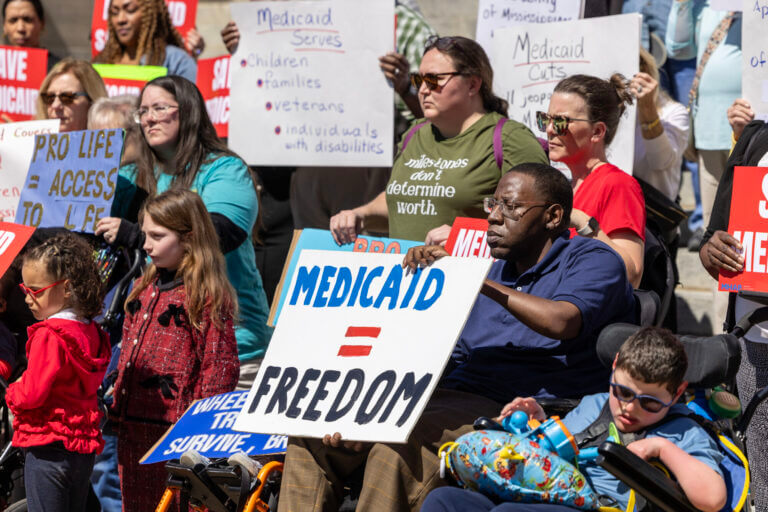
If Mississippi has taught me anything, it’s that federal policy rarely trickles down as promised. For people with disabilities, especially in our state, Medicaid isn’t a political talking point—it’s survival.
Medicaid pays for in-home support, daily nursing care, medications, equipment and community access. Without it, the alternative is often institutionalization, isolation or worse.
But under the Trump administration’s proposed budget, this vital program is facing devastating cuts. Medicaid is on the chopping block, and Mississippi is standing directly in the path of the blade.
Recently, I spoke with a mother in the Mississippi Delta whose son has a rare degenerative condition. He’s nonverbal, uses a wheelchair and needs help with every aspect of daily life. For the past three years, Medicaid has provided her a modest stipend to be his paid caregiver—allowing her to stay home, care for him full-time and keep him out of a facility 90 miles away.
“If they cut this program,” she told me, “I’ll have to go back to work. But no one else can care for him. What happens to him then?”
She already knows the answer: He’ll be institutionalized. Not because he needs to be — but because that’s the only option left when Medicaid collapses and the community-based care disappears.
The Kaiser Family Foundation ranks Mississippi as one of the states most vulnerable to federal Medicaid cuts. We rely on federal funds for nearly three-quarters of our Medicaid budget. Unlike wealthier states, we don’t have the cushion (or the political will) to fill the gap if that money disappears.
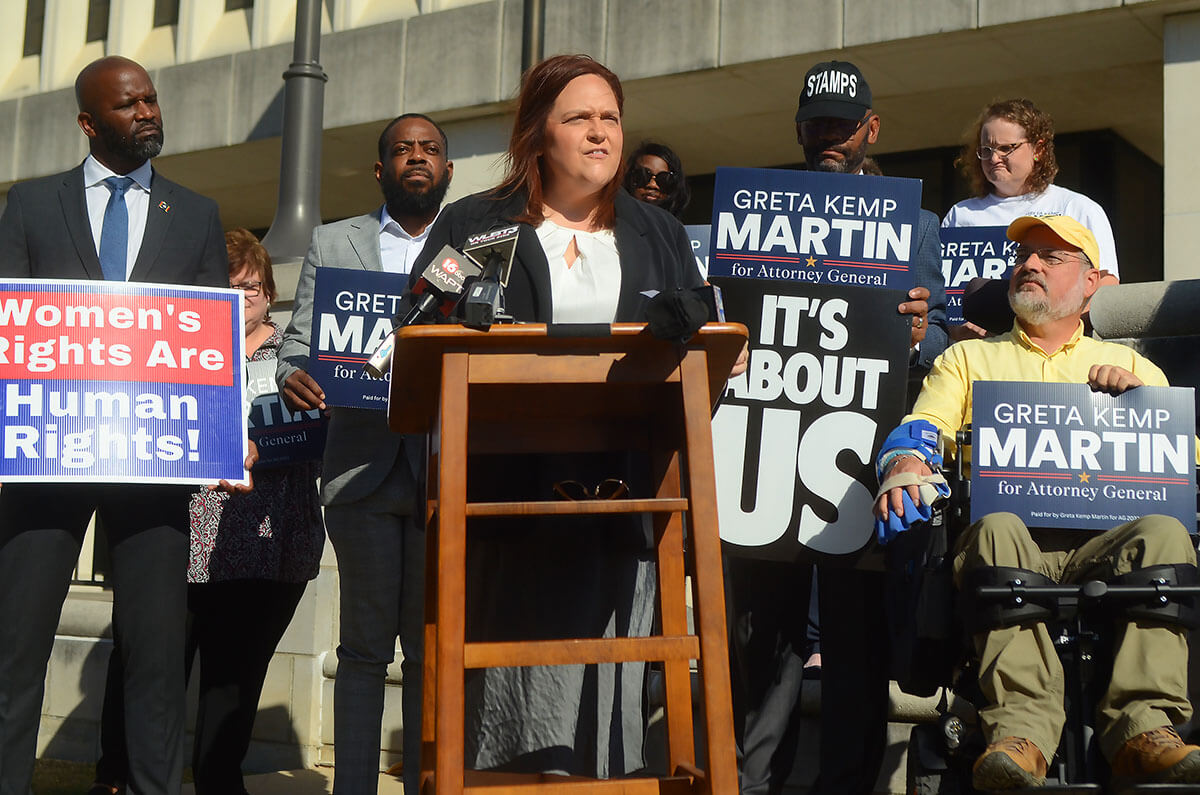
Greta Kemp Martin speaks during her unsuccessful campaign for attorney general in 2023. Credit: Vickie D. King/Mississippi Today
And it’s not just one program on the line. The Urban Institute outlines how slashing HHS funding will kneecap services that help disabled people live independently. That includes everything from personal care attendants to case managers to basic home health. Families as Allies of Mississippi and the Mississippi Coalition for Citizens with Disabilities have issued repeated warnings, but so far, the response from many of our lawmakers has been silence.
We’ve seen this film before. And we won’t like the ending: more people forced into institutions, more families pushed to the brink and more lives lost.
Even the Right Is Blinking. Sen. Josh Hawley of Missouri — hardly a progressive firebrand — was publicly opposing the Trump administration’s cuts in a recent New York Times op-ed.
For those not familiar with Sen. Hawley’s typical position, this should raise alarm bells.
“Medicaid isn’t a handout,” he writes. “It’s a commitment to human dignity.”
For once, he’s right. Message to current administration: If your policy has lost even Josh Hawley, maybe it’s time to ask yourself what exactly you’re defending.
What’s happening in Washington isn’t abstract. This is a direct threat to people in Mississippi, especially those with disabilities.
More than 700,000 Mississippians — about a quarter of the state’s population — rely on Medicaid or the federal Children’s Health Insurance Program, according to the Mississippi Division of Medicaid website. Medicaid covers 1 in 3 Mississippians with disabilities. Medicaid provides not only health care, but also essential supports like personal care services, durable medical equipment and access to home and community-based services that allow people to live independently instead of being institutionalized.
The latest GOP proposals in Congress may avoid the most dramatic cuts for now, but they still set the stage for devastating consequences. Policies like work requirements and funding clawbacks are being framed as “moderate reforms,” but let’s be clear: they target the very people Mississippi’s system is already failing, including low-income families, disabled residents and rural communities with limited alternatives.
National experts at KFF warn that cuts of this scale could force states to reduce benefits, tighten eligibility or shift costs in ways that make care harder to access. Recent Axios reports say Medicaid work requirements could lead to hundreds of thousands losing coverage. This is not because people can’t work, but because navigating paperwork shouldn’t be a condition for staying alive.
As of this week, Mississippi’s delegation has been largely silent, but the health care system they claim to protect is already in crisis. If these policies move forward, they’ll be accelerating a slow-motion disaster.
The question isn’t whether cuts are “technically moderate.” The question is: Who gets left behind and who’s counting on us not to notice?
Here’s the deal: Medicaid in general is and never will be perfect. But when it’s paired with deep underinvestment and a cruel federal rollback, it stops being a policy failure and starts being a moral one.
Mississippians with disabilities aren’t asking for special treatment. They’re asking to live in their homes. To go to school. To survive. If you gut Medicaid, you don’t just cut cost — you cut people off from their futures.
And from where I sit, the view is clear: We must sound the alarm, raise our voices and refuse to be complicit in policies designed to leave our most vulnerable behind.
Bio: A Tishomingo County native, Greta Kemp Martin is an attorney who advocates for the disabled as litigation director of Disability Mississippi. She is an Ole Miss alum and holds a law degree from Mississippi College School of Law. She and her family live in Jackson.
With just over a month before a new fiscal year starts, House and Senate leaders have sent Gov. Tate Reeves a proposed budget for approval.
House Speaker Jason White and Lt. Gov. Delbert Hosemann said separately that they have reached a handshake deal on a $7 billion state budget, which was supposed to have been passed earlier this year in regular session.
Still, Reeves will ultimately have to give sign-off on it and order a special legislative session before all 174 lawmakers can consider it.
Hosemann, the Senate’s presiding officer, told Mississippi Today in a statement that: “The House and Senate have come to an agreement on the budget. We have notified the Governor and are awaiting the call for special session.”
White gave a similar account on SuperTalk radio station this week and predicted lawmakers will vote on the budget to fund government services “within the next couple of weeks.”
Mississippi lawmakers control the purse strings and the budget process. But they adjourned their 2025 regular session earlier this year without passing a budget because of political infighting. Now, legislators must return to the Capitol to pass a budget in a special session before the new budget year begins July 1.
The state Constitution gives the governor the sole power to call a special session, and Reeves alone sets the parameters for what lawmakers can consider in a special session.
Reeves’ office did not respond to a request for comment on what his criteria will be for approving the budget before he calls the special session. But he told reporters earlier this year at a press conference that he wants legislative leaders to send him a fiscally responsible budget.
White and Rep. Karl Oliver, a Republican from Winona who serves as a House appropriations chairman, previously said that most state agency budgets will have level funding, with only increases for the public pension system and insurance costs.
One of the significant points of contention between the two chambers has been how to spend cash not allocated to government operations. Lawmakers typically spend this money on capital projects across the state — including many lawmakers’ pet projects in their districts.
The Senate wanted to spend only on projects for state agencies, universities and colleges. The House believed there is enough money to fund projects in counties and municipalities around the state, in addition to the state projects.
The political reality is that legislative leadership tightly controls the bulk of the local projects in what’s often referred to as the “Christmas Tree bill.” Leadership can use these projects to reward people who buy into their agenda and punish members who buck the leadership.
Such special projects for back home are often a key focus of rank-and-file lawmakers who don’t have prominent leadership roles at the Capitol.
A major flashpoint in the project funding debate appears to be money for installing a new interpretive center at the Vicksburg National Military Park, the hometown of both Hosemann and Senate Appropriations Chairman Briggs Hopson.
The Mississippi Department of Archives and History helps manage the exhibits of the park, and state money typically flows through the agency. Because the state agency helps manage the area, this was part of the Senate’s justification for the project.
However, the House leadership has apparently balked at the request and views the Senate’s attempt to secure money for the park as an attempt to steer dollars to its favorite project while preventing spending on any pet projects for the House.
In the remaining weeks before his scheduled execution, Richard Jordan, Mississippi’s oldest and longest serving death row inmate, is looking for ways to fight his death sentence.
Jordan was sentenced to death for the kidnap and murder of Gulfport resident Edwina Marter in January 1976. Marter’s sons, who were 3 and 9 at the time of her death, and her husband are still alive, according to public records. About a decade ago, her family told The Advocate they were hoping to receive closure from the execution after years of its delay.
The decision to let the execution proceed rests in the hands of the Mississippi Supreme Court, the U.S. Supreme Court and a federal district court judge – two courts that have rejected his previous requests and a judge who has allowed another execution to be carried out while a challenge to the state’s execution protocol continues.
Attorneys filed two motions asking the Mississippi Supreme Court to rehear its denial of the 78-year-old’s petition for post conviction relief and to rehear its order setting his execution.
They wrote that when the court denied his post-conviction relief petition, it “misapprehended the facts and the law.” To fix it, Jordan asked the court to vacate his death sentence or at a minimum return it to the trial court for another look.
His attorneys argue Jordan’s death sentence is not valid because in 1976, when the murder was committed and Jordan was sentenced, Mississippi and all other states had ceased executions based on a 1972 U.S. Supreme Court decision inFurman v. Georgia that capital punishment was unconstitutional.
On July 2, 1976, four months after Jordan was sentenced, the Supreme Court overturned this ruling in Gregg v. Georgia. Mississippi passed a statute allowing discretionary death penalty sentences in 1977.
“Here, because there was no constitutional provision for the death penalty at the time of Jordan’s offense, his death sentence is unconstitutional,” the May 15 filing states.
Jordan went to trial multiple times and his sentences were overturned. His death sentence did not stick until decades later in 1998. Since his first trial, Jordan has been incarcerated for nearly 50 years.
In another recent court filing, Jordan’s attorneys argue the state’s motion to set Jordan’s execution didn’t follow state law because he has not exhausted all state and federal remedies.
Jordan asked the U.S. Supreme Court in March to hear his case. As of May, that petition for writ of certiorari is awaiting a decision. The state opposes and has asked the high court not to take up Jordan’s petition, saying the Mississippi Supreme Court was correct in its ruling.
That petition centers around his access to a mental health expert separate from the prosecution to develop and present sentencing mitigation as an indigent defendant, which was established as a constitutional right through the U.S. Supreme Court’s Ake v. Oklahoma decision. The other issue is how the Mississippi Supreme Court handled Jordan’s Ake claims in his appeal and post-conviction.
At trial, Jordan was evaluated by a state psychiatrist whose report was also given to the prosecution, which his attorneys argue undermined his mitigation case since the Ake decision specified the evaluation was to be used on the indigent defendant’s behalf.
The petition states he was not diagnosed as suffering from post-traumatic stress disorder resulting from his combat service in Vietnam, but instead incorrectly as having antisocial personality disorder.
“Review of that decision is manifestly warranted to ensure appropriate respect for this Court’s decisions, vindicate the supremacy of federal law, and ensure that those defendants in Mississippi whose mental health will be an issue at trial receive the right to the expert assistance to which the Due Process Clause entitles them,” the March court filing states.
Additionally, Jordan and fellow death row inmate Ricky Chase are lead plaintiffs in a federal lawsuit challenging the constitutionality of the drugs used for lethal injection.
Since 2022, the state has since addedalternativeexecution methods if lethal injection drugs aren’t available: execution by gas chamber, electrocution or firing squad. To date, a handful of states have used these other methods, including the use of nitrogen gas inAlabamaand firing squad inSouth Carolina.
The Mississippi lawsuit did not stop the December 2022 execution of Thomas Loden, another inmate who was part of the legal challenge.
The same day Jordan’s attorneys filed motions with the Mississippi Supreme Court, Jordan and Chase filed a motion with U.S. District Judge Henry Wingate, asking for him to order the state to provide essential documents to the plaintiffs about the state’s possession and planned use of execution drugs as well as documents related to the most recent executions of David Cox in 2021 and Loden.
Plaintiffs wrote that access to this information would help them seek an injunction to stay Jordan’s execution and help with discovery, which is the process of obtaining evidence from other parties before trial. Trial for the lawsuit has been scheduled for Dec. 1, 2025.
“It is unconscionable for Defendants to seek the execution of Richard Jordan while continuing to stonewall Plaintiffs’ repeated demands for supplementation of discovery in this case,” a May 14 court filing states.
Weeks before the city could conclude its “100 Days of Peace” initiative, Jackson ousted the director of its Office of Violence Prevention and Trauma Recovery.
Keisha Colemanhad led the less than 3-year-old office, a key piece of outgoing Mayor Chokwe Antar Lumumba’s efforts to tamp down on crime, since January 2023.
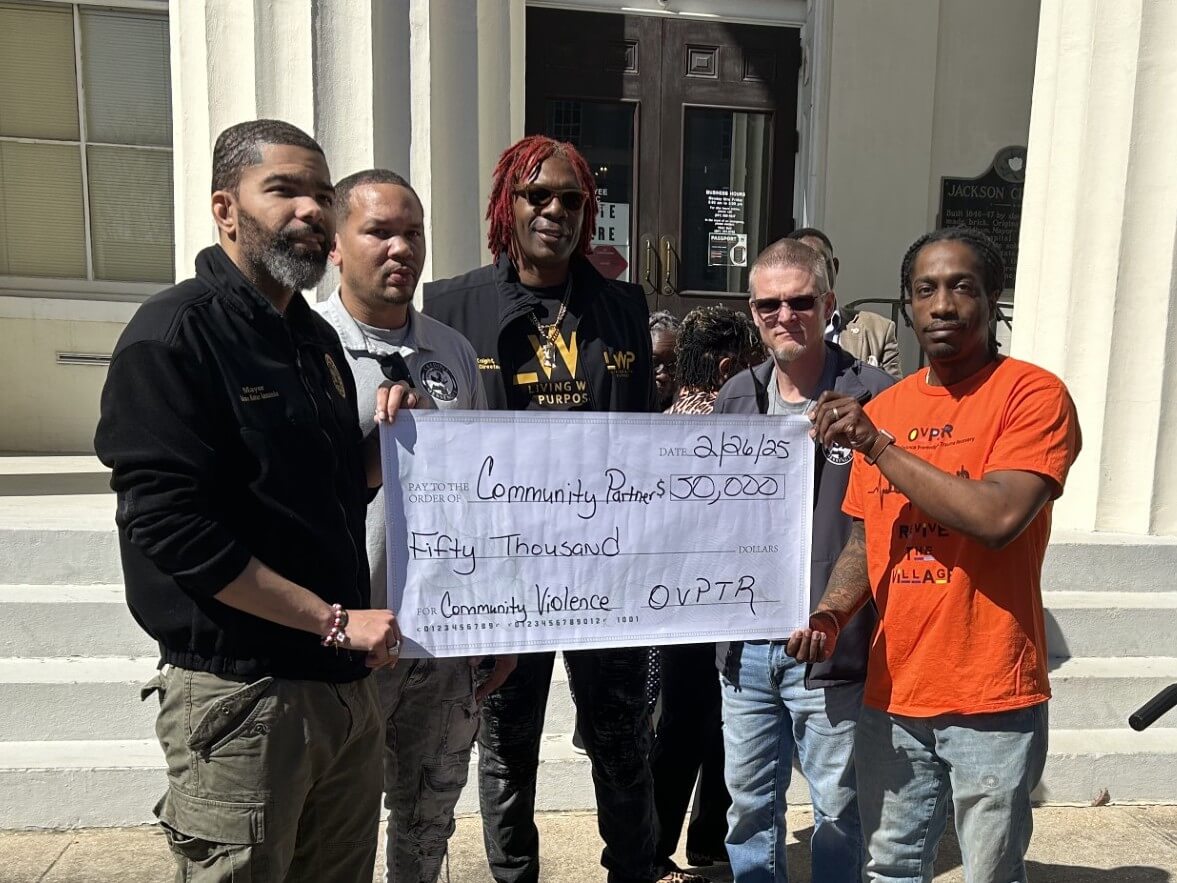
She was by Lumumba’s side earlier this year when he announced, weeks before losing reelection, that the office had awarded $150,000 to community-based organizations working to prevent violence. The press conference marked the beginning of 100 Days of Peace, also known as 100 Days of Action, an initiative that was to feature events like town halls, trainings and listening sessions and conclude with a sneaker ball to celebrate the Jacksonians working to reduce violence.
But if an event required funding, it did not happen, Coleman said, and she’s doubtful it will. Just a few months later, on May 7, Coleman said she received her termination letter from Lumumba’s chief of staff, Safiya Omari.
The alleged stated reason? The trauma recovery specialist had spoken to the mayor’s electoral opponent at a festival to celebrate south Jackson, Coleman wrote in an email to other city officials obtained by Mississippi Today.
Jackson Mayor Chokwe Lumumba awarded grants from the Office of Violence Prevention and Trauma Recovery to three community organizations outside of City Hall Wednesday, Feb. 26, 2025. From left to right: Mayor Lumumba, Terun Moore of Strong Arms of Mississippi, John Knight of Living With Purpose, Bennie Ivey of Strong Arms of Mississippi, and OVPTR Community Outreach Specialist Kuwasi Omari. Credit: Courtesy City of Jackson
“The termination, verbally framed as a ‘loyalty’ issue, follows repeated attempts to hold the administration accountable for gross misuse of public funds and nepotism that jeopardized critical community safety programs,” Coleman wrote.
In an interview, Omari said she could not discuss personnel matters but called Coleman’s allegations “false and misleading.” The chief of staff also said she could not discuss how the allegations are misleading, “because then that would involve me talking about her.”
Coleman alleged ina pointed May 7 email to city council members that over her time as director, Omari and the mayor’s executive assistant, Tiffany Murray, blocked her efforts to get the new office up and running by stymying Coleman’s ability to spend city funds. She wrote that they prevented her from using empty office space to host workshops and slowwalked the distribution of city funding meant to create a youth engagement center.
“OVPTR’s mission—to reduce violence and trauma in Jackson—has been crippled by Dr. Omari’s actions,” Coleman alleged.
The office was launched in 2023 with a $700,000 grant from the National League of Cities, a nonprofit. Despite being the office’s director, Coleman wrote that the mayor’s office did not grant her access to spend city funds until the beginning of this year, making it difficult to execute events.
“Most of the work was done from my personal funds and people in the community who supported the work,” Coleman wrote.
Reached at her office line, Murray said she did not have any comment at this time.
Coleman told Mississippi Today that she doesn’t want the termination to overshadow the office’s work. On June 3, Jackson will hold a General Election for mayor, in which Democratic nominee and longtime state senator John Horhn is the expected winner.
“I do want to keep a good standing in the community in the event that John Horhn does come in and I want to advocate for that office,” she said. “I don’t want to diminish what’s going on there and the importance of that work.”
City spokesperson Melissa Payne told Mississippi Today that while it had not been long since Coleman left the city, several applicants had already interviewed for the position.
“Her staff is still working, and they’re still doing what they need to do,” Payne said.
But in the email, Coleman alleged that she had recently put one of her two subordinates — Omari’s son, Kuwasi Omari — on a performance improvement plan for “chronic tardiness, absenteeism, incompetence to the role, and failure to complete tasks or submit weekly reports.” Coleman also alleged Omari used her position by “withholding staff hires in order to hire her son.”
Kuwasi Omari, listed online as the office’s community outreach specialist, did not return Mississippi Today’s messages. His 45-day improvement plan was set to end on May 8, Coleman wrote, but the city fired her on May 7.
Responding to this allegation, Omari, whose other son works as a community services coordinator in the city’s department of human and cultural services, said that Kuwasi Omari is responsible for a program the office is running that works with boys at Lanier High School, which involves plans for a community clean-up.
“Let me just say this: It was certainly her right as his director to do that, but contextually I will say that the only real work that has taken place in the office,” Omari said before pausing. “Okay, no, I won’t say that.”
The office will be without a director until at least July 1, when a new mayor comes in, after the city council instituted a hiring freeze Tuesday. Omari said this means that events like the sneaker ball probably won’t happen.
“Having an idea and making statements doesn’t mean that the work to make those things happen has taken place,” Omari said.
The council’s decision to freeze hiring came after WLBT reported the city had hired Lumumba’s former election opponent-turned-campaign supporter in the 2025 Democratic primary, David Archie, a former county supervisor, as a staff assistant to the mayor.
The city also recently brought on Tariq Abdul-Tawwab, a former employee of the third party manager over the city’s water utility, JXN Water, which reportedly fired him in 2023, as a deputy director in the city’s public works department. He was recently described as a director at one JXN Water’s staunchest critics, the nonprofit People’s Advocacy Institute founded by the mayor’s sister and where Abdul-Tawwab’s wife works.
The Office of Violence Prevention and Trauma Recovery was established as an office under the mayor’s executive branch. In response to a recent public records request, the City Clerk told Mississippi Today that the city does not have an overall organizational chart, but provided several departmental organization charts.
The mayor’s office was not among them.
One of the violence prevention office’s goals is to quantify the impact of violence prevention work in Jackson through data.In the press conference earlier this year, Lumumba cited data showing that efforts by local organizations, including credible messenger groups, have ushered in long periods without violence in some of the most troubled areas of the city.
“I don’t have access to that data, as you know Keisha is no longer with us,” Omari said, “so we’re trying to figure out how we’re gonna move forward with the data that has come in, as well as a lot of the data I’m sure is coming directly from JPD, and everybody has access to that.”
Coleman had told Mississippi Today earlier this year that her office was developing a public-facing data dashboard making it easier to examine crime trends and patterns in the city.
The office’s work has been supported by local advocacy organizations, and Horhn previously told Mississippi Today that he did not have plans to close the office.
But under the current administration, Coleman wrote her efforts were not receiving adequate support.
In one example, she alleged that she had repeatedly asked to use empty office space in a city building on North State Street to host events like youth workshops. But in front of the mayor, Omari and Murray told her “no,” Coleman alleged, because that space was going to become Lumumba’s second office.
“This directly denies community of service, support, and resources that would assist in the goal of the OVPTR,” Coleman wrote. “As of today, the space has yet to be used.”
The $50,000 grants that Lumumba announced earlier this year, the first transfers from the office to outside organizations, represent some of its largest expenditures, according to public records obtained by Mississippi Today. As of March, the office had reported spending nearly $430,000 since its inception, the bulk of it categorized under wages and benefits and the credible messenger grants. Coleman alleged that part of the money was used to pay Murray’s salary, “despite providing no operational support.”
The records show it has spent $1,200 on office supplies, $12,000 on travel and nearly $4,000 on data processing equipment, though if the office has conducted crime stats analysis to inform evidenced-based approaches to violence interruption, it has not publicized any such reports.
Coleman urged in her email that the office has remaining sources of funds that are at risk: A little over $200,000 the city council allocated to the office for a youth engagement center, and about $270,000 left from the National League of Cities.
“This is not an attempt to smear this administration,” Coleman wrote in the email. “This is me being proactive because there is over $470,000 of funds out there that someone will have to answer for and I will NOT be thrown under the bus because I’m no longer there to speak for myself.”
Omari said the youth engagement center will open sometime this summer at the currently defunct Mary C. Jones Center that is being rehabilitated with funds from the facilities department. The $202,000, Omari added, will be used for programming.
“I know when I looked a couple months ago, the money hadn’t even been set up in our budget,” Omari said.
The city did provide Coleman with one bit of support, she wrote. But it was apparently fleeting.
“Outside of the one time in March 2024 (that) Tiffany gave me a realm (sic) of copy paper, I’ve purchased, on my own, copy paper, office supplies, flyers, rack cards, brochures, etc. just to have an operational office,” Coleman wrote.
Erica Reed could feel herself tearing up as she walked into work at Jackson Medical Mall on a Monday in April.
It was the first time she had seen the lights out at the now relocated Jackson-Hinds Comprehensive Health Center’s adult medicine clinic – a harbinger of changes to come at the former shopping mall turned medical center.
The transfigured shopping mall finds itself on the cusp of change as the University of Mississippi Medical Center, long one of the medical mall’s key stakeholders and largest lessee of space in the facility, readies itself to move many of its clinical services and reduce its square footage at the mall by about 75% in the next year.
And with UMMC goes Jackson-Hinds Comprehensive Health Center, a federally qualified health center and one of the largest providers of primary health care services to poor and uninsured people in central Mississippi. The center has subleased space at the mall from UMMC for over a decade and is one of the last providers to offer primary health care services at the mall.
“It was just very overwhelming when I walked in the clinic,” said Reed, who began working at the medical mall as a housekeeper in 2010 and rose through the ranks to become chief operating officer of the Jackson Medical Mall Foundation. “I had never seen the lights out. And so to see the lights out, you know, it was kind of a day like, ‘this is real.’”
UMMC declined to answer any of Mississippi Today’s questions about its decision to leave the mall, future involvement at the mall or the impact that the changes will have on patients.
Since the late 1990s, the medical mall has stood as an access point to health care and an economic anchor in a majority-Black neighborhood in Jackson with a high concentration of people living in poverty. People from across Jackson and Mississippi have also come to the mall to receive care.
Jackson lawmakers argue that the loss of health care services will negatively affect patients who rely on the mall for health services and on the neighborhood as a whole.
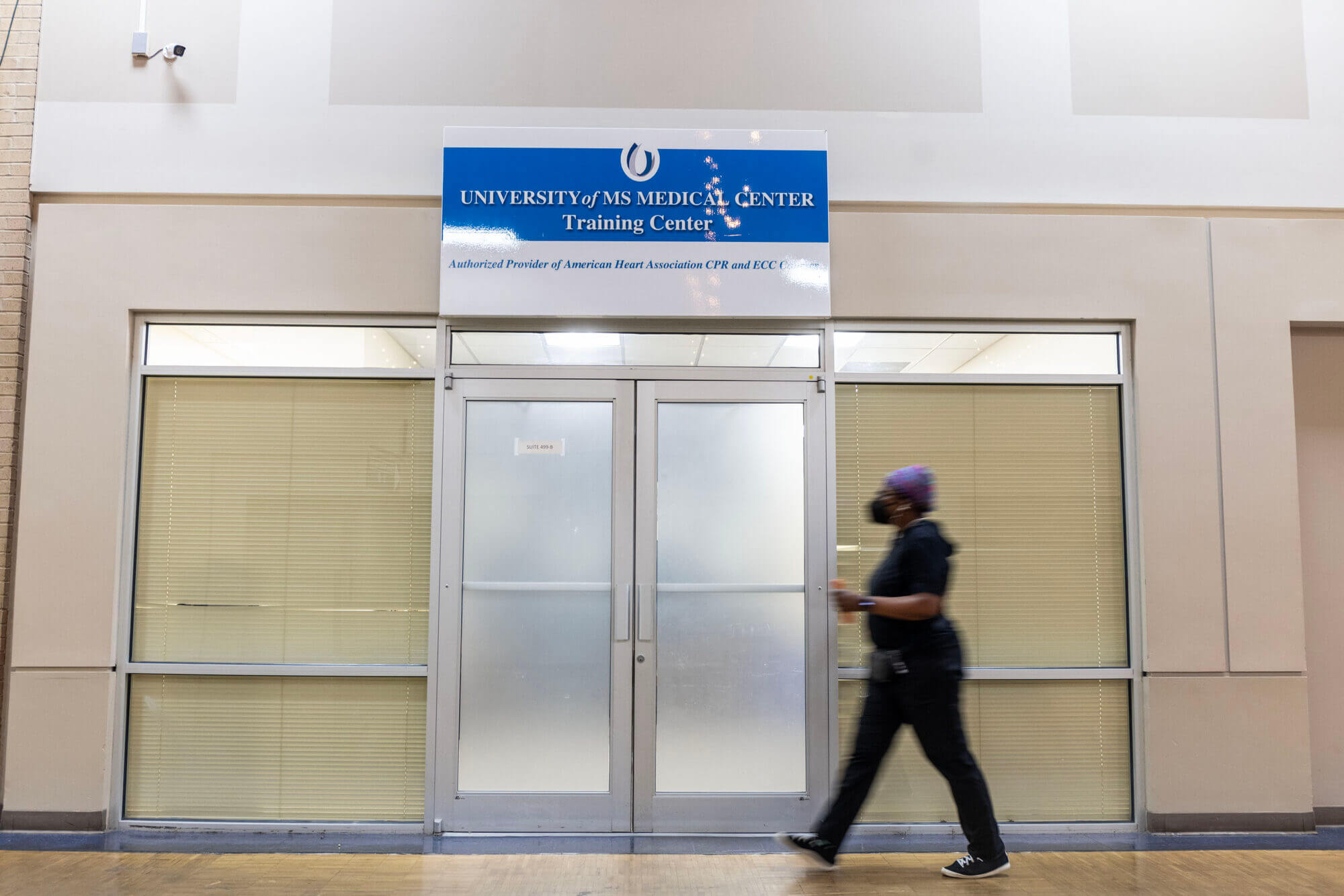
A medical worker walks past UMMC’s Training Center at the Jackson Medical Mall in Jackson, Mississippi, on Monday, March 3, 2025. Credit: Eric Shelton/Mississippi Today
“The impact is going to be very severe on that area,” Rep. Chris Bell, D-Jackson, told Mississippi Today. “Not only just in the face of the residents who need medical services, but in the whole aspect of an empty medical mall with no cars, or very few vehicles in there, which shows no life, which adds opportunities for crime.”
As Reed walked through the medical mall, she greeted each person she saw: patients, shop owners and fellow staff members. She picked crumpled receipts off the floor and threw them in the waste bin. The mall has grown into a home for her, she said.
She has watched the mall adapt before, but the loss of primary care, pediatrics and other clinical services at the medical mall is one of the most significant adjustments the medical mall has yet faced.
“We will persevere,” she said. “… One closed door is an opportunity for another open door.”
A long history
When Jackson Mall opened its doors in 1970, it was the first shopping mall in Mississippi, drawing customers from across the state. But it didn’t take long for business to falter with the opening of Metrocenter Mall in 1978 and Northpark Mall in Ridgeland in 1984.
By the 1990s, the mall was largely vacant, with only a few tenants left.
“The mall was but a skeleton of its onetime glory, surrounded by a decaying neighborhood,” wrote journalist Bill Minor in a 1998 column for the Clarion-Ledger. “For more than a decade it stood as a sort of elephant’s graveyard, a gargantuan relic of urban blight and a breeding ground for crime.”
Legislators and local leaders considered a range of failed proposals to revitalize the property in the late 1980s and 1990s. Plans proffered included a public arts school, an office building for state agencies, a federal Department of Defense accounting center, a latex glove plant and a temporary jail to ease prison crowding.
Primus Wheeler, executive director of Jackson Medical Mall, spoke Thursday, April 17, 2025, about medical services leaving the facility in Jackson, Mississippi. The University of Mississippi Medical Center (UMMC) is in the process of relocating some of its services from the mall, citing challenges with building infrastructure and city services. Credit: Eric Shelton/Mississippi Today
But the idea for Jackson Medical Mall, Executive Director Primus Wheeler recounted, was devised in an unexpected manner: drafted on a Piccadilly cafeteria napkin during a lunch meeting of Dr. Aaron Shirley, the first Black UMMC resident and then director of Jackson-Hinds Comprehensive Health Center, and Ruben Anderson, the first African American Supreme Court Justice in Mississippi.
Anderson said it didn’t exactly happen that way, and he doesn’t remember the napkin. But a lunch at Picadilly’s – which has remained a tenant at the mall since 1970 – did launch the vision: a multi-institution medical and commercial facility that would bring together UMMC, Jackson State University and Tougaloo College. Shirley passed away in 2014.
Jackson Medical Mall Foundation – a collaborative nonprofit helmed by board members from each academic institution – purchased the crumbling mall property for $2.7 million and its first health clinic opened its doors to patients in 1997.
Members from each academic institution remain on the foundation’s board today. The property is now worth $77 million, said Wheeler.
The mall addressed UMMC’s urgent need at the time for additional space to expand its outpatient clinics, and gave it room to open additional services, including a diabetes center, an adult day care center and a prevention and wellness program. When UMMC clinics opened at the mall, it was the hospital’s largest presence away from its main campus on North State Street.
UMMC has invested a total of $200 million in the medical mall over the years, according to the medical center.
The medical mall foundation has also redeveloped the area surrounding the mall by creating affordable housing, bringing a grocery store to the area and selling an old pawn shop to a local bank aiming to help low-income people access banking services.
The mall has served as a model for similar facilities across the country. In 2013, researchers estimated that there were 28 such facilities in the U.S.
“It is something that wasn’t supposed to happen, wasn’t supposed to be successful, but with all the partners working together, it became a great success story,” said Wheeler.
The University of Mississippi Medical Center (UMMC) is in the process of relocating some of its services from Jackson Medical Mall, and Jackson-Hinds Comprehensive Health Center will be leaving the medical mall entirely. Credit: Eric Shelton/Mississippi Today
Health clinics’ departure
When Joey Goodsell began receiving cancer treatment at Jackson Medical Mall in 2023, he was impressed by the convenience of having all of his medical appointments housed at a single location. He was also struck by a palpable sense of community at the medical mall.
“It just felt like a neighborhood,” he said.
But he has begun to notice changes. There are fewer cars in the parking lot, he said, and he recently received a notice that he will now have to go to UMMC’s main campus for certain health services.
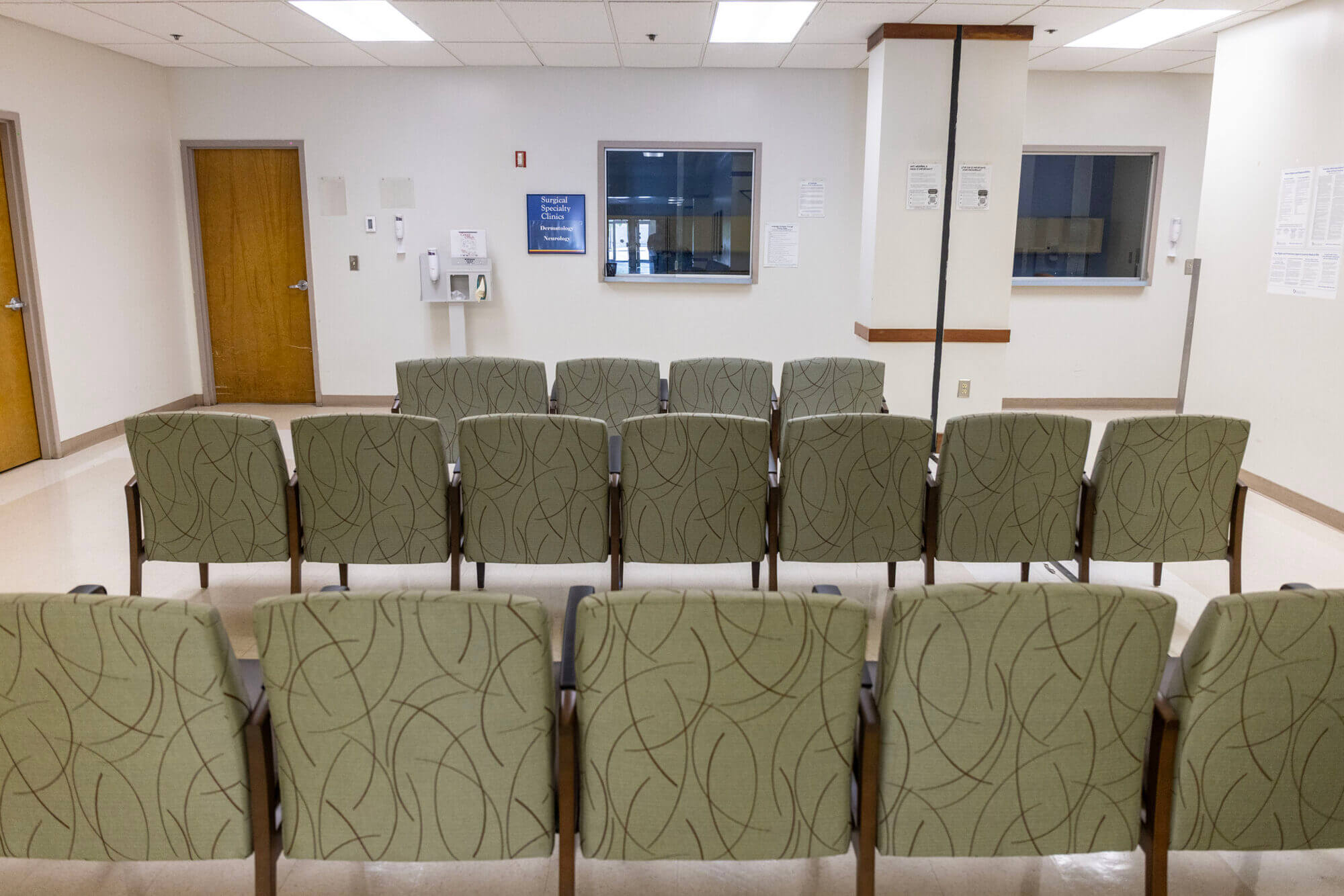
UMMC has leased about half of the mall’s approximately 900,000 square feet of space since 2010. After May 2026, the medical center will maintain just 100,000 square feet of space at the mall, which will include renal and dialysis, dental, infectious disease, pharmacy, addiction and HIV services.
UMMC has shared little information publicly about their decision to leave the medical mall, but a February memo distributed to legislators outlined its plans to exit the mall in phases.
UMMC will vacate unused, storage, administrative, education and subleased spaces in the mall by the end of this year, including clinic space subleased by Jackson-Hinds Comprehensive Health Center. The comprehensive health center has already removed adult medicine, cardiology, podiatry and social services from the mall. Its pediatrics clinic will leave in June and women’s health services by October.
UMMC will relocate the cancer center, OB-GYN and pain management services to its main campus by May 2026.
In the memo shared with legislators, UMMC said that ongoing building infrastructure challenges at the mall have resulted in disruptions to UMMC business practices, and that the medical center has experienced challenges with city services including water, crime and aging roads and bridges in the surrounding area.
Wheeler refuted these claims, saying that the building is in “great condition” because it was gutted in the late 1990s when the medical mall was created and has undergone constant renovations since then. The facility pumps in water delivered by tanker trucks when needed and crime is “basically nonexistent.” The mall has its own full-time security staff.
“The place is just as solid and new as when it was first built in 1970,” he said.
Mississippi Today spoke to patients from across the state who received health care services at Jackson Medical Mall. Many said they appreciated the convenience of the medical mall’s location and parking, clean facilities and the feeling of safety at the mall. But they also said some clinical services were crammed in areas that were too small, slowing patient visits, and that the roads around the facility are in disrepair.
Goodsell said beyond a loss of convenience, he worries that the mall’s community will be lost once health services leave.
“There’s this community that’s built up there, and people that have invested in putting a restaurant there,” he said. “And if all these people, if all the places move out of there, their livelihood is just evaporated.”
A ‘troubling trend’
At the same time that UMMC is scaling back services at Jackson Medical Mall, it is expanding outpatient clinical services in Ridgeland – a move that reflects a trend of UMMC outpatient clinics moving to wealthier, whiter areas in the Jackson suburbs.
UMMC opened its Grant’s Ferry clinic in Flowood, which offers primary and specialty care, in 2010.
The University of Mississippi Medical Center’s Colony Park South facility is seen Monday, May 5, 2025, in Ridgeland, Miss. Credit: Eric Shelton/Mississippi Today
Earlier this year, UMMC opened Colony Park South, another clinic offering primary and specialty care services, in Ridgeland. The movement of services to the new location allowed medical mall clinics to move to UMMC’s main campus, said LouAnn Woodward in an email to UMMC faculty staff and students in April. UMMC plans to open another clinic in Ridgeland next year.
Census tract data shows that the area Jackson Medical Mall is located in has a median household income of $22,500 and that 93% of residents are Black. By comparison, Grant’s Ferry and Colony Park South have median household incomes of $92,665 and $169,844, respectively, and over 70% of residents are white.
The movement of health care services out of Jackson and into the city’s suburbs is a “very troubling trend” and will make it more difficult for Jackson residents to access health services, said Sen. John Horhn, D-Jackson, who won the city’s Democratic primary race for mayor last month.
“We’re seeing a hollowing out of health care providers … being available in Jackson, and patients are feeling the brunt of that hardship upon them,” said Horhn.
UMMC provides a free shuttle every 30 minutes to Colony Park clinic locations from its main campus in Jackson, and many outpatient clinical services are offered at UMMC’s main campus in Jackson.
The Legislature sought to limit UMMC’s expansion outside of Jackson this year by restricting the medical center’s exemption from requiring state approval to open new educational medical facilities. The bill would limit this exemption to areas around its main campus and the Jackson Medical Mall. Gov. Tate Reeves vetoed the legislation, saying he opposed another unrelated provision in the bill.
Bringing primary health care to the mall is a priority, said Wheeler, who envisions new health services opening in the mall, the space being transformed into senior or dormitory housing and the Jackson Medical Mall Foundation implementing more of its own programs. The foundation will soon open a 500-seat auditorium in the space that formerly housed UMMC’s conference center.
Horhn said he hopes to see the medical mall house a workforce training facility.
The future of the medical mall remains uncertain, but whatever comes next, the foundation’s goal is to remain an anchor in the community, said Reed, the foundation’s COO.
“We don’t want to let Dr. Shirley’s vision die,” she said.
But it is clear the medical mall will look different than it has for the past 25 years.
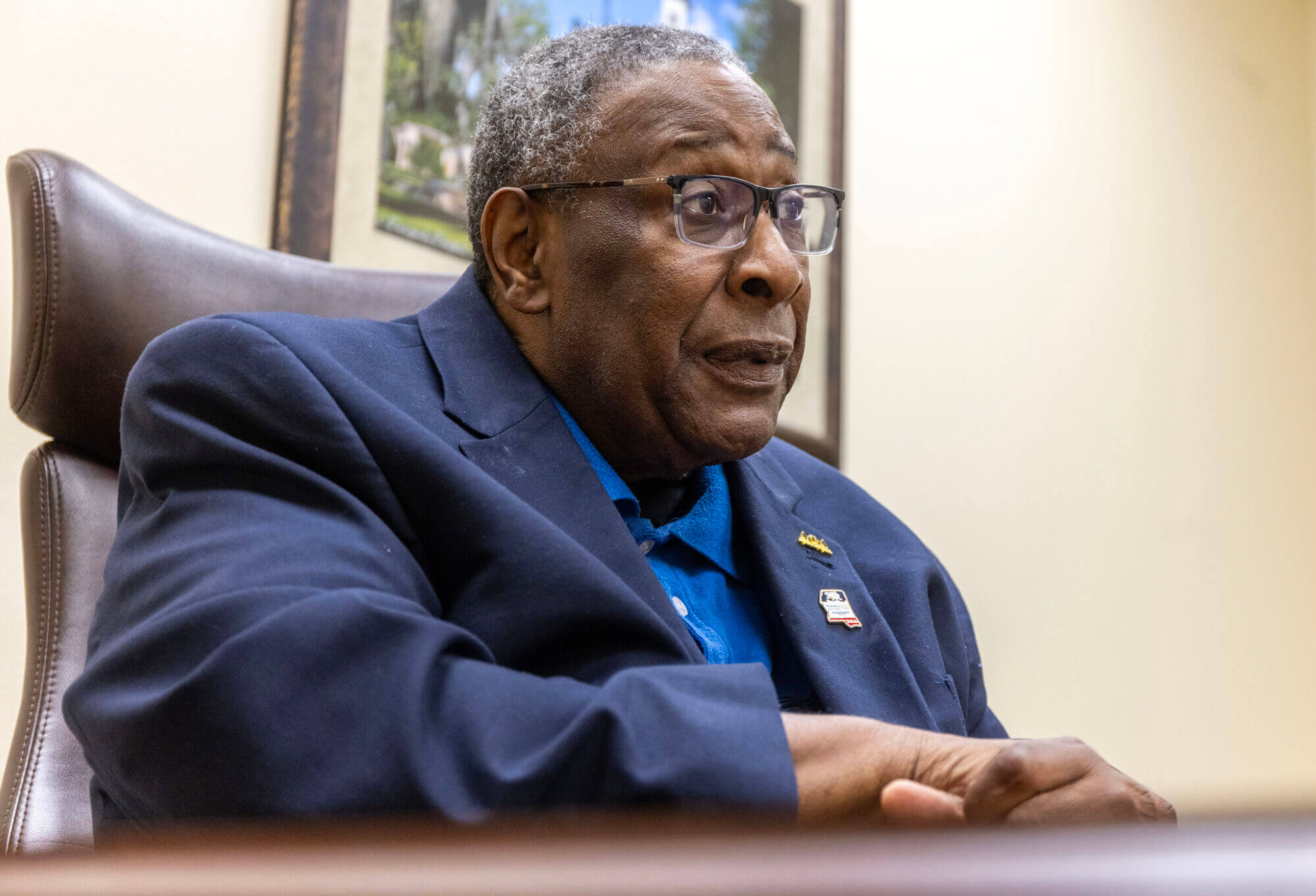
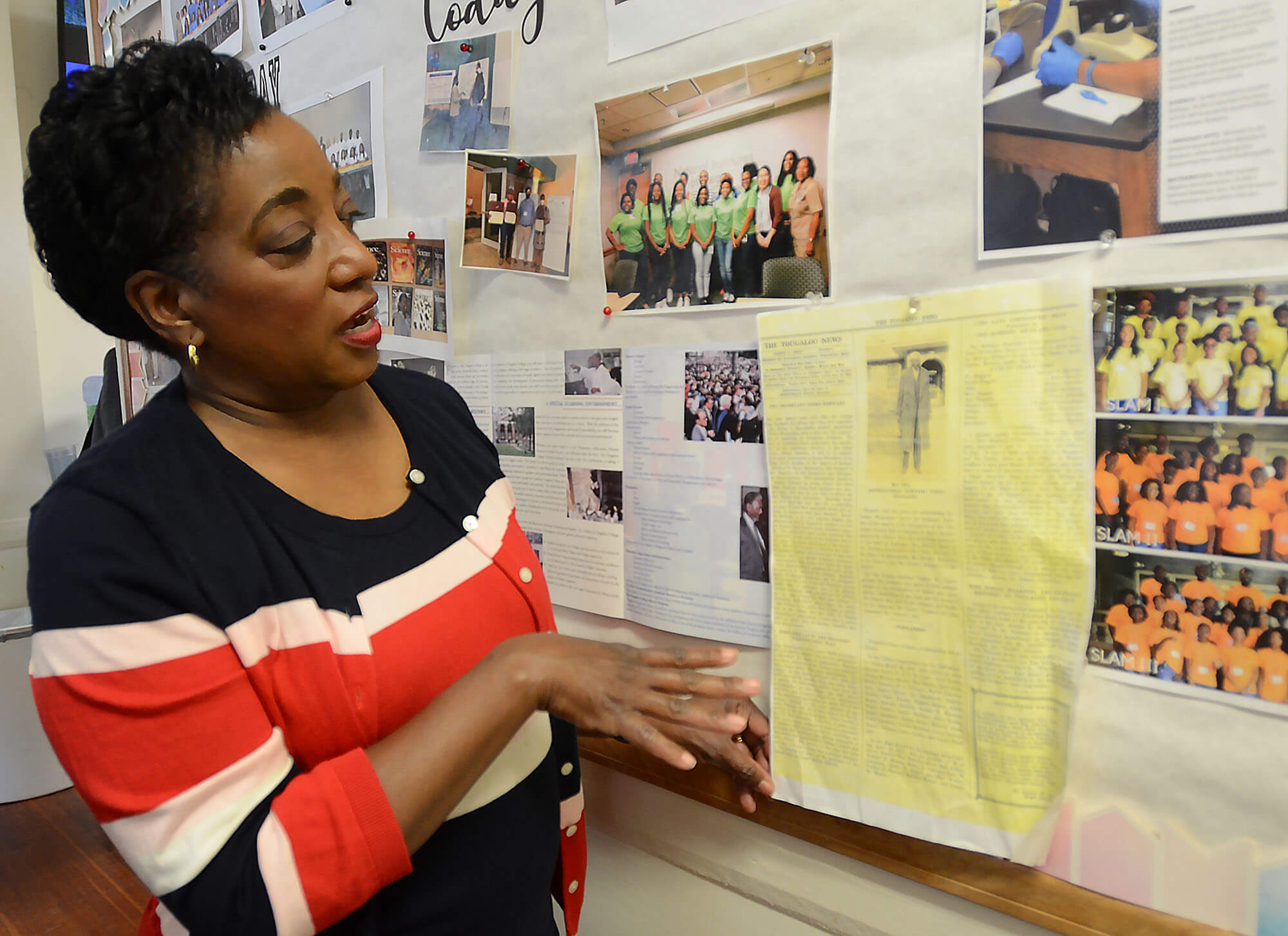
Wendy White, director of the Jackson Heart Study Undergraduate Training and Education Center at Tougaloo College, has experienced what financial markets and world leaders have all felt this year: whiplash.
In April, the Trump administration paused funding to the center, which is the nation’s largest and longest-running training program for early-career scientists and hub for research on heart disease in African Americans.
In total, 36 college students lost their scholarships. Five staff members, including White, lost their jobs. As a result of the cuts, the center planned to end its undergraduate training program later this summer.
Then came the whiplash. The administration reversed its decision in May. Relief.
White is “cautiously optimistic” about the $1.7 million grant’s renewal and the future of this program that has been the crown jewel for this small, private, historically Black liberal arts college in Jackson, Mississippi.
“It’s been a roller coaster of emotions ranging from gratefulness to frightening,” White said.
Since January, federal agencies like the National Institutes of Health and National Science Foundation have slashed millions of dollars in grants and contracts to comply with federal directives to end research on diversity, equity and inclusion, as well as the study of misinformation.
Some colleges have lost federal funds in President Donald Trump’s first 100 days of office. Others are trimming already lean budgets and launching fundraising campaigns to prepare for the worst, according to Inside Higher Ed.
While Trump has signed executive orders supporting HBCUs to “promote excellence and innovation,” the cuts to federal agencies and programs have had a chilling effect at these schools, which are already dealing with decades of underfunding. HBCU professors and graduates say the losses have greater potential for harm and eliminate professional opportunities for students.
Millions of dollars are potentially at risk. This year, Jackson State University received $7.2 million in federal research from NIH. Tougaloo College received $10 million.
Low hanging fruit
White and other professors believe their grants were pulled because of words like “race” or “gender” in the award’s abstract.
“[These federal agencies] are going for the low-hanging fruit,” Byron D’Andra Orey, political science professor at Jackson State University, said. “Our grants are on the chopping blocks simply because they are under this umbrella of D.E.I.”
Byron D’Andra Orey, political science professor at Jackson State University, Tuesday, May 6, 2025. Credit: Vickie D. King/Mississippi Today
Orey received an email in late April from JSU’s Office of Research that his $510,000 National Science Foundation Build and Broaden (B2) grant was terminated. In 2021, the grant was awarded to study the emotional and psychological toll of racial discrimination and trauma on African Americans participating in democratic and political activities such as voting and activism.
The research produced new insights on understanding racial disparities in the United States. It has also led to collaborations with prominent research institutions such as the University of Michigan. The collaboration brought resources, professional development, staffing and support that JSU lacked.
Since the grant was awarded four years ago, 21 students have taken the seminar and graduated. It has provided exceptional learning opportunities and exposed students to new career possibilities, Orey said.
“I’ve had students who have taken my classes apply to law schools, competitive Ph.D. programs at Ivy leagues and get into congressional public policy and advocacy work,” Orey said. “They get to see career avenues other than federal government jobs.”
A whole new world
Michael J. Cleveland, a graduate of Tougaloo College, benefited from these types of programs and mentorship. Cleveland trained as an undergraduate from 2014-2017 through the Jackson Heart Study program. He had opportunities to shadow medical professionals at hospitals and clinics.
Michael J. Cleveland, who trained as an undergraduate at Tougaloo College through the Jackson Heart Study program, is now the chief operating officer of Care Alliance Health Center. Credit: Courtesy of Michael J. Cleveland
In his sophomore year, he decided becoming a doctor wasn’t for him. Cleveland received guidance from his professors to pursue apprenticeships in community and public health research in Jackson.
The course work and curriculum as an undergraduate set him apart from his peers at Morehouse School of Medicine when Cleveland applied to get his master’s degree in public health. It eventually led him to become the first African American healthcare executive administrative fellows at Salem Health Hospital and Clinic System in Oregon.
The need for public health professionals of color in healthcare and medical settings is more important than ever, Cleveland said.
“Being a JHS scholar opened me up to a whole new world,” said Cleveland, who is now the chief operating officer of Care Alliance Health Center, a community health center in Cleveland, Ohio. “I’ve accomplished all of who I am at 30 because of this program.”
Future of research
Last month, Trump signed a new executive order that pledged to continue two existing White House efforts to support HBCUs during his first term in office.
The White House Initiative on HBCUs aims to increase funding, improve infrastructure and provide access to professional development opportunities for students in fields such as technology, healthcare and finance. And the President’s Board of Advisors on HBCUs will include appointed members who will sit in the U.S. Department of Education and is meant to guide the administration’s efforts on supporting these institutions.
“[The administration] is saying something on paper and in theory, but their actions aren’t aligned,” White said. “You can’t say you support [HBCUs] when you are cutting student loans, financial aid, research and other programs that support these students and institutions.”
While the future of this program remains unclear, she warned of the larger, overlooked impacts of potential cuts to this undergraduate program: It could mean the end to a unique collaboration between two HBCUs and a predominantly white institution in the state.
When the Jackson Heart Study began in the late 90s, it brought Jackson State University, a public HBCU, Tougaloo College and University of Mississippi Medical Center, a predominantly white medical school, together to create a first-of-its-kind partnership.
The goal was to provide funding in research for the colleges, and promote careers in public health to students. Eliminating this partnership could undermine NIH’s credibility and a symbol of racial progress in Mississippi, White said.
“We’ve spent more than two decades focusing on overcoming that legacy of medical mistrust for people in this city,” White said. “A move like this could set back decades of science and health research for this country. I just want us to ask, what are we doing about this?”
The best baseball teams in Mississippi, high school and college will be busy in post-season tournament play this week. Meanwhile, Davis Riley was pretty busy and pretty successful last weekend.