The Clevelands take a comprehensive look at this weekend’s NFL Draft, assessing Mississippi prospects and what the New Orleans Saints should do with the ninth pick. Many experts believe the Saints will take Ole Miss quarterback Dart, but the Clevelands are not so sure. It would not be the first time the Saints have taken an Ole Miss QB in the first round as Rick remembers and recounts the circumstances.
Faced with the options of a younger, self-described radical incumbent mayor and a more moderate and seasoned state senator, Jackson voters chose the latter as the Capital City’s likely new leader Tuesday.
Jackson Mayor Chokwe Lumumba became mayor in 2017 after beating state Sen. John Horhn and seven other candidates in the democratic primary that year. This year, Horhn’s fourth time running for mayor, the 32-year legislator flipped the script, handily beating Lumumba roughly 3 to 1 in a head-to-head runoff.
By just after 9 p.m. with all but one precinct counted, Horhn’s vote count reached 17,729 compared to Lumumba’s 5,940.
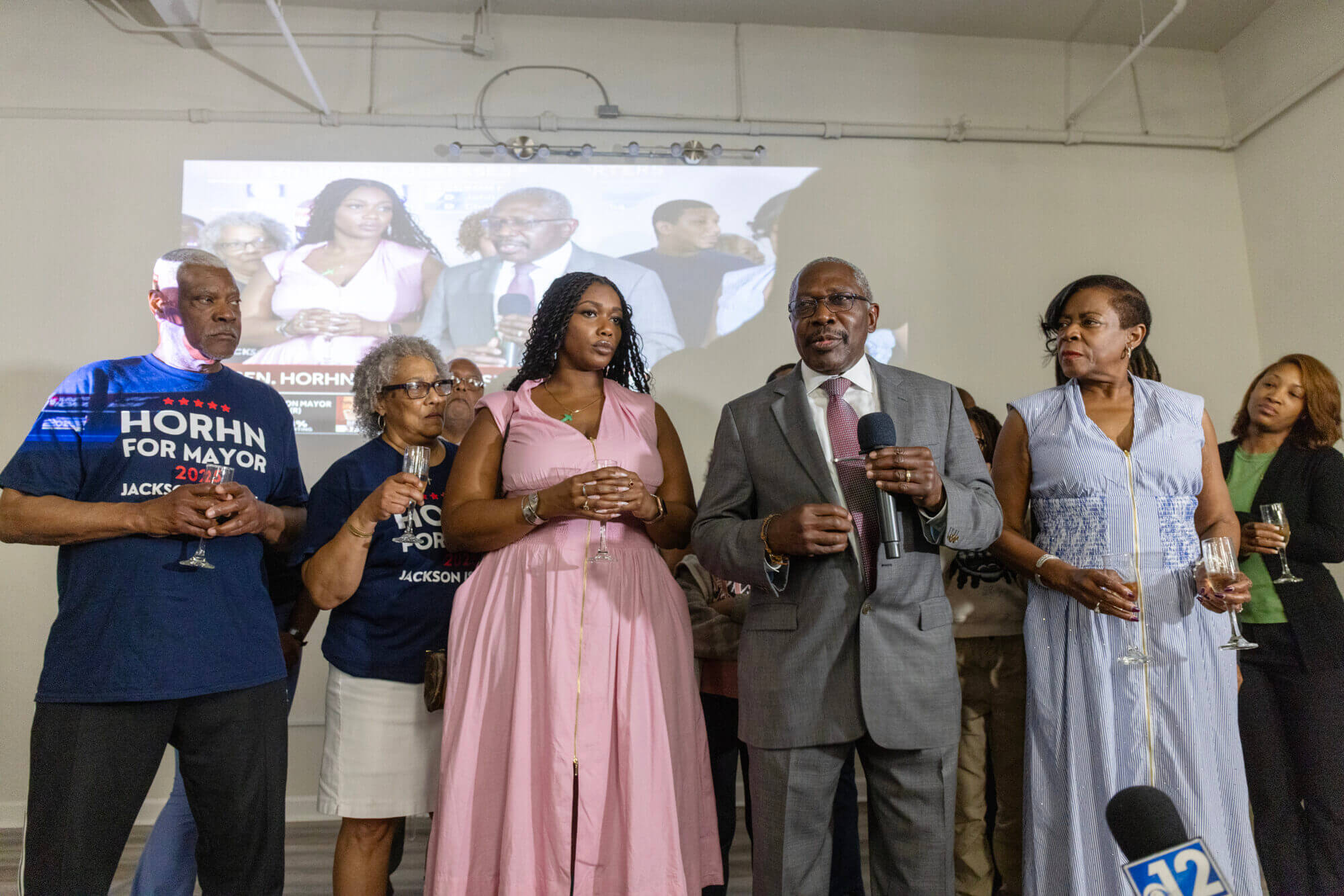
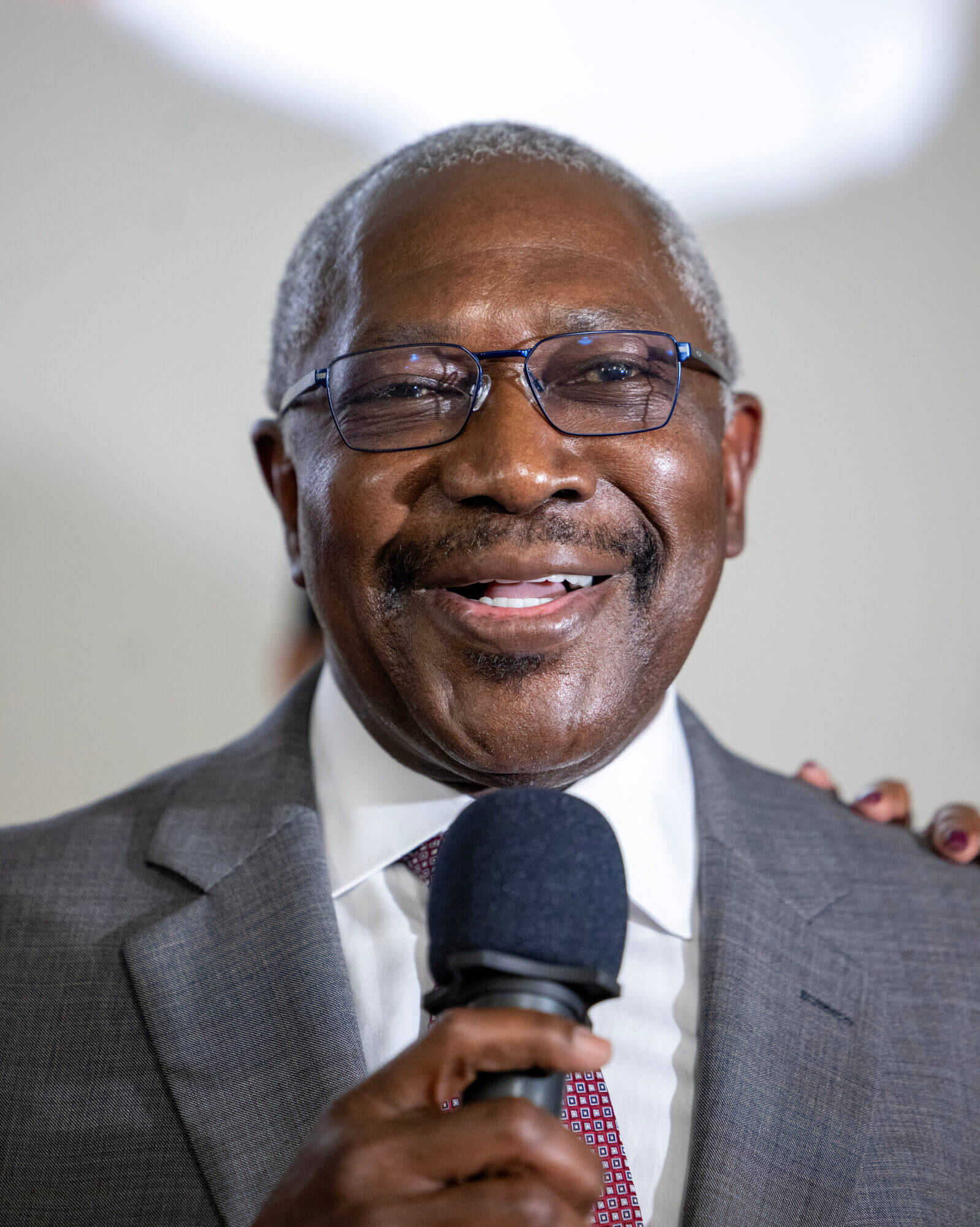
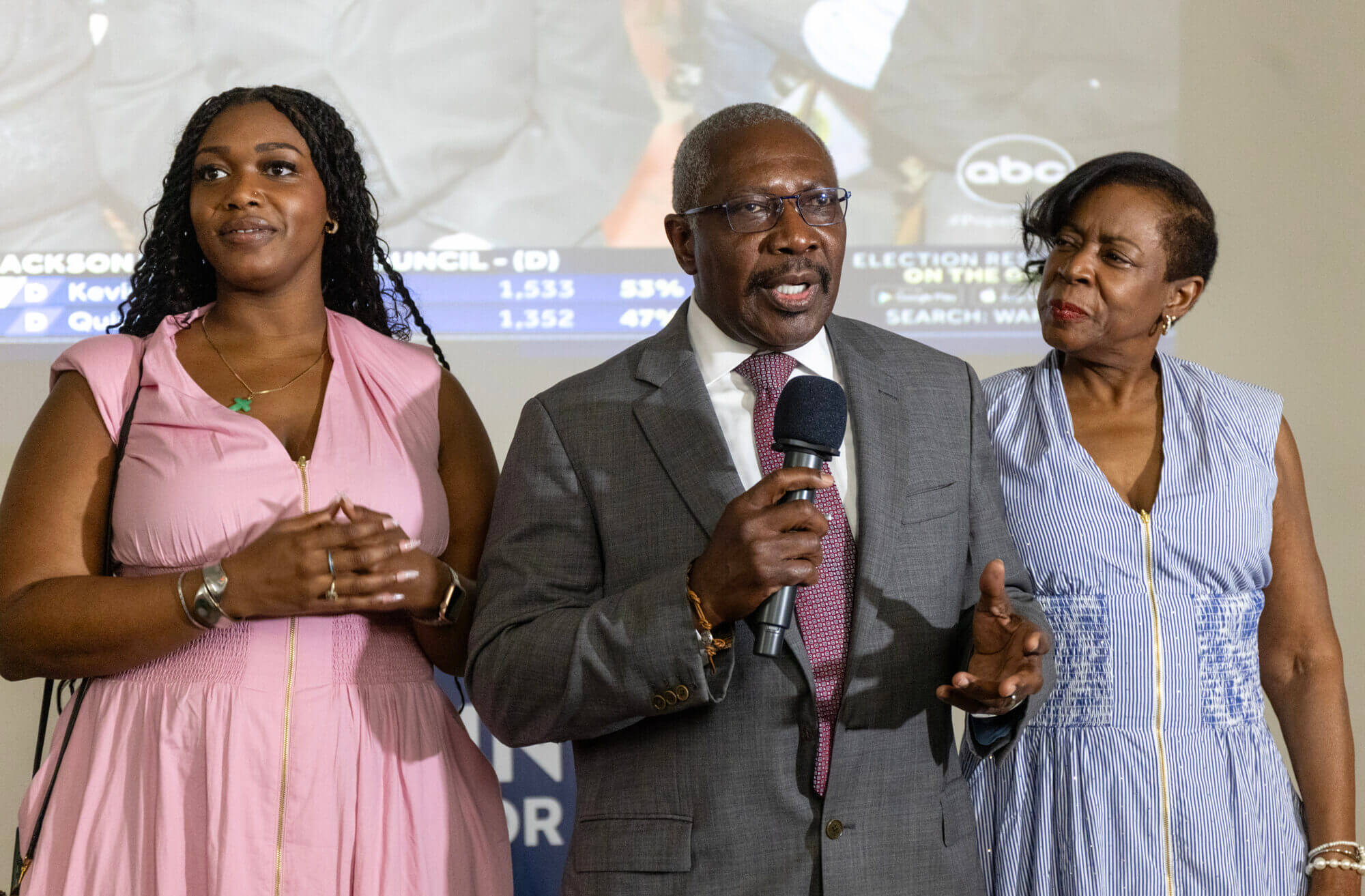
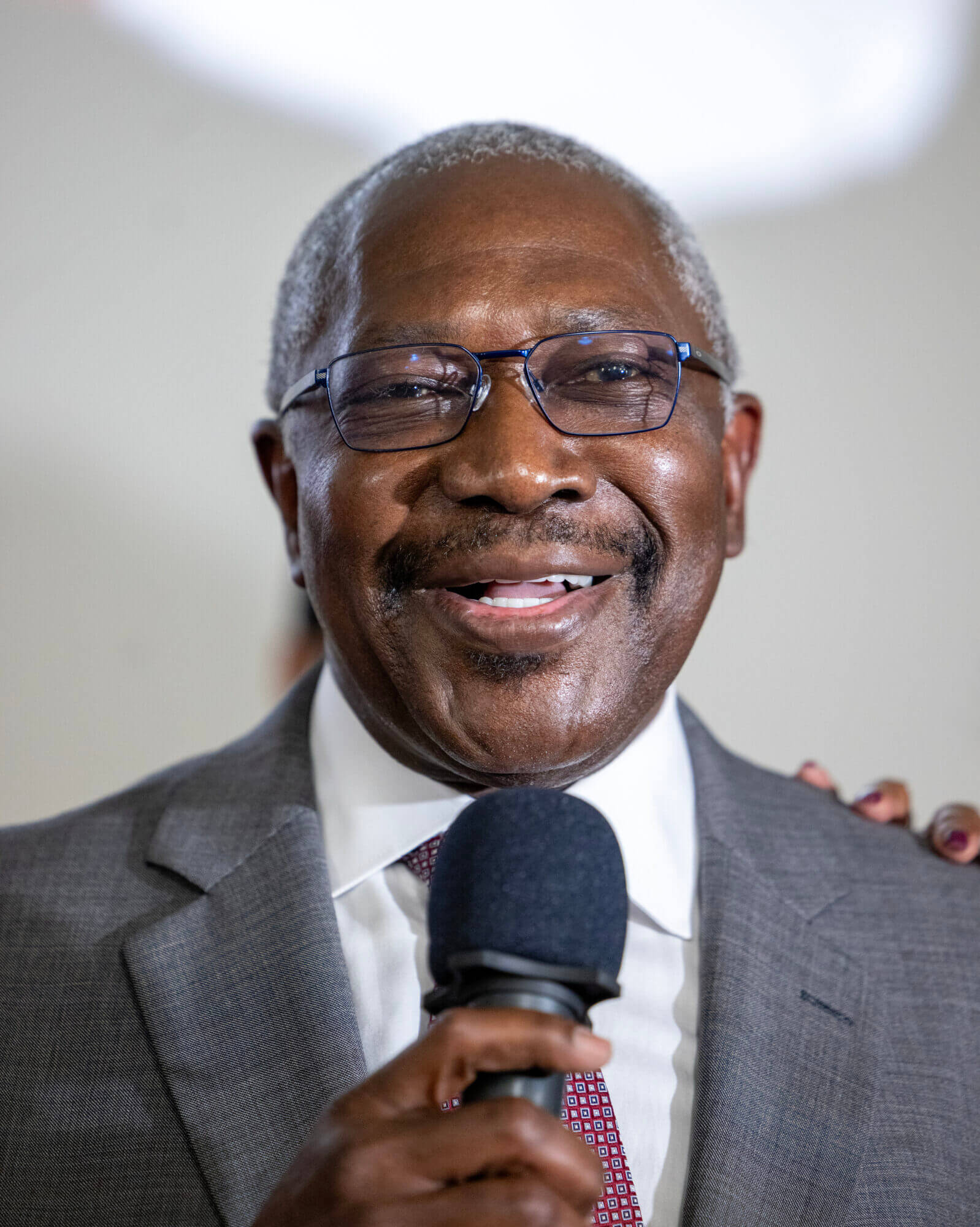
State Sen. John Horhn addresses supporters after winning the Democratic primary runoff for Jackson mayor at The Rookery in Jackson on Tuesday, April 22, 2025. Credit: Eric Shelton/Mississippi Today
State Sen. John Horhn addresses supporters after winning the Democratic primary runoff for Jackson mayor at The Rookery in Jackson on Tuesday, April 22, 2025. Credit: Eric Shelton/Mississippi Today
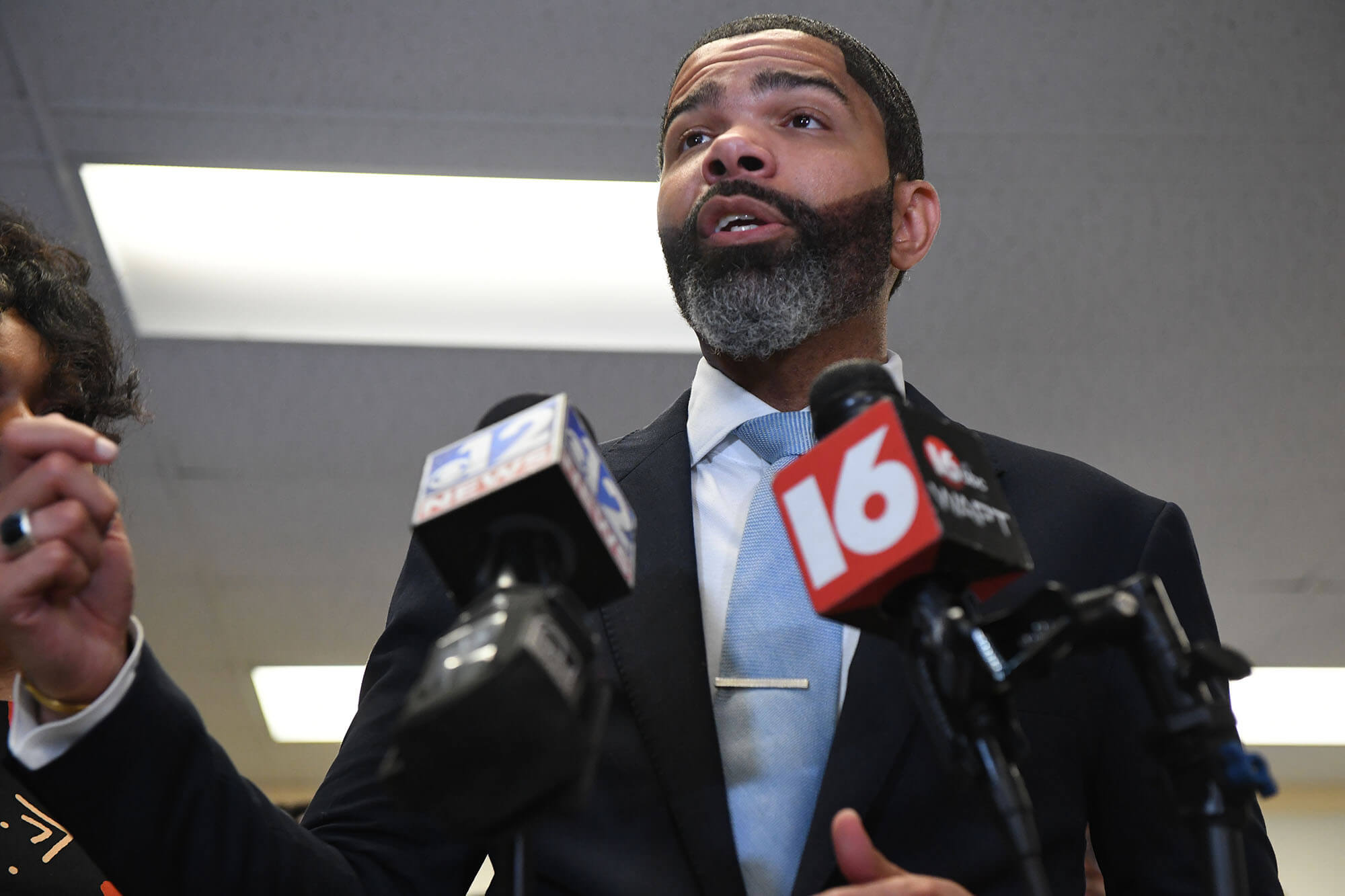
State Sen. John Horhn addresses supporters after winning the Democratic primary runoff for Jackson mayor at The Rookery in Jackson on Tuesday, April 22, 2025. Credit: Eric Shelton/Mississippi Today
State Sen. John Horhn addresses supporters after winning the Democratic primary runoff for Jackson mayor at The Rookery in Jackson on Tuesday, April 22, 2025. Credit: Eric Shelton/Mississippi Today
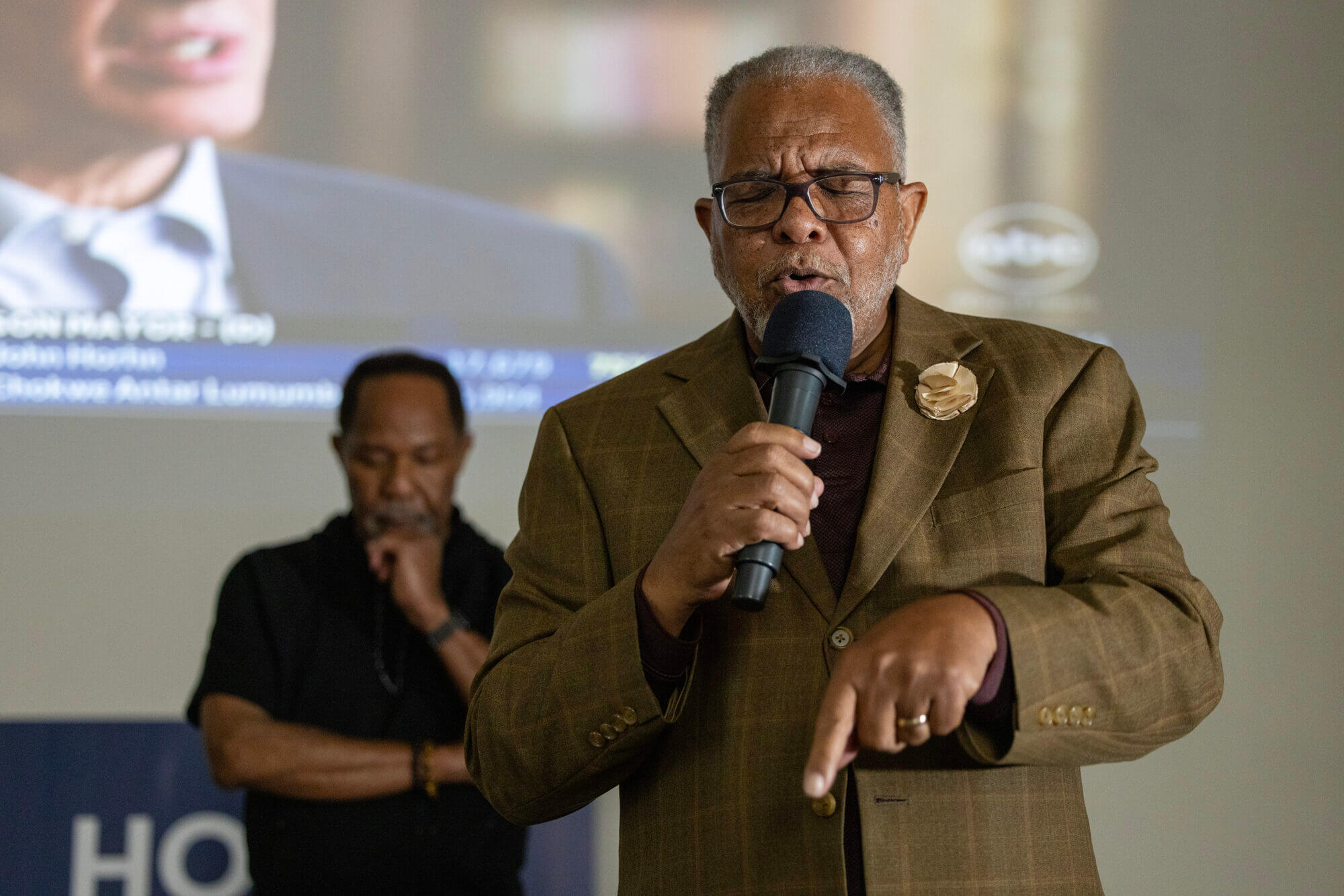
Bishop Ronnie Crudup Sr. prays after State Sen. John Horhn’s victory in the Democratic primary runoff for Jackson mayor at The Rookery in Jackson on Tuesday, April 22, 2025. Credit: Eric Shelton/Mississippi Today
Supporters gather at The Rookery in Jackson on Tuesday, April 22, 2025, for State Sen. John Horhn’s election watch party for the Democratic primary runoff for Jackson mayor. Credit: Eric Shelton/Mississippi Today
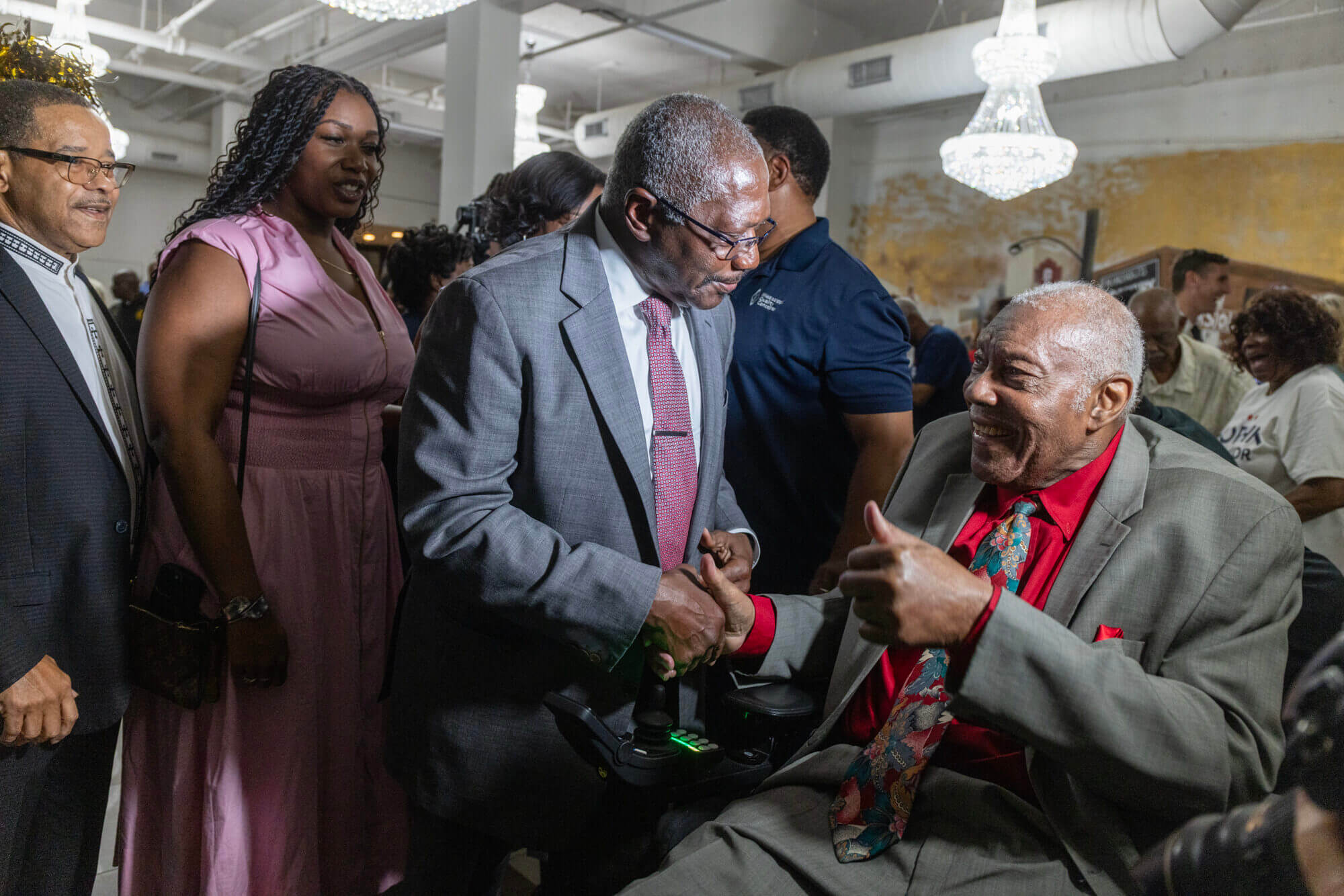
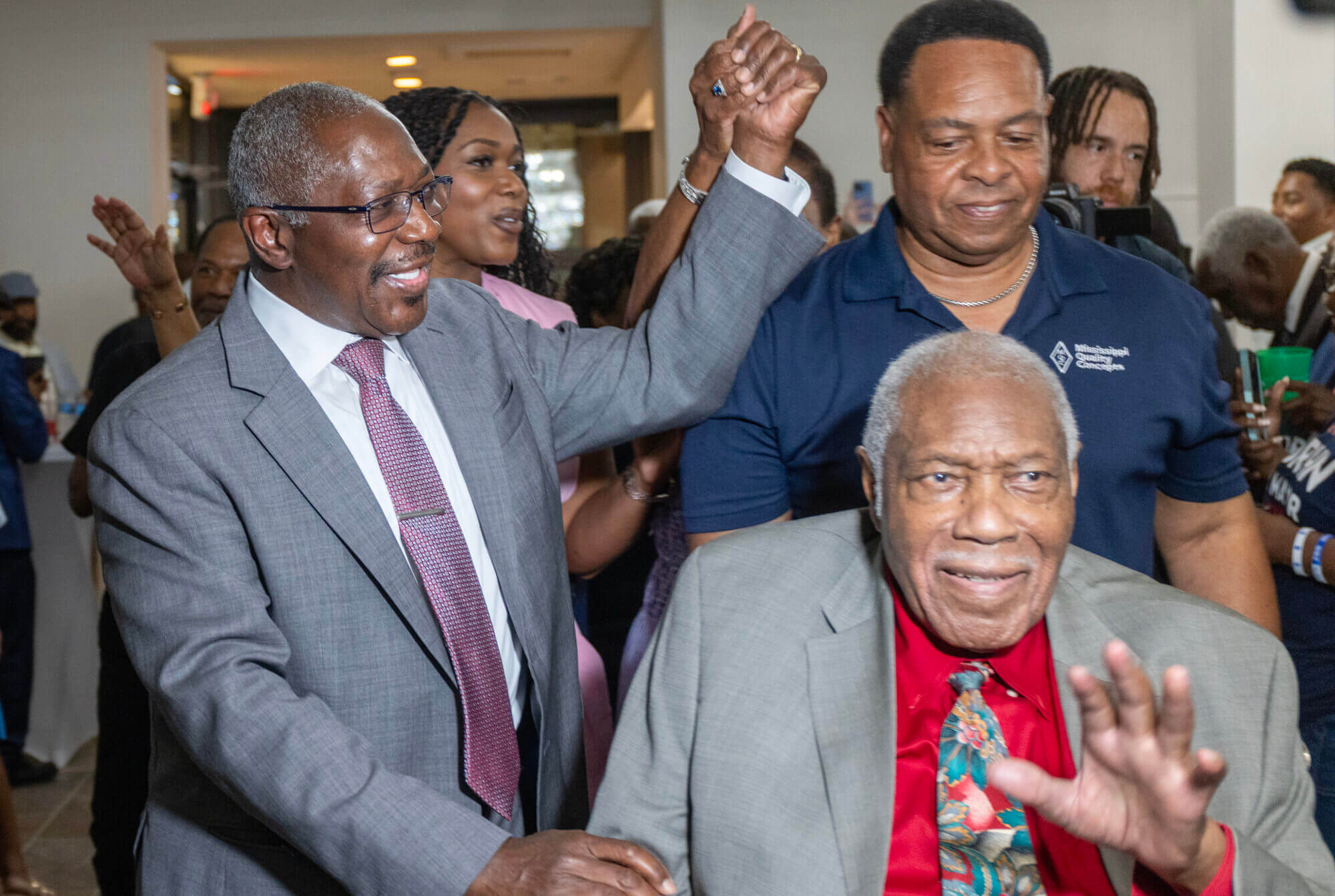
Supporters congratulate John Horhn following his victory in the Democratic primary runoff for Jackson mayor during a watch party at The Rookery in Jackson on Tuesday, April 22, 2025. Credit: Eric Shelton/Mississippi Today
John Horhn kisses his wife, Lydia Gail Horhn, after winning the Democratic primary runoff for Jackson mayor at The Rookery in Jackson on Tuesday, April 22, 2025. Credit: Eric Shelton/Mississippi Today
John Horhn celebrates with his family after winning the Democratic primary runoff for Jackson mayor at The Rookery in Jackson on Tuesday, April 22, 2025. Credit: Eric Shelton/Mississippi Today
John Horhn, Democratic nominee for Jackson mayor, greets attendees at his campaign watch party at The Rookery in Jackson on Tuesday, April 22, 2025. Credit: Eric Shelton/Mississippi Today
Read Mississippi Today’s live election blog documenting the day and evening.
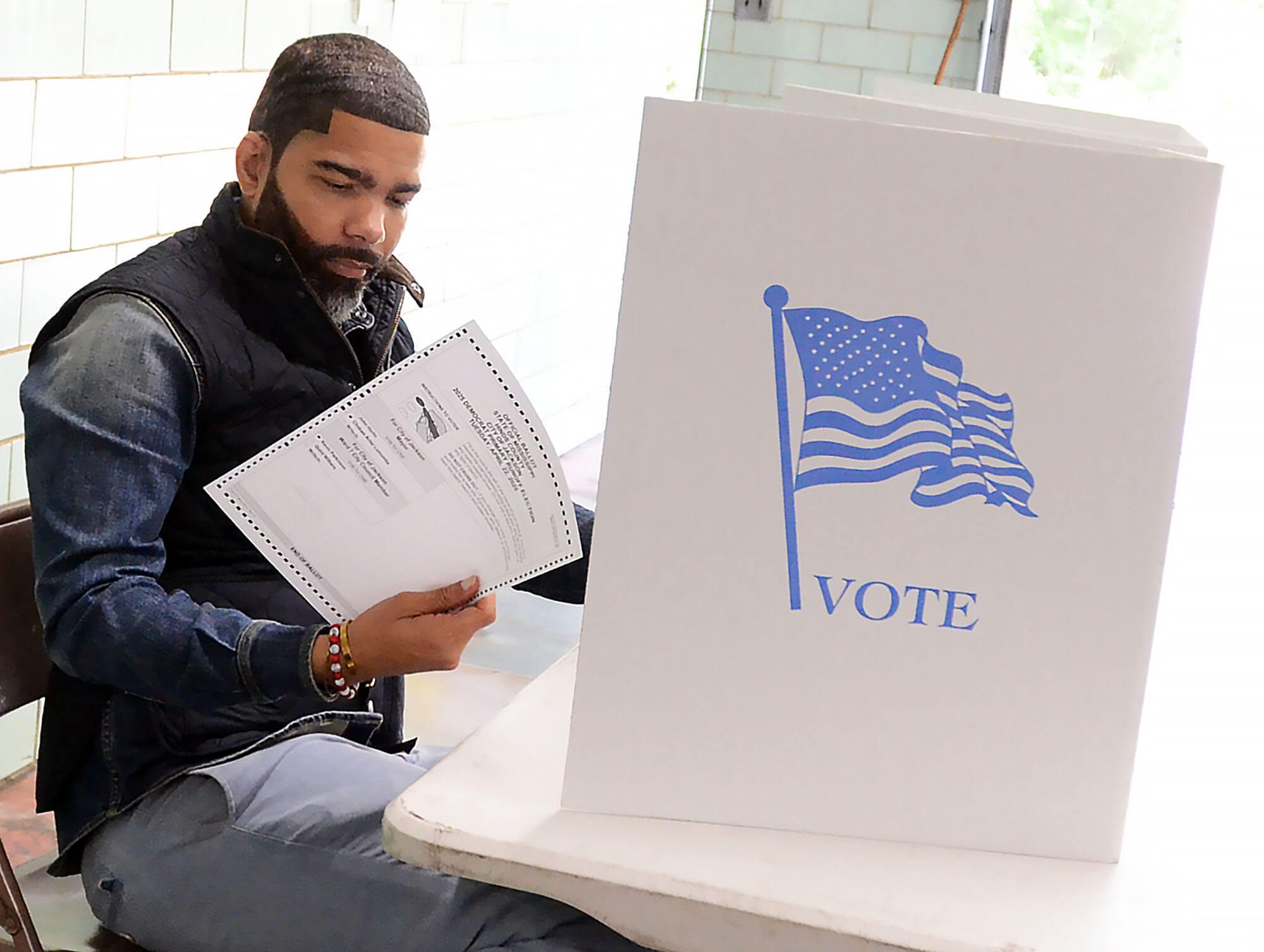
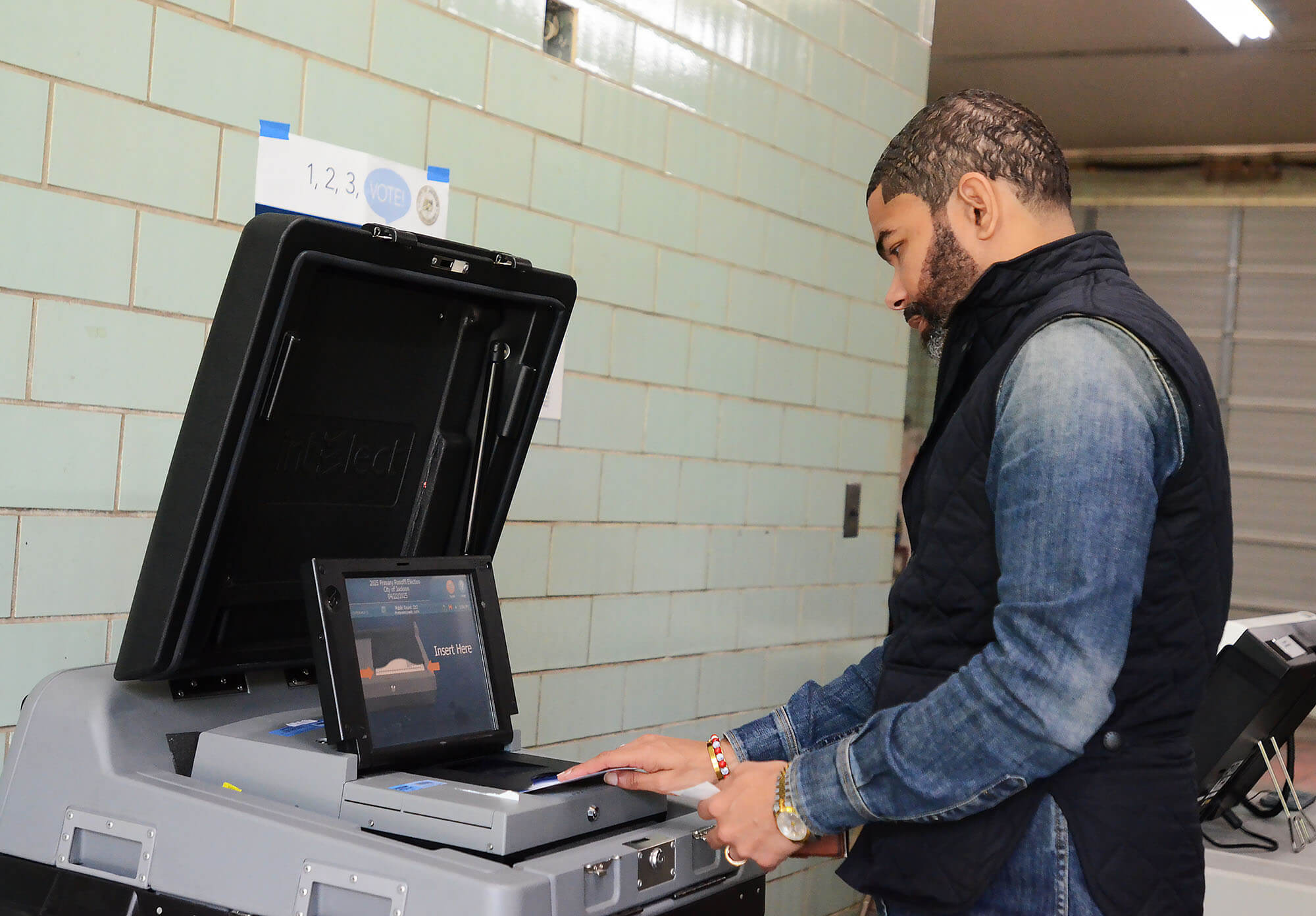
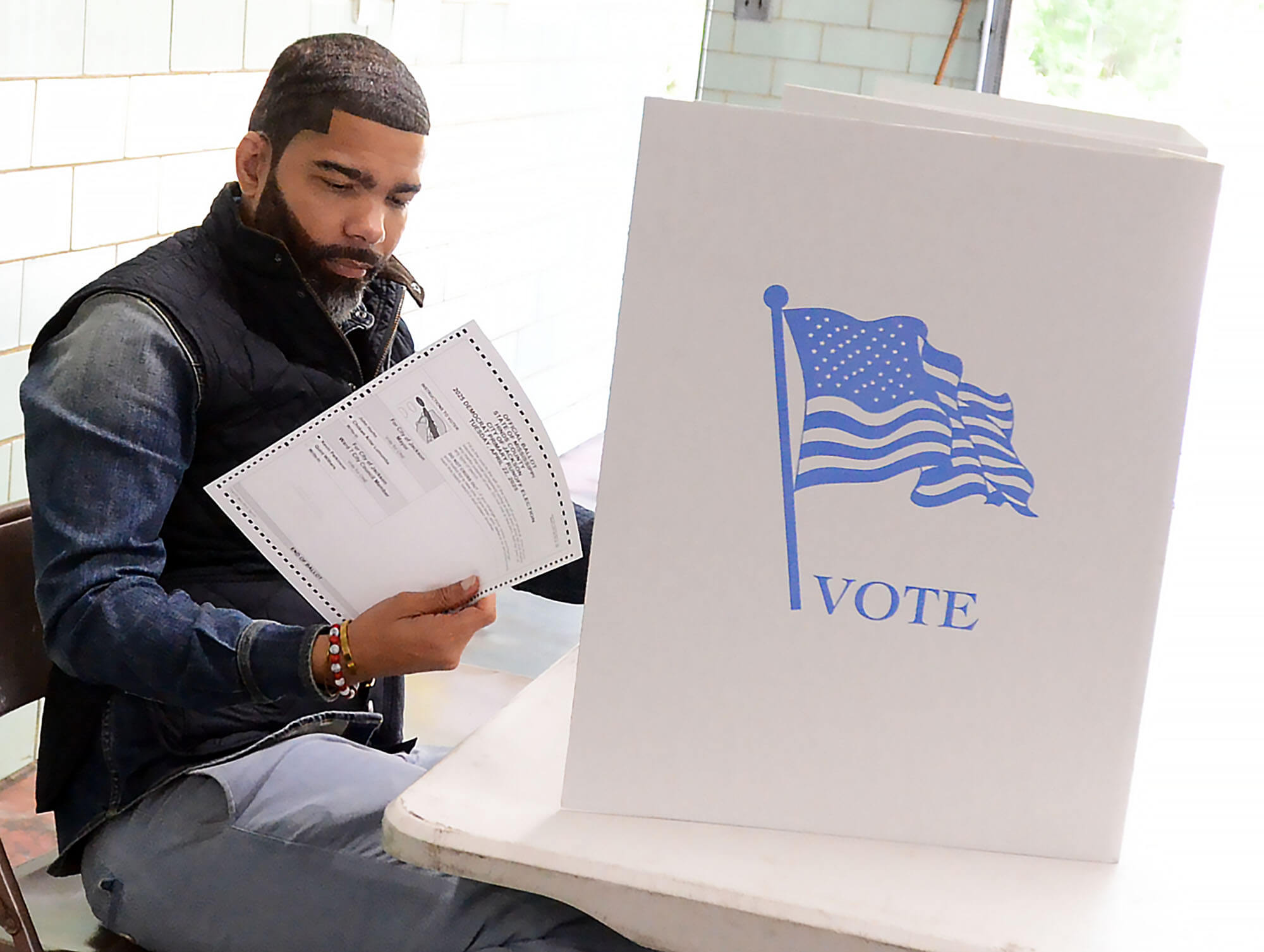
Incumbent Mayor Chokwe Antar Lumumba prepares to cast his vote, Tuesday, April 22, 2025 at Fire Station 16. Lumumba is in a runoff race against John Horhn. Credit: Vickie D. King/Mississippi Today
Election officials began counting ballots at the Jackson Fire Department’s downtown station after the polls closed at 7 p.m. Turnout in northeast Jackson caught officials by surprise, requiring the delivery of more ballots, which seemed to bode well for Horhn, who carried Ward 1 by wide margins in the April 1 primary. The winner of the Democratic primary usually goes on to become mayor, but Horhn will still face one Republican and four independent candidates in the General Election come June.
Residents in wards 6 and 7 also had an opportunity to vote for a new city councilperson Tuesday. In Ward 6, located in south Jackson, voters chose between Lashia Brown-Thomas and Emon Thompson Sr. The winner of the primary will become the next councilmember as there is no Ward 6 challenger in the General Election.
In Ward 7, encompassing parts of downtown, Belhaven, Midtown and Fondren, voters selected either Kevin Parkinson or Quint Withers. The winner faces one Republican and one independent in the General Election.
James Bowley at his Jackson home, Friday, Jan. 31, 2025. Bowley was a religious studies professor at Millsaps College, but was terminated in January after expressing political views. Credit: Vickie D. King/Mississippi Today
Amid a national maelstrom of attacks on academic freedom, the fate of James Bowley, the former chair and professor of Religious Studies at Millsaps College, hinges on a 10-word email he sent to his class of three students the morning after the presidential election. Nearly a month after a grievance committee repudiated his subsequent termination over those 10 words, his status remains in flux.
The day following his email, Bowley found out that he had been placed on paid administrative leave pending a review of his use of a Millsaps email account “to share personal opinions” with his students.
Around the days of the election, racist messages targeting African American students had been sent using the anonymous campus messaging platform Yik Yak. The FBI had informed the Millsaps community via email that it, along with law enforcement and the U.S. Department of Homeland Security, was investigating those messages.
“I personally would not send that kind of content to my class. But I understand the disappointment behind the email, understand the human sympathy, especially what happened with the Yik Yak post,” said David Wood, chair of the Modern Languages department at Millsaps College, referring to racist and threatening messages directed at African American students on the anonymous messaging platform Yik Yak, around the days of the 2024 presidential election.
“I knew the students were fearful. So I canceled my class,” Bowley said. “And I do not regret that for a second.” His 10-word email explained why the class was being cancelled: “to mourn and process this racist fascist country.”
Bowley filed a grievance against his leave of absence with the university’s grievance committee, which could not identify any specific policy that he had violated. It recommended in December that Bowley be reinstated immediately; that the Interim provost issue a formal apology to him, and that he be compensated for a loss of income that arose from his removal from a study abroad course he was supposed to have taught.
Weeks later, Bowley’s employment was terminated, by the interim provost — a decision he appealed. The interim provost at the time, Stephanie Rolph, was a candidate for the full-time position.
Now, nearly a month after the grievance committee decided to allow the terms of Bowley’s reinstatement be negotiated, his employment remains in flux as he waits for Millsaps’ president to affirm or overrule their decision.
The purpose of the college’s action “is to demonstrate the power of the administration over the faculty,” Bowley said. “I think the whole point is to make faculty self censor.”
The termination of Bowley comes amid a nationwide crackdown by universities and the Trump administration on speech by students and faculty. Since 2023, dozens of faculty members have been disciplined, or even fired. Since March, more than 1,500 international students have seen their visas revoked, with some even being detained without due process. And top universities have seen threats of funding freezes if they do not agree to laundry lists of demands and restrictions.
On Monday, Harvard University, which has vowed not to “surrender its independence or constitutional rights,” sued the Trump administration in an attempt to block them from freezing $2.2 billion in federal funding and an additional $1 billion in grants, which the administration in a letter had said it would do if the university did not overhaul its admissions and hiring policies, among others, allow for federal oversight of its operations, and commission external audits of a number of departments.
This letter, which the Trump administration now says was sent in error, came about a month after Columbia University capitulated to similar demands by the administration – in its case, which included empowering campus security to make arrests, suspending students involved in protests last spring, and placing its department of Middle Eastern, South Asian and African Studies under administrative receivership.
On Tuesday, the American Association of Colleges and Universities, which has more than 800 member institutions, issued a public statement, condemning “undue government intrusion in the lives of those who learn, live, and work on our campuses” and “coercive use of public research funding.”
Nearly 200 leaders of educational institutions signed the statement, including Millsaps College – the only Mississippi institution to do so. The president of Columbia University did not.
In March, Columbia University submitted to the Trump administration’s list of demands which followed pro-Palestine protests on its campus last spring. Credit: Mukta Joshi
“Millsaps promises free speech to its faculty members and when it makes a promise like that it should stand by that promise and protect it,” said Haley Gluhanich, senior program counsel of FIRE, the Foundation for Individual Rights in Education. In Bowley’s case, she said, “We saw these violations of fundamental due process rights – the fact that he was put on administrative leave before he even had a hearing.”
Millsaps’ Faculty Handbook says a faculty member is “entitled to freedom in the classroom in discussing the subject matter of the course, but should be careful not to introduce controversial matter which has no relation to the subject.” It elaborates that “when speaking or writing as a citizen, the teacher is free from institutional censorship or discipline, but this special position in the community imposes special obligations,” because the public may interpret the words of a faculty member as being representative of the position of the institution.
However, in the grievance committee’s December recommendation, it found that the handbook “does not offer guidance on how to distinguish personnel matters from matters of academic freedom,” and that this lack of clarity appeared to expose tenured faculty members to a disciplinary process that was subject to the sole decision of any acting provost, with no recourse.
“When they are sharing a personal opinion, a criticism of an election,” said Gluhanich, “no reasonable person is going to assume that that is the speech of the college.”
“Millsaps truly shaped me. It broke down the conceptions that I had of the world and religion and philosophy and ideas. By doing so it forced me to build them back up,” said Elizabeth Land, an alumna of Millsaps College. “I was taught to think for myself. And that’s a gift that you can’t put a price tag on.”
Land circulated a petition last December calling for Bowley’s reinstatement – a decision that in April, has yet to be made.
Joey Lee, director of communications at Millsaps College said, on behalf of the office of the president, that they could not comment on ongoing personnel issues.
“If I win,” Bowley said, “It is a win for students and for faculty and for academic freedom.”
Michael Guidry is an alumnus of Millsaps College, having attended from 2001 to 2005
Mastering Bonuses and Cashback at Casigood: The Ultimate Player’s Guide
When you first log into an online casino, the flood of offers can feel overwhelming. Many players wonder which promotion actually adds value and which is just marketing fluff. The key is to understand the core components of a bonus: the welcome bonus, the cashback system, wagering requirements, and the eligible games.
At Casigood, the welcome bonus is designed to give new players a solid boost right after the first deposit. It usually matches a percentage of your deposit and adds free spins on popular slots. The cashback system, on the other hand, returns a slice of every loss you incur, turning a losing streak into a smaller setback.
But what really sets top players apart from the rest? They read the fine print, compare the numbers, and choose the offer that fits their style. For example, a 100% match up to £200 with a 20x wagering requirement is more attractive than a 150% match up to £100 with a 40x requirement.
If you are looking for fast withdrawals and transparent terms, many players discover that CasiGood casino processes requests within hours, especially when using cryptocurrency. This early advantage solves the common problem of waiting days for funds to appear in a bank account.
Quick Bonus Comparison
Feature
Casigood Welcome Bonus
Competitor X Bonus
Match %
100%
150%
Max Cash
£200
£100
Wagering
20x
40x
Eligible Games
Slots, Live
Slots only
How Casigood’s Welcome Bonus and Cashback System Work
Casigood’s welcome package is split into two parts: a deposit match and a set of free spins. After you make your first deposit, the casino instantly credits the bonus amount to your account. The free spins are usually tied to a high‑RTP slot from Evolution Gaming, such as Mega Joker Live.
The cashback system runs daily and is calculated on net losses from the previous 24 hours. Players receive between 5% and 10% back, depending on their VIP tier. The returned funds are added as bonus cash, which can be wagered with a low 5x requirement before withdrawal.
Ready to take your game to the next level? Follow these steps to make the most of the offers:
Register and verify your account.
Deposit using Bitcoin or another supported cryptocurrency.
Claim the welcome match and free spins from the promotions page.
Play eligible Evolution Gaming titles to meet the wagering quickly.
Check the daily cashback credit in your bonus balance.
Cashback vs. Traditional Bonuses
Metric
Cashback
Traditional Bonus
Risk Reduction
Ongoing loss mitigation
One‑time boost
Withdrawal Speed
Fast, often instant
May require extra wagering
Player Loyalty
Encourages repeat play
Attracts new sign‑ups
Statistics show that players who use cashback features see a 12% higher retention rate over six months compared with those who only rely on welcome bonuses.
Maximizing Your Play with Bitcoin and Other Cryptocurrencies
Casigood was one of the first UK‑licensed platforms to embrace Bitcoin deposits. This move solves a common pain point: high fees and slow processing times associated with traditional banking. When you fund your account with Bitcoin, Ethereum, or Litecoin, the transaction is confirmed on the blockchain within minutes, and the casino credits your balance almost instantly.
Using cryptocurrency also opens the door to exclusive promotions that are not available to fiat users. For example, a crypto‑only reload bonus might offer a 25% match up to £150 with zero wagering on selected slots.
Here are three practical tips for crypto players:
Set up a secure wallet – hardware wallets provide the best protection against hacks.
Convert only what you need – avoid keeping large sums on the exchange to reduce exposure.
Track transaction IDs – they help resolve any disputes quickly with support.
The platform’s average withdrawal time for Bitcoin is under 30 minutes, while e‑wallets average 2‑4 hours and bank transfers can take 3‑5 business days.
Live Casino and Evolution Gaming: Getting the Most Value
Live dealer games bring the excitement of a brick‑and‑mortar casino to your screen. Casigood partners with Evolution Gaming, the industry leader, to offer a wide range of live tables, from classic Blackjack to Lightning Roulette.
These games often have lower house edges than their RNG counterparts, and they contribute to both the welcome bonus wagering and the daily cashback. Because Evolution Gaming streams in high definition, the experience feels immersive, especially on mobile devices.
What if there was a better way to stretch your bankroll? Play live tables during low‑traffic periods (early mornings GMT) to benefit from reduced competition and potentially higher win rates.
Live Game Feature Comparison
Feature
Evolution Gaming Live
Other Providers
Stream Quality
HD 1080p
720p
Table Variety
20+ titles
10–12 titles
Mobile Optimization
Full‑screen UI
Limited
RTP Range
96.5% – 98.2%
95% – 97%
A recent survey indicated that 68% of UK players prefer live casino action when the platform offers Evolution Gaming titles, citing smoother gameplay and higher payouts.
Fast Withdrawals, Mobile Play, and Player Protection in the UK
Casigood holds a UK Gambling Commission license, which means it must adhere to strict standards for fairness, security, and responsible gambling. The site uses SSL encryption, regular third‑party audits, and a dedicated compliance team to protect player data.
Mobile users enjoy a fully responsive website and a lightweight app that works on iOS and Android. All core features—deposit, bonus claim, live streaming, and withdrawal—are accessible on the go.
Fast withdrawals are a major selling point. When you request a payout via Bitcoin, the average processing time is 0.5 hours. For Visa and MasterCard, most withdrawals are completed within 24 hours, well below the industry average of 48–72 hours.
Payment Method Speed Table
Method
Avg. Processing Time
Fees
Bitcoin
0.5 h
Low
E‑wallet (Skrill)
2 h
None
Credit Card
24 h
Small
Bank Transfer
3‑5 days
Variable
Always gamble responsibly. Set deposit limits, use the self‑exclusion tool if needed, and never chase losses. Casigood provides a personal dashboard where you can track your spending and set daily, weekly, or monthly caps.
Pros, Cons, and Frequently Asked Questions
Pros and Cons
Pros
– Generous 100% welcome match up to £200
– Daily cashback that reduces net loss
– Bitcoin and other crypto deposits for instant play
– Evolution Gaming live casino with high RTP
– Fast withdrawal times, especially for crypto
Cons
– Cashback is credited as bonus cash, not real money
– Free spins are limited to specific slots
– High‑roller VIP tiers require substantial turnover
FAQ
Q: How do I claim the welcome bonus?
A: After registering, log in, make your first deposit, and click the “Claim Bonus” button on the promotions page. The match and free spins appear instantly.
Q: Can I use the cashback on any game?
A: Cashback is applied to all net losses, but wagering the returned amount is limited to slots and live dealer games from Evolution Gaming.
Q: What is the minimum withdrawal amount for Bitcoin?
A: The minimum is £10 worth of Bitcoin. Smaller amounts are rounded up to the nearest whole cent.
Q: Is the site safe for UK players?
A: Yes. Casigood holds a UK Gambling Commission license and uses SSL encryption to protect data.
Q: How can I set responsible gambling limits?
A: Visit the “Responsible Gaming” section in your account settings. You can set deposit, loss, and session limits, or opt for self‑exclusion.
By understanding the bonus structure, leveraging cryptocurrency, and playing the right live games, you can turn the Casigood platform into a reliable source of entertainment and steady returns. Remember to stay within your budget, use the tools provided for safe play, and enjoy the diverse world of online gaming that this UK‑licensed casino offers.
Editor’s note: Nina Rifkind is an adjunct professor at the University of Mississippi Law School and the granddaughter of one of the founders of a major national law firm that recently settled a dispute with President Donald Trump. She agreed to write about that settlement and about her grandfather’s story for Mississippi Today Ideas.
Last month, the Trump administration issued an executive order aimed at the New York law firm Paul, Weiss, Rifkind, Wharton and Garrison (known to many as just “Paul, Weiss”).
The order threatened the firm with withdrawal of the security clearances required to do certain legal work as retribution for work Mark Pomerantz, a former Paul, Weiss partner, had done while employed by the Manhattan District Attorney’s office in connection with the investigation of Trump’s businesses. Within days, Paul, Weiss announced that it had struck a deal with the Trump administration, offering, among other things, millions of dollars’ worth of free legal work for administration endorsed causes, and changes in hiring practices in exchange for the dismissal of the executive order.
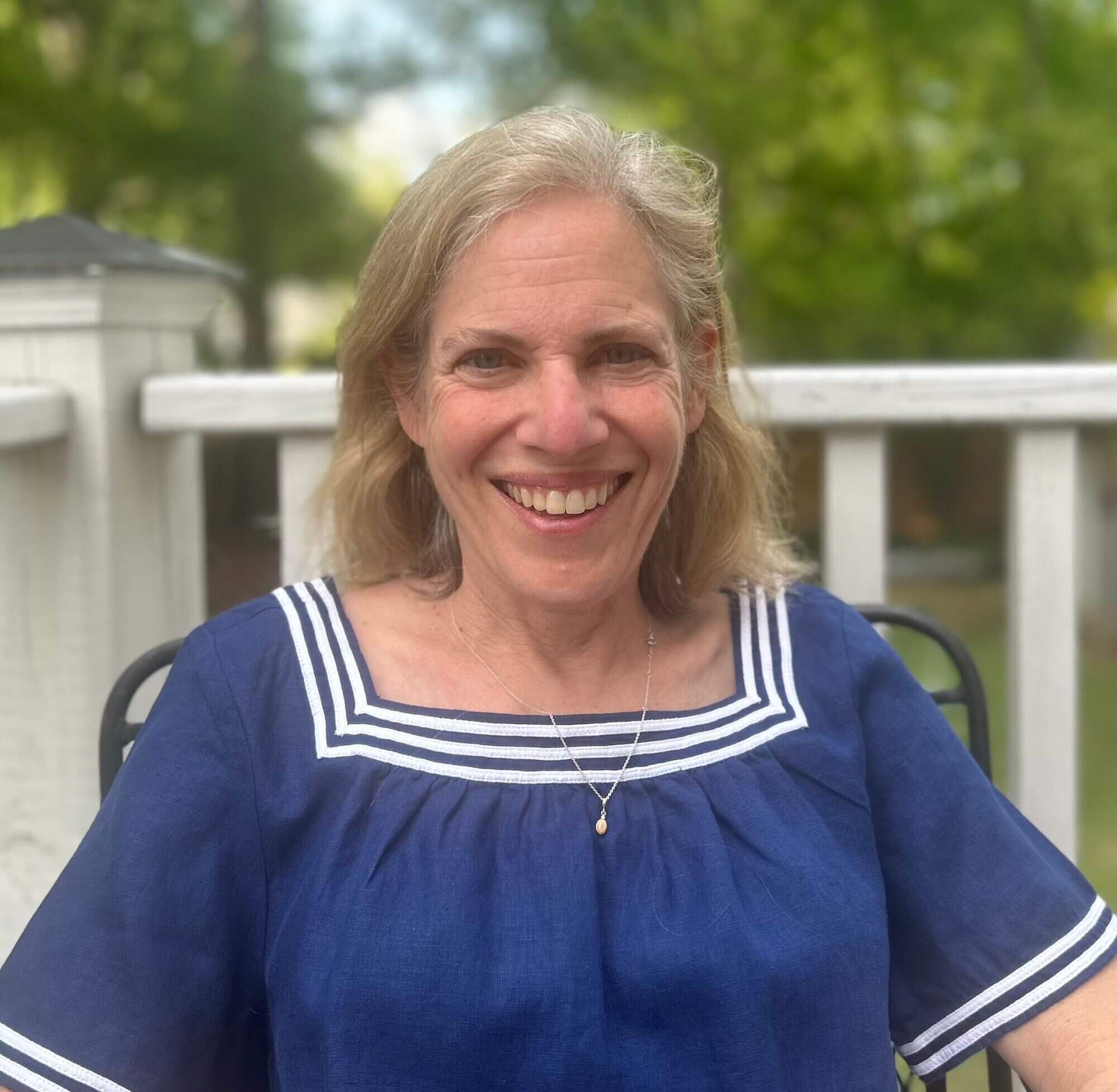
Nina Rifkind Credit: Courtesy photo
While I had been angry about many of the acts of this administration that seemed to undermine the very institutions and ideals of American government and society that I had been raised to revere, this one struck particularly close to my heart.
On the one hand, I had no particular interest in the affairs of this law firm, located half a continent away from my home in Mississippi, and to which I had no personal connection except that it was where my grandfather, Simon H. Rifkind, had practiced law until his death at the age of 94 in 1995. On the other hand, it seemed to me that the executive orders addressed to this law firm, and, ultimately, a handful of others, were an assault on my chosen profession, on our legal system and on our democracy as a whole.
So when the chairman of the firm Brad Karp, in defense of the decision to make a deal, cited the firm’s “Statement of Firm Principles,” written by my grandfather in 1963, I contacted my sister, Amy Rifkind, a lawyer practicing in Washington, D.C. We quickly decided to speak out. We did so in the form of a letter to Mr. Karp, explaining that his decision was an affront to those very principles he claimed to defend.
In that letter, we wrote that our grandfather believed that to practice law in this country is a privilege that comes with “responsibilities both to our profession and our country” and a duty “to protect ‘the prizes of our civilization.’” In light of those duties, we noted that, “We are confident that neither our grandfather, nor his colleagues with whom he built Paul, Weiss, would have negotiated a truce for themselves when the rest of the legal profession remains under threat for doing its jobs as lawyers. Consistent with his values, he would have above all sought to protect the independence of the bar, not just the firm.”
In writing the letter, we hoped that our small evocation of our grandfather’s enduring values would inspire others to speak out with their own messages of hope and courage in the face of adversity. We have been simultaneously stunned, humbled and honored by the media outlets (including Mississippi Today) and individuals that have chosen to amplify our message.
My grandfather was born in Russia at the turn of the last century. He often said that he was born and lived in the 16th century until, at the age of 9, he left his little village and immigrated with his mother and sisters to the United States. Before he left, he had never seen a power-driven piece of machinery, experienced running water or worn any factory-made garment. As is the case with many immigrants, he arrived in this country with no ability to speak English, but with a determination to make a home here. And also like many immigrants, by his teens, that determination had developed into a deep sense of patriotism. That love of country continued to develop throughout his life, fueled by his own varied personal and professional experiences.
He served the public in a variety of ways. He served as a legislative aide to Sen. Robert Wagner, helping to draft some of the New Deal legislation that helped stem the effects of the Great Depression. In 1945-46, as an advisor to Generals Eisenhower and McNarney in Europe, he brought to light the horror and despair experienced by hundreds of thousands of residents of the displaced persons camps in the wake of the Nazi genocide. He spent a decade as a federal judge in the Southern District of New York and a year as special master for a multi-state dispute over use of the Colorado River. But even in private practice at Paul, Weiss, where he spent most of his career and where many of his clients were large private corporations, he believed his work should, and did, serve the public good.
We all know that lawyers get a bad rap as they are often described as greedy and predatory. But to hear my grandfather talk about the practice of law, as my sister and I did during our family’s regular Sunday afternoon visits to his apartment throughout our childhood, you would think he was part of the noblest profession in the world. As a fierce defender of our adversarial system, he believed everyone deserved vigorous and ethical counsel, no matter how rich or poor, popular or unpopular. He believed that every client, whether paying top dollar or receiving the benefit of pro bono representation, deserved the highest quality of work his or her lawyer could provide.
And he believed, as he wrote at the end of his life, that “lawyers are licensed beneficiaries of privileges and immunities received as gifts from the community in which they practice and that they hold these gifts in trust for the service of the community.” In other words, all lawyers, regardless of the nature of their practice, who take their roles seriously and perform their duties with skill and integrity, provide a benefit to society.
My grandfather’s life spanned nearly the entirety of the 20th Century — a century that, despite some very dark moments, saw our country lead the charge in achieving the greatest advances in freedom and prosperity in human history. And while he benefited from those advances, he never lost sight of the fact that the foundations of that freedom, equality and prosperity are fragile and dependent on the individual and institutional pillars of our American democracy.
Indeed, in 1954, he wrote: “Every American generation has inherited from its predecessor the memory of freedom, of liberty and of constitutional government; but every generation if it would retain these prizes of our civilization, must reacquire them in its own lifetime. This day when the winds are full of doctrines subversive of the Constitution, inimical to our liberties, is the time to redevelop muscle and determination to defend them. In their defense we shall survive.”
In the most important respects, my family is not unusual. These principles and values were passed down through casual interactions, a commitment to religious and secular traditions and through modeled behavior. We laughed when my grandfather’s views seemed out of touch with the times. And we used his values as a blueprint to form our own paths and priorities.
I assume most of us grew up with at least some influential figures who adhered to and communicated a set of core values, whether explicitly or by example. And I suspect that despite our different backgrounds and experiences, if we examine those values closely, we will find that there is more that unifies us than divides us.
My sister and I wrote the letter to Mr. Karp as a reminder of what Paul, Weiss’s stated “principles” really mean for the legal profession and for American democracy. In doing so, we revisited those core beliefs ourselves, and hopefully inspired others to as well.
Perhaps, with such values in mind, we can rise above the destructive forces of greed, cynicism and selfish grievance, remember that together we are more than the sum of our parts, and continue our collective march toward freedom, equality and prosperity.
Nina Rifkind is a graduate of Yale College and New York University School of Law. Following law school, she practiced law first in New York and later in Los Angeles. Since moving to Oxford, she has continued to practice in a variety of capacities, most recently as an independent contract attorney and is an adjunct professor at the University of Mississippi Law School, where she teaches the Law and Religion course. She has taught legal writing at the USC Gould School of Law and Advanced Legal Writing at the University of Mississippi. She currently serves on the boards of the Jewish Federation of Oxford and the Oxford School District Foundation.
Jackson Mayor Chokwe Lumumba and longtime state Senator John Horhn are competing Tuesday in a Democratic primary runoff for mayor, a race that historically decides the city’s next leader. Read Mississippi Today’s profiles of Lumumba and Horhn. View election results here.
Incumbent Mayor Chokwe Antar Lumumba casts his ballot Tuesday afternoon, April 22, 2025, at Fire Station 16. Lumumba is in a runoff race against John Horhn. Credit: Vickie D. King/Mississippi Today
The election has been characterized by a widespread desire for change among Jackson residents as well as anxieties about the city’s future self-determination. Read what Jackson voters had to say about the election before the April 1 primary and again leading up to the April 22 runoff.
Horhn dominated in the first primary, securing more than 48% of the vote out of 12 candidates, leading in all but two precincts and nearly winning the election outright. Read an in-depth analysis of the precinct-level results of that election here.
Residents in wards 6 and 7 also will also vote Tuesday in a Democratic primary runoff for a new city councilperson. Read Mississippi Today’s features on the council races and issues impacting Ward 6 and Ward 7.
Jackson’s 2025 municipal elections saw more than 50 total candidates for mayor and council. The large field, in addition to last year’s ward redistricting and polling location changes, created challenges for voters in casting a ballot. Fewer than one-fourth of residents voted in the primary. Runoffs typically see a drop-off of voter participation, but some local civic organizations are hoping to change that.
Follow along for live updates throughout the day and evening.
10:20 PM
Molly Minta
Lumumba thanks supporters in emotional concession speech
Mayor Chokwe Antar Lumumba, his wife, Ebony, and their two daughters walked into a room of supporters chanting his father’s slogan – “one city, one aim, one destiny” – shortly after the race was officially called in his opponent’s favor Tuesday night.
During his concession speech, Lumumba thanked his staff and campaign volunteers and talked about the moment that convinced him to run for office: The night his father died in 2014, and Lumumba realized that running for office had more to do with “radical love” than political ambition.
“This has been a labor of love but I enjoyed every movement,” he said.
The now two-term mayor, who was first elected on a wave of grassroots support in 2017, made it clear that he and his supporters aren’t going anywhere. He said they will continue to fight to protect Jackson’s resources, from the airport to the water system.
“To be clear, we started this work by doing demonstrations on the mayor’s office, right” he said, referencing the Malcolm X Grassroots Movement.
As of Tuesday night, the mayor trailed state Sen. John Horhn by nearly 12,000 votes. His supporters have in part blamed his loss on negative media coverage, which Lumumba seemed to reference during his speech.
“While you may have been characterized otherwise, I want you to know what you have represented,” he said. “You’ve laid out an example of loving your city.”
The address started with a tender moment: Lumumba’s eldest daughter, 11-year-old Alake’ Maryama, was the first to take the mic and told Lumumba that his dad would’ve been proud.
“I just love Jackson so much,” she said. “When I was three years old, my dad became the youngest mayor of this city.”
Lumumba’s younger daughter, 7-year-old Nubia Ngozi, made the room laugh when she started to speak by saying “ever since I was a little girl.”
Ebony quoted Margaret Walker and reminded the room that Lumumba was elected mayor after he lost his first race for the position during the special election to replace his father.
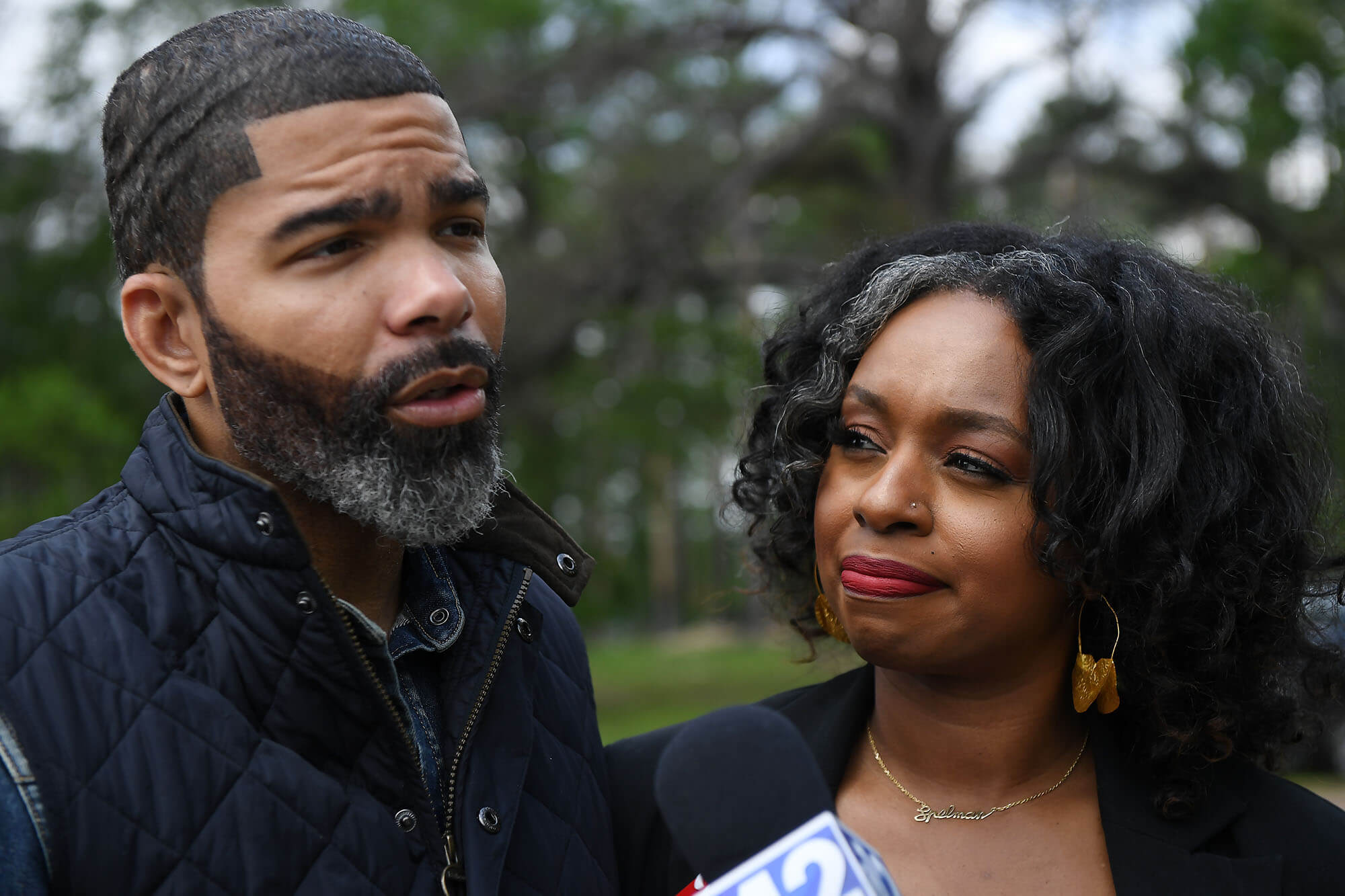
Incumbent Mayor Chokwe Antar Lumumba with wife Ebony, speak to members of the media after voting, Tuesday, April 22, 2025 at Fire Station 16. Lumumba is in a runoff race against John Horhn. Credit: Vickie D. King/Mississippi Today
“It was a time we should’ve ran and tucked our tails and cried ourselves to sleep, but you took that as an opportunity to lead,” she said.
Then she thanked Lumumba for sacrificing his youth to the city. By the time Lumumba took the mic, he had tears in his eyes.
“The only thing that makes me cry is these three women right here,” he said.
It was the honor of his professional life to be mayor of Jackson, he said, but his administration was about more than him.
When Jackson received $800 million for its water system, it was because the people spoke up, he said.
“You made the world, you made the nation see your value,” he said.
He thanked several members of his administration, including Safiya Omari, who served as his chief of staff.
“I’m going to call you what I really call you: Mama Safiya,” he said. “I thank you for your love. I thank you for taking the arrows to defend me.”
He then proceeded to reiterate that he was not guilty of any crime. Lumumba is facing federal corruption allegations in an FBI sting involving campaign checks and an alleged favor for a prospective developer.
“I know there was a lot you were given to think about this election,” he said. “A lot that they told you about who I am and who you are. I want to be clear: I am not guilty of any crime. I am not guilty of bribery. I am not guilty of quid pro quo.”
With that, Lumumba said the campaign should end where it started and his supporters started again chanting his father’s slogan: “One city, one aim, one destiny.”
Then everybody took to the dance floor for the electric slide.
9:51 PM
Maya Miller
Accepting Democratic nomination, Horhn likens himself to ‘Little Engine That Could’
It was all cheers and chants of “Jackson is Ready!” as state Sen. John Horhn accepted the Democratic nomination for Jackson mayor.
State Sen. John Horhn addresses supporters after winning the Democratic primary runoff for Jackson mayor at The Rookery in Jackson on Tuesday, April 22, 2025. Credit: Eric Shelton/Mississippi Today
The 32-year senator defeated incumbent Mayor Chokwe Lumumba by nearly 11,000 votes.
“I feel like The Little Engine That Could,” Horhn said. “He had perseverance and persistence, and today I feel like The Little Engine That Could because after the fourth try, we did it.”
Horhn was referring to his previous unsuccessful mayoral bids. In his speech, he also thanked Mayor Lumumba.
“He ran a passionate race, and we have differences of opinion about many things, but I think that ultimately everybody is trying to do the same thing, and this is an opportunity for us to come together in the city of Jackson. I salute the mayor for his efforts. We are going to turn the page, however,” he said, to another round of raucous cheers.
John Horhn celebrates after winning the Democratic primary runoff for Jackson mayor at The Rookery in Jackson on Tuesday, April 22, 2025. Credit: Eric Shelton/Mississippi Today
Horhn said that he plans to be the embodiment of change. He pointed to the overwhelming stats that show he won the runoff by 75%, more than the 48% he earned during the April 1 Primary.
“The people of Jackson are saying that they want change,” he said. “They want better leadership.”
Horhn still has the June 3 general election ahead of him, what he calls “a hard road to hoe.”
“We’re on our way, and we have to keep up the energy, keep up the momentum that we’ve seen in this campaign,” he said. “l trust and believe that you all will be helping me to keep this momentum going, because Jackson is ready!”
9:14 PM
Molly Minta
Lumumba supporters blame ‘challenging’ media coverage as one reason for loss
As Tuesday night’s runoff was called in favor of Mayor Chokwe Antar Lumumba’s opponent, his supporters said that unfavorable media coverage contributed to his loss.
“This is the moment the media has been working for,” said Makani Themba, a volunteer media coordinator for Lumumba’s campaign who spoke in her personal capacity as a resident of south Jackson.
With 78 out of 80 precincts reporting, Lumumba’s 5,904 votes trailed state Sen. John Horhn’s 17,679.
In the lead up to the runoff, Lumumba and his campaign worked to share his accomplishments with the city, believing that not enough residents knew what he’d achieved during his tenure.
But this was a tough campaign, said Nsombi Lambright-Haynes, the executive director of OneVoice who also served as Lumumba’s campaign coordinator.
A big reason for that was the public discourse around the election, she said.
“I’ve dealt with media bias before, but this year the media has been a little different, and I hesitate to say it has been intentional,” she said, “but it just almost looks like there was a purposeful slant against the mayor in order to paint his character in a certain way during this campaign, and that was very challenging to overcome.”
The bias even extended to painting Jackson in a negative light, she said, citing statements Horhn had made that described the city as having hit “rock bottom.”
“We spent a lot of time telling people that Jackson is not a horrible place to live in,” she said.
Albert Sykes, a supporter, said he thought tonight would be the best media coverage Lumumba received this election cycle, even though he lost.
“I don’t think he had a lot of help from the media, but that’s every mayor that ever lost,” Sykes said. “Their best night is the night they lose the election, because you get a chance to hear what they’ve done for the city.”
8:21 PM
Molly Minta
‘A people person:’ At watch party, city hall receptionist recalls working for Lumumba
Linda Weathersby said her job as a receptionist at City Hall is on the line if Mayor Chokwe Antar Lumumba is not reelected Tuesday night.
But that might be okay. At 72 years old, she’s planning to retire soon anyway. By this point in the evening, with over half of precincts reporting, just 30% of ballots counted belonged to Lumumba.
Weathersby was one among the first group of supporters to come to the ICE House, an event space downtown where Lumumba held his watch party Tuesday night.
She was also one of the mayor’s first hires in 2017, having served as his receptionist since day one. She helped set up his office and said she is one of a handful of staffers who’ve served the whole time.
“I’ve seen them come and go,” she said.
Answering the phone wasn’t always easy, she said. Especially during the water crisis.
“You don’t even wanna know” what people would say to her, she said. They’d curse. She’d laugh them off.
Even though being mayor kept Lumumba busy, Weathersby said he always had time for her.
“I know him as a person, but any time he’d come in, he’d always say good morning and give me a hug,” she said. “He is a people person. He cares about the people and the city of Jackson.”
8:01 PM
Maya Miller
Horhn watch party off to lively start
It’s lively at The Rookery tonight as supporters of state Sen. John Horhn flock to the downtown event venue. Nearly one hundred people have filled the space, and they wait joyously, watching the screen as results have started to trickle in.
Rashean Thomas, fire department union president, said that “Jackson is Ready,” quoting Horhn’s campaign slogan.
“He has the experience, he has the knowledge, he has the patience and the connections to move Jackson in the right direction,” Thomas said.
“…If you want something to change, you have to do something different. John Horhn is that difference maker.”
With 17 of 80 precincts reporting, Horhn is currently in the lead with 2,038 votes.
7:06 PM
Molly Minta
Jackson municipal clerk confirms one precinct ran out of ballots
While some precincts in Jackson ran low on ballots during Tuesday’s runoff election, Jackson Municipal Clerk Angela Harris said only one precinct ran out completely: Willie Morris Library, a polling location in northeast Jackson’s Ward 1.
Harris wrote in an email that the precinct ran out of ballots while her office was printing more after being notified the library was running low.
“The poll managers were notified to ask the voters to wait in line while ballots were delivered and ballots are still being printed and delivered to that precinct,” she wrote at 6:29 p.m.
Willie Morris never runs out of ballots, said Jocelyn Amos, the precinct manager who has worked there for more than a decade.
“We’re always on top of that, we always have more than enough,” Amos said. “It’s very, very rare that we run into any issues.”
Amos said the reason was due to much higher-than-anticipated turnout this Election Day. While runoffs typically see a drop in turnout compared to the primary, by 6:45 p.m., 782 ballots had been cast at Willie Morris, almost as much as the 795 ballots cast in the primary.
The lapse in ballots was embarrassing, but voters were not deterred, Amos said, adding that just one woman left the line — then came back with her neighbor.
“It was like a dam broke, but thank goodness they were patient,” Amos said.
Two voters stood talking in the quiet library after casting their ballots. John Michael Holtmann said that while he wasn’t sure the true cause of the high turnout, he knows that Jacksonians want real change in the city.
“I think people are ready to see some action,” he said.
But it remains to be seen if Sen. John Horhn will deliver change. The other voter, Bob Denny, said he wasn’t sure.
“I ain’t sure about that, but it’s the lesser of two evils,” he said.
6:01 PM
Molly Minta
Secretary of State responds to Horhn campaign report that four Jackson precincts ran out of ballots
The Mississippi Secretary of State responded to an inquiry from state Sen. John Horhn’s campaign about some precincts in Jackson allegedly running out of ballots amid higher-than-anticipated voter turnout.
Liz Johnson, a spokesperson for the Secretary of State, said the Horhn campaign reported that four precincts in Jackson, including Willie Morris Library, ran out of ballots. The SOS then called the Jackson City Clerk’s Office, which said they were already in the process of printing and delivering more ballots.
“I don’t know if it was that any precinct was officially out,” Johnson said.
Jackson Municipal Clerk Angela Harris did not respond to an email requesting comment. Johnson said it is not unusual for Jackson to run out of ballots but the city has been trying to remedy that.
Jada Barnes, an organizer with the Jackson-based MS Votes, helps maintain and respond to a voter hotline during elections in Mississippi. As of this afternoon, she said MS Votes has not heard of any reports of issues in Jackson, which she attributed to voters feeling passionate about the runoff and researching their precinct locations ahead of time.
“I guess voters heard about the primary election and are like maybe I need to get out this time or I need to make sure I get back,” she said.
4:54 PM
Molly Minta
Horhn election-eve apology reignites discussion of ‘crumbs’ gaffe
The moment that state Sen. John Horhn said the word “crumbs” during a Mar. 17 forum at the Afrikan Art Gallery on Farish Street, attendees “lost their minds,” said Tim Henderson, a former mayoral candidate who spoke at the event.
In the weeks leading up to the runoff, Horhn’s comment – which was translated various ways but essentially amounted to, “Jackson should be happy with the crumbs it receives from the Legislature” – had been making the rounds on social media. One of the voters Mississippi Today interviewed said it was the most memorable moment of the election.
The remark was indicative of the deferential posture that Horhn’s detractors have criticized him for adopting in the Legislature. But a recording of the gaffe, which could have provided the context in which Horhn said it, was never released, and discussion of it died down.
It was a poor choice of words, Horhn told Mississippi Today Friday, and he was trying to express that Black and Democratic lawmakers operate in a “hostile environment” in the Legislature and “it’s honestly a miracle that we can get anything done there at all.”
Then on Monday night, WLBT published a story with an apology from Horhn, who said he had intended to reference the poor relationship that Lumumba, not the residents of Jackson, have with the state Legislature.
Henderson, who is in Los Angeles this week for work, said on Tuesday he’d seen Horhn’s explanation, but that it wasn’t how he remembered the moment.
“That statement wasn’t pointed at Lumumba, that was to the people,” Henderson said. “I was there that night. That didn’t have anything to do with Lumumba. … It didn’t have anything to do with relationships. His statement was, ‘You oughta be happy for the crumbs you get.’ That was the statement.”
Eldridge Henderson, a radio host who moderated the forum, concurred.
“Basically, he (Horhn) was talking about Black folks,” the moderator told Mississippi Today Tuesday.
But Zach Servis, an independent candidate for mayor who also spoke at the forum that night, felt the opposite. He said the room was full of Lumumba supporters and that some of the candidates on the stage had spent the forum egging Horhn on.
“The context was definitely not directed towards the voters,” Servis said. “He wasn’t overtly saying ‘Lumumba,’ but he was basically saying, ‘Y’all’s administration should be happy you are even getting this from the state with how poorly you’ve managed an administration.”
It was one of the final moments of the forum, said Ray McCants, an independent candidate in the Ward 5 city council race. After Horhn said it, McCants recalled that a woman in the room exclaimed “crumbs are for dogs.”
3:27 PM
Maya Miller
Voters in North Jackson hope to elect mayor who puts the ‘people first’
At Aldersgate United Methodist Church in north Jackson, voters headed inside at a steady clip to fill their ballots throughout the afternoon.
Resident Marion Jordan said she always votes on Election Day.
“This is normal for me to come vote when it’s time,” Jordan said.
She said Jackson has changed since she moved here 35 years ago, and not for the better. To her, infrastructure and keeping the city clean are the biggest issues when deciding who should be Jackson’s next mayor.
“It seems to have gotten worse since I came here. Things seem to have been kept up better. It was better living conditions, I would think, for the citizens who lived here. And now, not as much attention was given to that as it was back then, I’m certain.”
“…I think that should be a priority for people that we are electing. When they say they’re going to do things, they should follow up, and we should hold them responsible for it.”
Ruth Gordon points to the Voting Rights Act of 1965 and the importance of African Americans making themselves heard at the polls. Jackson is nearly 80% Black.
“People think their vote doesn’t count but it does,” Gordon said. “Our ancestors fought and died for us to vote, and I think everyone should exercise their right to vote. It’s very important.”
She hopes to elect a leader that will put the people first. She points to issues of crime and residents migrating out of the city.
“We’ve had mayors before that were more concerned about making Jackson better, now it seems like people are not thinking about making it better. They’re thinking more about themselves than the people, I think. Hopefully we can get back there again.”
2:43 PM
Maya Miller
At Horhn’s home precinct, 700 ballots projected
Just before 3 p.m. at Aldersgate United Methodist Church, where Horhn cast his vote Tuesday morning, 486 people had voted and poll workers were estimating they’d see 700 voters before the day was up.
Aldersgate is the highest turnout precinct in the city. On April 1, nearly half of the precinct’s 1,845 registered voters turned out, 44% of which voted for Horhn and 21% for Lumumba.
2:15 PM
Molly Minta
Lumumba, Horhn running with various endorsements
Incumbent Mayor Chokwe Antar Lumumba and challenger state Sen. John Horhn have secured varying endorsements this election cycle.
Horhn has won the backing of Democratic heavyweights like Congressman Bennie Thompson and former Secretary of Agriculture Mike Espy. He’s also been endorsed by a smattering of local unions and developers, as well as a coalition of businesspeople in the city called Rethink Jackson that was convened by Robert Gibbs, a developer and attorney.
Lumumba has the support of several former mayoral Jackson candidates from this cycle, including David Archie, Delano Funches and James Hopkins. He also has backing from thought leaders in the city, including the publisher of the Jackson Advocate and social media personality Othor Cain. This morning, rapper and producer David Banner filmed an endorsement for the mayor.
Outside his polling place on Tuesday, Lumumba referenced the support he’s received from other American mayors of cities like Birmingham, Ala., and St. Paul, Minn.
“I’m grateful to these mayors,” he said. “We all put our heads together to find solutions to our problems.”
1:57 PM
Maya Miller
Strong showing at Ward 2 precinct
Just before 2 p.m. Tuesday, 535 people had voted at New Hope Baptist Church, Precinct 83 in Ward 2. On April 1, that precinct saw 980 ballots out of 2,642 registered voters there. While Horhn led the precinct with 46% of the vote, it was also one of the stronger precincts for Mayor Lumumba, who received about 21% of the vote.
Outside of the church, supporters of Horhn and Lumumba waved campaign signs. One woman could be heard yelling “Vote for Mayor Lumumba. Jackson is not for sale!” at passing cars.
Voter Athalia King said she’s concerned about Jackson. She’s lived in the city for more than 50 years.
“We want to do whatever we can to help out,” King said. “Voting is one way that we feel is leading in the right direction of what to do. Let’s just hope that it all turns out well.”
She urges young voters to head to the polls like their “life depends on it.”
“Tell them to pay attention to the news, to what’s going on in their city. Follow the history of how far we’ve come. We’ve earned the right to vote and we need to do that,” she said.
1:16 PM
Maya Miller
Lumumba casts vote, says “We’re claiming the victory”
Mayor Chokwe Lumumba voted at his precinct, Precinct 32 located at Fire Station #16 in Ward 7, at about 1 p.m. Tuesday. Just under 1,000 people are registered at that precinct, one of the city’s highest turnout polls, and one of the strongest footholds for Horhn.
Lumumba described his day: “We’re going to polling places. We still have to be mom and dad. We have to pick up our daughters from their school. At the same time, we’ll be trying to flush people out, monitoring where the numbers are, talking with the campaign team, making sure people are motivated, continuing phone banking and making sure we get the vote out.”
Three weeks ago, 394 total ballots, 378 of them Democratic, were cast at Precinct 32. Horhn received 72% of the vote there and Lumumba received just 2%.
Outside the precinct, Lumumba said, “We’re prayerful and we’re claiming the victory. These relationships are not temporary relationships. We’ve supported each other and our connection is more than we were elected into office. It’s because we love people.”
Incumbent Mayor Chokwe Antar Lumumba prepares to cast his vote, Tuesday, April 22, 2025 at Fire Station 16. Lumumba is in a runoff race against John Horhn. Credit: Vickie D. King/Mississippi Today
Incumbent Mayor Chokwe Antar Lumumba casts his ballot Tuesday afternoon, April 22, 2025, at Fire Station 16. Lumumba is in a runoff race against John Horhn. Credit: Vickie D. King/Mississippi Today
Mayor Chokwe A. Lumumba and his wife Ebony Lumumba, arrive at Fire Station 16 to cast their votes for mayor, Tuesday afternoon, April 22, 2025. Lumumba is in a runoff race against John Horhn. Credit: Vickie D. King/Mississippi Today
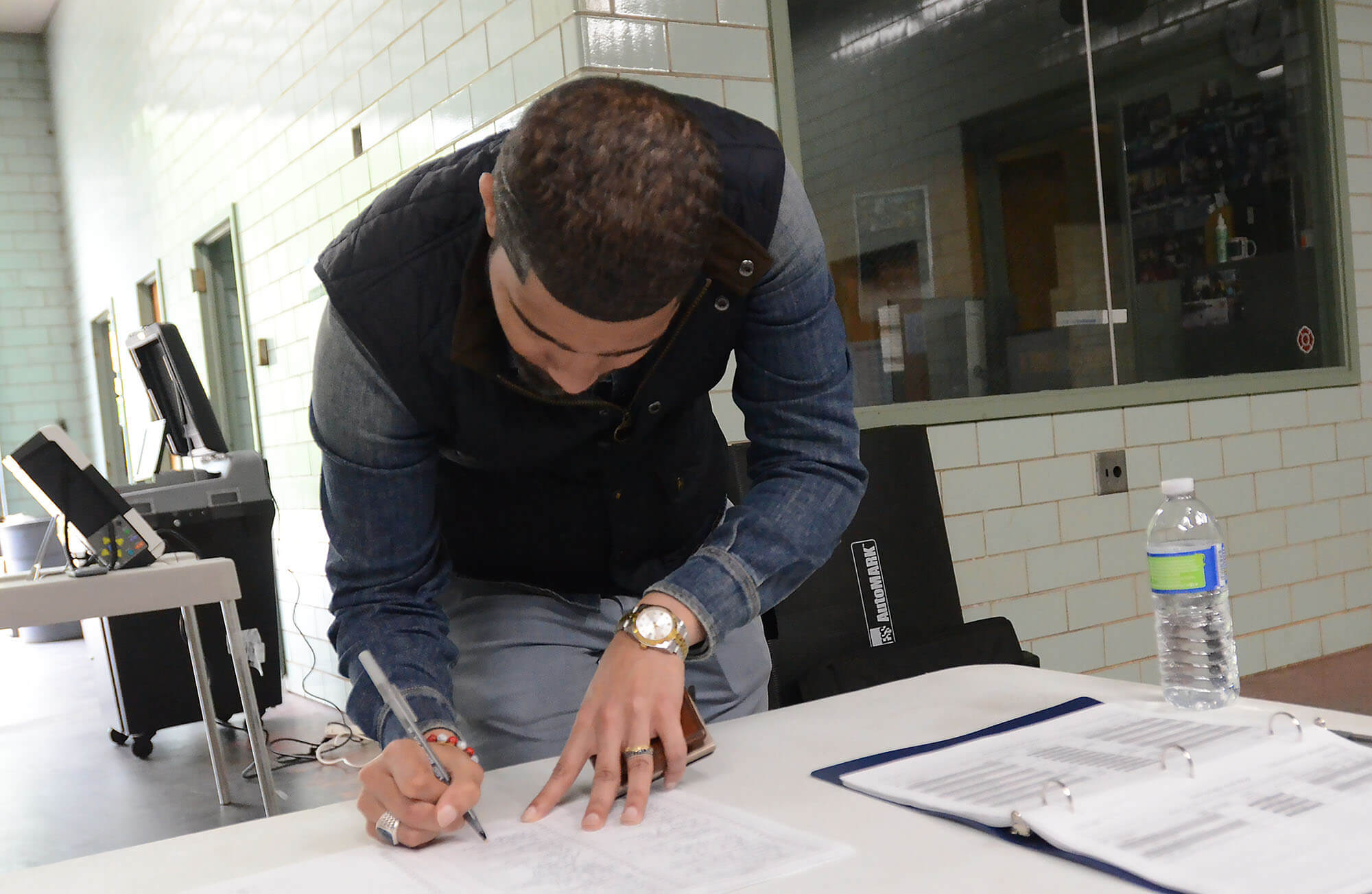
Mayor Chokwe A. Lumumba signs the voter roll before casting his vote Tuesday afternoon, April 22, 2025, at Fire Station 16. Lumumba is in a runoff race against John Horhn. Credit: Vickie D. King/Mississippi Today
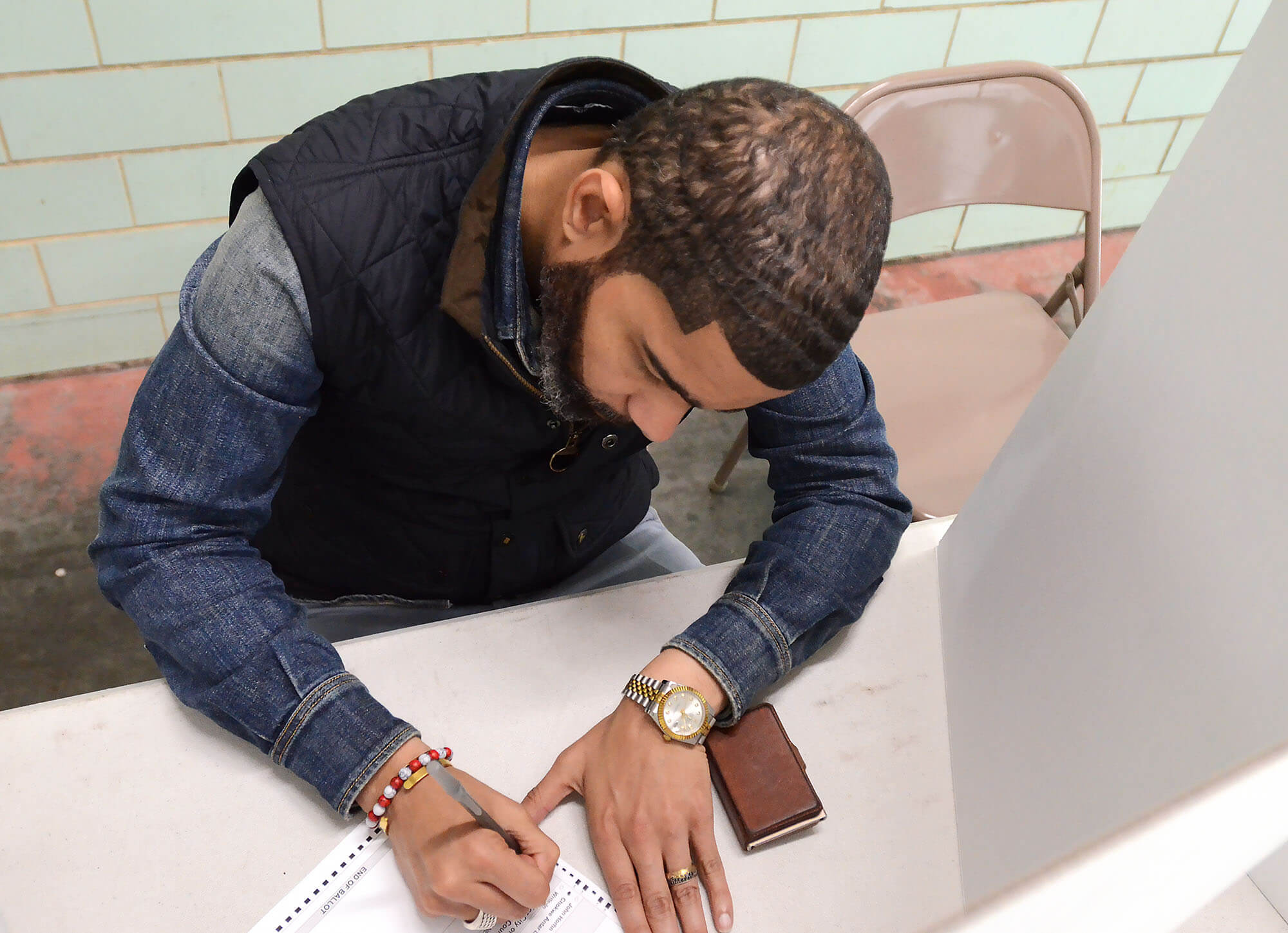
Mayor Chokwe A. Lumumba casts his vote Tuesday afternoon, April 22, 2025, at Fire Station 16. Lumumba is in a runoff race against John Horhn. Credit: Vickie D. King/Mississippi Today
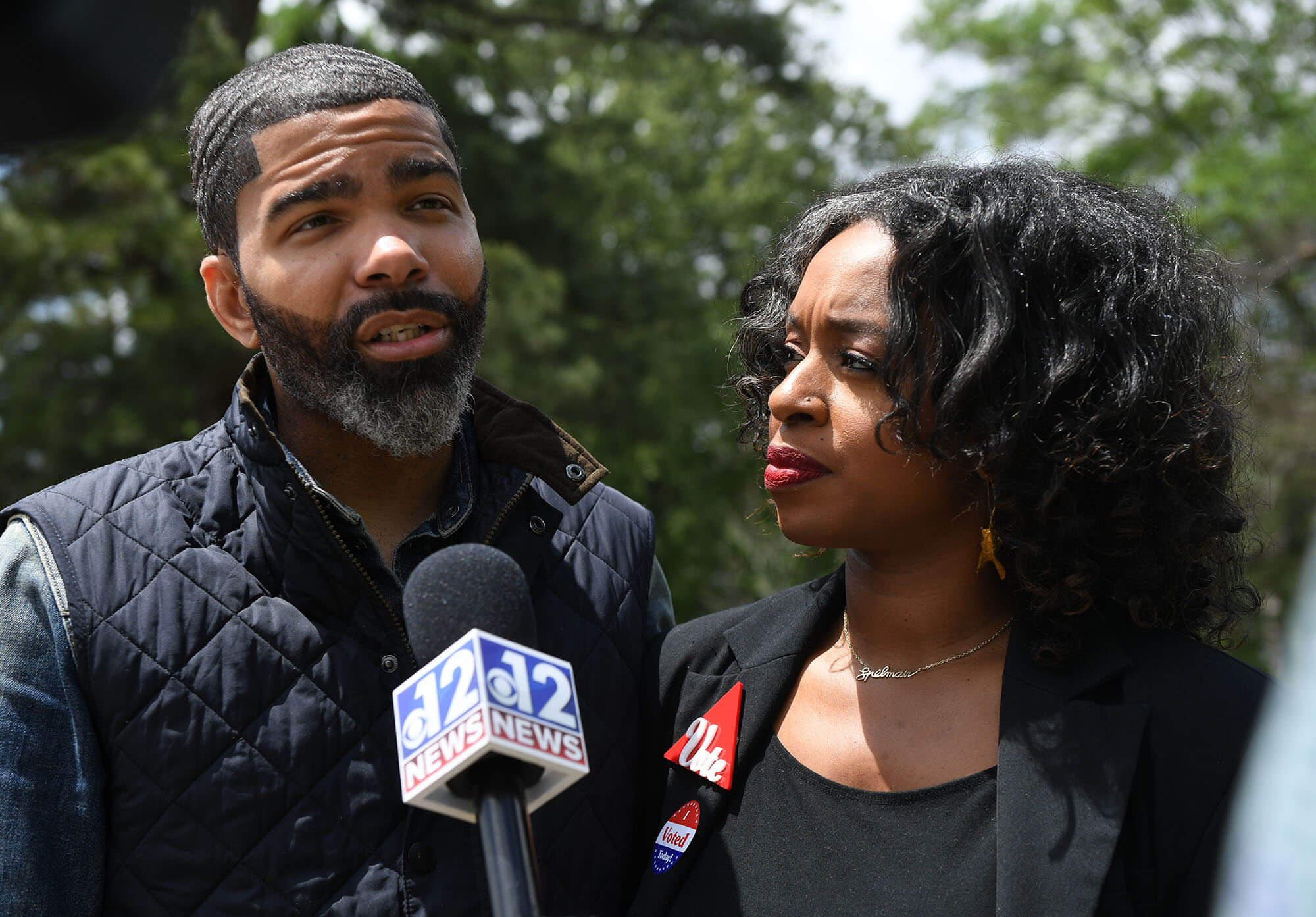
Incumbent Mayor Chokwe Antar Lumumba with wife Ebony, speak to members of the media after voting, Tuesday, April 22, 2025 at Fire Station 16. Lumumba is in a runoff race against John Horhn. Credit: Vickie D. King/Mississippi Today
Incumbent Mayor Chokwe Antar Lumumba with wife Ebony, speak to members of the media after voting, Tuesday, April 22, 2025 at Fire Station 16. Lumumba is in a runoff race against John Horhn. Credit: Vickie D. King/Mississippi Today
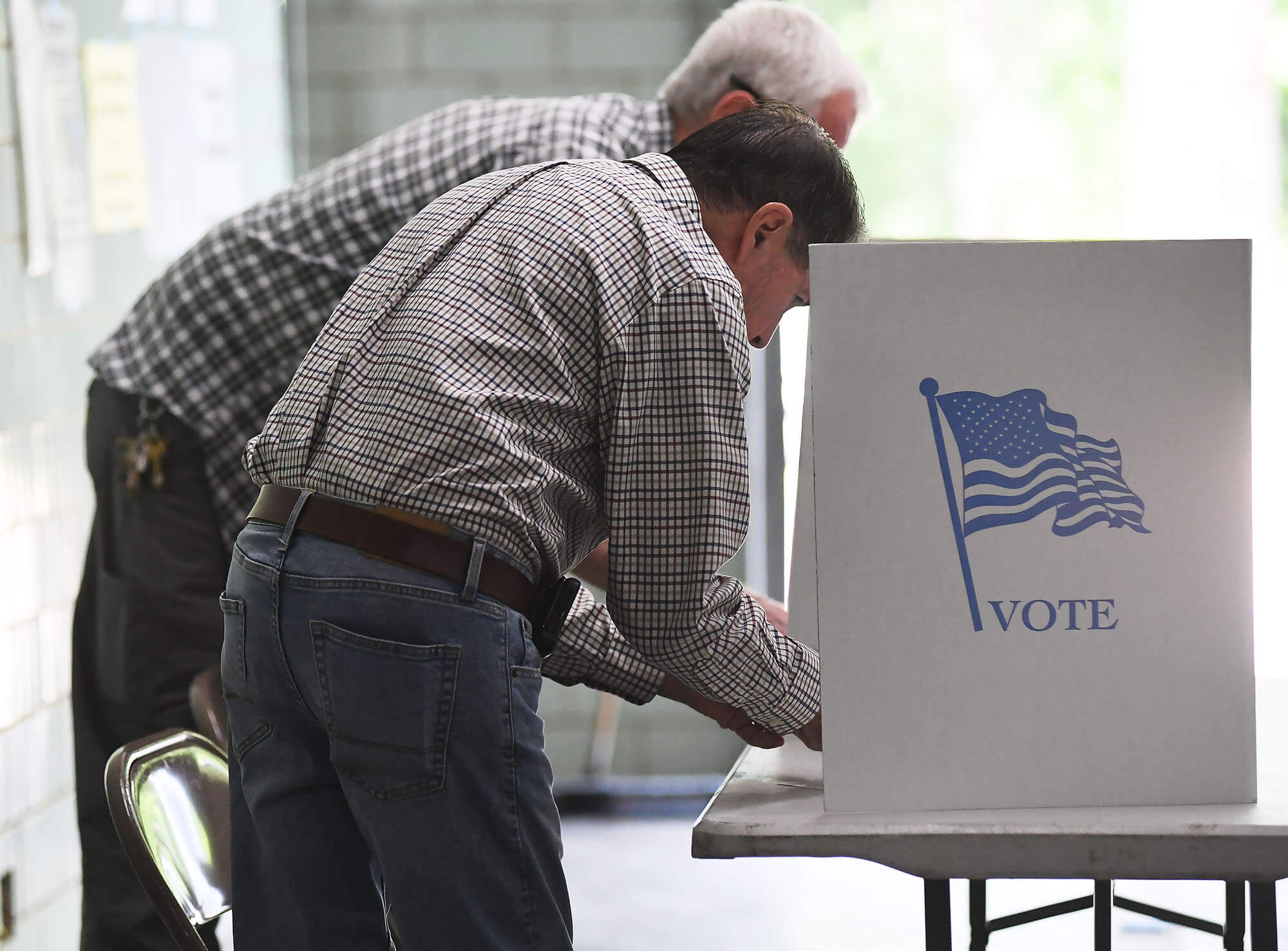
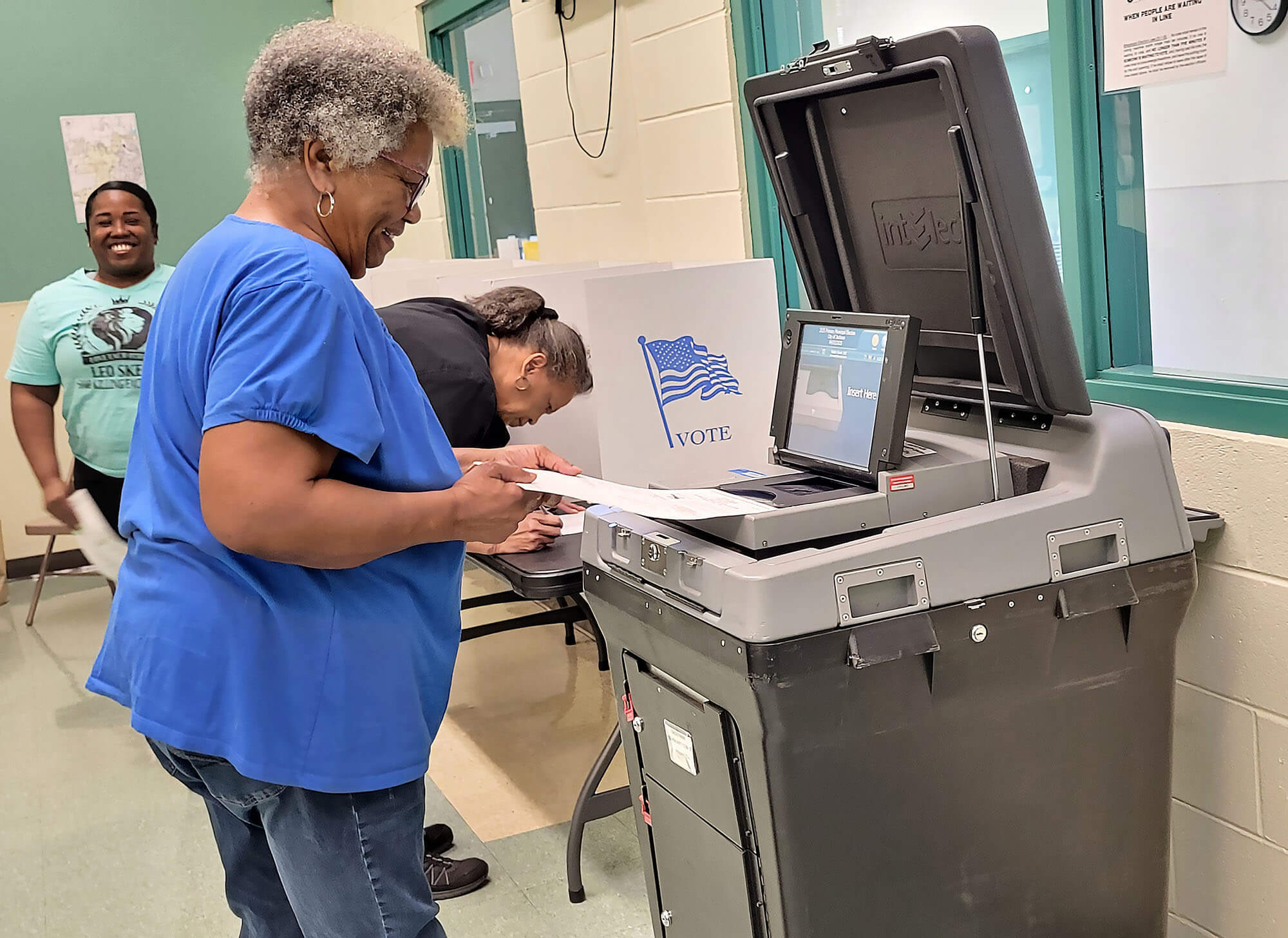
Voters mark their ballots, making their choice in the Jackson mayoral race between incumbent Chokwe Antar Lumumba and Sen. John Horhn, Tuesday, April 22, 2025 at Fire Station 16. Credit: Vickie D. King/Mississippi Today
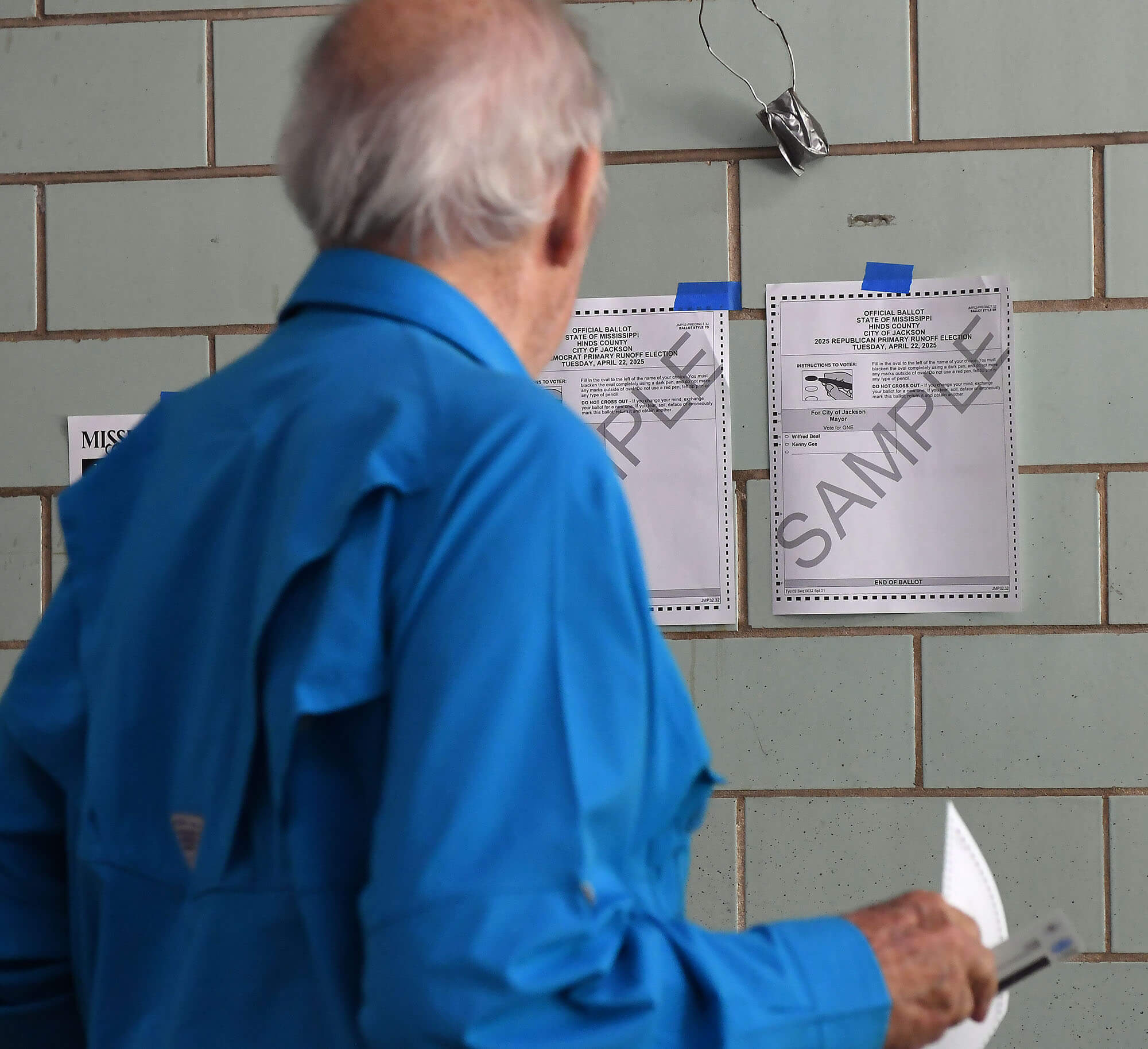
A voter reads over sample ballots before making his choice in the Jackson mayoral race between incumbent Chokwe Antar Lumumba and Sen. John Horhn, Tuesday, April 22, 2025 at Fire Station 16. Credit: Vickie D. King/Mississippi Today
A voter makes his choice in the Jackson mayoral race between incumbent Chokwe Antar Lumumba and Sen. John Horhn, Tuesday, April 22, 2025 at Fire Station 16. Credit: Vickie D. King/Mississippi Today
A voter reads over a sample ballot before making his choice in the Jackson mayoral race between incumbent Chokwe Antar Lumumba and Sen. John Horhn, Tuesday, April 22, 2025 at Fire Station 16. Credit: Vickie D. King/Mississippi Today
12:17 PM
Maya Miller
Ward 6 council candidate says campaign signs missing
In Ward 6, Jackson City Council candidate Lashia Brown-Thomas said someone has been removing her campaign signs, such as from Elton Road and Terry Road.
“They’ve been taking down my signs and throwing them in the garbage,” Brown-Thomas said. “I haven’t put any more down because those signs are expensive. Somebody is taking them down.”
Brown-Thomas, a law enforcement officer, is competing in the runoff Tuesday against Emon Thompson Sr., a businessman and retired veteran. In the April 1 primary, Thompson garnered 714 votes or 22% of the contest totals. Brown-Thomas earned 20% or 652 votes.
Both are running to replace two-term councilman Aaron Banks, who was indicted and pleaded not guilty to federal charges alleging he accepted cash bribes in exchange for his vote on a downtown development project. Banks told Mississippi Today in March that he always intended to serve just two terms.
11:53 AM
Molly Minta
Mississippi primary elections are open, with a caveat
Jacksonians who did not vote in the April 1 primary can still vote in today’s runoff in the Democratic and Republican primaries. However, those who voted in the April 1 primary are not legally allowed to vote in the opposite party’s runoff.
Most voters today will cast a Democratic ballot, choosing between Lumumba and Horhn. Residents in Wards 6 and 7 have a Democratic primary runoff for their representative on the City Council. There’s also a Republican primary runoff for mayor between Wilfred Beal and Kenneth Gee.
Mississippi has open primaries, meaning voters do not register with a political party and may vote in any party primary they choose. In June’s general election, voters may also select any candidate regardless of the primary they voted in.
11:28 AM
Molly Minta
Following negative mailer, Ward 7 council candidates urge Jacksonians to vote
Both candidates vying to represent Ward 7 on the Jackson City Council are out in the rain today, encouraging people to vote in the runoff.
Kevin Parkinson, a former principal of Midtown Public Charter who entered the runoff in first position, having garnered 1,125 votes or 38% of the vote, said he spoke on WMPR this morning to remind people it’s Election Day. He’s also walking through higher-turnout neighborhoods in the ward such as Midtown, Belhaven and Alta Woods.
“Even really engaged, really smart people might not be familiar with the runoff process, or people who are leading busy lives just might not know,” he said.
Candidate Quint Withers, an accountant and Realtor, has emphasized his family’s deep roots in Jackson. During the primary, he came in close second with 939 votes or 32%. Today, Withers wrote in a text that he’s been out waving and speaking to folks at precincts throughout the ward and that the voting lines are steady after this morning’s rain.
“Quint won’t Quit!” he wrote.
Both men are vying to replace outgoing councilwoman Virgi Lindsay. The race was somewhat uneventful before the runoff, with both candidates emphasizing that Jacksonians needed to elect a councilperson who knew the limitations of the role and how to collaborate. But as the runoff neared, the race took on a new tone when Withers sent out a mailer casting aspersions on Parkinson’s record leading Midtown Public Charter.
“Transparency and results are important,” Withers wrote. “Experience is important. FACTS are important.”
The mailer noted the school’s failing accountability letter grades under Parkinson, but Parkinson said that’s not the full picture, noting in part that test scores improved during his leadership.
“If there’s one thing we can all agree on, it’s that our city government has too many mudslingers,” he said. “We need somebody who can focus on bringing a positive vision.”
Horhn campaign found no election “irregularities” this morning, spokesperson says
State Sen. John Horhn’s poll watchers checked voting machines at key precincts throughout the city this morning and did not find any “irregularities,” meaning all the machines were at zero votes when the polls opened at 7 a.m., said Eric Walker, a campaign spokesperson. There are more than 80 precincts in Jackson, and some of the locations the Horhn campaign is watching include Tougaloo, Fondren Church, Timberlawn Elementary, Christ United and Casey Elementary.
At the end of the day, the poll watchers will check the number of votes on the machines against their manual count of each voter who entered the precinct.
“Typically what we do is we have our poll workers sit there and they count each person that comes in and they make hangman sticks if you will,” Walker said.
Last night, Horhn told WAPT that he wanted every voting machine in the city checked to ensure there is no “hanky-panky” on Election Day.
Mississippi Today profiled both Jackson mayoral candidates competing in the April 22 Democratic primary runoff. Read the profile of state Senator John Horhn here.
A brief encounter with Mayor Chokwe Antar Lumumba left the festivalgoers at Urban Foxes so stunned, as if they had just experienced the coolest thing in the world.
“What has happened?” said Zac Clark, whose band had just finished playing a set at the coffee shop’s annual CouchFest.
“My day is great, my day is made,” his friend responded.
“Word,” Clark said.
Lumumba was at the Belhaven Heights coffee shop on Saturday as part of a busy day campaigning for reelection, but after meeting Clark, the two-term mayor paused to share what he called his “origin story.”
“So my wife and I have known each other since kindergarten, right,” Lumumba began. “We lived in the same townhouse community and walked to school together. I’ve always had a crush on my wife.”
But there was competition.
“When we were five, there was a little boy who was a drumming prodigy … and all the little girls loved (him), so I asked my parents to get me a drum for Christmas,” he said. “They did. I never learned how to play, so I been trying to learn how to play the drums my whole life.”
“I had to share that,” Lumumba added. “One day I’m going to learn.”
Just as the two-term mayor has yet to learn the drums, Lumumba is still working to achieve the goals he set out to accomplish when he was first elected in 2017 on a wave of grassroots support — most notably, creating what he has termed a “dignity economy” in the beleaguered city of Jackson.
He says he’s had success. But he’s faced many challenges, too.
For one, Lumumba has repeatedly said that Jackson has more obstacles than other cities when it comes to basic government functions like data collection or blight elimination. And that’s not to mention the numerous crises he’s faced: The COVID-19 pandemic, multiple water system failures, a years-long contract dispute leading to garbage pickup interruptions, and now, federal corruption allegations in an FBI sting involving campaign checks and a favor for a prospective developer.
It may be one too many mishaps for Jacksonians to justify giving Lumumba, 42, another chance. Earlier this month, Sen. John Horhn, 70, all but trounced him in the Democratic primary. The incumbent took home just 17% of the vote and lost support in every single one of the city’s precincts compared to eight years ago.
But the race isn’t over yet, and Lumumba and his supporters have been out in the city, touting the accomplishments he says Jacksonians don’t know about.
Will it be enough?Clark’s bandmate, drummer Katie “Fort” Fortenberry, said defending the mayor is complicated.
“I feel that a lot of the stuff that happened while he was in office, what I saw of him was I saw someone who had a lot of integrity, almost so much integrity that it sometimes created issues with things actually working in our favor, if that makes sense?” she said. “Like with the city council, he wasn’t just going along with whatever everyone else wanted to do. … I would rather be like, yeah, we’ve got issues but it’s because we’re doing things the right way.”
It’s hard because she doesn’t trust “those people” — conservative politicians in Mississippi — and believes that when things are seamless in government, it’s often because “it’s all a show.” But sometimes, that’s what is needed.
“Because, practically, people do need things to just kind of work sometimes.”
Lumumba completed his first important initiative as mayor in 2018: A strategic plan for the city written with input from residents in the form of focus groups and “people’s assemblies,” periodic community meetings with a history in Jackson dating back to the Malcolm X Grassroots Movement in the 1990s.
The plan had five pillars: healthy citizens, affordable homes in safe neighborhoods, a thriving educational system, occupational opportunities in a growing tax base, and a city that is open and welcoming to visitors.
Some goals were more specific than others. The plan called for more public art in the city. It also specified the elimination of 25% of the city’s blight by 2021.
“We’ve been in reactive mode,” Lumumba said when he announced the plan. “We’ve been in often crisis management mode. And so we’re trying to look at how we move to not only creating a more stable plane but how we look at optimization.”
Since then, Lumumba said the plan has functioned as a “guiding star” for his administration. But it’s been tricky to measure progress.
That’s partly because the city is not as data-driven as Lumumba said he would like it to be. The mayor said he can point to examples of events the city has put on that support the goal of being welcoming and open to visitors — such as free concerts the city used to hold before the pandemic — but that’s not the same thing as being able to measure outcomes.
“While you may be doing good work,” he said, “the question is how does it contribute to the whole, and how much are you shaving off from the overall challenges?”
Plus, some information hasn’t been collected over the last 30 to 40 years, Lumumba said. But he added that he’s taken steps to fix that. Under his tenure, the city created a rental registry of landlords that Lumumba said is used for code enforcement. He’s also hired the city’s first-ever data analyst who primarily works with the Jackson Police Department. Lumumba hopes the analyst will examine homelessness in the city, including the primary cause in Jackson.
In another example, Lumumba has touted in campaign materials that his administration has paved more miles of roads than any others. While he didn’t have the numbers on hand, Lumumba said his administration has paved 144 roads and “spent well beyond what other administrations have had available to them.”
Despite these gains, Jackson has remained in reactive mode under Lumumba’s administration. Some of the crises he’s faced have resulted in gains for the city, such as $800 million in federal funding to help fix the water system — but they’re not exactly what Lumumba set out to achieve when he was first elected.
As far as whether the city has met its blight elimination goal, Lumumba was candid that hasn’t happened, mainly due to what he called “limitations” with the state’s blight elimination program, especially when it comes to the cost of clearing titles.
“The narrative that my opponent has tried to share is that the city has left money on the table,” Lumumba said. “First of all, that money was for statewide, and it was inefficient and ineffective statewide, because the program while it gave money for the demolition of the property and the upkeep, it didn’t give as much money for the administrative costs and those are some of the most expensive.”
The city’s current planning department has taken steps to better understand the current scope of the problem, Lumumba said, but it’s still a moving target.
After introducing a band and looking at local art booths, Lumumba left Urban Foxes to meet up with his campaign staff and volunteers at a gas station on Medgar Evers Boulevard. It was time for a canvassing event in Presidential Hills, a neighborhood in Ward 2 that Lumumba lost to Horhn this primary despite historically drawing support there.
A red truck carrying a campaign sign rolled through the neighborhood with a recorded message for voters.
“Jackson, don’t be fooled,” a woman said on a loudspeaker. “Don’t let the state take our city. The Republicans are using John Horhn to take our city. They are fighting to take our airport, our water system, Smith-Willis stadium, our zoo, and our schools. If you want to keep your city our city, Jackson, vote for Chokwe Antar Lumumba for mayor.”
Since the primary, Lumumba and his supporters — including former mayoral candidates David Archie and James Hopkins who are now endorsing him — have accused the Horhn campaign of being driven by hidden interests.
The challenge was to deliver that message in a neighborhood where many people support Horhn. Initially, there was some confusion over whether to knock on doors at homes that had a Horhn sign out front. One volunteer told Lumumba not to.
“That’s not a strategy,” he responded.
As he walked along John F. Kennedy Boulevard, Lumumba passed out a card with information about his accomplishments and aspirations for the city, as well as an edition of the Jackson Advocate with an endorsement of Lumumba. His campaign removed a page that contained an advertisement for Horhn.
When people answered the door, Lumumba wouldn’t say his opponent’s name, but he would make references, such as “I believe you deserve an administration that wants to be held accountable” or “we don’t need our resources taken.”
Mostly, people were just excited to see Lumumba, as if he was a celebrity.
“Oh Chokwe!” the guy who answered the door exclaimed. He ran back inside to get his grandma. “Grandma, it’s Chokwe!”
At a house with a Horhn sign on the property line, Lumumba was vindicated: The woman who answered the door said she was going to vote for him. Nearly every person Lumumba talked to said the same. A man in white socks holding a TV remote told Lumumba, “I’m gonna give you another shot.”
In one of his last stops, Lumumba, his wife and his daughters met a woman who wanted speed bumps installed on her road.
“Absolutely, well, you know what, that’s a council decision, however, have y’all gotten through the process of getting a petition?” Lumumba asked her.
The conversation then shifted to Callaway High School and Murrah High School, who attended which schools, what years they’d graduated, and if they knew the same folks.
What does it say about the direction Jackson has chosen if Lumumba is not reelected?
Sitting outside of Soule Coffee shop in Fondren, the mayor said it would mean that Jacksonians think another person is better equipped to handle the city’s future.
“It would also suggest that maybe people are not as familiar with the gains that we’ve made,” he said. “That’s my hope that we can communicate with them just how much work has taken place and how heavy of a lift it’s been, in spite of the odds.”
Communication – or lack thereof – has been a defining feature of Lumumba’s time as mayor, especially in recent years. And the mayor and his supporters have, at times, been critical of the media coverage his administration has received.
A dispute between Lumumba and the City Council over the city’s garbage contract, which spanned from 2021 until they finally inked a long-term contract in 2024, is the chief example, he said. Lumumba contended that Richard’s Disposal, a Black-owned company from Louisiana, had the lowest bid, while other city council members said that wasn’t true.
“It was very clear,” he said. “All you had to do was look at the documents and what was being offered. It was very clear. We released the numbers.”
But the media did not dig as far as it should’ve, Lumumba said. He also didn’t think it was clearly communicated to Jacksonians that the council stopped the trash service, not him.
“I think the media profited from the so-called ‘trash fight’ and it was more valuable to them to show dissension than to tell the truth,” he said.
Lumumba lobbed bribery allegations against council members, but when FBI agents eventually started poking around in Jackson, it was Lumumba they accused of corruption. He pleaded not guilty and is scheduled to face trial in 2026.
If Lumumba is not reelected, it won’t be the end of his work, he said. He’ll keep fighting for his ideals through his job as a criminal justice attorney.
Through his sister’s nonprofit, he said people’s assemblies would continue.
“There will be a million different ways that I’m going to continue working in community,” he added.
Mississippi Today profiled both Jackson mayoral candidates competing in the April 22 Democratic primary runoff. Read the profile of incumbent Mayor Chokwe Lumumba here.
State Sen. John Horhn had just finished standing on the bed of a shiny white truck, tossing packets of candy to the sparse crowd at the South Jackson Parade on McDowell Road, when a City Hall employee came up to him.
“We need you down there,” she told Horhn. “Oh, we need you bad. Bad, bad.”
A few hours later, another city employee pulled Horhn aside to say that she was looking forward to working with him when – not if – he’s elected mayor.
A four-time candidate for Jackson mayor, Horhn first ran for the office in 2009 on much of the same platform he’s using today: Cleaning up crime and blight, pursuing more federal funding, and growing and developing the city.
As his repeated interactions with city employees the weekend of April 12 illustrate, many Jacksonians feel these problems have only deepened. But Horhn, who has represented northwest Jackson and surrounding rural areas for 32 years, argues the mood around his campaign is much more optimistic.
“There’s something in the air, and I think they sense that,” he said. “You know, the most often used word that I hear from people – young, old, rich, poor, Black, white – is ‘excited.’”
So far, the numbers seem to support that. Earlier this month, Horhn, 70, took even his campaign team by surprise when he pulled 48% of the vote in a crowded Democratic Primary. His chief opponent, incumbent Mayor Chokwe Antar Lumumba, 42, lagged far behind at 17%.
But Tuesday’s runoff – an entirely different race from the primary – will prove the real test of whether voters are buying Horhn’s message this year.
The moderate Democrat has argued that Jackson’s basic city services are suffering and need to be improved. His election would be a marked shift from Jackson’s current administration that is guided by a commitment to radical politics grounded in Black self-determination.
For this, Lumumba’s campaign and supporters have attacked Horhn as the candidate in the pocket of the city’s white business community located in the northeasternmost ward — even though a majority of Horhn’s votes came from Black Jacksonians. The repeated claim that Horhn will all but sell Jackson for parts – from the city’s airport to the Smith-Willis Stadium on Lakeland Drive – has become one of the defining narratives of this year’s election.
As Horhn was talking to voters at the South Jackson Parade, for example, Lumumba’s campaign volunteers tabled with a sign that read: “Keep our city ours.”
Horhn, who was raised in Jackson by a labor organizer and a cafeteria manager for Jackson Public Schools, adamantly rejects this narrative. So do many others, including Congressman Bennie Thompson, whose endorsement of Horhn noted the senator’s intention to defend Jackson’s right to control its own resources.
“Every attempt, either successful or otherwise, of the state taking over an asset of Jackson, I’ve been the lead senator against whatever that take-over attempt happened to be,” Horhn said over small water cups at the Taco Bell on McDowell Road. “I’ve been the go-to guy in the Senate when it comes to fighting that stuff. I’m not all of a sudden going to change my stripes and hand over the city.”
In fact, Horhn said he thinks his style of politics is better suited to defending Jackson than the mayor’s. Horhn described his approach as deliberate, behind-the-scenes, using the existing legislative process to leverage resources, and best summarized by the following aphorism:No permanent friends, no permanent enemies, only permanent interests.
“It’s hard for people to understand how it is that you can be fighting one minute and working with them another minute, and for me it depends on the issue,” he said. “It depends on what’s at stake and what’s the best path of victory to get to the best interest of my community.”
Horhn concedes that most of the bills he authors never become law – the woes of being in the Legislature’s minority party – but he says he’s won significant funding for Jackson nonetheless, including $85 million for the downtown convention center, $20 million for the Westin Hotel, and $20 million for the JSU Metro Parkway.
And he said he’s used the legislative process, from floor fights to bill amendments, to fight for Jackson.
Horhn cited the state’s ongoing effort to wrest control of the Jackson Medgar Wiley Evers International Airport as one example.
The day the bill to regionalize the airport authority came up for a vote in the Senate in 2016, Horhn said the Jackson delegation was caught by surprise.
“Of course we spoke on the floor against the bill,” Horhn said.
As Horhn offered one amendment after another to kill, then water down the bill, he said Lumumba was watching from the gallery and even texted him encouraging words and suggestions for what to say on the floor.
But the bill passed the Senate. Horhn said that members of the House Jackson delegation then went to meet with Philip Gunn, the Speaker of the House at the time, and the group came to what Horhn called a “gentleman’s agreement.” Gunn would not bring the airport bill to the House floor if the Senate Jackson delegation, including Horhn, agreed to help kill a bill that Gunn did not want to see passed.
“Some might say it violates the quid pro quo oath that you take, but it happens all the time,” Horhn said. “We held up our end of the bargain. We killed that bill.”
The former speaker told Mississippi Today he could not recall any meetings about the bill because it was nearly 10 years ago, but that he doesn’t “traditionally do a gentleman’s agreement.”
Horhn added that some other House members then had their own meeting with Gunn that was not as cordial as Horhn thought it should’ve been.
“The meeting did not go well and some things were said by some members that insulted the Speaker, and he became angry,” Horhn said.
In the end, the efforts failed.
“That’s a battle that we lost, but it’s one that we should not have lost,” he said, “because cooler heads should’ve prevailed.”
The narrative that white, conservative, statewide interests want to take what rightfully belongs to Black, progressive Jacksonians persists, especially among Lumumba’s supporters.
Horhn says he understands why.
“There is so much mistrust it becomes something you can weaponize,” he said.
Plus, narratives often possess a kernel of truth.
This election, Horhn has secured the backing of Rethink Jackson, a coalition of city leaders and business people convened by Robert Gibbs, a downtown Jackson attorney and developer. Horhn recently touted an endorsement from a local developer named Gabriel Prado who is building apartments in north Fondren.
And, a review of Horhn’s campaign finance reports shows that he accepted $4,000 from a political action committee named Build MS that primarily donates to Republican candidates, according to its filings with the Mississippi Secretary of State’s Office. Build MS declined to comment.
The PAC was started two years ago to promote “business friendly” candidates and is affiliated with a government relations firm co-foundedby Austin Barbour.
After he was asked about this documentation, Horhn reviewed his documentation and said he believed he received the check by mail and that he was not aware of the connection between Build MS and the Mississippi Republican Party. He went on to say that he’s received many contributions from a diverse group of donors — but it doesn’t mean he adopts their political ideology.
He also pointed to the first donation he received: $10,000 from a Black woman who started her own home care company.
“They’re all supporting our campaign because of one thing and that is because they want to see things change for the better in Jackson,” he said.
To be sure, Horhn, who has worked as a business development consultant, has never denied being a “business friendly”candidate. Neither has Lumumba.
But the two candidates differ in what that means. Lumumba has historically focused on the idea of creating cooperatives in an effort to build a new kind of economy in Jackson. Horhn is not opposed to that approach, but he is more likely to emphasize working within the current system.
“Folks want you to make a difference,” Horhn said. “You have to be able to work with the white business community. You have to be able to work with white statewide officials, because they control this state, and if you’re going to get resources you have to have some type of relationship. And we’ve been successful at getting resources.”
When it comes to managing City Hall, Horhn said he thinks the current mayor has done a poor job, from keeping parks clean, helping businesses get permits, completing audits on time and answering questions from constituents.
But that’s not all – he said he thinks it is Lumumba who has failed to defend Jackson’s resources.
In early 2018, Jackson suddenly dropped its longrunning lawsuit opposing an effort by the West Rankin Utility Authority, which serves surrounding suburban communities, to build its own wastewater treatment plant instead of continuing to pay to use one owned by the City of Jackson. Lumumba’s public works director told him it wasn’t worth fighting.
Horhn said he would’ve fought harder, because he believes the loss of West Rankin kicked off a series of incidents that ultimately led to Jackson losing control of its wastewater system to a third-party manager two years ago.
“We’ve seen a deterioration of our wastewater since then, and what are we seeing now? The second rate increase in the last couple years that’s being implemented by the third-party manager, because we’re not taking in enough revenue to operate the system,” he said.
Horhn also pointed to the state of west and south Jackson. If downtown Jackson is the trunk of the city’s economy, then the city’s outlying neighborhoods are withering branches, deprived of water and poised to fall off.
Even though it’s not part of Horhn’s district, he said he’s tried to help these communities. He cited his efforts to assist Pearl Street AME Church’s community development corporation secure funding to transform an abandoned Holiday Inn on Highway 80 into a senior living facility.
That work took years, Horhn said, and was made possible in part because of connections he had forged in the state Senate with organizations like the Gulf Coast Housing Partnership or the Mississippi Home Corporation.
“The business of business is business,” Horhn said. “If you’re trying to do business, you have to do business with the people that are doing business, and if you’re trying to develop wealth in your community you have to follow some of the same codes around which wealth is created.”
But if that was Lumumba’s goal, Horhn called it a “miserable failure.”
During the April 12 parade, Horhn kept talking about how few people had come out to celebrate. Last year, when the Sonic Boom of the South and Alcorn State’s band played, he said thousands of people turned out.
On Saturday, the floats and high school bands marched past a boarded-up beauty supply store, a defunct Chinese restaurant, an empty elementary school, abandoned homes and overgrown bushes.
There was one new business: A plasma donation center. It used to be a pharmacy.
Addressing the crowd at the festival, Horhn said on the microphone that turning around South Jackson would be the first thing on his to-do list.
But it’s going to be a tall order. The neglect in this part of Jackson runs so deep that much more than economic development is needed. All the same issues Horhn ran on in 2009 are more pronounced now.
Horhn and his campaign team made it back to their cars in a sunwashed parking lot outside a Save-A-Lot that had served as a staging ground for the parade. As they planned the rest of the day, parents picked up their kids, and a little girl hopped into a black sedan dotted with rusted bullet holes on the side.
Last month, more than a hundred people sat in the auditorium of Dollye M. E. Robinson Hall at Jackson State University. It was a Tuesday night, and nearly all of the mayoral candidates in a stacked primary race waited patiently near the front of the room readying for their turn to share their platforms.
It was the first time that JSU Votes hosted an event such as this, creating an opportunity for residents and students to meet the candidates. The organization partnered with The League of Women Voters Jackson Area for the forum.
“We just want to try our best to make sure that the people of our generation understand that politics is important … not just the presidential election either, but also the mayor and city council is just as important,” said Amiyah Banks, vice president of the campus organization.
However, when the primary Election Day came around, the precinct located at Jackson State University’s Student Center had the lowest turnout after only 1% of its registered voters visited the polls. In a precinct with 2,600 registered voters, 27 ballots were cast on April 1.
“ I don’t think people realize it’s powerful to use your vote to say you know what you want to change, what you want to fix within your community. That’s powerful,” Banks said. “I don’t think people realize all that our ancestors had to go through to even just get the ability to vote. So it’s very disappointing when they don’t go out to the polls.”
Jacksonians will have another chance to make their voices heard in the municipal Democratic primary, which historically decides who will be mayor, by voting in the Tuesday runoff between incumbent Mayor Chokwe Lumumba and longtime state senator John Horhn. Runoff elections typically see lower turnout, which could play a factor in the results.
Savina Schoenhofer is with the League of Women Voters Jackson Area. She’s the chair of the Get Out the Vote Committee. She said that in a democracy, it’s important to have civic participation.
“ It’s our voice. The vote is our voice, and this is a democracy, and so that means it’s of the people, by the people and for the people and the way we the people live. Our democracy is in large part by voting,” Schoenhofer said.
The League of Women Voters is a nonpartisan nonprofit organization that works to educate citizens of their voting rights and support voter access on both the local and national level. Schoenhofer said she doesn’t like to focus on the concept of voter apathy as much as she hopes to encourage students to be active participants in democracy.
“I think, ‘Wow, if we don’t have students involved, we’re not gonna have voters tomorrow or next year,’” she said. “We’re already seeing the results of that and I attribute it and a lot of people attribute the decreased interest in citizen participation in government to the absence of civics education in the schools.”
But what does it mean for a community when there’s low turnout?
“It means things happen to them, and not with them and by them,” Schoenhofer said. “We can’t have that. If we’re gonna have a democracy, we have to have participation.”
The precincts with the lowest turnout are located in Wards 5, 6 and 7. At Precinct 73, which is located at Key Elementary School on McDowell Road in southwest Jackson, there are 1,065 registered voters, but only 99 votes were cast on April 1. Similarly, turnout was low at Shirley Elementary and St. Luther Baptist Church, where just around 11% of registered voters cast a ballot. Turnout didn’t necessarily affect how candidates performed, though. While Ward 1’s high turnout precincts represented Horhn’s largest wins, he also received more votes than Lumumba in all but two precincts across the city.
In the April 22 runoff, most voters will cast a Democratic ballot, choosing between Lumumba and Horhn. Residents in Wards 6 and 7 have a Democratic primary runoff for their representative on the City Council. There’s also a Republican primary runoff for mayor between Wilfred Beal and Kenneth Gee. Mississippi has open primaries, meaning voters do not register with a political party and may vote in any party primary they choose. However, those who voted in the April 1 primary are not legally allowed to vote in the opposite party’s runoff. Anyone who did not participate in the primary may vote in either runoff race. Voters may also select any candidate in the General Election in June regardless of the primary they voted in.
One Voice, with offices located on Jackson State University’s campus, is another group doing voter outreach work in Mississippi. Catherine Robinson is the program director of the nonprofit organization based in the capital city. She said one reason why voter turnout is low is because residents feel unheard.
“One of the things that we hear a lot is that they’re not going to change anything. It’s gonna stay the same. So why should I vote? Why should I vote?” Robinson said. “We try to educate them on that systematically. Change does not occur just by complaining. In order for us to have this change, it’s a democracy, and without democracy, we’re ineffective.”
One Voice has been holding voter registration drives and distributing educational materials to inform people of their rights and what’s on their ballots.
“We understand that there’s a gap in understanding how these local elections or national elections impact their everyday lives,” she said. “ One thing that we try to do here at One Voice is close that gap by making sure that we are creating relatable materials for people to understand the complex policies in a simpler form.”
Schoenhofer said that it’s key to vote in every election, especially the smaller ones, in order to see the change desired in Jackson, such as improving clean water access and infrastructure woes.
“Those are things that happen because of your local elections, your city council, your mayor, and the mayor, who appoints department heads,” she said. “So that’s where you can really see the results, and that’s where you really need to express your opinion.”
When it comes to the upcoming election, she encourages voters to do their research, not just for the April 22 runoff but beyond.
“Study these candidates, these people who are willing to put themselves forward,” she said. “Study their ideas and choose who you think is best, and once you’ve done that, tune in once in a while to the online livestream of the city council meetings, because it doesn’t just stop on election day.”
Note: This column is part of Mississippi Today Ideas, a platform for thoughtful Mississippians to share fact-based ideas about our state’s past, present and future. You can read more about the section here.
Mississippi is the beating heart of American culture.
Our writers have reshaped literature, our musicians have birthed modern genres, our freedom fighters have given voice to the nation’s conscience.
From Welty and Faulkner to Jesmyn and Kiese, from Robert Johnson to Jimmie Rodgers, from Ida B. Wells to Medgar Evers, Mississippi’s influence on American culture isn’t just important — it’s foundational.
Mississippi, for its many faults, excels at preserving and showcasing these contributions to the nation. We have, without question, gotten the humanities right. And in countless cases, local economies across our state rely on this cultural study and preservation through museums, monuments and programming to ensure that while we work toward a better future, we’re maintaining a full understanding of our past.
But today, the humanities are under attack. To defund them is to erase the roots of American identity, and no state has more to lose, or more reason to fight back, than Mississippi.
The Trump administration, at the direction of billionaire Elon Musk and his band of tech bros hunting for federal budget cuts, has gutted the National Endowment for the Humanities — slashing its funding and demanding an 80% reduction in staff. The effects of this mind-blowingly obtuse decision are devastating for Mississippi: the $1 million in federal funding appropriated annually to the Mississippi Humanities Council, whose decades of work and grant making touches every county and corner of this state, is gone.
The Mississippi Humanities Council is a nonprofit founded in 1972 that responsibly distributes these federal funds through grants to entities that are boosting our state’s arts and culture, preserving history for generations to come, and creating deeper cultural life in small towns across the state.
The abrupt budget cut jeopardizes more than 35 grants that were already awarded by the council for programs like an oral history of former Gov. Kirk Fordice’s time in office, a museum exhibit on Mississippians who fought and died in the Vietnam War, and lectures about the work and legacy of artist Walter Anderson.
Musk and Trump’s tech bros at the Department of Government Efficiency (DOGE) may know how to download personal data and make sweeping decisions that may or may not be constitutional, but they don’t seem to understand the power of poems, paintings, songs or history. And they certainly don’t know a thing about Mississippi.
They’ve declared war on something our state has long treasured: the power of story, of memory, of meaning. And whether they know it or not, their budget cut stands to erase some of our nation’s most important culture.
Understand that the work of the Mississippi Humanities Council is not “woke,” focused on DEI or skewed toward liberal causes. These Trump administration cuts appear totally indiscriminate, which makes the situation all the more frustrating to those who rely on this funding. Though conservative politicians have long targeted the National Endowment for the Humanities budget, prominent Republicans — including those in Mississippi’s congressional delegation — support the work of the council.
President Ronald Reagan, not too long ago heralded by Republican Party officials as a model leader, likened humanities to a beacon of American freedom. At a time when the Soviet Union threatened our nation’s livelihood, President Reagan leaned into aspects of American life that brought people together. He wasn’t focused merely on the real threats to American society at the time. He went out of his way to underscore the importance of community theaters, small-town museums, library book clubs and school field trips — the very places and moments where Americans have long come to understand themselves and their neighbors.
“The humanities teach us who we are and what we can be,” Reagan said at the White House in 1987. “They lie at the very core of the culture of which we’re a part, and they provide the foundation from which we may reach out to other cultures so that the great heritage that is ours may be enriched by, as well as itself enrich, other enduring traditions.”
It was President Lyndon Johnson, who created the NEH in 1965, who warned: “Where there is no vision, the people perish.” Johnson rightly believed that the humanities were not a luxury but a local lifeline. They existed not in some marble gallery, but “in the neighborhoods of each community.”
Here in Mississippi, these neighborhoods and communities are literal. These are our hometowns, and these are our neighbors. Grants from the Mississippi Humanities Council have supported civil rights education in the Delta, local history archives in Gulf Coast libraries, and storytelling festivals in small towns where history is still passed down by word of mouth.
So when things feel more chaotic than ever, what can we do? We can fight. We must stand up and let our leaders know that the humanities cuts are too harmful to our state to let slide, that Elon’s tech bros cannot so easily erase the national contributions Mississippi has made. Demand they sponsor new bills to restore humanities funding that cannot be touched by a vulgar, spiteful billionaire or the president he serves. Implore them to save the Mississippi Humanities Council — to do anything before it’s too late for the preservation of our culture and for so many of our small towns.
If you’re eager to get more personal with our six members of Congress, here are some starting places:
Call U.S. Sen. Cindy Hyde-Smith and ask if she enjoyed her 2023 photo op at the opening of a traveling Smithsonian exhibit at her hometown library in Brookhaven. That exhibit and so many more in small towns across her state were underwritten by the Mississippi Humanities Council, which just lost its funding because Elon Musk said so.
Call U.S. Sen. Roger Wicker and ask if he learned anything by narrating Vernon Dahmer’s story for the traveling exhibit “A More Perfect Union: Mississippi Founders,” which aims to “celebrate the rich legacy of ideas and ideals at the core of our democracy.” That exhibit and so many more across his state were underwritten by the Mississippi Humanities Council, which just lost its funding because Elon Musk said so.
Call U.S. Rep. Trent Kelly and ask whether he supports the Possumtown Book Festival in Columbus, the Oxford Conference for the Book, the Behind the Big House program in Holly Springs, or the Small-Town Preservation Symposium in Eupora. All of these community festivals or programs in his district are underwritten by the Mississippi Humanities Council, which just lost its funding because Elon Musk said so.
Call U.S. Rep. Bennie Thompson and ask whether he supports Mississippi Freedom Trail unveilings across his district like a recent one in Canton, grants to support civil rights movement anniversaries, and a Jackson State University-supported program that created a book club at Parchman. All of these programs in his district are underwritten by the Mississippi Humanities Council, which just lost its funding because Elon Musk said so.
Call U.S. Rep. Michael Guest and ask him if he supports programs that bring history to incarcerated youth and provides prison education to adults who are incarcerated in Pearl, or the recent Jimmie Rodgers seminar at the Mississippi Arts and Entertainment Experience in Meridian. These programs and so many more in his district were underwritten by the Mississippi Humanities Council, which just lost its funding because Elon Musk said so.
Call U.S. Rep. Mike Ezell and ask whether he supports the Walter Anderson Museum of Art in Ocean Springs, the Maritime and Seafood Industry Museum in Biloxi, the University of Southern Mississippi oral history center, or the Hancock County Historical Society. All of these entities boast recent programming underwritten by the Mississippi Humanities Council, which just lost its funding because Elon Musk said so.
For our six members of Congress to allow these cuts without taking action is to suggest Mississippi’s stories — the painful and proud, the devastating and inspiring — don’t matter. That we don’t matter.
But we do. We really, really do. And if we don’t fight for our culture, who will?
In the state where so much of America’s artistic and moral imagination was born, defending the humanities isn’t about nostalgia or wokeness. It’s about survival. It’s about reminding the nation — and maybe even ourselves — that Mississippi always has something important to say.