At his first convocation as Tougaloo College’s president, Corey Wiggins reflected on a question he’d asked himself before the event: What prepared him for this moment?
“And strangely enough, my mind didn’t go to a job I had, a title I’ve carried, or even a degree I’ve earned,” Wiggins said during his speech. “It went home.”
Wiggins, who took over as the college’s president on July 1, talked about growing up in Copiah County, and how his experiences led him to his new role. He also recounted the college’s storied civil rights history and its connection to the institution’s future.
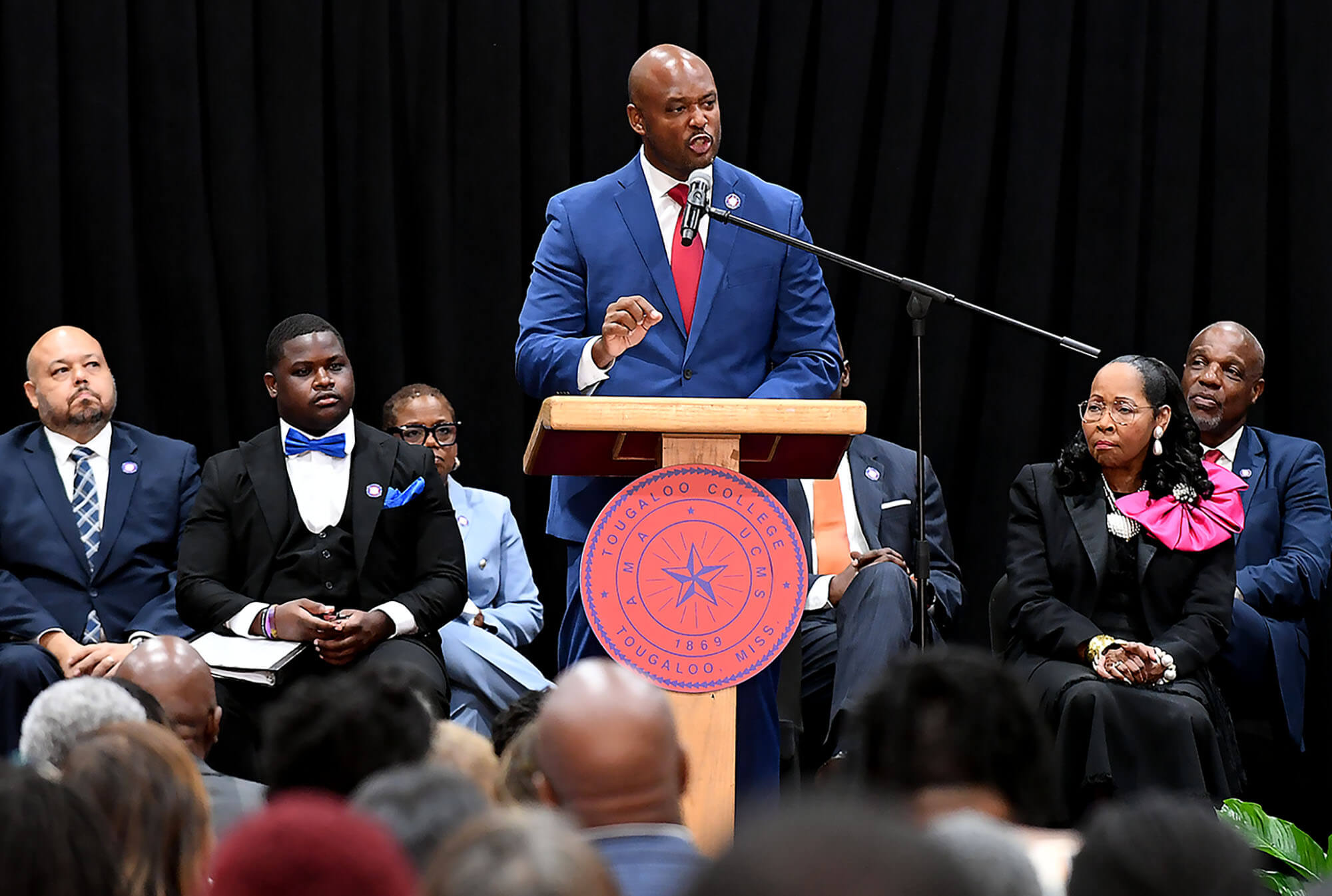
Nearly 250 Tougaloo alumni, faculty, students and local high school students and community residents filled the Kroger Gymnasium in the Owens Health & Wellness Center for the convocation Wednesday. The event opened with brief remarks and prayers from campus student leaders followed by the college’s concert choir singing “Lift Every Voice and Sing,” which is often called the Black national anthem.
Wiggins recounted Tougaloo’s history before talking about his role in its future.
Tougaloo College was founded in 1869, four years after the Civil War, when the American Missionary Association bought 500 acres and established the school there. Nearly a century after the college’s founding, nine Black students — later dubbed the Tougaloo Nine — staged a sit-in at the segregated Jackson Municipal Library on March 27, 1961.
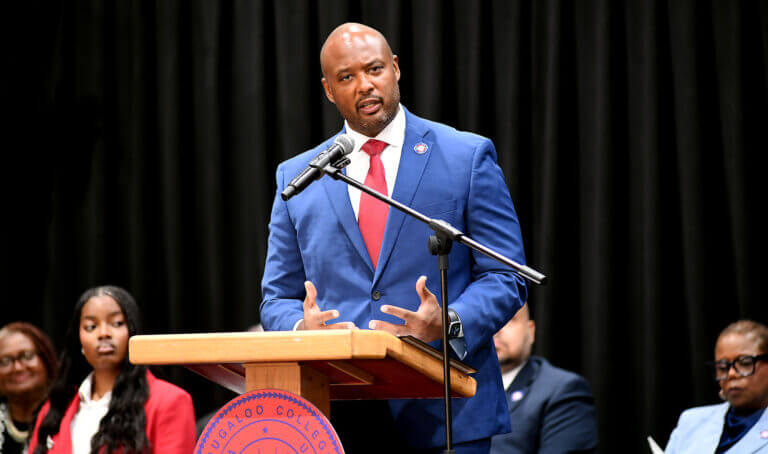
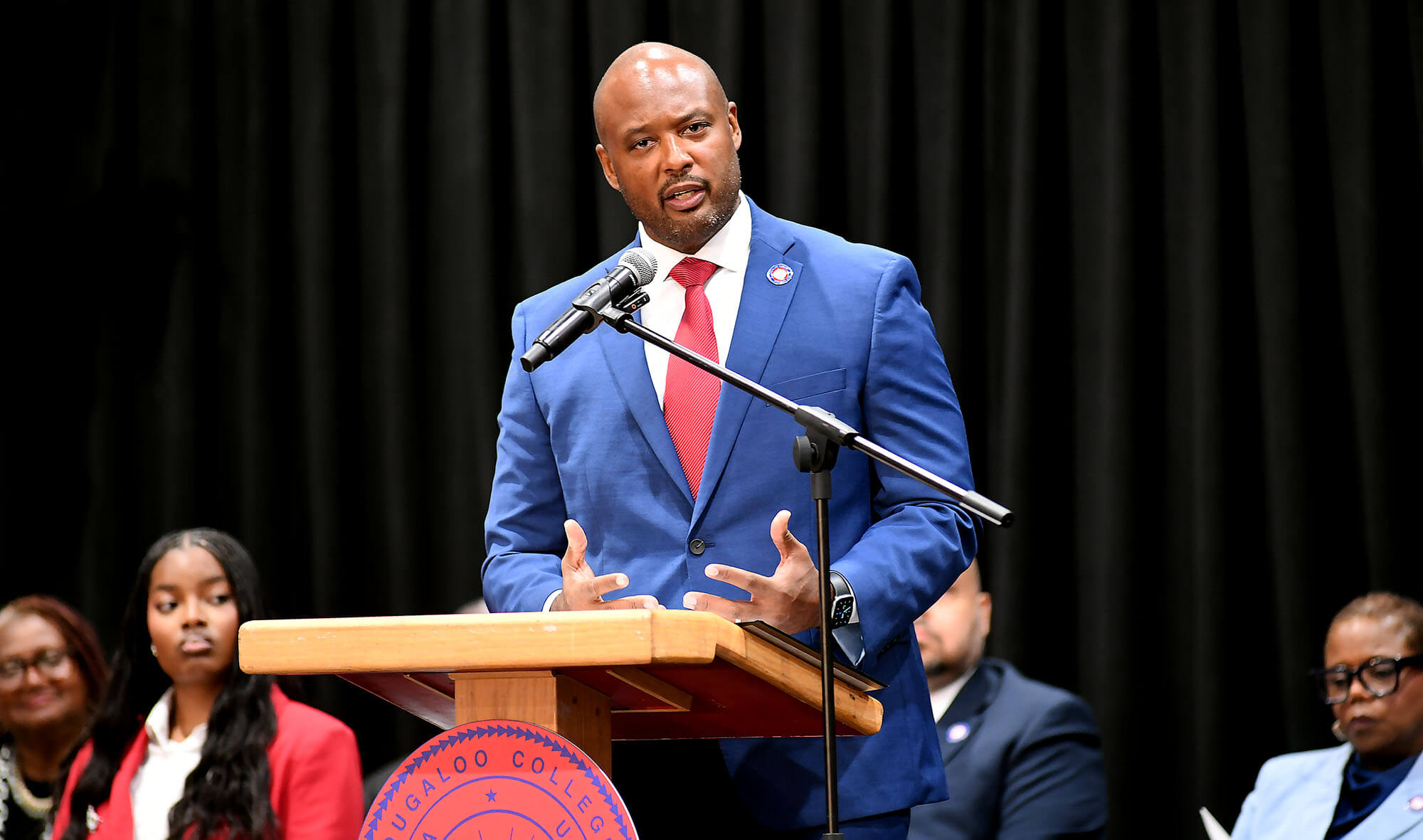
Tougaloo College President Corey Wiggins delivers his convocation address, Wednesday, Aug. 26, 2026, at the campus in Jackson. Credit: Vickie D. King/Mississippi Today
That moment and other events during the Civil Rights Movement, Wiggins said, defined the college’s mission: to learn, lead and serve.
For Wiggins, the college’s legacy will require new and prospective students to show the same courage by embracing change. It will ensure Tougaloo remains strong for future generations, he said.
“You have to show up. You have to do the work. You have to be curious,” Wiggins said to applause. “Whatever path you take, your Tougaloo education should prepare you for your moment to think critically, to act courageously and serve something larger than yourself.”
Those commitments come as Wiggins inherits lingering concerns about the college’s leadership.
In March 2025, the college’s faculty senate issued a series of no-confidence votes for former President Donzell Lee, Provost Josiah Sampson III and Registrar Pam England.
The faculty senate previously voted no confidence in Sampson and England in May 2024. Lee was interim president of the university at the time.
The dissatisfaction also predates Lee.
In 2022, Tougaloo students voted no confidence in President Carmen Walters. That year, a group called the Tougaloo College Alumni Coalition for Change garnered more than 1,500 signatures on an online petition calling for Walters’ removal.
On Tuesday, Wiggins told Mississippi Today he can’t speak to what happened on campus before his arrival. But he has attended alumni events, faculty senate meetings and walked the campus with students.
“I think that’s how we build camaraderie,” Wiggins said. “That’s how we build and create the healthy tension that you need to create an institution that’s forging a way ahead.”
Wiggins said Tougaloo faces challenges competing with public institutions for faculty, an issue he plans to address as he develops the college’s strategic plan.
Meherun Laiju, vice chair of Tougaloo’s faculty senate, said she was a member of the selection committee for the president and believes they chose the right candidate.
“We believe that he will be transparent,” Laiju said.
Wiggins asked faculty to work directly with Pamela Foster, the college’s new provost and vice president of academic affairs, to address their concerns, Laiju said.
Jalynn Sanders, a senior physics major, said students have felt unheard by college administrators, particularly around campus infrastructure. But Wiggins has reached out to student groups since the start of the semester to create a positive impact on their campus experiences, Sanders said.
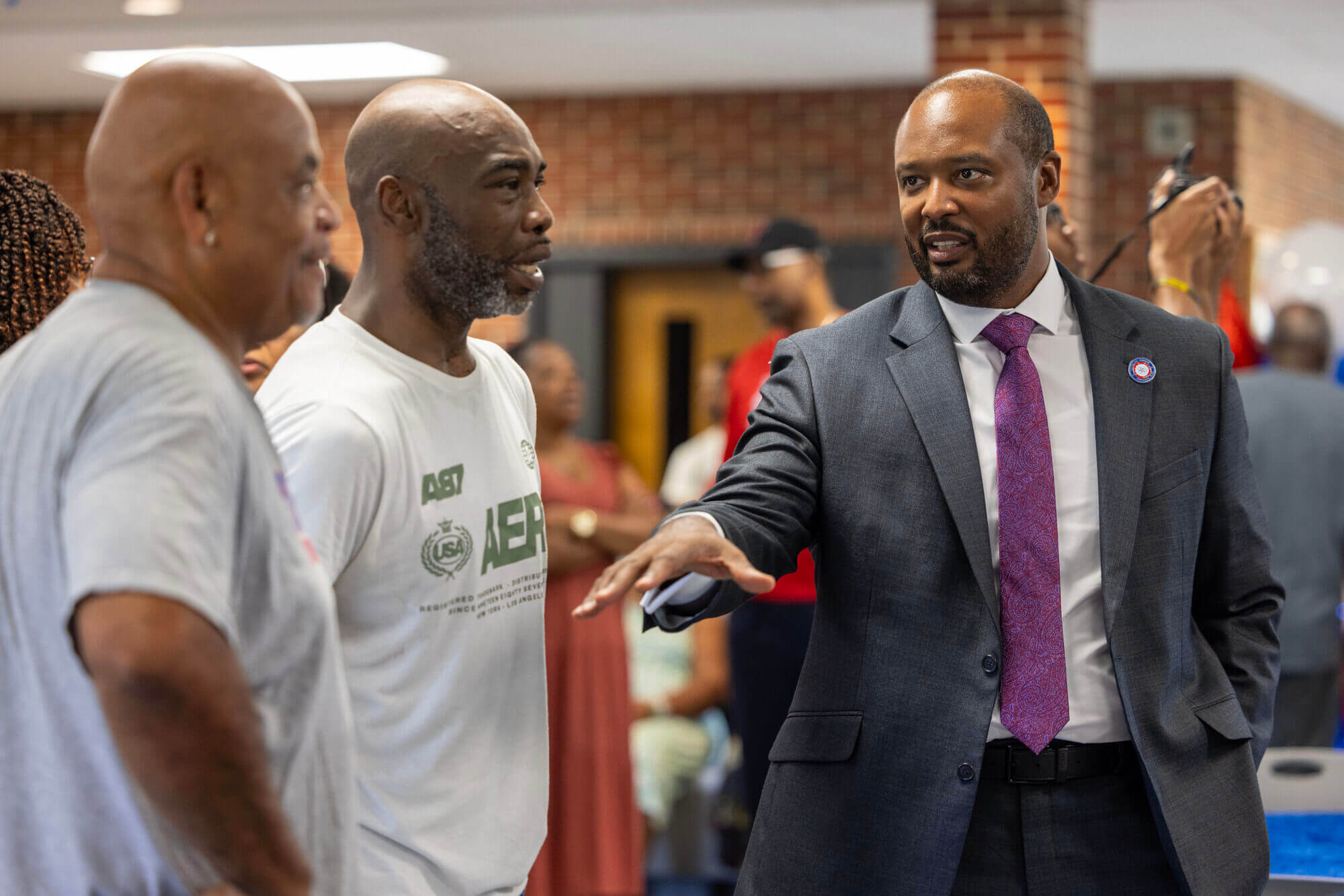
Tougaloo College President Corey Wiggins speaks with attendees during a meet-and-greet at the school in Jackson on Wednesday, July 1, 2026. Credit: Eric Shelton/Mississippi Today
The institution has had too much change, said Blondean Y. Davis, who chairs the college’s board of trustees. Wiggins will provide the leadership that the college needs, she said.
“With change comes a sense of unrest,” Davis said. “He also has the aggressiveness in terms of facilitating financial stability that we need to lead us into the world.”
Wiggins has a deep understanding of the college’s community and the potential to elevate the institution nationally, said Michael J. Cleveland, vice chair of the Tougaloo College National Alumni Association board of directors. It is important that Wiggins involves alumni, the community, and faculty, in shaping the institution’s future, he said.
Wiggins and his administration should also address faculty and student recruitment, retention, fundraising and donor retention, Cleveland said.
“I think he’s coming at the right moment to do what needs to be done,” Cleveland said.
“And if he isn’t,” he said. “We’re going to hold him accountable.”
Madison County residents were told that Amazon’s data centers would pay significant property taxes that would boost school and government budgets. But the actual amount may be lower than was projected, with Amazon challenging the tax valuation of its properties.
Amazon Web Services recently challenged the Madison County tax assessor’s valuation of its data centers in Canton claiming that the county’s assessment is too high. The lower assessment Amazon is claiming would mean $5 million to $6 million less in tax dollars next year for schools and the county, according to the tax assessor’s office, down from an estimated payment of over $28 million.
At an August county Board of Supervisors meeting, the company argued that each of its five buildings is worth $69 million, while the assessor put the value at $292 million per building.
The board upheld the tax assessor’s valuation but Amazon could appeal the decision to Circuit Court.
In the next few years, Amazon plans to build 34 data centers in Madison County, expected to bring in tens of millions of new tax dollars each year.
Amazon representative James Polianski said the company’s valuation came from industry standards. But Madison County Tax Assessor Norman Cannady, argued that Amazon’s buildings are unique and should be evaluated as such.
“They’re highly specialized data centers,” Cannady told the board. “And this is not simply a conventional building or shell. The real property includes specialized building systems that are integral to the facility. And their construction involves significant electrical, specialized structural requirements, mechanical cooling, redundancy, and supporting infrastructure. ”
Cannady said that when calculating the value of a building, Amazon used replacement costs but his office estimated the actual costs associated with constructing the building.
Cannady added that Amazon had refused to share data about the actual construction costs with his office. Polianski said that it was company policy not to share those documents as it “may put Amazon at a competitive disadvantage.”
Even in his first conversation with Dolly Parton in the early 1980s, Sam Haskell leaned on his Mississippi roots to connect with the country music icon.
Haskell’s job, working with the Beverly Hills talent group William Morris Agency, didn’t seem to interest her much. What piqued Parton’s interest, Haskell said, was when he told her he was from a small town called Amory and went to the University of Mississippi.
“She said, ‘Ole Miss, that’s my husband’s favorite football team. Sit down here,’” Haskell recounted to Mississippi Today. “And that’s how our relationship began.”
Years later, Haskell became Parton’s agent as she continued to write and record some of the most famous country songs of the 20th century. The duo expanded their ambition, producing television movies and winning multiple Emmy awards together.
Haskell said their professional success was grounded in their deep friendship, and that friendship was natural from their first meeting because of their shared small-town Southern roots.
“That instant connection brought trust, and brought respect, and brought friendship,” Haskell said. “And that’s what Dolly’s about.”
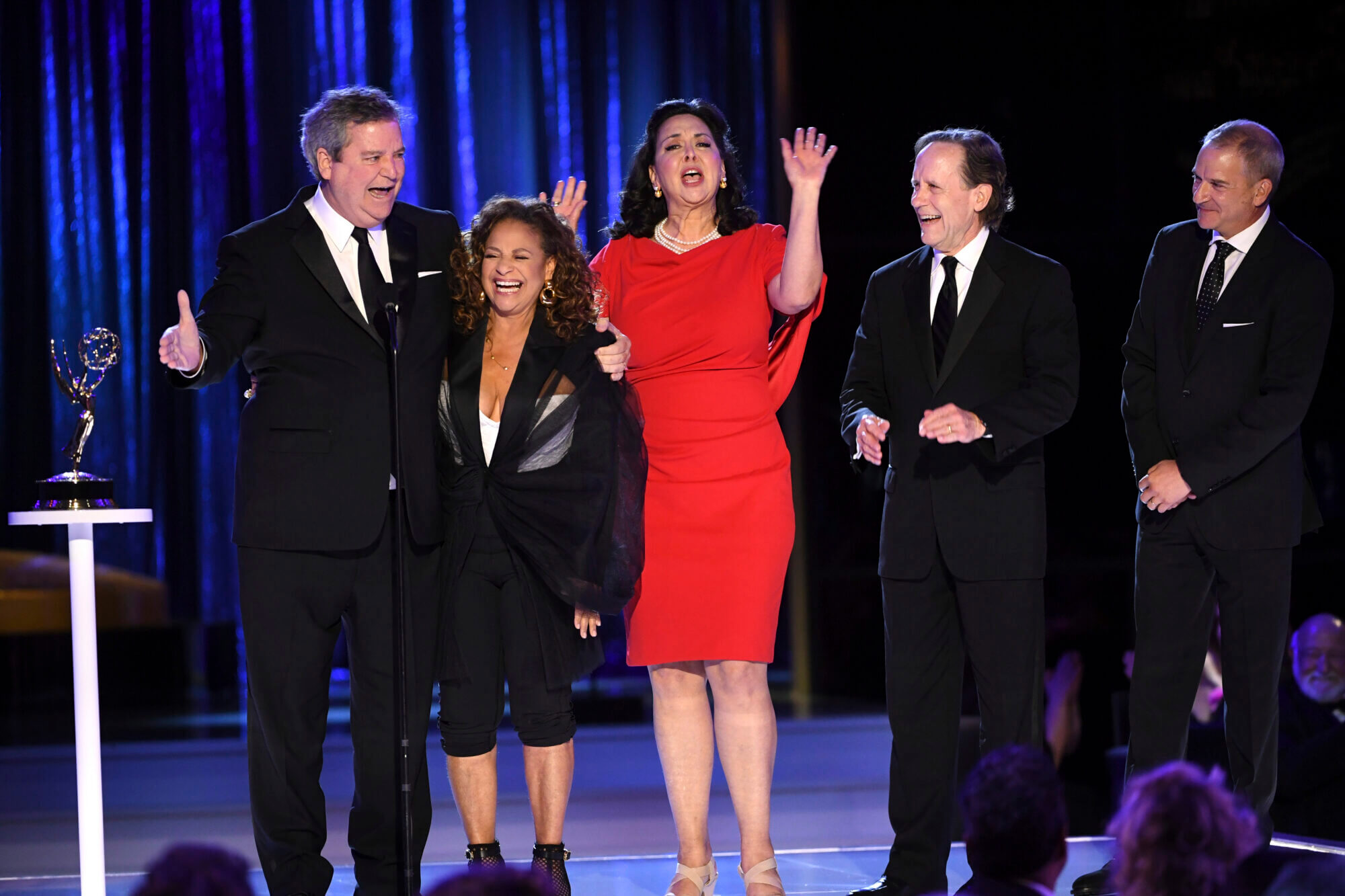
Sam Haskell, from left, Debbie Allen, Maria S. Schlatter, Hudson Hickman, and Joe Lazarov accept the Emmy for outstanding television movie for “Dolly Parton’s Christmas on the Square” during the third ceremony of the Television Academy’s 2021 Creative Arts Emmy Awards at the L.A. LIVE Event Deck on Sunday, Sept. 12, 2021, in Los Angeles. Credit: Phil McCarten/Invision/AP
Parton’s fans from the nation’s capital to the Appalachian hollers near where she grew up are mourning her death Tuesday at age 80. Haskell and other Mississippians are reflecting on the connection she had with this state — both her appreciation of the place and the deep admiration she garnered from its people.
Haskell saw Parton’s admiration for Mississippi constantly, especially during the 2000 edition of “Stars Over Mississippi”. It was a biannual Amory charity concert series Haskell hosted to raise money for local college scholarships. Haskell asked Parton to be the headliner of the October concert that year, and she agreed.
Long before the event, Haskell got a call from Parton. She had dialed him up from the landline phone at an ice cream shop in Amory.
“I said, ‘Dolly you don’t have to come to Amory until October,’” Haskell said. “She said, ‘I’m just here to check it out and see where you’re born.’”
Parton gave the phone to the woman working at the ice cream shop, who told Haskell about all the times he would order a double dip chocolate cone from her as a kid. As she handed the phone back to Parton, Haskell realized the woman didn’t recognize the country music icon.
“I go, ‘Dolly, does she not know who you are?’ And she went ‘uh uh,’” Haskell said. “I said, ‘How is that possible? These are your people.’ She said, ‘Oh Sam, I just take off my wig and wear a baggy shirt. Nobody knows who I am. I’ve been up in Walmart all morning.’”
But that October, 10,000 people came out to watch Parton in the “Stars Over Mississippi” concert, according to Haskell.
Amory native Dee Monaghan Howard was one of them. She wasn’t a big country music fan, but she braved the cold autumn day to watch Parton perform.
“Any time a star comes to Mississippi, it’s a big deal,” Howard said. “Especially a small town like Amory.”
And of the stars Haskell brought to Amory, Howard said Parton was the one she was most excited about.
Dolly Parton performs on NBC’s “Today” show in New York on May 13, 2014. Credit: AP Photo/Charles Sykes
Hudson Hickman, a New Albany native and producer who worked on television hits such as “The Love Boat” and “MacGyver,” met Parton through Haskell, a longtime friend, 11 years ago. The two approached Hickman about making short movies based on her songs, starting with “Coat of Many Colors.”
Parton always wanted to make more movies, Hickman recalled, and saw her music as a vehicle for that ambition.
“ I was just kind of taken aback because I just thought, here I am, this boy from Mississippi sitting in a room with Dolly Parton, and she’s telling me that the work we’re going to be doing is going to be a dream come true for her,” he said.
Hickman remembered the legend’s glowing presence on the set of productions including “Dolly Parton’s Mountain Magic Christmas” and “Dolly Parton’s Heartstrings,” dishing out hugs to crew members and knowing everyone by name.
During one “magical” meeting he and Haskell had with Parton, Hickman said she jokingly broke into song mid-conversation.
“I don’t remember what the song was because I was just sitting there looking into her blue eyes about two feet away from me, thinking: Dolly Parton is singing a song to me,” the producer said. “I said, ‘It is the voice of an angel.’”
Despite the somber moment, Hickman conveyed an overwhelming sense of fortune.
“Of course I’m sad at her passing, but I’m just struck with a feeling of being grateful,” he said. “I’m grateful to have had the opportunity to work with her and observe up close her genius.
“She spread love wherever she went.”
Dolly Parton performs benefit concert at Marty Stuart’s Congress of Country Music on Aug. 26, 2023, in Philadelphia, Miss. Credit: Curtis Hilbun
Mississippi Gov. Tate Reeves ordered flags to be flown at half-staff in honor of Parton.
“An American music icon. An even better person,” Reeves said on social media. “Mississippi is praying for Dolly Parton’s entire family.”
Her renowned philanthropic legacy has had direct benefits for Mississippians. Dolly Parton’s Imagination Library sends books to children across the country, coordinating with dozens of organizations in Mississippi. The Ole Miss Women’s Council for Philanthropy chose Parton for its 2020 Legacy Award, an honor reserved for those who embody the values of philanthropy, leadership and mentorship.
The COVID-19 pandemic delayed Parton from accepting the award until 2022, an event at which she surprised the audience by playing two songs. Elizabeth Randall, chair of the women’s council at the time, told Mississippi Today in an email Wednesday that Parton’s values represented the very best of what the award aims to recognize.
“Even Dolly’s willingness to come to Ole Miss was an act of philanthropy,” Randall said, adding that it was a testament to the friendship between her and Haskell and his wife, Mary. “That was so characteristic of Dolly. She showed up for people she loved.”
Parton directly lent her public image to others’ charitable efforts as well, including many directed to help Mississippi. Haskell said that when he co-chaired fundraising campaigns for different colleges, including the University of Mississippi, Parton offered to help out in a way only she could.
“She would always tell me, ‘Just auction off a dinner with me,’” Haskell said. “‘Just tell them you can have dinner with Dolly, and see how much you can get.’”
Haskell said those “Dinners with Dolly” would be auctioned for up to $75,000, all of which would go straight to the fundraisers.
Her music made a strong impression on Mississippians across the state, as well. In the fall of 1972, long before Malcolm White started booking artists at Hal & Mal’s restaurant in Jackson, he drove up to Nashville to see a Grateful Dead concert at Vanderbilt’s campus. White hung around the stage after the show, until he had a chance to speak to lead guitarist Jerry Garcia.
White asked Garcia what music he’d been listening to lately. The guitarist told him about a country artist and an album White had never heard of.
“He didn’t miss a beat,” White said. “He turned and said, ‘You got to get Dolly Parton’s ‘Coat of Many Colors.’”
White, who later led the Mississippi Arts Commission, said he bought the album as soon as he got back to Mississippi, and he still has that same copy over 50 years later. “Coat of Many Colors” has since become one of his all-time favorite records. It helped him realize that a lot of the rock music he loved listening to — from the Grateful Dead to Jimi Hendrix — had country roots from artists like Parton.
Country singer Dolly Parton appears at a rehearsal session in Nashville, Wednesday, Nov. 11, 1982. Credit: AP Photo/Mark Humphrey
The album’s title song tells the story of Parton as a young girl, when her mother stitched together a coat made of rags. Parton recounts feeling pride despite other schoolchildren mocking her — a message White said resonated with what he saw growing up in rural Stone County.
“It just reminded me of kind of where I came from,” he said. “I think everybody connected with her in their own unique way, because she lived so long and had so many lives and so many careers.”
Parton maintained her Mississippi connections in recent years. On Aug. 26, 2023, she performed a benefit concert at the Congress of Country Music, developed by her friend and country music icon Marty Stuart, in the east Mississippi town of Philadelphia. The venue was smaller than those where Parton normally played, but she felt it was important to do the concert as a favor for Stuart and his wife, country music singer and songwriter Connie Smith.
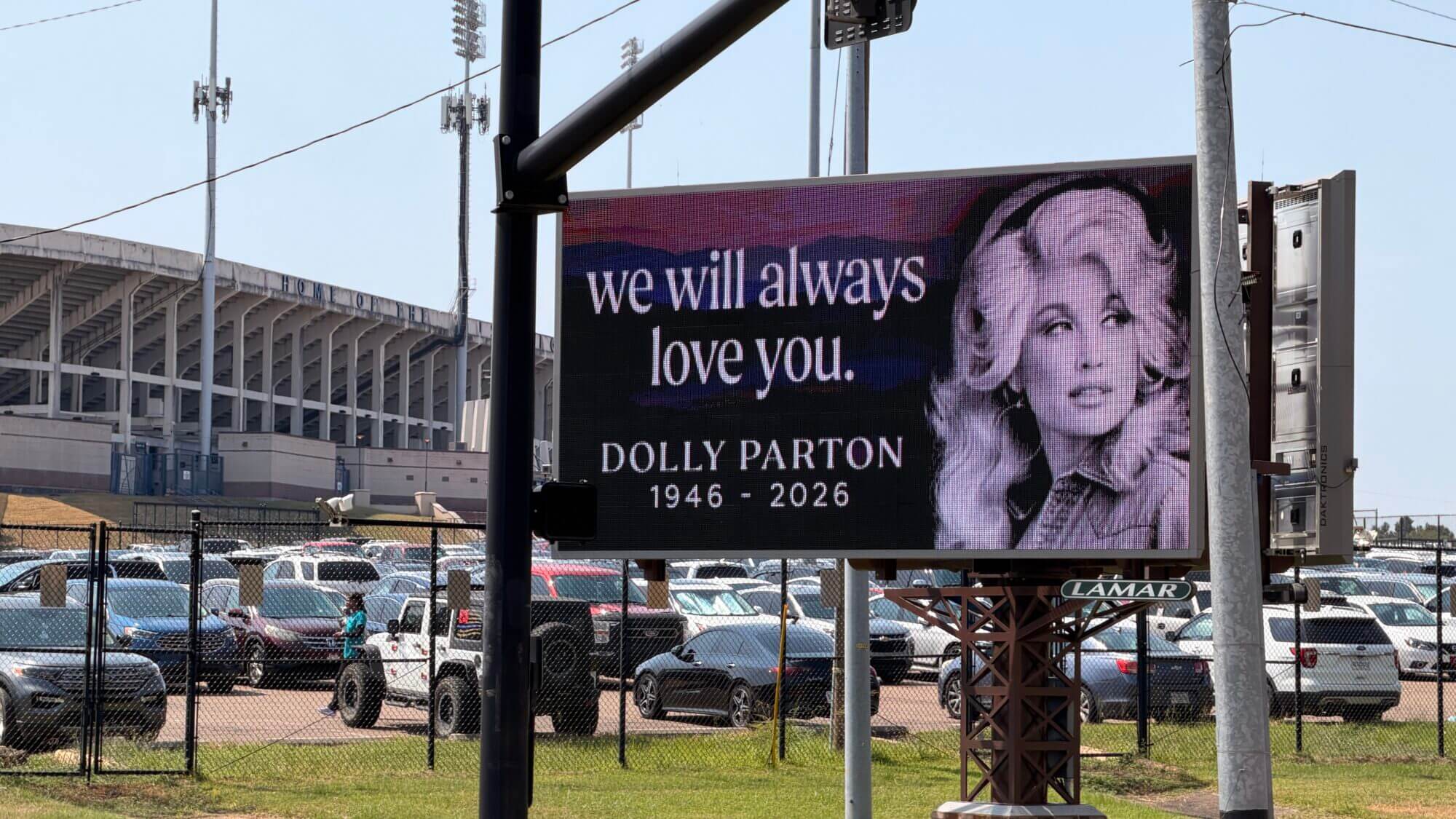
“The Congress of Country Music benefited greatly from the concert she performed inside our hallowed walls in Philadelphia, Mississippi,” the venue said in a statement. “She did it out of her love for Marty and Connie, with a smile on her face and a song in her heart to help support the cause of preserving the history of country music. We will always love you, Dolly.”
For Haskell, the connection runs deeper than most. Parton was close with much of his family, and Haskell said she would dote on his three young grandchildren. When they were moving from California to Mississippi, she would speak to each of them separately to see how they were handling the big transition.
Just before Parton performed for a 2023 NFL Thanksgiving halftime game dressed as a Dallas Cowboys cheerleader, Haskell said she called him up with a message.
“‘Get those boys in front of the television, because they’re about to see Aunt Dolly like they’ve never seen before,’” Haskell recalled.
Whether reflecting on Parton’s nationally televised performances or the small moments of laughter and wisdom she shared with his family, Haskell is working to figure out how best to mourn his friend of nearly five decades.
“It’s just devastating to our whole family. She was part of our family.”
Rick Cleveland contributed to this report.
Dolly Parton speaks to a audience gathered to celebrate the expansion of the Imagination Library of Kentucky at the Lyric Theatre in Lexington, Ky., on Aug. 27, 2024. Credit: AP Photo/Timothy D. Easley
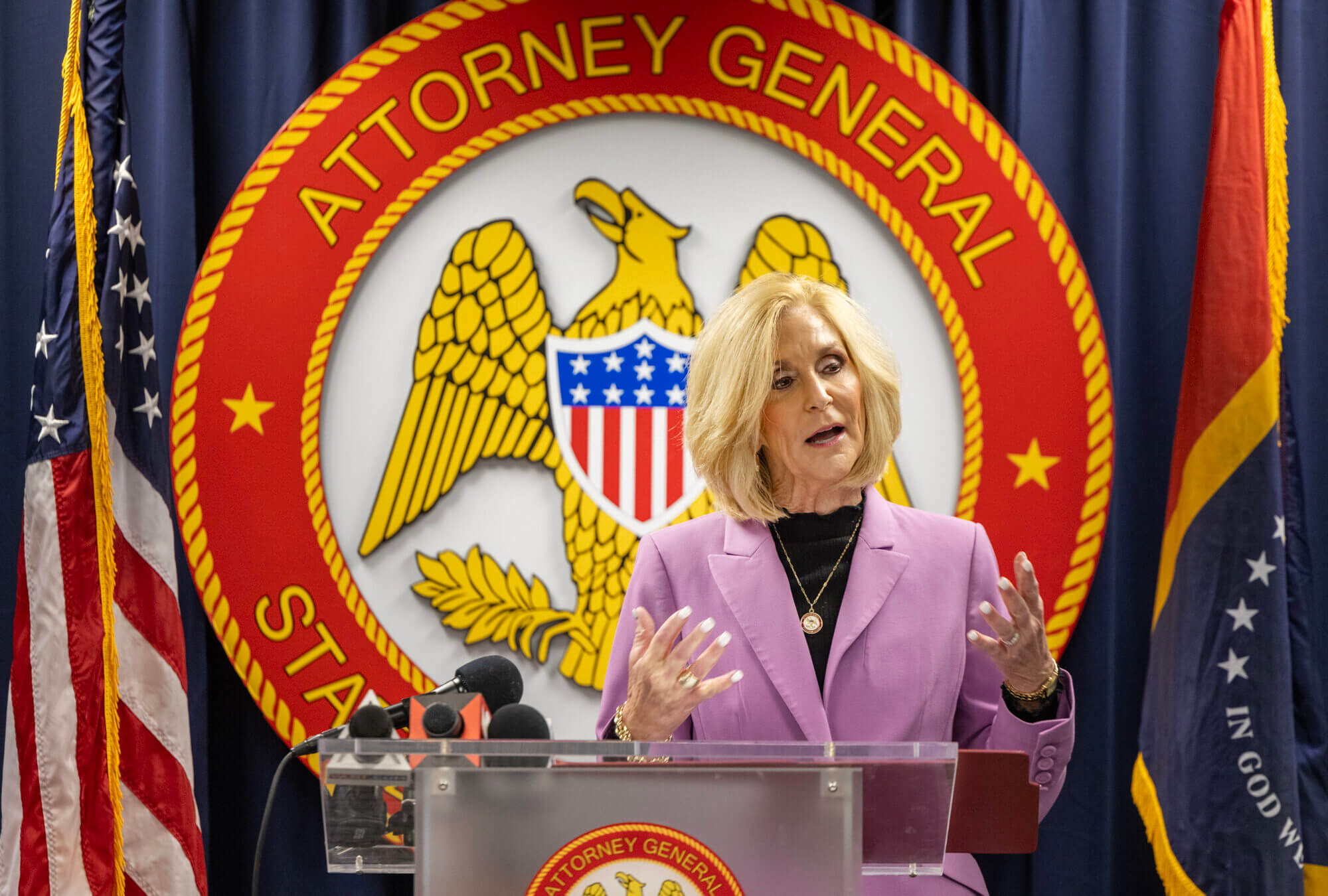
Mississippi will receive $189 million over 10 years as a result of a settlement announced on Wednesday between technology giant Meta and 47 states, the District of Columbia and U.S. territories that sued claiming the company’s social media platforms harmed children.
The agreement nationwide comes out to $17.1 billion, the largest settlement ever paid by a social media company to states. Mississippi’s share of the payout was announced by Attorney General Lynn Fitch, who said Meta is setting a new standard for the way children engage with social media.
“Big Tech has been conducting a social experiment on our children’s developing brains by making platforms that were purposefully addictive and preyed on children’s greatest vulnerabilities,” Fitch said in a statement. “A generation of children have suffered, but with this settlement we spark transformational changes to protect children from harm.”
The settlement was reached after a bipartisan, nationwide investigation that nearly every attorney general in the country participated in, starting in 2021. The investigation found that Meta designed Instagram’s features to addict children, documented the resulting mental health harm and showed how the company failed to warn parents, Fitch said.
In 2023, states around the country, including Mississippi, began filing parallel lawsuits and joint federal complaints. This settlement resolves those cases, Fitch said.
Legal experts said the settlement could be a watershed moment for the social media industry, which has largely escaped regulation in response to how its platforms could harm children.
Under the settlement, Meta will be required to institute a series of safety features on Instagram and Facebook, including daily time limits on platform use by children, blocks restricting children’s access during school hours, age verification and a range of content control.
States could receive more money if other platforms agree to similar settlements. Meta will initially pay about $12 billion, but it will pay an additional $5 billion if fellow tech companies Snap, TikTok and YouTube also agree to financial penalties and changes to make the platforms safer for children. If that happens, Mississippi could receive $270 million over 10 years, Fitch said.
Meta’s legal team said on Wednesday that the company negotiated the terms of its settlement to require the other companies to join Meta in developing industry standards, the New York Times reported.
Michelle Williams, Fitch’s chief of staff, said Mississippi will next month file a consent decree in Hinds County Circuit Court, where the state lawsuit played out. That filing will contain more information on how the money will be spent in Mississippi.
Compared to other federal settlements such as the one that mandated spending to fight opioid addiction, the Meta settlement gives Mississippi more leeway on how it chooses to spend the money, Williams said. But the settlement does include guidance that the money should be spent on youth mental health and similar initiatives.
Fitch filed a similar suit against TikTok, and litigation in that case is ongoing.
These used to be among the fundamental facts about going to college in America: College lasts four years. And though that timeline had been flexible when it comes to sports, there was never much debate over the notion that once a player moved on to the pros, their days as a college athlete were over.
A recent rule passed by the NCAA has resulted in confusion, lawsuits and the once unthinkable notion of players leaving college, signing with professional teams and then turning around to head back to college.
Among this week’s headline grabbers were Dae’Quan Wright and Zxavian Harris, a pair of undrafted players out of Mississippi who had tryouts in the NFL over the summer, hoping to play this season at Ole Miss’ rival in the Southeastern Conference, No. 11 LSU.
Wright and Harris are among a number of college athletes who have sued for the right to return to college to play as the start of both the college football and NFL seasons approach. Their moves, however, might not work out, as both the SEC and Big Ten passed new rules Tuesday barring pros from heading back to college to play. Those rules themselves could also be challenged in court.
A quick look at how we got here:
NCAA passes a new rule allowing for five years of eligibility
This part happened in June, and by the NCAA’s plodding standards, it happened quite fast.
The rule now allows athletes to play five seasons over the span of five years. Most college athletes now see the “clock” start on their eligibility either when they enroll full-time in college or at the start of the regular school year immediately following their 19th birthday, whichever comes first.
The rule itself isn’t all that outlandish. A lot of players were taking redshirt years (and getting extensions due to the pandemic) to prolong their eligibility to five, six, seven years and more, so putting some guardrails around it made some sense.
But the NCAA’s decision to start applying this new rule to athletes who graduated high school in 2023 is what caused the chaos. By not including those from the Class of ’22, many of whom saw their fourth and final year of eligibility end after last school year, they opened themselves up to trouble.
The members of the Class of ‘22 are arguing they’re being deprived of education and potential NIL financial benefits by being excluded from the rule.
Meanwhile, college athletes are suddenly looking at unexpected competition for roster spots and playing time coming from a class of players they thought would be gone this season. And teams, most of which have locked in their football rosters, are seeing a potential influx of talent they didn’t expect.
A federal lawsuit filed by those who only got 4 years of college
A basketball player named Brock Wisne filed a federal class-action lawsuit, saying the NCAA violated antitrust law by excluding that Class of 2022 from the new rule. A judge in Denver ruled in favor of Wisne, opening the door for everyone in the class to come back to college, but only to their former college. The judge left NCAA transfer portal rules intact, meaning the players couldn’t come back, enter the (currently closed) portal and find a new school.
State lawsuits pile up as a workaround to the federal case
Despite the federal court ruling, players across the country have filed lawsuits in state courts and many judges granted orders allowing them to come back to school. This “find a local judge” approach has generally been successful for the athlete over the past couple of years.
In some cases — including the case involving Wright in Louisiana — a judge not only said the players could come back, but also ordered a weeklong reopening of the transfer portal, which gave the players a chance to shop around.
Sam Ehrlich, a former lawyer who follows college sports litigation at Boise State, said the state lawsuits were filed “just in case” the federal order got overturned. It did, and that federal case had no bearing on the various state lawsuits.
According to Ehrlich’s College Sports Litigation Tracker, at least 26 eligibility cases have been filed in state and county courts across the U.S. In at least 10 of those, judges have granted a restraining order or injunction favoring the players. In only one — involving basketball player Filip Borovicanin — has an appeals court overturned the initial decision, leading to a favorable outcome for the NCAA.
When will this all be decided?
Court cases move slowly, and in the Wisne case, odds are nothing will be final until long after football (and maybe basketball and baseball) season is over and there’s no relief left to give to the impacted players.
While football teams are madly scrambling, trying to make sense of it all, basketball teams are also feeling some pressure. Teams are allowed to start practice on Sept. 25. A notable instance of where confusion might set in is Gonzaga, which recruited two players from that Class of ’22 who (presumably) had their eligibility restored.
One, however, is Javon Bennett, who was part of the Borovicanin lawsuit that an Ohio court overturned. The other is Chauncey Wiggins, who comes from Florida State and was part of a case in Georgia, where the ruling favorable to the players remains in force.
Mississippi cattle producers and politicians are worried that President Donald Trump’s plan to suspend tariffs and cut a deal to import more cheap beef to the U.S. will hurt the state’s farmers and potentially cause long-term damage to an industry already facing high costs and record low herd numbers.
“This policy does not help the U.S. herd-rebuilding efforts and could possibly do permanent damage,” the Mississippi Farm Bureau Federation and its president, Mike McCormick, said in a statement. “Instead the Administration should focus its time and energy on reducing fuel and input costs for American agriculture that could result in lower prices for all American consumers.”
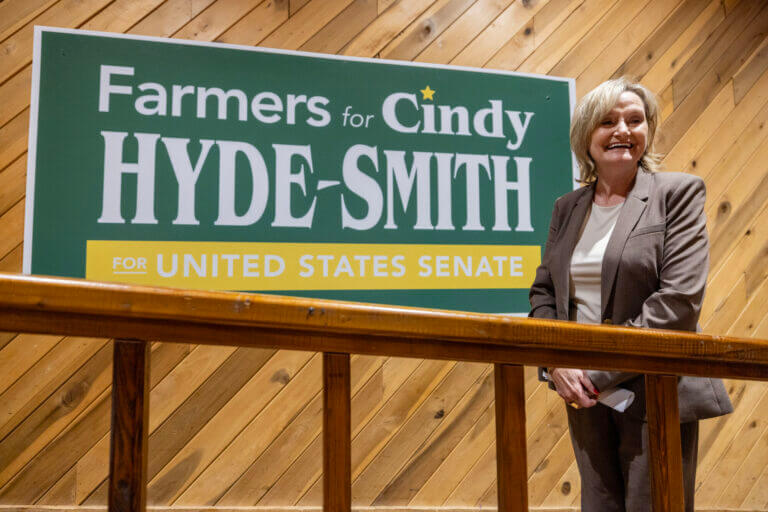
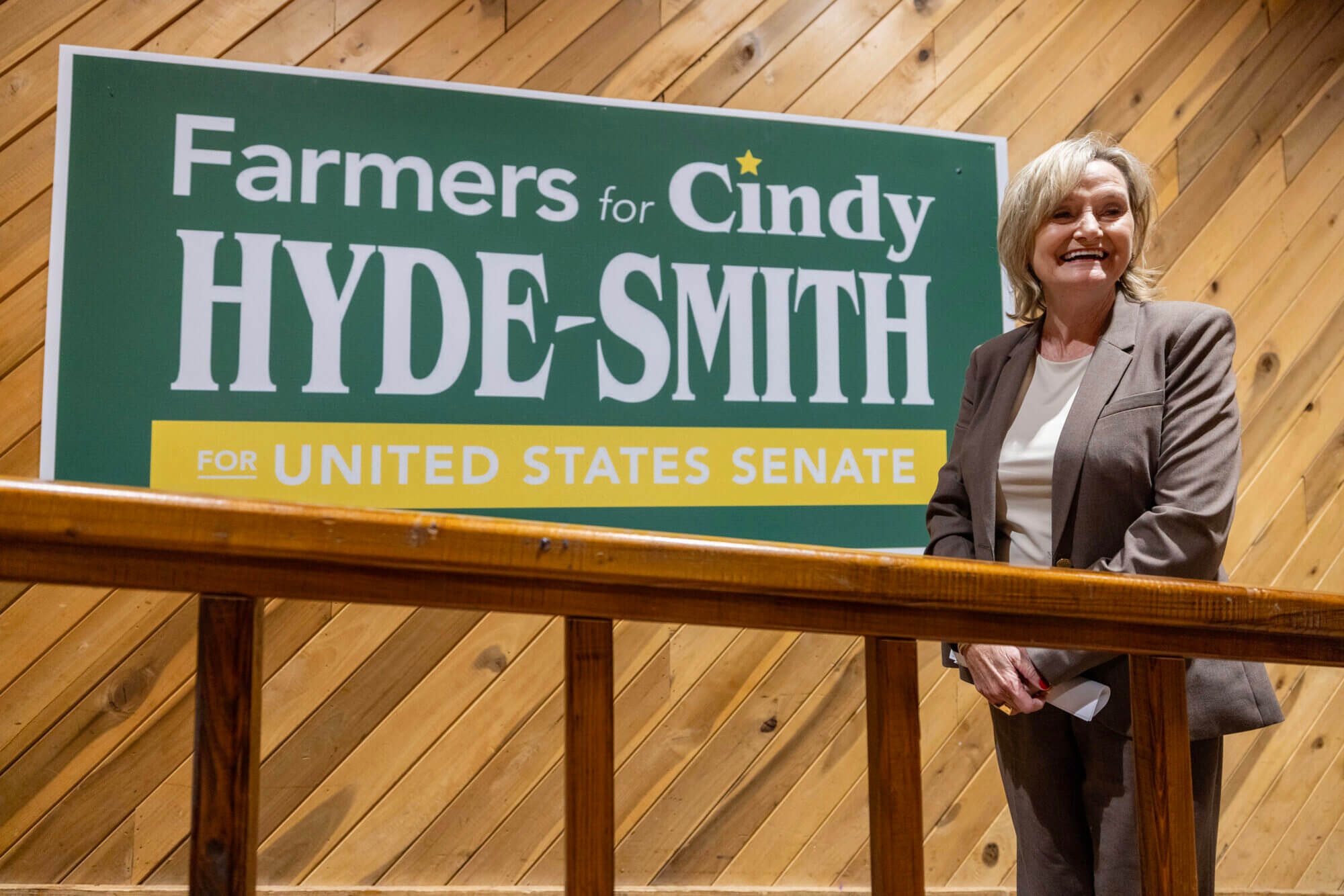
The Trump plan brought rare, if mild, dissention from Republican U.S. Sen. Cindy Hyde-Smith of Mississippi, one of Trump’s staunchest allies who has generally supported Trump’s trade policies. She and her husband are cattle farmers.
Trump recently posted on social media that over the next 90 days he will allow up to 300,000 metric tons of beef to be imported into the U.S with lower tariffs in an effort to bring consumer prices down. According to reporting from Bloomberg and the New York Times, the president is expected to sign an executive order removing the tariffs in the next few weeks. Trump has said he has struck a deal for foreign importers to sell the beef at 25% below current market prices.
Additional beef imports would happen ahead of the November midterm elections, as politicians focus on high consumer costs.
The cattle industry is an important part of Mississippi’s economy, and beef is one of the state’s top five agricultural commodities. It had about a $640-million production value last year according to Josh Maples, an agricultural economist at Mississippi State University Extension Service.
Maples said the state has over 14,000 cattle farms and most are small farms with about 30 head of cattle each.
“There’s a lot of people involved. Even more so than some other crops or commodities you might think about. They may have a higher value of production but fewer total people involved,” Maples said.
Smaller herds, rising costs
The American cattle herd has been shrinking and is at a 75-year low, in part because of continued droughts and rising operating costs. Maples said that producers were unprofitable for many years and chose to sell their cows for meat instead of expanding their herds, a lengthier process that involves predicting where the market might be in a few years.
Constrained supply and strong consumer demand has resulted in sky-high prices.
In July, ground beef was $6.89 per pound according to data from the Federal Reserve Bank of St. Louis, nearly double what it was 10 years ago and up 10% from July of last year. In his post, Trump wrote that the imported beef will be sold at 25% below current market price.
Agriculture groups warn that while the infusion of cheaper, imported beef could lower consumer prices, it could prevent the U.S. from rebuilding its herd.
“Higher production costs combined with downward pressure on cattle prices will not encourage producers to retain heifers, expand their herds or invest in additional cattle production,” the Mississippi Cattlemen’s Association wrote.
Maples said the lack of details available right now is causing uncertainty and market volatility which could impact what producers do as they decide whether to sell their heifers or keep them to build up their herds.
“It doesn’t give detail about where they would come from and in particular, what matters is, are these additional imports that we weren’t going to get or is it the same beef just coming in at a lower tariff,” Maples said of Trump’s Truth Social post announcing the lower tariffs.
This is already a big year for imported beef, but whether the 300,000 metric tons are included in already expected imports or will be new would determine how much of a shock the imports would cause market. Mississippi producers say that even a small amount could have a significant impact on their bottom line.
The Cattlemen’s Association said producers and consumers need “certainty and a fair marketplace — not government actions that create additional volatility and downward pressure on cattle prices.”
Mississippi politicians weigh in
Livestock is one of Mississippi’s most valuable agricultural commodities. The state’s cattle industry was valued at over $700 million in 2025 according to the Mississippi State University Extension Service. Mississippi politicians took to social media to voice their support for American beef.
Hyde Smith, who serves on the Senate Agriculture Committee, said in a post on social media that she had been to the White House to express concerns about the impact of cheaper imports on farmers. She said she would “promote policies that help farmers and ranchers grow our domestic herd without leaning on foreign beef to paper over the problem.”
Scott Colom, a Democrat challenging Hyde-Smith in the November midterm election, has said she is doing too little to help Mississippi beef producers. “Cindy Hyde-Smith gave away Mississippi’s voice on tariffs,” Colom said.
Statewide officials including state Agriculture Commissioner and gubernatorial candidate Andy Gipson and Lt. Gov. Delbert Hosemann, a potential gubernatorial candidate, posted on social media that the focus should be on lowering costs and supporting U.S. beef producers.
“We need to double down on supporting and buying American beef, not foreign imports,” Gipson wrote on social media.
Hosemann wrote: “Importing more foreign beef at a lower rate is not the way to significantly lower prices for Mississippi families.”
Hyde-Smith and other Mississippi Republicans did not refer to Trump in their posts nor did they directly mention tariffs. But for Hyde-Smith this represents a rare, if tepid, break from the president.
In a February interview, when asked about what Republicans would do to get rising beef prices down, Hyde-Smith said that lower fuel prices at the time could help lower overall costs.
“You have so many proteins to choose from and all commodities go through peaks and valleys,” Hyde-Smith said. “You know it is a global market, but we will be seeing a difference, I truly believe, because of so many things.”
But the U.S. war with Iran has caused fuel and fertilizer costs to increase.
Rural Mississippi has the third highest rate of using texting services for mental health support in the nation, according to a new report by the crisis intervention nonprofit, Crisis Text Line.
The report is based on nearly 2 million text conversations across the nation from 2019 to 2024, at Crisis Text Line’s 741741 number. In Mississippi, 53% of people contacting the line resided in a rural county. Only Wyoming and Vermont had more rural texters.
Crisis Text Line hopes this report will add to the conversation around what people from rural communities need to support their mental well-being, said Tracy Costigan, vice president of impact evaluation and storytelling. She pointed to data on coping strategies as a potentially actionable area.
The most common topics of discussion among texters, who were mostly under age 25 and female, were depression and sadness. When it came to coping with these feelings, texters said they sought more social connection and opportunities for making art, such as writing, painting, theater or music.
“ One of the things that we find ourselves talking to policymakers about and community leaders about is, what will it take to get the funding in place, the infrastructure in place, to set up programs and spaces for people to connect socially,” Costigan told Mississippi Today.
Phaedre Cole, president of the Mississippi Association of Community Mental Health Centers, has seen texting and call lines bring more people into spaces where they can get help with their mental health.
“Crisis lines level the playing field, so to speak, with regard to rural pockets of the state,” Cole said.
While urban centers have more access points to mental healthcare, such as hospitals, psychiatric centers and public transportation, rural Mississippians often lack these resources, she said. Even if someone seeking care has means of transportation, the cost of gas can make continual trips to the closest treatment center prohibitive.
Text lines also provide more anonymity in small communities where someone may be afraid to be recognized in a mental health clinic, Cole told Mississippi Today.
“From most of the people who walk through our doors, it took months, and in some cases, years of anguish before they got the courage to pick up that phone,” she said. “So the crisis lines are really kind of unique and special in that you don’t even have to identify yourself.”
In Mississippi, if staff at the crisis centers in Jackson and Columbus aren’t able to answer a call or text to 988, the suicide and crisis lifeline, Crisis Text Line serves as a backup. Both are 24/7 services in English and Spanish that connect people seeking help with a licensed staff member. For 988 calls and texts, the contact gets first picked up in-state.
Mississippi has one of the highest answer rates for 988 calls in the nation, with 98% of the nearly 17,700 calls answered in the 2025 fiscal year, said Brenda Patterson, executive director of Mississippi’s CONTACT the Crisis Line. If needed, her staff can connect Mississippians to their local community mental health centers, a mobile crisis unit for immediate help or other resources for follow up.
Like Cole, Patterson pointed to the anonymity of crisis calls and text messages being a motivating factor for its use.
”While the national number and some helplines record calls, we in Mississippi do not record our calls, and I think that makes people feel a little bit easier about reaching out,” she said.
The usage of chats and texts has been increasing, Mississippi Department of Mental Health Executive Director Wendy Bailey wrote in a statement to Mississippi Today. She shared that there was a 140% increase in the usage of this service from fiscal year 2025 to 2026, with nearly 6,000 chats in the past fiscal year.
With transportation challenges and a lack of behavioral health workers in rural Mississippi, the standard model of sending people to a provider’s office isn’t sufficient, she told Mississippi Today.
“The goal is to make sure that when someone needs help right now, there is a trained person there to answer, listen, provide support, and connect that individual to the next level of care,” she wrote. “In a rural state like Mississippi, that accessibility can make a tremendous difference.”
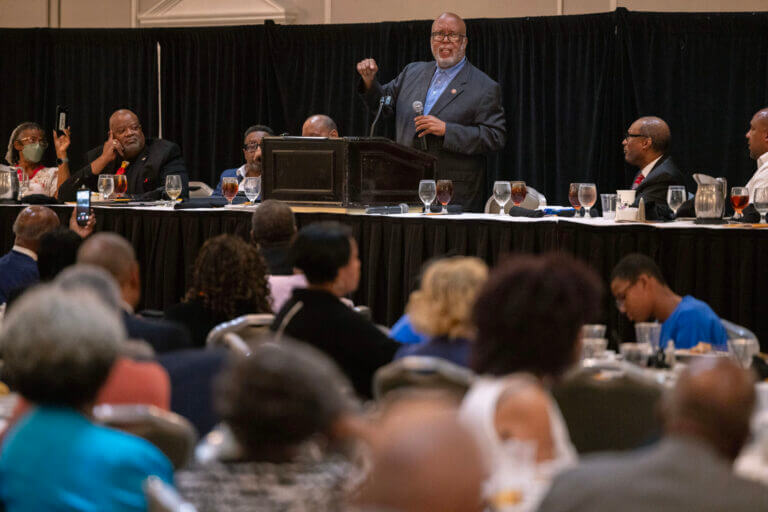
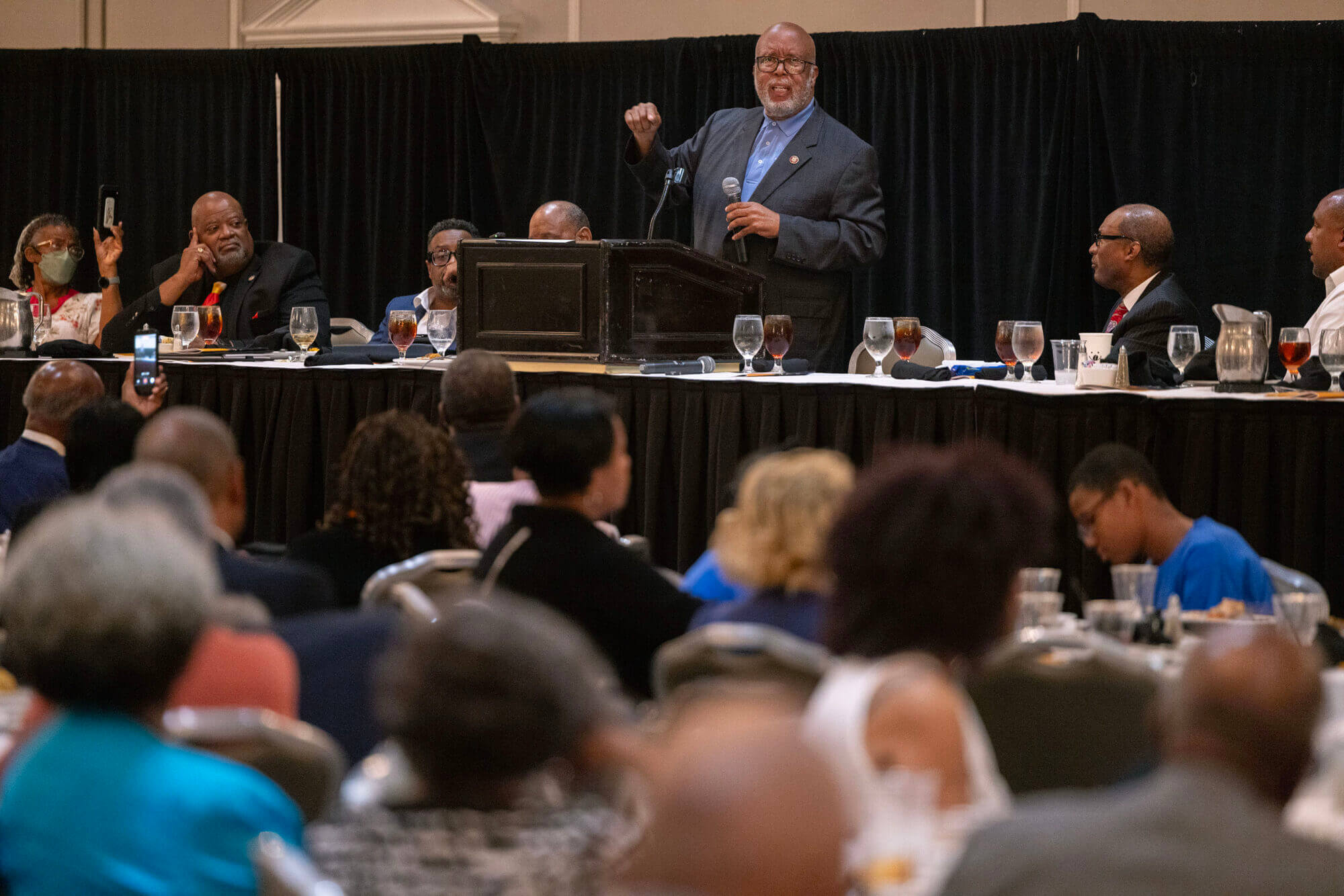
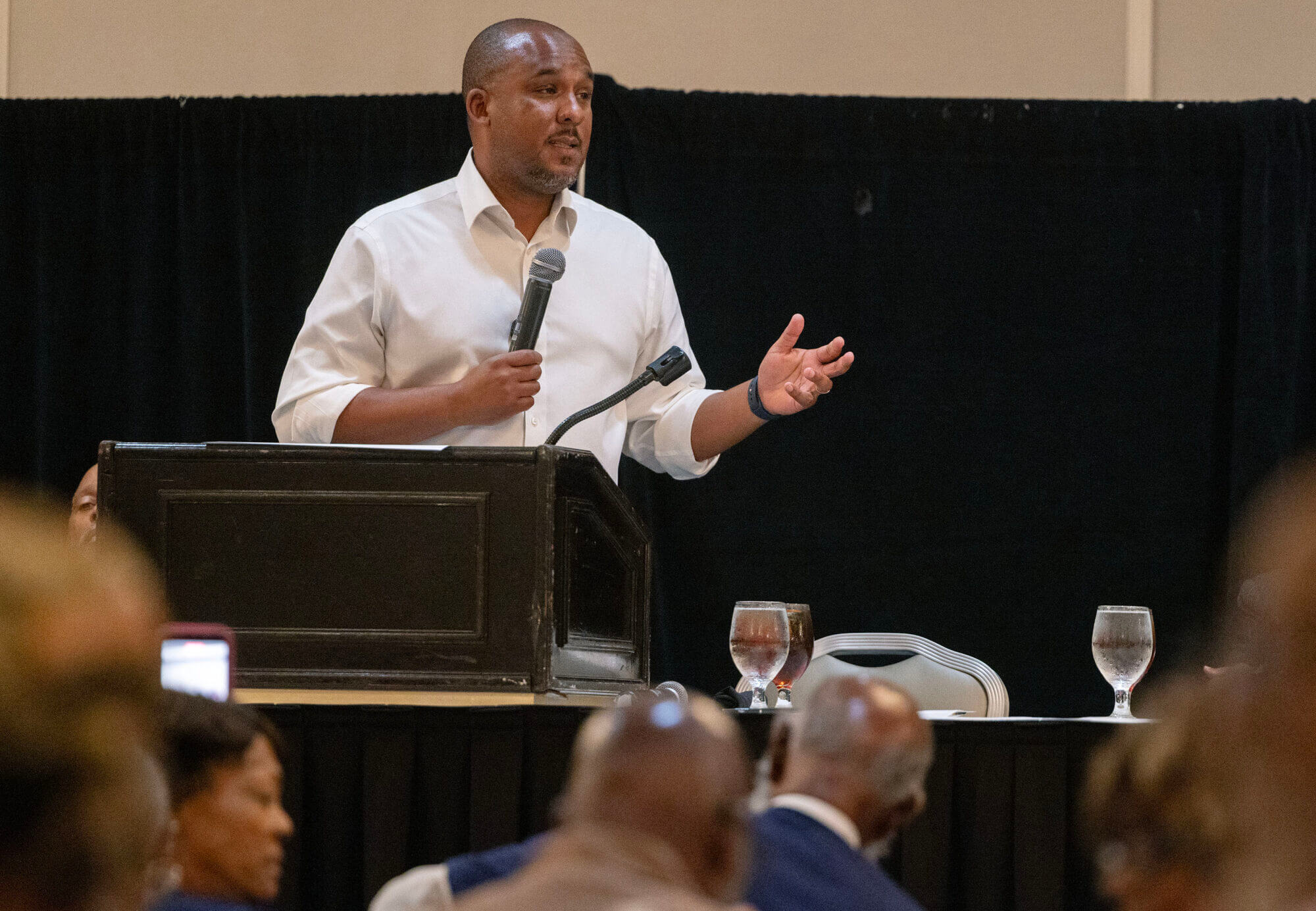
U.S. Rep. Bennie Thompson and Democratic U.S. Senate candidate Scott Colom on Tuesday called for Black Mississippi voters to turn out in November’s midterm elections to fight back against President Donald Trump’s agenda and an expected effort from state leaders to redraw electoral maps in Republicans’ favor.
At a “Power in the Pews” luncheon in Jackson organized by the NAACP, the candidates spoke to a packed room at the Hilton Jackson filled with hundreds of attendees alongside faith leaders, political organizers and Democratic officials.
Churches have long been an engine of political organizing for Black voters in Mississippi and across the Deep South. NAACP workers at the event handed out informational packets on voter engagement and urged attendees to consult their local churches for information on how to get involved. Thompson called such efforts a blueprint for turning out Black voters in Mississippi.
Thompson and Colom warned about what they said were threats to voting rights and Black representation posed by Trump and Republican state officials. Colom, who is gearing up for the final stages of a general election campaign against incumbent Republican Sen. Cindy Hyde-Smith, also took the opportunity to sharpen his closing attacks on Mississippi’s junior senator, whom he labeled “Cindy High Prices.”
“Our junior senator cares more about what her MAGA daddy says than what’s best for Mississippi,” Colom said.
Democratic nominee for the U.S. Senate Scott Colom speaks at the “Power in the Pews” faith leadership luncheon Tuesday, Aug. 25, 2026, at the Hilton Jackson. Credit: Eric Shelton/Mississippi Today
Colom, who also faces independent Ty Pinkins in the general election, criticized Hyde-Smith for voting for the “Big Beautiful Bill” act and supporting President Trump’s tariffs, which he has said raised prices of consumer goods across the economy. He also accused Hyde-Smith of using political donations for personal travel, such as billing trips to Las Vegas to her campaign account.
“Not only is she allowing the corruption, not only is she remaining silent, she’s partaking in it,” Colom said.
In a statement, Jake Monssen, Hyde-Smith’s campaign manager, disputed Colom’s remarks.
“Scott Colom started lying to voters about Sen. Hyde-Smith on the very first day of his campaign,” Monssen said. “We shouldn’t be surprised to see him double down on that tactic.”
Thompson, the only Democrat and only Black member of Mississippi’s congressional delegation, noted the size of the crowd that came out on a Tuesday afternoon. The turnout could be traced to Trump’s unique ability to unite Black voters in opposition, he said.
“Now let me tell you what’s making this happen. It’s that fella in the White House,” Thompson said. “This man has done more to get Black folks together in America than Martin Luther King could have ever done”
If Democrats reclaim a majority in the U.S. House this November, six Black members could become committee chairmen, Thompson told the crowd.
“There’s nothing like being in the room, in charge,” he added.
Thompson faces Republican Ron Eller and independent Bennie Foster this November.
Since the U.S. Supreme Court’s decision in the Louisiana Callais redistricting case in May, which weakened the Voting Rights Act, Thompson has been the target of calls from Gov. Tate Reeves and Republican state legislators to redraw Mississippi’s electoral maps.
A legislative joint committee is holding public hearings across the state, and the full Legislature is expected to convene in a special session this fall to redraw at least state legislative maps. That wouldn’t impact this November’s federal election, but Mississippi lawmakers are likely to target Thompson’s seat with redistricting before he’s up for reelection again in 2028.
Colom called the Callais decision “a threat to our democracy” the country hasn’t seen in decades.
“(Gov. Tate Reeves) is going to try to draw lines that prevent the people in this room from being able to pick leaders they want. He wants to pick your leaders for y’all,” Colom said. “He doesn’t want Cindy High Prices to have to compete for votes, because they won’t to have to answer for these terrible policies.”
Charles Taylor, Mississippi’s NAACP executive director, said his organization has been meeting with Black circuit clerks and election commissioners to discuss “election security” and that organizers will “turn out Black folks in droves.”
“The eyes of the country have been on Mississippi this year, and it’s because of the work we’ve been doing day in and day out,” Taylor said. “The election in November is crucially important because it has been a long time since they have tried to roll back our rights like this.”
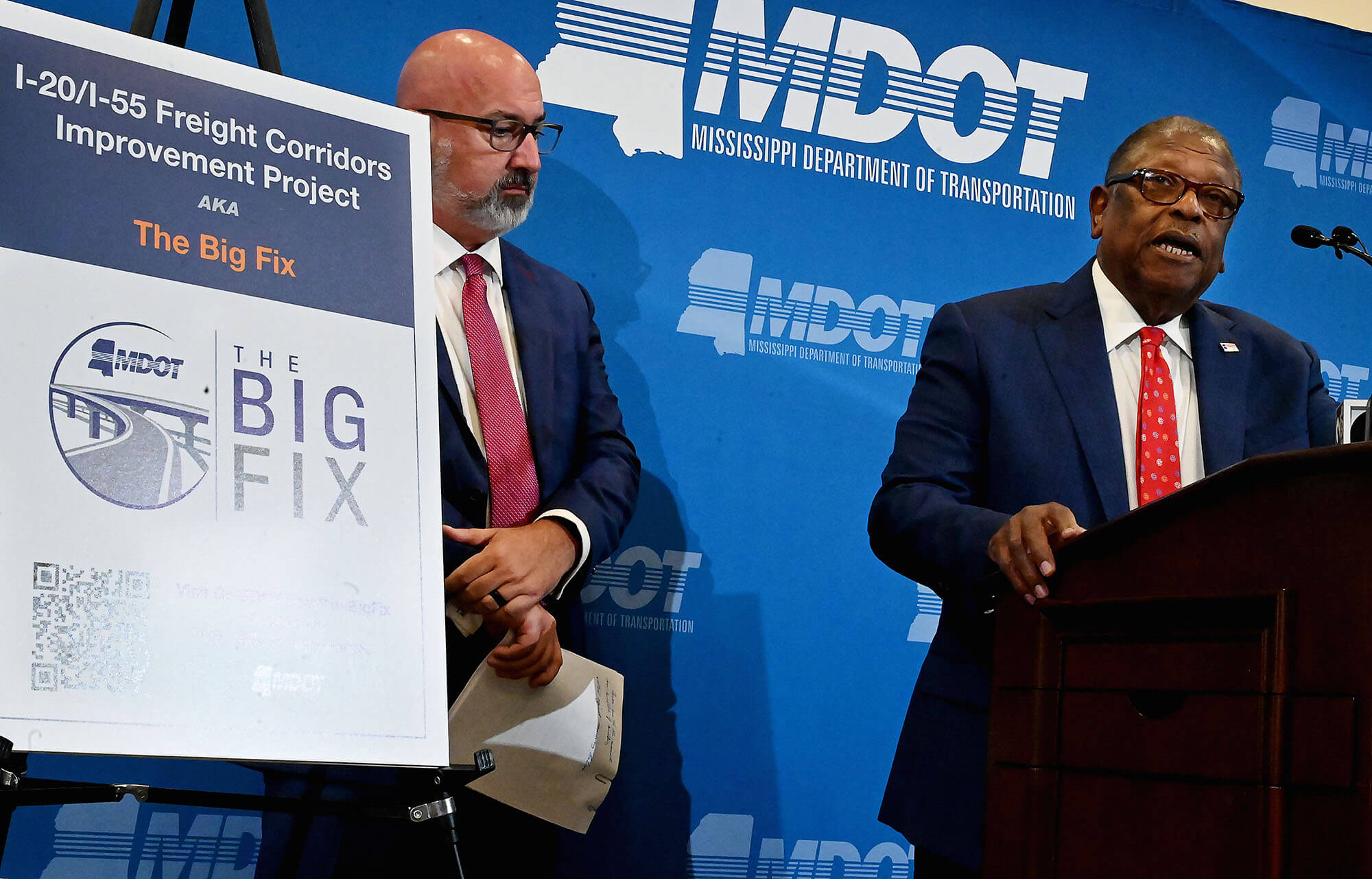
Leaders at the Mississippi Department of Transportation announced Tuesday that some of Mississippi’s busiest roadways will undergo major renovations over the next two-and-a-half years as part of a $400-million project.
Called the “Big Fix,” the project will improve roads and bridges on Interstate 20, which runs east-west, and Interstate 55, which runs north-south, in Hinds and Rankin counties. The project, funded with federal and state dollars, will rehabilitate 36 bridges, resurface 32 miles of roadway and deploy new technology to make travel safer.
Willie Simmons, Central District transportation commissioner, said at a press conference that when the interstate system was constructed in the 1950s and 1960s, it met all engineering and safety standards at the time. But since then, vehicles have grown larger and traffic has increased.
“Updating this infrastructure today isn’t about correcting the past,” Simmons said. “It’s about keeping pace with today’s demands and tomorrow’s needs.”
The project along I-20 will span from Wiggins Road in Jackson to just east of the Pearson Road interchange in Pearl. The project will also run along I-55 from McDowell Road to north of the High Street interchange in Jackson.
Construction will start next month and is scheduled to conclude toward the end of 2028. Most road closures are expected to occur at night and on weekends to minimize traffic disruption.
Two full interstate closures on I-20 in each direction will occur: one in 2027 and another in 2028. The westbound lane will be shut down for 45 days during the summer of 2027, and the eastbound lane will be shut down for 45 days in the summer of 2028.
Explanation of the Mississippi Department of Transportation’s $400-million renovation of I-55 and I-20 is presented on Tuesday, Aug. 25, 2026, at MDOT headquarters in Jackson. Credit: Vickie D. King/Mississippi Today
Agency leaders said about 110,000 vehicles travel in this area each day, so the agency has worked with local elected officials, emergency services and industry leaders for years to plan safe alternate routes.
Detour routes have not yet been announced but will be posted on the agency’s website as the road closures approach.
Brad White, executive director of MDOT, said the agency decided to renovate the longer stretch of road at one time instead of targeting portions of road piecemeal to save taxpayers money in the long term and reduce the disruption to drivers.
“By doing the project this way, you’re turning a project that otherwise would have taken decades to be built into one that could be done within a two-and-a-half-year time,” White said.
The public can visit GoMDOT.com/TheBigFix for more information and updates about the project.
CANTON — Fees from new data centers in Madison County could generate millions of dollars for area public schools starting in January.
Canton and Madison County schools officials say they plan to earmark the money for building improvements and investing in career and technical education. County leaders say the money could be “transformational,” allowing the schools to update their campuses, attract quality educators and offer innovative courses to students.
That transformation is happening amid concerns about traffic and pollution around the data centers, and their water and energy use.
Amazon aims to build 34 data centers in Madison County over the next two years, said Joey Deason, executive director of the Madison County Economic Development Authority. Five are operating and another five are expected to go online this year. The $25 billion project is the biggest capital investment in the state’s history.
To incentivize Amazon to bring the project to Mississippi, state leaders and county officials worked out a deal for the company to pay discounted fees — a third of what they’d typically owe in property taxes — for the first 10 years of each data centers’ operations over a 30-year term.
Starting in January, Amazon will start paying fees for the first five centers, which are located in Canton. Half of the money — about $14 million — would go toward paying off a loan the county took out to improve infrastructure around the data center project. The other half would be split between community colleges, the city of Ridgeland, Madison County and the county’s public schools.
And as more data centers crop up around the country and in Mississippi, additional school districts could receive more money from fees data center owners have to pay.
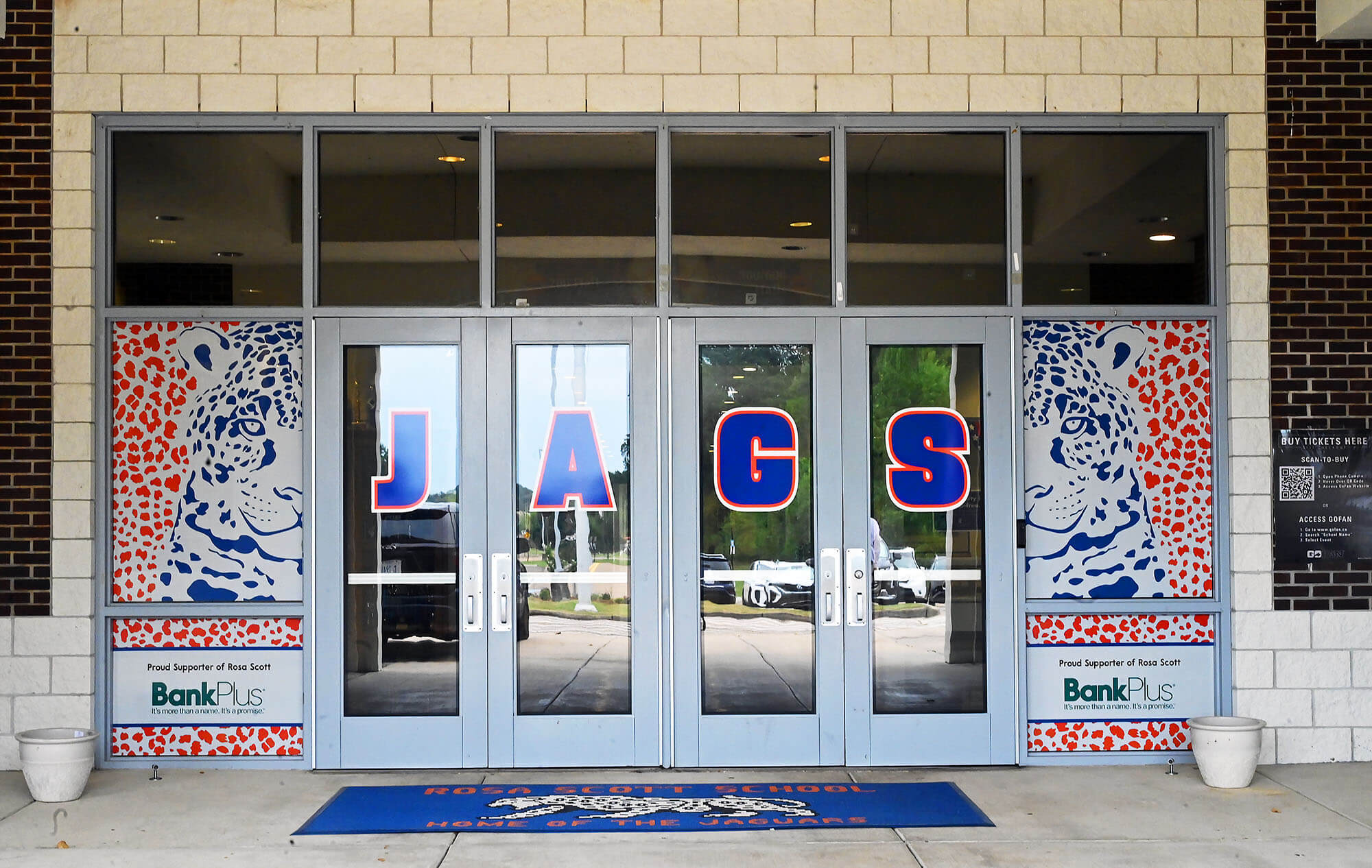
The Jaguar mascot graphic at the front entrance of Rosa Scott High School, located at 929 Poore’s Pass in Madison, Monday, Aug. 24, 2026. Madison County Schools and the Canton district anticipate getting millions of dollars from data centers operating in the county. Credit: Vickie D. King/Mississippi Today
The county tax collector will give Amazon’s fees to the county board of supervisors, who will then give Canton Public School District its share. The district is projected to receive over $7 million in a lump sum during the first quarter of 2027. The annual payments steadily increase to $17 million in 2029.
Once the fee agreement ends, Amazon will pay full property taxes for each of their data centers. By 2038, Canton schools could receive upwards of $35 million annually. That’s about half of the district’s budget for the current school year.
Similarly, Madison County Schools is projected to receive a $7 million annual payment during the first quarter of 2028. The district is getting its share a year later because the Ridgeland data centers began operating a year after Canton’s. The district’s allotment could go up to an annual $33 million payment by 2039. For context, Madison County school district officials approved a $204 million budget this year.
“These schools have got an opportunity that they’ve never had before to think outside of the box,” Deason said.
The amount of money the school districts will receive is not yet certain. Amazon Web Services recently challenged the Madison County tax assessor’s valuation of its five data centers in Canton claiming that the county’s assessment is too high, which could result in millions of dollars less for county government and schools. The tax assessor valued each data center at $292 million, but Amazon said each building is only worth $69 million. The Madison County Board of Supervisors upheld the tax assessor’s valuation, but the company could appeal the decision to the courts and could challenge the valuation again in coming years.
Investing in CTE, teachers, buildings
Austin Brown, Madison County Schools’ new superintendent as of July 1, saw the projections for how much money the data centers would bring into his district on his first day.
“I said, ‘I think I’m gonna retire,’” he recalled. “My day couldn’t get any better, you know? What a blessing.”
Brown said he can’t make promises about how the district will spend the money, but he knows where he’d like to start.
District leadership is interested in increasing teacher salaries. The state is facing a teacher shortage, and increasing the district’s local supplement could help Madison County Schools stay competitive, Brown said.
Schools in other states have used money from local data centers to boost teacher pay.
Madison County Schools is also renovating several buildings. Brown said he’d like to use the money to continue those efforts.
“What you’re seeing is basically the first phase of dedicated, intentional upgrades of our facilities,” he said.
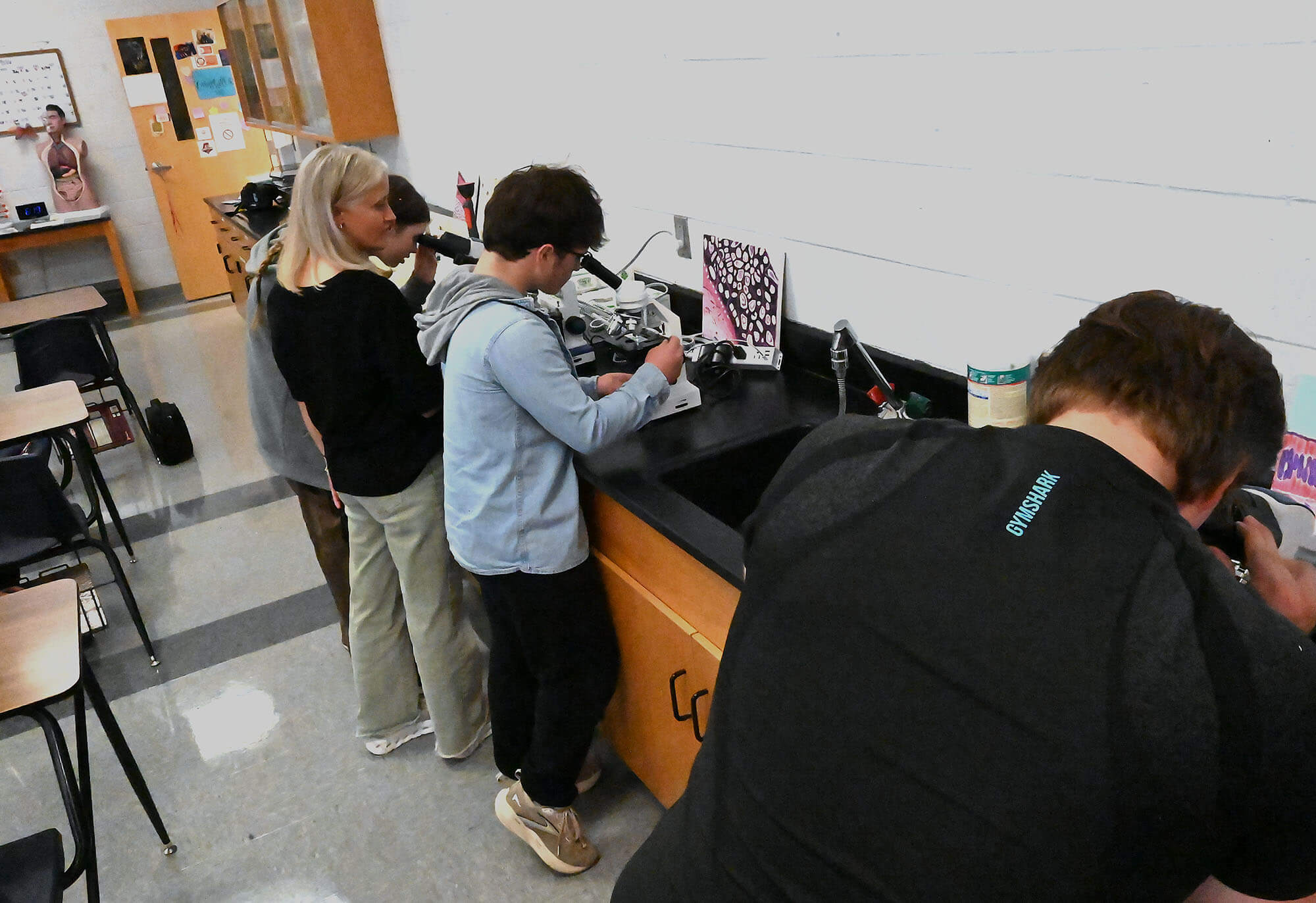
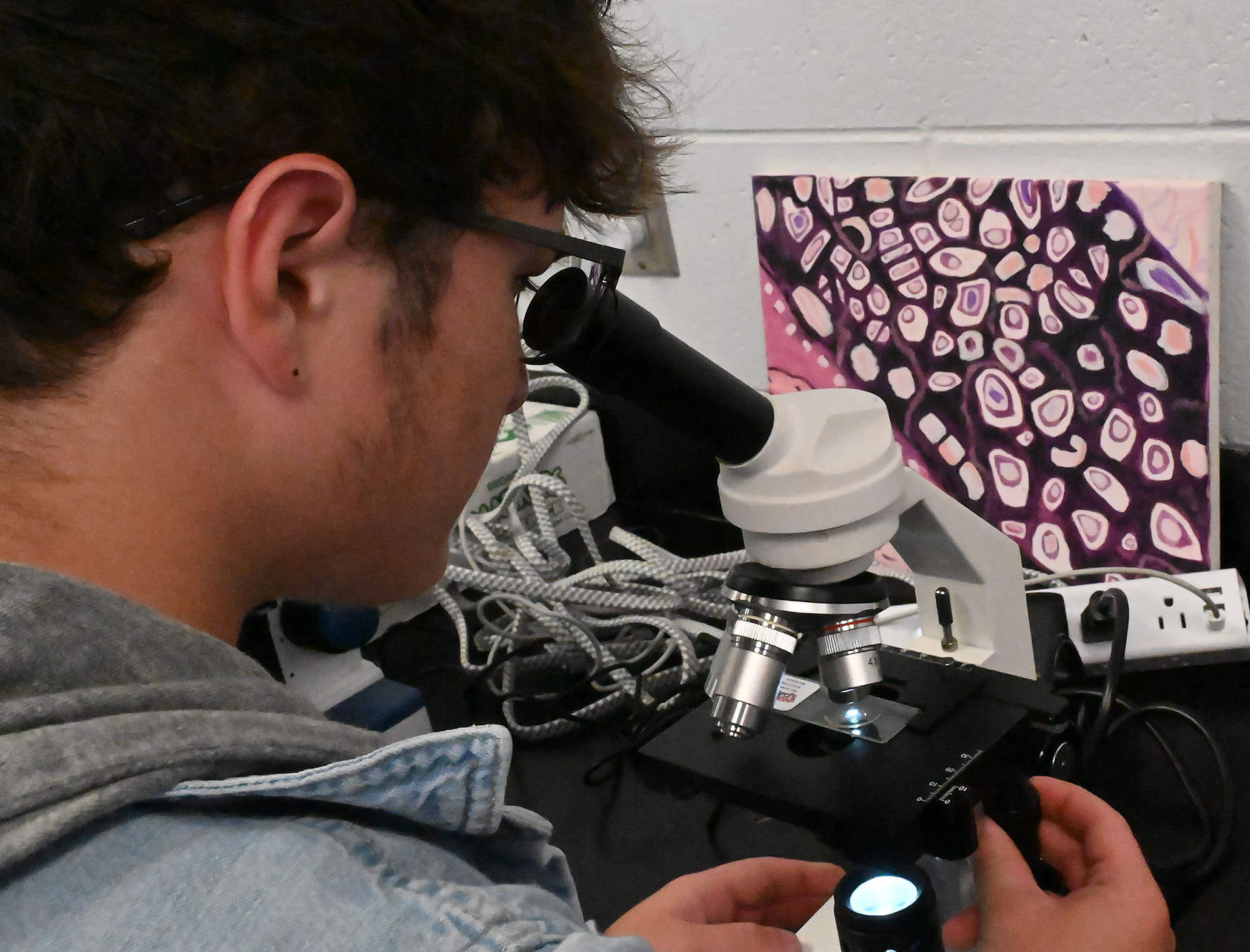
A ninth grade student views organisms through a microscope in Principles of Biomedical Science class at Rosa Scott High School, Monday, Aug. 24, 2026, in Madison. Credit: Vickie D. King/Mississippi Today
A substantial amount of the money could go toward a new career and technical education building.
“Ultimately, we are going to use it in a way that will provide the right kind of experiences for our students to prepare them for what’s next,” Brown said. “There are no limitations on what we can do.”
Canton’s interim superintendent, Dwight Luckett, has similar plans. Luckett, despite his temporary position, has created a five-year strategic plan that hints at his priorities for the money: Recruiting highly trained teachers, boosting student achievement, focusing on career and technical education and providing students with state-of-the-art facilities.
He said the district’s central office, for example, is at least 80 years old and needs to be upgraded. Luckett also said district leaders might consider raising teacher pay the next school year and paying off debts they’ve accumulated.
“Those dollars will definitely, first and foremost, be used in the classroom,” he said. Luckett previously served as the district’s superintendent from 2006 until 2014. “There is also a tremendous need for some capital improvements.”
Luckett said he’d also like to see the dollars go toward creating classes focused on science, technology, engineering and math — or STEM.
His interest in career and technical education is in line with a push from the Mississippi Department of Education and state lawmakers to better prepare students for the workforce and bolster the state’s economy.
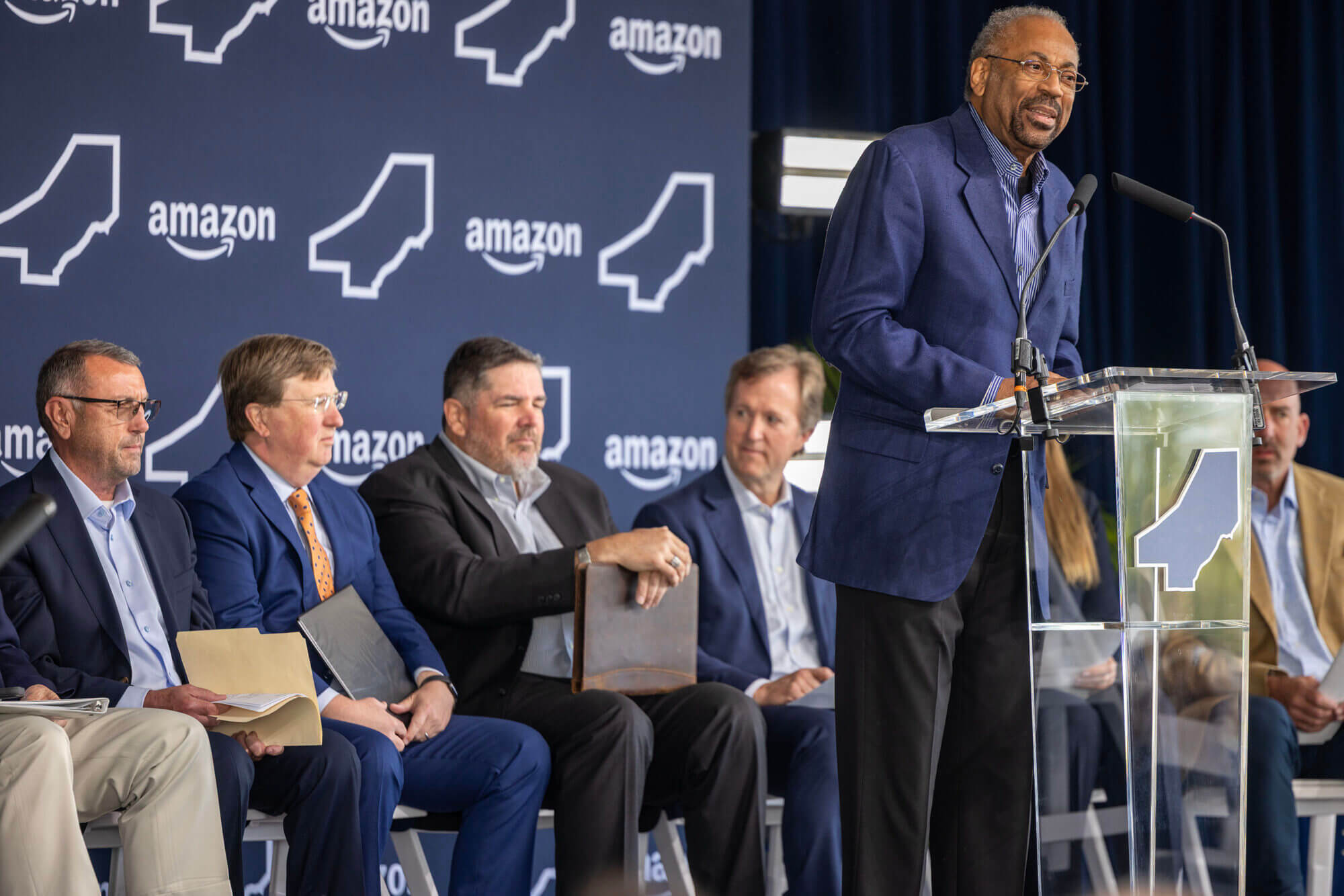
Dwight Luckett, superintendent of the Canton Public School District, speaks during an announcement about an Amazon data center in Ridgeland on Thursday, April 9, 2026. Credit: Eric Shelton/Mississippi Today
“I’d like to see … additional teachers,” Luckett said. “So putting money around those that can come in and really help get us our own program … That’s really good for workforce development.”
Data center tradeoffs
Sen. Bradford Blackmon, a Democrat from Canton, said the infusion of money could be impactful to a district like Canton.
“You just have to take the good with the bad because it’s there,” he said. “It’s not going anywhere at the moment or anytime soon.”
Deason said construction at the site stirs up dust. The construction will eventually end, but meanwhile, Amazon and the Madison County Economic Development Authority offered to pay for car washes, humidifiers and house cleaners, Deason said.
“This is a part of growing, a part of getting bigger,” Deason said. “It is what it is.”
Blackmon hopes that despite residents’ concerns, the money could help Canton schools retain teachers, attract talent and offer more to their students.
“School districts drive communities,” he said. “If the district is good, people would think about making this their home. This type of money is transformational for Canton.”
Economic development reporter Katherine Lin contributed to this report.