Mississippi lawmakers are expected to debate taxes and regulations around lithium in the 2027 legislative session, determining whether the state becomes a major producer of the mineral critical to battery production.
The Mississippi Development Authority published a report in May arguing Mississippi has the potential to engage in large-scale lithium production, but lawmakers have yet to decide taxes, incentives and environmental regulations for the companies that could develop the industry.
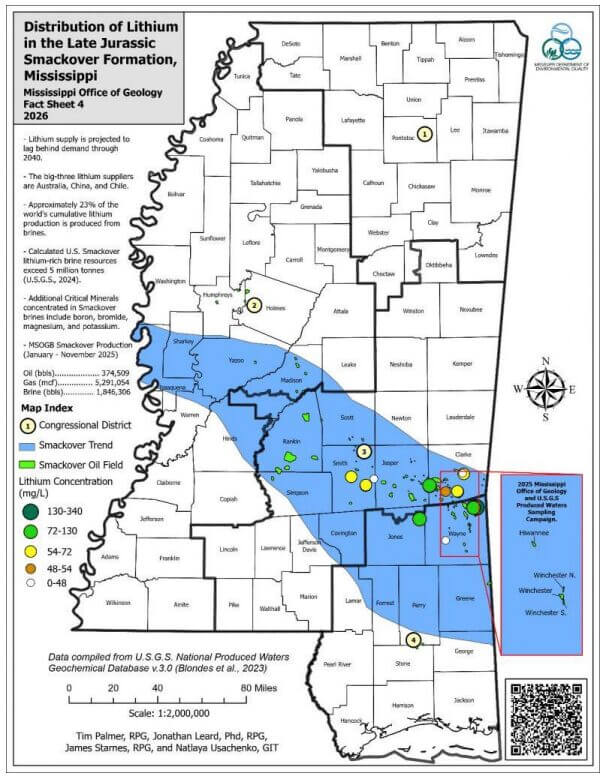
States that sit atop the Smackover Formation have recently begun to view the Jurassic limestone as a potential source of lithium. The Smackover Formation spans 20 counties from west-central Mississippi to the Southeast. Credit: Mississippi Development Authority
The state sits atop the Smackover Formation, a large swath of porous rock that contains mineral-rich solutions known as brines. Companies would pump mineral-rich brine from underground, remove the lithium using a process called direct lithium extraction, or DLE, and then return the remaining brine to the water table.
Tim Palmer, a geologist at the Mississippi Department of Environmental Quality, used coffee as a way to compare DLE with solar evaporation, a more traditional method of lithium production.
“I can take my coffee, I can run it through a system and it’ll concentrate the coffee — that’s what DLE does,” Palmer said. “Whereas (with evaporation) I’d have to take a bunch of coffee and impound it at the surface… and you have to wait for it to concentrate.”
Lithium — a key mineral in rechargeable batteries used for electric vehicles, consumer electronics and some military technologies — is labeled a critical mineral by the U.S. Department of the Interior. The majority of lithium used in the U.S. is shipped from overseas, largely from China, so domestic production is seen by state and federal leaders as both an economic boon and a matter of national security.
“This is really not only an economic opportunity for Mississippi, it’s an opportunity for Mississippi to help once again provide for our nation’s defense,” Gov. Tate Reeves said at an Aug. 5 news conference.
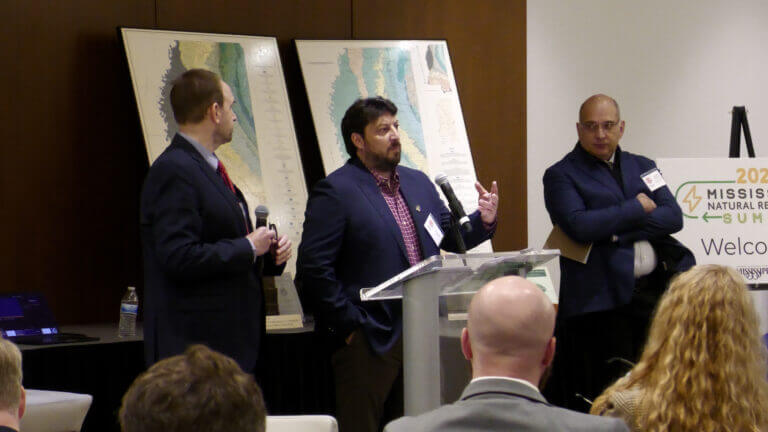
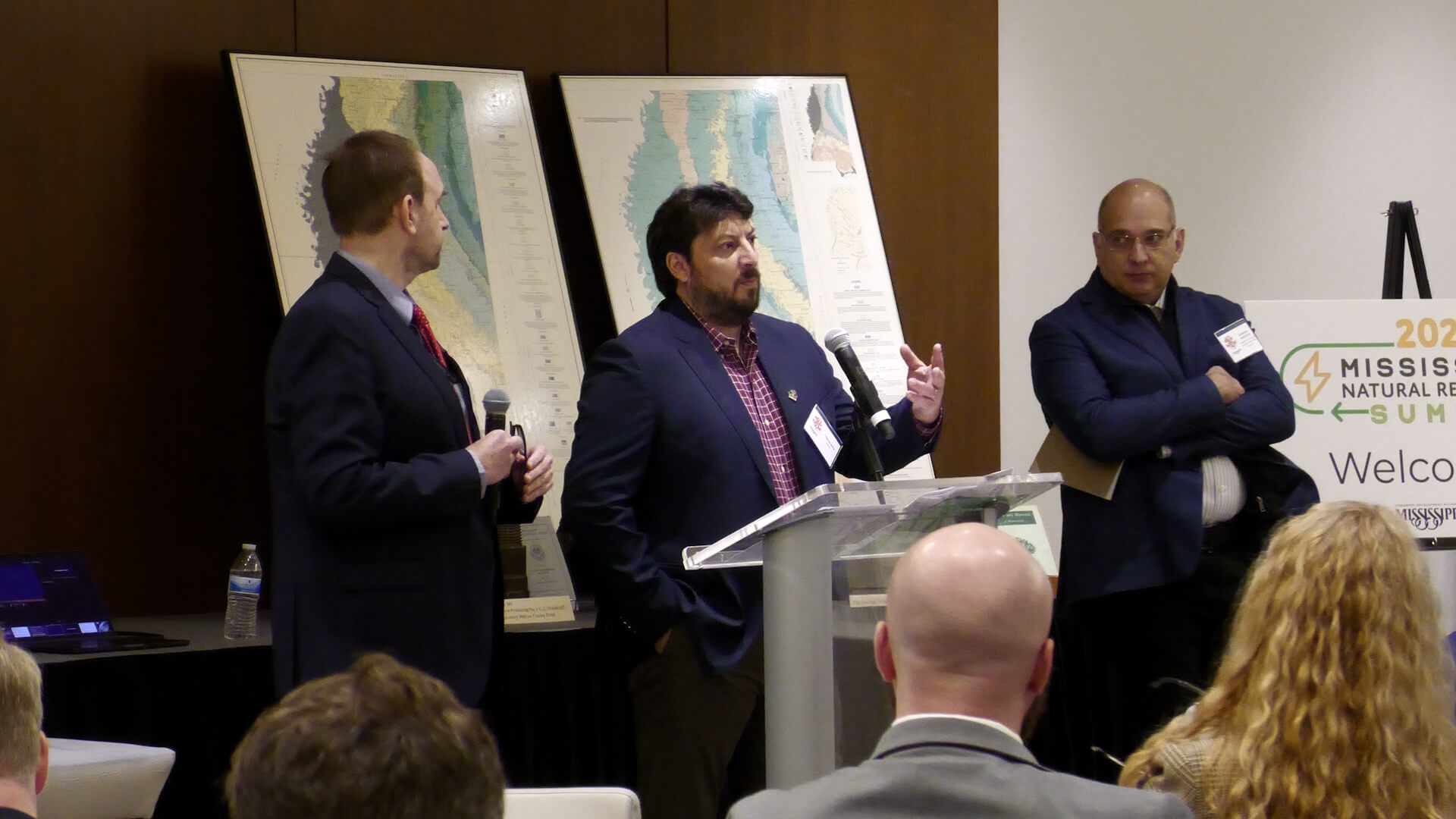
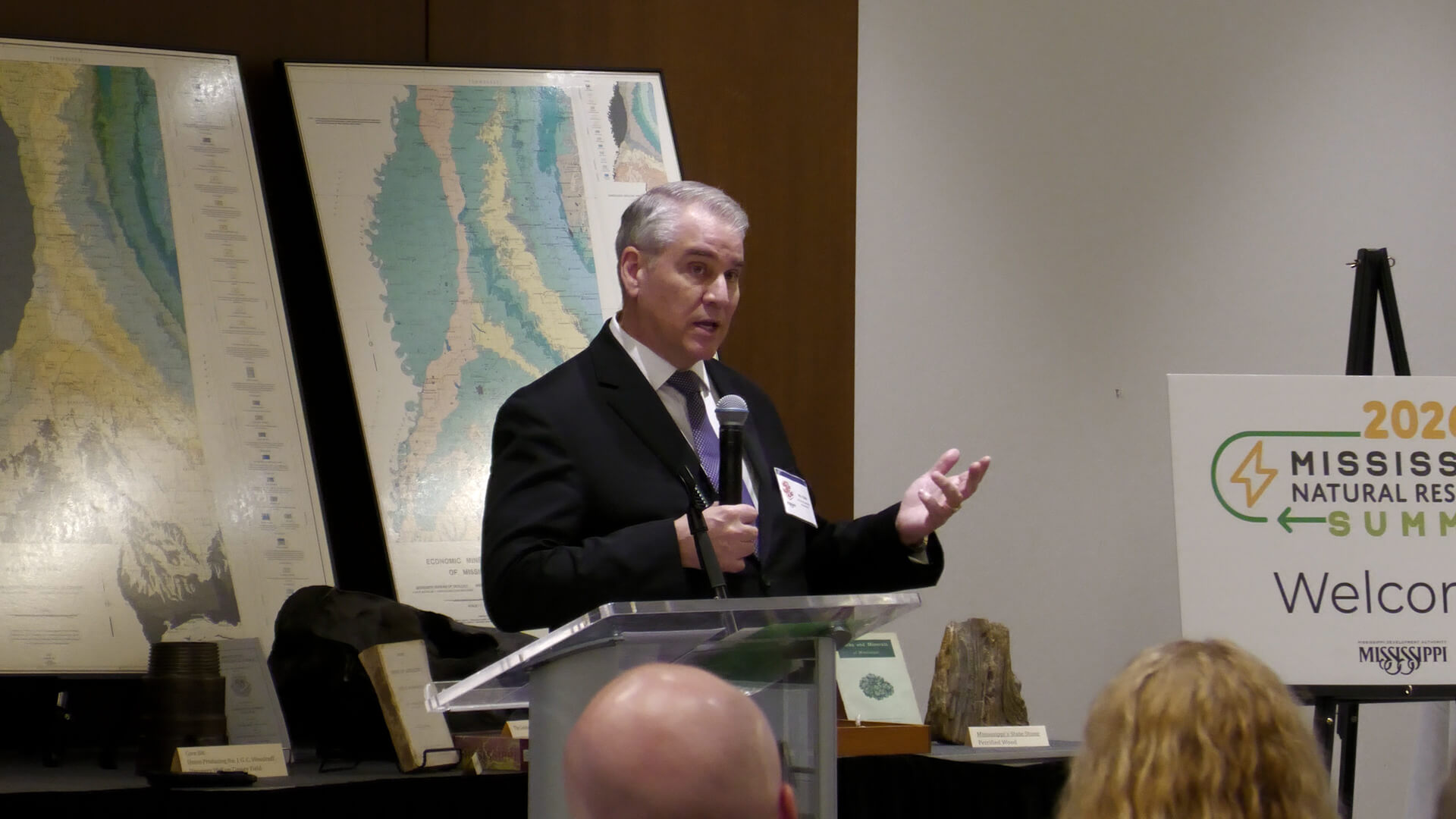
Domestically, lithium could serve as a large source of revenue. Mississippi Development Authority Executive Director Bill Cork told the crowd at the 2026 Mississippi Natural Resources Summit that lithium extraction’s potential economic benefits for the state should be a key part of the narrative that the project’s champions tell.
The Mississippi Development Authority said in a May report that lawmakers will need to write legislation to pave the way for a lithium industry in Mississippi. Its suggestions include reclassifying brine as a resource, imposing a severance tax on lithium and providing financial incentives for industrial partners, among others. Credit: Justin Glowacki/RHCJC
“Mississippi can make some money to help the real problems we have,” Cork said. “Things like intergenerational poverty, rural health care and a number of other things.”
Whether lithium production becomes more profitable in Mississippi will depend partly on market conditions and state policy.
With ongoing volatility in lithium prices, as well as high startup costs for DLE projects, the MDA suggests creating financial incentives to attract lithium companies. Among its proposals are a 2.5% royalty that scales down if prices decrease and a six-year holiday on severance taxes and royalties that companies pay to the state and county upon extraction for the industry’s pilot companies.
While potentially attracting industry, concerns around similar domestic lithium projects suggest that financial incentives for companies may increase the burden of risk that Mississippians bear. Groups critical of lithium extraction argue state legislators should consider severance taxes based on revenue to protect communities from the economic uncertainty around lithium as the industry develops.
Arkansas, which also sits atop the Smackover Formation, adopted a different tax model in 2025. The state does not have a distinct tax on lithium but taxes $2.75 per 1,000 barrels of saltwater or brine extracted, a tax model that does not scale with industry revenue. Critics there argue the relatively low tax rate leaves the state vulnerable if lithium prices decline.
While the Mississippi Development Authority recommended a scaled severance tax of 2.5% for lithium, Gov. Tate Reeves indicated at a Wednesday, Aug. 5, 2026, news conference that he would support no taxes on lithium. Advocates for severity taxes argue they offset the risk communities face if the lithium industry is unsuccessful. Credit: Gaven Wallace/RHCJC
Mississippi already levies severance taxes on resources such as oil, natural gas and timber, but state law does not establish one for lithium production.
Reeves indicated at a recent news conference that he wants no severance tax on lithium in Mississippi.
“I’m okay if we don’t tax it because I believe pretty strongly if you want more of something, you tax it less,” Reeves said. “I’m sure there will be a debate and discussion about specific severance taxes if and when the legislature comes in, but zero is okay with me.”
The environmental impact of lithium mining in the state also depends on legislative guidance. DLE is an umbrella term for several technologies that extract lithium and other metal ions directly from brine, greatly reducing land use, water use and carbon dioxide emissions compared with traditional extraction methods. However, researchers at Columbia University argue that more research is needed to determine how DLE affects freshwater resources.
Palmer said he expects Mississippi to use a variety of DLE processes, and the decision on which process to use would be left to industry partners.
“These decisions are made by industry because it’s all about economics, and so, Mississippi isn’t going to tell industry what process to use,” Palmer said. “These are very expensive things to do. … whatever is the most cost-effective process, that’s what’s going to be applied.”
Palmer said it is important to begin domestic lithium extraction now.
“Understanding (how to extract lithium) is a problem for 2026,” Palmer said. “But it’ll take 100 years if we don’t start trying to figure out how we actually take metals out of solutions.”
The Mississippi Development Authority indicated that clarifying laws, acquiring data and creating economic incentives for companies are the three major pillars for beginning lithium production in the state.
High school came with more responsibility and less accountability for Josiah Ulukita. Courses were much harder, teachers were less strict about attendance, and it was easier to skip school with friends or go on his phone during class, said 16-year-old Ulukita, who attends Kaimuki High School in Honolulu.
He went from easily passing middle school to failing freshman English and social studies. After missing roughly half of his freshman year due to poor attendance, he found out he needed to repeat ninth grade. Ashamed, he began to skip more school, he said — until his counselor warned him that he may not graduate on time.
“I was acing all my classes, and then I hit freshman year,” Ulukita said. “I thought it was going to be easy.”
Throughout the country, states and school districts approach retention — often considered a last resort to catch students up academically — in very different ways. In some states, like Hawaii, schools often wait until ninth grade or later to retain, or hold back, students. Other states, like Mississippi and Florida, tend to retain students at much younger ages, between kindergarten through third grade, according to numbers from 2021-22, the most recent year for which national data was available.
As concern about student performance nationally intensifies, a growing number of states are mandating this approach: More than two dozen states now have laws requiring or allowing schools to retain third grade students who are not reading at grade level, according to an analysis from the Education Commission of the States, a nonprofit that tracks state legislation in the U.S.
Despite these laws, the rate of students who were retained in school fell across the U.S. from the 2011-12 to 2021-22 school years, according to data from the federal Office for Civil Rights compiled by the journalism organization Big Local News in partnership with The Hechinger Report. Overall, very few students are held back each year: Less than 2 percent of students in the U.S. repeated a grade level in 2021-22, down from about 3 percent of students a decade prior. (The Office for Civil Rights, the only source for consistent data across all states, is now eight months behind in releasing new data.)
The research on retention is mixed — there’s little consensus on whether retention can catch students up to grade level. Historically, most studies indicated that students who had to repeat a grade often benefited very little and had long-term negative consequences. Research from the past decade complicates that picture: Younger students may see some positive effects from retention if schools are also combining it with high-intensity tutoring and support, some studies have shown.
“If the retention happens in earlier grades and is combined with help — not just a threat, but some kind of positive intervention — the results, at least in the short-run, tend to be good,” said Dan Goldhaber, director of the Center for Education Data and Research at the University of Washington.
There is less proof that students in middle and high school, like Ulukita, ultimately benefit from repeating a grade.
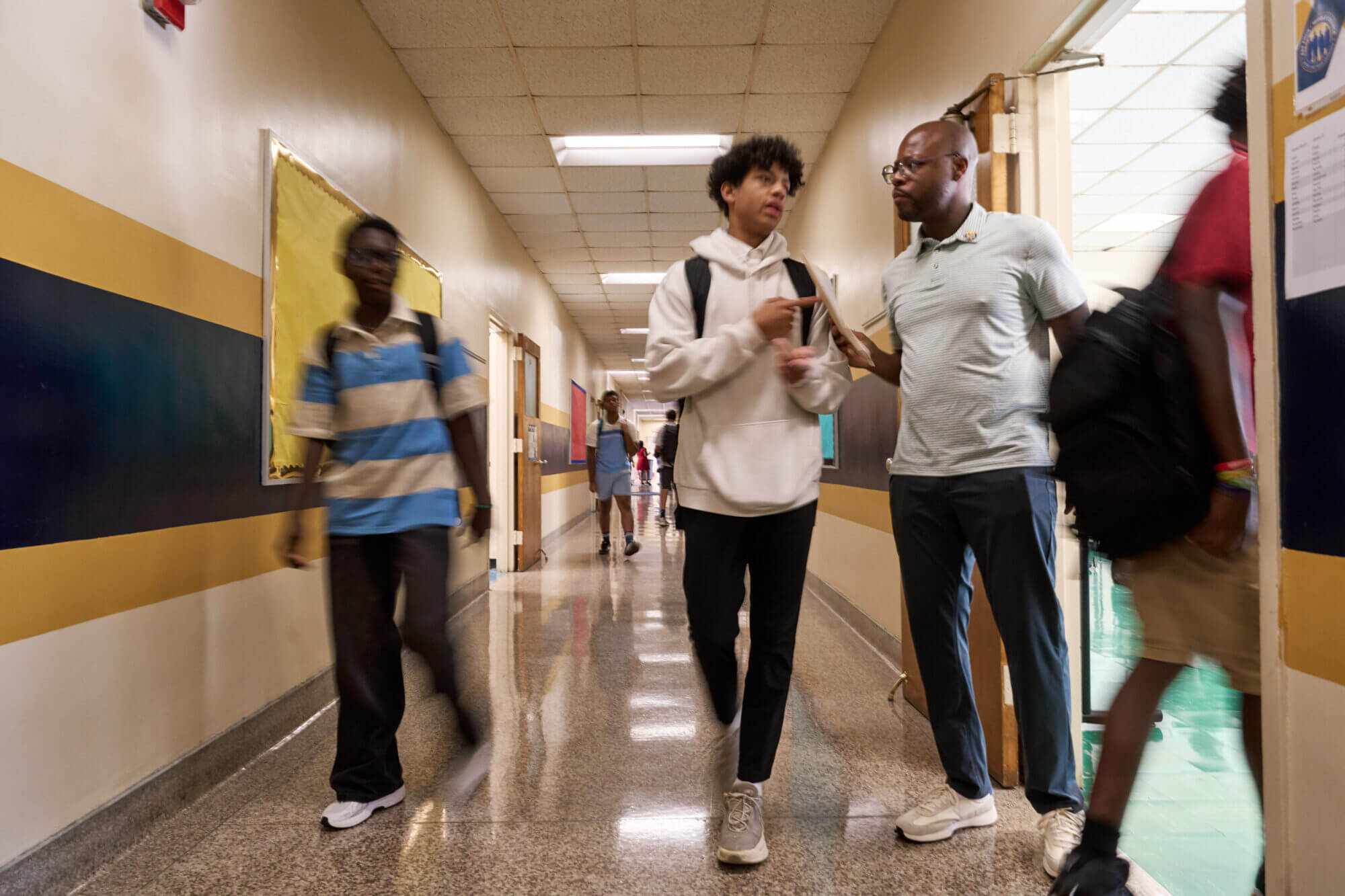
Students at the all-boys public school A&T Four Middle College find their home rooms on the first day of school in Greensboro, N.C., on Thursday, Aug. 6, 2026. A&T Four Middle College recently started a program to help ninth graders adjust to high school. Credit: Matt Ramey for The Assembly
“The evidence suggests that it leads to higher rates of student disengagement from schooling, it leads to higher rates of high school dropouts, less likelihood of high school graduations, and it leads to lower likelihood of enrolling in college. Basically, worse outcomes,” said Umut Ozek, a researcher and senior economist at the policy think tank Rand Corp., who has studied retention.
In every year measured, schools in the South held students back more than any other region, according to the data. Boys were held back more than girls, and Black boys were retained at nearly three times the rate of white boys — a gap that did not narrow over the decade even as retention fell.
In Hawaii, roughly 1 in 10 freshmen in public high schools had to repeat ninth grade in the 2021-22 school year. That was more than double the national rate for this group of students.
In the state, freshmen must earn five credits — the equivalent of five year-long classes — to move on to 10th grade. Students and teachers attribute the spike in ninth grade retention to those strict credit requirements, along with more difficult coursework and increased peer pressure to skip class and dodge assignments.
Schools work to avoid holding students back by offering summer school, counseling, personalized learning plans and other resources, Hawaii Department of Education Deputy Superintendent Heidi Armstrong said in a statement. Students may be held back when they’re struggling to make academic progress and earn enough credits to advance to the next grade, she said.
“The Department’s goal is to ensure students are prepared for continued academic success and remain on track toward earning a high school diploma,” Armstrong said, adding that schools decide to hold students back on a case-by-case basis.
Mississippi has taken a markedly different approach. In 2013, as part of an overhaul of literacy instruction, the state introduced a policy to retain third graders if they couldn’t pass the reading portion of the state’s English Language Arts assessment.
Rachel Canter, an education policy expert who helped craft the 2013 Literacy-Based Promotion Act, said Mississippi lawmakers looked to Florida in particular, where former Gov. Jeb Bush made ending “social promotion” — the practice of passing students because of their age — one of his signature policies.
“The Legislature was desperate,” Canter said. “The argument that won was, ‘We have to do something, and we know how harmful it is when kids pass with no skills.’”
The state’s third grade retention policy has had a trickle-down effect: Retentions in Mississippi are concentrated in kindergarten through second grade, too.
Researchers such as Canter say that’s because the literacy legislation established more monitoring and higher standards in those grades as well.
A&T Four Middle College students find their home rooms on the first day of school in Greensboro, NC on Thursday August 6, 2026. Credit: Matt Ramey for The Assembly
That holds true at Western Line School District, a small district with schools on the banks of the Mississippi River. Western Line held back 68 students in kindergarten through third grade during the 2021-22 school year, compared to 56 students in all other grades combined, according to the Big Local News/Hechinger analysis.
Not all of those retentions are tied to reading, Superintendent Lawrence Hudson said, but the policy raised the bar for students in early grades.
“We want to make sure kids are successful for the rest of their life,” he said. “We know if children have deficits at younger grades, they’ll get to third grade with those deficits.” He added:“The longer you wait, the harder it is to clear those deficiencies.”
But Canter said students don’t automatically improve when they’re retained. To help students, schools have to get them the academic support they need in that year they repeat. The decision to retain a student is difficult, she said, but combined with intervention, it can pay dividends.
“Any time a child is retained, it is a signal that we have not done what we needed to do as adults,” Canter said. But the retention policy paired with additional support has “done great things for kids,” she said.
Yet some educators worry that, even in relatively well-funded school districts, resources to provide that support are falling away. Shana Richards has been a school counselor for 19 years in North Carolina, which holds back more students in ninth grade than in any other grade.
“You used to have teachers that would stay after school, provide tutoring,” said Richards, who now works at A&T Four Middle College, an all-boys public high school on the campus of North Carolina A&T State University in Greensboro. “But now those people are having to leave to go to another job when the school day ends.”
The stipends for educators to provide after-school programming dried up years ago, she said, and the buses that used to carry students home from their after-school activities no longer run, either.
Richards helped design a program for her school’s incoming ninth graders that she hoped would help reduce the need forsupports that are now harder to come by. She applied for a grant from the NEA Foundation to help fund the program, an expanded version of the summer orientation the school was already doing.
The program, which just completed its second year, is called “Welcome to the Brotherhood” and primarily serves the population with the highest retention rates: Black boys. Students learn study skills and hear about academic expectations from their English and math teachers. They also have time to make friends and tour the college campus that surrounds their school.
Richards meets with every student before the program begins to get a sense of their anxieties and where they might need extra support, and she meets with them again in the first month of the school year to get a sense of any emerging problems.
“We know if we can get them to and through ninth grade,” Richards said, “then they have a higher chance of actually staying until graduation.”
In Washington state, more students were held back just before graduation, in 12th grade, than at any other grade, according to the data from 2011-12 to 2021-22. That’s not because of any state policy though; decisions are made at a district level.
A&T Four Middle College guidance counselor Shana Richards greets incoming ninth graders on the first day of school in Greensboro, N.C. Richards says that in recent years in the state, the sorts of services that help keep students on track to graduation have been disappearing because of funding and other challenges. Credit: Matt Ramey for The Assembly
Still, Liz Trautman, the executive director of the Washington affiliate of Stand for Children, an advocacy organization that works to boost high school graduation rates, said she was not surprised by the trend.
“I would argue and suggest that when we see those high rates of retention in senior year, we’re actually seeing a cumulative effect of missed opportunities to intervene and to support students that started much, much earlier,” Trautman said.
Washington officials say retained students include those who were behind in credits for a variety of reasons, including from absences related to medical issues or involvement in the juvenile justice system. Many are also enrolled in transition programs for students who receive special education services and are counted as 12th graders until they’re 22 years old or exit the program, officials said.
Daniel Lee, who has spent 14 years as a counselor at Garfield High School in Seattle, said a high student-to-counselor ratio means counselors aren’t able to work with students and parents as closely as they would like to ensure students have everything they need to meet requirements before 12th grade.
The American School Counselor Association recommends a 250:1 ratio. Washington’s was 364:1 in the 2024-25 school year.
“In order for us to be effective in all facets of our job, not just interventions, but every aspect of our job — whether it’s college and career-readiness or social-emotional health — all of that hinges on the 250:1 ratio,” he said.
But, he said, counselors check in every quarter with students who are struggling to find out what’s hindering them. That could include finding ways to help them attend regularly or setting up mental health support if that’s the barrier, he said.
Tutoring and summer classes are available for those who aren’t grasping the material or need to recover credits, he said, though access to them is uneven.
“They do have an incentive to finish,” Lee said. “It’s pretty rare to say, ‘I am not doing it.’”
Ulukita, the high schooler in Hawaii who repeated ninth grade, is on track to graduate with the rest of his peers in 2028. Now a junior, he was able to earn the credits he needed to complete both his freshman and sophomore years through additional courses, after-school work and a better attendance record.
Said Ulukita: “You’ve got to lock in more, do all your classes, make sure you get all your credits — and graduate on time.”
Contact editor Caroline Preston at 212-870-8965, via Signal at CarolineP.83 or on email at preston@hechingerreport.org.
This story about being held back was produced by Big Local News and The Hechinger Report, a nonprofit, independent news organization focused on inequality and innovation in education, in collaboration with The Assembly in North Carolina, Honolulu Civil Beat, Mississippi Today and The Seattle Times.
The data analysis was conducted by Eric Sagara, senior data journalist with Big Local News. Reporting was contributed by Megan Tagami, Ariel Gilreath, Devna Bose, Carli Brosseau and Denisa R. Superville. Sign up for the Hechinger newsletter. Learn more about Big Local News and how it supports local journalists.
The Saints played their first exhibition and college football is slightly more than two weeks old. We are on the cusp of football and the AP preseason poll is out. Ole Miss is No. 9. Too high? To low? The Clevelands discuss, plus Rick remembers the only Mississippi team to ever play in the Little League World Series, which turns 74 this month and saturates ESPN’s August programming.
TUPELO – Mississippi residents who spoke on Tuesday at the first of several public hearings on redistricting around the state urged lawmakers to not redraw electoral maps, calling the effort a needless power grab aimed at diluting Black political power in a state with a sordid racial history.
The Republican-dominated joint House and Senate committee on redistricting kicked off its slate of public hearings in a nearly packed room at Itawamba Community College in Tupelo. Leaders of the committee say the hearings will allow lawmakers to solicit feedback before making recommendations on new voting maps to the full Legislature in a likely special session this fall.
The push to redraw maps comes after the U.S. Supreme Court issued a decision in the Louisiana Callais case in May. The ruling gutted part of the Voting Rights Act and, by removing protections for minority districts, cleared the way for Republican-controlled state legislatures to redraw political lines in their favor.
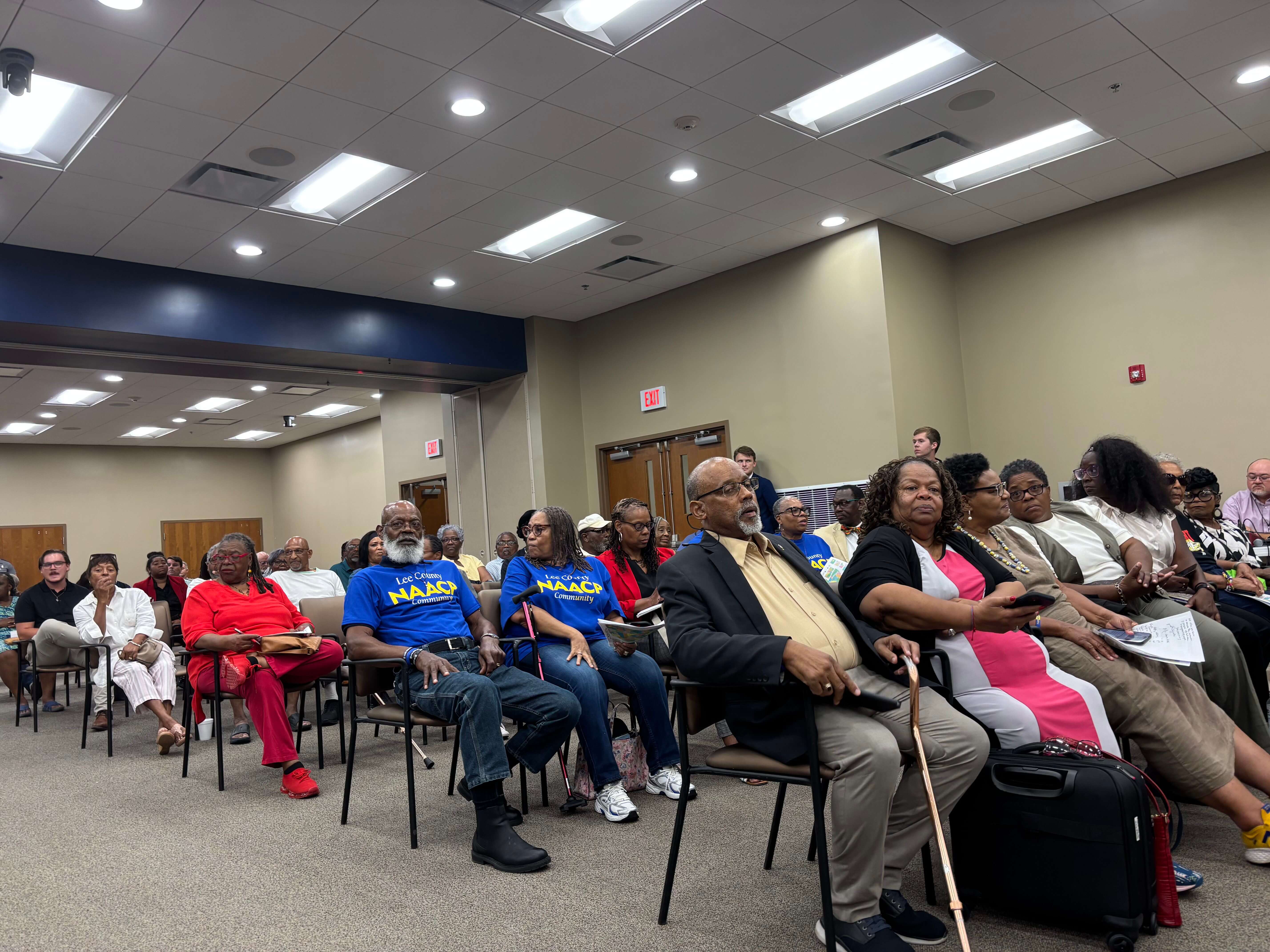
A crowd of residents attended a legislative redistricting public hearing in Tupelo on Aug. 18, 2026. Credit: Michael Goldberg / Mississippi Today
President Donald Trump, who is working to protect a slim GOP majority in Congress in this November’s midterm elections, has pressured states his party controls to redraw maps, and many have already complied.
In Mississippi, the joint House and Senate committee is expected to do the bulk of the work of redrawing Mississippi’s legislative, judicial and congressional voting lines. But with Mississippi having had its federal midterm primaries months ago, it appears unlikely congressional maps would be redrawn for November’s federal election.
Only 10 of the 20 members on the state joint committee were in attendance on Tuesday.
The room was dominated by Mississippi residents who oppose redistricting. Many of those who spoke said the Callais decision doesn’t require Mississippi to redraw its maps, and that doing so would create confusion for voters and impose a financial cost on localities. They also said hard-won progress to increase Black representation in Mississippi since the Jim Crow era would be eradicated.
The Reverend Jeffrey Gladney, pastor of a Church in Shannon, said redrawn maps would “eliminate Black districts” and attack “Black voices that represent the Black community.”
“If maps are redrawn, they will split neighborhoods, divide communities, take away resources from already weakened communities,” Gladney said.
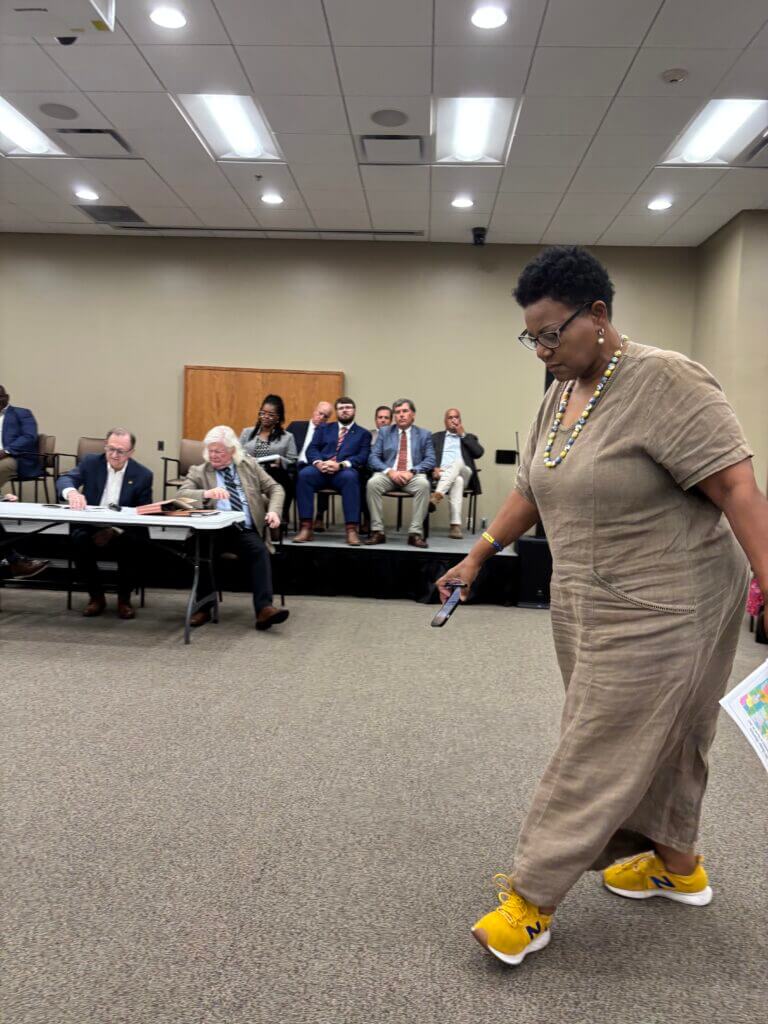
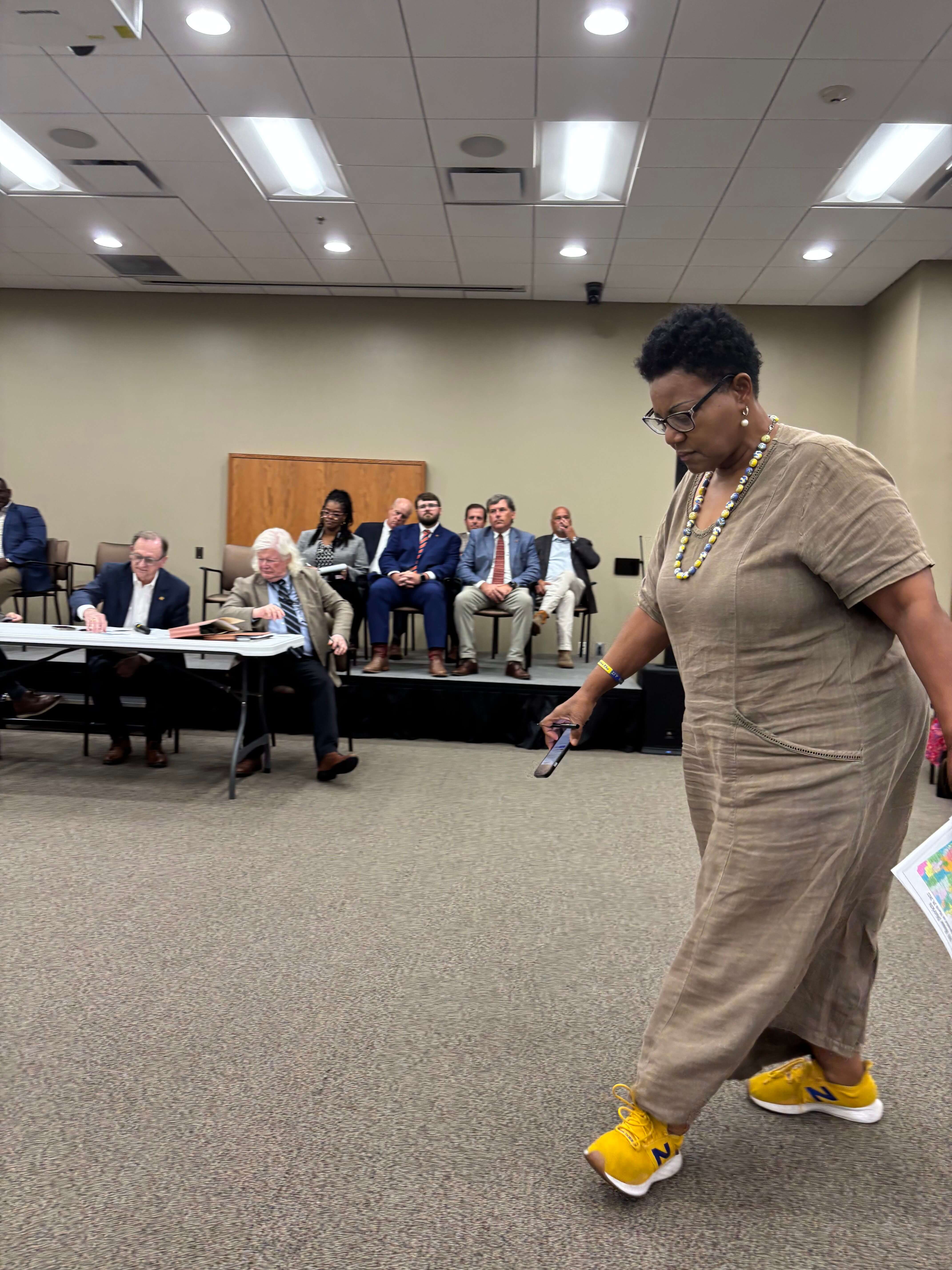
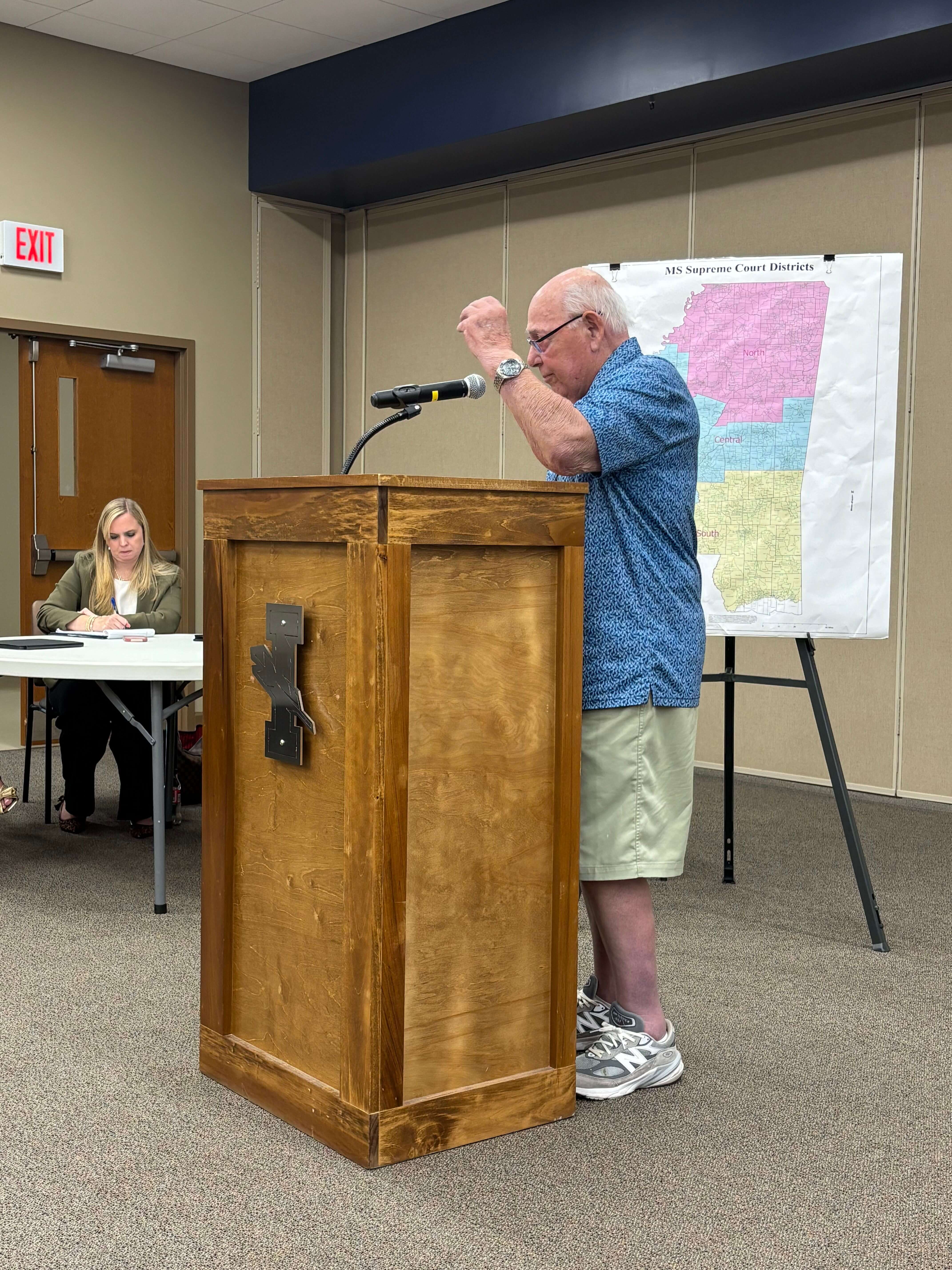
Resident Jim Newman speaks at redistricting public hearing in Tupelo. on Aug. 18, 2026. Credit: Michael Goldberg / Mississippi Today
Jim Newman, chairman of the Lee County Democratic Party, said the Legislature should redistrict after the next U.S. Census in 2030 rather than rushing to redraw maps at President Trump’s urging as states such as Texas have done.
“Y’all are looking for a power grab, plain and simple,” Newman said. “It didn’t have to happen. But the president asked for it, and by God, everybody bends over to take care of the president. And it’s not any different here in Mississippi.”
Teresa Roberts said redistricting would impact the social and economic well-being of “marginalized people.”
“These are people who need us, who need you, and you are going to take away what little strength they already have,” Roberts said. “Shame on you.”
Katie Gilbert said she came straight from work to attend Tuesday’s hearing. She was raised in Tupelo and went to Tupelo High School. She said redistricting would contribute to the “brain drain” flight of young people out of Mississippi.
“We wonder a lot of times why we have a brain drain in Mississippi, why a lot of educated young folks leave this state. It’s because of decisions like this that are leaving us in the past,” Gilbert said. “Mississippi has a very dark history, but we do not need to continue on with a dark future. Equitable maps lead to a stronger Mississippi.”
Walter Jones said his family lived down the street in Chicago from the family of Emmett Till, a Black youth whose murder in Mississippi helped spark the Civil Rights Movement. He said moved to Mississippi because of the progress the state had made in overcoming its history of racial discrimination, but he now wonders whether he made the wrong move.
“I came down here because things have changed. Mississippi was becoming a great place to stay. People was people. Everybody like everybody,” Jones said. “If this is what y’all want to do to Mississippi after all the hurt and struggles y’all went through to get to where we’re at today, I made a bad decision.”
Only one person in attendance, Mike Walker, appeared to speak in favor of redistricting.
“All I’ve heard up here today is bashing these elected representatives for what they’re trying to do,” Walker said. “So let me ask you, what color is your soul? It’s a soul thing people. It ain’t Black or white. It’s a soul thing.”
Many civil rights leaders, Black lawmakers and voting rights advocates believe the hearings are a pretext for the Legislature moving to dismantle majority-Black districts and weakening Black political power in the state.
Democratic Rep. Rickey Thompson of Shannon, who is not on the joint committee but attended the hearing, said he doubted his Republican colleagues would take community feedback into account.
“They already have their plans together,” Thompson told Mississippi Today. “They’re just going through the motions.”
Republican leaders believe that when the U.S. Supreme Court issued its ruling in the Callais decision, it ended an improper practice of allowing for the consideration of race in drawing political maps.
Since the Callais decision, some GOP leaders in Mississippi and Washington, D.C., have called for heavy partisan gerrymandering, including redrawing of incumbent U.S. Rep. Bennie Thompson’s district to help oust him, the state’s only Black member of Congress and only Democrat.
Cliff Johnson, a University of Mississippi law school professor who is the Democratic nominee challenging Republican U.S. Rep. Trent Kelly in this year’s midterms, attended the hearing and mingled with attendees. He said the hearing showed Mississippians didn’t want a redistricting process that inflamed racial and partisan divides.
“I thought it was very powerful to see people stand in front of a bunch of legislators and ask to have a say. My sense as a lifelong Mississippian is that our diversity is such a strength,” Johnson said. “The notion of having representatives chosen by a cross-section of our population is something that makes us stronger.”
The committee is encouraging the public to participate in future hearings. The public can offer comments at any of the seven remaining public hearings, or submit written comments to Ted Booth, the committee’s attorney, at ted.booth@peer.ms.gov.
Below is the schedule of the future planned redistricting hearings. Each will start at 6 p.m.
Aug. 27 at Northwest Mississippi Community College in Southaven
Sept. 1 at Delta State University in Cleveland
Sept. 8 at Alcorn State University in Natchez
Sept.10 at Meridian Community College in Meridian
Sept. 17 at the University of Southern Mississippi in Hattiesburg
Sept. 22 at Mississippi Gulf Coast Community College in Gulfport
Mississippi Today is pleased to welcome Blake Barnes as its new multimedia producer.
Barnes joins a multimedia team responsible for collaborating with reporters and editors to produce social videos based on Mississippi Today’s reporting. He will also contribute to the production of the newsroom’s video podcasts, as well as long-form video projects. He began work Monday.
The hire reflects Mississippi Today’s commitment to reaching audiences and creating impact across multiple mediums.
“Blake is a proven producer whose work I’ve respected and admired,” said Michael Guidry, Mississippi Today’s editorial director of multimedia. “His passion for telling Mississippi stories makes him an awesome addition to this newsroom, and I am excited for what he will deliver for our audiences.”
Barnes most recently served as a producer at Mississippi Public Broadcasting, where he directed Everlasting: The New Generation.
He grew up on a farm in Ludlow, Mississippi with a family of storytellers. He attended East Central Community College, then Delta State University. He’s called Jackson home for the last five years.
“I’ve always loved Mississippi,” said Barnes. “This is my home, and I think telling stories is a way I can help push the state forward. I’m looking forward to the opportunities Mississippi Today will offer me in this way, and continuing to tell and to preserve these local Mississippi stories.”
Mississippi Today Ideas is a platform for thoughtful Mississippians to share their ideas about our state’s past, present and future. Opinions expressed in guest essays are the author’s own and do not necessarily represent those of Mississippi Today. You can read more about the section here.
In the U.S., the number of billion-dollar disasters is increasing each year. Wildfires, hurricanes, floods, tornadoes and extreme weather events are hitting communities with increasing frequency and severity, placing more Americans at risk of losing their homes, livelihoods and financial stability.
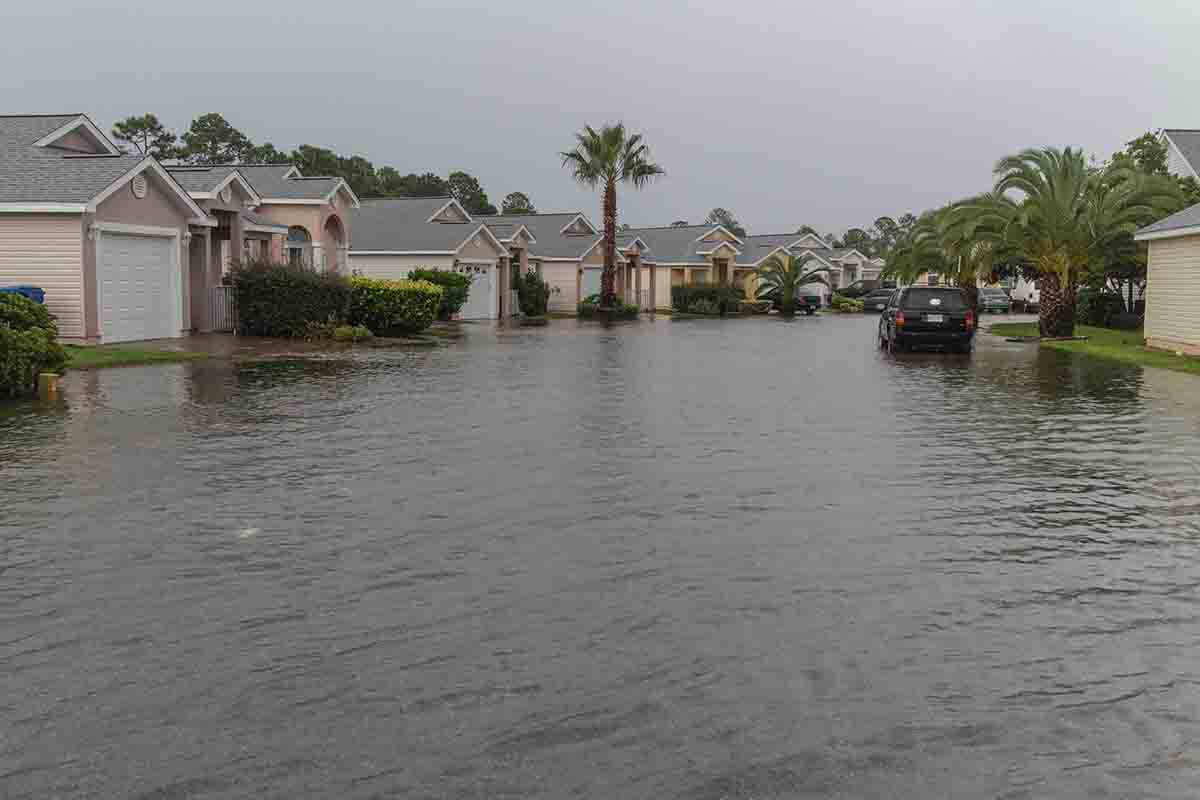
Mississippi offers a clear example of this growing threat. Over the past decade, the state has faced a steady drumbeat of tropical storms and hurricanes, not always direct hits, but often just as damaging. In 2020 alone, multiple storms, including Hurricane Zeta, Hurricane Sally and Tropical Storm Cristobal, brought flooding, storm surge and widespread power outages. In 2021, Hurricane Ida tore through the region, causing severe flooding and fatalities even after making landfall in Louisiana.
These are not rare, once-in-a-generation events. They are recurring disruptions that strain infrastructure, delay recovery and test the limits of state and local response systems.
In recent years, Mississippi also has been hit with other disasters, ranging from tornadoes to ice storms to droughts.
Yet, instead of preparing for this reality, the Trump administration stopped tracking these disasters to advance an alternate-reality narrative and an out-of-touch ideology cooked up by a Beltway think tank. Dismantling the Federal Emergency Management Agency or FEMA, the very system millions of Americans rely on when disaster strikes, is not something a president can do alone. Congress has the power to stop it, and right now, too many members are choosing not to.
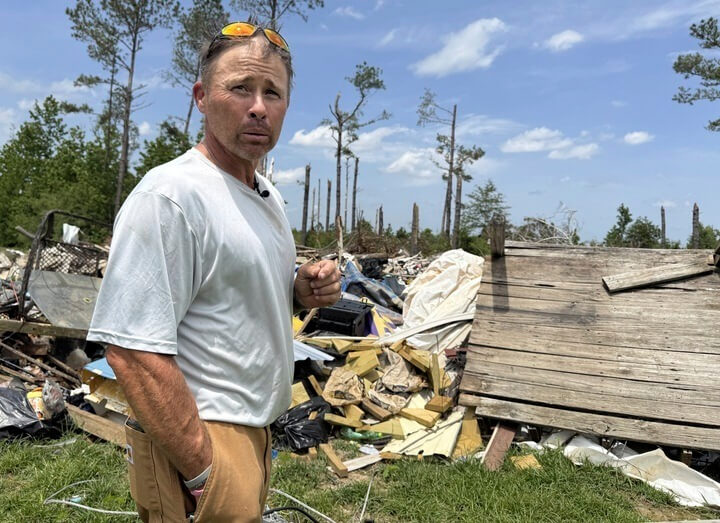
Brian Lowery stands before what remains of his home, which was ripped apart by a tornado, in Tylertown, Miss., on Thursday, May 15, 2025. (AP Photo/Sophie Bates) Credit: AP Photo/Sophie Bates
This follows a familiar pattern. Promises to put Americans first have repeatedly translated into gutting programs that actually serve the public, while costly, high-profile political priorities move forward unchecked. The rhetoric may win headlines. The consequences, however, fall squarely on American communities.
FEMA is not an abstract federal agency. It is one of the most widely relied upon forms of federal support in the country. Around 94% of Americans live in a county that has received FEMA assistance since 2011. From 2017 to 2023, $267.7 billion in disaster aid and reconstruction supported communities across rural and urban areas, in red states and blue alike.
If FEMA disappears, what happens to your community after the next wildfire, flood, hurricane, tornado or terrorist attack?
Last year, Trump said, “I’d say after the hurricane season we’ll start phasing [FEMA] out.” Interesting delay from an administration so confident that FEMA is not essential. The same overconfidence already resulted in multiple “fire-first-then-realize-the-wrong-people-were-fired” moments. Let’s remember that there is no serious plan to replace FEMA’s capabilities.
Without FEMA, disaster response responsibilities shift to state and local governments that are already stretched thin and to families who cannot afford to wait for help that may never come.
Ben Smilowitz, of Rockville, Maryland, witnessed the bungled Hurricane Katrina response while managing a Red Cross Client Service Center in Gulfport. Soon after, he launched Disaster Accountability Project – SmartResponse, an independent watchdog, to confront the root causes of the failed Katrina response and maximize the impact of billions of dollars of disaster relief and humanitarian aid.
DAP – SmartResponse has successfully advocated for the release of millions of dollars of disaster relief and recovery funds after Superstorm Sandy, investigated deficiencies in emergency planning surrounding 19 commercial U.S. nuclear power plants and improved the transparency of nearly $2 billion dollars of disaster relief donations after disasters in the U.S., Haiti and Nepal. DAP’s reports, advocacy and op-eds have been covered by global news media
Prior to starting DAP – SmartResponse, Ben had a background in civic engagement and issue advocacy. He wrote successful legislation in Connecticut and created a youth cabinet in Missouri. Ben is an Echoing Green fellow, studied political science and nonprofit management, and holds a law degree from the University of Connecticut School of Law.
The Jackson City Council has approved rezoning for the long-vacant YMCA on Fortification Street.
The council approved the rezoning from light industrial to community mixed use. The plan is to eventually approve a mixed-use housing and recreation site called Prado Conservatory according to the developer Gabriel Prado, president and CEO of PraCon Global Investment Group.
“Their vote gives us the opportunity to save a property that has been dilapidated for years and transform it into something meaningful for Jackson. Our commitment to this city is long-term, and we believe Prado Conservatory can become a signature example of what is possible when vision, persistence and private investment come together,” Prado said in a statement.
The YMCA closed in 2017 and has sat empty since. PraCon plans to convert the existing YMCA building into about 60 multifamily units and add approximately 100 more units in a new five-story building.
The YMCA building sits along the Pearl River and PraCon said that part of the property’s appeal will be its proximity to the river, which could be revamped in the coming years thanks to a proposed flood-control lake project
For decades, Jackson Metro area officials have debated how to address flooding along the Pearl River. While indicating support for a version of the controversial project, federal officials recently said that a final environmental impact study is needed before any final decision is made about the design. Environmental groups have criticized the project saying it would destroy wildlife habitats downstream, and have also pointed to much cheaper flood control alternatives.
However, advocates of the project say that in addition to better controlling the river’s flooding, the project would open up new recreational and economic development opportunities.
“Prado Conservatory is an incredible fit along with the Pearl River Flood Control Project and the larger vision creating Jackson’s riverfront. Bringing new housing, recreation and private investment to a long-vacant property on the Pearl River creates exactly the kind of momentum that can help turn the riverfront into a destination and a catalyst for growth,” said Jeff Rent, President & CEO of the Greater Jackson Chamber Partnership
PraCon has become one of the Jackson Metro area’s most prolific developers with projects including Topgolf in Ridgeland, Prado Lofts in Jackson and a potential foray into data centers.
“Prado Conservatory is another demonstration of our confidence in Jackson and our determination to complete projects that others may have already given up on,” Prado said.
Mississippi Today, in partnership with Reveal from the Center for Investigative Reporting and The New York Times, has won a National Edward R. Murrow Award for the podcast “Abuse of Power: Beyond the Goon Squad.”
The project features more than 70 interviews with former inmates and officers at the Rankin County jail. Reporters from Mississippi Today and The New York Timesdiscovered a system in which guards ordered beatings, inmates who participated were rewarded, and those trying to raise an alarm about the system for more than a decade were ignored.
The podcast allowed people who experienced abuses by the Rankin County Sheriff’s Department to tell their stories in their own voices.
“Mukta Joshi, Brian Howey and Nate Rosenfield took their in-depth and impactful reporting about abuses at a Mississippi sheriff’s office to another platform, allowing listeners into the world they witnessed and wrote about,” said Debbie Skipper, Justice Team and Special Projects Editor at Mississippi Today. “Their podcast demonstrated the hurdles they had to overcome and their concern for protecting the people who dared to challenge a system stacked against them. It opened the eyes of a community to what was going on behind the walls of the sheriff’s office and jail and empowered residents to seek solutions.”
The Radio Television Digital News Association (RTDNA) oversees the Edward R. Murrow Awards, which honors work in broadcast and digital journalism. Among the most prestigious in news, the Murrow Awards recognize local and national news stories that uphold the RTDNA Code of Ethics, demonstrate technical expertise and exemplify the importance and impact of journalism as a service to the community.
The award will be presented at the Edward R. Murrow Awards Gala on Oct. 12 at Gotham Hall in New York City.
Only one Mississippi baseball team in history has advanced to Williamsport, Pennsylvania, and the Little League World Series, which turns 74 years old this month and saturates August ESPN programing.
The Hub City’s Pineview Little League All-Stars, an all-Black team, first won the 1977 Mississippi Little League championship at Biloxi. How that Hattiesburg team advanced from Biloxi, to the South Regional Championship in St. Petersburg, Florida, and finally to the Little League World Series is a fascinating story, one well worth telling 49 years later.
This will be mostly from first-hand perspective. I covered that Little League World Series for the Hattiesburg American, where I was the 24-year-old sports editor. I remember telling my bosses we should cover the Little League World Series and being somewhat shocked when they agreed.
Rick Cleveland
So off to Pittsburgh I flew, rented a car and drove to Williamsport. The Hattiesburg team, which included future Major Leaguer Charlie Hayes and future Southern Miss football great Andrew Mott, was already there, along with coaches Boot Walker and Kenny Fairley.
The truth is, I had already missed the biggest story, which was how Hattiesburg won the South Regional, defeating a Tampa team that featured a fearsome 12-year-old pitching phenom named Dwight Gooden. Yes, that Dwight Gooden, the future Dr. K, who seven years later would win National League Rookie of the Year, unanimously, winning 17 games and leading Major League Baseball with 276 strikeouts.
Hattiesburg and Tampa, on opposite sides of the bracket, cruised through the tournament until the championship. Both trounced everyone they played. Hayes, a future Major League third baseman, pitched a two-hit shutout in Hattiesburg’s opening victory over Louisiana. Gooden threw a no-hitter in Tampa’s opener. Each team won two more games to set up the championship showdown. To hear Hattiesburg players and coaches tell it, nobody, except them, expected Hattiesburg to win. Gooden, who was huge and muscled for 12, had overpowered everyone he faced in tournament competition. He hadn’t given up so much as a hit in tournament play. He was already a well-publicized cult hero in Tampa and had a huge following in St. Petersburg where a crowd of hundreds cheered the Tampa team.
Back then, Gooden threw strictly fast balls that few 12-year-olds could touch. Hayes was different. He didn’t throw as hard as Gooden, but had mastered a curve ball that made his fast ball seem all the faster.
“I threw mostly curves against Tampa,” Hayes would tell me years and years later. “It kept working and I kept throwing it.”
Hayes threw a one-hit shutout. Hattiesburg scratched across one run. The Hub City team, many of whom had never been out of state before, won 1-0 and were now headed for Williamsport. There’s a story there, too. When the team’s bus driver learned he wasn’t on the travel list for Williamsport, he headed back to Hattiesburg and took the team’s travel money with him.
So after beating Dwight Gooden, the team celebrated at the motel with baloney sandwiches and Kool-Aid. Motel vans carried them to the airport the next day, and it was on to Williamsport. Only two of the Hattiesburg players had ever been on a plane. Not many more had ever been out of state before that week.
But they were in Williamsport by the time I got there and already had been fitted for their new World Series uniforms – green jerseys, with yellow trim, which read “SOUTH” in huge capital letters on the front. The Hattiesburg boys wore them proudly. Understand, these kids were mostly from poor families. Says Hayes, now 61 and living in Houston, “Most were like me, and I was on public assistance, food stamps, all the time I was growing up.
“People asked me why I wore two pair of thick socks under my uniform socks at Williamsport,” Hayes says. “It was because my baseball cleats were hand-me-downs, a size and a half too big.”
Charlie Hayes at Williamsport.
Some of the Hattiesburg players used gloves borrowed from fathers or uncles that seemed far too big for their hands. But believe this: Those little kids could play ball and they could even more hit. In one state tournament game, all nine starters hit home runs in the first three innings of a mercy-rule victory.
Mott, the team’s catcher, and Hayes were both home runs waiting to happen. Mott had homered in every tournament game until the championship game at Tampa.
“But our best player wasn’t me or Mott,” Hayes said. “The best player on the team was Ernest Charles Walker, our centerfielder. Man, he could do everything.”
At Williamsport, Hattiesburg would need to win three straight games to get to the nationally televised championship game, which everyone assumed would be against perennial champion Taiwan. Hattiesburg faced the West champs from El Cajon, California, a San Diego suburb.
Hattiesburg ran into a buzzsaw named John Osborne, the El Cajon pitcher.
Hayes pitched well for Hattiesburg. Osborne, a tall, strapping 12-year-old who easily could have passed for 14, pitched better. He allowed only three hits and struck out 15 of a possible 18 batters.
Hattiesburg battled. Down 3-0 going into the last inning, Mott singled and later scored Hattiesburg’s only run. But with the bases loaded, Osborne struck out Hattiesburg’s last hope.
That dropped Hattiesburg into the consolation bracket, which they easily won with two straight lopsided victories over Spain and Ohio. In the consolation championship game, the Hattiesburg team pounded out 20 hits to win 9-2. The next day, they watched Taiwan, as expected, defeat California 7-2.
As it turned out, the Hattiesburg players hung out mostly with the Californians and Taiwanese in the Little League village, where each team had its own cabin. You may wonder about the language barrier. The Taiwan players did not speak English. The California and Hattiesburg players did not speak Mandarin Chinese.
“But baseball has a universal language and there were interpreters,” Mott says.
One encounter stands out in my memory. A player from Spain poked a player from Taiwan, and asked him, “Pitcher?”
The Taiwanese player shook his head. “Shortstop,” he said, then smiled. “Home run hitter!”
The Taiwan players hit lots of those. One of Mott’s favorite Williamsport memories was from a Hattiesburg practice, which was interrupted several times by balls landing in the infield, hit from another diamond across the way.
“Where are those balls coming from?” one of the Hattiesburg coaches asked.
“That’s Taiwan taking batting practice,” an outfielder told him.
Says Mott, “So Coach Fairley gets me and Hayes to take batting practice and hit balls over into the Taiwan practice field, which we did.”
The Hub City team’s Little League World Series experience didn’t end in Williamsport. No, they rode a bus to Washington D.C., where they toured the city and had breakfast with President Jimmy Carter. Later, the same day, they were on to Baltimore where they watched the Orioles play a night game against the Kansas City Royals.
Forty-nine years later, Hattiesburg players cherish all those memories. They didn’t get to play Taiwan. They didn’t get to play on national TV. Only one of them, Hayes, went on to play professional baseball. Hayes played 14 Major League seasons with 10 different teams, including the 1996 World Series champion New York Yankees. Indeed, Hayes caught Mark Lemke’s out when the Yankees defeated the Atlanta Braves to win it all. Hayes hit .262 for his career with 144 home runs and 740 runs batted in. He is one of only 12 in history to play in both the Little League World Series and the Major League World Series.
New York Yankees Derek Jeter (2) celebrates as teammate Charlie Hayes catches the final out of Game 6 of the World Series between the New York Yankees and the Atlanta Braves at Yankee Stadium in New York, Saturday, Oct. 26, 1996. The Yankees defeated the Braves 3-2 to win the game and the World Series. (AP Photo/Kathy Willens) Credit: AP
Hayes, 61, lives in Tomball, Texas, a Houston suburb, where he operates a baseball academy and follows closely the career of his youngest son, Cincinnati Reds third baseman Ke’Bryan Hayes.
Mott, who led the nation in punt return yardage at Southern Miss, still lives in Hattiesburg where he deals will injuries that required 21 surgeries from his football career that included a stint in the Canadian Football League after USM.
Hayes insists Mott would have been a Big League catcher had he decided to pursue baseball instead of football. “Mott could really catch,” Hayes said. “He had the pop time, could hit for power and he was fast.”
When told what Hayes had said, Mott said, “Maybe I wouldn’t be so beat up.”
Both Hayes and Mott say they still watch the Little League World Series every year when it comes around. “Brings back so many memories,” Mott says.
Could that Hattiesburg team of 1977 compete with the current World Series teams?
“I don’t think there’s any doubt,” Mott says. “We were fundamentally sound and, man, we had some athletes.”
State and national GOP strategist Henry Barbour runs through likely and confirmed candidates for Mississippi races this year and next, running down the ticket from U.S. Senate, stopping just shy of dog catcher.