
FAQ: Mississippi redistricting. Why does it matter? What’s being considered?

Audio recording is automated for accessibility. Humans wrote and edited the story.
The U.S. Supreme Court’s recent Louisiana v. Callais decision gutted the federal Voting Rights Act protection for minority voters in redistricting, prompting some states, at the urging of the Trump administration, to try to redraw voting lines for GOP advantage ahead of the November midterm elections.
Mississippi had been ordered by a federal judge to redraw its state Supreme Court districts to allow Black voters adequate representation. But Gov. Tate Reeves canceled a special legislative session set for this week to address the court districts after a federal appeals court set aside the judge’s order.
Reeves and other state Republican leaders say they want Mississippi to gerrymander its congressional voting districts to try to prevent reelection of the state’s lone Democrat, longtime U.S. Rep. Bennie Thompson, also the state’s only Black member of Congress. But it appears doubtful Reeves will try to get the Legislature to do so before the midterms, as Mississippi has already held its primaries.
The governor said he does want lawmakers to redraw congressional, judicial and state legislative districts before the 2027 statewide elections.
Here are some answers to frequently asked questions about the political issue sure to embroil Mississippi, the South and the nation for years to come.
What is redistricting?
Redistricting is the process for a lawmaking body, such as the Mississippi Legislature or a local city council, to redraw district boundaries to determine which voters belong in a district.
Redistricting normally occurs after the decennial census. The purpose of redistricting is to ensure equal representation in each district. The mandate for legislative seats is to have the near identical number of people in each district to ensure the one-person, one-vote principle. More leeway is allowed in judicial districts.
While lawmakers typically redraw the lines to account for population shifts, racial and political gerrymandering has long been a practice. Mississippi, with its long history of Jim Crow voter suppression, has often faced litigation and federal court intervention with its redistricting.
People in a district vote to determine who represents them, but the process of determining which voters belong in districts is the subject of much debate and controversy.
What could redistricting impact?
Redistricting can impact everyone, but minority voters, especially Black voters, are usually the most impacted by redistricting in the Deep South.
The point of voting districts is to elect representatives who understand the needs of that area, such as the Mississippi Gulf Coast or the Mississippi Delta. But legislators often draw district lines to protect incumbent politicians or give their political party an advantage. In Mississippi, the state with the largest percentage Black population, partisanship and race are intertwined.
Despite Black people making up close to 40% of the population in Mississippi, Black representation in government has not reflected that, particularly in congressional and statewide offices.
Before the first voter casts a ballot, politicians have already influenced the outcome by determining who the voters are.
What is the Voting Rights Act, and how does it relate to redistricting?
Congress passed the 13th, 14th and 15th amendments to the Constitution in the 19th Century. These amendments were enacted to abolish slavery and to try to ensure equality for formerly enslaved people. But as formerly enslaved people began to gain voting power, white supremacists enacted Jim Crow laws in the Deep South that stripped voting rights and political power from Black people.
These laws included requiring Black citizens to pay poll taxes and pass literacy tests or answer impossible questions in order to vote. White supremacists also used violence and intimidation to prevent Black people from voting.
After years of protests and pressure, Congress passed the Voting Rights Act in 1965 to try to prohibit such voter intimidation. After its passage, Black people began registering to vote in large numbers. But to prevent Black voters from wielding any real influence, state lawmakers in Mississippi and across the South began to redraw state legislative and congressional districts in ways that prevented Black voters from being able to elect Black candidates.
Lawmakers did this by “cracking” majority-Black areas and diluting the vote and placing them in majority-white districts. It wasn’t until 1979 that a significant number of Black people were elected to the Mississippi Legislature, and 1986 when Mississippi elected its first Black person, Mike Espy, to Congress.
Because white legislators intentionally tried to prevent Black voters from electing candidates of their choice, federal courts interpreted the Voting Rights Act to require states to draw districts in a way that gives Black voters fair representation. The recent U.S. Supreme Court Callais decision stops the practice of race being a factor in drawing districts.
What does this mean for me as a Mississippian?
How legislators redraw districts goes to the heart of a healthy democracy.
If voters believe they have fair, representative districts, they are more likely to participate in the political process. If lawmakers draw politically or racially gerrymandered districts, it tends to create voter apathy.
What communities are included in certain districts is also important. For example, if someone who lives in Jackson represents a district that includes the Gulf Coast, that representative may not advocate for the needs of the Gulf Coast as much as they would for the Jackson metro area.
Who draws districts?
Lawmaking bodies draw districts.
The Mississippi Legislature draws congressional, state legislative and judicial districts. Local boards of supervisors draw county districts and local city councils or boards of aldermen draw municipal districts.
What’s the difference between congressional districts and judicial districts?
Congressional districts determine who elects members of the U.S. House of Representatives. Mississippi is currently represented by three white Republicans and one Black Democrat.
Each state has two senators elected by a statewide vote.
Judicial districts determine who represents voters in the state’s judiciary. The highest court in Mississippi is the state Supreme Court.
What redistricting is being considered in Mississippi?
Lawmakers are considering redrawing congressional, state legislative and the state Supreme Court districts.
Gov. Reeves cancelled a special legislative session that had been planned to redraw state Supreme Court districts, but House Speaker Jason White and Lt. Gov. Delbert Hosemann recently announced the creation of committees to study redistricting over the summer and make recommendations to lawmakers. Since both the House and Senate are studying redistricting, it appears likely that lawmakers will debate redistricting measures during the 2027 session that begins in January.
Many Republican politicians in Mississippi are calling for the state to move more quickly, to nullify the results of the state’s congressional midterm primaries, and gerrymander the districts to try to provide a GOP sweep in the November general elections for Congress. Trump has been pressuring states, including Mississippi to do so.
Reeves cast doubt on that happening in Mississippi before November since the primaries have already been held — it would be unprecedented for lawmakers to overturn duly held elections — and he said the move could have unintended detrimental consequences for Republicans nationwide. But he left the door open and said he is working closely with the Trump administration.
Mississippi is losing public school students. Where are they going?

Audio recording is automated for accessibility. Humans wrote and edited the story.
Mississippi has lost nearly 70,000 public school students since the state’s student population started its downturn in 2013.
The vast majority of Mississippi’s school districts, 113, have seen enrollment declines — some as much as 40%.
Some experts link the falling public school enrollment to the state’s overall population loss.
If districts continue to lose students, their funding will decline, too. In 2024, Mississippi adopted a new public school funding formula that ties money to student enrollment. A section of the student funding formula included a “hold-harmless” provision, which prevented districts with declining enrollment from being hit with significant cuts. That protection expires in July 2027.
Kymberly Wiggins, the Mississippi Department of Education’s chief operating officer, said every district will then have to live with their “true” allocation, which may be a wake-up call. She said the Legislature has an opportunity to adjust the funding formula in 2028 and minimize enrollment-related budget decreases.
But Tyler Hansford, superintendent of Union Public School District and president of the state superintendents’ association, is worried about what’s going to happen in the meantime, as federal pandemic relief money dries up and the state’s hold-harmless deadline approaches.
“To really cure budget shortfalls, just about the only way is cutting personnel,” he said.
And if that doesn’t work, Hansford knows what comes next: consolidations and school closures. “I would think that would be unavoidable,” he said.
Those possibilities are already becoming a reality for some districts.
Leake County schools have lost about a fifth of their enrollment over the past decade. In February, district leaders announced that two high schools will be consolidated at the end of this school year. Former graduates and school employees told Mississippi Today they believe the move is necessary and overdue.
Another case is Leland, a Delta town that peaked in population at 6,667 in 1980. Now, fewer than 4,000 people call it home.
The public school district’s population parallels that of the town. Leland schools have lost about 300 students, a third of their enrollment, since the 2013-14 school year. Superintendent Jessie King is frank about what could happen if Leland schools lose more money.
“We may have to cut staff,” he said. “That’s definitely a concern.”
Schools have fixed costs such as building maintenance and bus driver salaries, said Tara Moon, a researcher at FutureEd, an education think tank. But if they don’t have the same amount of money coming in, it can present challenges.
“They need to figure out how to close the gap in their budget,” she said.
Often, the first casualty is teachers.
Superintendents face tough decisions
When teachers retire in Philadelphia, they may not be replaced.
That’s because a third of the student population has evaporated in the past 10 years, and Superintendent Shannon Whitehead has to cut costs where she can.
Philadelphia’s population dropped from 7,477 people in 2010 to 7,118 in 2020. City schools have seen steeper declines in enrollment.
Philadelphia Public School District has lost nearly 40% of its student population since the 2013-14 school year, dropping from 1,224 students to 750.
The factors for the enrollment loss aren’t clear. Some students are moving out of city limits and attending nearby Neshoba County schools, Whitehead said. Students often transfer to nearby districts.
What’s resulted is a shrinking staff and growing class sizes. Whitehead said she’s dissolving roles now to prevent future layoffs.
King, superintendent of Leland schools, is looking to trim costs, too. One option he’s considering is participating in the state’s virtual teacher program, with Jackson-based instructors teaching online classes across Mississippi.
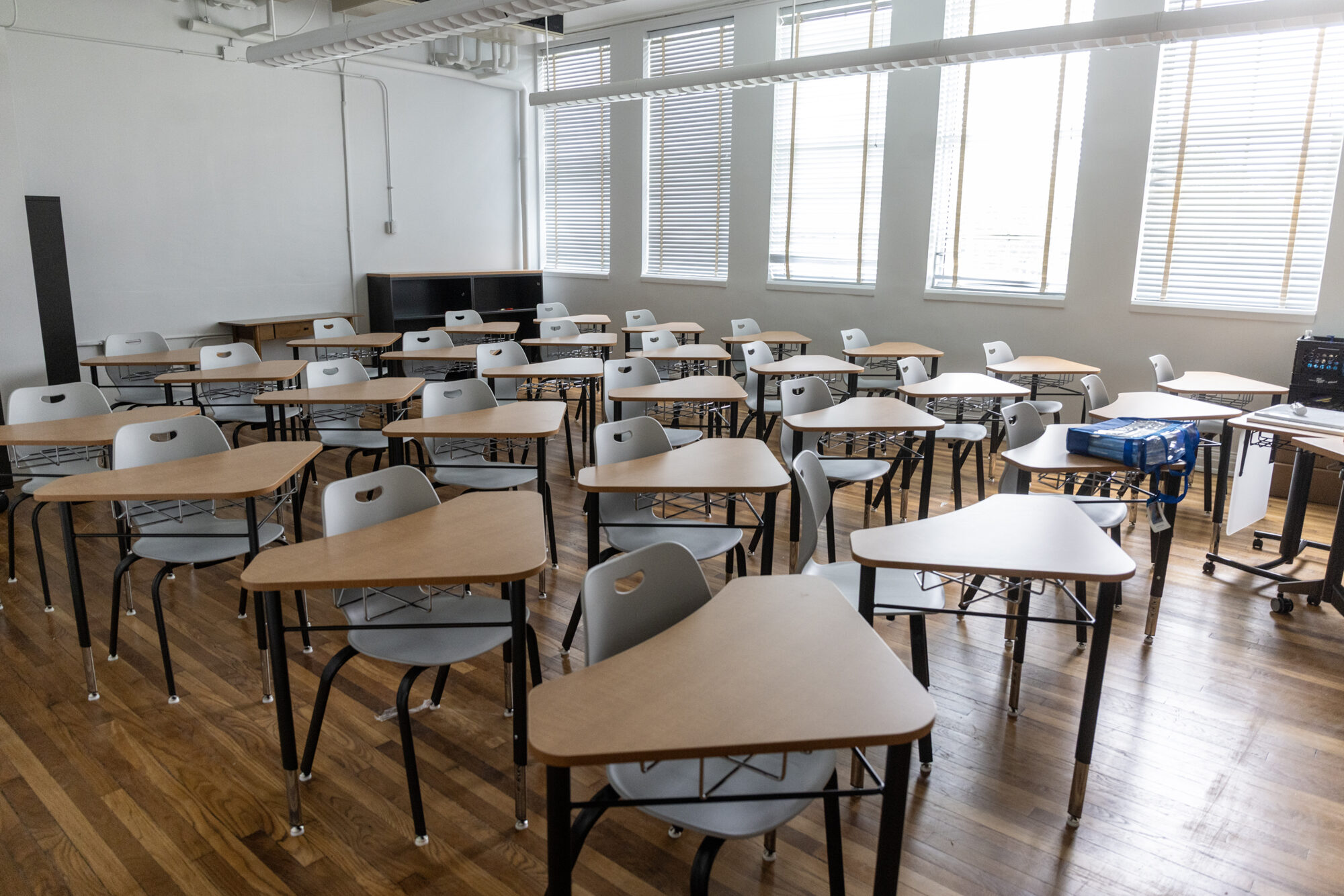
Jackson Public Schools is losing students at the third-highest rate of Mississippi districts. JPS enrollment declined by half, about 13,000 students, since the 2013-14 school year. Skeletal buildings of former schools sit unused across Jackson. District spokespeople declined to comment on the district’s shrinking enrollment.
Will Russell, superintendent of Leake County School District, said he decided to “realign” the district’s high schools because of resource disparities tied to enrollment declines. He said he avoids the word “consolidation” because it evokes emotional responses in his community.
One school didn’t have a football team, for example, because of low enrollment. The county high school needs a chemistry teacher. Teachers are paid on the same salary schedule at both schools, but classes at one school only have six or seven students, compared to at least a dozen more at the other.
“If anybody wants to say that we’re wasting money, they would be right,” Russell said.
Grace Breazeale, a K-12 education researcher at policy advocacy organization Mississippi First, said that because population and enrollment declines will likely continue, district leaders should consider consolidating schools or districts.
But some district leaders aren’t willing to have those conversations. For years, there have been rumors about consolidating Philadelphia Public Schools and Neshoba County School District, but city school alumni have pushed back.
“Our community is not interested in that at all,” Whitehead said. “We feel as though we’re strong enough.”
Few districts are growing
Oxford School District is one of the state’s few districts bucking the declining enrollment trend. The 4,649-student district is the fastest-growing in the state at an increase of 16% over the past 10 years. No other district comes close, Mississippi Today’s data analysis shows.
Superintendent Bradley Roberson said the district’s growth is tied to the city’s. District officials have also worked hard to make Oxford schools parents’ first choice, he said.
District leaders have spent $44 million in recent years to upgrade facilities and expand Oxford’s early education program, course offerings and extracurricular programs — investments for which Roberson credits the strong tax base in the city that’s home to the University of Mississippi.
Local support also helps explain the growth of schools in Petal, a suburb of Hattiesburg with 4,307 students that is the second-fastest growing district in the state.
Petal schools’ enrollment has dipped some years and increased by 150 students the next, growing modestly over the past decade. Still, Dillon is keeping an eye on the state’s waning student population.
“We’ve got to figure out ways to reach families and students,” he said.
Students who left schools during the pandemic haven’t returned
Lower birth rates and immigration trends have driven national student enrollment declines for years. The pandemic accelerated those losses, said Thomas Dee, a professor at Stanford University who studies education policy. Families increasingly turned to other education options like homeschooling.
“I expected a bounce back,” Dee said. “But that didn’t really happen.”
Homeschool enrollment in Mississippi dramatically rose during the first year of the COVID-19 pandemic. Census data shows an 11.6% increase in homeschooled students in Mississippi between May and September 2020, more than twice the increase nationwide, said Breazeale of Mississippi First. Those numbers have held steady.
In other states, new residents help offset the loss of public school students to homeschooling. But that’s not the case in Mississippi, said Jake McGraw, director of Working Together Mississippi’s Rethink MS initiative, which aims to find solutions to the state’s population decline.
Experts say converging state-specific issues such as Mississippi’s outmigration and brain drain of skilled workers and national population trends such as declining birth rates have resulted in a steady trickle of students leaving public schools.
The losses come even as the state’s public education system draws praise for its success with fourth grade reading amid a nationwide literacy crisis.
Education quality is not a driving factor that attracts people to a specific community and incentivizes them to stay, McGraw said. The state’s economic opportunities aren’t keeping up with the education system’s progress, which means Mississippi’s education system might be training people to leave, he said.
“An education in Mississippi now opens doors all over the country,” McGraw said. “That education also shuts doors in Mississippi … What we’re doing is just developing students for jobs that don’t exist in the state.”
Belhaven’s Charles Rugg: Proof that big-time coaches don’t always reach the big time

Audio recording is automated for accessibility. Humans wrote and edited the story.
Charles Rugg, a Mississippi Sports Hall of Famer who died Thursday at the age of 94, might well have been the best basketball coach 99.9% of the world’s basketball fans never heard of.

That’s because Rugg did his coaching at Belhaven, a tiny Presbyterian school in Jackson that played its NAIA games in a 500-seat building now appropriately known as Charles Rugg Arena. And if that humble gym’s walls could talk, what an entertaining and inspirational tale they could tell. Charlie Rugg did it his way. He was tough. He was demanding. And if you hung around him long enough, you would learn how smart he was and that he had a tender side as well.
Understand, Rugg took the Belhaven job not long after the former women’s college began accepting men. He built the program from scratch.
Rugg’s teams won hundreds and hundreds of basketball games, but more importantly he positively affected thousands of athletes and students. He was more than a basketball coach. He was a national championship tennis coach. He was a beloved history professor. Before that, he was a fire-balling professional baseball pitcher until his promising career was ended by an arm injury after he went to spring training with the Brooklyn Dodgers and players such as Jackie Robinson, Roy Campanella, Duke Snider and Peewee Reese.
He was an excellent golfer until he tired of the game. He was a Bible scholar. Later in life, he was a rose grower of much renown.
My introduction to Rugg came more than half a century ago when I was a teen sports writer in Hattiesburg, often assigned to cover William Carey basketball games. Belhaven was Carey’s arch-rival. It was Rugg vs. Carey’s John O’Keefe, two basketball coaches who could match Xs and Os with any coach at any level, anywhere. It was Baptists vs. Presbyterians. Two things were certain: a pre-game prayer and a mid-game brawl (or two). Noses were broken. Blood was spilled.
Ole Miss-Mississippi State had nothing on Carey-Belhaven when it came to intensity and ferocity. Once, in Hattiesburg, Rugg was called for a technical five seconds into the game.
The late, great Orley Hood, the Mark Twain of Mississippi newspaper writers, once wrote that Rugg was “the most dynamic man I ever met.” At Belhaven, Orley served as Rugg’s basketball manager and played a little tennis as well.
“It was my lucky day the day I met Charlie Rugg,” Hood wrote.
Mark Windham, who became like the son Charlie and Janie Rugg never had in their 71 years of marriage, was a shy and skinny teen when he walked on to the Belhaven campus in 1972. He well remembers his first game, especially Rugg’s halftime speech.
“Coach wasn’t happy with our effort, and he let us know it,” Windham said.
Windham just thought Rugg’s booming voice was loud, until Rugg booted a metal garbage can crashing clear across the locker room, caving it beyond repair.
Said Windham, “I was terrified.”
To say Windham grew to love Rugg like a second father is an understatement.
“I had no confidence and a poor self-image when I got to Belhaven,” Windham said. “Coach Rugg changed all that. He impacted my life forever. I have no words to adequately express the influence he had on my life.”
Put it this way: Rugg once drove Windham and a friend to a lumber company where they would work over the summer stacking lumber and driving a forklift. Seven years later, Windham bought the company.
“Everything I have, I owe to Charlie and Janie Rugg,” Windham said.
And I well remember my first interview with Richard Williams, the Hall of Fame coach who famously took Mississippi State to the Final Four. This was just after he got the job at State. I asked Williams about his coaching influences. The first name he mentioned: Charlie Rugg.
Williams said he often visited Rugg’s Belhaven practices when he was a young high school coach at St. Andrew’s. He learned about Rugg’s match-up zone defense and his intricate offensive system. Later, when Williams was the head coach at Copiah-Lincoln Junior College, his teams often scrimmaged against Belhaven. Williams said he always learned something.
“I believe Charlie is one of the all-time great coaches who never received the respect due him,” Williams said.
But those who played for Rugg or watched his teams play know how good he was. John Brady, who coached LSU to the Final Four, knows. Brady was a cocky, sharp-shooting guard from McComb when he arrived at Belhaven in 1972. Rugg taught Brady that basketball was about lots more than swishing jump shots.
“He stayed on my ass, and that’s what I needed,” Brady said.
“He taught me that if anybody was going to change me, it was going to me,” Brady said. “I cherish the time he made me uncomfortable with myself. He made me want to coach.”
Yes, and Brady never forgot. When LSU went to Indianapolis for the Final Four in 2006, he took Charlie Rugg with him. What’s more, he had Rugg talk to his team at a pre-Final Four workout. What’s even more, when LSU had held a banquet to celebrate an SEC Championship and the Final Four participation, Rugg was there and Brady presented him with a Final Four ring that Rugg treasured.
Rugg never really coached big-time college basketball, but Brady knew Rugg was a big-time coach.
Bennie Thompson may be safe for 2026 election after Gov. Reeves recognizes redistricting’s pitfalls for the GOP

Audio recording is automated for accessibility. Humans wrote and edited the story.
Republican Gov. Tate Reeves ignored intense pressure and announced recently he was canceling an upcoming legislative special session where it was speculated that he would try to redraw Mississippi’s four congressional districts with the intent of eliminating a majority-Black district held by longtime Rep. Bennie Thompson.
The governor’s decision must have been gut-wrenching considering his allegiance to President Donald Trump, who has been pressuring states to redraw political maps to create more Republican districts before the November midterm elections. But Reeves’ decision should not be surprising when considering the unique challenges in redrawing the Mississippi districts.
Challenges of redrawing maps
Perhaps the overarching challenge is that Black Mississippians vote Democratic while white Mississippians vote Republican at a higher rate than in any other state.
The state also has the highest percentage of Black residents at about 38%.
As Reeves and others in Mississippi’s Republican political leadership contemplated redrawing district lines before the November midterm elections to eliminate the state’s only Black congressional district while creating another Republican district, they had to realize that Black voters still had to go somewhere if they were unpacked from the majority-Black 2nd District.
Many people believe Mississippi does not have to have a majority-Black district because of the recent controversial U.S. Supreme Court ruling in Louisiana v. Callais. The ruling potentially gutted the Voting Rights Act by overturning decades of established law mandating minority districts when feasible. It also ignored the heroic history of people who died to obtain voting rights for minorities.
Indeed, Reeves has said that he still wants the Legislature to redraw Mississippi’s four U.S. House districts at some point with the intent of eliminating the majority-Black district Thompson has represented since 1993. But the same issues will remain whenever that redistricting effort is mounted — perhaps later this year but more likely in 2027 for the 2028 federal elections..
Perhaps there are smart mathematicians/mapmakers who can draw four sure-fire Republican congressional districts in the state, but it might not be as easy as some people believe it will be.
Remember, the one-person, one-vote rule still applies, meaning the districts have to be nearly identical in population.

If there is no majority-Black district, it is likely that one or maybe two of the new districts will have a Black population of more than 40%, making the districts at least purple or competitive and perhaps a little blueish or Democratic-leaning. In a year where the approval rating of Trump is low even in deep red Mississippi, creating potential competitive districts had to be a little scary for Republicans.
Would redrawing of the lines this year hand Mississippi Democrats two U.S. House members instead of the one they have now? Maybe Reeves considered that when he opted not to call the congressional redistricting special session.
The bottom line is that under the current district alignment, Mississippi’s three Republican U.S. House members represent districts that are safe for the GOP and, not surprisingly, they want to keep them that way.
Past redistricting efforts
In 2022 when the Mississippi Legislature was redrawing the congressional districts after the 2020 Census, Thompson requested all of Hinds County and south Madison County be moved from the 3rd District represented by Republican Michael Guest to his 2nd District. The move would have made the 2nd District more compact, and by the way, less Black.
Instead of placing the Jackson metro area in the 2nd District as requested by Thompson, the Republican-controlled Legislature opted to extend his district nearly the entire length of the western side of the state along the Mississippi River.
It was no secret that while Thompson was eyeing a more compact district, he and others also were proposing a map where a Democrat would have a better chance in Guest’s 3rd District.
Even if the affluent white voters in south Madison County were included in Thompson’s district, he concluded there still would be enough Black voters to ensure victory for him and future Democrats while making the Republican 3rd District at least a little more competitive. Republicans also understood that fact.
Redistricting is like putting together a puzzle with complex rules.
That redistricting puzzle was complicated more by the fact Mississippi primary elections already have occurred this year. If the state were redistricted now, those elections would have to be invalidated.
It has gone against all norms for so many states to undertake mid-decade redistricting. Normally, the process occurs after the decennial census, but Trump, fearing he will lose Congress this November, has urged states to act this year to create more Republican districts. The U.S. Supreme Court, as it is wont to do, aided Trump’s effort by gutting the Voting Rights Act, giving Southern states in particular the excuse to eliminate majority-Black districts that normally vote Democratic.
But after looking at the landscape, it appears the governor came to what must have been a gut-wrenching decision for a MAGA supporter: Mississippi is not in a position to help Trump this year.
Groups rally to defend Black political representation in the birthplace of the Civil Rights Movement

Audio recording is automated for accessibility. Humans wrote and edited the story.
MONTGOMERY, Ala. — Thousands of people rallied Saturday in the cradle of the modern Civil Rights Movement to mobilize a new voting rights era as conservative states dismantle congressional districts that helped secure Black political representation.

U.S. Sen. Cory Booker of New Jersey called Montgomery “sacred soil” in the fight for civil rights.
“If we in our generation do not now do our duty, we will lose the gains and the rights and the liberties that our ancestors afforded us,” Booker said.
The crowd was led in chants of “We won’t go back” and “We fight.”
“We are not going down without a fight. We are not going down to Jim Crow maps,” said Shalela Dowdy, a plaintiff in the Alabama redistricting case.
A recent U.S. Supreme Court ruling involving Louisiana hollowed out the voting rights law that was already weakened by a separate decision in 2013 and then narrowed further over the years. That helped clear the way for stricter voter ID laws, registration restrictions, and limits on early voting and polling place changes, including in states that once needed federal preclearance before they could change voting laws because of their historical discrimination against Black voters.
The Rev. Bernice King, the daughter of the Rev. Martin Luther King Jr., said the decision was a direct attack on the legacy of generations who faced “dogs and batons and bombs and billy clubs so that Black people and all marginalized communities could participate fully in this democracy.”
Rally where King spoke in 1965
A crowd of thousands gathered in front of the city’s historic Alabama Capitol, the place where the Confederacy was formed in 1861 and where the elder King spoke in 1965 at the end of the Selma-to-Montgomery Voting Rights March. The stage, set in front of the Capitol, was flanked from behind by statues of Confederate President Jefferson Davis and civil rights icon Rosa Parks — dueling tributes erected nearly 90 years apart.
Speakers said the spot was once the temple of the Confederacy and became the holy ground of the Civil Rights Movement.
Some in the crowd said the effort to redraw lines has echoes of the past.
“We lived through the ’60s. It takes you back. When you think that Alabama’s moving forward, it takes two steps back,” said Camellia A Hooks, 70, of Montgomery, Alabama.
READ MORE: Lt. Gov. Hosemann forms committee to study Mississippi redistricting
READ MORE: Gov. Reeves calls off Mississippi’s special session on judicial redistricting
The rally Saturday began in Selma, where a violent clash between law enforcement and voting rights activists in 1965 galvanized support for passage of the Voting Rights Act. It then moved to the state Capitol, where King gave his “How Long, Not Long” speech that same year.
Veterans of the Civil Rights Movement are alarmed by the speed of the rollbacks, noting that protections won through generations of sacrifice have been weakened in little more than a decade.
Kirk Carrington, 75, was a teen in 1965 when law enforcement officers attacked marchers in Selma on what became known as “Bloody Sunday.” A white man on a horse wielding a stick chased Carrington through the streets.
“It’s really just appalling to me and all the young people that marched during the ’60s, fought hard to get voting rights, equal rights and civil rights,” Carrington said. “It’s sad that it’s continuing after 60-plus-odd years that we are still fighting for the same thing we fought for back then.”
Civil rights leaders, members of Congress from across the country, union leaders and pastors spoke at the rally, which lasted four hours.
“They think they can draw us out of power. They do not know the sleeping giant that they just awakened,” said U.S. Rep. Alexandria Ocasio-Cortez, a Democrat from New York.
City will be affected by Supreme Court ruling
Montgomery is home to one of the congressional districts that is being altered in the wake of the Supreme Court ruling.
A federal court in 2023 redrew Alabama’s 2nd Congressional District after ruling that the state intentionally diluted the voting power of Black residents, who make up about 27% of its population. The court said there should be a district where Black people are a majority or near-majority and have an opportunity to elect their candidate of choice.
-

People gather during a voting rally, Saturday, May 16, 2026, in Montgomery, Ala. Credit: AP Photo/Mike Stewart -
U.S. Sen Corey Booker, D-NJ, has his photo taken during a voting rally, Saturday, May 16, 2026, in Montgomery, Ala. Credit: AP Photo/Mike Stewart -

The Alabama Capitol is seen during a voting rally, Saturday, May 16, 2026, in Montgomery, Ala. Credit: AP Photo/Mike Stewart -

A protester holds a sign of the late Georgia Congressman John Lewis during a voting rally, Saturday, May 16, 2026, in Montgomery, Ala. Credit: AP Photo/Mike Stewart -
U.S. Sen Corey Booker, D-NJ, has his photo taken during a voting rally, Saturday, May 16, 2026, in Montgomery, Ala. Credit: AP Photo/Mike Stewart -
A protestor holds a sign of the late Georgia Congressman John Lewis during a voting rally, Saturday, May 16, 2026, in Montgomery, Ala. Credit: AP Photo/Mike Stewart


But the Supreme Court cleared the way for a different map that could let the GOP reclaim the seat. While the matter remains under litigation, the state plans special primaries Aug. 11 under the new map.
Democratic Rep. Shomari Figures, who won election in the district in 2024, said the dispute is not about him but rather people’s opportunity to have representation.

“When Republicans are literally turning back the clock on what representation, what the faces of representation, look like, what the opportunities, legitimate opportunities for representation look like across this country, then I think it starts to resonate with people in a little bit of a different way,” Figures said.
Alabama House Speaker Nathaniel Ledbetter, a Republican, said the Louisiana ruling provided an opportunity to revisit a map that was forced on the state by the federal court.
“People tend to forget what happened. When this thing went to court, the Republican Party had that seat, congressional seat two,” Ledbetter said last week. “There’s been a push through the courts to try to overtake some of these red state seats, and that’s certainly what happened in that one.”
Evan Milligan, the lead plaintiff in the Alabama redistricting case, said there is grief over the implosion of the Voting Rights Act, but it is crucial that people recommit to the fight.
“We have to accept that this is the new reality, whether we like it or not,” Milligan said. “We don’t have to accept that this will be the reality for the next 10 years or two years or forever.”
Update, 5/16/2026: This story has been updated with additional quotes and details from Saturday’s event. New photos have been added.
Mississippi autism office focuses on resources and support gaps

Audio recording is automated for accessibility. Humans wrote and edited the story.
A new initiative from the Mississippi Department of Mental Health is promoting community resources for Mississippians with autism, while its director says adult support remains one of the biggest gaps in care.
While Shavvone Williams and the rest of Mississippi’s Division of Autism Services plan to eventually expand autism resources in the state, she said the division is currently focused on building relationships with clinicians and increasing public awareness of current services.

“We’re still in the baby steps phase of everything and just working things out and figuring out what would be best for Mississippi,” Williams said.
One potential area for improvement is adult-focused treatment. While there are resources in the state for both children and adults with autism, Williams said adults have far less support.
“A lot of adults get left behind when it comes to their autism diagnosis and support … kids have some support — it could be more — but adults have very little,” Williams said. “Mississippi could possibly be one of the first states to have a clinic or therapy center focused on adults.”
Williams said the division also could improve public understanding of autism in Mississippi and help Mississippians better understand the resources already available.
What is autism?
Clinicians generally recognize autism as a spectrum disorder with three levels of support. Symptoms include persistent social difficulty and restrictive and repetitive patterns of behavior. Symptoms vary widely, and treatment is tailored to the individual rather than their level of support needs.
Williams, an applied behavior analysis therapist for 10 years, said one of the biggest misconceptions around autism is the belief that it manifests the same way in everyone.
“Just because you meet three people with level three autism doesn’t mean they are going to be the same,” Williams said. “If you meet one person with autism, you just meet that one person. It’s literally different in everybody.”
Tony Norwood is a poet and volunteer with The University of Southern Mississippi’s Institute for Disability Studies who was diagnosed with level one autism at age 3. Norwood requires a low level of support and only needed speech and occupational therapy as a child. Now, Norwood has published a poetry collection and has five more book-length projects in progress.

Norwood explored the intersection of his identities as Black, neurodivergent and a member of the LGBTQ community in one of his first poems, “Triple Minority.”
“(The poem) started out with, ‘I come from the best of three worlds, there’s no need for me to choose a side,’ meaning … I’m proud to celebrate all different types of holidays such as Black History Month, Kwanza, Juneteenth, Pride Month, Autism Awareness Month … all the things I can celebrate to allow people to get to know me because there are so many layers of who I am,” Norwood said. “No one is one-dimensional.”
He volunteers with the institute’s Empowering Pathways to Independence in Communities program, which seeks to teach financial and life skills to adults ages 18 to 40 with intellectual disabilities. During his time as a student at USM, Norwood benefited from the institute’s services.
“They gave me the tools and tips to advocate for myself while also advocating for others,” Norwood said. “They’re like a second family to me.”
With the guidance of the institute, Norwood applied for and received tutoring and test-taking accommodations that helped him graduate with a bachelor’s degree in 2025.
“I don’t know what I would have done without those resources. I don’t think that I would have graduated with my graduating class without that extra help,” Norwood said.
Resource fair connects providers
As part of its outreach, Mississippi’s Division of Autism Services hosted a resource fair on April 28 at the Mississippi Trade Mart in Jackson. Williams said the fair connected Mississippians with autism resources and clinicians.
“It’s what’s needed. People don’t know about the resources that we already have, so let’s bring it to them,” Williams said. “Having an opportunity to connect with providers is the perfect first step to take.”

autism resource fair April 28, 2026, in Jackson, Miss. The nonprofit provides independent living services, skills training and peer support for Mississippians with disabilities. Credit: Gaven Wallace/RHCJC
The event featured many service providers from across Mississippi, including Youth Villages, SPARK and The Puzzle Box. Desmeon Thomas, a community liaison for Living Independence for Everyone of Mississippi, spoke to the potential benefits of events like the resource fair.
“There’s nothing better than all of us coming together to make things better,” Thomas said. “I think that the more we come out to show our faces and show support services that we have for children and adults with autism, the more resources are going to come out of it. We’re just happy to be part of that change.”
Norwood said the division could help more people understand autistic Mississippians are active members of their communities.
“It will open up people’s eyes that autism is here to stay,” Norwood said. “It’s a very good step in the direction to let people know that there are individuals with autism that are capable of living a normal life.”
‘Speak their names’: Jackson State community honors civil rights organizer slain in 1967 protest

Audio recording is automated for accessibility. Humans wrote and edited the story.
Benjamin Brown was walking to a cafe on Lynch Street near downtown Jackson to buy food on May 11, 1967, when he encountered a standoff between students and police officers at Jackson State.
Students objected to the presence of Jackson police on the campus and had begun protesting the previous day. As the demonstration continued, the state highway patrol and the National Guard got involved. Brown was nearby when law enforcement officers fired guns into the crowd.
Bullets struck Brown in the leg, back and head. People cried out for help, but 45 minutes passed before police took Brown to a hospital. He died the next morning, on his 22nd birthday.
Now, a new historic marker will honor Brown near the site where he was shot.
University officials, along with state and local leaders, unveiled the Ben Brown Freedom Trail Marker on Thursday during JSU’s annual Gibbs-Green Commemoration. The ceremony recognizes 21-year-old Phillip Lafayette Gibbs, who was a Jackson State student, and 17-year-old James Earl Green, who was a high school student. Both were shot to death when law enforcement officers opened fire during protests on the campus in 1970.
Brown’s marker will eventually be moved to the Council of Federated Organizations (COFO) Civil Rights Center on Lynch Street, at the edge of the Jackson State campus, after road construction is completed, said Robert Luckett, a history professor and director of JSU’s Margaret Walker Center.
JSU President Denise Jones Gregory said the university’s annual event is to not only remember history but to keep alive the spirits of Gibbs, Green and James “Lap” Baker, who was also a student and survived the 1970 shooting. Baker died in January at 77 years old.

“We promise to speak their names and tell their stories here at JSU and beyond,” Gregory said. “We promise to channel our remembrance into action to support justice, equality and peace, and this is our charge and our commitment.”
The event ended with Renae Baker and Nick D’Angelo Baker, the sister and nephew of James “Lap” Baker singing “Someday We’ll All Be Free,” by Donny Hathaway.
“Someday, we all will be free,” Baker sang into a microphone.
“Did you hear what I said?” she asked. “Someday, with all of the stuff going on in the world, one day, we won’t have to worry about all the stuff that’s going on, because we’ll be free.”
On Thursday, Arthur Brown said he was grateful for the dedicated historical marker and that his brother Ben has not been forgotten.
“I hope you’ll always remember that he was a great person that wants the rights of all people, not just Black or white,” Arthur Brown said.
At 16, Ben Brown protested the arrest of Freedom Riders and helped organize an economic boycott of downtown Jackson businesses with his peers. His activism continued into Freedom Summer 1964 with COFO, where he joined other volunteers in registering Black voters.
After COFO dissolved in 1965, Brown became a field secretary for the Delta Ministry’s Freedom Corps, a coalition of voter registration organizers across the Mississippi Delta. When the Delta Ministry ran out of funding, Brown returned to Jackson.

Brown’s historic marker is a declaration that Mississippi’s history cannot be erased, said state Rep. Zakiya Summers, a Democrat from Jackson. The marker reminds everyone that the struggle for civil rights also happened on campus, she said.
Summers said Baker was “a bridge between generations,” where he dedicated his life to keeping the history, stories and memory of the Gibbs and Green tragedy alive. The greatest way to honor Baker is through collective action, she said.
“Action that protects voting rights, action that protects truth and education and history, that expands opportunity and justice, that ensures that our young people here in the great state of Mississippi,” Summers said.
Brown’s historical marker is part of an ongoing struggle to preserve history, memory and legacy for Black communities in the South, said John Spann, director of strategic initiatives at Mississippi Humanities Council.
“In the face of erasure, remembering becomes an act of resistance,” Spann said. “It becomes a way of preserving truth, honoring dignity and asserting the full humanity of our people.”
Free workforce expo in Jackson will connect job seekers with employers and training

Audio recording is automated for accessibility. Humans wrote and edited the story.
People looking for work, training opportunities or a new career path can meet directly with employers and workforce organizations at Clocked In, a workforce expo hosted by Mississippi Today, Deep South Today and the Foundation for the Mid South.
The free event takes place 9 a.m.-2 p.m. Tuesday at the Jackson Medical Mall, 350 W. Woodrow Wilson Ave. in Jackson.
More than two dozen organizations are expected to participate, including private businesses, public agencies, training providers, staffing groups and community organizations.
The lineup is expected to include Amazon, Dependable Source Corp., the U.S. Navy, the Hinds County Sheriff’s Office, Hinds Community College, Mississippi Department of Employment Security, The Bean Path, Metro Booming Training Academy, Surge Staffing and other workforce and community partners.
The expo will also include public conversations about workforce challenges in Mississippi, including hiring needs, certifications, training pathways and barriers for people to enter or stay in the workforce.
Clocked In is part of the Foundation for the Mid South’s Moving Mississippians Forward Through Employment initiative.
Admission is free and the event is open to the public. Attendees are encouraged to bring résumés and come ready to speak with employers, training providers and workforce organizations.
After 40 years, federal judge who oversaw ‘Goon Squad’ case is stepping down

Audio recording is automated for accessibility. Humans wrote and edited the story.
Senior U.S. District Judge Tom Lee, who most recently presided over the guilty pleas of the “Goon Squad” of Rankin County law enforcement officers, will stop hearing cases next month in Jackson, closing out over 40 years since his appointment to the bench.
Lee, 85, will assume inactive status in the U.S. District Court for the Southern District of Mississippi. His existing cases will be assigned to other judges in the district.
Chief U.S. District Judge Sul Ozerden said Lee held himself to a high standard and maintained a level of professionalism and excellence throughout his tenure. That work earned him the respect of judges, lawyers and litigants.
“The judges of our Court join me in congratulating Judge Lee on his lengthy record of dedicated
service to the federal judiciary,” Ozerden said in a Tuesday statement. “He has been a friend and mentor, and he will be deeply missed. We wish him all the best.”
Lee handled a range of civil and criminal cases, including personal injury lawsuits, Voting Rights Act violations and extortion.
In 2024, he presided over the trial and sentencing of former law enforcement officers known as the “Goon Squad” who handcuffed, beat and shocked two Black men, Michael Jenkins and Eddie Parker, during a warrantless raid of Parker’s home in January 2023. Lee sentenced the Rankin County sheriff’s deputies to between 17 ½ and 40 years in federal prison and he sentenced a Richland police officer who was also involved to 10 years imprisonment.
Lee is highly regarded for his intellect and a reputation for fairness and integrity, Ozerden said. He is a true “gentleman judge” who demonstrates the qualities of humility, courtesy, compassion and civility – all valuable characteristics in a judicial officer, Ozerden said.
Lee was appointed to the federal bench by President Ronald Reagan in 1984.
He served as chief judge from 1996 to 2003. During his tenure, Lee oversaw the implementation of the district’s electronic case filing and management system that is still in use.
Lee took senior status in April 2006 when he was succeeded by District Judge Daniel Jordan.