Audio recording is automated for accessibility. Humans wrote and edited the story.
Several DeSoto County residents, including former Republican gubernatorial candidate and current county Supervisor Robert Foster, have filed a federal lawsuit arguing that the Legislature’s creation of majority-Black subdistricts for the state judiciary violates the Voting Rights Act.
The lawsuit argues that when the Legislature redrew the state’s court districts, it gave DeSoto County an additional judge for Circuit Court and for Chancery Court. But those judges had to be elected from a majority-Black subdistrict.
“Racially motivated and mathematically problematic, H.B. 1544 and S.B. 2768 are doubly unconstitutional and violate federal law as they treat similarly situated citizens unequally and deny 3 out of 4 DeSoto Countians the right to vote based on race,” the lawsuit reads.
The lawsuit was filed against the three-member State Board of Election Commissioners, which is comprised of Gov. Tate Reeves, Secretary of State Michael Watson and Attorney General Lynn Fitch. Fitch’s office will likely defend the state in the litigation, and her office did not respond to a request for comment.
State Sen. Mike McLendon, a Republican from Hernando, is not a party to the litigation, but he told Mississippi Today in a statement that he supports the lawsuit.
“DeSoto County was singled out,” McLendon said. “This is bad legislation that was designed to deny you the opportunity to vote for judges who will exercise authority over every person in this county.”
A subdistrict is used for a judge to be elected from a smaller area in the main district, but the judge can still hear cases from anywhere in the district.
When legislative leaders redrew the court districts in 2025, they changed the districts to account for population shifts and caseload data, but they also allowed for majority-Black subdistricts in certain areas to give Black voters a chance to elect candidates of their choice.
The Legislature first created judicial subdistricts in the late 80s and early 90s, partially at the urging of former state Rep. Ed Blackmon Jr., a longtime Democratic legislator from Canton.
In a recent interview with Mississippi Today, Blackmon said he convinced his legislative colleagues and judges in the state to agree to judicial subdistricts after Blackmon said it would not place an incumbent judge in a subdistrict and would give all judges in the state more resources.
“Almost every single judge I talked to in the state wanted it,” Blackmon said. “They would say, ‘That’s not a bad thing.’”
One of Blackmon’s legislative colleagues who bought into the idea was Mike Mills, who, at the time, was the chairman of the House Judiciary A Committee and is now a federal judge in northern Mississippi. The case was initially assigned to Mills, but he recused himself.
The DeSoto County lawsuit is now before U.S. District Judge Sharion Aycock for consideration, the same judge who previously ruled that Mississippi’s state Supreme Court districts violate the federal Voting Rights Act because they don’t give Black voters a chance to elect a candidate of their choice.
The U.S. Court of Appeals overturned Aycock’s initial ruling in light of the U.S. Supreme Court’s recent Louisiana v. Callais decision that rolled back protections for minority voters during redistricting. Aycock is now evaluating how that case should proceed.
The DeSoto County plaintiffs asked Aycock to block the DeSoto County map from going into effect, and a hearing is scheduled to take place on July 22. Aycock would likely have to rule quickly because judicial elections will take place in November.
Audio recording is automated for accessibility. Humans wrote and edited the story.
Gov. Tate Reeves on Tuesday announced that Jabil, a Florida-based manufacturing company, will open a new plant in Marshall County.
The $119-million investment is expected to bring about 2,200 jobs.
“Jabil would not be making this investment unless the company was confident that Mississippi and her people can deliver results. Manufacturing is thriving in Mississippi, and this investment is further proof of that,” Reeves said.
In the announcement, Reeves said that the new project will “support customers in the data center infrastructure market.” According to Jabil’s website, the company builds servers, power systems and liquid cooling that data centers need. No further details were provided on what the plant will produce.
This follows last year’s announcement that the company was investing $70 million in the county to construct a facility that can use X-ray technology to sterilize medical devices.
“Jabil will bring tremendous economic benefits to Marshall County and will create wonderful career opportunities for our citizens,” said Marshall County Board of Supervisors President George Zinn III. “This investment is a result of a strong collaboration among our state and local partners.”
“AI infrastructure demand remains extremely strong, and our full-year AI-related revenue outlook is now meaningfully higher,” the company’s CEO Mike Dastoor said in the company’s third quarter report. This year, the company, which had $29.8 billion in revenue in 2025, was named one of Time Magazine’s top 10 most influential manufacturing and logistics businesses.
The data center industry has resulted in unprecedented investment in Mississippi with over $50 billion in spending announced over the past two years.
Audio recording is automated for accessibility. Humans wrote and edited the story.
Mississippi Today Ideas is a platform for thoughtful Mississippians to share their ideas about our state’s past, present and future. Opinions expressed in guest essays are the author’s own and do not necessarily represent those of Mississippi Today. You can read more about the section here..
On Aug. 9, 2018, I stood in the graduation rehearsal line with fellow, future graduates, who would walk across the stage the next day.
Visually impaired since birth, I have never had a driver’s license. Dora Robertson, my partner of 23 years, drove me to Painter Hall for the graduation rehearsal. Three years earlier, she encouraged me to apply to the master’s in creative writing program at the Mississippi University for Women. After giving a long list of reasons why I couldn’t – all were connected to my disability and poverty – Dora said, “I will help you.”
I applied. I was accepted. This warm August evening in 2018 was a celebration of our hard work.
The hallway erupted in excitement as the line disassembled. Some people talked with each other. Some talked on their cell phones. Some stood amazed that they were graduating. I stepped from the noisy line. I dialed Dora’s cell, then stepped from Painter Hall. The door swung closed behind me, muffling the noise inside. Clouds lay haphazardly in a clear darkening sky. A perfect day.
“Hello,” Dora said. Immediately, I noticed her speech was different. It was slower. If I didn’t know better, I would’ve sworn she was drunk.
“Graduation rehearsal is over,” I said.
“Be right there,” she said.
As I waited for her, I wondered what was going on with her voice. I knew she wasn’t drunk. At most, she drank one beer a night. She had probably been drunk twice in her 70 years. I shrugged it off as temporary. It wasn’t. Sixteen months later, we received the diagnosis.
“Amyotrophic lateral sclerosis, ALS,” an older doctor with a tired face and slumped shoulders told us. “Life expectancy is two to five years.”
There was no medicine to cure it or slow it down. He prescribed Riluzole, which supposedly might give her a couple extra months. There was nothing else she could try. No way she could contribute to research.
To be eligible for clinical trials, a person must have first symptoms beginning in two years or less. Dora’s first symptoms started two and a half years earlier. Therefore, she wasn’t eligible for a clinical trial. The unspoken message was just go home and die.
A wristband with 4-ALS inscribed honor of Lou Gehrig is worn by Miami Marlins’ Jakob Marsee during the second inning of a baseball game against the Washington Nationals, Tuesday, June 2, 2026, in Washington. (AP Photo/Terrance Williams) Credit: AP Photo/Terrance Williams
We let the words settle. Two to Five years. In an instant, our lives were changed forever. Our holiday season schedule was forever disrupted. No preparing for Thanksgiving and Christmas. No trip to the cemetery on Jonathon’s – Dora’s son who was shot at 12 years old – birthday. No Advent Service. No Christmas parties.
Dora died on Feb. 2, 2020, 76 days after diagnosis. On March 3, 2020, I joined “I AM ALS,” a patient-led movement to end ALS, where I started advocating for treatments and cures for all people living with ALS.
In 2020 I advocated for the Accelerating Access to Critical Therapies for ALS Act or ACT for ALS, introduced in the House of Representatives by Rep. Jeff Fortenberry, a Nebraska Republican, and Mike Quiggley, an Illinois Democrat.
A companion bill was introduced in the Senate by Chris Coons, a Delaware Democrat, and Lisa Murkowski, an Alaska Republican, The bipartisan bill was signed into law by President Joe Biden in December of 2021.
The law directs $500 million over five years toward research, accelerates drug development and expands access to investigative treatments for people living with ALS who are not eligible for clinical trials.
People like Dora.
The ACT for ALS is scheduled to expire on Sept. 30. The bill was reintroduced for reauthorization in the House of Representatives by Reps. Quiggley and Ken Calvert , a California Republican. They were joined in the Senate by Sens. Murkowski and Coons.
With no legal ties to one another, Dora and I navigated ALS one day at a time with me as her only caregiver. For 76 days, I took care of her. For 76 days, we faced statements like, “Dora Gail needs to go to the hospital,” or “Take her home and keep her comfortable.”
Seventy-six days of slow calculated steps – with me behind her supporting her for balance – to the bathroom, doctors’ appointments and hospital stays. Seventy-six days of knowing she was going to die, knowing no one was coming to save us, knowing we couldn’t afford Riluzole, the medicine that wouldn’t cure the disease.
And on the night of that 75th day, I knelt beside her as she slipped into the active phase of death. Her last words to me were, “I love you.”
Her words sustained me through the horror of watching her body being removed from our home, and they sustained me as I stood on the front porch listening to the zipper on the body bag. Metal against metal solidifying the end of her life, the end of our life together, but not the end of ALS.
Her words sustained me through the return of medical equipment, through the condolence calls and through the funeral, where I sat at the back at the request of her family. They sustained me through the long days of the pandemic, the empty chair at the kitchen table and the cold reality that if Lou Gehrig were diagnosed today, he’d have the same prognosis.
ACT for ALS gives hope to people living with ALS. With its expanded access programs, it gives people ineligible for clinical trials an opportunity to try new drugs and therapies. An ALS diagnosis is one of exclusion and often leads to a delay in diagnosis that causes clinical trial ineligibility.
This landmark law has already made a measurable difference, addressing numerous gaps in research, infrastructure and access. The ACT has established access to promising therapies for hundreds of people, established grant programs for rare neurodegenerative diseases and built a coordinated national research ecosystem, driving unprecedented progress toward a cure for ALS.
Each year 6,000 Americans are diagnosed with ALS. Veterans are up to two times likelier to receive an ALS diagnosis than their civilian counterparts.
Significant strides have been made in research, yet there is still no cure. People are still dying. When I entered the ALS community, I had only one connection to ALS. Now, I have far too many ALS connections to count.
Nearly six years after Dora’s death, I work with ALS Problem Solvers, ALS Hope Foundation, Everything ALS, ALS Therapy Development Institute, Les Turner ALS Foundation and I AM ALS for the reauthorization of ACT for ALS. I advocate for continuity in care, more effective therapies, a more efficient diagnosis process and for an end to ALS.
I stood by Dora during her ALS journey. Today, I continue to stand for all people living with and or impacted by ALS. I urge everyone to contact your senators and representatives and ask them to reauthorize ACT for ALS.
Katrina Byrd, a lover of feather boas, is a storyteller living in Jackson. A six time recipient of Mississippi Arts Commission’s grants, Byrd received her master’s in creative writing from Mississippi University for Women. Byrd is also an ALS advocate who serves on the ALS Hope Foundations Veterans Action Committee. She will speak this week at the Living WellThoreau, Health and Flourishing 2026 Annual Gathering hosted by the Henry David Thoreau Alliance in Concord, Massachusetts.
Audio recording is automated for accessibility. Humans wrote and edited the story.
The Jackson City Council met twice on Monday to debate the future of data centers in the city.
For over two hours, council members heard from the city attorney, the planning department director, the county economic developer and Jackson residents.
The Economic and Development Committee on Monday afternoon discussed a regulatory framework for data centers and the City Council at an evening meeting introduced a temporary moratorium that if passed would stop all data center development until regulations are passed.
This follows a June meeting where the council made it clear that no data centers would move forward in Jackson without regulations.
While a developer is interested in potentially bringing a data center to the city, the project is far from a sure thing. Council members have said that they want to be proactive when it comes to regulating the industry.
Nationwide, data centers have become a hot-button political issue from small towns to Congress. There are six large data center projects underway in Mississippi and economic developers across the state have said that there are developers looking to build more.
At the Economic and Development Committee meeting, Jackson City Attorney Drew Martin presented a draft of an ordinance change that incorporates feedback from council members and residents from a recent public hearing. Martin was clear that the document is still a work in progress and said that whether the changes are enacted or even introduced depends on city officials.
The draft currently includes definitions, zoning laws and opportunities for council review. Council President Brian Grizzell said it would take time for the body to vote on any new ordinances.
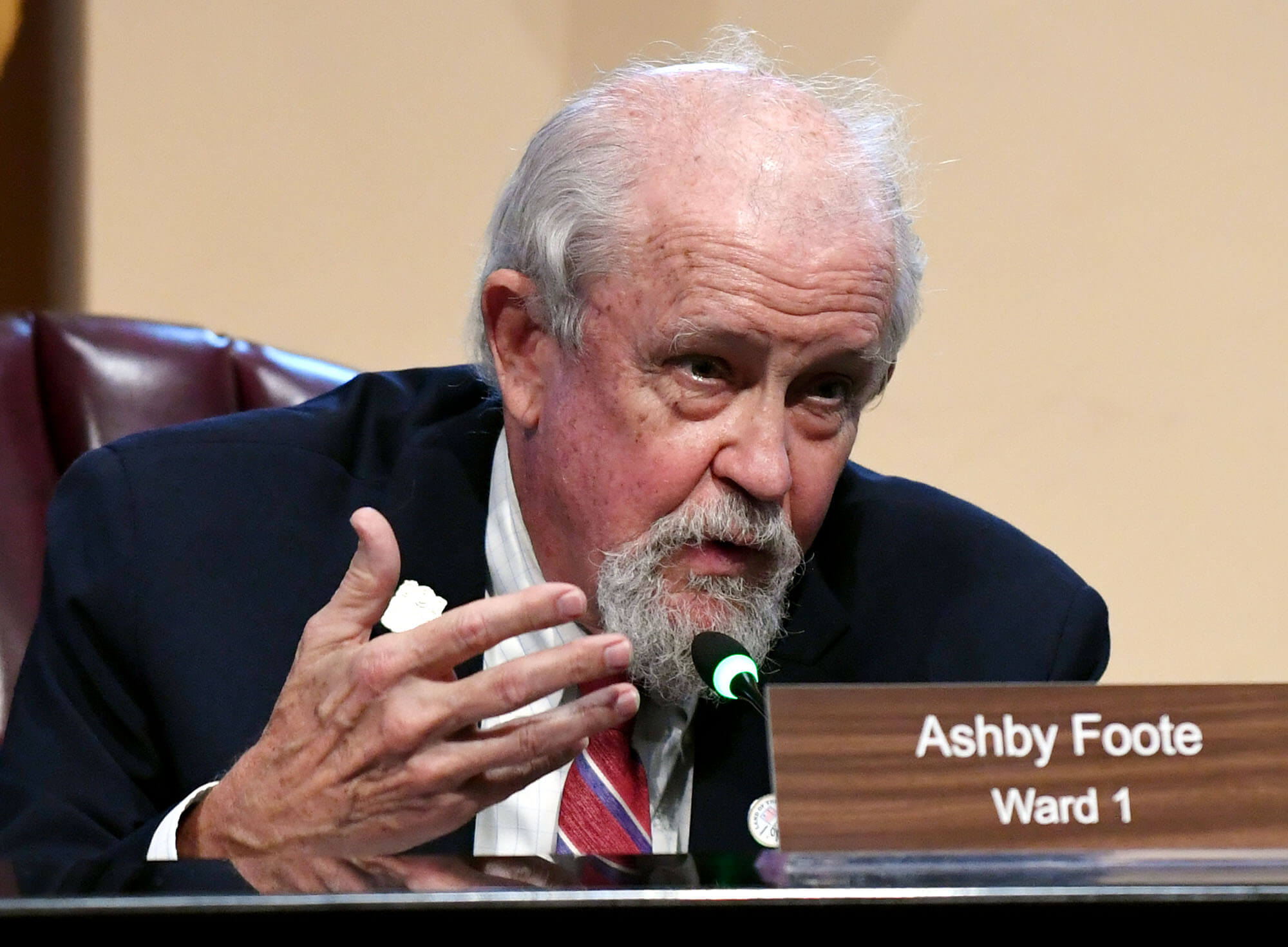
Ward 1 City Councilman Ashby Foote offers his opinion on data center development in Jackson during a City Council meeting held at City Hall, Monday, July 6, 2026. Credit: Vickie D. King/Mississippi Today
Ward 7 Council Member Kevin Parkinson asked Hinds County Economic Development Authority Executive Director Hunter Gardner whether a data center moratorium would kill any potential project.
Gardner told the council that data center developers are primarily concerned with energy availability, speed and minimizing risk. He added that a data center moratorium could indicate to businesses that there would be extra hurdles to overcome and might dissuade some.
“I think they’re a lot less dangerous than some people perceive when they’re properly permitted and properly located,” Ward 1 Council Member Ashby Foote said.
In May, Foote wrote an opinion column about data centers and how they could bring “gushers of ad valorem tax receipts that will last for decades.” Jackson has struggled for years with a declining tax base as its population has shrunk. This year’s city revenue is falling short of what was budgeted.
Economic development for Jackson?
The debate around data centers has also become a conversation about economic development in Jackson. Residents and officials asked why the city has not seen large business projects as other cities have grown and seen private investment.
Tina Clay said that she wants development besides a data center that would bring “jobs and revenue and taxes.” Other council members said they want to see more grocery stores in the city.
Gardner, who has been in the job for about a year, said that it is “critical that we have positive economic development in Jackson.” He stressed the need to have a long-term plan and promised to engage with the council.
Jackson residents weigh in on six-month moratorium
Council President Brian Grizzell clarified at the beginning of the packed evening meeting that the council is only discussing a moratorium and not changes to the city’s zoning ordinance.
Grizzell proposed a six-month data center moratorium just as the city Planning Commission was considering an application to rezone land for a potential data center in northwest Jackson. The application by the New Jersey-based developer is being delayed until the city finalizes regulations.
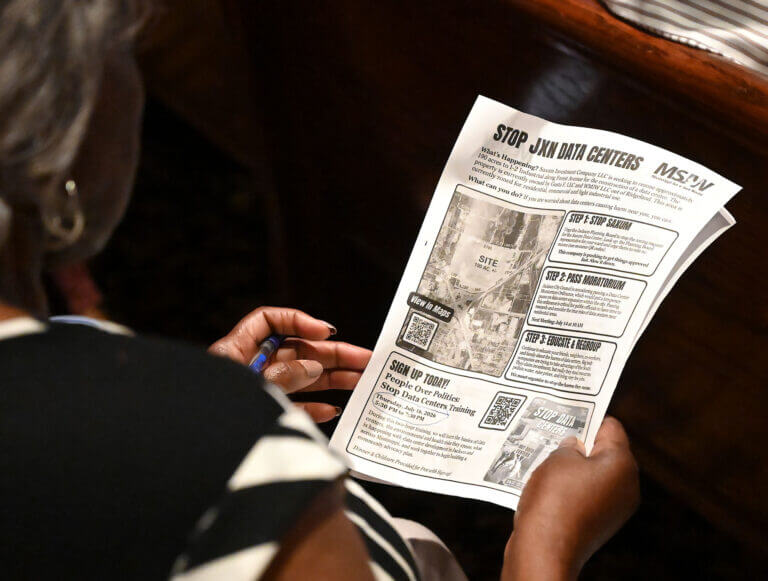
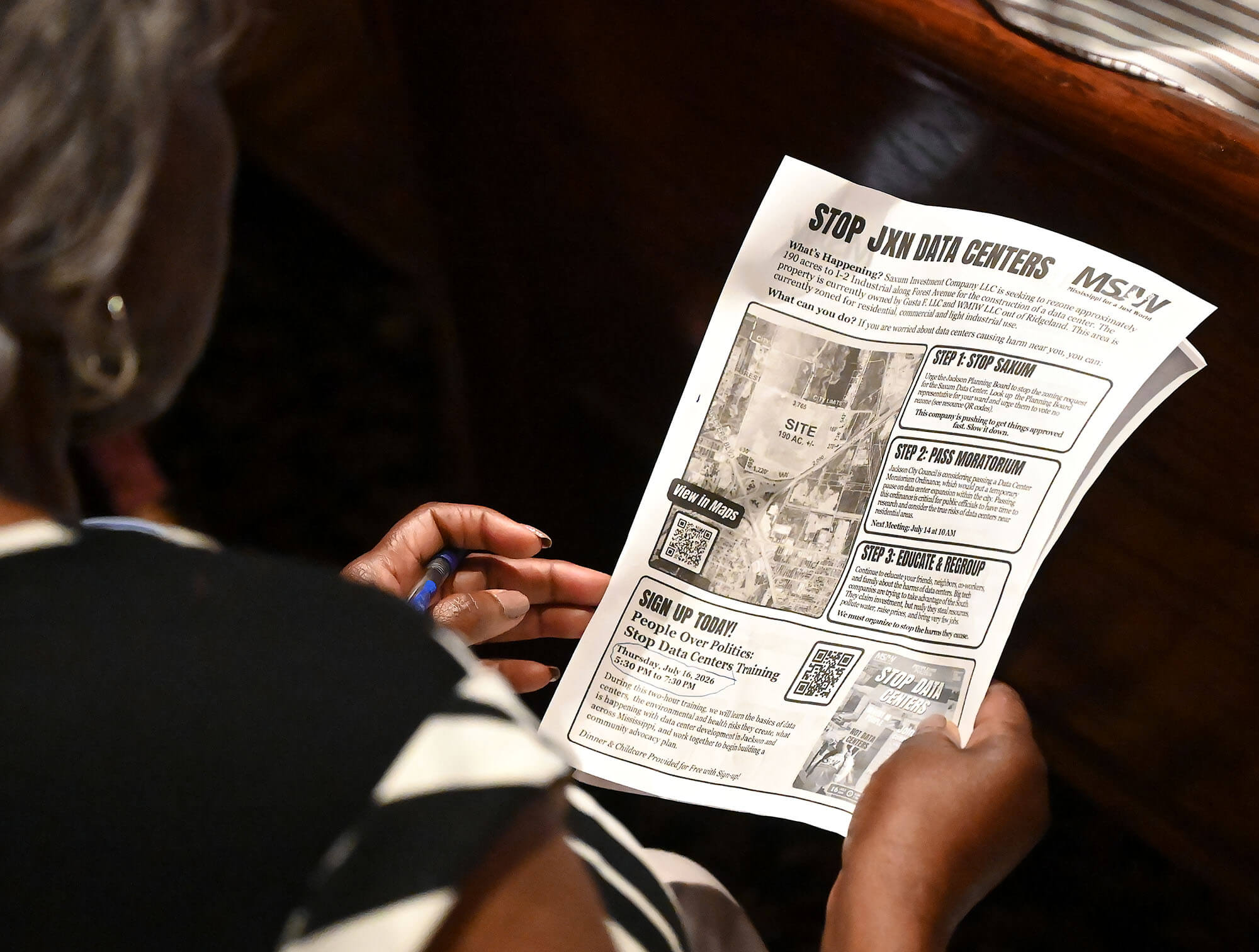
The application was met with swift community pushback. A slew of community meetings have been held where residents have overwhelmingly expressed concern about the environmental and health impact of a data center in Jackson, especially whether a data center would strain Jackson’s water system and other utilities.
Many of the same concerns were reiterated at Monday’s meeting with some calling for a permanent ban on data centers and others for more evidence based research to be done on the topic.
“Ideally, the council would ban development and expansion of data centers. But in lieu of that, a temporary moratorium is vital,” Jackson resident Jackie Warren Tatum said.
Jackson is not the first city to enact local rules governing data centers. Clarksdale rezoned a property with conditional uses for a data center as part of its approval. Clinton and Ridgeland recently amended their zoning ordinances to regulate data centers after construction on such projects had begun within the cities.
Grizzell said that it was important to “have the regulations in place to make sure that we maintain a sustainable city and also protect the lives of Jacksonians.”
The six-month moratorium will be considered at the next regular city council meeting on July 14, at 10 A.M.
Audio recording is automated for accessibility. Humans wrote and edited the story.
Former Jackson Mayor Chokwe Antar Lumumba and former City Council member Aaron Banks on Monday pleaded guilty to conspiracy in a federal corruption case that rocked Mississippi’s capital city.
Their pleas come a week after Hinds County District Attorney Jody Owens made a similar plea in the case and a week before Lumumba and Banks were set to go to trial.
A federal grand jury indicted Lumumba, Owens and Banks in 2024 on multiple charges.
Former Jackson City Council Member Aaron Banks enters the federal courthouse in downtown Jackson on Monday, July 6, 2026, to plead guilty in a corruption case. Credit: Vickie D. King/Mississippi Today
On Monday, Lumumba pleaded guilty to one count of conspiracy to commit bribery, wire fraud and money laundering, with Banks pleading guilty to one count conspiracy to commit bribery. They face penalties of up to five years in prison, a fine up to $250,000, and the government on Monday said it will be requesting restitution.
Sentencing for the three has been tentatively set for Oct. 15, and they will remain out of jail until then.
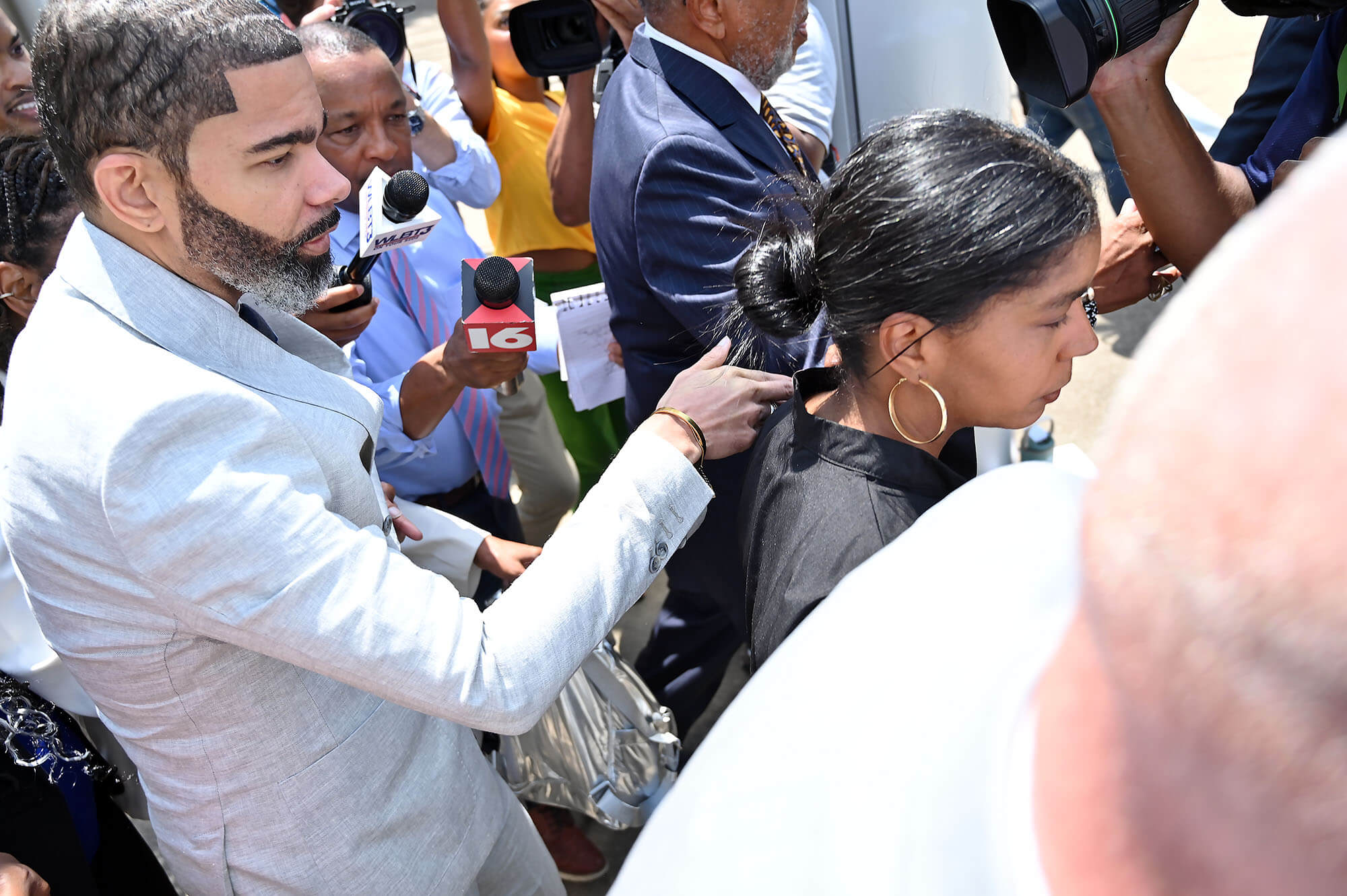
As Lumumba left the packed courtroom, some of his supporters placed their hands on their chests. Wiping tears from his eyes, he received hugs from his friends and family members. Outside the courthouse, the former mayor was swarmed by reporters as he was ushered to his car. He declined to comment, but lawyers from the National Conference of Black Lawyers defended his legacy and said the case reflected “double standards.”
“For all his supporters out here, as you can see, the legacy has not been tarnished,” said attorney Jaribu Hill. “What’s been tarnished, if anything, is the ongoing facade of justice.”
Lumumba’s prosecution was the continuation of a long history of Black elected officials facing disproportionate scrutiny, the attorneys said.
“Today’s proceedings mark the conclusion of one chapter in Mayor Lumumba’s legal journey, but they do not end the larger national conversation about equal administration of justice,” said Mawuli Davis, an attorney for the national group. “Mayor Lumumba accepted accountability for the count before the court today. That decision should not obscure the broader historical reality that Black elected officials have too often exercised leadership under a level of prosecutorial scrutiny and political pressure that is neither equally applied nor equally experienced.”
National Conference of Black Lawyers Credit: Vickie D. King/Mississippi Today
Banks, accompanied by his father and wife, did not address reporters as he left the federal courthouse.
The three officials served as Democrats. Lumumba was mayor from 2017 until mid-2025, when he lost his bid for reelection. Lumumba had vowed to transform Jackson into “the most radical city on the planet.”
Owens was first elected in 2019 as the top prosecutor in Mississippi’s largest county. A self-proclaimed “progressive prosecutor,” he had run with national support. He resigned when he pleaded guilty last week.
Banks served as Ward 6 councilman from 2017 to 2025, representing south Jackson. A political organizer, he started working for the city during Lumumba’s father’s mayoral administration in 2013.
The pleadings prevent what was a highly anticipated trial from taking place, meaning the public will not see the full extent of the federal investigation into Jackson.
Owens had planned to argue the federal government entrapped him. Banks had intended to argue his innocence at trial, according to court documents, while Lumumba primarily contended in court filings that he did not take an “official action” in exchange for bribes from agents posing as developers.
The Mississippi Bar Association on Monday asked the state Supreme Court to immediately suspend Owens from practicing law because of his guilty plea.
Beginning as early as 2023, two undercover FBI agents posed as real estate developers in a sting that mimicked operations the federal authorities have brought in other cities. The two agents sought to build a convention center hotel in downtown Jackson on a plot of land the city had previously obtained a federal loan to develop.
Prosecutors allege the scheme worked like this: The agents, purporting to represent a company called Facility Solutions Team, funneled money through an unsuspecting Owens to Lumumba and Banks, who were then supposed to help the developers secure the city’s approval to use federal funds to build a downtown convention center hotel.
In the indictment, prosecutors alleged that Lumumba accepted $50,000 in campaign donations in exchange for assisting the developers in obtaining the city’s blessing.
The indictment alleges that while Lumumba was on a yacht off the coast of Florida, he discussed the payment Owens was going to give him on behalf of the developers. Then he placed a call asking a city employee to shorten the bid window for the hotel development.
Lumumba, 43, described this action as “ministerial at best,” according to court documents, thus not in line with how federal law and the courts have defined an official action a public official must take as part of a quid pro quo.
Two others had already pleaded guilty in the scheme: Another former City Council member, Angelique Lee, and Owens’ cousin and associate, Sherik “Marve” Smith, who pleaded to acting as a go-between for the district attorney with both Lumumba and Banks.
Federal investigators were drawn to Jackson as early as 2022 after years of public accusations of corruption among its leaders. In just one instance, a city councilmember wrote the U.S. Attorney’s Office asking them to investigate Lumumba while he was mayor.
Unlike his co-defendants, Banks, 48, did not agree to the government’s best offer, the assistant U.S. attorney prosecuting the case, Dave Fulcher, told the judge. Banks’ previous offer would have required him to cooperate with the federal government, a difference his court-appointed lawyer, Carlos Tanner, described as “only technical.”
Banks made the decision to plead after Owens took the plea agreement last week.
The courtroom was standing-room-only for Lumumba’s plea. His head was bowed as Fulcher read out the facts that he said the government would have proven at trial. U.S. District Judge Daniel P. Jordan III asked the former mayor if he agreed with the facts the prosecutor described.
“I accept the facts that he just said,” Lumumba responded.
The judge paused and reiterated his question.
“I agree,” Lumumba said.
Update, 7/6/2026: This story has been updated to add information about former Jackson Mayor Chokwe Antar Lumumba and former Councilman Aaron Banks pleading guilty.
As the now-former district attorney cleaned out his office on the fifth floor of the Hinds County Courthouse, more routine scenarios unfolded in the courtrooms below.
In Circuit Judge Debra Gibbs’s courtroom Wednesday, a 26-year-old man pleaded guilty to second-degree murder and received a 40-year sentence.
That same day, another man indicted for aiding and abetting the 26-year-old appeared in Circuit Judge Adrienne Wooten’s courtroom for a status hearing. To the judge’s irritation, the man’s attorney was absent and hadn’t properly notified the court, meaning the judge wouldn’t receive an update on the man’s case.
She sighed audibly into the microphone and sent the man home.
Defendants hadn’t checked in with their public defenders. Deputies yelled their names loudly into the courtroom hallways, to no avail. Young men waiting for their cases to be called sat in the audience, hunched over and alone. Families watched anxiously as their shackled loved ones faced the judge and were sent back to the Raymond Detention Center.
Attorneys discussed plea offers, missing evidence and motions for continuances. The prosecutor, Deputy Chief Gwen Agho, assured Wooten that if the judge called a case to trial in August, “we can be ready.”
Hinds County District Attorney Jody Owens speaks outside the federal courthouse in Jackson after he pleaded guilty to a conspiracy charge on Monday, June 29, 2026. Credit: Richard Lake/Mississippi Today
For all the headlines generated by Owens’ alleged and admitted actions, the bulk of the work prosecuting cases in Hinds County is undertaken by some 15 assistant district attorneys in five courtrooms, oftentimes at docket calls just like this one.
And the work of the district attorney’s office is continuing even as its leadership is in limbo. The Mississippi Bar Association on Monday asked the state Supreme Court to immediately suspend Owens from practicing law because of his guilty plea.
Whoever takes the reins next at the Hinds County District Attorney’s Office, the work of prosecuting cases will continue. State law says the governor will call an election to fill the office of a district attorney who has resigned. Republican Gov. Tate Reeves will make an emergency appointment to fill the vacancy until an election is held.
“If the person who leads Ford Motor Company resigns, they still make cars,” said Matt Steffey, a professor at the Mississippi Christian University School of Law.
After Owens, a Democrat, won election in 2019, critics sometimes commented that the former head of the Southern Poverty Law Center’s Mississippi branch wasn’t a career prosecutor and had never tried a case before.
On paper, that’s what a district attorney does. According to state statute, the job of a district attorney is to handle “all criminal prosecutions and all civil cases in which the state or any county within his district may be interested.”
But in Hinds County, more than 2,000 felony cases are resolved each year – by far the busiest criminal docket in the state.
The district attorney can’t address the enormous case load alone on top of other duties, such as lobbying at the Capitol, serving on appointed commissions, signing checks, seeking grants and making budget requests to the board of supervisors.
Not to mention campaigning for reelection.
With that workload, the job of Hinds County district attorney becomes more about managing and delegating, said Jim Kitchens, a former Mississippi Supreme Court justice who was a district attorney earlier in this career.
“Most of the trial work – the pick and shovel work, if you will – is done by assistant district attorneys,” he said.
Of course, when tasked with prosecuting a high-profile case, Kitchens said the district attorney will sometimes step in. Owens did that a few times early on in his five and a half years in office, such as in the case of a Provine High School teacher who was convicted in November 2020 of fondling a student.
But in the vast majority of cases, it is the assistant district attorneys who are tasked with carrying out the district attorney’s agenda.
For Owens, that agenda was encompassed by the phrase, “Smart Justice.” During his initial campaign, Owens described the slogan as encompassing a number of policies that could reduce mass incarceration in Hinds County, including an increased emphasis on pre-trial diversion for people who had never been accused of a crime before, as well as sending more people to drug court.
But when it came to prosecuting violent cases, the policy was more nuanced. In a 2023 annual report, Owens described “Smart Justice” as “evaluating every case in terms of the best result for both the victim and the community.”
To that end, despite campaign promises that his office would not charge people for “low-level marijuana possession,” Owens did not have a blanket policy against prosecuting certain drug crimes. Instead, assistant district attorneys evaluated whether a person had a criminal history or if they faced violent charges in addition to the drug offense, according to office policies.
In most cases, assistant district attorneys were given latitude to make their own plea negotiations, said Joe Hemleben, a former assistant district attorney who worked under Owens from 2022 to 2025.
But in an effort to push back on the perception that Hinds County was not tough on violent offenses, Owens was involved in every plea decision for murder cases, with most offers starting at the maximum sentence of 40 years for second-degree murder.
Prosecutors had to write a memo to Owens justifying why a plea deal was warranted, according to an office handbook. In response, Owens often pushed for longer sentences – a stance that rankled some defense attorneys who expected more mercy from a self-proclaimed “progressive prosecutor.”
Another way Owens brought more uniformity to the office was through the adoption of an electronic case management system called Karpel. Under his predecessor, the controversial Robert Shuler Smith, the office worked with paper files.
With the newer system, prosecutors can request case files from the police, who upload digital documents that can be automatically transferred to the defense.
Still, issues with missing discovery persist for reasons beyond the district attorney’s control.
Toward the end of Wooten’s docket call, the judge called a defendant named Sydney Wright to the stand. The shackled man walked from the jury box, where he had been sitting with the other detainees, to the podium to stand next to his attorney.
“The status is basically the same,” said public defender Zach Adkins, who was assigned earlier this year to defend Wright against charges of aggravated assault and car burglary.
Adkins explained that he would have trouble moving the case forward because the discovery he had received so far lacked two files he believed were important to Wright’s defense: a recording of an interview with one of Wright’s co-defendants, and a record reflecting an interaction Wright had with police before he was arrested where he had allegedly offered information Adkins believed might be used against him.
Jackson Police Department Detective Stephanie Burse had referenced the incidents in her affidavit, but the prosecution didn’t include the documents in the file that Adkins received.
The prosecution seemed just as confused as Adkins.
“What should I be looking for, a report, a video?” asked Agho, the lead prosecutor in the courtroom.
“I don’t know,” Adkins responded. “Something that documents the interaction.”
Adkins then informed the judge that the name of one of Wright’s co-defendants was misspelled in the indictment.
Wooten called the next case. Another defendant stood before her without his lawyer.
“He didn’t know I had court today,” said the man facing a capital murder charge that carries life in prison without parole.
Update, 7/6/2026: This article has been updated to show that the Mississippi Bar Association is asking the state Supreme Court to immediately suspend Jody Owens from practicing law.
Audio recording is automated for accessibility. Humans wrote and edited the story.
For the third year in a row, Gov. Tate Reeves opted out of a state-federal partnership that would have given summer grocery benefits to roughly 320,000 Mississippi children who rely on free meals during the school year.
Thirty-eight states and the District of Columbia are enrolled in the program, called SUN Bucks, which doles out $120 for each eligible child during the months when school is not in session. By opting not to participate, Reeves turned down about $38 million in federal funding.
Statewide, nearly three-quarters of students rely on free or reduced-cost school meals for consistent nutrition, according to the Mississippi Department of Education. In the summer, many of those children go hungry. On an average day in the summer of 2023, only 1 in 4 Mississippi children who depend on free or reduced-cost school meals made it to an in-person meal site, according to a national study conducted by the Food Research and Action Center.
Shelby Wilcher, the governor’s spokesperson, told Mississippi Today that Reeves opted out of SUN Bucks because it was a pandemic-era program that was never meant to be permanent.
“This program was originally intended to be a COVID-era policy to help bridge the gap during summer months while schools were forced to close,” Wilcher said in an email to Mississippi Today.
However, Congress established the SUN Bucks program in 2024, long after the pandemic began. A brief released by the U.S. Department of Agriculture calls the program permanent. Wilcher then said that the program is “essentially the permanent continuation of Pandemic EBT.”
Kelsey Boone, a summer EBT expert with the Food Research and Action Center, said this was an incorrect — albeit common — response. SUN Bucks is based on a series of successful pilot programs dating as far back as 2011. Boone also said she believes any program proven to reduce childhood hunger should be implemented regardless of whether the country is in a pandemic.
“Summer EBT existed before pandemic EBT existed,” Boone said. “This is not a program that came out of a pandemic-era program. It is its own tested and evaluated program that is known to increase nutrition and decrease food insecurity in families.”
‘Why summer EBT was created’
Mississippi’s statewide summer meals program offers boxed lunches to children at 320 sites. Seventy-one of those locations allow families to pick up meals for the week in one trip.
The option to pick up a week’s worth of meals helps, but it doesn’t solve the problem of transportation, said Boone, which has become a greater concern amid rising gas prices. It also doesn’t address the difficulty for low-income parents needing to take time off work to go to the sites at a specific time.
The fact that 3 in 4 Mississippi children who rely on school meals don’t make it to these sites highlights significant access problems and is “why summer EBT was created,” Boone said.
Families can use EBT benefits at locations that are closer to home and shop at convenient times.
In 2024, after Reeves first opted out of SUN Bucks, a Jackson-based nonprofit called Springboard to Opportunities began its own version of the state-federal program. It currently reaches 327 families and 611 children in Jackson.
A family’s ability to pick out foods they prefer is dignifying and necessary, especially when accounting for cultural differences, said Paheadra Robinson, director of strategic initiatives at Springboard to Opportunities. Robinson believes that choice shouldn’t go away for low-income families.
“I don’t think we should be in the habit of treating people as second-class citizens simply because they have a need that is going unmet, and the government has the ability to support them in meeting that need,” Robinson said.
An internal survey conducted by Springboard to Opportunities in 2025 showed that summer EBT disbursement resulted in an 83% reduction in hunger among families who participated.
That’s the case for Jasmine Samuel, a single mother of three boys ages 4, 6 and 12.
Samuel, a lifelong Jacksonian, works at the Bingo Depot in South Jackson, and she said she struggles to make ends meet during summer. During the school year, her children rely on free school meals. When school lets out, Samuel picks up extra food and childcare costs without additional income.
Her boys are growing fast and are always asking for snacks, often immediately after leaving the table from lunch or dinner.
“I’m like, ‘I thought I had at least another 45 minutes!’” she laughed.
Samuel remembers painful experiences in her past when her children were hungry, and she knew it would be difficult to make the food in her pantry last until the next paycheck. She said she has had to come up with creative ways to keep their mind off hunger, such as making popcorn and getting them excited about watching a movie.
Before she began receiving summer EBT benefits, buying groceries was an anxiety-inducing ordeal. She would count her last dollars at the register and was often forced to put back items she could not afford as other shoppers standing in the checkout line rolled their eyes.
“I don’t like to be embarrassed at the counter … I dreaded it sometimes,” Samuel said. “I feel like now I can go grocery shopping.”
Samuel is no stranger to hard work. The youngest of four children, she began working at a grocery store at 17 to help her mother cover household expenses. She delayed going to college, and while it’s been hard to go back, she has not given up hope. In 2024, she completed partial coursework to become a pharmacist.
As a parent, Samuel said she tries to balance teaching her kids the value of hard work and protecting them from feeling stigmatized by poverty.
A gateway to arts and culture across the state, The MAX features a museum celebrating Mississippi’s creative legacy, a two-story hall of fame showcasing the state’s groundbreaking artists, and dynamic studio and performance spaces where people of all ages explore their creative passions.
Now on view at The MAX, John Jennings: Build Your World, is an immersive new experience from one of the most innovative storytellers working at the intersection of comics, speculative fiction, and Afrofuturism.
Jennings fell in love with the imagined worlds in the Marvel comic books his mother gave him as a young boy in Flora, Mississippi. Filled with superheroes who helped people and fought against oppression and evil, those comics inspired Jennings to build his own worlds and “create comics that make people feel the way I felt as a kid… see[ing] what I saw when I opened a Marvel comic book.”
Now a New York Times bestselling, award-winning graphic novelist and a professor of media and cultural studies at the University of California at Riverside, Jennings has returned home for an exhibition that explores his extraordinary visual storytelling and world-building through four creative projects.
In Silver Surfer: Ghost Light (Marvel Comics), Jennings reinvents a forgotten Black character from the pages of the Marvel comic books he grew up reading, transforming Al B. Harper from a plot device to a cosmic guardian. The complex process of working with a behemoth like Marvel and its team of creatives is given a comprehensive overview, alongside art of the new Marvel hero Jennings created.
Two dozen original drawings from Kindred: A Graphic Novel Adaptation (Abrams ComicArts) show how Jennings builds on Octavia Butler’s seminal work of Black science fiction to create new worlds, using different sketch styles and color schemes to differentiate California in the 1970s from antebellum Maryland in the early 1800s.
Blue Hand Mojo: Hard Times Road (Rosarium Publishing), a solo project conceived, written, drawn, and colored by Jennings, blends history with folklore and magic in a gritty graphic novel set in 1930s Chicago. Original watercolor artworks show how Jennings richly layers new worlds using Mississippi culture.
Another solo project, Kenny Dreadful and the Hainted Hoodie,presents an original Southern Gothic tale that blends horror, folklore, and coming-of-age themes through the lens of a magical hoodie haunted by ancestral spirits. Jennings has complete control over every aspect of Kenny’s story, with early concept art alongside annotated sketches, showing influences from Mississippi folklore, African spirituality, and horror traditions.
Imagining futures is the central theme of Build Your World. Each project highlights Jennings’s unique ability to blend speculative fiction with Southern Gothic sensibilities. Soundscapes and interactive technology paired with sketches, storyboards, and finished art, allow visitors to explore how he has built entire worlds, bringing Black characters to the fore and infusing each alternative reality with the culture that shaped him.
For Jennings, “You can’t separate my work from Mississippi. It’s in every ghost and every future I imagine.”
Jennings returned home last fall as part of a site visit to plan the exhibition, and again in June for the opening of Build Your World. During that initial trip, Jennings traveled to the Delta, with stops at Graball Landing near Glendora, believed to be where Emmett Till’s body was brought from the Little Tallahatchie River; Dockery Plantation, home to blues legends like Charley Patton, Robert Johnson, Howlin’ Wolf, “Pops” Staples, and David “Honeyboy” Edwards; and the famed crossroads from the Robert Johnson blues mythology in Blue Hand Mojo.
These places hold particular significance for Jennings, who is working on a graphic novel about Till and considers the blues a major influence on his work—a connection he traces back to spending time at a juke joint “too young,” he once admitted.
On view through March 27, 2027, Jennings has several return trips planned during the exhibition’s run, including an artist residency this fall where he will travel the state to meet with students and discuss his work, followed by a visit to the Mississippi Book Festival in Jackson.
Related programming, including workshops on creating handmade zines, making your own monsters, and receiving hands-on guidance from Jackson Comics artists, will be offered at The MAX through next spring.
Audio recording is automated for accessibility. Humans wrote and edited the story.
Crops are in the ground, the weather is cooperating, soybean prices are up slightly from 2025, and China — the biggest buyer of U.S. soybean exports — is once again placing orders after a trade agreement ended the country’s purchasing freeze last fall.
But while morale is higher among soybean farmers as the2026 growing season gets underway, the cost to plant crops remains high, and U.S. Department of Agriculture data shows there is still a long way to go before China’s purchases reach pre-trade war levels.
“There have been some positive movements in trade relations with China, specifically with soybeans, that have caused markets to improve over last year,” said Stefan Maupin, executive director of the Tennessee Soybean Promotion Council. “However, we are definitely not where we were in years past. For most farmers out there, the big question in front of them is, will it get back?”
Soybeans are a major agricultural product nationwide, covering about 10% of all U.S. farmland. Roughly 40% of U.S. soybeans are exported, and in recent years, around half of exported beans went to China.
Soybeans are the second-largest agricultural product in Mississippi behind chickens. Valued at around $1.6 billion a year, almost all of the state’s soybeans are destined for international markets. The state ranked 11th in U.S. soybean production in 2025, producing 97 million bushels on 1.7 million acres, according to the Mississippi State University Extension Service and USDA.
Will Maples, an agricultural economist with the Mississippi State University Extension Service, said some markets have shown modest improvement this winter, including a 27% increase in soybean planting projections.
“We have seen a decent rally in soybean and cotton prices this winter. Margins are still expected to be tight, but things are slightly better,” Maples said in an April 8 Extension Service report. “Last year, tariff uncertainty weighed on soybean prices and contributed to reduced acreage in Mississippi. This winter, soybean prices have strengthened, making them more competitive relative to other crops.”
China stopped purchasing U.S. soybeans in 2025 during tariff negotiations with the Trump administration, leaning instead on soybeans from South American trade partners. China ultimately agreed to purchase 12 million metric tons of soybeans in 2025 and at least 25 million metric tons each year through 2028.
USDA Deputy Secretary Stephen Vaden said he is confident that China will meet those numbers.
“They have the entire marketing period to meet the 25 million metric ton commitment for this year,” Vaden told Brownfield, an agriculture-focused news outlet.
The current marketing period runs from September 2025 to September 2026.
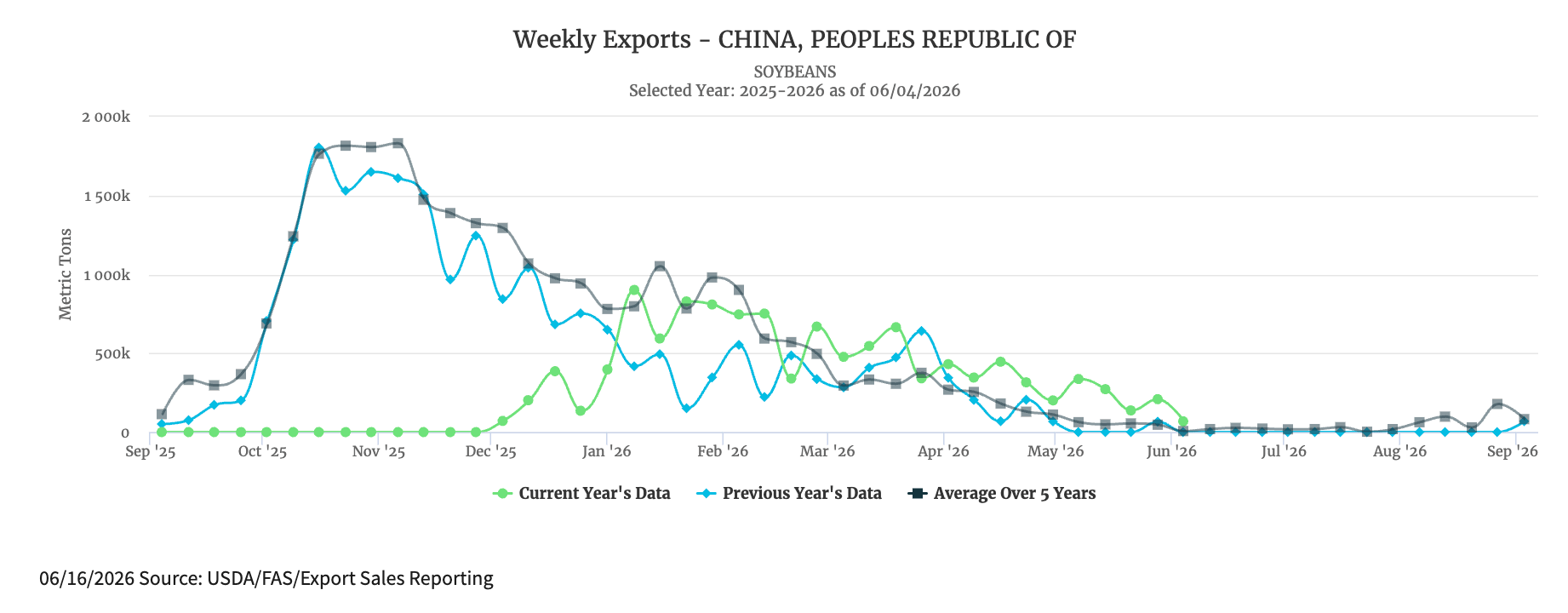
Exports to China from January through March were up 57% compared to last year, USDA data shows. That’s explained by an increase in sales to China during the off-season in response to the trade agreement, said Andrew Muhammad, a professor of agricultural and resource economics at the University of Tennessee.
In other words, China is now buying the soybeans that U.S. producers stored in fall 2025, when China halted its usual buys. Typically, China purchases most of its American soybeans in the fall, turning instead to Brazil and Argentina for soybeans during the South American harvest season in the spring.
“But if we look at the accumulated total for the actual marketing year, going back to September, exports to China are still lagging what we did in years past,” Muhammad said.
From the start of September through March, China accounted for less than 30% of U.S. soybean exports — about half of their volume in previous years.
“We won’t really know until the end of this year whether or not China is able to keep up with these commitments,” Muhammad said.
Asked about China’s total soybean purchases lagging behind previous years, a USDA spokesperson stated that President Donald Trump “has made clear he will hold China to its commitments.”
“President Trump executed another historic deal with China after the previous administration refused to hold them accountable to its future purchase of American soybeans, sorghum, beef, and other commodities,” the spokesperson stated.
Long-term outlook still ‘daunting’
“The farmers and everybody with whom they do business feel better about that positive movement in the negotiations, but they’re not naive,” Maupin said of Tennessee soybean farmers. “They know … there is that potential that (China) will not fully buy what they have committed to buying.”
What really matters is whether commodity traders believe that China will fulfill those commitments, Maupin said. Market prices are currently stronger this year, but “the jury is still out on that.”
And despite improved prices compared to 2025, University of Tennessee data predicts that the price of soybeans at average yields still won’t be high enough for farmers to break even.
“(Farmers) are now in their third year of the question, how much money will they lose on this crop?” Maupin said.
The University of Tennessee estimated total losses of nearly $110 million for soybean farmers last year, on top of multimillion-dollar losses in 2024.
Those who are still farming this year likely made “major adjustments” to try to lower their expenses and input costs as much as possible to weather the financial hardships of the last two years, Maupin said, but trying to just break even is not sustainable, particularly when many farmers depend on financing tied to their property and equipment.
Government stockpiles and growing global markets
North Dakota farmer Tyler Stafslien stands in front of storage silos holding grain and soybeans. The tariff war with China forced Stafslien to store more of his soybeans in the 2025 harvest season, Ryder, North Dakota, Nov. 14, 2025. Credit: Gabrielle Nelson/Buffalo’s Fire
Muhammad said this type of trade deal also means governments are involved in agricultural markets.
“When you say to China, ‘We need you to buy so many soybeans,’ the only reason they could pull that off is because we’re not talking about capitalistic market purchases, we’re just talking about government stockpiling,” Muhammad said.
While the trade deal may appeal to U.S. producers, “once tensions die down, they’ll just start using what they’ve stockpiled. It almost comes across as a Band-Aid for a much more serious problem … the trade tensions between the U.S. and China,” he said.
Vaden said Trump sets targets in his trade deals, making outcomes measurable. The USDA did not respond to questions about the long-term effectiveness of trade targets.
Maupin said China has been known to stockpile goods and then cease purchasing or put excess goods back out on the world market.
It’s this market instability that encourages farmers to develop relationships with other countries and find domestic uses for soybeans, Maupin said. Commodity farmers pay a percentage of the sale price of their products — called “checkoff dollars” — toward research and new market development.
During a 2025 Mississippi agriculture legislative committee meeting, one idea that was floated was building a processing plant in the state to create more demand and expand capabilities.
Vaden said that while China is an “important market” for the U.S., Canada and Mexico buy more U.S. agricultural products overall.
“We’re not just focused on China,” he said. “We’re focused on our larger trading partners here in North America, as well as the many other markets that we need to open, because ultimately this is a game of addition. If we focus too much on any one country, we’re not keeping our eye on the overall ball, which is increasing sales worldwide.”
Maupin said representatives from the European Union visited Tennessee last growing season to see if the state’s soybean production meets their sustainability goals. Their feedback was positive, Maupin said.
The U.S. is also looking to develop relationships with nations that could use soybean meal to feed livestock, or as a protein source for human consumption.
The country has exported more soybeans to Egypt, Indonesia, Pakistan and Japan since September, partially offsetting the decrease in sales to China, Muhammad said.
“At the end of the day, worldwide, the demand for soybeans as an ingredient, mostly in animal feed, remains high, whether it’s in China or Mexico, the EU, or Egypt,” Maupin said.
Mississippi Today Economic Development Reporter Katherine Lin contributed to this report.