Audio recording is automated for accessibility. Humans wrote and edited the story.
Allen Siegler, mental health reporter at Mississippi Today, has been named a finalist for the 2025 National Institute for Health Care Management (NIHCM) Awards for his investigation into how Mississippi officials spent the state’s opioid settlement funds.
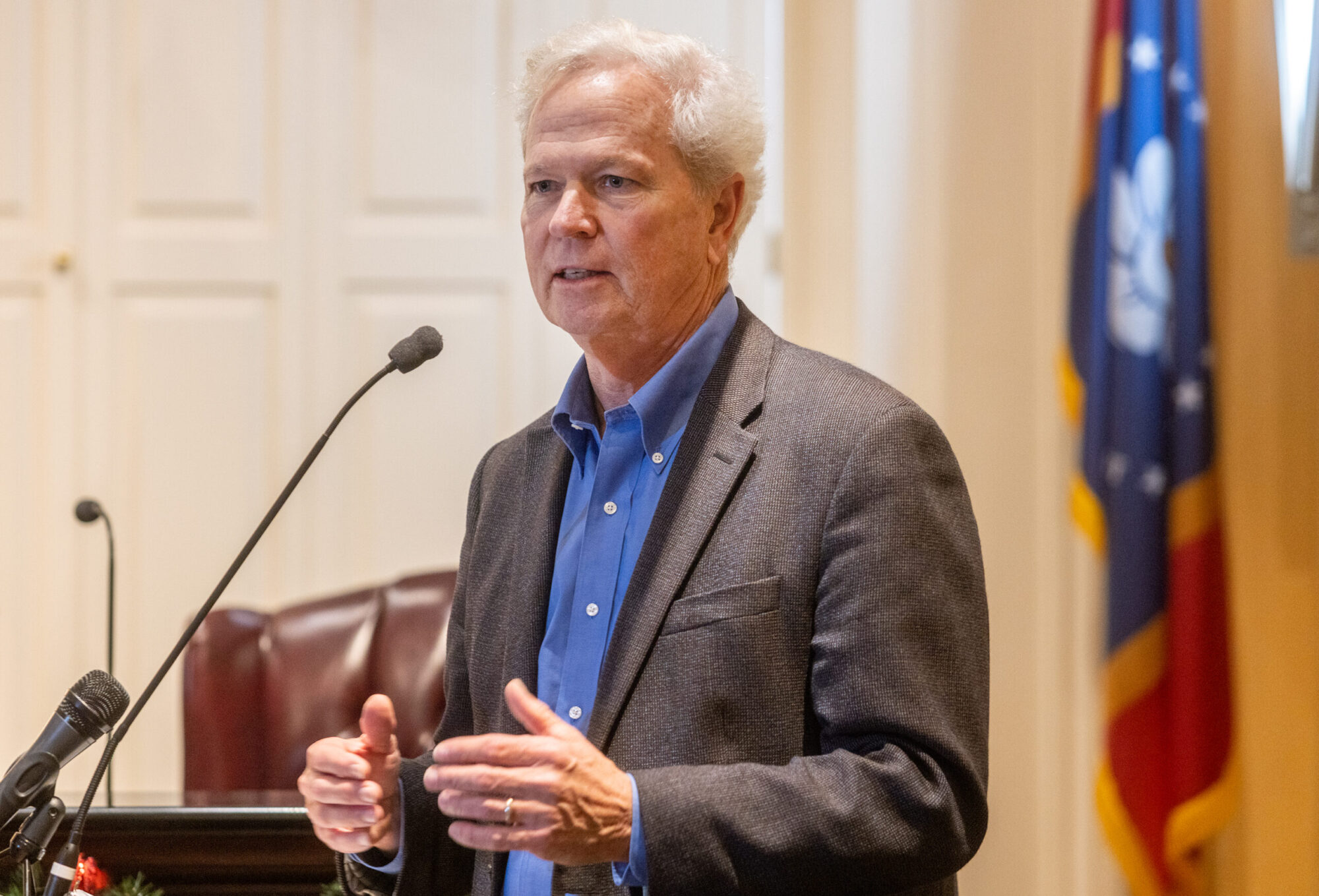
Allen Siegler is a Health Reporter at Mississippi Today. Credit: Vickie D. King/Mississippi Today
In September, Siegler’s Black Box series investigation found that Mississippi spent less than 1% of over $124 million the state had received so far on measures that would prevent more overdose deaths. Since 2000, more than 10,000 Mississippians have died as a result of opioid use.
Siegler earned a spot among 42 finalists from local, state and national news outlets from across the country through the competition judged by independent panels and hosted by the NIHCM Foundation, a nonprofit, nonpartisan organization that relies on evidence and collaboration to explore issues in health care and policy research.
“These stories and studies represent the best of health care journalism and policy research – work that brings to light important stories and strengthens the evidence base on the nation’s most pressing health care challenges,” said Andrew Dreyfus, CEO and President of the NIHCM Foundation, in a released statement.
It is an honor for his newsroom’s work to be recognized in this way, Siegler said, but he finds the moment bittersweet.
“At the same time, it’s devastating to find that financial resources intended to be life saving for Mississippians struggling with addiction, like Chelsea Aultman Sadler, went unspent or for other purposes when they were needed most,” Siegler said.
After his investigation’s initial launch, Siegler has continued to cover how Mississippi lawmakers and officials award contracts and respond to the overdose crisis.
“As recent events at the Legislature show, the Black Box reporting by itself is not enough to guarantee all funds will be spent for their intended purpose — to end one of the worst public health crises in modern history,” Siegler said. “But we will continue to advocate for truth and transparency around the settlements, while documenting how the most powerful Mississippians manage them.”
Winners will be announced in late April in Washington, D.C.
Each year since 2022, Mississippi has been paid tens of millions of opioid settlement dollars, money that is supposed to help respond to the overdose public health crisis. But 15% of those dollars — the money controlled by the state’s towns, cities and counties — is unrestricted and being spent with almost no public knowledge. Mississippi Today spent the summer finding out how almost every local government receiving money has been managing the money over the past three years. Read The Series
Audio recording is automated for accessibility. Humans wrote and edited the story.
Jarvis Dortch, executive director of the ACLU of Mississippi and a former state lawmaker, warns of a pending Supreme Court decision from a Louisiana case and efforts in Congress that would undermine the Voting Rights Act and potentially turn back the clock on voting rights and redistricting in Mississippi and elsewhere.
Audio recording is automated for accessibility. Humans wrote and edited the story.
House Speaker Jason White on Monday night said legislators were working on a proposal to revive legislation to enhance the regulation of pharmacy benefit managers and may ask Gov. Tate Reeves to call a special legislative session later this week if legislators reach an agreement.
The Speaker’s remarks came as lawmakers finalized the bulk of the state’s $7.36-billion budget for the next fiscal year to fund state agencies and signaled they will conclude their 2026 session by the end of the week. It also came just after the House passed a resolution that would extend the legislative session, at least “on paper,” to April 15, a legislative maneuver White said would give legislators flexibility to address any last-minute issues.
The Senate is expected to agree to the resolution, which would buy lawmakers a little more time to haggle out some measures. The Speaker said those measures could include any last-minute snafus in an agreement to give teachers a pay raise, and efforts to revive measures to redraw Mississippi’s Supreme Court districts and pharmacy benefit manager reform.
“If we can get an agreement on PBMs, we’re going to ask the governor to call a special session for one day, maybe later this week and see where we get on that,” White said.
A proposal aimed at increasing the transparency of operations of pharmacy benefit managers, middlemen used by health insurance companies and self-insured employer plans, died in negotiations between the House and Senate, even as it became one of the major issues of the 2026 legislative session. Pharmacy benefit managers have increasingly drawn scrutiny from policymakers because of their opaque business practices, market consolidation and concerns that their practices are leading to increased drug prices with little accountability.
White had already called on Reeves to call a special session to revive talks to pass legislation addressing pharmacy benefit managers. On Monday evening, he said lawmakers were “close” to reaching a new agreement that could prompt a special session within or at the end of the current regular one, which he also said could be as soon as Thursday.
“We’re looking at some alternative language that a large portion of the independent (pharmacies) seem to support,” White said. “So we’re going to see where we get with that and with our friends at the other end of the building.”
White declined to provide details on the new agreement in the works, but has previously attributed the earlier bill’s failure to the Senate’s inclusion of language mandating a dispensing fee on pharmaceuticals. The House’s original bill would have given independent pharmacists 90% of what they have been advocating for the past three years, White has said.
The House plan, authored by Rep. Hank Zuber, a Republican from Ocean Springs, would have moved the regulation of pharmacy benefit managers from the Board of Pharmacy to the insurance commissioner.
The Senate’s version, authored by Sen. Rita Parks, a Republican from Corinth, would have kept the regulation of pharmacy benefit managers at the Board of Pharmacy and added language to the House’s bill that she said independent pharmacists requested to ensure they are paid fairly and transparently for dispensing drugs to patients.
Independent pharmacists have warned year after year that if legislators do not pass reform legislation, their businesses may be forced to close. They say the companies’ low reimbursements and unfair business practices have left them struggling to break even.
The Trump administration and Reeves have also gotten involved in the dispute.
In a memo dated March 18, the Trump administration urged the House to invite further negotiations on the bill to remove a provision that would interfere with TrumpRx, a government-run website launched in February that offers cash discounts for prescription drugs.
Reeves later met with lawmakers to discuss the legislation, where Senate negotiators said he encouraged the chambers to find language that they can agree on so pharmacy benefit manager reform can be passed.
Last year, a pharmacy benefit reform bill made it to a similar stage in the legislative process but died in the House after a lawmaker raised a procedural challenge.
Mississippi Today reporter Gwen Dilworth contributed to this report
Audio recording is automated for accessibility. Humans wrote and edited the story.
As the Mississippi Legislature’s regular session enters what lawmakers hope are its final days, legislators on Monday appeared to settle the state’s biggest ticket item: spending $3.4-billion on K-12 education.
Though lawmakers were wrapping up most of their work on a nearly $7.4-billion budget, House Speaker Jason White on Monday evening filed a resolution that would extend the legislative session, at least “on paper,” to April 15. The Senate is expected to agree to the resolution, which would buy lawmakers a little more time to haggle out some measures.
House leaders said they still expect to end their session as early as Thursday, and the extension is a parliamentary move. The eleventh-hour haggling includes trying to agree to bills to fund special projects in members’ districts around the state before the session ends.
White on Monday said lawmakers still hope to end an impasse over changes to the state’s pharmacy benefit manager laws, and might ask the governor to call a special session within or at the end of the current regular one to try to reach an agreement.
The education budget bill, which accounts for nearly half of the state’s general fund spending, earmarks around $108 million for teacher and assistant teacher raises.
While the education budget, including an increase of $121 million over the current fiscal year, has been approved by both chambers, it’s not final yet — the bill has been held on a procedural motion that could invite more debate, though that’s unlikely.
A teacher pay raise was one of the session’s headline issues. The two chambers have debated the issue for months, killed each other’s bills, and then revived their respective proposals. In the end, it appears that the Senate’s original $2,000 raise has won out.
The Senate had recently passed a $6,000 teacher pay raise, spread over three years, but legislative leaders said that after reviewing other agencies’ hefty budget requests, the state could only afford the $2,000 raise this year.
During floor debate, Rep. Robert Johnson III, the House Democratic leader from Natchez, unsuccessfully attempted to stall the passage of the education budget to revive the House’s $5,000 teacher pay raise proposal it passed earlier in the session.
“I would suggest that the gentleman has a wonderful idea, and it was our House position, but we based our final decision on the teacher pay raise based on what we had available and what we could afford to give the teachers,” said Rep. Karl Oliver, a Republican from Winona, who promised, “we’ll come back and look at it another year.”
Lawmakers also earmarked millions for a number of Mississippi Department of Education initiatives, including extending the literacy act that boosted reading rates into higher grades, creating a similar statewide math program and implementing financial literacy courses. Lawmakers’ decisions raise state per-student spending to $7,202, up from $6,961.
The House has until Tuesday to table the motion to reconsider it. Then, the education budget would go to the governor for his consideration.
And while the K-12 education budget bill provides funding for the pay raises, the bill that changes teachers’ salary schedules in state law still awaits approval from both chambers, with a deadline of Wednesday.
Lawmakers on Monday continued to haggle over the last of the 100 or so bills that make up the state budget, and on general bills, many of which they’ve debated for weeks. Some highlights:
Session extended ‘on paper’
Lawmakers have extended the legislative session “on paper” until April 15, but it’s largely a precautionary measure.
The Mississippi Constitution does not allow the Legislature to pass bills that spend money during the last five days of a session. Since the final day of the session is set for Sunday, April 5, the measure would give legislators an extra cushion in case they need more time on revenue and spending bills.
Lawmakers could vote to extend the session on paper but still finish by either the end of the week or Sunday’s scheduled final day.
House Rules Committee Chairman Fred Shanks, a Republican from Brandon, told Mississippi Today that lawmakers should pass all of their revenue and budget bills in time, but House leaders wanted to pass the measure as a backup.
PERS changes adopted, no cash infusion
Lawmakers this session have debated changes to the Public Employees’ Retirement System, an effort to undo some changes they made last year that have drawn criticism.
In an effort to shore up the system’s $26 billion in unfunded liabilities, lawmakers last year made the plan more austere, a hybrid defined contribution plan instead of a defined benefit plan, for people hired after March of this year. Opponents said this will make hiring and retaining state employees, such as teachers and first responders, more difficult.
Lawmakers scuttled a proposal from the Senate to pump $1 billion into PERS over the next decade.
A final agreement approved nearly unanimously by the House and Senate would:
Reduce the service requirement for full retirement for new hires from 35 years to 30.
Allow retirees to return to state work after 30 days instead of 90, and make other changes to allow retirees to more easily fill vacant state jobs without jeopardizing their retirement benefits.
Base retirement payments on an employees’ highest four years of salary instead of their highest eight years.
Allow state employees to pay into “catch-up” plans such as Roth IRAs.
Bill requiring protective equipment for prisoners sent to governor
Both chambers on Monday adopted a compromise version of House Bill 1444, a measure authored by Rep. Justis Gibbs, a Democrat from Jackson, that will require the Department of Corrections to provide prisoners with protective equipment when using raw cleaning chemicals.
Gibbs introduced the legislation, which also passed the House last year but died in the Senate, in response to the case of Susan Balfour, a woman who developed terminal breast cancer after she came into contact with raw industrial chemicals during cleaning duty. Balfour died in August.
Balfour had filed a federal lawsuit against three private medical contractors for the prison system, alleging medical neglect.
The companies contracted to provide health care to prisoners at the facility over the course of Balfour’s sentence — Wexford Health Sources, Centurion Health and VitalCore, the current medical provider — delayed or failed to schedule follow-up cancer screenings for Balfour even though they had been recommended by prison physicians, the lawsuit alleged. The suit is ongoing even after Balfour’s death.
House Bill 1444 is one of the only prison health reform measures that survived this session. The Senate blocked most of the proposals to improve health care in Mississippi’s prisons, which were driven in part by findings from an ongoing Mississippi Today investigation.
Rep. Becky Currie, the House Corrections Chairwoman driving the push for reforms, said she will try again next session.
Oil spill settlement money sent to Coast projects
The House and Senate adopted a compromise measure that provides $41 million from the Gulf Coast Restoration Fund to various projects to support economic growth along the Coast. The money comes from the state’s settlement with BP over its 2010 Gulf oil well disaster. The House has until Tuesday to table a motion to reconsider its passage of the bill.
Of the 19 projects that would receive money, nine were recommended by the Mississippi Development Authority or the board’s advisory council, which administers funds and manages the application process. The Legislature appropriated funds to 10 projects that were not recommended, totaling about 45% of this year’s money.
While the Legislature makes final decisions on spending the money, a report from the state auditor’s office published in March raised concerns about giving money to projects that are not recommended by MDA. The report said projects might not “meet MDA standards” or not “have clear performance metrics.”
Historically, most projects the Legislature funds for the program follow the application process but the Auditor’s report found that 34% of projects the legislature has approved did not submit an application. This year, at least one project did not appear to have submitted an application to MDA. This year’s projects include the restoration of the Long Beach Harbor Complex, repairs to a shipbuilding facility and setting up a museum at the Mississippi Songwriters Performing Arts Center.
Audio recording is automated for accessibility. Humans wrote and edited the story.
The Senate Rules Committee on Monday afternoon killed a last-minute measure that would have turned two majority-Black state Senate districts back into majority-white districts if the U.S. Supreme Court weakens the federal Voting Rights Act as many expect.
With only days left in the 2026 legislative session, Sen. Jeremy England, a Republican from Vancleave, filed a so-called “trigger” resolution. It would revert Mississippi’s Senate districts to their original boundaries before a federal three-judge panel ruled in 2024 that the state unconstitutionally diluted Black voting strength when it redrew legislative districts in 2022.
The federal judicial order resulted in 14 special legislative elections in Mississippi last year.
But no member of the Senate Rules Committee meeting voted to advance England’s measure out of committee. Sen. Dean Kirby, a Republican from Pearl, said since the committee did not want to take action on the measure, it was dead.
England told Mississippi Today that he decided to file the resolution because when the Legislature redrew its districts in 2022 to account for population shifts, it strongly considered factors such as preserving communities of interest and keeping districts compact.
“I voted in favor of those maps when we debated them the first time,” England said.
After lawmakers redrew their districts, voters sued the state and argued that Black voters in three areas of the state did not have a fair shot at electing a candidate of their choice. A panel of three federal judges agreed and ordered the Legislature to redraw certain districts again.
To comply with the order, lawmakers created a majority-Black House district in the Chickasaw County area, a majority-Black Senate district in the Hattiesburg area and a majority-Black Senate district in the DeSoto County area. Because of the domino effect of changing those district lines, the state had do-over elections for 14 legislative seats last year.
The special elections resulted in two new Democratic legislators — Johnny DuPree of Hattiesburg and Theresa Gillespie-Isom of Southaven — being elected in areas that Republicans previously occupied.
DuPree told Mississippi Today that he would oppose England’s resolution and believes it’s “way too early” for the Legislature to preemptively try to respond to a U.S. Supreme Court ruling that it hasn’t been issued.
“This is another barrier that prevents voters from electing a representative of their choice,” DuPree said.
After the Mississippi special elections, a majority of U.S. Supreme Court justices signaled they were open to rolling back parts of the federal Voting Rights Act, which is the federal law that plaintiffs used to force the state to create additional majority-Black districts.
But Sen. Derrick Simmons, a Democrat from Greenville who leads Senate Democrats, said he doesn’t believe the Mississippi litigation would be invalidated simply because the U.S. Supreme Court restricted parts of the Voting Rights Act.
Audio recording is automated for accessibility. Humans wrote and edited the story.
Lawmakers have sent a bill to Gov. Tate Reeves to reform the Mississippi’s opioid settlement laws as they seek to finalize their first spending decisions for the money.
The Senate bill would change how the state distributes hundreds of millions of dollars won in national lawsuits against companies accused of contributing to the opioid epidemic, a public health crisis that’s killed hundreds of thousands of Americans over the past two decades. Every state in the country is receiving millions to billions of dollars from these or similar lawsuits.
The Legislature, which is expected to control at least $357 million from the lawsuits through 2040, passed a law last year to set up an advisory council independent of the Legislature to help oversee the funds. In that bill, lawmakers tasked this council with soliciting applications from organizations interested in addressing the opioid epidemic. The council would review and score those plans’ effectiveness and sustainability, and provide recommendations for the Legislature to approve or reject.
That council, led by Attorney General Lynn Fitch, accomplished those tasks last summer and fall. But many Mississippi recovery advocates expressed concern about how the council made its decisions. At the last council meeting of 2025, one member asked for the help of a third party with expertise in the area to help guide the committee in making responsible decisions to prevent overdoses.
This year’s bill, if it becomes law, would codify that ask. It would require the Attorney General’s Office to contract with a consultant within two months of the law’s enactment. Additionally, it would strengthen the council’s rules to prevent conflicts of interests with council members interacting with applications they may be associated with — a concern raised by recovery advocates during last year’s review process.
The bill also would give lawmakers more power over opioid settlement funding. It expands the Legislature’s role from only approving or rejecting council applications to allowing the House and the Senate to amend recommended funding amounts.
The bill sent to the governor does not include a previous provision that would have required tens of millions of additional opioid settlement dollars to be spent on addressing addiction. While the Legislature controls most of Mississippi’s lawsuit money, about $63 million is expected to be sent to 147 towns, cities and counties.
Fitch authorized those local governments to spend the money however their elected leaders wish without reporting their purchases, and many have done that. Of the $15.5 million local governments received as of last summer, over four times as much money was spent for general purposes than efforts to prevent overdoses. In early March, Republican House Public Health and Human Services Committee Chairman Sam Creekmore changed the bill to require all local governments to spend opioid settlement money on public health overdose prevention efforts.
Rep. Sam Creekmore speaks during a press conference on Thursday, Feb. 5, 2026, at the Capitol in Jackson. Credit: Eric Shelton/Mississippi Today
But that language didn’t survive negotiations between a small group of senators and representatives, including Creekmore. In response to a question on the House floor Sunday night about the local government language from Rep. Bob Evans, a Democrat from Monticello, Creekmore said Fitch gave lawmakers an opinion that the local governments’ money was meant to pay back opioid-related expenses from the past two decades.
“We’re not requiring them to give any evidence whatsoever that they’ve actually spent one cent in opioid interdiction or otherwise, are we?” Evans, the only representative to vote no on the bill, asked Creekmore on the House floor.
“No sir, we’re not requiring it,” Creekmore responded.
“So if the mayor and board of aldermen wanted to give themselves big raises and whatnot, that’s fine, they can do that, right?” Evans asked later in the exchange.
“That is their right to do so,” Creekmore said.
Evans said the bill had been referred to the House’s Accountability, Efficiency, Transparency Committee.
“Would you agree with me that in this bill, there is no accountability, no efficiency, or no transparency requirements whatsoever?” Evans asked Creekmore. “They don’t even have to tell us how they spent it, period, if they don’t want to, right?”
“The locals do not have to tell us, no sir,” Creekmore responded.
In response to an emailed question about the attorney general’s legal opinion, MaryAsa Lee, a spokesperson for Fitch’s office, sent a statement that the office’s Chief of Staff Michelle Williams originally sent Mississippi Today in 2025. The statement outlines that the overdose crisis cost hundreds of billions of dollars, and the national settlements allow a minority percentage of a state’s total share to be used for non-addiction purposes.
The national agreements say lawyers on both sides of the agreement do not recommend spending available money on purposes other than addressing addiction. Most states have taken steps to guarantee that more settlement money goes to overdose prevention than the settlements require.
Rep. Jeffery Hulum III, a Democrat from Gulfport, on Sunday also expressed concern about Creekmore and the other lawmaker negotiators’ decision to remove the local government spending restrictions. When the Gulf States Newsroom hosted an event at the Capitol with audio testimonies of Mississippians impacted by the opioid epidemic, Hulum was one of two state lawmakers who stopped to listen to the recordings.
State Reps. Bubba Carpenter, R-Burnsville, and Jeffrey Hulum III, D-Gulfport, prepare to vote and review a document during a special session at the Mississippi Capitol in Jackson, Miss., Wednesday, May 28, 2025. Credit: Eric Shelton/Mississippi Today
Creekmore said he still believes local governments should use settlement money for treating and abating the opioid epidemic, and he said he may try again next year to add those provisions. But he did not try to make changes to the current bill.
“It’s ready to go,” Creekmore said to Hulum.
Although he voted to approve the bill, Hulum told Mississippi Today on Monday morning that he found Creekmore’s decision to sign off on removing the local government restrictions disturbing — a comment Creekmore declined to respond to. Hulum’s home county has one of the highest overdose rates in the state, and he knows those most impacted by the public health catastrophe have said they want this money to prevent others from dying.
“When you take that restriction off, and you allow municipalities, towns or organizations to utilize that money in any form or fashion, how is that really helping to stop, prevent or treat opioid addiction?”
Audio recording is automated for accessibility. Humans wrote and edited the story.
A bill that would create a separate water authority to run Jackson’s water and sewer systems is headed to Gov. Tate Reeves for consideration.
Lawmakers on Monday approved changes to House Bill 1677 after select members from both chambers discussed the proposal over the last week. The House and Senate initially proposed different versions of the makeup of the water authority’s board, the main point of contention over the last few legislative sessions.
The agreed changes to the board appointments are: three at-large appointments from the mayor of Jackson, two from the governor, one from the lieutenant governor, one each from the mayors of Ridgeland and Byram, and one who the governor and mayor of Jackson would consult with each other to decide.
Jackson’s mayor, currently John Horhn, would also be on the board as a nonvoting member. Appointments from the mayors would need the approval of their respective city council or board of aldermen, except for the one with the governor’s consultation.
Rep. Shanda Yates, an independent from Jackson who introduced the bill, said if the governor and mayor of Jackson couldn’t agree on the ninth member there would just be eight members instead.
Horhn has pushed for a majority of the board appointments to come from or through Jackson elected officials, which existed in the original House version of the bill. The Senate version, though, gave Byram and Ridgeland direct appointments rather than ones needing approval from the Jackson City Council.
The Jackson mayor agued the city should have a majority control because the city would be responsible for any debt payments the authority can’t make. Horhn’s office did not reply to a request for comment for this story.
Sen. Joel Carter, a Republican from Gulfport who led the Senate’s work on the proposal, raised two other changes in the latest version of the bill. The first is requiring the authority to conduct an independent rate study every two years. If two straight rate studies recommend a rate increase, and the authority hadn’t raised rates in two years, the new law requires the body to adopt a rate increase.
Ted Henifin speaks during a press conference at City Hall in Jackson, Miss., Monday, Dec. 5, 2022. Henifin was appointed as Jackson’s water system’s third-party administrator. Credit: Eric Shelton/Mississippi Today
The other change is the authority will have to create a process for customers to dispute their bills, Carter said. Jacksonians have recently criticized the existing third-party utility, JXN Water, for not having such a process.
The law also says a two-thirds vote would be required for any rate increase or for any expenditure over $5 million.
The legislation sets a May 1 deadline to appoint the board members. Within 30 days of the appointment of a majority of board members, the authority would then consult with U.S. District Court Judge Henry Wingate, who is presiding over the federal lawsuit dealing with Jackson’s water system, to appoint a president. The president would then be a deputy under JXN Water manager Ted Henifin prior to Henifin’s departure. At that point, the president would then take over daily operations of the water and sewer systems.
Henifin, who took over in 2022, plans to leave his role and return to retirement in 2027. During a court hearing last week, JXN Water said it had completed seven of the 13 “priority projects” the 2022 federal order enlisted the utility to take on. The utility is set to complete two more projects by the end of the year, with the remaining four set to be done by October 2027, JXN Water attorney Paul Calamita said.
The House adopted the new version of the bill by a vote of 78-40. Fifteen Democratic senators, including four who represent Jackson, voted against bill before it was also adopted in that chamber.
Proponents say the legislation would level the playing field for fathers and courts would reserve the right to award sole custody in cases that warrant it. But family lawyers who spoke to Mississippi Today say overriding a presumption of joint custody will be difficult and too many vulnerable parents will not receive sole custody when that’s best for them and their children. Critics say the legislation will not work well in practice, and it may violate the state constitution.
While lawmakers are still hashing out details, versions of the bill garnered overwhelming support in both chambers.
John Hatcher, a Booneville-based attorney, served as chancery court judge for eight counties in northeast Mississippi for 12 years. He told Mississippi Today he believes the bill is well-intended, but thinks it would be a “travesty if it passes.”
Judges should give children an impartial hearing without preference for a particular outcome, and there should be no presumption that each parent deserves equal time parenting, Hatcher said.
“No person can have property rights over children,” Hatcher said. “They are not chattel.”
The legislation is also arguably at odds with the Mississippi Constitution, Hatcher said. Under state law, the chancery court has complete jurisdiction over divorce, alimony and the matters of children. Hatcher sees this bill as an attempt to diminish the court’s power.
“Now the Legislature is going to be the superior guardian?” said Hatcher. “It’s wrong. I don’t believe it’s constitutional.”
Mississippi Today spoke to eight divorce attorneys in the state about the issue. They all said they were against the bill. Seven said it would be detrimental to women and children.
Mack Varner, who has been practicing family law for 50 years in Vicksburg, was shocked to hear the bill’s author, Rep. Shane Aguirre, a Republican from Tupelo, is not an attorney but an accountant. Only 25% of Mississippi’s lawmakers are attorneys, and most don’t include family law in their area of practice.
“The bottom line is, they don’t know what they’re doing,” Varner said.
If passed, Varner believes the legislation would help fathers evade child support.
“In a lot of instances, they don’t want joint custody,” Varner said. “They just don’t want to have to pay child support.”
Even under the current system, there are women who have joint custody but end up providing the majority of caregiving.
Pamela Stokes of Madison endured a decade-long custody battle with her ex-husband, whom she divorced in 2006. In the beginning, they agreed on joint custody of their three children. But the children were primarily living with her, said Stokes, because her ex-husband was regularly intoxicated and unable to care for them.
Mississippi Today reviewed court records showing that in 2010, the court ordered Stokes’ ex-husband, Robert Martin III, to undergo regular drug and alcohol testing. Martin did not respond to a request for comment from Mississippi Today.
Stokes said she had almost no money after her divorce. She had to reinvent herself several times, worked in real estate and government contracts and eventually established her own swimming pool business, which she still operates. The money her ex-husband gave Stokes in monthly child support payments didn’t even cover the cost of daycare, she said, much less activities, food or clothing. As a single mother, she said the odds were stacked against her.
“They rape you financially and reduce you to poverty,” Stokes said of the legal system.
What is in the best interest of children?
Research shows co-parenting is good for many children in low-conflict situations. But parents in low-conflict situations are often amicable and agree to joint custody outside of the court, experts told Mississippi Today, while cases that are litigated are typically more contentious. Those experts say mandating that courts use joint custody as a standard only serves to tie judges’ hands.
While judges would still have the final say, a presumption can be difficult to override, said Douglas NeJaime, a family law professor at Yale Law School. And Mississippi’s legislation offers no exceptions for cases involving domestic violence or high conflict. That is problematic, NeJaime said.
“Those people might stay married rather than get divorced and have to confront this presumption of shared parenting time,” NeJaime said.
Sen. Brice Wiggins, a Republican from Pascagoula, and Sen. Joey Fillingane, a Republican from Sumrall, serve on the Judiciary A Committee, where Lt. Gov. Delbert Hosemann originally sent the bill. Wiggins and Fillingane, two of six lawmakers tasked with deciding the final details of the bill, told Mississippi Today that the bill would create more equal opportunity for fathers to be involved in their children’s lives. Wiggins and Fillingane both practice family law and said they see the legislation as progressive and reflective of families today.
“In 2026, we shouldn’t be giving preferences to one gender over the other as it relates to custody,” Fillingane said.
Fathers should receive a fair hearing and be considered for custody, said Kelly Williams, a Ridgeland-based attorney and a child welfare law specialist certified by the National Association of Counsel for Children. But she said this happens under the current system.
Doling out more rulings of 50-50 custody might give the appearance of equality, she said, but it will make the system less equitable – particularly for survivors of domestic violence, parents in low-income households and stay-at-home mothers.
More importantly, the argument that fathers deserve a system they perceive to be more fair is misguided, William said.
“We don’t take the focus off the best interest of children to satisfy or level the playing field for litigants,” Williams said. “That doesn’t even make sense.”
The bill is still in negotiations. The Senate made minor changes to the House bill, but both chambers’ versions would make joint custody the standard in all divorce cases if Gov. Tate Reeves signs the bill into law.
Lawmakers must agree on language by 8 p.m. Monday for the bill to survive, and the legislation would then go to the full House and Senate for a final vote.
Audio recording is automated for accessibility. Humans wrote and edited the story.
County and state officials are coordinating with volunteers in Carroll County to wrangle what they said is one of the five largest wildfires ever in Mississippi. As of Monday morning, the inferno had spread across 4,246 acres, or 6.6. square miles, the county’s fire coordinator Jake Hurst said.
There have so far been no injuries or damages to any structures, Hurst said. As a precaution, officials on Friday evacuated 10 homes along County Roads 218, 360 and 163.
Officials are still investigating the cause of the fire, which Hurst said began on Wednesday last week. Hurst said a lot of “fuel” in the area from the recent tornadoes and ice storm, like dead trees and limbs and also young pine trees, helped the fire gain momentum.
“It was thick, highly fueled terrain,” he described. “The dryness, the low humidity, the wind, anything you needed for a perfect storm, per se, we had from Friday until yesterday (Sunday).”
Based on information from the Mississippi Forestry Commission, the wildfire is the largest ever in Carroll County, and one of the top five largest in the state’s history, Hurst said. MFC did not respond to calls Monday to confirm.
“This honestly looked like something you would see in California on the news type of fire,” he said. “It was definitely something I hope I never have to deal with again. It was very challenging in the terrain and environment we were in. It was one for the history books for sure.”
Like many places across the country, Carroll County relies heavily on volunteer firefighters. Hurst, the only paid firefighter in the county, said 25 volunteers have worked on this response. The county is working together with the Mississippi Forestry Commission and the Mississippi Emergency Management Agency to attack the fire. Groups including the Cajun Navy and Red Cross are helping to feed first responders.
To contain fires of this size, he explained MFC will bring in bulldozers or plows to create “fire lanes,” which put a boundary around the fire to prevent it from spreading. A helicopter is also being used to drop 100 to 150 gallons of water at a time on certain “hotspots,” he added.
“A firetruck and water will not contain them,” Hurst said.
As of Monday officials had the fire 70% contained. The fire as of Saturday was 40% contained and had spread to 3,000 acres, Gov. Tate Reeves said on social media at the time.
Doug Evans, a now-retired prosecutor with a history of dismissing Black jurors for discriminatory reasons, knocked all but one Black person off the jury that tried and convicted Terry Pitchford.
Judge Joseph Loper allowed it to happen. The Mississippi Supreme Court upheld the conviction.
Just seven years ago, in a case involving the same district attorney, trial judge and state high court, the U.S. Supreme Court overturned the death sentence and conviction of Curtis Flowers because of what Justice Brett Kavanaugh described as a “relentless, determined effort to rid the jury of Black individuals.”
Seven of the current nine justices were on the court then.
The Supreme Court has in recent years taken a dim view of defendants’ claims in capital cases, especially in the last-minute efforts to stave off execution. Last week, the court turned away the appeal of Texas death row inmate Rodney Reed over the dissent of three liberal justices, who believe he should be allowed to test evidence that he has argued would exonerate him.
Claim of racial discrimination
But the court in December agreed to hear Pitchford’s appeal relating to a claim of racial discrimination that, in other cases, has gained traction even among some conservative justices.
Pitchford was sentenced to death for his role in the 2004 killing of Reuben Britt, the owner of the Crossroads Grocery, just outside Grenada in northern Mississippi. Pitchford, now 40, was 18 when he and a friend went to the store to rob it. The friend shot Britt three times, fatally wounding him, but was ineligible for the death penalty because he was younger than 18. Pitchford was tried for capital murder and sentenced to death.
The case has been making its way through the court system for 20 years. In 2023, U.S. District Judge Michael P. Mills overturned Pitchford’s conviction, holding that the trial judge did not give Pitchford’s lawyers enough of a chance to argue that the prosecution was improperly dismissing Black jurors.
Mills wrote that his ruling was partially motivated by Evans’ actions in prior cases. A unanimous panel of the 5th U.S. Circuit Court of Appeals reversed the ruling.
In the course of selecting a jury, lawyers can excuse a juror merely because of a suspicion that a particular person would vote against their client.
The Supreme Court tried to stamp out discrimination in the composition of juries in Batson v. Kentucky in 1986. The court ruled then that jurors could not be excused from service because of their race and set up a system by which trial judges could evaluate claims of discrimination and the race-neutral explanations by prosecutors.
In Pitchford’s case, the prosecution excused four of the five remaining Black people in the jury pool and defense lawyers objected. Loper, the judge, accepted all four explanations and moved on without analyzing whether race was the reason, Mills wrote.
Issues in Pitchford’s case
The Supreme Court case focuses on whether Pitchford’s lawyers did enough to object to Loper’s rulings and whether the state Supreme Court acted reasonably in ruling they had not.
Joseph Perkovich, who will argue Pitchford’s case Tuesday, said the record in the case clearly favors his client. Loper “did not grasp he had to a constitutional duty to determine whether the reasons the district attorney gave for striking the Black citizens were credible and truthful,” Perkovich wrote in an email. “The judge simply failed even to try to discharge that critical duty, despite the defense’s efforts.”
In the state’s written filing, Mississippi Attorney General Lynn Fitch defended the state Supreme Court decision and said Evans did not inappropriately strike Black people from the jury.
Pitchford should be released or retried if he wins at the Supreme Court, his lawyers argued in written filings. Mississippi said the case should return to the state Supreme Court to review his arguments that the jury strikes were discriminatory.
Flowers was tried six times in the shooting deaths of four people. He was released from prison in 2019 and the state dropped the charges against him the following year, after Evans turned the case over to state officials. Evans stepped down from his job in 2023.
On its own, Mills wrote, the Flowers case does not prove anything. But he said that the Mississippi Supreme Court should have examined that history in considering Pitchford’s appeal.
“The court merely believes that it should have been included in a ‘totality of the circumstances’ analysis of the issue,” Mills wrote.