
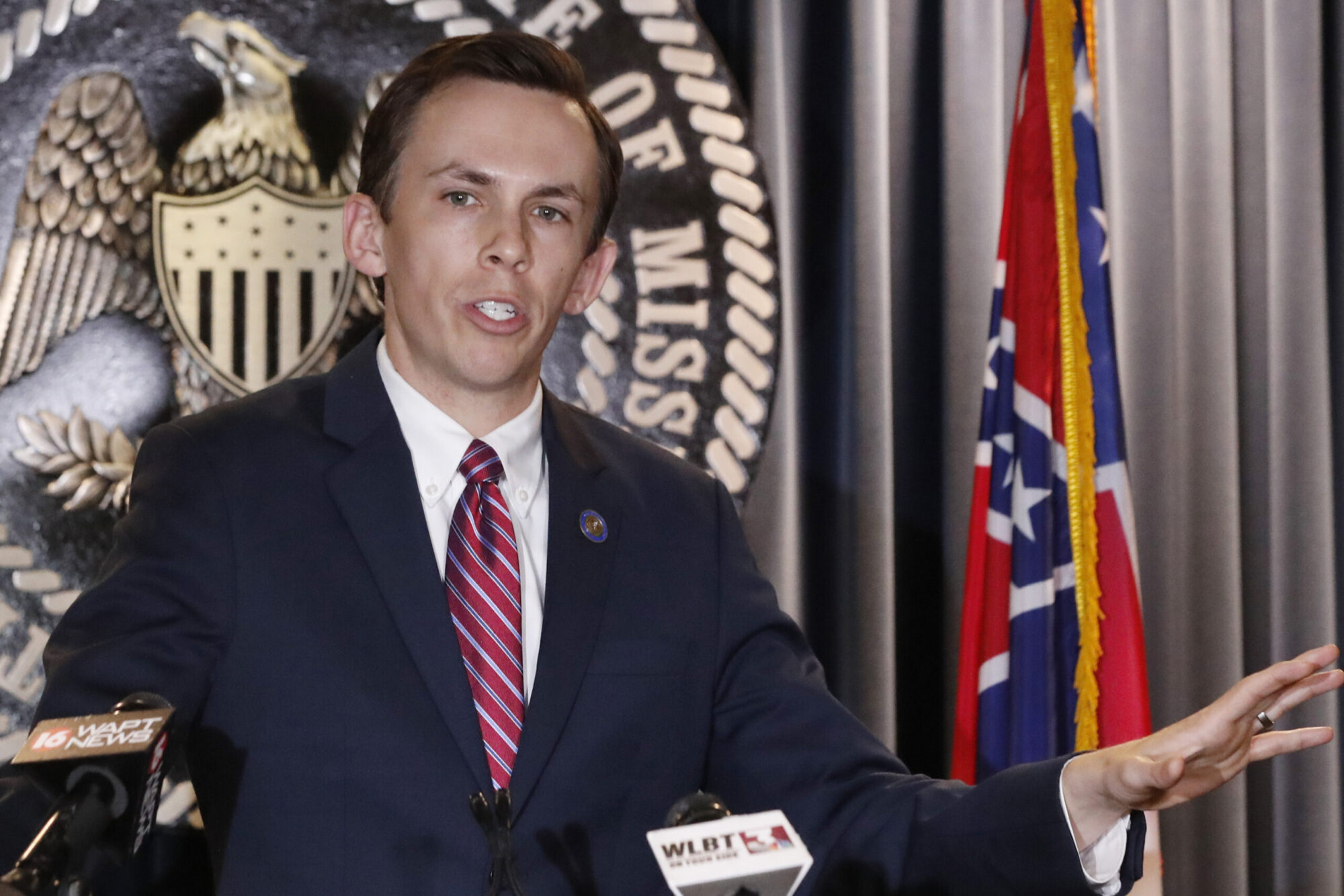
Mississippi Auditor Shad White is going on offense in 2026.
That’s what he said when he unveiled his agenda for the upcoming legislative session. The aggressive posture is necessary because he said state senators tried last session to limit his ability to audit nonprofits and attempted to cut his budget, with the latter proposal spilling into public view in a tense standoff at a committee hearing.
The senators responsible for those proposals, both fellow Republicans, retired this year. But the chamber is still led by Lt. Gov. Delbert Hosemann, who is seen by many as a chief rival for the Republican nomination for governor in 2027.
In addition to fending off potential efforts to limit his powers, White has called for lawmakers to adopt proposals from a legislative agenda built around three planks: immigration enforcement, government waste and ethics reform.
White spoke to Mississippi Today about how his proposals would work, his feuds with state senators, his potential run for governor (he’s still considering it) and whether he’d like to see lawmakers punish Lane Kiffin.
This interview, conducted in early December, has been edited for clarity and length.
Mississippi Today: As far as the bill that you mentioned last year that would have restricted some of your powers, Sen. David Parker obviously will not be back this session. Have you heard any rumblings about whether there’s still an appetite for that among others?
Shad White: I have not, but you know, I didn’t really hear any rumblings that that was going to happen last year, right up until the moment the bill dropped. We discovered that bill on a Friday night. So I would say that the politicians who don’t like me in the auditor’s office don’t make it a habit of warning me beforehand they’re going to do something like that
MT: Moving on to your legislative agenda, you propose making illegal immigration a state crime. Are there any specific gaps in federal enforcement that you’re trying to fill? Are there certain enforcement mechanisms that Immigration and Customs Enforcement isn’t using where you think the state could do better?
White: No, I think ICE is doing a great job, and I think you can see it in Operation Swamp Sweep, which is happening in New Orleans, Louisiana and parts of Mississippi. I think it’s very clear also that ICE is in need of manpower. So, if you just look on social media or see job postings, you see that ICE is actively trying to recruit law enforcement officers.
So, one thing that I think state and local authorities can do to help with ICE’s mission is to sign up to become a task force partner with ICE, which is what my office has done, and I believe several others around the state have done. But two, I think the other thing that state and local authorities can do is assist ICE in enforcing illegal immigration laws if it were illegal under state law.
And so that’s really the point of that plank of the legislative agenda – to make this a violation of state law and therefore give all state and local law enforcement the chance to add to the manpower that ICE already has to make our country safer and to make sure that folks who are here illegally are held accountable.
MT: And do you know if this is being done in any other states right now?
White: I don’t know if it’s being done this session. Most of these ideas that we’ve gotten, we’ve taken from either other states or the federal government. So I believe that illegal immigration is a state crime in other states.
(Florida, Texas, Oklahoma and Iowa have passed laws to create state-level crimes related to immigration or transporting undocumented immigrants.)
MT: As far as the fee on money sent abroad, you describe the fee that Mississippi should impose as a heavy one. Do you have a specific rate that you’re wanting to propose? And do you have a revenue estimate?
White: I think that’s the sort of detail that you would hope would get worked out in the legislative process. I think the federal fee that was imposed in the One, Big, Beautiful Bill is a 1% fee. And then the Oklahoma fee changes based on the size of the remittance.
What I would do if I were a legislator, or as this bill gets down to a final negotiation, if it gets that far, I’d look and see what the federal government’s doing, what Oklahoma is doing, and then impose something based on those remittances.
I do think that the primary purpose of placing a fee on those remittances is actually deterrence rather than generating revenue, though generating revenue is a nice secondary benefit. So, whatever the fee is, it needs to be big enough to provide a deterrent against illegal immigration.
Folks need to know if they’re coming here to Mississippi illegally, and they’re going to send money back home, that money is going to be heavily, heavily taxed.
MT: Does the policy proposal have a way to ensure that legal immigrants are not bearing the brunt of those fees?
White: Yeah, I think that Florida had a proposal this past year that would have required some sort of immigration or legal status check when somebody goes there to submit the remittances.
In fact, I’d go maybe even a step further than Florida and say that if you’re a Western Union and someone comes in and they cannot provide documentation that they are here legally, you probably just shouldn’t serve them at all, period.
MT: On the government waste front, I think you say Mississippi spends more than Louisiana, Arkansas, and Iowa on vehicles and travel. What inefficiencies have those states solved that Mississippi hasn’t?
White: What we find in procurement is that states that are doing better than Mississippi have more centralized procurement and they’re benefiting from an economy of scale. So, for example, you’ll see some states that have consolidated lots of back-office functions and lots of back-office procurement processes under a single agency. That’s something that’s been debated here in Mississippi and I think that’s a good idea.
The way you might approach it here in Mississippi as it relates to vehicles is rather than having each individual agency go out and purchase vehicles, you could have agencies coordinate that through DFA (Department of Finance and Administration) and there might be a larger Enterprise solution for the entire state. So maybe it is DFA carrying into a large contract with a rental car company to save money on the maintenance of those vehicles.
Those are the kinds of things that I think are happening in other states and the kinds of things that we should be debating here in Mississippi. The bottom line really for me is that we know we’re inefficient relative to those other states and so we need to do something to make sure that we’re not spending this much.
MT: Not to goad you into picking on any particular agency, although I’ll certainly give you the opportunity if you want to, did your office identify any particular agencies that have the worst inefficiencies with this?
White: Well, what we did when we came up with those estimates is that we looked at the agencies that were highlighted in Project Momentum. And so those were the agencies that are listed there. Most of them are executive agencies with appointed heads, and then in addition to that, there’s the Mississippi Department of Education and DFA.
The reason we looked at those specifically is we wanted to look at agencies with a singular head who could make a decision quickly about whether or not they wanted to change a policy internally as opposed to agencies that were run by a board, where action is sometimes slower.
Now, the one exception is the Department of Education and we threw them in simply because they spent so much money. It’s such a huge part of the state budget that we felt we couldn’t leave them out of Project Momentum. So, I won’t call out any individual agency, but I will say that the numbers we got show that we’re spending more than other similar states.
MT: Speaking of state revenues, now that some time has passed since Gov. Reeves signed into law a bill setting Mississippi on path to becoming the first state to eliminate an existing income tax, what do you think of the policy?
White: I think it’s going to make Mississippi more competitive.
I was on the phone this morning with a friend who owns a business up in North Mississippi near Corinth in Alcorn County, and they live with the tax disadvantage every single day because they’re losing workers to Tennessee.
I think that we have to also simultaneously cut fat from government, as this income tax elimination is being phased in, because you don’t want to wake up and have to cut emergency management to the bone. We don’t want to have to wake up and cut law enforcement and get state troopers off the streets. What you want to do is you want to cut unnecessary spending.

And so that’s one of the reasons why we focused on necessary and wasteful spending in the auditor’s office over the last two years – to provide a road map for the Legislature if they want to act on our recommendations.
MT: You’ve mentioned that you’ve received push back over the years from state agencies in Jackson. As you outline your legislative agenda, are you gearing up for a big fight with state agencies?
White: I don’t think so, to be honest with you. I think often the conflict is actually with the Legislature and some of the politicians in the Legislature. You know, some of these ideas that we got for cost savings actually came from interviews with people who work at those agencies.
For whatever reason, sometimes when we translate audits into policies and legislative ideas, for some reason, there’s a group of legislators who don’t want to do anything to make Mississippi government more efficient and would rather spend their time fighting the auditor’s office. So I hope that doesn’t happen again this year.
MT: As far as conflicts with individual lawmakers, you said that a similar version of your Ethics and Whistleblower Reward Act bill was killed by lawmakers previously. Which lawmakers were you talking about?
White: I don’t know which lawmakers killed it because most of the time these bills just die on the calendar. They die due to a deadline. So you have no idea who behind closed doors is opposing it. But I can tell you, I believe that starting two years ago, we proposed this whistleblower reward bill and I was told by Senate leadership that they supported it and, of course, it never passed.
MT: Is this proposal a direct offshoot of the Mississippi welfare/TANF scandal?
White: I would not say that the whistleblower reward statute is a direct offshoot of that. I think it’s an offshoot of all the cases that we’ve had over the course of the last few years, where we would have loved for more people to come forward.
So to give you an example, I had people asking me for years, why don’t you investigate and indict this or that mayor? Well, we don’t take information to a prosecutor unless we have something that is criminal.
Usually, the thing that stands in the way of us building a good investigation is that we look at documents and documents tell apart the story, but we really need somebody to come forward and testify about what they saw. Whether it’s a kickback or an improper relationship or a bribe or something like that.
That is usually the hold-up that prevents us from taking a set of facts and turning it into a slam-dunk investigation.
MT: Maybe this will get worked out later, but how large would the prize be?
White: The federal statute says it could be up to 15% of the amount that the government recovers. So if I were in the negotiating room and talking about what number needs to go in the bill, that’s probably where I would start.
MT: You recently said that you will always fight to make the state stronger and safer, whether serving as the auditor or in some other role. Is there any update on your potential run for governor in 2027?
White: I’ve made no secret that I’m seriously considering running for governor and part of the reason is that I see common-sense ideas like this that need to get done in Mississippi. I can do a few things as auditor to help usher those ideas in, so we can do spending analyses and audits on how taxpayer money is wasted and better uses of those dollars. But ultimately, that’s all you can do as auditor.
You can audit, and you can try to persuade people to adopt your policy recommendations based on the strength of your ideas. We know that other positions, such as the governor’s office, have much greater control. roll over some of these state agencies, and you can make some of these changes directly. You also get a much bigger bully pulpit to argue for the policy solutions that you think are best for the state. And so that’s one of the reasons why I’m considering that.
But I think at this point, more than a year-and-a-half out from an election, my focus is going to be to continue doing my job as an auditor and highlighting these ideas all about how to make the state better, and telling people about them and seeing who is interested in getting on board.
MT: Will you be introducing a legislative proposal to penalize Lane Kiffin?
White: It’s not off the table. You can quote me on that.

- Legislators haggle over ‘Christmas tree’ spending, immigrant wire transfers, youth court as 2026 session winds down - April 1, 2026
- Lawmakers approve 50-50 joint custody in divorce cases and send bill to the governor - April 1, 2026
- Home mitigation bill heads to governor in yearslong effort to improve disaster resilience in Mississippi - April 1, 2026