
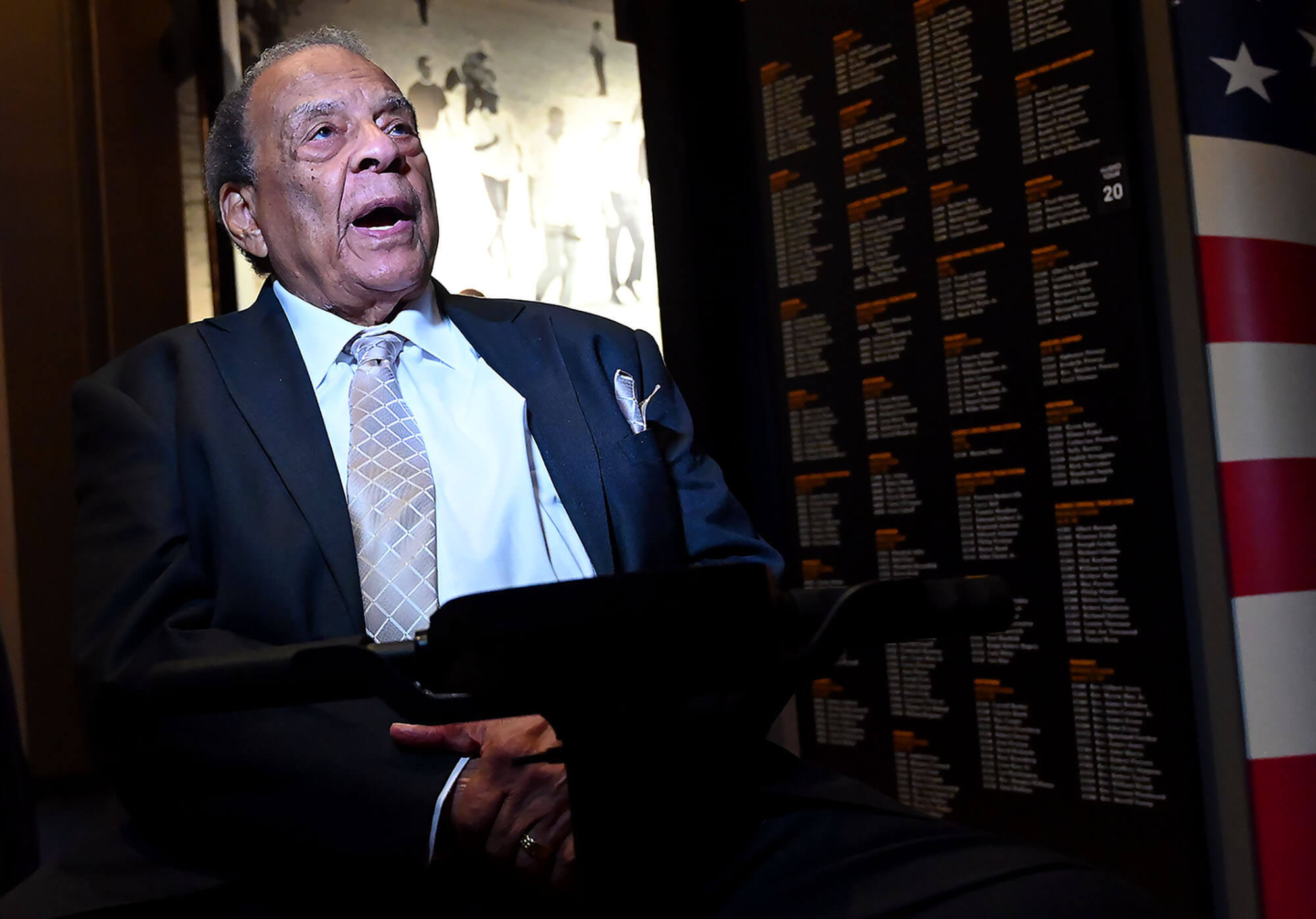
Andrew Young wheeled through the Mississippi Civil Rights Museum on Thursday, soaking in the history that he helped make.
The former pastor and civil rights leader, who worked closely with Martin Luther King Jr. at the Southern Christian Leadership Conference, was there during the 1966 March Against Fear in Mississippi. He was there when Grenada public schools began to integrate. Two years later, he was there when King was assassinated at the Lorraine Motel in Memphis.
When the bullet struck King, it severed his spinal cord, Young said. “He couldn’t feel anything or hear anything.”
The first thing Young thought of as he witnessed the assassination was the Bible story of the prophet Elijah.
Young looked out over the Mississippi River as the setting sun seemed to catch fire in the sky. “It was a beautiful set of clouds,” he said. “It was about 6 o’clock in the evening. I said, ‘Damn, Martin’s going to heaven in a flaming chariot.’”
The former U.S. ambassador to the United Nations came to Mississippi to deliver the Medgar Wiley Evers Lecture, sponsored by the Mississippi Department of Archives and History, W.K. Kellogg Foundation and the Medgar & Myrlie Evers Institute.
Inside the museum Thursday morning, Young saw the pictures of the fight for civil rights and voting rights. He played a role in pushing the 1964 Civil Rights Act and the 1965 Voting Rights Act through Congress.
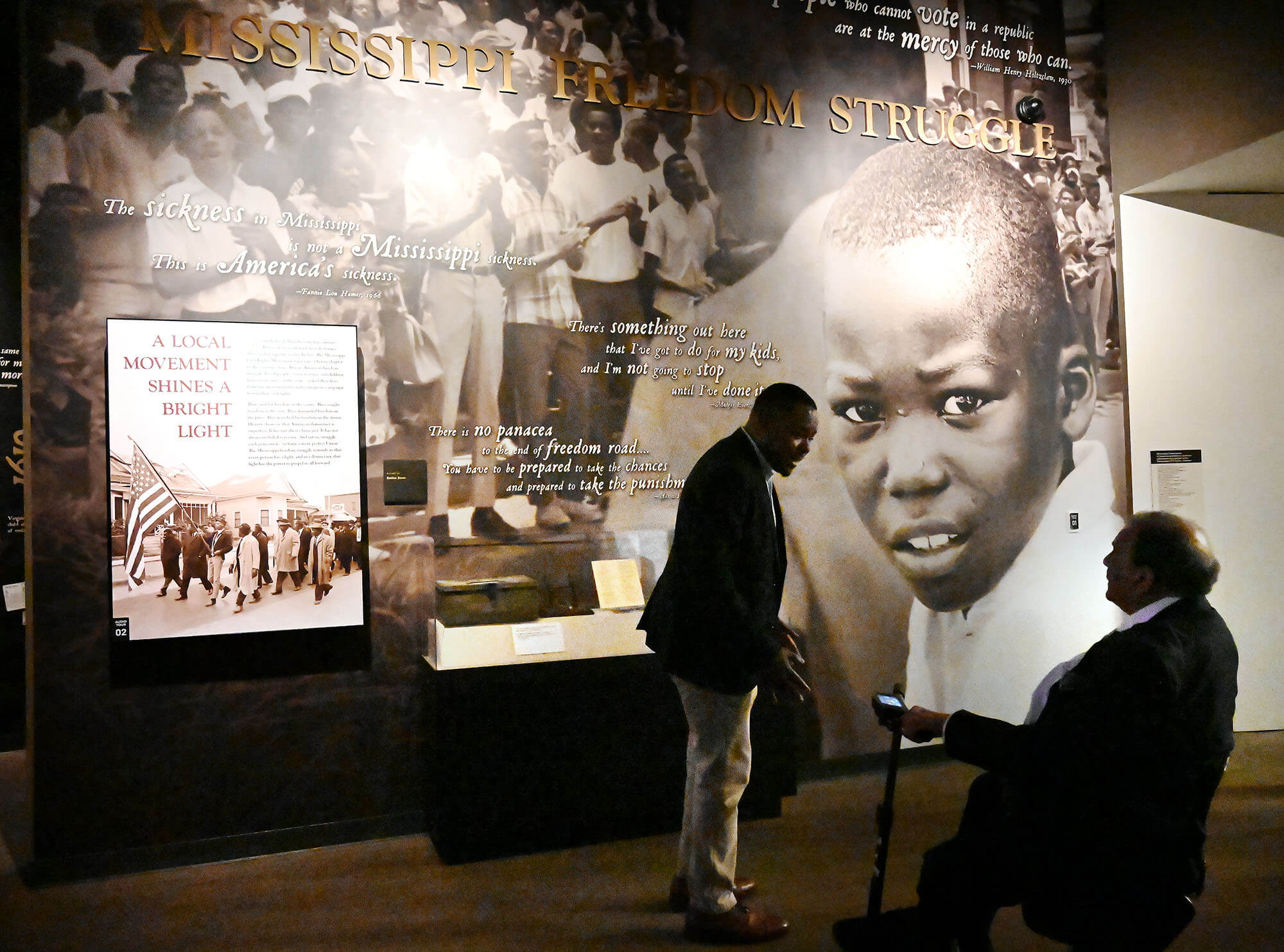
He glimpsed photographs of himself, King and James Meredith making their March Against Fear in Mississippi in June 1966. That march included a terrifying encounter in Philadelphia, where a white mob, including Klansmen, hurled eggs, rocks and racist slurs at the marchers.
In September 1966, when the first Black students tried to attend what had been an all-white public school in Grenada, a white mob attacked them with chains, pipes and clubs.
The mob broke plate glass windows where the students were, Young said. Days later, on Sept. 20, 1966, he, King and folk singer Joan Baez safely escorted the students to school. Young is expected to reunite with some of those former students Thursday.
Young recalled, too, the 1968 Poor People’s March on Washington that started in Marks and ended at the nation’s capital a month later.
In 1972, Young became the first Black member elected to Congress from Georgia since Reconstruction. He served as mayor of Atlanta during the time the city hosted the 1996 Olympic Games and served as co-chair.
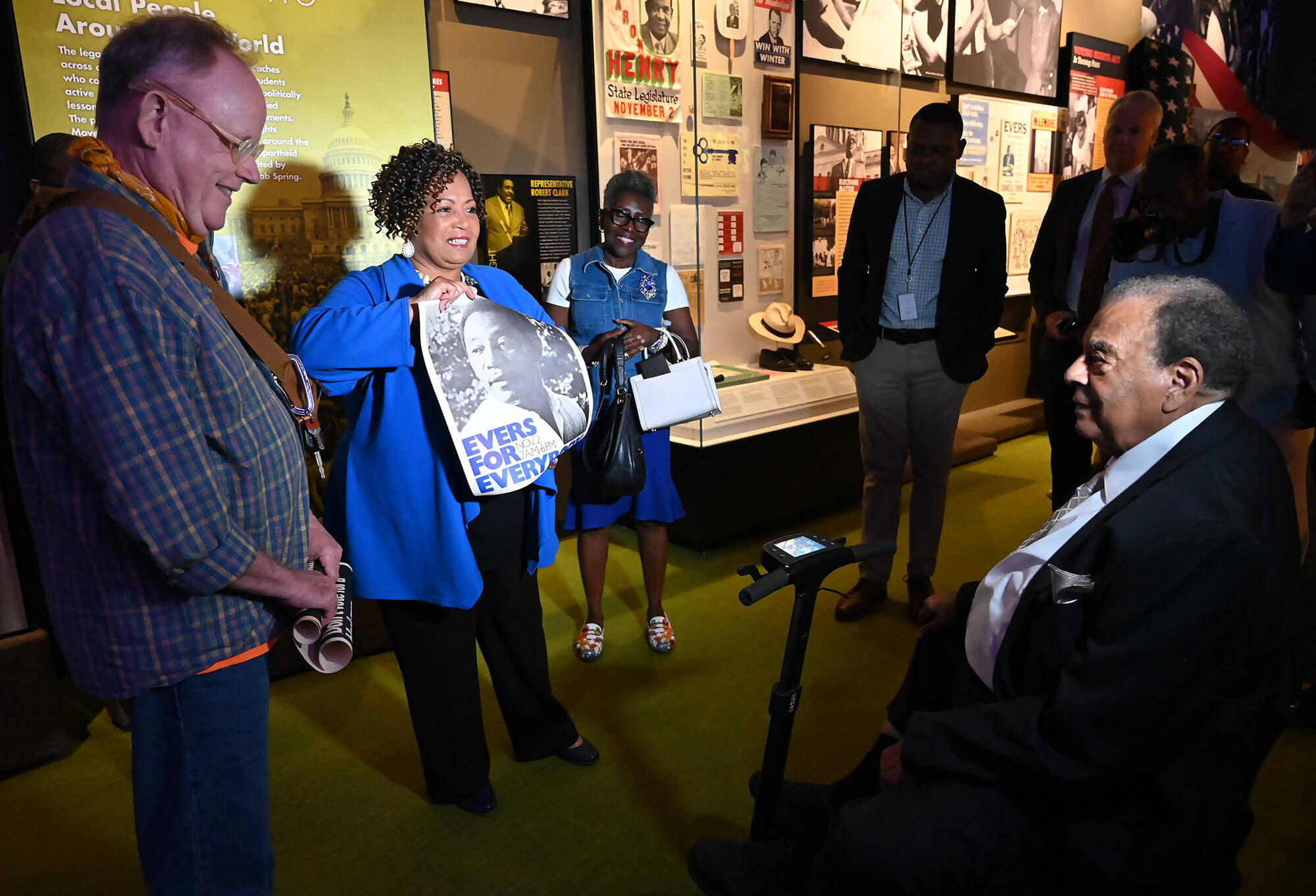
The 94-year-old native of New Orleans continues to chair GoodWorks International, an organization that pushes for economic development in the Caribbean and Africa. His memoirs include “A Way Out of No Way” and “An Easy Burden.”
When he saw a photograph of Fannie Lou Hamer in the museum, he talked about hearing that she had been beaten in the Winona jail in 1963. Those from the Student Nonviolent Coordinating Committee who tried to free her were arrested, too.
Young said he and fellow civil rights leader James Bevel traveled there in hopes of freeing Hamer and the others. When Hamer and the others emerged, Young shared the awful news he had heard on the radio — NAACP leader Medgar Evers had been assassinated.
“Medgar Evers has been a hero in my head and my heart,” Young said. “In every picture I see, I see his strong character, and his faith in his people.”
In 1977, the White House provided a plane for Young to travel to Mississippi for Hamer’s funeral, he said. “To have a presidential delegation attend her funeral showed how much progress had been made.”
After finishing his tour Thursday, Young said it’s easy to think the museum deals only with the past.
“We’re not looking back on it, we’re in the middle of it. We would normally look at this exhibit as the old days,” he said. “The only thing we can do is realize this is not history. We’re still in a struggle to save Black men’s bodies and white men’s souls.”
He has known hate his whole life. He grew up in New Orleans across the street from an office for the American Nazi Party. “I could look out my window and see the swastikas,” he said.
That hate is still happening, he said, and that’s why the struggle continues. “I don’t think we’re losing ground,” he said. “We’ve come too far from where we started from.”
After he left the museum, he spoke with Jackson State University students and urged them to make a difference with their lives. “It’s not what you want,” he told the students. “It’s what you were created for.”
He recalled his father’s advice on keeping an even keel, even when confronting hatred. “My daddy’s message was, ‘Don’t get mad, get smart. That’s how I made it.”
He told students that he almost dropped out of Howard University — until he happened to run into an old classmate in New Orleans who had left school in the third grade. When he asked the classmate where he had been, the man replied that he had been in every reform school and prison in Louisiana.
When Young shared that he was thinking about dropping out, the old classmate replied, “Motherf—er, if I ever catch your Black ass on the street and you not in school, I’m going to beat the s— out of you. You got to get your ass back in school and you got to be somebody.”
Young said he took those words as his marching orders.
After graduating from Howard, he recalled going through North Carolina on the way back to Louisiana. “Everything in the sky looked perfect. The cornfields were yellow. The cows were eating,” he said. “It suddenly hit me that everything has a purpose for me, and whoever made all of this made everything with a purpose for me.”
From that moment forward, he said he decided that if he found something no one else wanted to do, he would take that as a divine cue, and he’s lived that way since.
On Thursday night, Ebony Lumumba, who chairs JSU’s Department of English, asked Young what he meant when he told students, “We don’t belong to ourselves.”
Young replied, “‘To whom much has been given, much shall be required.’ It’s not suggested. It’s required.”
He praised the courage of E.W. Steptoe, who went to the Amite County courthouse to register to vote, only to encounter white men with guns. Young quoted Steptoe as telling the armed mob, “You can kill me, but I’m gonna vote.”
Steptoe recruited many other Black Mississippians to register to vote, too, and eventually ran for Congress. “If we had 2,000 more people like that over the last 10 years,” Young said, “we wouldn’t be in the mess we are in right now.”
Over the decades, “ we have been through ‘many dangers, toils and snares,’ and God’s amazing grace has seen us through,” he said. “As long as you trust in that, you’ll find a way to make it.”
No one said the way is easy, he said, “but God didn’t bring us this far to leave us. I’m not nervous about the future. I know God is still on the throne.”
He shared the words that King quoted from abolitionist James Russell Lowell at the end of the Selma march in 1965:
Truth forever on the scaffold,
Wrong forever on the throne,
Yet that scaffold sways the future,
And, behind the dim unknown,
Standeth God within the shadow,
Keeping watch above his own.
