
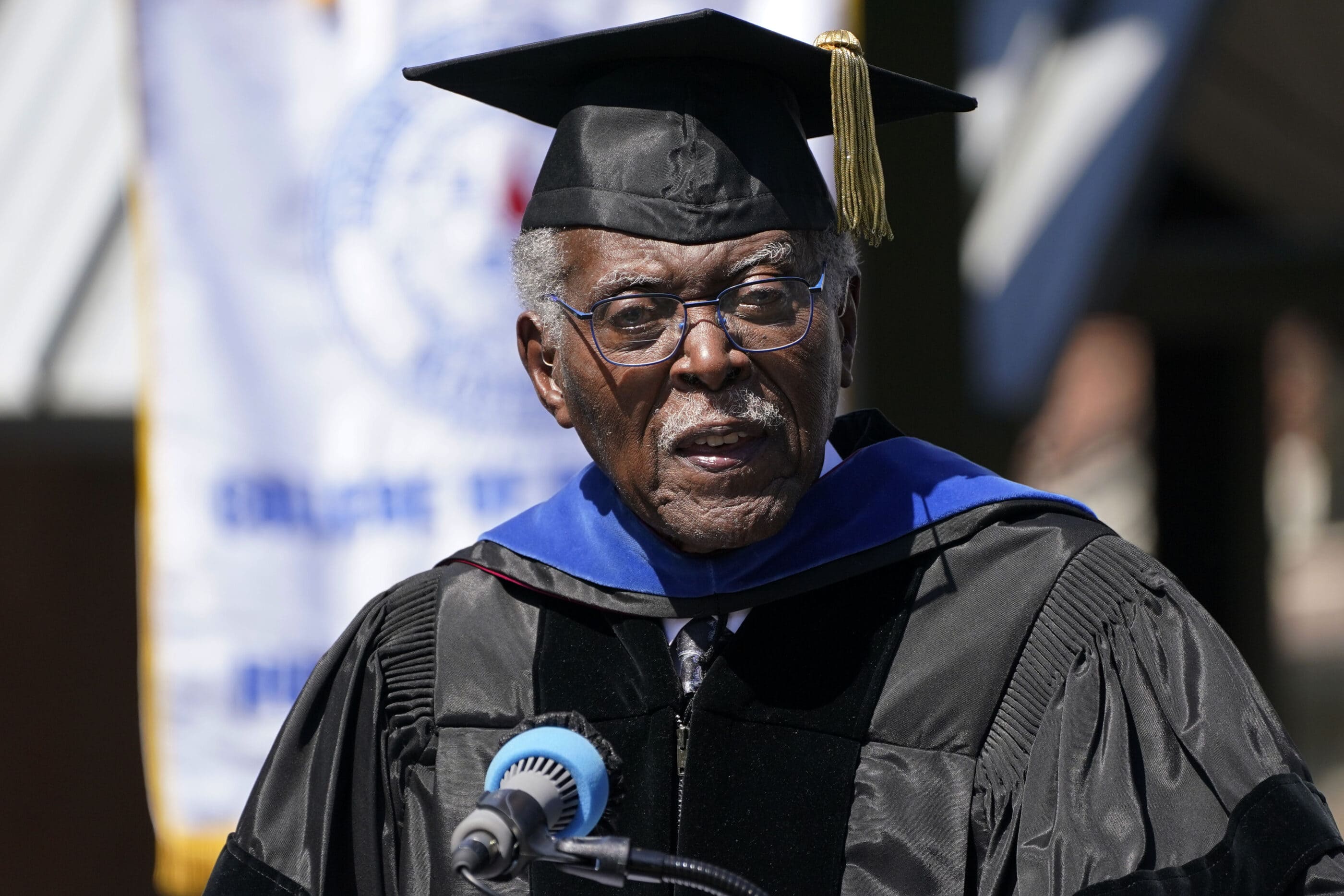
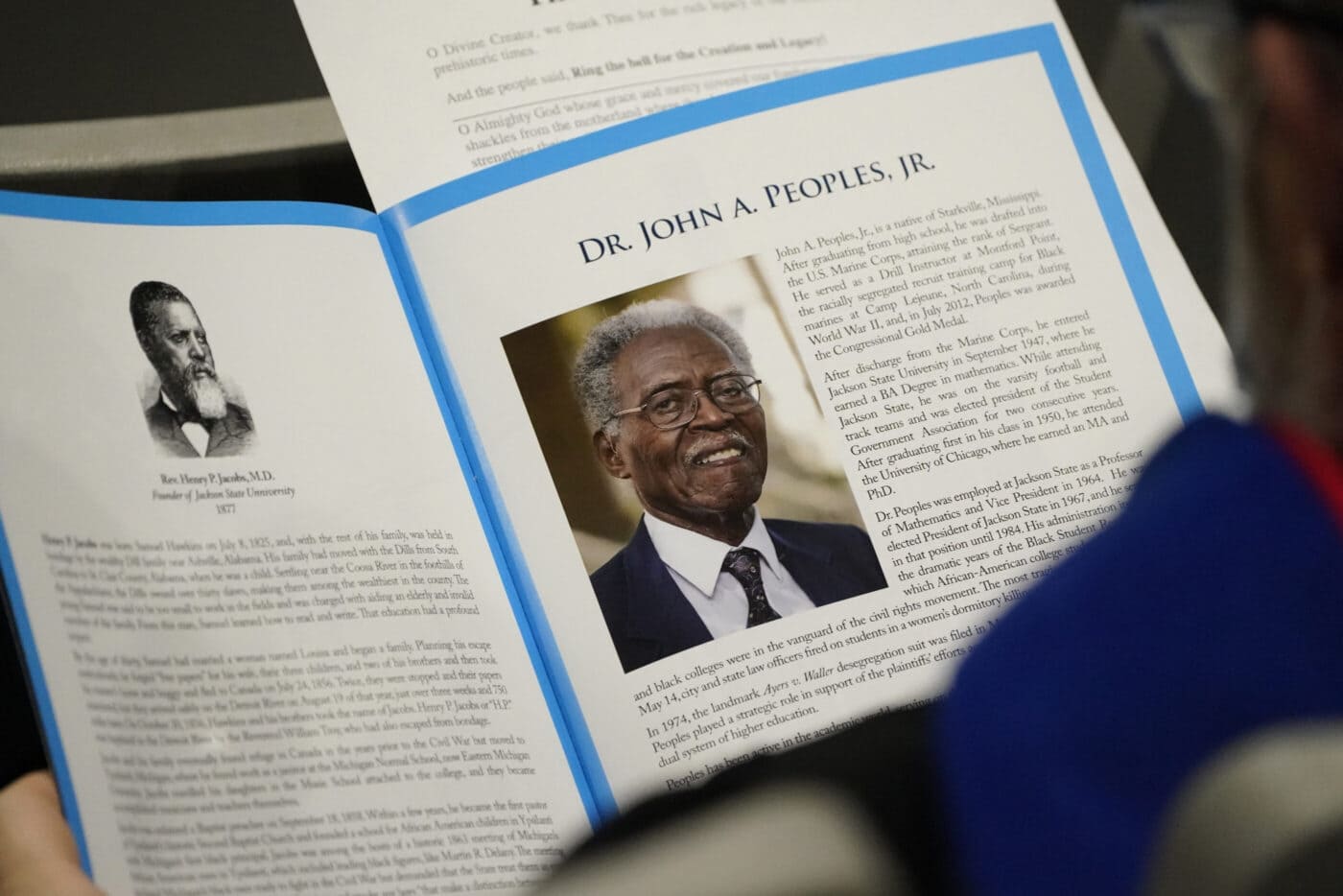
John A. Peoples Jr., a beloved leader who shepherded Jackson State’s evolution from a teachers college to a university, died Thursday. He was 100.
Lisa M. Ross confirmed Peoples’ death on behalf of his family. Ross, a Jackson-area attorney and JSU alumna, praised Peoples’ leadership.
“Dr. Peoples was an extraordinary leader,” Ross said. “He prepared us to believe in ourselves and never abandon our dreams.”
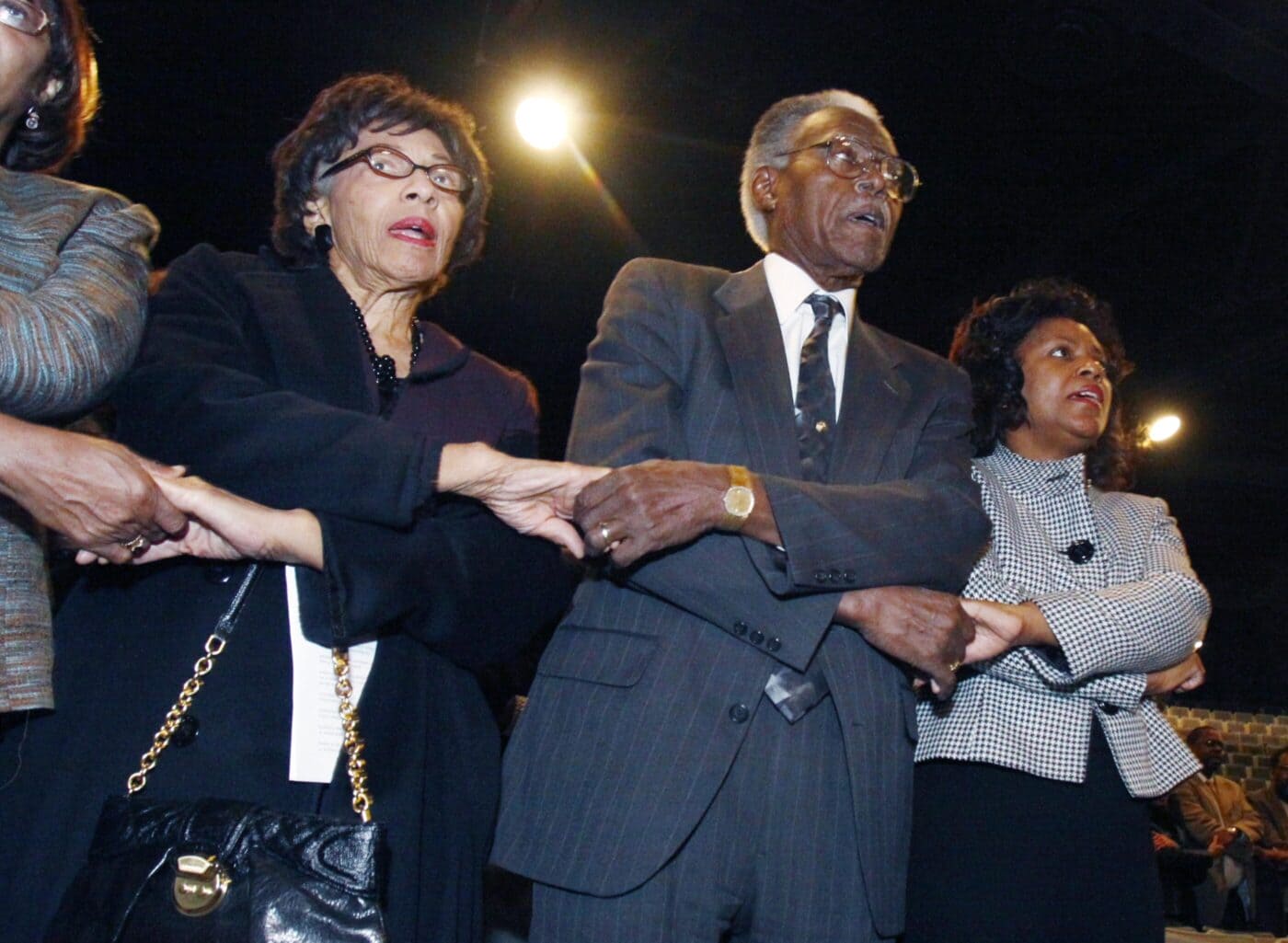
Peoples was the first Jackson State alumnus to also serve as its president, leading the university from 1967 to 1984. When he stepped down, he continued teaching for a year at JSU before retiring in 1985.
Peoples was “a giant whose leadership forever shaped the trajectory of Jackson State University,” Jackson State President Denise Jones Gregory said in a statement. She extended condolences to Peoples’ wife, Mary, their children and the rest of the family.
“His legacy lives on in every graduate, faculty member and building that bears the imprint of his vision,” Gregory said.
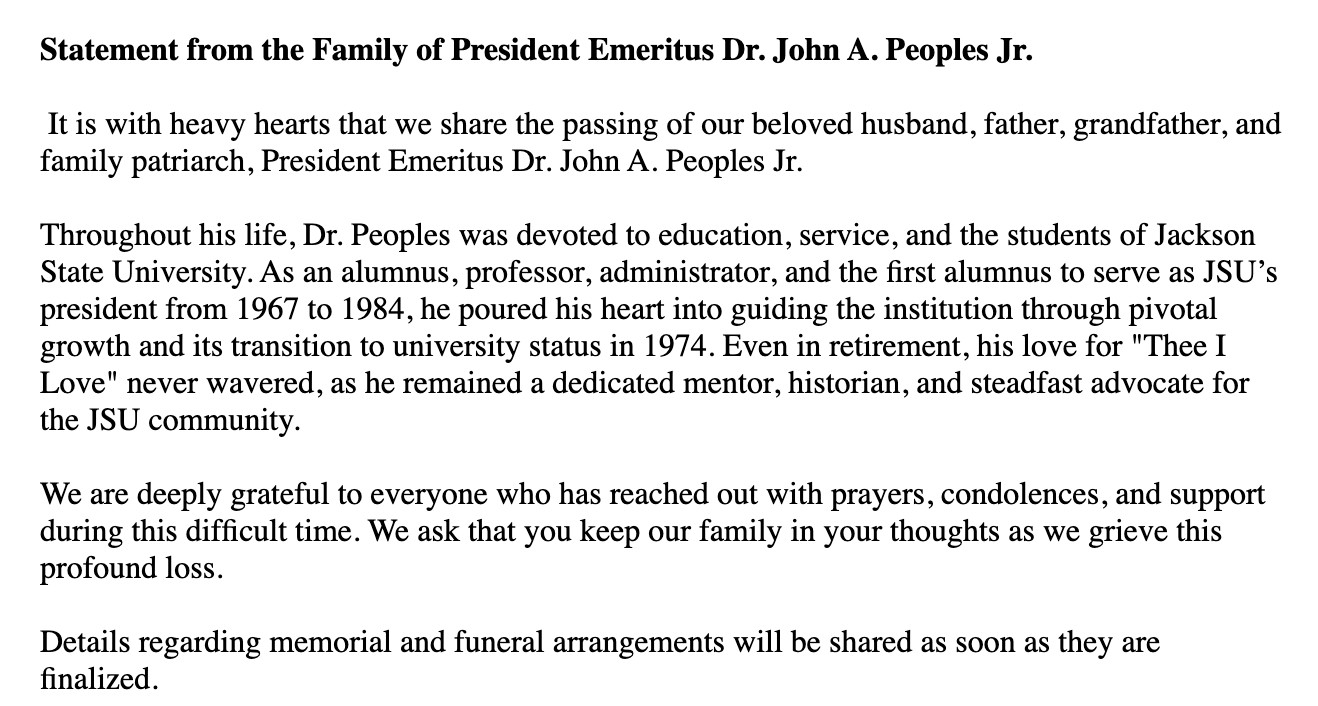
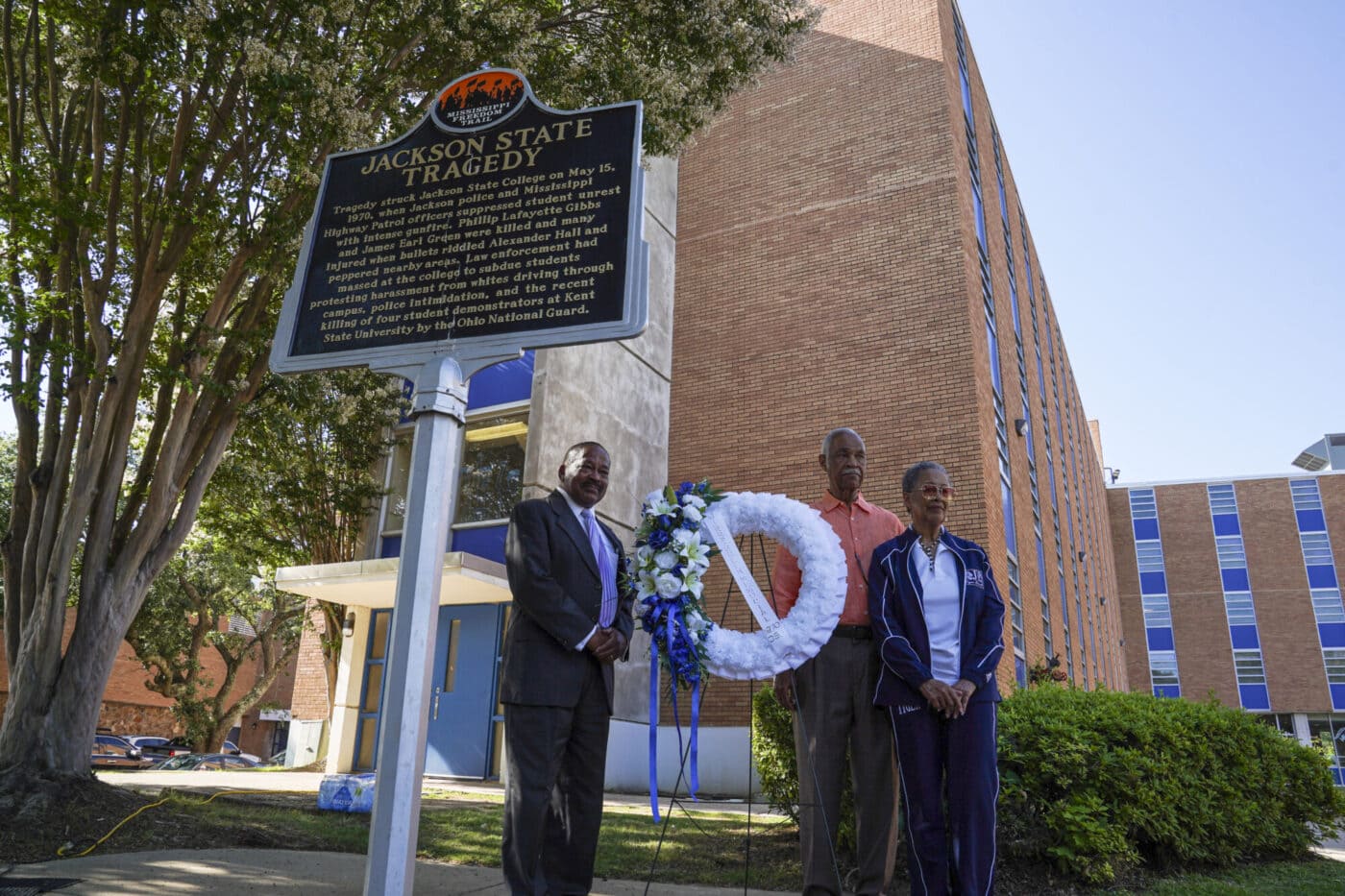
Peoples also led Jackson State during one of the darkest periods in its history. In May 1970, law enforcement officers opened fire on campus, killing Phillip Lafayette Gibbs, a Jackson State student, and 17-year-old James Earl Green, a high school student, and injuring others.
Sen. Sollie Norwood, a Democrat from Jackson, was a student during the Jackson State tragedy. He said the aftermath of the campus shootings was Peoples’ finest hour as president.
Norwood recalled Peoples walking around campus and sitting with students and faculty in what is now known as the Gibbs-Green Memorial Plaza to restore calm and reassure the university community. His leadership during those turbulent years set a standard for future presidents, Norwood said.
“We’ve had many presidents since Peoples’ tenure that have had some of his qualities but there was only one John A. Peoples Jr.,” said Norwood, who graduated from JSU in 1974. “He was a genuinely good person.”
Peoples supported efforts to desegregate Mississippi’s public higher education system through the landmark Ayers lawsuit, which challenged racial inequities in the state’s public universities.
“We weathered difficult times, times of tragedy and of opposition to our progress, but we came through,” Peoples said in a video posted by the JSU National Alumni Association commemorating his 100th birthday in August.
“Looking back from this long vantage point, I have been happy to see the continued growth of our dear institution, and to boast about achievements and contributions that you Jackson State alumni have made,” he said.
During Peoples’ 17-year tenure, student enrollment grew from 2,200 to 7,800, and Jackson State expanded its academic offerings beyond its traditional focus on teacher education.
Peoples pressed the state’s college board to grant university status to Jackson State College. It did so in 1974. Jackson State awarded its first doctoral degrees eight years later, becoming the first historically Black college or university in Mississippi to do so.
Peoples established new academic schools, launched an Army ROTC program and, in 1975, introduced a meteorology program, making JSU the first HBCU to offer a bachelor’s degree in the field.
Born Aug. 26, 1926, in Starkville, Peoples graduated from Oktibbeha County Training School in 1944. He enlisted in the U.S. Marine Corps the following year and served until 1947.
He earned a bachelor’s degree in mathematics from Jackson College in 1950 before earning a master’s degree in mathematics and a doctorate in higher education from the University of Chicago.
Peoples is widely regarded as one of Jackson State’s best presidents. When the state college board began searching last year for the next JSU president, alumni and others tied to the university said they wanted a leader like Peoples. They shared stories of their experience under Peoples’ leadership and how he emphasized the need to respect the campus community.
Sen. Hillman Frazier, a Democrat from Jackson and JSU alum, said he often turned to Peoples for advice on higher education issues after joining the Mississippi House of Representatives in 1980.
At the time, Frazier said, the state’s college board prohibited the university president from lobbying lawmakers. The two often discussed funding disparities at Mississippi’s historically Black universities and Jackson State’s needs for better faculty pay, campus improvements and student housing.
“JSU is surviving because of him.”
Ivory Phillips, a former Jackson State professor, was chairman of the university’s social science department during Peoples’ tenure.
Phillips said he had a chance to talk with Peoples at a JSU National Alumni Association Conference in the 1990s. They discussed Peoples’ memoir, “To Survive and Thrive: The Quest for a True University,” and his efforts to advance Jackson State.
Decades later, at Peoples 100th birthday celebration, the moment came full circle. Phillips gave Peoples a copy of “The Ayers vs. Waller Case: The Promise & Disappointment,” the book he wrote about the Ayers lawsuit, which chronicled Peoples’ role in the case.
Peoples thanked him for highlighting his administration’s work in the book, Phillips said.
“He had the intellect and courage to lead Jackson State in such a way that no president before or after that was able to do what he did,” Phillips said. “He spoke boldly on behalf of JSU students, faculty and alumni and was a true leader in every sense of the word.”
Update 11/26/26: This story has been updated to include a statement from Jackson State University President Denise Jones-Gregory and a response from Ivory Phillips, a former JSU professor.

- John A. Peoples Jr., beloved former Jackson State president, dies at 100 - November 26, 2026
- Colom once displayed leadership, as well as grit and tenacity, on the Millsaps College basketball team - November 26, 2026
- Hinds DA candidate files overdue campaign disclosure reports - November 25, 2026