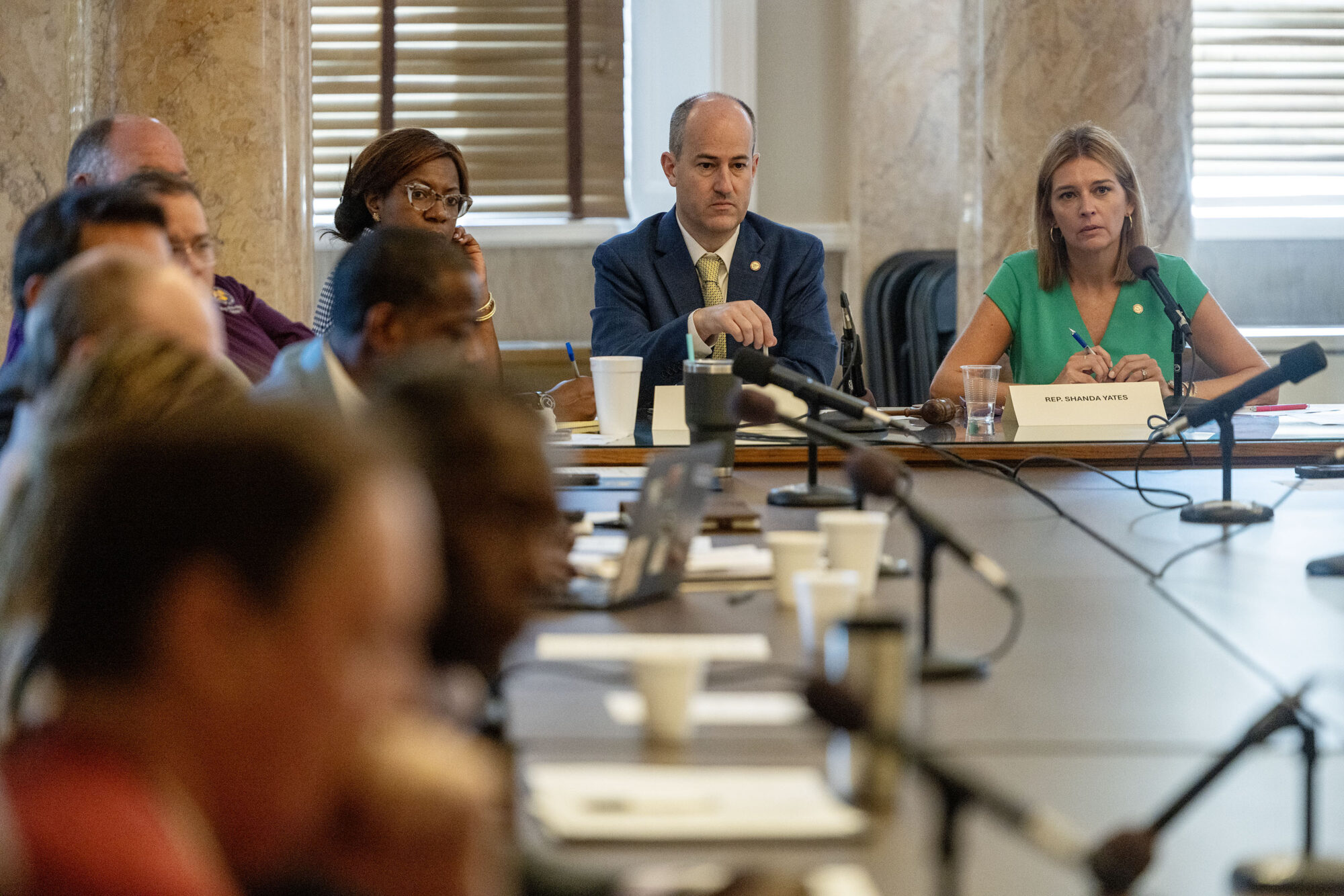
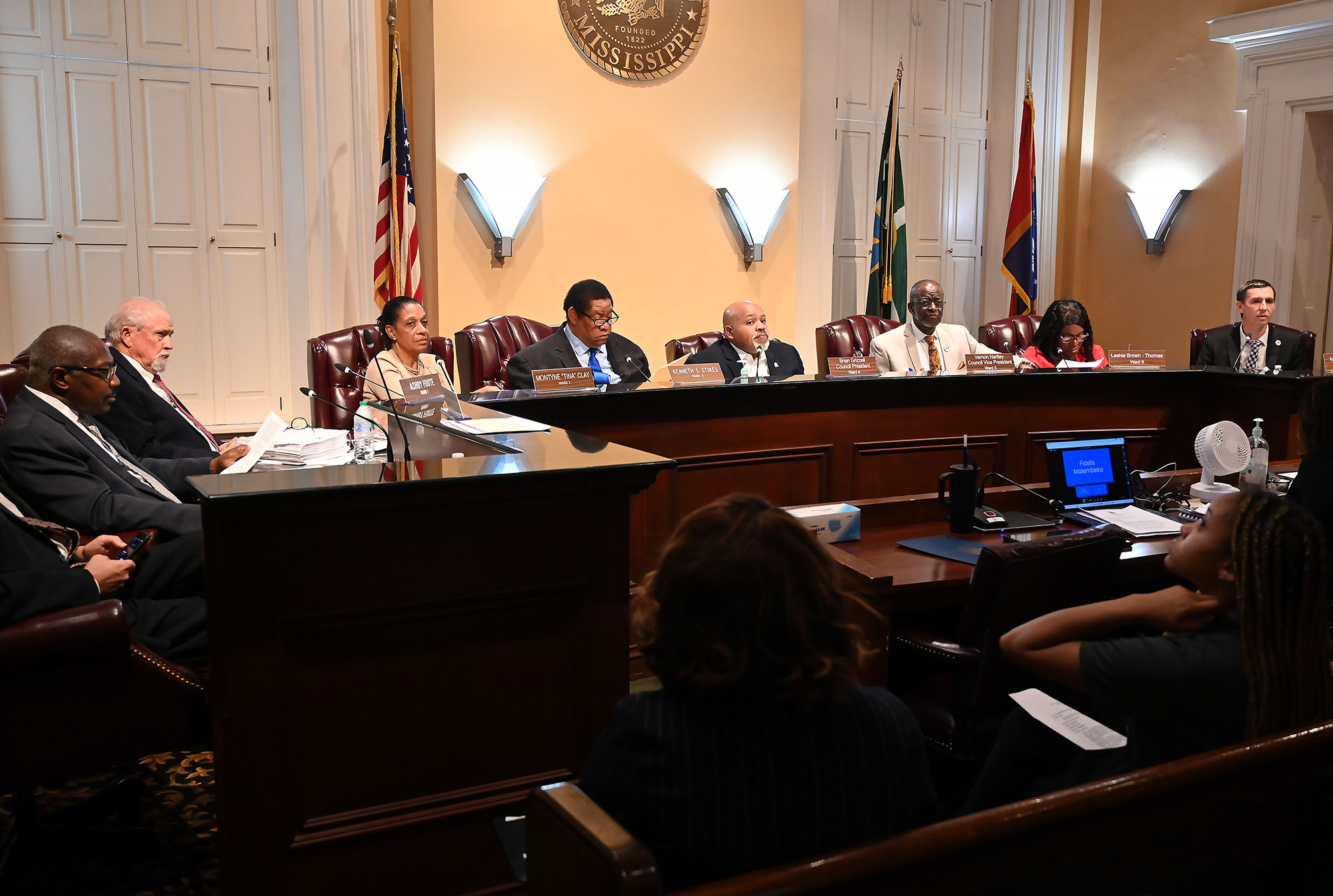
Mississippi’s Public Service Commission scheduled a “show-cause” hearing over Holly Springs’ troubled utility department for Sept. 4 at 9 a.m. at New Albany Municipal Court.
The PSC announced the hearing during a docket meeting Tuesday, a week after it released a third-party report detailing the struggles of the power provider. The report echoed previous criticisms from state lawmakers, the PSC, the Tennessee Valley Authority and others blaming Holly Springs officials for not investing in its power supply system over the years and allowing it to deteriorate to a point where customers have seen constant outages.
Holly Springs, which buys power through a contract with TVA, serves about 12,000 customers in Marshall, Benton and Lafayette counties as well as a small part of Tennessee.
The PSC, which regulates utilities in the state, initially tried to schedule a hearing for Jan. 7 in Jackson. But Holly Springs successfully appealed after arguing one of its lawyers, Sen. Bradford Blackmon, needed to be with the state Legislature then. The PSC then agreed to delay the hearing until after the legislative session.
A light pole covered in vegetation stands near Holly Springs, Miss., on Wednesday, Dec. 4, 2024. Poor maintenance has been a persistent issue for the Holly Springs Utility Department, contributing to years of unreliable power and worsening conditions during the 2023 ice storm. Credit: Eric Shelton/Mississippi Today
The state initially had no jurisdiction over the Holly Springs Utility Department, but a 2024 bill that became law gave the PSC the power to investigate the utility and recommend, if it decides the utility doesn’t provide “reasonably adequate service,” that a court put the department into a receivership.
“We strongly encourage public participation in the upcoming show-cause hearing, emphasizing that this is more than a procedural requirement — it is critical for HSUD to address the issues raised in the report and to clarify its actions,” the commission said in a press release Tuesday. “By working together, we can ensure that the outcome serves the best interests of the people who rely on HSUD services.”
The company behind last week’s report, Silverpoint Consulting, wrote that it may be hard to find a receiver willing to take on the utility, and instead recommended one of three options: selling the utility to another city or cooperative utility; converting it into a cooperative to open up access to low-interest loans; or seeking eminent domain and condemnation.
Holly Springs is also facing a lawsuit from TVA, which alleges the city mishandled funds from the utility and failed to raise rates when needed. On June 9, though, a federal judge ordered a 90-day stay in the case. Then on July 24, court filings show, both parties told the court they would meet on Aug. 15 to “discuss a negotiated resolution of this action.”
10 bewezen strategieën voor jackpot slots in live‑mode bij Igo Bet Casino
Het vinden van een jackpot slot dat echt loont, vraagt meer dan geluk. Het draait om inzicht in de spellen, slimme inzet en een betrouwbare omgeving. Sinds de lancering in 2019 heeft Igo Bet Casino zich ontwikkeld tot een van de favorieten onder Nederlandse spelers. Het platform is gelicentieerd door de Malta Gaming Authority en biedt meer dan 3 000 spellen, waaronder talloze progressieve jackpot slots. Met een snelle uitbetalingstijd en een 24/7 live‑chat maakt de site het gemakkelijk om direct te spelen.
Voor spelers die op zoek zijn naar een solide start, is het belangrijk om eerst de basis te begrijpen. Kies een spel met een gunstige RTP (return to player) en controleer de volatiliteit. Een lager risico betekent vaker kleine winsten, terwijl een hogere volatiliteit juist grote jackpots kan opleveren, maar minder vaak.
Wil je direct profiteren? Bezoek de officiële site via deze link: Igo Bet Casino casino officieel. Hier vind je de welkomstbonus, een breed scala aan betaalmethoden en een overzicht van alle live‑mode spellen. Met deze basis kun je de eerste twee strategieën meteen toepassen.
Strategie 1‑2: Kies de juiste jackpot slot en begrijp de volatiliteit
1. Selecteer een slot met hoge RTP en lage volatiliteit
Slots met een RTP van 96 % of hoger geven gemiddeld meer geld terug aan spelers. Lage volatiliteit zorgt voor regelmatige uitbetalingen, waardoor je bankroll langer meegaat. Populaire keuzes bij Igo Bet Casino zijn “Mega Fortune” en “Hall of Gods”.
2. Focus op progressieve jackpots met realistische win kansen
Progressieve jackpots groeien snel, maar niet elke jackpot is even haalbaar. Kijk naar de “hit‑frequency” – hoe vaak een jackpot wordt gewonnen. Een studie van de branche toont aan dat 70 % van de spelers de voorkeur geeft aan slots waar de jackpot binnen 10 000 spins kan vallen.
Pro Tip: Controleer altijd de jackpot‑historie in het spelmenu. Een recente winst wijst op een actieve jackpot.
Strategie 3‑4: Maak optimaal gebruik van bonussen en promoties
3. Claim de welkomstbonus bij Igo Bet Casino
Nieuwe spelers ontvangen een 100 % bonus tot €200 plus 50 gratis spins. Deze extra speeltegoed verhoogt je kans om de jackpot te raken zonder eigen geld te riskeren. Let op de inzetvereiste: meestal 30 x de bonus.
4. Gebruik reload‑bonussen voor extra speeltegoed
Wekelijkse reload‑bonussen geven tot 50 % extra op je storting. Combineer dit met de “Free Spin Friday” actie voor extra kansen op jackpot‑winsten.
Industry Secret: De meeste casinoplatformen beperken de inzet van bonussen op high‑RTP slots. Kies daarom een slot met minimaal 96,5 % RTP om het meeste uit je bonus te halen.
Strategie 5‑6: Beheer je bankroll en stel limieten
5. Bepaal een dagbudget en houd je eraan
Stel een vast bedrag in dat je per dag mag verliezen. Een goede richtlijn is 5 % van je totale bankroll. Door consistent te blijven, voorkom je grote verliezen.
6. Pas de inzet aan op basis van de jackpotwaarde
Wanneer de jackpot boven €10 000 stijgt, verhoog je je inzet met 10‑15 %. Bij lagere jackpots verlaag je de inzet om je geld langer te laten duren.
Bullet List – Belangrijke betalingsmethoden bij Igo Bet Casino
– iDEAL – directe stortingen, geen kosten
– Trustly – snelle verwerking, 24 uur uitbetaling
– Skrill – veilige e‑wallet, lage limieten
– Visa/Mastercard – breed geaccepteerd, vertrouwd
Pro Tip: Gebruik dezelfde betaalmethode voor stortingen en opnames om de verwerkingstijd te verkorten.
Strategie 7‑8: Speel live‑mode en profiteer van real‑time jackpots
7. Kies live dealer slots met jackpotfunctie
Live‑mode slots combineren het echte casino‑gevoel met digitale jackpots. Spellen zoals “Live Mega Wheel” bieden een realtime jackpot die elke ronde kan groeien.
8. Let op de jackpot‑timer en speel op piekmomenten
Veel live‑mode jackpots resetten elke uur. Speel net voor de reset – de kans op een winst is dan het hoogst.
Did You Know? Live dealer spellen hebben gemiddeld een 2 % lagere huisvoordeel dan reguliere slots, waardoor je meer kans maakt op winst.
Strategie 9‑10: Versnel uitbetalingen en optimaliseer je spelervaring
9. Gebruik snelle betaalmethoden bij Igo Bet Casino
Kies voor iDEAL of Trustly om je winst binnen 24 uur op je rekening te hebben. Bij traditionele bankoverschrijvingen kan het tot 5 werkdagen duren.
10. Speel via mobiel voor flexibiliteit en bonusvoordelen
De mobiele app van Igo Bet Casino biedt dezelfde bonussen als de desktopversie, plus exclusieve “Mobile‑Only” promoties. Zo kun je overal jackpot slots spelen.
Bullet List – Tips voor verantwoord spelen
– Stel een verlieslimiet in en houd je eraan
– Neem regelmatig pauzes, minimaal 15 minuten per uur
– Gebruik de zelfuitsluitingsoptie bij tekenen van problematisch gedrag
– Houd je speeltegoed gescheiden van je dagelijkse uitgaven
Industry Secret: Spelers die hun sessies beperken tot 30 minuten per dag hebben een 40 % hogere kans om hun bankroll te behouden.
Conclusie
Jackpot slots in live‑mode bieden enorme winsten, maar alleen als je de juiste strategieën toepast. Door een slot met hoge RTP te kiezen, bonussen slim te gebruiken, je bankroll te beheren, live‑mode te benutten en snelle uitbetalingen te kiezen, vergroot je je kansen aanzienlijk. Igo Bet Casino levert de tools en het spelaanbod om deze strategieën in de praktijk te brengen. Begin vandaag nog, claim je welkomstbonus en zet de eerste stap naar een potentiële jackpot‑overwinning.
Onthoud: speel altijd verantwoord en stel je eigen limieten. Veel succes en plezier bij het jagen op die grote jackpot!
Editor’s note: This Mississippi Today Ideas essay is published as part of our Brain Drain project, which seeks answers to Mississippi’s brain drain problem. To read more about the project, click here.
Back when I was a kid in 1988, my mama and I had an argument about what I wanted to major in at college.
I had dreamed of being a journalist since the age of 8. To me, that meant that I was going to Ole Miss, which had the journalism department.
My mama said I could only go away from home to Ole Miss if I was going to major in law.
So I settled on going to Mississippi State University just down the road and majoring in communication. She told me I should major in engineering since that’s what State was known for.
I said, “That’s even dumber than me going to law school. I hate math.”
“Well, you could at least try,” she said.
I said no. Then she told me I was wasting my education and turned her back on me.
Julie Liddell Whitehead Credit: Courtesy photo
I get it. She knew and I knew that I couldn’t stay in Choctaw County where I was raised and earn a living with that degree. I would have to go somewhere else — probably to the Jackson metro area and work for Gannett or the Associated Press. Or to Memphis. Or Biloxi. Or even New Orleans. She never really forgave me for moving to the Jackson metro, working in my field and raising her grandchildren so far from her.
After a while, I got used to the pace of life around here. I knew I probably wouldn’t ever move anywhere else because I noticed that people who left Mississippi often came back, whether due to family obligations or a realization that “somewhere else” wasn’t quite all it was cracked up to be.
I also noticed that a lot of people played up how they were from Mississippi while making a very good living being someplace else. I decided I wanted to prove you could be from Mississippi, live in Mississippi, work in Mississippi and make something of yourself without leaving Mississippi.
But I noticed something else over the years, too. Most of the kids in Brandon dreamed of going off from home to cities like Atlanta, Nashville, Dallas, DC, New York or Orlando. They didn’t seem to have reasons — just a desire to get away from the state as fast as they could.
Then my three daughters and I started having conversations about what they wanted to major in when they went to college. My oldest wanted to be a chef. My middle one was undecided between chemical engineering and landscape architecture. And my youngest was fascinated with roads and bridges.
I was all too aware of what had happened in the job markets in Mississippi since I had come up. Companies closed operations in a globalized economy and fled to cheaper labor markets. The advent of the internet meant employers could hire from all over the world. Longtime business leaders retired and sold out to big corporations that reduced investments in local communities that had supported those businesses for decades and then complained that those towns didn’t offer enough amenities for their employees to want to relocate there.
But the reality really set in when my chef daughter chose her first internship — in historic Williamsburg, Virginia.
I would never have dreamed of driving that far from home to try out a place to work when I was her age. Then after her senior year, she interned at Walt Disney World and got hired full-time before the internship was over. She was off to live in Orlando where now with her husband and young son she’s creating community and loves going to work every day with a pretty enviable benefits package, too, a thing unheard of in the culinary world in Mississippi.
My middle one finally settled on chemical engineering and was picked for a co-op job in her first semester at age 18 at a company in Georgia. When she graduated four years later, we packed her off to Indiana for a research and development job, and she now lives in New Hampshire with her husband, making six figures a year at 26 years old and looking forward to partaking in the cultural offerings in New York City when she can.
The youngest is currently in college for civil engineering, and I’m bracing myself for the inevitable. She doesn’t want to work for state government, so she’s likely going out of state as well. Her comment about coming back to Jackson metro was the most damning of all. “There’s nothing to do here,” she says.
A lot of people ask me questions: How often do you see your daughters? How can you stand being so far from your grandson? Don’t they at least come home for Christmas?
The answer to all of those questions is that we do the best we can. We text, we message on Facebook, we talk on the phone at least once a week, every Sunday. We arrange visits; sometimes it’s us driving to them while other times they drive to us.
I can’t imagine making my children as miserable as my mom made me over my life choices. We are flexible, understanding, and very, very proud of our daughters, who are grappling with enough in their lives without us loading them down with guilt over when they are coming home.
The calculus may change in the future. We may have declines in health and need to move closer to one of our children if we need assistance. Or we may need to be in assisted living care here in Mississippi where such care may be marginally cheaper than wherever our girls land.
But I don’t wish our girls had settled for life in Mississippi.
What I wish is that Mississippi could find a way to live up to its potential — to be a place more worthy of my daughters’ loyalty, affections and investment in themselves.
Maybe it will be someday. I hope so, for all of our sakes.
Julie Liddell Whitehead lives and writes from Mississippi. An award-winning freelance writer, Julie covered disasters from 9/11 to Hurricane Katrina throughout her career. Her first book is “Hurricane Baby: Stories,” published by Madville Publishing. She writes on mental health, mental health education and mental health advocacy. She has a bachelor’s degree in communication, with a journalism emphasis, and a master’s degree in English, both from Mississippi State University. In 2021, she completed her MFA from Mississippi University for Women.
A federal three-judge panel ordered Mississippi to conduct special elections for 14 legislative seats this year because the court determined the Legislature diluted Black voting strength when lawmakers redrew legislative districts.
The federal panel specifically ordered the state to have special elections for House districts in the Chickasaw County area, Senate districts in the Hattiesburg area and Senate districts in the DeSoto County area.
Four seats are not contested, which means only one candidate filed paperwork to run in the race. But 10 of the legislative seats are being contested.
Tuesday is primary election day, where voters must choose to participate in either the Republican primary or the Democratic primary. If no candidate in a primary election receives an outright majority of the votes cast, then the two candidates who received the most votes will participate in a primary runoff on September 2.
However, only Senate District 42, which includes portions of Forrest, Greene, Jones and Wayne counties, allows for the mathematical possibility of a runoff election because three Republican candidates are running.
After party primaries, the Republican and Democratic nominees will compete in a general election on November 4.
If voters have any questions about voting on Election Day, they can contact their local circuit clerk or the secretary of state’s elections hotline at 1-800-829-6786. For more voter information, visit to the secretary of state’s Elections and Voting portal.
A Mississippi Today investigation into suffering, secrecy and the business of prison health care
Susie Balfour, diagnosed with terminal breast cancer two weeks before her release from prison, has died from the disease she alleged past and present prison health care providers failed to catch until it was too late.
The 64-year-old left the Central Mississippi Correctional Facility in December 2021 after more than 30 years of incarceration. She died on Friday, a representative for her family confirmed.
Balfour is survived by family members and friends. News of her passing has led to an outpouring of condolences of support shared online from community members, including some she met in prison.
Instead of getting the chance to rebuild her life, Balfour was released with a death sentence, said Pauline Rogers, executive director of the RECH Foundation.
“Susie didn’t just survive prison, she came out fighting,” Rogers said in a statement. “She spent her final years demanding justice, not just for herself, but for the women still inside. She knew her time was limited, but her courage was limitless.”
Last year, Balfour filed a federal lawsuit against three private medical contractors for the prison system, alleging medical neglect. The lawsuit highlighted how she and other incarcerated women came into contact with raw industrial chemicals during cleaning duty. Some of the chemicals have been linked to an increased risk of cancer in some studies.
The companies contracted to provide health care to prisoners at the facility over the course of Balfour’s sentence — Wexford Health Sources, Centurion Health and VitalCore, the current medical provider — delayed or failed to schedule follow-up cancer screenings for Balfour even though they had been recommended by prison physicians, the lawsuit says.
“I just want everybody to be held accountable,” Balfour said of her lawsuit. “ … and I just want justice for myself and other ladies and men in there who are dealing with the same situation I am dealing with.”
Rep. Becky Currie, who chairs the House Corrections Committee, spoke to Balfour last week, just days before her death. Until the very end, Balfour was focused on ensuring her story would outlive her, that it would drive reforms protecting others from suffering the same fate, Currie said.
“She wanted to talk to me on her deathbed. She could hardly speak, but she wanted to make sure nobody goes through what she went through,” Currie said. “I told her she would be in a better place soon, and I told her I would do my best to make sure nobody else goes through this.”
During Mississippi’s 2025 legislative session, Balfour’s story inspired Rep. Justis Gibbs, a Democrat from Jackson, to introduce legislation requiring state prisons to provide inmates on work assignments with protective gear.
Gibbs said over 10 other Mississippi inmates have come down with cancer or become seriously ill after they were exposed to chemicals while on work assignments. In a statement on Monday, Gibbs said the bill was a critical step toward showing that Mississippi does not tolerate human rights abuses.
“It is sad to hear of multiple incarcerated individuals passing away this summer due to continued exposure of harsh chemicals,” Gibbs said. “We worked very hard last session to get this bill past the finish line. I am appreciative of Speaker Jason White and the House Corrections Committee for understanding how vital this bill is and passing it out of committee. Every one of my house colleagues voted yes. We cannot allow politics between chambers on unrelated matters to stop the passage of good common-sense legislation.”
The bill passed the House in a bipartisan vote before dying in the Senate. Currie told Mississippi Today on Monday that she plans on marshalling the bill through the House again next session.
Currie, a Republican from Brookhaven, said Balfour’s case shows that prison medical contractors don’t have strong enough incentives to offer preventive care or treat illnesses like cancer.
In response to an ongoing Mississippi Today investigation into prison health care and in comments on the House floor, Currie has said prisoners are sometimes denied life saving treatments. A high-ranking former corrections official also came forward and told the news outlet that Mississippi’s prison system is rife with medical neglect and mismanagement.
Mississippi Today also obtained text messages between current and former corrections department officials showing that the same year the state agreed to pay VitalCore $100 million in taxpayer funds to provide healthcare to people incarcerated in Mississippi prisons, a top official at the Department remarked that the company “sucks.”
Balfour was first convicted of murdering a police officer during a robbery in north Mississippi, and she was sentenced to death. The Mississippi Supreme Court reversed the conviction in 1992, finding that her constitutional rights were violated in trial. She reached a plea agreement for a lesser charge, her attorney said.
As of Monday, the lawsuit remains active, according to court records. Late last year Balfour’s attorneys asked for her to be able to give a deposition with the intent of preserving her testimony. She was scheduled to give one in Southaven in March.
Rogers said Balfour’s death is a tragic reminder of systemic failures in the prison system where routine medical care is denied, their labor is exploited and too many who are released die from conditions that went untreated while they were in state custody.
Her legacy is one RECH Foundation will honor by continuing to fight for justice, dignity and systemic reform, said Rogers, who was formerly incarcerated herself.
Former interim Hinds County sheriff Marshand Crisler is appealing bribery and ammunition charges stemming from his 2021 campaign, arguing that the federal government played on his relationship with a former supporter to entrap him.
Crisler had asked Tonarri Moore, who donated to past campaigns, for a financial contribution for the sheriff’s race. Moore said he would donate if Crisler helped with several requests. Without the previous relationship, Crisler would not have acted, his attorney argues, and Crisler had no reason to believe he was being bribed.
“The government, having concocted a bribery scheme to entrap Crisler, then had to contrive a corresponding quid pro quo to support the scenario with which to entrap him,” attorney John Holliman wrote in a Saturday appellant brief.
Crisler is asking the U.S. 5th Circuit Court of Appeals to reverse his conviction and render its own rulings on both counts.
He was convicted in federal court in November after a three-day trial and sentenced earlier this year to 2 ½ years in prison. Crisler is serving time in FCI Beckley in West Virginia.
The day before Crisler reached out to Moore to ask for support for his campaign for sheriff, Drug and Enforcement Administration agents raided Moore’s home and found guns and drugs. An FBI agent called to the scene looked through Moore’s phone and saw Crisler had called.
According to the appellant brief, the agent asked Moore what Crisler would do if offered money, and if Moore was bribing him. Moore said he wasn’t bribing Crisler, and the agent asked if Moore would do it.
At that time, there weren’t reasonable grounds to start a bribery investigation into Crisler, his attorney argues, nor was there reason to believe he was seeking a bribe.
Moore agreed to become an informant for the FBI, in exchange for the government not prosecuting him for the guns and drugs.
The FBI fitted him with a wire to record Crisler during meetings, which began that day. The meetings included one inside Moore’s night club and a cigarette lounge in Jackson. Agents provided Moore with the $9,500 he gave to Crisler between September and November 2021.
Crisler’s 2023 indictment came as he campaigned again for sheriff and months before the primary election. He remained in the race and lost to the incumbent who he faced in 2021.
At trial, the government argued the exchange of money were attempts to bribe because Moore made several requests of Crisler: to move his cousin to a different part of the Hinds County Detention Center, to get him a job in the sheriff’s office and for Crisler to let Moore know if law enforcement was looking into his activities.
In closing arguments, Assistant U.S. Attorney Charles Kirkham pointed to examples of quid pro quo in recordings, including one where Moore said to Crisler, “You scratch my back, I scratch yours” and Crisler replied “Hello!” in a tone that the government saw as agreement.
The appellant’s brief argues that without Moore’s requests, the government lacked a way to show quid pro quo, a requirement of bribery charge:that Crisler committed or agreed to commit an official act in exchange for funds.
Moore also asked Crisler to give him bullets despite being a convicted felon, which is prohibited under federal law. The brief notes how the government directed Moore to come up with a story for needing the bullets and to ask Crisler to give them to him.
In response, Crisler told Moore he could buy bullets at several sporting goods stores. Moore said they ran out, and eventually Crisler gave him bullets.
Crisler also argues that the government prosecuted routine political behavior. Specifically, accepting campaign donations is not illegal, and can not constitute bribery unless there is an explicit promise to perform or not perform an official act in exchange for money.
“Our political system relies on interactions between citizens and politicians with requests being made for this or that which is within the power of the elected official to do,” the brief states. “This does not constitute a bribery scheme. It is the normal working of our political system.”
PERKINSTON — In the embrace of a cheerfully chittering spider monkey named Louie, an Army veteran who grappled for decades with post-traumatic stress disorder says he finally feels at peace.
“Being out here has brought a lot of faith back to me,” said John Richard. “There’s no feeling like it.”
The bond began last fall when Richard was helping two married veterans set up the Gulf Coast Primate Sanctuary, volunteering his time to build the enclosure that’s now Louie’s home in rural southeastern Mississippi.
During a recent visit, Louie quickly scampered up Richard’s body, wrapping his arms and tail around him in a sort of hug. Richard, in turn, placed his hand on the primate’s back and whispered sweetly until Louie disentangled himself and swung away.
“He’s making his little sounds in my ear, and you know, he’s always telling you, ‘Oh, I love you,’” Richard said. “‘I know you’re OK. I know you’re not going to hurt me.’”
Richard said his connection with Louie helped more than any other PTSD treatment he received since being diagnosed more than 20 years ago.
It’s a similar story for the sanctuary’s founder, April Stewart, an Air Force veteran who said she developed PTSD as a result of military sexual trauma.
“It was destroying my life. It was like a cancer,” she said. “It was a trauma that was never properly healed.”
April Stewart, a founder of the Gulf Coast Primate Sanctuary, checks on a kinkajou in Perkinston, Miss., on Friday, July 25, 2025. Credit: AP Photo/Sophie Bates
Stewart’s love of animals was a way to cope. She didn’t necessarily set out to create a place of healing for veterans with PTSD, but that’s what the sanctuary has become for some volunteers.
“By helping the primates learning to trust, we’re also reteaching ourselves how to trust, and we’re giving ourselves grace with people,” she said.
Her 15-acre property, nestled amid woods and farmland, is filled with rescue dogs, two rather noisy geese and a black cat. It’s also now home to three spider monkeys, two squirrel monkeys and two kinkajous, a tropical mammal that is closely related to raccoons.
The sanctuary in Perkinston, about 30 miles north of the Gulf Coast, includes three large enclosures for the different species. Each has a smaller, air-conditioned area and a large fenced-in outdoor zone, where the primates swing from platforms and lounge in the sun. Checking on the animals — changing their blankets, bringing food and water — is one of the first and last things Stewart does each day.
However, she can’t do it alone. She relies on a group of volunteers for help, including several other veterans, and hopes to open the sanctuary to the public next summer for guided educational tours.
A spider monkey sits on a rope ladder inside its enclosure at the Gulf Coast Primate Sanctuary in Perkinston, Miss., Friday, July 25, 2025. Credit: AP Photo/Sophie Bates
Stewart and her husband, also a veteran, decided to open the sanctuary in October after first rescuing and rehoming monkeys. With the help of two exotic-animal veterinarians, they formed a foundation that governs the sanctuary — which she said is the only primate sanctuary in Mississippi licensed by the U.S. Department of Agriculture — and ensures the animals will be cared for even when the Stewarts are no longer able to run it themselves.
All the animals were once somebody’s pet, but their owners eventually couldn’t take care of them. Stewart stressed that primates do not make good or easy pets. They need lots of space and socialization, which is often difficult for families to provide.
The sanctuary’s goal is to provide as natural a habitat as possible for the animals, Stewart said, and bring them together with their own species.
Mississippi Today’s politics team recaps the 2025 Neshoba County Fair. This year’s political speaking lacked some of the fire and brimstone of big election years, but state leaders laid out some major policy plans sure to dominate debate in the next legislative session.
If ultra successful businessman Tommy Duff does run for governor of Mississippi in 2027, history will not be on his side.
Duff of Hattiesburg, who along with his brother James are listed as the state’s only billionaires, according to Forbes Magazine, has made no secret of the fact he is considering a run for governor.
If he does, it will mark the first time for Duff’s name to be placed on ballot for public office. The 68-year-old would be starting his political career vying for the highest office in Mississippi.
Combustible Vicksburg contractor Kirk Fordice, a unique politician in Mississippi on many levels, is the only person in the modern era to win the Mississippi governorship in his first venture as a candidate.
All other successful candidates for governor in the modern era have held other elected offices before capturing the seat.
Going all the way back to the 1950s, Ross Barnett was a successful trial attorney before running for governor — his first elected office. He lost the governor’s race twice before finally winning the post in 1959 and then becoming a national figure as he fought to maintain Mississippi’s segregated society.
A few other people have tried to win the governor’s mansion in their first campaigns. They have not been successful.
People always say a candidate needs strong name identification to run for governor. Even though he has not run for statewide office, Duff has the wherewithal and presumably the willingness to write seven — and maybe eight — figure checks to develop that recognition. And with his money, he has the ability to craft the narrative he wants Mississippians to hear.
But what we don’t know yet is whether Duff has the “it” factor. Will Duff look comfortable in his own skin traveling around the state asking people for their support?
Often, though not always, it comes down to the old adage that people vote for the candidate with whom they would have a beer or glass of tea.
It can take a special personality to navigate campaigning. Experience on the campaign trail helps develop the skills to do and say the right things in often stressful circumstances. It helps to be quick on your feet.
Andy Mullins, a longtime administrator at the University of Mississippi and before then an aide to Gov. William Winter, tells the story of Winter campaigning.
Winter entered a drug store in south Mississippi and went to the pharmacist to ask for his support. The pharmacist told him in no uncertain terms, Mullins said, that he would not vote for Winter because he would not help get his son into medical school.
After enduring a verbal beating from the pharmacist, Mullins recalled what Winter said as he left the store: “Put the pharmacist down as undecided.”
Who knows how Duff will perform if he does engage in his first campaign. He may be a natural.
Many thought Tupelo businessman Jack Reed was a natural in 1987 when he entered the governor’s race as a political novice. Indeed, he did appear to be one, but he ran into and lost a close election to a politician with more experience in Ray Mabus.
Reed will go down with others, such as Mike Sturdivant and John Arthur Eaves Jr., who waged and lost their maiden political campaign for the hard-to-obtain office of governor.
Sturdivant, a Glendora farmer and businessman, spent a large sum of his own money running in the Democratic primaries in 1983 and 1987. Eaves also wrote large personal checks to his campaign against incumbent Haley Barbour in 2007.
Duff recently appeared at an economic forum hosted by Mississippi Today and JPMorgan Chase. During his on-stage interview before the hundreds of attendees, he deflected most questions and laid out few policy specifics.
But Duff has plenty of time to develop a campaign platform before the 2027 election. The question is whether he has the skills to connect with Mississippians as he delivers it.