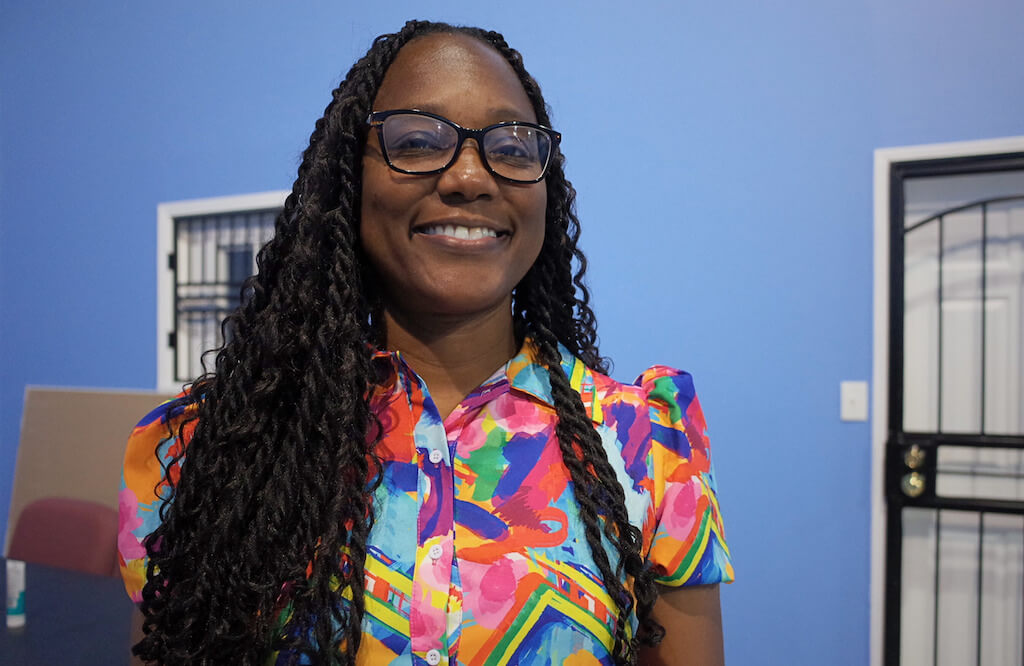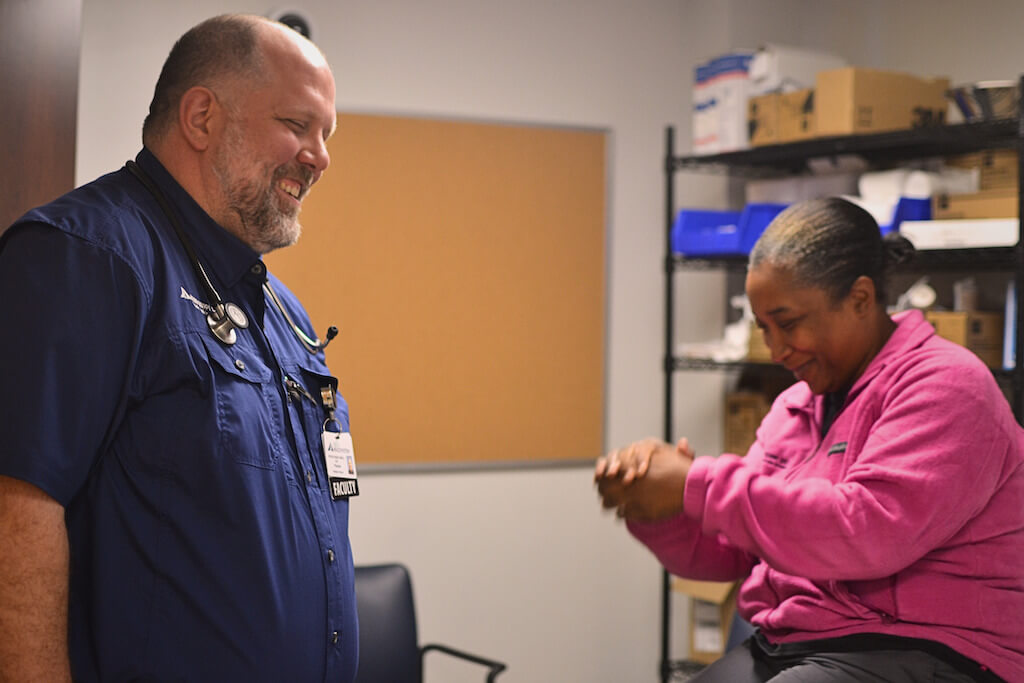
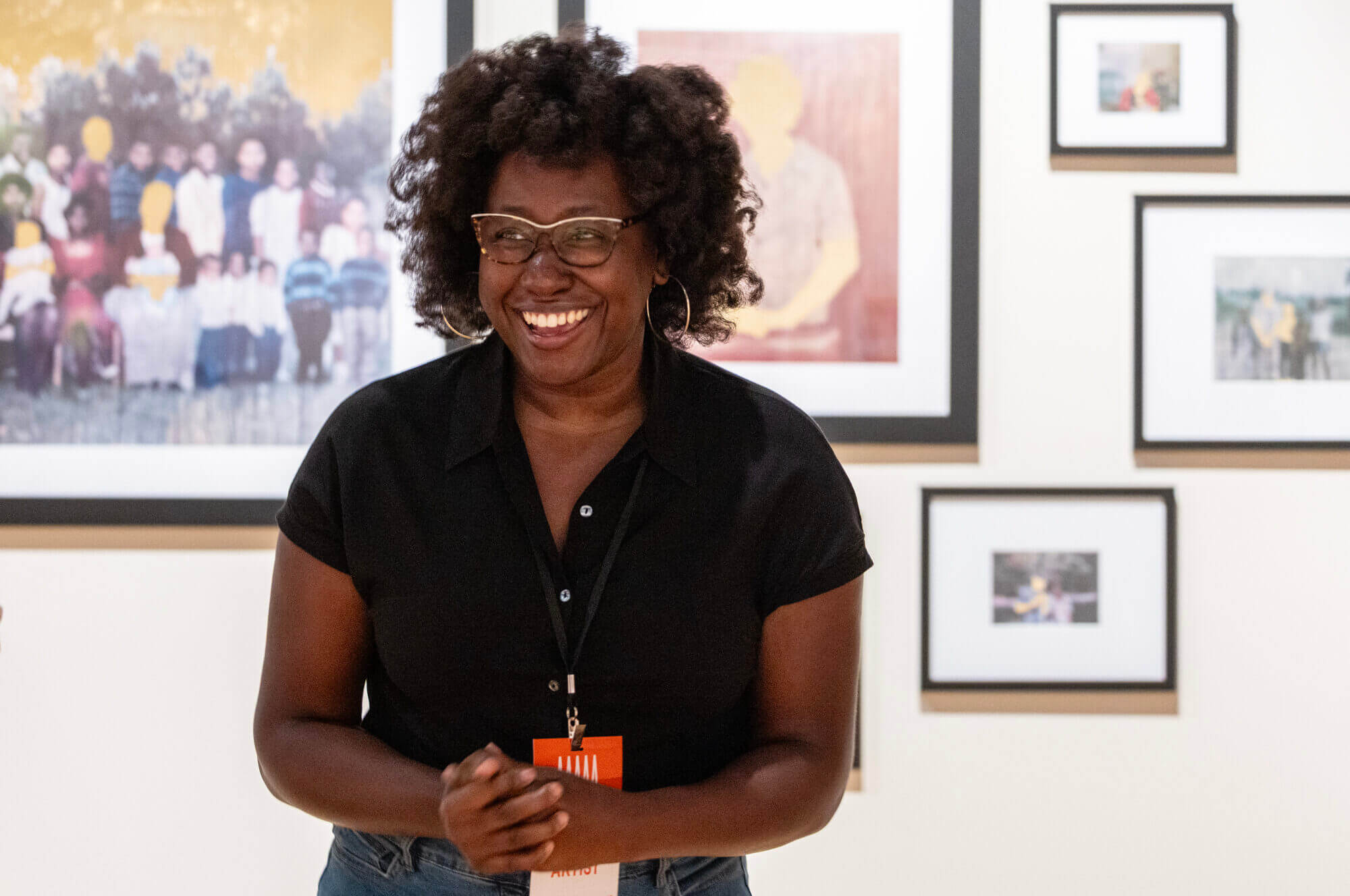
Artist Alexis McGrigg talks about her piece “A Personal Constellation” during a media preview at the Mississippi Museum of Art on Thursday, June 26, 2025, in Jackson, Miss. McGrigg’s work is featured in the exhibit “Call Home.” Credit: Eric Shelton/Mississippi Today
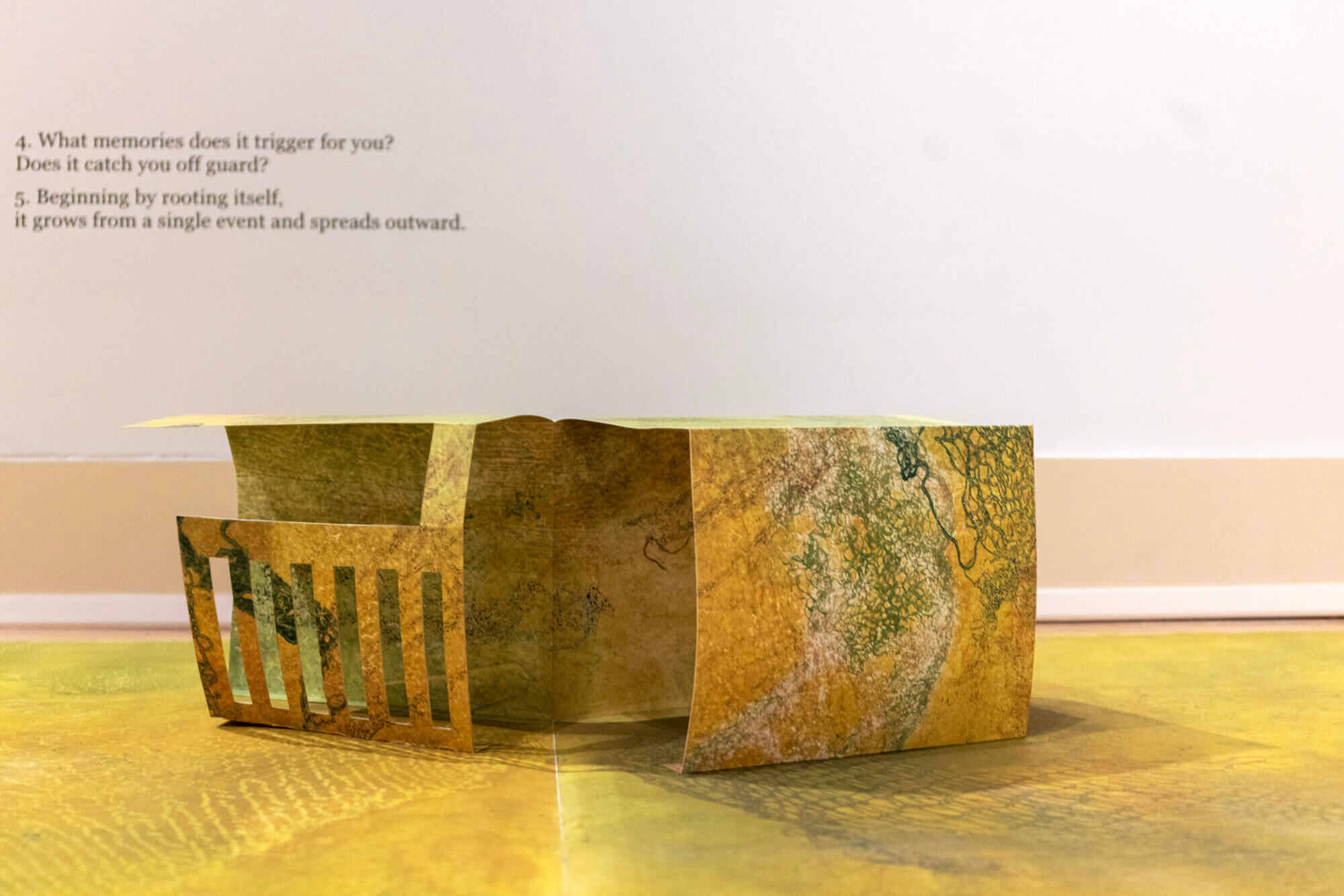
Artist Alexis McGrigg’s piece “A Personal Constellation” is on display during a media preview at the Mississippi Museum of Art on Thursday, June 26, 2025, in Jackson, Miss. McGrigg’s work is featured in the exhibit “Call Home.” Credit: Eric Shelton/Mississippi Today
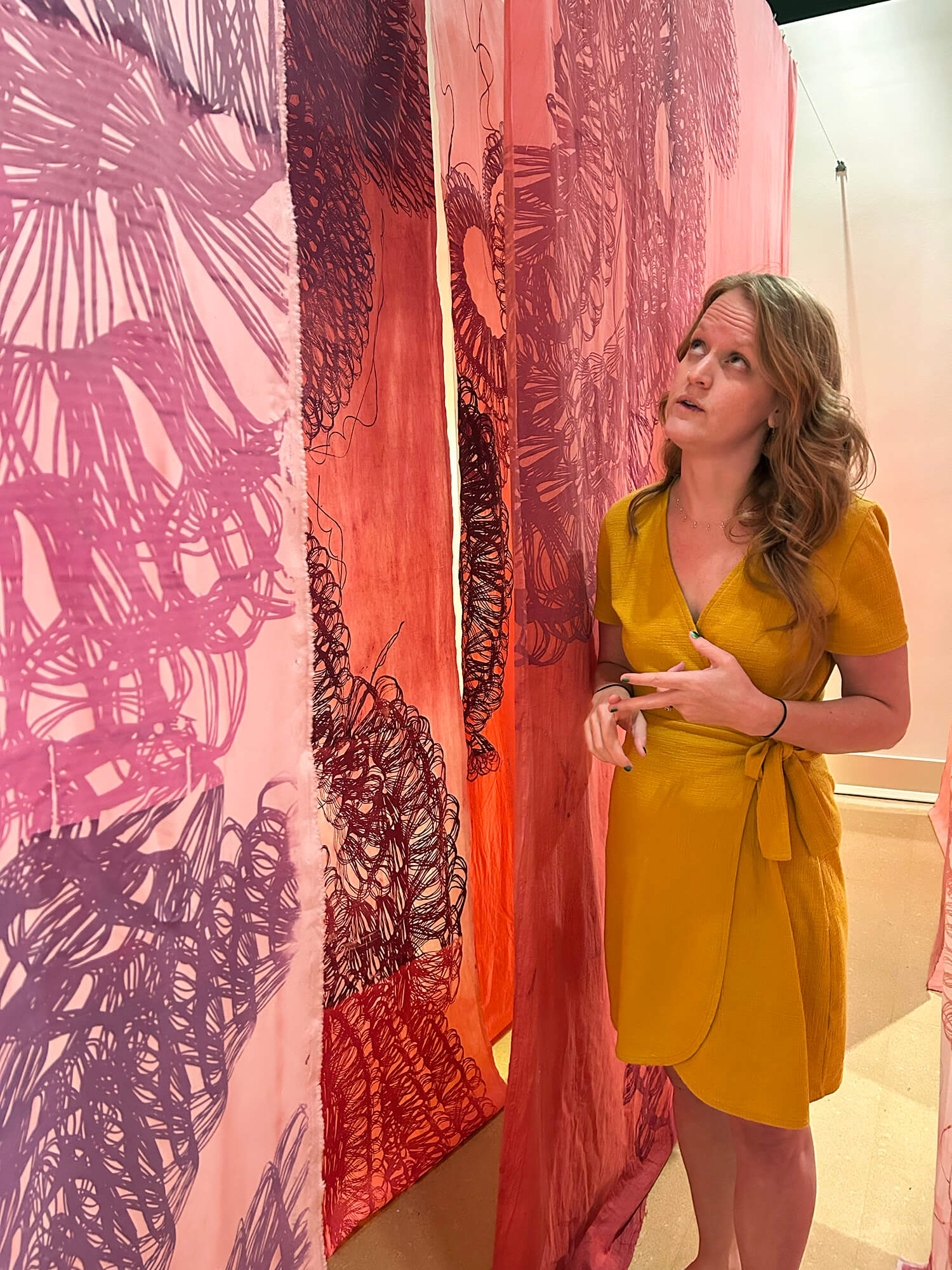
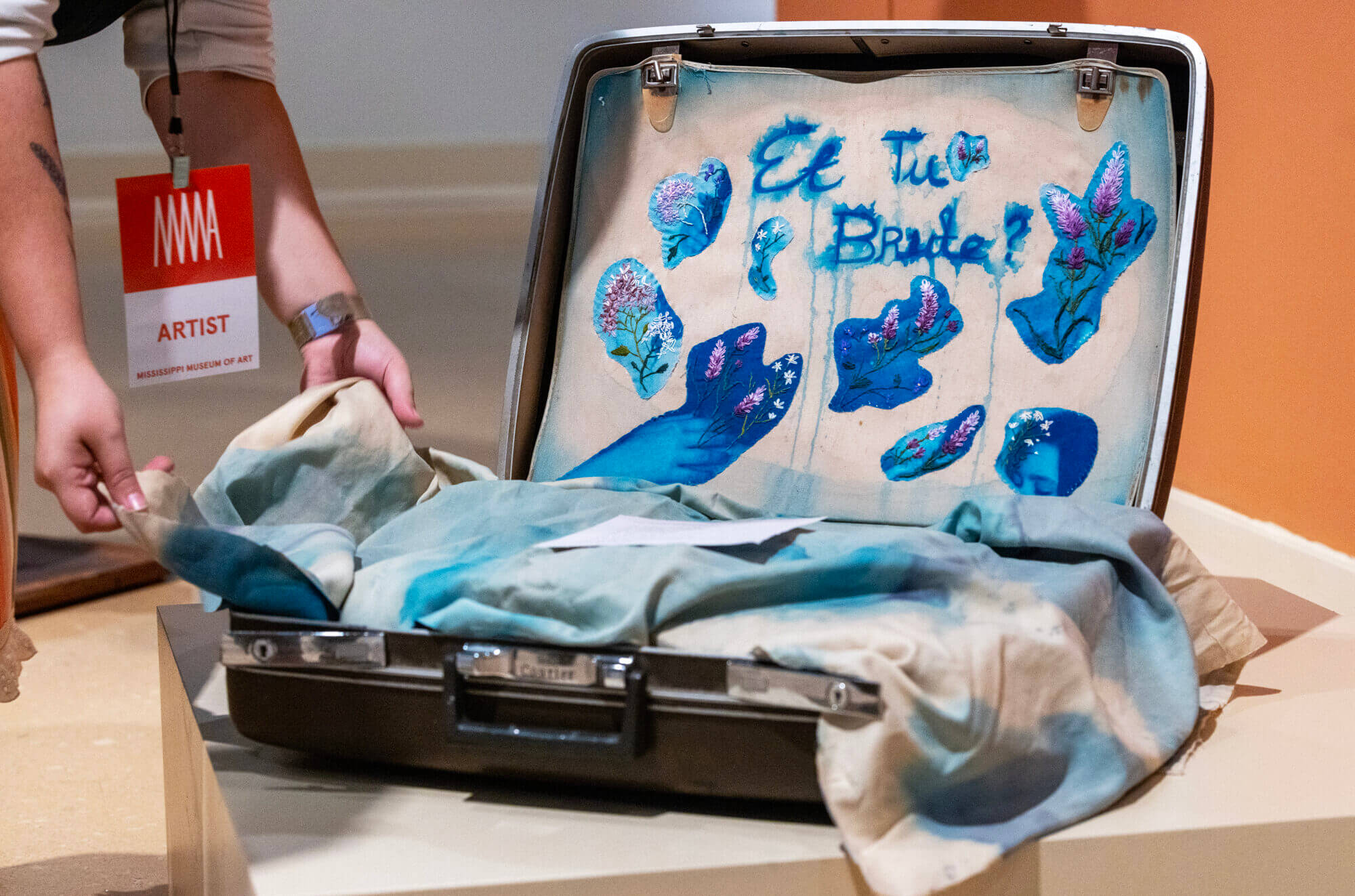
Artist Alexis’ art is on display during a media preview at the Mississippi Museum of Art on Thursday, June 26, 2025, in Jackson, Miss. McGrigg’s work is featured in the exhibit “Call Home.” Credit: Eric Shelton/Mississippi Today
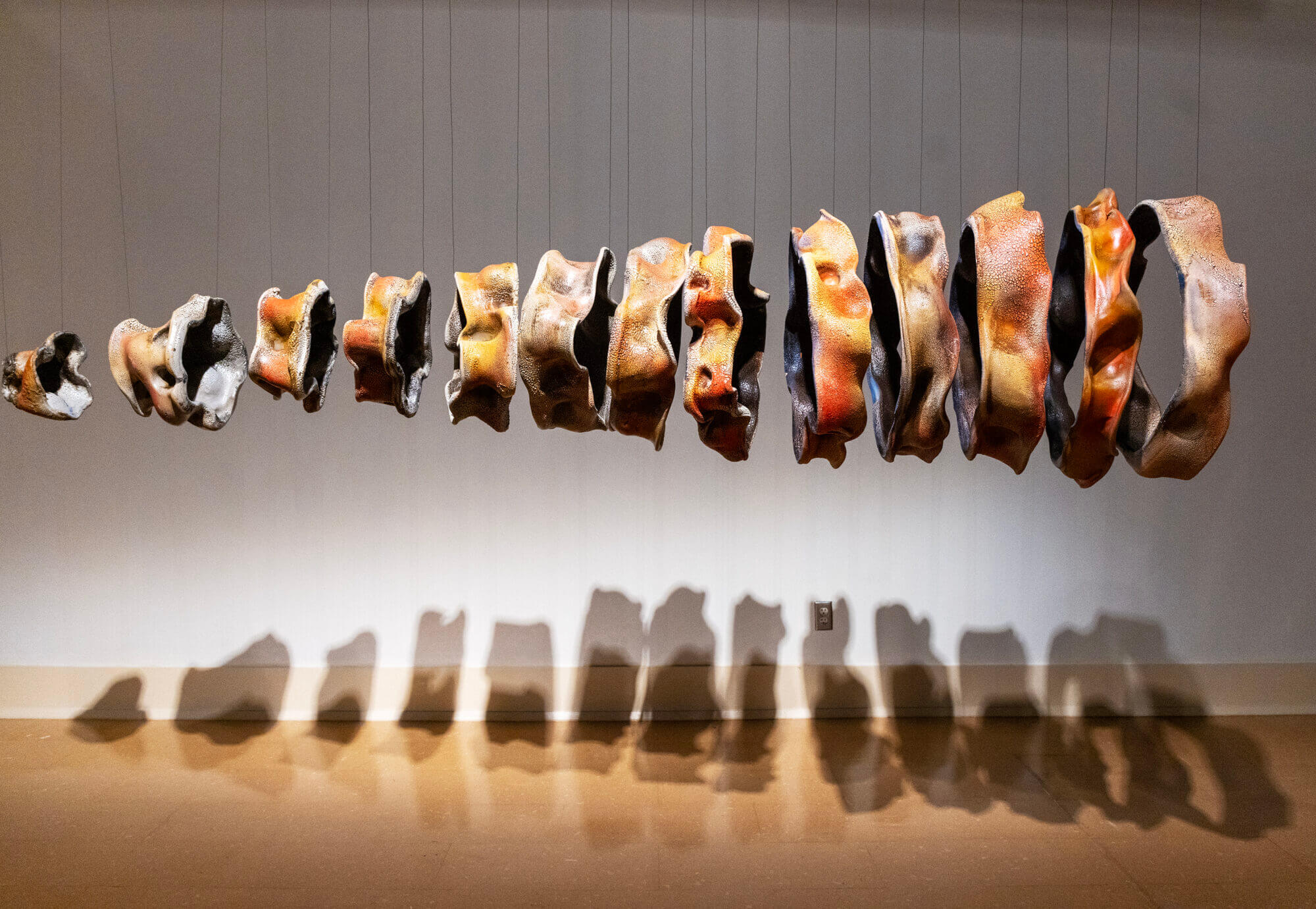
Artist Allen Chen’s piece “Passage of the Spine” is on display during a media preview at the Mississippi Museum of Art on Thursday, June 26, 2025, in Jackson, Miss. Chen’s work is featured in the exhibit “Call Home.” Credit: Eric Shelton/Mississippi Today
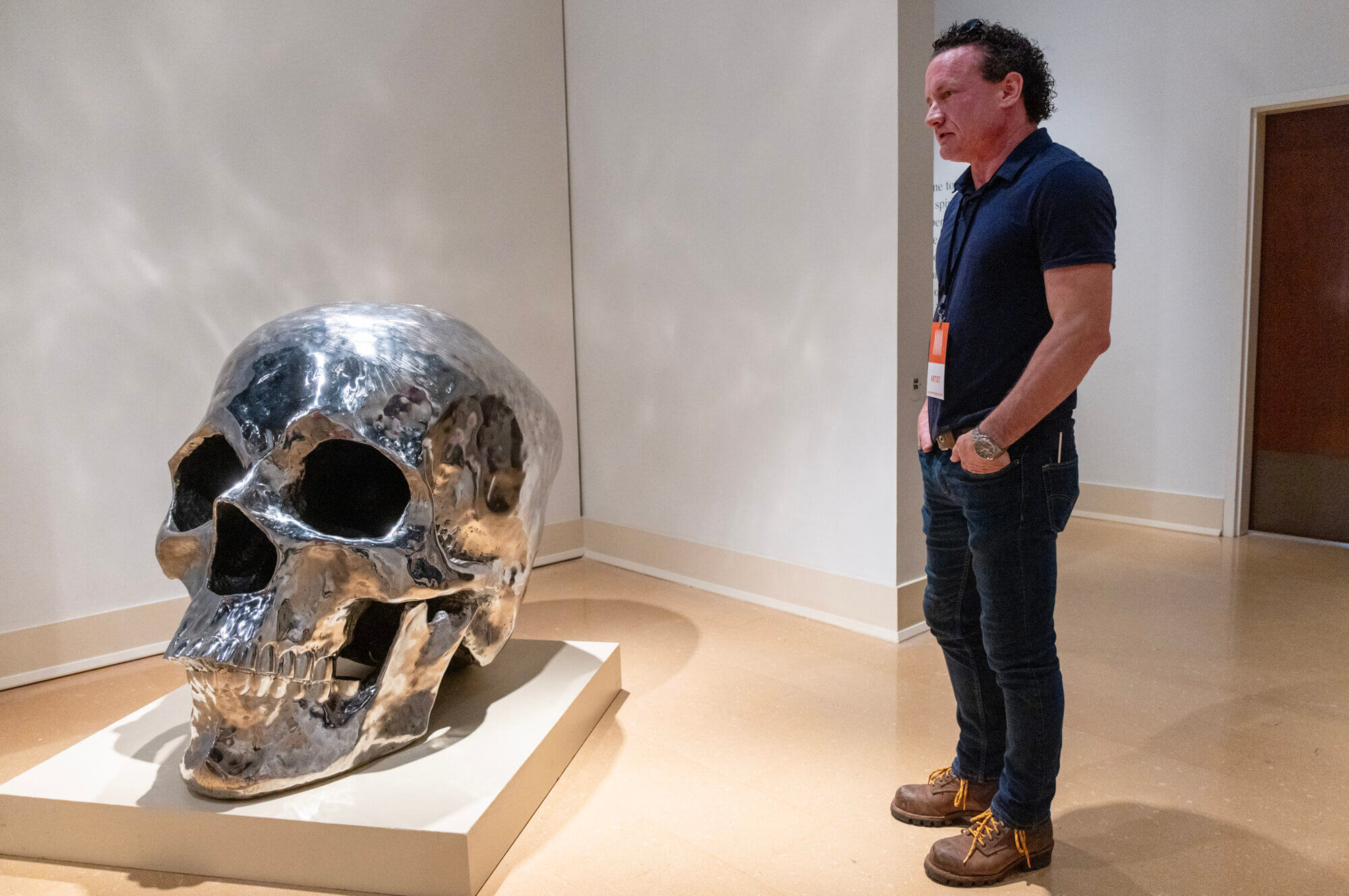
James Kimes’ piece “Veni” is on display during a media preview at the Mississippi Museum of Art on Thursday, June 26, 2025, in Jackson, Miss. Kimes’ work is featured in the exhibit “Call Home.” Credit: Eric Shelton/Mississippi Today
James Kimes discusses his artwork during a media preview at the Mississippi Museum of Art on Thursday, June 26, 2025, in Jackson, Miss. Kimes’ work is featured in the exhibit “Call Home.” Credit: Eric Shelton/Mississippi Today
“Call Home” will be exhibited at the Mississippi Museum of Art from June 28 to Sept. 7, 2025, and features 12 artists from across the state. The exhibition explores the theme of “home” and what it means to create and belong in Mississippi today, according to the museum. Credit: Eric Shelton/Mississippi Today
Sue Carrie Drummond talks about her art during a media preview at the Mississippi Museum of Art on Thursday, June 26, 2025, in Jackson, Miss. Drummond’s work is featured in the exhibit “Call Home.” Credit: Sherry Lucas
Ceramic works by artist Allen Chen are on display during a media preview at the Mississippi Museum of Art on Thursday, June 26, 2025, in Jackson, Miss. Chen’s pieces are featured in the exhibit “Call Home.” Credit: Eric Shelton/Mississippi Today
Artist Allen Chen discusses his ceramics during a media preview at the Mississippi Museum of Art on Thursday, June 26, 2025, in Jackson, Miss. Chen’s work is featured in the exhibit “Call Home.” Credit: Eric Shelton/Mississippi Today
Artist Emma Lorenz discusses her artwork during a media preview at the Mississippi Museum of Art on Thursday, June 26, 2025, in Jackson, Miss. Lorenz’s work is featured in the exhibit “Call Home.” Credit: Eric Shelton/Mississippi Today
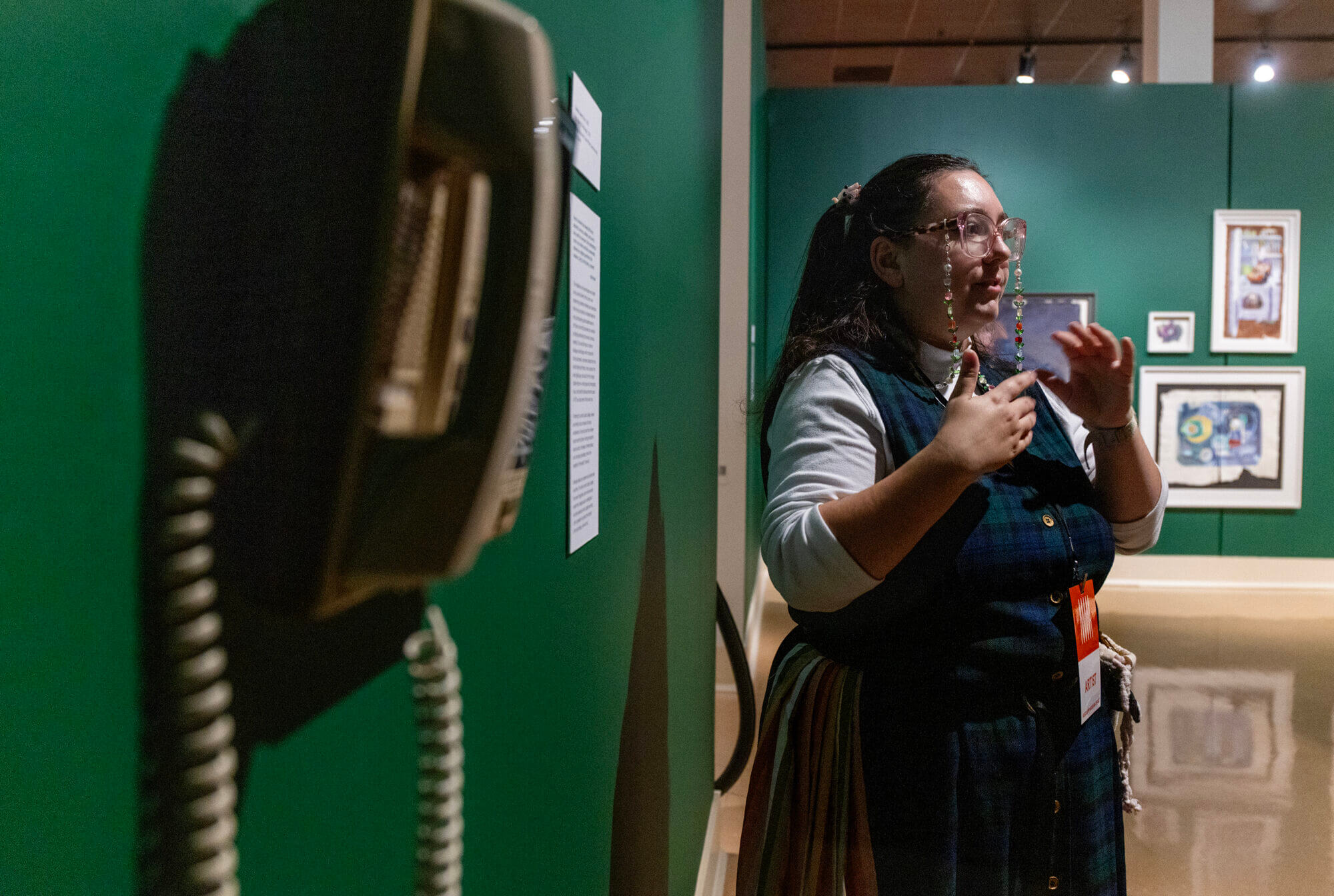
Artist Emma Lorenz discusses her piece “You Have XX Messages” during a media preview at the Mississippi Museum of Art on Thursday, June 26, 2025, in Jackson, Miss. Lorenz’s work is featured in the exhibit “Call Home.” Credit: Eric Shelton/Mississippi Today
Curator TK Smith talks with artists during a media preview at the Mississippi Museum of Art on Thursday, June 26, 2025, in Jackson, Miss. Credit: Eric Shelton/Mississippi Today
Betsy Bradley, director of the Mississippi Museum of Art, discusses the upcoming exhibit “Call Home” during a media preview at the museum on Thursday, June 26, 2025, in Jackson, Miss. Credit: Eric Shelton/Mississippi Today
Sue Carrie Drummond’s piece “My Mold Garden” is on display during a media preview at the Mississippi Museum of Art on Thursday, June 26, 2025, in Jackson, Miss. Credit: Eric Shelton/Mississippi Today
Sue Carrie Drummond talks about her piece “My Mold Garden” during a media preview at the Mississippi Museum of Art on Thursday, June 26, 2025, in Jackson, Miss. Drummond’s work is featured in the exhibit “Call Home.” Credit: Eric Shelton/Mississippi Today
Sue Carrie Drummond talks about her art during a media preview at the Mississippi Museum of Art on Thursday, June 26, 2025, in Jackson, Miss. Drummond’s work is featured in the exhibit “Call Home.” Credit: Eric Shelton/Mississippi Today
Jerrod Partridge’s work is on display during a media preview at the Mississippi Museum of Art on Thursday, June 26, 2025, in Jackson, Miss. Partridge’s work is featured in the exhibit “Call Home.” Credit: Eric Shelton/Mississippi Today
Connor Frew’s work is on display during a media preview at the Mississippi Museum of Art on Thursday, June 26, 2025, in Jackson, Miss. Frew’s work is featured in the exhibit “Call Home.” Credit: Eric Shelton/Mississippi Today
A sprinkle of rocking chairs, kitchen sinks and family photos in Mississippi Museum of Art’s “2025 Mississippi Invitational” exhibition pepper the galleries with near universal touchstones. Signs of love and signs of loss, frayed connections, conflicting expectations, notions of belonging and the creep of time come through in artworks, too, evoking the deeply personal relationships and complex emotional ties forged in that place called home.
The museum’s 14th biennial survey of recent works by contemporary visual artists living and working in the state opens a fresh window into Mississippi and into this particular moment. The exhibition is on view through Sept. 7.
Its 12 featured artists were selected from about 180 applications and 37 studio visits across the state. Guest curator TK Smith, an Atlanta-based writer, curator and cultural historian, drew on his conversations with artists in their studios and tapped into his own summer visits with grandparents in Mississippi for the exhibition’s “Call Home” theme.
“All of these artists are reaching out — reaching to connect in some way, either to their audiences, to other artists, to communities, for political reasons, personal reasons,” Smith said. “Everybody is just kind of yearning, and I think that is shaping the work that’s in the show.”
Both up-and-coming and established artists are among the show’s 12, with creations covering a broad swath of media. Painting, printmaking, ceramics, sculpture, photography, film, assemblage, installation and more deliver a diverse, vibrant and provocative portrait of the state of art in Mississippi. Unfolding across three sections, or “three breaths” in Smith’s words, the exhibition explores home as a physical space, as a body and beyond, and artists’ works in each section showcase their individual range.
An actual phone opens the exhibition — the vintage Panasonic Easa-Phone telephone and answering machine in artist Emma Lorenz’s “You Have XX Messages.” Personal voicemails and audio from the Golden Record combine in Lorenz’s study of how technological progress can risk losing touch with the past, and how even content inaccessible in the moment is still proof of life, care and love.
Lush hues on handmade paper lend beauty, depth and inviting texture to domestic scenes in a suite of paintings by Ocean Springs artist Jerrod Partridge. An open fridge, a puddle of clothes, even a laundry room peek of a baby lulled to sleep by the dryer, put viewers right at home in the messy comforts of daily life. Other exhibition works highlight coastal natural surroundings and, in a nod to the much-traveled artist’s global home, a series of drawings from Italy. Partridge was awarded the Invitational’s Jane Crater Hiatt Artist Fellowship, a $20,000 grant that he will use to develop a series of paintings about communities within the Gulf Coast’s seafood industry.
Laser cut metal fronds arc up from a circle of sandbags, forming a prickly dome in “Garden Pavilion (Cutgrass)” by Connor Frew of Jackson. Inspired by a semi-aquatic grass with serrated leaves that can cut skin, Frew tucked in concepts of resilience and resistance in wilderness, likening the sandbags’ text to a search engine query of how to grow strong enough to destroy the blades (in stronger language).
“It’s this idea of wild, unrestrained growth and collectivity as a means of resisting attempts at culling, or destroying a particular community.”
Wander through the large-scale pop-ups in Sue Carrie Drummond’s installation “My Mold Garden,” drawn from an artist book collaboration with a cultural anthropologist (digital copy of the book also on display). Post-heartbreak grief coupled with mold growth in the home became a journey to emotional self-help.
“It puts you in the experience of someone who is dealing with slow breakdown, and then how they put themselves back together. And, the mold mimics that,” Drummond said, breaking down matter to raw material that can be re-used.
“A Beautiful Snare,” another interactive installation, confronts ideas of femininity through the etymology of lace. Its maze of voile, chiffon, charmeuse and cotton panels deepen from white to reddish hues, with increasingly intense coil designs the farther inside you wander. Is it fragile or strong? A lure or a snare, enticement or entrapment, or maybe both?
Artist Alexis McGrigg’s works in photography, film and painting embody deep family and ancestral ties, as in “A Personal Constellation.” There, gold leaf signifies departed members in a collection of old family photographs, to moving effect. Those are the souls that have touched “The Beloved” (her term for a heaven-like space, or origin of humanity).
“We have these people that are connected to us, that are no longer here,” McGrigg said, thinking of them as guardians who still watch over her.
A family photo finds a place, too, in Christina McField’s home scene installation, soothing in its details of a crocheted afghan on a rocking chair, worn books, antique table and the framed 1920s photo on its surface. It pictures her great-grandmother with her grandfather, then a small child, standing atop that very table.
“I wanted to bring them back to life and honor them,” McField said, fondly recalling family visits to Philadelphia, Miss., as a child. “This is what I think about when I think about calling home.”
Elsewhere in the exhibit, her sculptural triptych assembles architectural scraps — ceiling tiles, spindles, brackets — in a meditation on past lives, the erosion of time and enduring fragments of memory.
Groupings of Hattiesburg ceramicist Allen Chen’s remarkable vessels channel generations of ancestors and migratory patterns, from the “original tribe” of earthen-hued pairs to different colored and carved “offsprings” bearing the changes new environments bring.
Forms are similar, “the bones” are the same, he said, but colors — a surface quality, like skin tone — are different.
“Home is not really a static place. We would like it to be, but wherever you end up comes from long lines of people moving around.”
Chen’s “Passage of the Spine,” with its concentric ceramic shapes suspended in a horizontal line, may call to mind ancient whale fossils. The shadow this large piece casts only heightens its dramatic appeal.
“2025 Mississippi Invitational” selected artists also include: Rylee Brabham, with sculptures and installations exploring gender and society, with a dash of humor; Kaleena Stasiak, with windsocks, mobile and folk warnings about the weather conveying whimsy and wisdom; Ashley Gates, whose touching installation overlays images of her late mother with projections of a solar eclipse; and documentary photographer Betty Press, whose eye for intimacy and design shines through in photos of home births, pairings of Kenyan and Mississippi storefronts and more.
Three larger-than-life sculptures by Jason Kimes of Laurel follow a life cycle through the galleries, each one bearing a name that, together, form Julius Caesar’s famous phrase. A fetal position baby in clear epoxy is the blank-slate start (“Veni’). The 8-foot striding figure in weathering steel, made of thousands of individually welded squares, carries the rusty patina of experience (“Vidi”) and a noble skull in polished stainless gleams at the exhibit’s close (“Vici”).
“You start with nothing. You build up all the way through until you end up with something praiseworthy,” Kimes described a lifespan. And then, “It’s the ultimate call home.”
“2025 Mississippi Invitational” is on view at the Mississippi Museum of Art, 380 S. Lamar St. in Jackson, through Sept. 7. Admission is $15 adults, $13 seniors 65-plus, $10 youth 6-17 and college students with ID. It is free for museum members, children 5 and younger, active military and families this summer, and for certain groups on designated days. Find more details atwww.msmuseumart.org.
Editor’s note: This essay is part of Mississippi Today Ideas, a platform for thoughtful Mississippians to share fact-based ideas about our state’s past, present and future. You can read more about the section here.
Everything seems to be turned upside down.
President Donald Trump is asking the federal courts to ignore what our United States Constitution says and to rule against birthright citizenship.
The president is asking the Supreme Court to reverse what has been law since 1868 when the 14th Amendment to the Constitution was ratified. The 14th Amendment states clearly that people born in America are American. It is known as birthright citizenship.
As director of the Lowndes County-based Saving Grace Mission, I hear from people — including many children — who unfortunately say their American citizenship is being questioned.
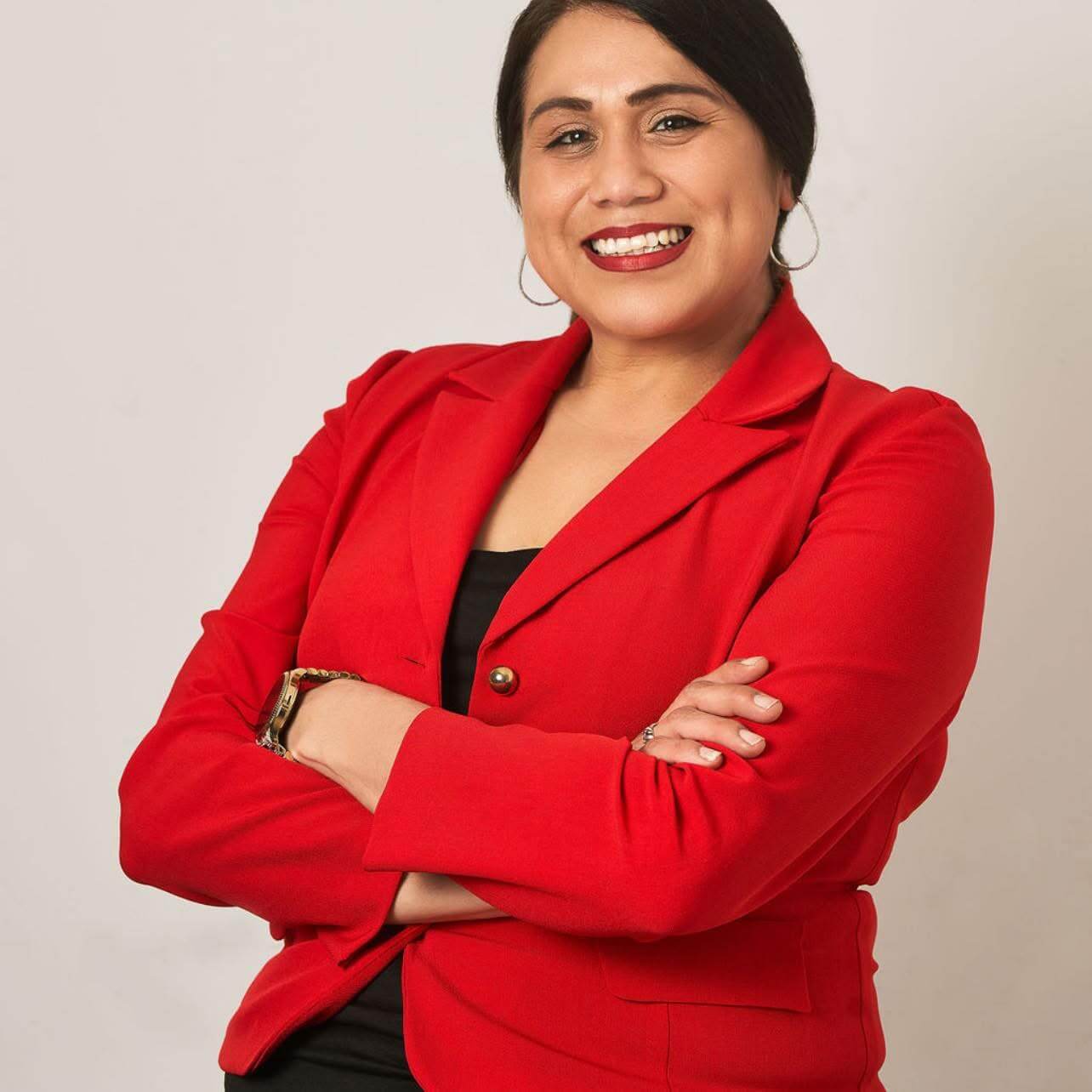
I was born in Louisiana to Mexican-American parents with indigenous roots and grew up in Texas before moving to my adopted Mississippi. As an advocate for immigrants and the daughter of immigrants, it breaks my heart what American children are having to go through.
“You can’t just take away someone’s birthright,” said a 17-year-old Hispanic female from Caledonia High School, a school that had the nickname the “Confederates” until it was finally changed in 2020.
Julia Chavez Credit: Courtesy photo
“The kids in my class threaten to call ICE on my parents every day,” said a 13-year-old at the same school. “I’m bullied just because I’m Hispanic, but I’m American. I was born here.”
When I see the fear of our own community members who serve and give back, fear for their lives, it is very alarming. It is especially alarming when it is the federal government responsible for this fear — fear even being experienced by U.S.-born children.
It is unfortunate for American children to be so afraid of their own government.
“Save the children” is our U.S. motto, and we shouldn’t allow our president to torment our own with fear of separation of families who are part of closely knit groups in these communities.
“Would you know where to go?” I asked a 43-year-old mother of four and grandmother of two who is a native of Mexico, but has been a resident of north Mississippi for the past 24 years. Her children and grandchildren live in the area, too, and are U.S. citizens — born right here in Mississippi.
“No, where would we go?” she asked. “This is our home, and we have a new baby. We can’t go anywhere.”
I asked her if she is afraid.
“I trust the Justice Department, but it seems like he (Trump) gets to do whatever he wants and gets away with whatever he wants anyway, so that’s what’s scary,” she said.
Another scare tactic the Trump administration has used to diminish people of color is the 1798 Alien Enemies Act law, which gives the president the authority to remove non-citizens in times of war.
Sadly, depression and anxiety are at an all-time high with the lack of community resources due to lack of funding for the immigrant population — especially here in Mississippi.
Julia Chavez is the founder and CEO of Lowndes County-based Saving Grace Mission, a rescue center for families in need of clothing, shoes, school supplies and other basic immediate needs. She also is a motivational speaker and published author. She and her husband Sergio Chavez are business owners.
Note: This story first published in Stateline, which is part of States Newsroom, the nation’s largest state-focused nonprofit news organization.
LAKE PROVIDENCE, La. — East Carroll Parish sits in the northeastern corner of Louisiana, along the winding Mississippi River. Its seat, Lake Providence, was a thriving agricultural center of the Delta. Now, the town is a shell of its former self. Charred and dilapidated buildings dot the small city center. There are a few gas stations, a handful of restaurants — and little to no industry.
Mayor Bobby Amacker, 79, says at one point “you couldn’t even walk down the street” in Lake Providence’s main business district because “there were so many people.”
“It’s gone down tremendously in the last 50 years,” said Amacker, a Democrat. “The town, it looks like it’s drying up. And it’s almost unstoppable, as far as I can tell.”
Now, East Carroll residents stand to lose even more. Like many people in Louisiana, they received a lifeline when the state expanded Medicaid to more low-income adults in 2016. Expansion drove Louisiana’s uninsured rate to the lowest in the Deep South, at 8% in 2023 for working-age adults, according to state data, despite it having the highest poverty rate in the U.S. that year.
This week, both chambers of Congress approved President Donald Trump’s “big, beautiful” tax and spending bill. It includes more than $1 trillion in cuts to Medicaid, the joint state-federal health insurance program for poor families and individuals, to help pay for tax cuts that mostly benefit the rich. The legislation would cause 11.8 million more Americans to become uninsured by 2034, according to the Congressional Budget Office.
The bill includes new work rules for Medicaid recipients and would require them to verify their eligibility more frequently. It also would limit a financing strategy that states have used to boost Medicaid payments to hospitals.
Republicans say enrollees are taking advantage of the Medicaid program and getting benefits when they shouldn’t be. They say the program costs too much and states are not paying their fair share.
The Delta region, which includes communities in both Louisiana and Mississippi, would suffer under such large cuts. But in Louisiana — where almost half of the state depended on Medicaid in 2023, the Louisiana Department of Health reported — the cuts could be ruinous. Louisiana could lose up to $35 billion in federal Medicaid support over the next decade, according to KFF, a health policy research group. Mississippi, which never expanded Medicaid, could still lose up to $5 billion.
Residents are watching with apprehension, fear and, sometimes, anger, wondering how Congress could be so blind to how much they are struggling.
“If they take that away from us and everyone that really needs it, that’s going to be bad,” said Sherila Ervin, who lives 20 minutes up the road from Lake Providence in Oak Grove and has Medicaid coverage.
Medicaid work requirements and other health care provisions in the bill ignore the reality of living in poorer rural communities, where people struggle to find the jobs, transportation and internet access required to meet the rules, according to interviews with people and providers in the Delta region.
Even though Louisiana and Mississippi have taken very different approaches to Medicaid — one expanded eligibility under the 2010 Affordable Care Act and the other didn’t — both rely heavily on the program to sustain access to medical care for all their residents.
On a hot summer day in June, Ervin walks into the bare-bones 99-cent store in downtown Lake Providence. As she looks over some clothing, she says she’s heard about the potential Medicaid cuts. But she hadn’t heard about the work requirements, and is shocked they’re even on the table.
“I don’t like that. I don’t think they should put a stipulation on that,” Ervin says, exasperated that she would have to report her work hours. It’s hard enough as it is, she says, to thrive in this community.
Ervin, 58, has been working at Oak Grove High School in the cafeteria, serving hot plates to children for two decades. She says it’s one of the good, steady jobs available in this area, but her income is only around $1,500 per month.
Ervin’s job offers health benefits, but she can’t afford the premiums on her salary. She relies on Medicaid for care, including medications for her high blood pressure.
In East Carroll Parish, around 46.5% of people live below the poverty level, meaning the area is overwhelmingly poor, at over four times the national poverty rate, with a median income of $28,321. For Black households, the figure is a mere $16,690.
Expansion was a lifeline for people such as Ervin. Louisiana offers Medicaid to people who earn below 138% of the federal poverty line — currently about $22,000 a year for an individual.
“Sometimes you can work, but then when you work, you still can’t pay to get help,” Ervin said.
It’s a similar economic situation an hour away across the river. Poverty is about three times the national rate in Washington County, Mississippi, where residents in the city of Greenville lament the consequences of not being able to avoid destructive medical debt, which can keep them stuck in a cycle of gig work and of living paycheck to paycheck.
Greenville, the county seat, is among the fastest-shrinking cities in the U.S. It’s still one of the larger rural cities in Mississippi, with coffee shops, restaurants, hotels, a regional hospital and several big-box stores. But the downtown has just a few small businesses and a bank, and residents say jobs are hard to find.
Greenville resident April McNair, 45, remembers giving birth 17 years ago, long before Mississippi extended postpartum Medicaid to a full year. She had Medicaid coverage during pregnancy, but was kicked off shortly after giving birth, despite having post-delivery complications.
April McNair, 45, is a resident of Greenville, Miss. (Photo by Shalina Chatlani/Stateline)
The result was a trip to the emergency room and a $2,500 bill she couldn’t cover. Right after giving birth, McNair looked for work. She said potential employers often told her that she was overqualified because she had a master’s degree.
“I had to kind of figure out how to make my ends meet,” McNair said. “I ended up with a significant bill, all because I did not have Medicaid.”
McNair feels like Mississippi leaders are making a mistake by continuing to reject full Medicaid expansion.
“That’s a selfish move. To me, they’re selfish,” McNair said, adding that now she’s worried for neighbors in Louisiana who may lose the lifeline she wishes she had.
“God forbid, hypothetically speaking, what if one of them meets their demise because of this bill that [Congress] passed?”
Hard to thrive
Mississippi experienced its first taste of equalized access to medicine in the late 1960s.
Delta Health Center, the first federally funded health center in the nation, opened during the peak of the Civil Rights Movement in the all-Black town of Mound Bayou, about an hour north of Greenville. The center vowed to care for anyone regardless of race or ability to pay in a region plagued with poverty, poor health and discrimination — and continues to do so to this day.
It was a significant opportunity for generations of African Americans who had gone without health care, in a place where people had no access to clean drinking water, running sewage systems or even food, said Robin Boyles, chief program planning and development officer at Delta Health Center.
But it wasn’t easy for the clinic to mobilize support, even though it was clearly needed. Before its opening, it faced pushback from politicians and even doctors. In a 1966 clipping from a local newspaper, the white-owned Bolivar Commercial, the editorial board railed against the new clinic, saying it would “lead further to socialized medicine.”
The situation is certainly better in Mississippi and Louisiana than it was in the 1960s, but critics say the Medicaid cuts could reverse hard-fought progress.
People who live in the Delta are fiercely proud of their communities, but conditions there make it hard to thrive.
Black residents, who are the overwhelming majority, have had a particularly hard time. After the Civil War, many were relegated to sharecropping of cotton and corn for subsistence. Meanwhile, an elite white class of plantation owners and investors amassed enormous amounts of wealth.
A 2001 report from the U.S. Commission on Civil Rights described the area as one with “limited economic resources; inadequate employment opportunities; insufficient decent, affordable housing; and poor quality public schools.”
“We have a lot of patients that are one health issue away from either being out of a job or being bankrupt because of a trip to the emergency room,” said Dr. Brent Smith, a physician at a primary care clinic at Delta Health System in Greenville.
Even some of the most vulnerable people, such as new moms in Mississippi, still struggle to get basic care, in part because the state has left billions of dollars in federal funding for Medicaid expansion on the table, said Dr. Lakeisha Richardson, an OB-GYN at Delta Health System.
“There are a lot of maternal [care] deserts in Mississippi where women have to travel 60 miles or more just to get prenatal care and just to get to the closest hospital for delivery,” Richardson said. “And I don’t see that getting any better in Mississippi and in rural areas.”
Richardson says nearly all her patients are working moms, many of whom would really benefit from having Medicaid expansion.
“America doesn’t realize that there are people out here struggling for no reason of their own,” she said.
That’s why Medicaid expansion in Louisiana in 2016, much like the community health center movement in Mississippi, was a bright spot in the rural South, said Smith.
“Louisiana expanded Medicaid, a surprising move in the South to see any state expand,” Smith said. “They saw it for what it was, which was a very real opportunity to assist this specific group of patients.”
Dr. Brent Smith, left, a physician at a primary care clinic at Delta Health System in Greenville, laughs with a co-worker. (Photo by Shalina Chatlani/Stateline)
In Mississippi, 20 rural hospitals are at immediate risk of closure, according to a recent report, more than double the number at risk in Louisiana. In many cases, Medicaid is the largest and most reliable payer for rural hospitals. While Louisiana’s overall uninsured rate plummeted to 8.3% by 2023, in Mississippi it was 10.5%.
“Unlike a lot of our Southern peers, we have not had the same level of closures of facilities,” said Courtney Foster, senior policy adviser for Medicaid, with the nonprofit Invest in Louisiana.
“Medicaid was like a real lifeline for people in transition. Oftentimes it was people who had lost their jobs and were just looking to get back on their feet.”
Now, the new work and reporting requirements could put that progress at risk.
In East Carroll Parish, finding a job — let alone a good-paying one with health benefits — is difficult, says Rosie Brown, executive director at the East Carroll Community Action Agency, a nonprofit that helps low-income people with their rent and utility bills. Many of the jobs available in town pay minimum wage, just $7.25 an hour.
Brown loves living in Lake Providence; this is where her family is. She doesn’t want to move but wishes the government would invest more in her community — not take away benefits that help people who are hanging on by a thread.
“We have one bank. We have one supermarket,” she said. “Transportation isn’t easy either.”
Local infrastructure is so limited, she’s even heard of some people charging residents $20 for a ride to Walmart. Some people have to hitch a ride an hour away to go to work, she said.
“There’s nowhere to go,” Brown said.
Dominique Jones works at the local library, where she helps roughly 75 to 85 people per month apply for programs such as Medicaid and food assistance. Many of the residents she helps don’t have access to the internet or even a computer, a real barrier for people who’d be required to report their working hours to state Medicaid officials.
“This town right here is made up of a lot of old people that need Medicaid and Medicare. And without it, they wouldn’t have any kind of health care at all,” Mayor Amacker said.
Even a job in local government in Lake Providence doesn’t offer affordable health insurance.
Nevada Qualls, 25, sits across from Amacker’s office. She earns just $12 an hour as a cashier at city hall. The low pay means she qualifies for Medicaid expansion coverage, which is good because she can’t afford the premiums for private insurance.
“I feel like there should be a higher threshold for people that can get Medicaid, because they’re still struggling,” she said.
At the 99-cent store, school district worker Ervin wonders whether state and federal leaders understand what it’s like to live in her community, urging them to visit and see for themselves.
“They want to do stuff for the rich people that’s already rich,” she said. “What are they doing? It’s almost like there’s no common sense with them.”
‘The tremble factors’
While leaders in the U.S. Senate were working into the night this past weekend debating Trump’s tax and spending bill, Greenville resident Jennifer Morris was praying for the pain to stay away.
Morris, 44, has hemicrania continua, a headache disorder that causes constant pain on one side of her head. There’s no underlying trigger and no cure. Her doctors help her keep the pain to a minimum with regular treatments that include dozens of injections into her head.
“It doesn’t take the pain away,” she said during a late-night gathering in Greenville’s Greater Mount Olivet Missionary Baptist Church in June. “It does reduce the pain so that I’m able to function. But it’s rough.”
Morris is worried about the looming Medicaid cuts. She qualifies for Mississippi Medicaid because her condition counts as a disability, and she depends on the coverage to afford her medications.
Morris’ Medicaid may be safer than that of her Delta neighbors in Lake Providence, as some of the most dramatic Medicaid changes being considered — such as work requirements — target Medicaid expansion states only.
But Mississippi could be hurt by a provision in the Senate bill that would target a strategy states have used to boost the Medicaid dollars they get from the federal government.
Mississippi could see a major hit to its Medicaid funds, which “would be a tremendous decrease in revenue for the state,” harming “services and access to care,” says Mitchell Adcock, executive director at the Center for Mississippi Health Policy.
“It would be just the opposite of expansion. It would be a contraction for the Medicaid program in the state,” he said.
Leonard Favorite, a pastor who was attending the same event at Mount Olivet Church, as Morris, says he grew up on a plantation in Louisiana and worked his way out of poverty by joining the Air Force. This type of journey is hard, he said, when you’re already starting from so far behind. He thinks the “big, beautiful bill” will create more roadblocks for poor people.
“You have people who are already living below the poverty line and they will certainly be submerged into poverty at unspeakable levels,” said Favorite, 70.“ That seems to be the trend of this administration from the point of view of looking from the outside.
“Poor people are beginning to feel the tremble factors of an administration that caters toward the rich.”
National researchers estimate that up to 132,000 Louisianans who gained health insurance under expansion could lose it under work rules.
But national reports that rely on census data likely underestimate the potential Medicaid losses. For example, while 2023 census data show 47% of East Carroll Parish was on Medicaid, state health data reviewed by Stateline and Public Health Watch suggests the number is more like 64%. Similarly statewide, census data showed about a third of Louisianans were on Medicaid. State data shows that percentage is closer to 46.5%.
Experts such as Joan Alker at the Georgetown Center for Children and Families say the undercounts nationally are a well-known issue among researchers, but it’s difficult to correct because the quality of state reporting can be so uneven.
State Medicaid funding is also at risk. For years, both Mississippi and Louisiana have relied on revenue generated through a financing tool — known as a provider tax — to draw down more federal dollars and boost Medicaid reimbursements to providers. But congressional Republicans hope to limit states’ ability to collect those taxes.
Depending on how Congress restricts provider taxes, Mississippi could lose hundreds of millions in federal Medicaid funding, crucial in a state with such a high uninsured rate, said Richard Roberson, president and CEO of the Mississippi Hospital Association.
“It’s unavoidable that when you’re taking that much money out of the system, that there’s not going to be some repercussions felt even in non-Medicaid expansion states like Mississippi,” Roberson said.
Last week, the Louisiana Hospital Association signed a statement calling the package of Medicaid cuts before Congress “historic in their devastation.”
From her small, sunny office in East Carroll Parish, nurse Jennifer Newton can’t understand the attacks on Medicaid.
Newton, who grew up one parish over in West Carroll, is executive director of the Family Medical Clinic, a community health center in Lake Providence and one of the few health providers in town. She says 50% of the clinic’s patients have Medicaid insurance.
Newton has worked in health care in the area for decades and watched as Medicaid expansion made it possible for more patients to access and afford health care they desperately needed, including preventive services. “It’s absolutely helped,” she said. “Absolutely.”
In 2015, the year before Louisiana expanded Medicaid, the uninsured rate among working-age adults in East Carroll Parish was nearly 35%. By 2021, that number was 12.7%.
“Why are we going back?” Newton asked. “We’ve made so much progress.”
Republican supporters of work requirements, including Louisiana representative and U.S. House Speaker Mike Johnson, argue they will encourage people to find jobs and ensure Medicaid goes to people who need it most. But according to KFF, a majority of Louisiana adults with Medicaid — 69% — already work.
Brian Blase, president of the Paragon Health Institute, a conservative policy group that is working with Republicans to formulate Medicaid cuts, is not concerned about eligible people losing coverage, as has happened under previous work requirement efforts. He says the bill has built in exceptions for certain people and requirements “can be met by not just work,” so “concerns seem pretty overstated.”
Medicaid recipients also can meet the requirement by volunteering or attending school for 80 hours per month.
“It’s hard for me to understand that there are areas in the country where there’s not jobs. There’s always work to be done,” Blase told Stateline. Blase said he believes Medicaid is “the government conditioning welfare for able-bodied working-age adults.”
But advocates and experts predict East Carroll, where internet access is notoriously bad, would experience results similar to when Arkansas instituted Medicaid work requirements in 2018: People disenrolled because of lack of awareness and confusion over the policy, as well as paperwork errors — not because they weren’t working enough.
“Unless the beneficiary can navigate that red tape, they’re going to lose coverage and become uninsured,” said Benjamin Sommers, a health economist at Harvard T.H. Chan School of Public Health.
Data shows Arkansas’ experiment did not increase employment, Sommers said, and instead led to more people reporting medical debt and delaying care because of cost.
‘Take a step back’
People in the Delta — where the legacy of government neglect and discrimination are all around — want politicians to visit their towns and see the barriers people face trying to improve their lives and stay healthy.
“People spent their lives uninsured,” said Amy Hale, a nurse practitioner at East Carroll Medical clinic. “Medicaid expansion allowed them to get in here and be treated.”
Lake Providence residents are scared they may find themselves in a similar situation as McNair and other people across the river in Greenville: working, uninsured, and too poor to access health care.
Recent estimates show up to 317,000 Louisianans could lose Medicaid health insurance under Trump’s tax bill. Nearly 33,000 in Mississippi.
“People are actually trying,” McNair said. “I really wish [lawmakers] would look at it from a different lens. What if it was their kid? Or they didn’t have the salaries they have now and your baby is ill. … Like really take a step back and think about what it is that you’re doing.”
This story is part of “Uninsured in America,” a project led by Public Health Watch that focuses on life in America’s health coverage gap and the 10 states that haven’t expanded Medicaid under the Affordable Care Act.
Karah Spencer Perkins Potter died from the kind of pervasive gun violence her family has spent decades working to curb in Jackson.
At her funeral service Wednesday, family members, friends and others talked about the 23-year-old’s spirit, smile and servant’s heart — reminiscent of her grandfather, renowned civil rights and evangelical leader, the Rev. John Perkins, who advocated for development and racial reconciliation in west Jackson.
While working at a summer camp run by her family’s nonprofit, the John and Vera Mae Perkins Foundation, Potter helped local kids, taking them for a haircut or out to eat. With her friends, she’d dream up ways to build back Jackson’s forgotten communities.
“She was right on the edge of everything opening up, and she was walking forward with flair,” Liz Perkins, Potter’s aunt, said during the service at New Horizon Church International. “She had a way of making people feel safe just by being with her.”
But her family believes Potter’s desire to help and protect others may have led to her death in the early morning hours of June 22, 2025.
Potter and some friends had just come from a club when they stopped at a gas station on Northside Drive off I-55 at about 4:40 a.m. There, Potter’s friend and the friend’s boyfriend, Phillip Bullock, got into an argument, and Potter intervened.
Karah Spencer Perkins Potter Credit: Courtesy of the Potter family
An off-duty officer who witnessed the incident said he saw Potter and Bullock arguing with guns in their hands, and Potter fired her gun into the air, according to a redacted report from Capitol Police, the responding agency. The officer also saw Bullock shoot Potter, who fell to the ground, the report said.
After firing, Bullock drove away, and the off-duty officer shot at Bullock, according to the report.
Officers did not find a weapon at the scene, according to the report. Capitol Police called Potter’s family soon after, and Perkins said they told her the gas station’s video showed Potter was tussling with Bullock when he grabbed her hand, pushed it down, pulled out his gun and shot her in the head.
The officer also told Perkins that they were still looking for the gun Potter supposedly had. “If she shot the gun, where is the gun?” she asked.
But Bullock has not been charged with Potter’s killing. While the Capitol Police incident report listed his initial charge as aggravated assault, Bullock was charged with possession of a gun as a convicted felon, according to Hinds County Court records. A call to Bullock’s court-appointed public defender was not returned.
In 2017, he had pleaded guilty to aggravated assault against his sister-in-law in Holmes County as well as home invasion. The judge gave him seven years in prison.
Potter’s family is outraged.
“He got out Tuesday, the day after she was declared dead,” said Potter’s mother, Joanie. “He should be charged with murder.”
Perkins said Bullock, who lives just two doors down from the family in west Jackson, is now claiming self-defense, but her understanding is that Potter was trying to get her friend away from him.
“We ain’t saying she was perfect,” Perkins said, “but Karah was a human being who didn’t need to be shot down like a dog.”
Potter’s parents say she was a charismatic young adult who was trying to figure out her future. After moving to Starkville to attend Mississippi State University, Potter decided not to enroll and moved back home to live with her parents while managing a soap store and studying for the real estate exam.
“That was going to change her trajectory,” her mother said.
Potter had also recently started bartending at Babes, a local club. In the past month or so, Potter’s mother discovered a gun in her daughter’s drawer and questioned her, but Potter insisted she needed the gun for protection and that everyone at the club had one.
Her mother argued against it. “What about a man overpowering you and killing you with your gun?” her mother quoted herself as asking Potter.
At the service Wednesday, clergymen passed out tissues as gatherers watched videos of Potter laughing, blowing out birthday cake candles, playing with puppies and kittens, visiting Washington, D.C., and riding a horse.
Karah Spencer Perkins Potter Credit: Courtesy of the Potter family
When Potter’s father Ron Potter and his wife got the call from the Capitol Police, Ron said they feared that Potter had been in a car accident. The detective said no, Ron said, she was shot in the head.
“I was faced with a critical question that I’ve wrestled with for years now,” he said. “That question takes on real flesh, and the question is, does the Christian faith have anything meaningful to say to the lived realities of injustice, terminal illness, sickness, death?”
In search of answers, Ron said he was forced to take a look at what he called “signals of transcendence” that Potter possessed, or the ways in which God revealed himself through Potter, such as her appreciation for beauty, her desire to form relationships with others and her empathy.
Those qualities were reflected in many of the other testimonies to Potter’s life. Several of her cousins spoke, and they all said she was like a sister to them.
One cousin, Shelby Perkins, shared 23 memories for each year of Potter’s life: Her dimples, visiting Jamaica, dinner at the Mighty Crab, shucking peas in their grandma’s kitchen, riding home from the reservoir in the back of their uncle’s truck, holding each other tight as they walked up creaky stairs in their family home, and how the kids at the summer camp adored “Miss KK.”
“I thank God for handpicking us to be cousins,” she said.
Potter’s older sister Varah shared that the family adopted Potter, who was just 18 days old, because Varah wanted a little sister. Varah, who is seven years older, said the two did not always get along, though they’d grown closer in recent years.
“We were like oil and water,” Varah said.
Karah Spencer Perkins Potter’s family held a celebration of her life at New Horizon Church International on Wednesday, July 2, 2025. Credit: Molly Minta/Mississippi Today
Then Varah read a poem inspired by the flowers that Potter loved.
Potter’s hairstylist said she wanted to tell Potter’s mother that “she was a good soul and you raised her right.” Another friend said that the day Potter died, she had just left the doctor’s office and was planning to tell Potter that she was pregnant.
“Now she knows, of course she knows, she’s everywhere now,” she said.
To honor Potter,the Perkins family has set up the Sunshine Scholarship Fund at the Perkins Foundation to aid young people heading to college. Potter’s parents also say they also plan to work to dissuade young people from owning guns.
Potter grew up in a family dedicated to community service. The Perkins Foundation, founded in 1983, focuses on “transforming lives, equipping leaders and restoring hope in communities.”
Catherine Cook, who went to high school with Potter at Saint Joseph Catholic School in Madison, said Potter wanted to follow in those footsteps, but the world can be a cruel place for people like Potter who have a big heart.
“Still, she had a dream that life could be better,” she said. “We would drive around Jackson and point at a building and say this is the business that I want to put in this building or this is how I want to build up the community and I just, I would hate to see her dream never come true.”
Prosecutors fighting the release of death row inmate Jimmie Duncan after a judge found him “factually innocent” of raping and murdering 23-month-old Haley Oliveaux are “not speaking for Haley’s family,” her mother says.
Speaking publicly for the first time, Allison Layton Statham called for Duncan to go free in a July 22 bail hearing. “This innocent man is on death row,” she told Mississippi Today. “Justice needs to be done.”
In April, a judge threw out Duncan’s conviction, questioning their conclusions and citing the failures of his court-appointed counsel.
Prosecutors have appealed the judge’s decision and are fighting his release on bail, saying Duncan poses both a flight risk and “a safety risk to not only the victim’s family, but also the general public.”
Statham disagreed and said she wants all of the evidence, including a sealed video of a bite-mark expert examining her child’s body, made available so that everyone can know the truth. “Authorities are still wanting to bury the truth,” she said. “What they did was railroad him.”
For a long time, Haley’s paternal aunt, Jennifer Berry, awaited word of Duncan’s execution, she said. “We’ve mourned quite a few people in our family, and we have never mourned like we mourned when that child died.”
Haley Oliveaux ’s paternal aunt, Jennifer Berry, had awaited word of Jimmie Duncan’s execution in the child’s death but, since digging into the case, now believes he should go free. Credit: Courtesy of “The Murder that Never Happened”
Since talking with a documentary filmmaker in February and digging into the case, she believes he should go free. “I’ve been in turmoil since realizing this,” she said. “He’s a young man who was falsely accused of a crime he didn’t commit.”
She has petitioned prosecutors, the attorney general and the governor for a meeting but has yet to receive a reply.
The judge’s dismissal marks at least 10 wrongful convictions involving pathologist Dr. Steven Hayne, who has since died, or bite-mark expert Michael West, who once claimed he matched a suspect’s teeth to a half-eaten bologna sandwich. Eight of these wrongful convictions happened in Mississippi.
In 1994, the American Board of Forensic Odontology suspended West for a year for overstating credentials and misidentifying bite marks, and a dozen years later, he was forced to resign from the American Board of Forensic Pathology.
In 2008, the state of Mississippi barred Hayne from doing autopsies. He once wrote in his autopsy report about removing and examining a victim’s ovaries. The problem? The victim was male.
That same year, Levon Brooks and Kennedy Brewer were exonerated after spending a combined 30 years in prison. West’s bite-mark testimony helped convict Brooks of the rape-murder of a 3-year-old girl in Noxubee County. When another 3-year-old girl was raped and killed, West gave bite-mark testimony that helped lead to a death sentence for Brewer.
DNA discovered the truth: a serial killer had raped and murdered both girls. He confessed to his crimes, and Brooks and Brewer were freed.
It remains unknown how many other wrongful convictions these experts may have played a role in. Hayne once said he conducted up to 30,000 autopsies in Mississippi. West has said he analyzed more than 300 bite marks and investigated more than 5,000 deaths. He no longer believes bite marks should be used in court and did not respond to requests for comment on the dismissal of Duncan’s conviction.
Berry felt compelled to come forward now and call for a review of each case in Louisiana and Mississippi involving these discredited experts, she said. “Every case they put their fingers on needs to be reopened and examined.”
‘I wasn’t going to lie for them’
On the morning of Dec. 18, 1993, Statham said as she left for work Oliveaux was bouncing on her bed, tossing her “moo cow” in the air. She said she left her daughter in the care of the 25-year-old Duncan, whom she loved and had been living with for several months.
Duncan, who has maintained his innocence for more than three decades, told police he made Oliveaux oatmeal for breakfast and put her in the bathtub, where the water measured less than 3.5 inches. While doing dishes, he said he heard a noise and found her face down in the water. He said he grabbed her out of the tub and ran next door. The neighbors, paramedics and doctors were unable to save the life of Oliveaux, who had suffered recent seizures.
Haley Oliveaux
When Statham said she arrived at the emergency room, Duncan was distraught, apologizing over and over. Police charged Duncan with negligent homicide.
At the hospital, when West Monroe Police Detective Chris Sasser examined the body and saw the girl’s anus dilated and “laying open,” he concluded she “had been sodomized,” according to the police report. “It was a horrible sight.”
Rather than use a nearby pathologist, then-District Attorney Jerry Jones had the girl’s body transported two hours away to Mississippi for Hayne to do the autopsy. After the pathologist examined Oliveaux, he called in West to examine suspected bite marks.
Video captures West’s initial examination, starting at 9:35 p.m. He mentions a bruise on her left elbow, possible abrasions and contusions, and visible diaper rash. No mark can be seen on her cheek, and West makes no mention of one.
Twenty minutes later, Hayne telephoned Detective Sasser and said at about the time of the child’s death, she suffered lacerations and penetration to the anus, which the pathologist attributed to sexual assault, as well as multiple contusions to multiple surfaces on the body and lacerations and contusions to the scalp, according to the police report.
Hayne also said there were adult bite marks on the child made at or about the time of death and asked for the suspect’s dental molds.
After receiving this information, Sasser contacted a prosecutor, and the charge was upgraded to first-degree murder, which can carry a death penalty in Louisiana.
Publicity photo of Michael West for “The Innocence Files” Credit: Courtesy of Netflix
After the molds arrived the next day, the video resumed. West can be seen jamming a mold of Duncan’s teeth into the child’s cheek. West identified these as bite marks belonging to the suspect.
Hayne did the autopsy. He concluded that Haley’s death was a homicide, that her injuries suggested she had been sexually assaulted at or about the time of her death and that she had been forcibly drowned.
Other pathologists questioned Hayne’s conclusions. A rape kit came back negative. The Louisiana State Crime Lab tested Duncan’s clothing, the child’s clothing and her bath toys for any seminal fluid. There was none.
In the days following her daughter’s death, Statham said prosecutors called her into their office. She said they asked her if her daughter ever said or implied that Duncan wanted her to suck his penis like a baby bottle.
She told Mississippi Today that her toddler daughter could hardly speak. “She could say, ‘I want burgers,’ or ‘I want M&Ms,’” she said.
After she told them no, she said they replied, “If you don’t tell the truth, you could be implicated.”
She was 21 at the time. “My baby died, and the man I loved had been hauled off,” she said. “It was very intimidating. I was scared. But I wasn’t going to lie for them.”
Months later, police got a statement from jail inmate Michael Cruse. He quoted Duncan as saying the baby pointed at his penis and he said “something about a bottle or bobble.” Cruse later testified that Duncan said he blacked out and when he came to, he was trying to have sex with the baby and killed her because he “couldn’t get the baby to be quiet.”
To demonstrate his innocence, Duncan took a polygraph test. He reportedly showed no deception when he said he didn’t kill the child or hold her head underwater. Jurors never heard this, because polygraphs are inadmissible as evidence.
By the time the trial began in 1998, much of the important physical evidence was gone. The rape kit had been lost. So had Hayne’s autopsy slides. Samples of her blood that no one had tested for toxicology — a standard practice for autopsies — had been destroyed. So had Hayne’s detailed reports on his slides.
All that experts had available to examine were Hayne’s autopsy report and a few photos of the child’s body and injuries.
In his opening remarks at the 1998 murder trial, the district attorney said Duncan “rode that baby like a bull” and “in a sexual frenzy … bit her behind the ear … bit her elbow … She screamed, and she died in a bathtub full of water so bloody you couldn’t see the bottom.”
With West’s credentials now under question, prosecutors relied on another expert, who looked at West’s photos and identified Duncan as the one who made bite marks on the child. That expert didn’t see West’s video. Neither did the defense experts. Neither did the jury.
Questions about his credentials led Mississippi to bar using the late pathologist Dr. Steven Hayne for autopsies. Credit: Courtesy of Frontline
Hayne backed up the prosecution theory that Duncan drowned the child to cover up his sexual assault. He told jurors the bruise on her head was “consistent with a digit, such as a thumb or finger, pressing down on the back of the head.”
Asked if the child could have suffered a seizure, Hayne said no because “the brain showed no sign of seizure activity.”
Hayne testified that the child wouldn’t have survived her anal injuries, and another doctor told jurors there would have been so much blood, it would be like someone having their head cut off.
But police never found a drop of blood anywhere in the house, never found any evidence of cleaning. The detective later said if there had been any blood or semen at the scene, they would have discovered it.
Hayne testified that fragmented tomato, pickle and onion were in the child’s stomach, but no oatmeal — a detail prosecutors seized on as proof that Duncan concocted this cover story to conceal his horrific crime.
When police arrived, they found oatmeal in the kitchen, in the bathtub and on Duncan’s clothing. The neighbor saw uncooked oatmeal when he cleared Oliveaux’s throat before performing CPR.
The prosecutors told jurors the uncooked oatmeal was proof he planted it.
The jury convicted Duncan and sentenced him to death.
‘Bad medicine, bad science and bad lawyering’
Tucker Carrington, who wrote a book on Hayne and West with journalist Radley Balko, “The Cadaver King and the Country Dentist,” said the Louisiana case bears similarities to the case of Jeffrey Havard, convicted of capital murder for allegedly raping and killing an infant in Natchez in 2002, thanks to Hayne’s testimony.
Havard has said he was bathing his girlfriend’s 6-month-old baby, Chloe Britt, when she slipped from his hands and hit her head on the toilet.
But as in Duncan’s case, law enforcement officers thought the baby had been sexually assaulted. At trial, a parade of doctors and nurses testified about anal rips and tears they saw, describing the worst anal trauma they had seen, and prosecutors called Havard a monster.
The autopsy report, however, showed no such damage, only anal dilation and a small contusion. The rape kit came back negative.
Despite that, Hayne’s testimony backed the prosecution’s theory of sexual assault, and Havard was sentenced to Mississippi’s death row.
After examining the case, renowned pathologist Dr. Michael Baden concluded that Britt’s injuries were consistent with her being accidentally dropped and that she wasn’t sexually assaulted. “Dilation of the anus occurs normally in children when they die as muscles relax and when seen by a casual observer can be misinterpreted as evidence of perimortem penetration,” he said.
Other pathologists agreed with Baden that the anal dilation had been misread as abuse, and in 2014, Hayne told a reporter he didn’t believe a rape took place. He said the anal contusion could have resulted from a bowel movement.
He originally testified that the baby had died from shaken baby syndrome. Now he said he didn’t believe that was true because science had since determined such conclusions were flawed.
At least 37 people have been exonerated in shaken baby cases after being wrongly imprisoned, according to the National Registry of Exonerations.
Graham Carner of Jackson, Jeffrey Havard’s current attorney, said his client’s case is filled with “bad medicine, bad science and, frankly, bad lawyering.”
After a three-day hearing where the defense called Hayne to testify, the trial judge reduced Havard’s sentence from death to life. His appeal for freedom is now pending in U.S. District Court. Credit: Screenshot of the film “The Murder That Never Happened”
Havard’s lawyer, Graham Carner of Jackson, said the case is filled with “bad medicine, bad science and, frankly, bad lawyering.”
After a three-day hearing where the defense called Hayne to testify, the trial judge reduced Havard’s sentence from death to life. His appeal for freedom is now pending in U.S. District Court.
“Innocence is different than not guilty, and innocence is different than you didn’t get a fair trial,” Carner said, “but I believed as soon as I dug into Jeffrey’s case that he was an innocent man and I believe that to this day.”
‘Science, like law, evolves over time’
The damage that Hayne and West have done to Mississippi is immense, said former state Supreme Court Justice Oliver Diaz Jr., and he is stunned the state has never reviewed their cases for possible wrongful convictions.
“They operated in Mississippi for years unchecked,” he said. “Mississippi used Hayne as the state medical examiner, even though he did not meet the statutory qualifications.”
Hayne’s testimony helped convict Tyler Edmonds, who was just 13 when he falsely confessed that he and his half-sister had both killed her husband. He said she had told him she would “fry,” but he would go unpunished.
At trial, Hayne testified that the fatal wound was consistent with two people pulling the trigger, saying, “I can’t exclude one [shooter], but I think that would be less likely.”
The Mississippi Court of Appeals concluded such testimony was scientifically unfounded: “You cannot look at a bullet wound and tell whether it was made by a bullet fired by one person pulling the trigger or by two persons pulling the trigger simultaneously.”
Former Mississippi Supreme Court Justice Oliver Diaz Jr. said he is stunned the state has never reviewed the cases Dr. Steven Hayne and Dr. Michael West worked on for possible wrongful convictions. Credit: Courtesy of “The Murder that Never Happened”
Diaz said Hayne’s testimony prompted him to dig deeper. “Two hands on a trigger? You don’t have to do any research to know that’s ridiculous,” he said. “That’s what led me to look at Hayne closer.”
What he found was disturbing. He didn’t realize Hayne was essentially acting as state medical examiner, but he wasn’t a board-certified pathologist.
Diaz wound up writing a scathing dissent centered on the pathologist that prompted other justices to change their minds, he said. “As science, like the law, evolves over time, one generation’s expert is another’s quack.”
He now regrets the first vote he cast on the high court, a death penalty case that relied on the words of Hayne and West, he said. “Based upon their testimony, my first Supreme Court vote was to execute an innocent man, Kennedy Brewer.”
He and other justices later supported the dismissal of Brewer’s conviction, and his last opinion called for the end of the death penalty. “It’s not a workable system when errors like this can take place,” he said. “No matter how careful we are, we’re going to vote to execute innocent people.”
What the jury never heard
In November 1993, Statham brought her daughter twice to the hospital for seizures after she stopped breathing. One doctor suggested she could be suffering from Stevens-Johnson Syndrome, a potentially life-threatening reaction, often to medication, that can cause lesions in the mouth and the genital area. The disease can also cause seizures.
Nearly three weeks before her death, a chest of drawers fell on Haley, who suffered three skull fractures and a subdural hematoma that caused her to spend six days in the hospital. Duncan and Statham told child social services that she had been climbing to reach her piggy bank.
But the jury never heard about this serious injury because of a deal that Duncan’s original lawyers made with prosecutors.
Pathologists say it’s critical to know everything possible about a person’s medical history before drawing conclusions about a death. Testimony shows police knew Oliveaux’s medical history, but it remains unclear if Hayne knew that history before concluding she had been raped and killed.
In a six-day hearing last September, two pathologists called Hayne’s conclusions unfounded, said they saw no evidence of a rape or homicide, and believed Haley drowned accidentally, perhaps after suffering a seizure.
In one sworn statement, former jail inmate Michael Lucas said he heard Duncan tell Cruse that he didn’t kill the toddler. An investigator testified that Cruse now admits he lied at the 1998 trial because he wanted leniency for the felony he was facing.
Duncan’s lawyers told those at the hearing that they planned to show West’s video involving Haley, warning that it was graphic and disturbing. An excerpt of that video had first surfaced in 2009 when the Reason website published it. The video appalled many in the legal and forensic science communities.
The video showed West jamming, dragging and scraping Duncan’s dental mold across the child’s body dozens of times. Some of those in the courtroom gasped, some covered their eyes, and others, including Duncan, wiped away tears.
After seeing the video, Lowell Levine, past president of the American Board of Forensic Odontology, called what West did “fraud.”
In 2009, the National Academy of Sciences concluded there was no basis in science for forensic odontologists to conclude a person is “the biter” to the exclusion of all other suspects.
Adam Freeman, past president of the American Board of Forensic Odontology, testified that the bite marks identified on Haley weren’t bite marks at all. He called these determinations “junk science” that can’t be defended scientifically.
In 2015, he helped conduct a study on the reliability of bite marks. In all but a few cases, board-certified dentists couldn’t even agree if they were looking at a bite mark. As a result, he resigned from leadership in protest and stopped doing any bite-mark analysis.
Nationwide, at least 34 wrongful convictions have occurred since 1989 because of bite marks, six of them in Mississippi that all involve West, according to the National Registry of Exonerations.
Dr. Robert Bux, who served as chief medical examiner for the El Paso County Coroner’s Office in Colorado Springs, questioned how Hayne could say the child’s injuries matched shoving her face underwater.
If that were so, “I’d expect to see injuries on the front part of her body, particularly on her forehead or nose, cheeks, anterior parts of shoulders, anterior parts of the knees,” said Bux, who helped investigate Pat Tillman’s death in Afghanistan.
The autopsy showed lacerations to the anus. Bux said these could have been caused by an infection, a diaper rash, a hard stool or vigorous washing. “There’s no way to know. You have to look at it microscopically, and it wasn’t looked at,” he said.
Up until 2007 or so, people believed anal dilation proved sexual abuse, he said. “A dilated anus means nothing. We saw it all the time in adults and children.”
The lack of blood at the scene suggests something other than a violent assault, he said. “It’s absolutely bloodless. I mean where is the blood in the sink? Where’s the blood on the victim?”
He rejected the claim by Hayne that the child stopped bleeding because she was dead. Blood gives way to gravity, he said. “It’ll come out drip, drip, drip, so, you’re going to see it, and you’re going to see it for hours, and you’re going to see it for days. I don’t think you can just wash that off because it’s going to continue to ooze after she’s dead.”
Her death appears to be “a tragic accident of drowning,” he said. “I don’t see any evidence to me that would support that it was forced.”
She drowned, possibly because she suffered another seizure, he said, “but I can’t prove that because Hayne didn’t do any investigation that would help us on that.”
Hayne’s lack of research and examination prompted Duncan’s lawyers to twice ask for the exhumation of Oliveaux’s body before the 1998 trial. The judge denied the requests.
Her mother said if her daughter’s body needs to be exhumed to answer any questions, she supports that. “It might give us some answers to what happened then,” Statham said.
If prosecutors win their appeal, Duncan would remain on death row and face execution. ProPublica and Verite News reported that Duncan’s bid for freedom has become more urgent with Louisiana Gov. Jeff Landry pushing for executions. In March, Louisiana held its first execution in 15 years, using nitrogen oxide to put Jessie Hoffman Jr. to death.
If Duncan faced another trial, jurors would hear a much different story, his lawyers said. “Rather than the State’s sensational story of pure horror — including rape, biting, blackouts, a panicked forcible drowning, and a cover-up involving massive quantities of blood that Mr. Duncan, cold and calculating, cleaned up before seeking help for the child — the jury would instead hear the true story: Haley tragically but accidentally drowned in the bathtub.”
After the 1998 trial, Statham spiraled downward. She could have survived her daughter’s death, but surviving this horror story proved nearly impossible, she said.
Duncan’s conviction didn’t just destroy his life, she said. “All of our families were destroyed by this. We’re still collateral damage in this.”
Catherine Legge is an award-winning documentary filmmaker who lives in Toronto. Formerly executive producer of original video for GEM, she also spent two decades traveling around the world as a documentary director at CBC. Her indie films under her banner Play Nice Productions have been shown in 250+ countries including “The Unsolved Murder of Beverly Lynn Smith,” “Met While Incarcerated/From Prison With Love,” and “Billion Dollar Caribou.” Her current film and podcast “The Murder That Never Happened” takes place on death row in Louisiana.
School districts in Humphreys County and Yazoo City are one step closer to regaining local control.
The Mississippi Department of Education on Tuesday disbanded the Mississippi Achievement School District, which consolidated the struggling school districts in 2019 into a single one under direct state supervision.
The Legislature created the Mississippi Achievement School District in 2016 to target the lowest-performing schools in the state. Yazoo City and Humphreys County, both majority-Black and low-income areas, were the district’s inaugural school systems.
But House Bill 1696 passed in 2024 — co-authored by Democratic Rep. Timaka James-Jones, who represents Humphreys — dissolved the Mississippi Achievement School District starting July 1, 2025.
State Rep. Timaka James-Jones speaks during a press conference at the Mississippi Capitol in Jackson, Miss., on Monday, April 14, 2025. Credit: Eric Shelton/Mississippi Today

Republican Rep. Kent McCarty of Lamar County, who authored the bill as vice-chair of the House Education Committee, said the legislation was aimed at giving districts more control.
“I hope the extra flexibility allows them to move toward more independence,” McCarty said Thursday. “Eventually, we’d love to see every district function independently without oversight from the department and make the improvements they need to be high-performing districts.”
But that doesn’t mean the districts are fully back to local control. They’ve just separated and become “districts of transformation” — a different, more widespread framework for low-performing schools to improve their student achievement.
School systems can become districts of transformation if they consistently receive failing grades in the state’s accountability report card. Under that model, those districts have to develop and implement improvement plans. They get support from the state education department and are closely overseen by the agency. State takeovers can mean more teaching observations and frequent classroom visits from administrators.
Since 1996, school districts have been taken over using the “district of transformation” model 23 times. Four districts currently operate under the model: Holmes, Noxubee, Humphreys County and Yazoo City.
Earl Watkins, who previously managed the Humphreys County and Yazoo City schools as superintendent of the achievement district, will take the helm of the Yazoo City school district, while Stanley Ellis will lead the Humphrey County district.
The two superintendents will still answer directly to the state Board of Education.
That’ll be the case for at least one more year — both Yazoo City and Humphreys County received “C” marks on their state report card this past school year, so if they receive “C” grades this year, they still need one more consecutive year of that grade or higher to regain local control.
“With the scores we have, we’re well on the way to the next steps,” James-Jones said. “It really does boost the pride of our community and we have this united goal now. We’re looking forward to our students getting everything that they need to be successful.”
Humphreys, which received a “D” rating during the 2023-2024 school year, made a “C” by two points.
The growth was largely due to higher scores among the bottom 25% of 3rd to 8th grade students in math and English. Both English and math test scores are given extra weight along with any improvements made by students in the bottom 25%.
Yazoo City raised its grade from an “F” through similar means, with math students in the bottom 25% showing more growth from last year.
Tenashe White, who teaches 8th grade math in Humphreys, gives credit foremost to her students. But she also acknowledges the help of educational consultants and her fellow teachers who helped plan activities that helped students master math standards through play.
“We threw math bowls, science bowls, spelling competitions to kind of open it up more so they can have some fun but also perform on the tests,” White said. “We had different incentives like ice cream socials.”
Ellis started as the Humphreys superintendent Tuesday. He said anyone who’s not focused on teaching and learning will find themselves “out of place” at the district.
“Our motto is, ‘New day, new direction,’” he said. “This is our opportunity to get a new start.”
In one of his first acts as mayor of Jackson, John Horhn announced the team that will help him lead the city, including several new faces and some holdovers, at a packed meet-and-greet at the Two Mississippi Museums Thursday.
Leading the appointments as the city’s interim chief administrative officer, Pieter Teeuwissen, a former Hinds County Court Judge who served as city attorney under former mayors Harvey Johnson and Frank Melton.
The chief administrative officer is a vital position in Jackson City Hall as Teeuwissen will essentially serve as the deputy mayor, with most of the city’s departments reporting to him. So far, Teeuwissen said the job has mostly entailed a lot of reading in preparation for the city’s intensive budget process.
“How do we craft a budget with audits that are now three years old?” Teeuwissen said, referring to the city’s failure to complete timely audits in recent years. “That would be the issue, and if you ask me next Monday, that’s gonna be the issue. Next Tuesday, next Wednesday, until we get a budget done.”
Willie Bozeman, Horhn’s campaign manager, will serve as interim chief of staff. Horhn’s appointments can serve in an interim capacity for 90 days, and Horhn must put their name on the agenda to be confirmed by the Jackson City Council before that time period is up.
Jackson Mayor John Horhn announces his new administrative team at the Two Mississippi Museums on Thursday, July 3, 2025. Credit: Molly Minta/Mississippi Today
Other new faces in the administration include:
ReSean Thomas, a former leader of the firefighters union who helped secure pay raises in recent years, will serve as interim fire chief;
Von Anderson, who oversaw communications for Horhn’s transition team after serving as the chief commercial officer for the Jackson Municipal Airport Authority, will be the interim director of planning and development;
Grace Fisher, a former communications director at the Mississippi Department of Corrections and editor at the Clarion Ledger, will serve as interim communications director;
Pearlean Campbell, former victim services director at MDOC, will serve as interim constituent services director;
Nathan Slater, a local technology consultant, will oversee the IT department;
and Jamal Sibley, a staff on the Horhn campaign, will serve as interim special assistant to the mayor.
Slater has already started working on the city’s website and said he hopes to roll out a new one within 30 days.
Of the directors Horhn has retained from former Mayor Chokwe Antar Lumumba’s leadership team, the most notable is Fidelis Malembeka, the chief financial officer.
Other holdovers include City Attorney Drew Martin, Municipal Clerk Angela Harris, Police Chief Joe Wade, and Director of Human Resources, Toya Martin.
Emad Al-Turk, the contractor for the city’s public works department, will stay on with public works director while Horhn launches a national search for a new one, WLBT reported.
A bit over 200 years ago, a group of guys made a pretty big splash about their tea. They made history. Revolutionary, to say the least. Even before then, tea has been a soul soother the world over.
Whether sipped from dainty cups, pinkies out accompanied with giggles; or whispered secrets or on hot, sunny days over ice, lazing on a front porch; or as spiritual satisfaction after an elaborate ceremony steeped in tradition, tea offers a quiet revelation.
Christina Berry, owner and chief tea officer of ‘Sippsi Good Tea in Jackson, has a desire to be a revelation.
“My brand blends our southern culture and community together,” said ‘Sippsi Good Tea founder Christina Berry, at her tea shop located in the Pinnacle Building in downtown Jackson, Wednesday, June 18, 2025. Credit: Vickie D. King/Mississippi Today
“When I decided to start the business, I went to a tea conference to learn all that I could. At first, drinking tea out of my cup was just something that I did daily. But I wanted an understanding of the business of it,” said Berry, as she sipped a blended brew in her tea shop, located in the Pinnacle Building in downtown Jackson.
“I met this really great network of women in the tea industry. I knew I wanted to attract different consumers and bring us all together with tea. So one lady that I really connected with was willing to be my mentor. She encouraged me in naming my business and making it Mississippi-related, (and) even though seemingly everything in the state is sip this or sip that, I stuck with it.”
‘Sippsi Good Tea founder Christina Berry, at her tea shop located in the Pinnacle Building in downtown Jackson, Wednesday, June 18, 2025. Credit: Vickie D. King/Mississippi Today‘Sippsi Good Tea founder Christina Berry, steeps a blended herbal tea at her tea shop located in the Pinnacle Building in downtown Jackson, Wednesday, June 18, 2025. Credit: Vickie D. King/Mississippi TodayTea baristas Jaylayn Carraway (left) and Arianna DiGiovanni talk tea blends at ‘Sippsi Good Tea, located in the Pinnacle Building, downtown Jackson, Wednesday, June 18, 2025. Credit: Vickie D. King/Mississippi Today
‘Sippsi Good Tea offers a wide variety of teas, from herbal to apothecary teas for wellness. There are green and black teas as well as bottled favorites with catchy names like Shade Tea Mechanic, a cranberry and orange flavor, and Berry Southern, a blackberry flavor. Add a locally baked pastry with your tea.
‘Sippsi Good Tea founder Christina Berry (right), explains to customers how they can choose a blend or create their own at her tea shop located in the Pinnacle Building in downtown Jackson, Wednesday, June 18, 2025. Credit: Vickie D. King/Mississippi TodayTea baristas Jaylayn Carraway (left) and Arianna DiGiovanni (center) with ‘Sippsi Good Tea founder Christina Berry, enjoy their favorite brews, Wednesday, June 18, 2025 in Jackson. Credit: Vickie D. King/Mississippi TodayBlended teas available at ‘Sippsi Good Tea, located in the Pinnacle Building in downtown Jackson, Wednesday, June 18, 2025. Credit: Vickie D. King/Mississippi TodayTwo of the popular handcrafted, small batch bottled tea brews are the Berry Southern, a blackberry flavor and Shade Tea Mechanic, an orange and cranberry flavor, available at ‘Sippsi Good Tea, Wednesday, June 18, 2025. Credit: Vickie D. King/Mississippi Today
The selection includes Southern Hospitali-Tea and Wild Strawberry Fields, a caffeine-free Mississippi Blueberry and a green tea, among others. You can even blend your own.
The teas can be purchased in-house or online, and also at the 2 Mississippi Museums.
‘Sippsi Good Tea offers a variety of apothecary teas to ease the body and mind. Credit: Vickie D. King/Mississippi Today
Berry said she’s pondering another kind of tea as well.
“I’ve had input from some customers that suggested I should do strawberry-raspberry lemonade, and also a blueberry. We’ll see. I invite everyone to come in, take your time and ‘Sipp deeply. You’re home.”
‘Sippsi Good Tea founder Christina Berry, invites you to stop by, relax and enjoy, Wednesday, June 18, 2025. Credit: Vickie D. King/Mississippi Today‘Sippsi Good Tea is located in the Pinnacle Building in downtown Jackson, Wednesday, June 18, 2025. Credit: Vickie D. King/Mississippi Today
‘Sippsi Good Tea is located at 100 E. Capitol Street, Suite 106 in the Pinnacle Building in downtown Jackson.
Mississippi will attempt to overturn a portion of a recent federal court decision that found the state’s latest legislative redistricting plan unlawfully diluted Black voting power. However, it’s unclear what part of the court order the state will contest.
The three-member state Board of Election Commissioners on Thursday filed a court document declaring it intends to appeal to the U.S. Supreme Court an order issued by a federal three-judge panel.
A representative in Attorney General Lynn Fitch’s office, which is filing the appeal on behalf of the state, said the appeal will not disrupt the upcoming elections. Fourteen legislative districts around the state are preparing to conduct the election based on the lower court ruling.

Fitch’s office has not yet filed a substantive briefing outlining what portion of the lower court’s order it intends to appeal. But an official within Fitch’s office said the appeal will only present a narrow legal issue to the nation’s highest court and not appeal the entire lower court order that required the state to conduct do-over elections this year.

Still, the appeal is notable because it comes in the middle of special elections that the lower court ordered the state to conduct to allow Black voters in Mississippi a realistic chance to elect candidates of their choice. The party primaries are scheduled for August.
5 Essentiële Tips voor Live Dealer Spellen op Igo Bet Casino
Live dealer tafels variëren van low‑stakes tot high‑stakes. Het is verleidelijk om meteen bij de grote tafels te beginnen, maar dat kan je bankroll snel leegmaken. Kijk eerst naar de minimale inzet: bij Igo Bet Casino vind je tafels vanaf €0,10 tot €500 per hand. Voor beginners is een tafel met een inzet van €0,10‑€0,20 ideaal. Hiermee kun je de spelregels leren en je strategie testen zonder grote risico’s.
Ervaren spelers kiezen vaak voor medium‑stakes tafels (bijvoorbeeld €1‑€5) omdat ze een betere balans bieden tussen winsten en risico’s. High‑stakes tafels geven hogere winsten, maar de volatiliteit is ook hoger. Bedenk van tevoren hoeveel je per sessie wilt riskeren en houd je aan die limiet.
Een goede tip is om eerst een paar rondes te spelen op een low‑stakes tafel en vervolgens stap voor stap omhoog te gaan. Zo bouw je vertrouwen op en kun je je speelstijl verfijnen voordat je grotere inzetten plaatst.
2. Maak optimaal gebruik van de mobiele app
Mobiel spelen is bij Igo Bet Casino niet alleen een mogelijkheid, maar een sterkte. De app is geoptimaliseerd voor zowel iOS als Android, waardoor je zonder haperingen live dealer spellen kunt spelen, waar je ook bent.
Met de app kun je snel schakelen tussen verschillende tafels, bonusaanbiedingen bekijken en zelfs realtime chatten met de dealer. De interface is intuïtief: één tik op “Live Casino” en je ziet direct alle beschikbare spellen.
Voor spelers die veel onderweg zijn, biedt de mobiele versie een snellere laadtijd dan de desktopversie. Dat betekent minder wachttijd en meer speelplezier. Bovendien kun je push‑meldingen instellen zodat je nooit een tijdelijke promotie mist.
Dit niveau van gemak vind je precies bij Igo Bet Casino casino spelen. Deze site levert een soepele mobiele ervaring, snelle stortingen en directe uitbetalingen, zodat je je kunt concentreren op het spel zelf.
3. Profiteer van bonussen en promoties bij live dealer
Bonussen kunnen je speelbudget aanzienlijk vergroten, vooral bij live dealer spellen waar de inzet vaak hoger ligt. Igo Bet Casino biedt verschillende promoties die specifiek gericht zijn op live tafels.
Welkomstbonus: 100 % match tot €200 + 50 gratis spins op geselecteerde slots (gebruikbaar voor live casino stortingen).
Live Dealer Cashback: 10 % terug op alle verliezen gedurende de eerste 30 dagen.
Maandelijkse Reload: 50 % extra op je volgende storting, geldig voor live tafelspelen.
Deze aanbiedingen hebben meestal een inzetvereiste van 30×, wat lager is dan bij veel andere platforms. Let wel op de looptijd; de meeste bonussen vervallen binnen 7‑10 dagen.
Een voorbeeld: Stel je stort €100 en ontvangt een €100 matchbonus. Met een 30× inzetvereiste moet je €6.000 inzetten voordat je kunt opnemen. Als je gemiddeld €30 per ronde inzet, bereik je dit in ongeveer 200 rondes – goed te combineren met een lage‑stakes tafel.
Door de juiste bonus te kiezen, kun je je bankroll verlengen en meer tijd besteden aan het verfijnen van je strategie.
4. Beheer je bankroll en speel verantwoord
Wat is het geheim van langdurig succes bij live dealer spellen? Een solide bankroll‑managementplan. Stel een maximale dagelijkse limiet in en houd je hier strikt aan.
Voorbeeld: Je begint met €200. Beslis dat je niet meer dan €50 per dag mag verliezen. Als je die grens bereikt, stop je en kom je de volgende dag terug met een frisse blik.
Heb je ooit gemerkt dat je sneller geneigd bent meer te spelen na een verlies? Dat is een klassiek valkuil. Door een vooraf bepaald stop‑loss‑punt te hanteren, voorkom je impulsief gedrag.
Igo Bet Casino ondersteunt verantwoord spelen met tools zoals stortingslimieten, verlieslimieten en zelfuitsluiting. Maak gebruik van deze opties via je accountinstellingen.
Daarnaast is het verstandig om alleen geld te gebruiken dat je kunt missen. Zet nooit je huur of andere vaste lasten op het spel. Een gezonde mindset zorgt ervoor dat je langer van het spel kunt genieten zonder stress.
5. Gebruik de live chat en klantenservice voor een soepele ervaring
Een goede klantenservice kan het verschil maken wanneer je een technisch probleem of een vraag over een bonus hebt. Igo Bet Casino biedt 24/7 live chat met vriendelijke en deskundige medewerkers.
Stel je voor dat je tijdens een live roulette‑ronde een vertraging ervaart. Via de chat kun je direct contact opnemen, en meestal wordt het probleem binnen enkele minuten opgelost.
Voorbeelden van situaties waarin de chat handig is:
Betalingstransacties: Wanneer een storting nog niet zichtbaar is op je account.
Bonusvragen: Hoeveel inzet moet je nog doen om een bonus vrij te spelen?
Spelregels: Onzeker over de “double down” optie bij live blackjack.
Door de chat te benutten, bespaar je tijd en kun je je weer focussen op het spel. Bovendien toont een snelle respons van de supportteam aan dat Igo Bet Casino betrouwbaar is en spelers serieus neemt.
Met deze vijf tips ben je beter voorbereid om het meeste uit live dealer spellen te halen. Kies de juiste tafels, speel via de mobiele app, benut bonussen, beheer je bankroll en maak gebruik van de klantondersteuning. Zo geniet je van een veilige, plezierige en winstgevende ervaring op Igo Bet Casino. Vergeet niet altijd verantwoord te spelen en je limieten in de gaten te houden. Veel succes!