After more than 10 months closed due to mold, asbestos and issues with the air conditioning system, Thalia Mara Hall has officially reopened.
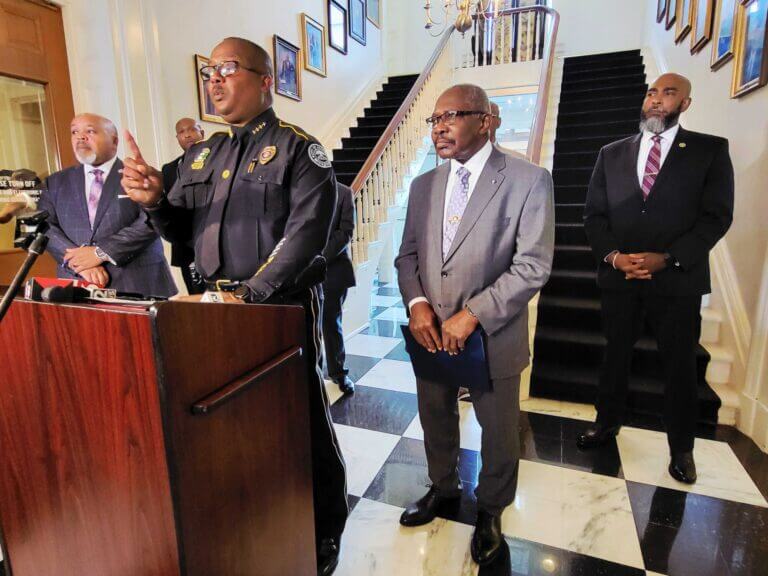
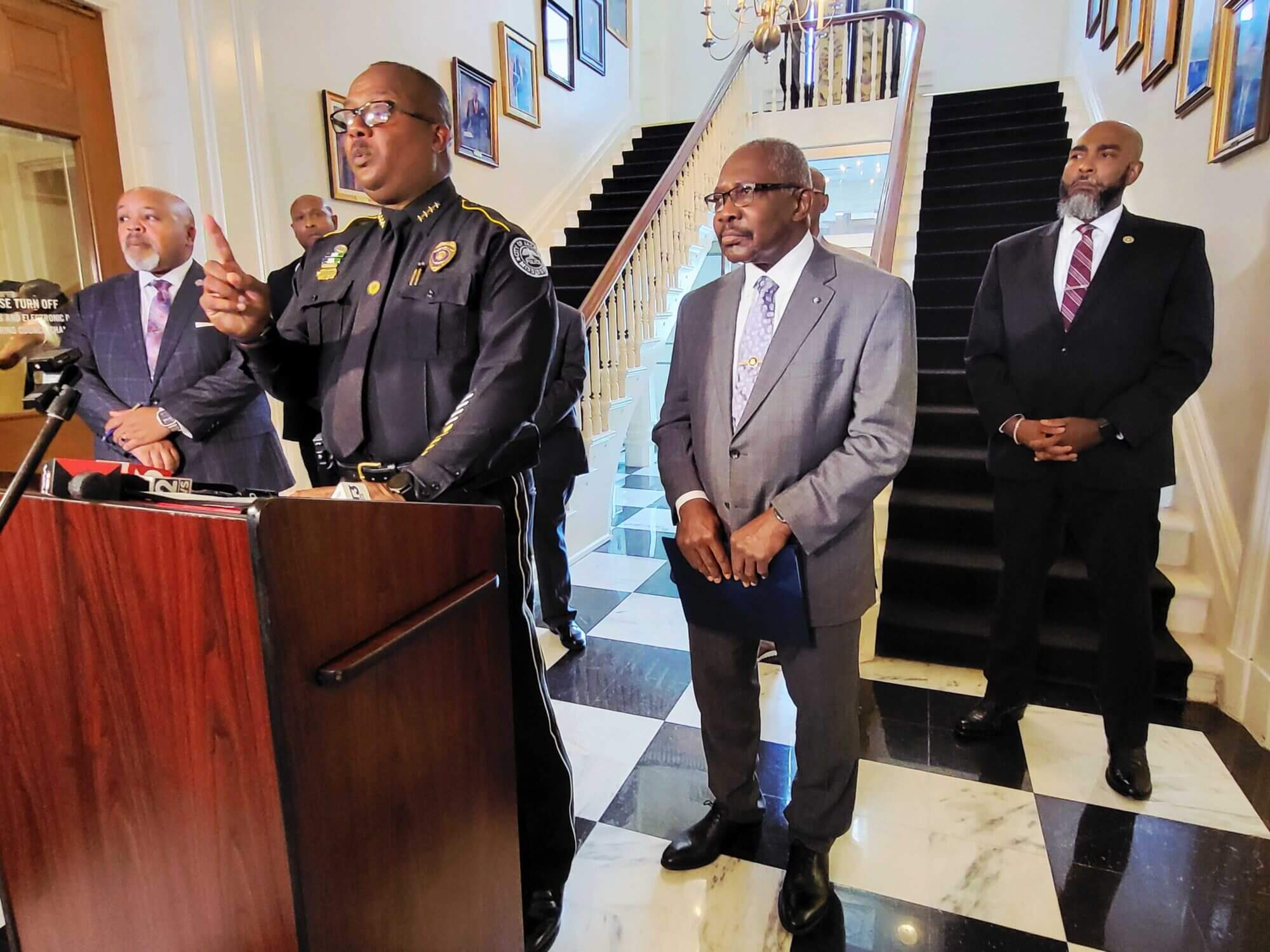
Outgoing Mayor Chokwe A. Lumumba announced the reopening of Thalia Mara Hall during his final press conference held Monday on the arts venue’s steps.
“Today marks what we view as a full circle moment, rejoicing in the iconic space where community has come together for decades in the city of Jackson,” Lumumba said. “Thalia Mara has always been more than a venue. It has been a gathering place for people in the city of Jackson. From its first class ballet performances to gospel concerts, Thalia Mara Hall has been the backdrop for our city’s rich cultural history.”
Thalia Mara Hall closed last August after mold was found in parts of the building. The issues compounded from there, with malfunctioning HVAC systems and asbestos remediation. On June 6, the Mississippi State Fire Marshal’s Office announced that Thalia Mara Hall had finally passed inspection.
“We’re not only excited to have overcome many of the challenges that led to it being shuttered for a period of time,” Lumumba said. “We are hopeful for the future of this auditorium, that it may be able to provide a more up-to-date experience for residents, inviting shows that people are able to see across the world, bringing them here to Jackson. So this is an investment in the future.”
In total, Emad Al-Turk, a city contracted engineer and owner of Al-Turk Planning, estimates that $5 million in city and state funds went into bringing Thalia Mara Hall up to code.
The venue still has work to be completed, including reinstalling the fire curtain. The beam in which the fire curtain will be anchored has asbestos in it, so it will have to be remediated. In addition, a second air-conditioning chiller needs to be installed to properly cool the building. Until it’s installed, which could take months, Thalia Mara Hall will be operating at a lower seating capacity of about 800.
“Primarily because of the heat,” Al-Turk said. “The air conditioning would not be sufficient to actually accommodate the 2,000 people at full capacity, but starting in the fall, that should not be a problem.”
Al-Turk said the calendar is open for the city to begin booking events, though none have been scheduled for July.
“We’re very proud,” he said. “This took a little bit longer than what we anticipated, but we had probably seven or eight different contractors we had to coordinate with and all of them did a superb job to get us where we are today.”
On his last day as mayor of Jackson, Chokwe Antar Lumumba recounted accomplishments, praised his executive team and said he has no plans to seek office again.
He spoke during a press conference outside of the city’s Thalia Mara Hall, which was recently cleared for reopening after nearly a year of remediation. The briefing, meant to give media members a peek inside the downtown theater, marked one of Lumumba’s final forays as mayor.
Longtime state Sen. John Horhn — who defeated Lumumba in the Democratic primary runoff — will be inaugurated as mayor Tuesday, but Lumumba won’t be present. Not for any contentious reason, the 42-year-old mayor noted, but because he returns to his private law practice Tuesday.
“I’ve got to work now, y’all,” Lumumba said. “I’ve got a job.”
Thalia Mara Hall’s presumptive comeback was a fitting end for Lumumba, who pledged to make Jackson the most radical city in America but instead spent much of his eight years in office parrying one emergency after another. The auditorium was built in 1968 and closed nearly 11 months ago after workers found mold caused by a faulty HVAC system – on top of broken elevators, fire safety concerns and vandalism.
“This job is a fast-pitched sport,” Lumumba said. “There’s an abundance of challenges that have to be addressed, and it seems like the moment that you’ve gotten over one hurdle, there’s another one that is waiting in the shadows.”
Outside the theater Monday, Lumumba reflected on the high points of his leadership instead of the many crises — some seemingly self-inflicted — he faced as mayor.
He presided over the city during the coronavirus pandemic and the rise in crime it brought, but also theone-two punch of the 2021 and 2022 water crises, exacerbated by the city’s mismanagement of its water plants, and the 18-day pause in trash pickup spurred by Lumumba’s contentious negotiations with the city council in 2023.
Then in 2024, Lumumba was indicted alongside other city and county officials in a sweeping federal corruption probe targeting the proposed development of a hotel across from the city’s convention center, a project that has remained stalled in a 20-year saga of failed bids and political consternation.
Slated for trial next year, Lumumba has repeatedly maintained his innocence.
The city’s youngest mayor also brought some victories to Jackson, particularly in his first year in office. In 2017, he ended a furlough of city employees and worked with then-Gov. Phil Bryant to avoid a state takeover of Jackson Public Schools. In 2019, the city successfully sued German engineering firm Siemens and its local contractors for $89 million over botched work installing the city’s water-sewer billing infrastructure.
“I think that that was a pivotal moment to say that this city is going to hold people responsible for the work that they do,” Lumumba said.
Lumumba had more time than any other mayor to usher in the 1% sales tax, which residents approved in 2014 to fund infrastructure improvements.
“We paved 144 streets,” he said. “There are residents that still are waiting on their roads to be repaved. And you don’t really feel it until it’s your street that gets repaved, but that is a significant undertaking.”
And under his administration, crime has fallen dramatically recently, with homicides cut by a third and shootings cut in half in the last year.
Lumumba was first elected in 2017 after defeating Tony Yarber, a business-friendly mayor who faced his own scandals as mayor. A criminal justice attorney, Lumumba said he never planned to seek office until the stunning death of his father, Chokwe Lumumba Sr., eight months into his first term as mayor in 2014.
“I can say without reservation, and unequivocally, we remember where we started. We are in a much better position than we started,” Lumumba said.
Lumumba said he has sat down with Horhn in recent months, answered questions “as extensively as I could,” and promised to remain reachable to the new mayor.
Mississippi House Speaker Jason White outlined on Monday a list of priorities he will aim to advance during the 2026 legislative session, a policy agenda whose viability will depend on negotiations with the state Senate and the impact of federal legislation moving through Congress.
In broad terms, these policies will focus on reshaping the state’s K-12 education system, addressing financial challenges facing Mississippi’s pension system for state workers, expanding voting rights and addressing infrastructure challenges facing the capital city of Jackson.
Days after White announced the formation of three new select committees to study key policy areas ahead of the 2026 session, White spoke Monday to the Mississippi State University Stennis Institute of Government and Capitol Press Corps.
White offered more specifics on the legislative strategy he plans to push next year after a 2025 legislative session shaped by Republican infighting, historic tax reforms and uncertainty at the federal level.
House will propose ‘school choice/education freedom’ package
The House will propose one sprawling education reform package containing many of the “school choice” provisions that died last session, White said.
This is a departure from the piecemeal strategy House Republicans undertook last session, where the chamber passed a series of standalone education bills. Many of the House’s bills either died in the Senate or, in the case of a proposal that would have allowed some Mississippi parents to use taxpayer money to pay for private schools, didn’t come up for a vote on the House floor.
The new approach is modeled after the sweeping tax reform package that the Legislature passed last session and the “Big Beautiful Bill” moving through the Republican-controlled Congress.
“I think it’s why you see even in our national Congress now considering that one huge bill because in the volatile political world that we live in, there are things in there that folks for whatever reason, because of a certain voter base or political ideology, they say they can’t go there, but there are enough good things (in the bill) that they’re able to get there,” White said.
The congressional measure, which was being debated Monday in the United States Senate, could itself alter public education funding in states around the country.
Next session, White said the House will introduce a “comprehensive” package containing all of its key priorities, which include lifting restrictions on public school transfers, closing and consolidating some schools, and allowing Mississippi children being home-schooled to play public school sports.
White also said he wants to focus on social factors, such as poverty, that may hinder academic performance.
“It’s going to be comprehensive, it’ll be bold and it’ll be uncomfortable,” White said. “It’ll be uncomfortable for me, it’ll be uncomfortable for people in my own caucus, and for people on the other side of the aisle. But it can absolutely alter the (education) landscape.”
White said he is a proponent of “universal school choice,” which often refers to policies that allow all households — regardless of income level — to use public education dollars to send their children to private schools or other institutions of their choice, rather than being assigned to public schools based on where they live.
But White acknowledged on Monday that there haven’t been enough votes in his chamber to advance such a measure, a political reality he traced back to the racial politics of education in Mississippi. Following the Civil Rights reforms of the 1960s, many private schools in Mississippi opened as bulwarks against racial integration.
White, who favors the term “education freedom” instead of the “school choice” moniker embraced by most conservative education groups, said the new Education Freedom Select Committee will examine education policies passed by many other Republican-controlled legislatures nationwide.
Finding a “dedicated revenue stream” for PERS
White said the House will try again to pass legislation with a “dedicated revenue stream” for the Public Employees’ Retirement System, or PERS, which currently faces an over $25 billion unfunded liability.
White said his House Republican Caucus still favors either diverting most of the state’s lottery proceeds to PERS or legalizing mobile sports betting and using the revenue to help make the pension system solvent. These proposals will be the subject of another House select committee.
The Senate has favored a “hybrid” retirement plan to shore up the system financially by cutting benefits for future employees.
Voter Rights
The House will again aim to implement early voting in Mississippi, which is one of only three states without no-excuse early voting or no-excuse absentee voting.
Senate leaders, on the last day of their regular 2025 session, decided not to send a bill to Gov. Tate Reeves that would have expanded pre-Election Day voting options. The governor has been vocally opposed to early voting in Mississippi and would likely have vetoed the measure.
A House Voters’ Rights Select Committee will examine paths forward for restoring suffrage for individuals convicted of crimes who have completed their sentences. The committee will also explore re-establishing a ballot initiative process, an effort that has failed for several years in a row after the previous initiative process was struck down by the state Supreme Court.
In the Senate, such a measure would have to go through the Accountability, Efficiency, Transparency committee, where last session it died under the leadership of Republican chairman Sen. David Parker.
Parker is not running for reelection, a development that bodes well for restoring the ballot initiative process, White said Monday, without naming Parker.
Jackson-related bills and local projects
The Capital and Metro Revitalization Select Committee, established in 2024, will continue to focus on local governance issues in the capital city of Jackson after helping pass five bills into law last session.
In 2026, White said, the House will focus on addressing infrastructure woes plaguing Jackson’s water and sewer systems. White said the state would not aim to “take over” the systems, a concern often voiced by Democrats, almost all of whom are Black, about the majority-white, Republican-controlled Legislature usurping local rule in Jackson.
Last session, a source of Republican infighting between the House and Senate concerned whether to pass a “Christmas Tree” bill, or a bill that appropriates hundreds of millions of dollars in local projects around the state. To the House’s chagrin, that never happened, and White said he remains “disappointed” in the Senate leadership over the disagreement.
“We should have funded local projects, and we didn’t because of politics and nothing else,” White said.
White said he heard the Senate might introduce a local projects bill in January next session, earlier than normal, but he remains concerned the chambers are far from reaching an agreement.
A former federal probation officer who pleaded guilty will serve a decade in prison for receiving video and photos of child sexual exploitation, U.S. Attorney Clay Joyner announced Monday.
Lonnie Everill, 46, of Water Valley, whose work focused on supervising and rehabilitating sexual offenders, was sentenced in federal court, months after receiving over 1,400 images sent and received over a four-month period.
An FBI investigation began after Everill sent chats with an undercover agent about arranging to travel to California and have sex with a child Everill believed was the agent’s niece, according to court records.
They began to exchange chats after Everill joined a public group on the platform KIK that the agent was in – a group with about 100 members who were exchanging child sexual abuse material and talking about children.
Investigators found images and videos of young children and toddlers not being sexually abused on Everill’s accounts. The material also included selfies of Everill and pictures of local minors not engaged in sexually explicit conduct.
Joyner and Robert Eikhoff, special agent in charge of the FBI Jackson Field Office, called the crime a betrayal of trust for the victims, community and credibility of federal probation officers in the district.
Everill had worked in several states including Mississippi, according to Joyner’s office.
“No matter their badge or title, the FBI will always aggressively pursue those that prey on our children,” Eikhoff said in a statement.
U.S. District Judge Dan Jordan sentenced Everill to 10 years in the Bureau of Prisons followed by 10 years of supervised release. Everill will be required to register as a sex offender, and the judge also ordered requirements meant to restrict Everill’s access to children and the internet.
The judge also ordered him to pay $3,000 in restitution to the victims in the images he had, and an additional $10,000 assessment.
The federal government is restoring $137 million in education funds to Mississippi schools.
The U.S. Department of Education notified states last week that it would reinstate pandemic relief funds. The decision comes less than three months after the federal government revoked billions nationwide as part of Trump administration efforts to cut government spending.
State education agencies and school districts originally had until March 2026 to spend the money, but the federal government claimed that because the pandemic was over, they had no use for the money.
That March 2026 deadline has been reinstated following a series of injunctive orders.
A coalition of Democratic-led states sued the federal government in April over the decision to withhold the money. Then, a federal judge granted plaintiff states injunctive orders in the case, which meant those states could continue spending their COVID-relief dollars while other states remained restricted.
But the education department decided that wasn’t fair, wrote Secretary Linda McMahon in a letter dated June 26, so the agency was restoring the money to all states, not just the ones involved in the lawsuit.
“The original intent of the policy announced on March 28 was to treat all states consistently with regards to safeguarding and refocusing their remaining COVID-era grant funding on students,” she wrote. “The ongoing litigation has created basic fairness and uniformity problems.”
The Mississippi Department of Education notified school districts about the decision on Friday.
In the meantime, schools and states have been requesting exemptions for individual projects, though many from across the country have been denied.
Eleven Mississippi school districts had submitted requests to use the money to fund services such as tutoring and counseling, according to records requested by Mississippi Today, though those are now void because of the federal government’s decision.
Starting immediately, school districts can submit new requests to the state education department to draw down their federal allocation.
Mississippi Today previously reported that about 70 school districts were relying on the federal funds to pay for a range of initiatives, including construction projects, mental health services and literacy programs.
In 2023, almost half of Elementary and Secondary School Emergency Relief funds, pandemic relief money allocated to schools across the country, went to students’ academic, social, and emotional needs. A third went to operational and staff costs, according to a report from the U.S. Department of Education.
Though Lt. Gov. Delbert Hosemann previously said that legislative leaders might consider helping agencies that were impacted by federal funding cuts, House Speaker Jason White said Monday that he did not have an appetite for directing state funds to pandemic-era programs.
Small school districts were already feeling the impact of the federal government’s decision to rescind the money. In May, Greenwood Leflore Consolidated School Board voted to terminate a contract on a school construction project funded with federal dollars.
The litigation is ongoing, so the funding could again be rescinded.
Clarification: A previous version of this article misstated thestatus of school districts’ pandemic relief money.
The Mississippi Department of Environmental Quality announced on Friday it has lifted an extended water contact advisory for the Pearl River, which had stretched south from Byram almost as far as Monticello.
MDEQ put the warning in place on June 5 after third-party utility JXN Water notified the agency of a “catastrophic” sewer failure at the critical West Bank Interceptor.
“Recent samples of the Pearl River, within the area of the extended advisory, indicate the impact of the untreated sewage has subsided and sample results have returned to pre-incident levels,” the agency said in a press release.
A 2019 advisory for the river, which runs from Hanging Moss Creek in the northern tip of Hinds County to the Byram Swinging Bridge, is still active. It warns the public against swimming, wading, or fishing in the water because of “ongoing sanitary sewer overflows around the City of Jackson.”
JXN Water discovered the most recent failure on May 28. The malfunction led to the release of between 10 million to 20 million gallons of untreated sewage into the Pearl River each day, according to MDEQ. JXN Water stopped the overflow on June 6, nine days after discovering the issue.
The utility estimated it is spending $300,000 a month to redirect the wastewater through 4,000 feet of piping, and will need $7.5 million for long-term repairs. JXN Water said it is working with the Environmental Protection Agency to secure the funding.
Q: Why are there so many traffic lights out in the city?
A: Aging infrastructure, vehicle collisions and arsonists.
Q: Where do I go if I want to get a pothole fixed?
A: Call 311.
Q: Why do you hate white people?
A: I do not hate white people.
These are some of the questions folks had recently for outgoing Jackson Mayor Chokwe Antar Lumumba – and his answers.
In 2024, Lumumba began an initiative called “Ask Antar,” in which residents could submit inquiries and concerns through the city’s website.
The city received more than 180 questions. Mississippi Today requested and reviewed them all and found that in the last year, Jacksonians have had the most curiosity and frustration about accessing services and responsiveness from City Hall, housing and homelessness, and street conditions.
Lumumba, whose two-term administration ends Tuesday, responded to about a fourth of the questions, plus more submitted through social media, across 15 video segments on the city’s YouTube page. In many videos, the mayor explained processes – such as how environmental courts determine what to do about derelict structures or why Jackson Police Department is unable to address squatting unless it receives a report from the owner of a specific property.
Another theme among his answers was that the administration is not in control of all functions people had complaints about – like in the case of water rates now governed by private manager JXN Water, or street lights on interstates that are a state responsibility. He also said the administration did not have resources to address all problems – potholes, for example.
Mississippi Today went a step further, contacting people who submitted questions. Of the two dozen who responded to the news organization, most had no idea the mayor had answered their questions.
“Why is it you replied to my email, yet I never heard from the city of Jackson?” said one person, who had asked in December about the broken stop light at the intersection of Woodrow Wilson and State Street.
For those whose questions Lumumba answered, we directed each person to the corresponding video and asked them to rate their satisfaction with the answer on a scale of 1 to 5.
Review the question and answer and submit your own rating.
What actions are we as citizens supposed to take about squatters trashing the neighborhood? I have called the owners of the lots, code enforcement, police (stolen trailers and cars), fire department (burning copper), water/sewer (water being stolen), and environmental agency (dumping of antifreeze). I just need to know what is my mother to do when we are trying to contact people. — Carlyn
Rate this answer:
★ ★ ★ ★ ★
Average rating:
Carlyn’s Rating:
★ ★ ★ ★ ★
Carlyn said: “The problem is still ongoing, no call back from city.”
Review the question and answer and submit your own rating.
What is the mayor doing to combat teen violence & what are some activities he can bring to the city so that teens can have something to do on the weekend? — Javion
Rate this answer:
★ ★ ★ ★ ★
Average rating:
Javion’s Rating:
★ ★ ★ ★ ★
Javion said: “I feel like the new administration, they’re going to be proactive on that, especially considering Jackson’s full of young people … I’m feeling very optimistic about young people living in the city of Jackson.”
Review the question and answer and submit your own rating.
What did you do in China, who went with you, and who paid for it? Has Jackson become the “radical city” you hoped for? — John
Rate this answer:
★ ★ ★ ★ ★
Average rating:
John’s Rating:
★ ★ ★ ★ ★
John said: “I never expected him to answer. His M.O. didn’t include transparency or accountability.”
Review the question and answer and submit your own rating.
Why is there a $40 fee for water availability? — LaDedra
Rate this answer:
★ ★ ★ ★ ★
Average rating:
LaDedra’s Rating:
★ ★ ★ ★ ★
LaDedra said: “When I called JXN Water and was notified about the $40 fee, I asked her why. She couldn’t tell me why besides it was a fee added. I have a friend in another part of Jackson and he did not have the fee added. This fee is very unnecessary in my opinion and is a part of greed for whoever decided on it for the citizens to pay.”
Review the question and answer and submit your own rating.
What is being done about Animal Control? Specifically, what are the plans for opening an animal shelter? Strays as well as owner negligence are huge problems in the city. — Judy
Rate this answer:
★ ★ ★ ★ ★
Average rating:
Judy’s Rating:
★ ★ ★ ★ ★
Judy said: “There once was a City Shelter where animals were housed and, if not claimed, were put up for adoption. It was often referred to as “the pound” back many years ago. So, he is wrong about that. So his usual avoidance of taking responsibility is in play once again.”
Review the question and answer and submit your own rating.
What are you going to do, along with Capitol Police & JPD, about the racing, loud cars, & crime that seems to come with them? — Robin
Rate this answer:
★ ★ ★ ★ ★
Average rating:
Robin’s Rating:
★ ★ ★ ★ ★
Robin said: “They all used to group in the parking lot in front of Cowboy Maloney’s at Briarwood and 55. JPD kicked them out of there. Now they seem to use the QT at Beasley and 55. It’s nice to know that JPD is coordinating with Capitol PD and the Hinds County Sheriff’s Office in efforts to reduce the racing.”
Review the question and answer and submit your own rating.
I saw something about Livingston rd housing where the old plant was. There was chatter about crime, but isn’t it better and a blessing that investments are coming? Instead of leaving dead area there? Thoughts? — Dre
Rate this answer:
★ ★ ★ ★ ★
Average rating:
Dre’s Rating:
★ ★ ★ ★ ★
Dre said: “We can have problems and differences, but we can address like grown men not like little boys on TV and mayor Lumumba took the high road many times when he could have been dirty.”
Review the question and answer and submit your own rating.
Why are there no bike lanes in the city? — Jay
Rate this answer:
★ ★ ★ ★ ★
Average rating:
Jay’s Rating:
★ ★ ★ ★ ★
Jay said: “While I appreciate the two examples (Mill St. and Meadowbrook), future plans were very vague and general. I’d hoped for a more substantive plan.”
Review the question and answer and submit your own rating.
Who is in charge of the city’s website and when will the “upgrades” be complete with missing information available? What was the reason for the upgrade? — Elizabeth
Rate this answer:
★ ★ ★ ★ ★
Average rating:
Elizabeth’s Rating:
★ ★ ★ ★ ★
Elizabeth said: “Overall, it just seemed like a waste of time and money considering all of the other issues plaguing the City. We are in June and I still don’t consider the new website to be nearly as ‘user friendly’ as it was before the change.”
Mississippi Today requested an interview with Lumumba to discuss our findings, but city spokesperson Melissa Payne said he was unavailable. Lumumba lost reelection during the April Democratic primary and was working on transitioning out of office to make way for Mayor-elect John Horhn. Lumumba’s last question-and-answer segment was posted April 20, two days before he lost in the primary runoff.
Three residents made submissions to Ask Antar seeking space to hold dance classes in the city, and recent high school graduate Javion Shed asked about what the mayor is doing to combat youth violence and introduce positive activities for teens.
“As a teen in Jackson, you’re always plagued with, what can I do on the weekends, where can I go to just relax, have a great time, and not worry about the fear of violence or the fear of someone I know getting killed?” Shed told Mississippi Today.
In response to Shed last October, Lumumba said the city was developing a curfew center, where teens who may otherwise end up at the youth detention facility could be taken instead to receive services. Shed ranked the response a “solid 4” out of 5. Amid turmoil in the city’s Office of Violence Prevention and Trauma Recovery, though, the center Lumumba described has yet to open.
Several residents raised concerns with a lack of communication and listening among the administration. Referencing a three-year fight between the mayor and city council over renewing the city’s garbage contract, which led to trash pickup interruptions in 2023, one resident wrote that the mayor’s “antics and over-complication of intent” created a “4-lane thoroughfare for justified criticism of the ability of African Americans to use critical thinking analysis, and compromise to would-be detractors.”
Another wrote, “When you become Mayor, we become Mayor was part of your campaign slogan at one point … Why can’t you listen to the recommendations from us via our Council Person?”
Others said they were unable to reach city officials to answer questions or receive basic city services. There were inquiries about getting an electrical pole removed, about repairs to a water meter and about where to drop off old paint cans “now that the household hazardous waste dropoff is closed due to fire.”
“Why don’t the traffic office answer the phone??????” one resident wrote.
One woman who submitted a question about the federal corruption allegations against Lumumba, for which he’s pleaded not guilty and is scheduled to face trial next summer, admitted her intent was to troll the mayor.
But many more of the submissions conveyed the serious and dire conditions some Jacksonians are living in.
Last July, Carlyn Cornelius submitted concerns about the unhoused population near his mother’s house in west Jackson stealing trailers and cars, burning copper and dumping antifreeze. He told Mississippi Today that a year later, the problems remain.
In his submission, Corneluis said he’d called in reports of these activities to law enforcement, the fire department, Public Works, environmental authorities and the owner of the property, but received no help.
A few days later, another person submitted to Ask Antar, “I need a place to live. I am homeless.”
Mississippi Today Editor-in-Chief Adam Ganucheau won the J. Oliver Emmerich Award for Editorial Excellence, and several of the newsroom’s journalists won 13 other 2024 Mississippi Press Association prizes.
The honors, awarded annually by the state’s print news association, recognize the best journalism of Mississippi’s newspapers and digital newsrooms. The 2024 prizes were announced at a Saturday luncheon in Memphis at the Tri-State Press Convention, where Mississippi’s press association joined the Tennessee and Arkansas press associations for three days of programming.
A series of Ganucheau’s 2024 editorials on the debate to expand Medicaid in Mississippi were singled out by judges as “thoughtful, accurate, and passionate.”
“If you’re not motivated to vote for Medicaid expansion by the end of each of these submissions, you haven’t read them carefully,” the judges commented. “That’s what great opinion writing should do: Take a position and argue it persuasively. Here, we get the details, the reporting and insider knowledge that provide credence to the proffered opinion … The arguments here are so well laid out and convincing that it’s hard to imagine anyone would dissent.”
Several other Mississippi Today journalists took home 2024 Mississippi Press Association awards. Below is a complete list of the winners, the awards they won and the recognized work:
Mississippi Today’s 2024 Mississippi Press Association awards are displayed following the Tri-State Press Convention in Memphis, Tenn., on June 28, 2025. (Emily Wagster Pettus/Mississippi Today)
Anna Wolfe, first place in the general news story category for her in-depth reporting on the Jackson mayor and Hinds County district attorney’s federal indictments.
Rick Cleveland, first place in the sports column category for a series of powerful columns over the course of 2024. Read the winning series here: Column 1, Column 2, Column 3.
Bobby Harrison, first place in the commentary category for a series of columns over the course of 2024. Read the winning series here: Column 1, Column 2, Column 3.
In addition to the Emmerich award, Ganucheau won first place in the editorials category for a series of editorials about the debate over Medicaid expansion in the 2024 legislative session. Read the winning series here: Editorial 1, Editorial 2, Editorial 3.
Alex Rozier, first place in the headline category for his story headlined, “Curdled creek: Kosciusko residents sour over town’s milky lagoon.”
Geoff Pender, second place in the commentary category for a series of columns over the course of 2024. Read the winning series here: Column 1, Column 2, Column 3.
Pender and Taylor Vance, third place in the in-depth/investigative category for their “Trey Way” series about state Rep. Trey Lamar.
The recent announcement that state Agriculture and Commerce Commissioner Andy Gipson plans to run for governor has fueled speculation about who will be running for what office in a wide open 2027 Mississippi election cycle.
Will all or any of the combination of Lt. Gov. Delbert Hosemann, Auditor Shad White, Attorney General Lynn Fitch enter the gubernatorial donnybrook? Who will be the Democratic Party standard bearer, and will Democrats field competitive candidates for any of the other down-ticket statewide offices that could be vacant based on who is running for governor?
Perhaps, most importantly, will billionaire businessman Thomas Duff of Hattiesburg enter the gubernatorial race after showing numerous signals that he intends to?
But before the 2027 elections roll around there will be another consequential statewide race in Mississippi: for the U.S. Senate in 2026.
Incumbent Cindy Hyde-Smith will be running in her third U.S. Senate race, and she surely hopes it will be her first easy one. Her first race, a special election in 2018 after longtime Sen. Thad Cochran retired, was the closest non-party primary U.S. Senate race in modern Mississippi history. Hyde-Smith, running then as the interim appointment of former Gov. Phil Bryant, captured 53.6% of the vote compared to 46.4% for former U.S. Secretary of Agriculture and congressman Mike Espy in the special election held to fill out Cochran’s term.
Trent Lott’s first race for the U.S. Senate was almost as close in 1988, when he won 53.9% to 46.1% against 4th District U.S. Rep. Wayne Dowdy. And in a 2008 special election, Republican Roger Wicker, appointed by Gov. Haley Barbour to fill a vacancy left when Lott retired, garnered 55% to 45% by former Democratic Gov. Ronnie Musgrove.
But after those relatively close elections, both Lott in 1994 and Wicker in 2012 had easier second elections.
Lott captured 69% of the vote against former state Sen. Ken Harper of Vicksburg. Wicker, on the other hand, had a little tougher race against Albert Gore, winning 57% to 40.6%. Gore was little known and underfunded, but was in many ways an attractive candidate with a noteworthy resume. Interestingly, Gore, like Wicker, was a Pontotoc County native.
In Hyde-Smith’s second race, she again faced Espy in a rare Mississippi campaign when the Democrat raised more money than the Republican. It is practically unheard of in the South — and assuredly in Mississippi — for a Democrat to raise more campaign funds than an incumbent Republican senator. Espy did.
Still, Hyde-Smith, who remains Mississippi’s only woman elected to a federal office, won 54.1% to 44.1%, but the campaign was far from easy for her.
The trend for decades has been that once a U.S. Senate seat is won in Mississippi, the incumbent holds the post for a long time with minimal opposition.
Hyde-Smith is still looking for that minimal opposition race. Will 2026 be when Hyde-Smith finally has an easy path to victory like other incumbent Mississippi senators normally have in their reelection efforts?
Perhaps hoping to ensure that easier path, President Donald Trump already has endorsed Hyde-Smith for her 2026 campaign.
But Trump also endorsed her in 2018 and 2020. Those endorsements did not result in easy campaigns for Hyde-Smith. In both of those campaigns, Hyde-Smith underperformed Trump’s Mississippi results.
Democrats Ty Pinkins and Albert Littell, both of whom have military backgrounds, already have announced their candidacy for 2026. Speculation is that District Attorney Scott Colom of Columbus also will challenge Hyde-Smith. And on the Republican side, author Sarah Adlakha, a Gulf Coast resident who works in health care, also has announced her campaign.
Whether other candidates emerge remains to be seen. And whether Hyde-Smith can experience a less stressful 2026 also remains to be seen.
So far the campaigns have not been as easy for her as for other incumbent U.S. senators from Mississippi.
Mississippians next week will start paying higher taxes at the gas pump but lower taxes at the grocery store.
A new state law that raises Mississippi’s gasoline tax by 3 cents a gallon and cuts the state grocery tax by 2% will take effect on Tuesday, along with other statutes the Legislature passed and governor signed into law earlier this year.
Mississippi currently has a flat 18.4 cents a gallon excise tax on fuel, one of the lowest gas taxes in the nation. The law will raise the tax to 21.5 cents a gallon this year, then increase it three cents a year until July 1, 2027. At completion, the state gas tax will be 27.4 cents a gallon, a 9-cent total increase.
Proceeds from the tax will go toward building and maintaining state roads specified by the Mississippi Department of Transportation.
Mississippi also has a 7% sales tax on non-prepared food, commonly called the grocery tax. The tax, the highest of its kind in the nation, will be reduced to 5% in July. Municipalities around the state receive a portion of this sales tax. The new law ensures cities will receive a larger diversion rate, and be “made whole” from the cut.
“The decrease is part of House Bill 1 that passed during this year’s Regular Session of the Mississippi Legislature,” Revenue Commissioner Chris Graham said in a press release. “We are excited to be able to administer this reduction to help provide relief on the cost of groceries to Mississippi families.”
Mississippians will also see a reduction in the state income tax rate because state officials are still phasing in a 2022 law that is reducing the income tax to 4%. The Legislature this year passed a new law that will reduce the 4% tax rate in 2027 to 3% over four years. Starting in 2031, the remaining 3% tax will be eliminated over time, based on economic growth triggers.
In addition to the tax overhaul, other laws will also go into effect on July 1, including:
Direct wine shipment
A new law legalizes shipping some wines to Mississippians’ homes. Supporters pushed to allow direct wine shipment for over a decade before they succeeded this session. Mississippi was one of only a handful of states that didn’t allow direct shipment.
Under the new law, shippers must obtain a permit from the Department of Revenue to ship wine, and they are capped at 12 nine-liter cases of wine annually to any one address. The measure also restricts citizens to ordering only certain specialty or rare wines that may not be available at Mississippi package stores. The law aims to generate taxes by enacting a 15.5% tax on direct wine shipments. Some of the tax revenue will fund mental health programs.
Kratom banned for people under 21
Mississippi will limit kratom purchases to people 21 and older and outlaw more potent forms of the herbal substance. The new law institutes fines for people under 21 who buy or possess kratom and retailers that sell it to them. The measure also bans synthetic kratom extracts, which are considered more dangerous than “pure” forms of the herbal substance because of their higher potency.
More than thirty counties and cities in Mississippi already restrict or ban kratom products, which can be found widely in gas stations and tobacco or vape shops. Any ordinances that have been adopted by municipalities or counties to regulate or ban kratom will remain in effect.
Rape kit mandate
Mississippi hospitals will now be required to perform rape kits on sexual assault victims who come to their ERs. A new law mandates all hospitals stock rape kits, have a provider available to perform a rape kit, and that they do not turn rape victims away.
The legislation was inspired by several cases where survivors did not receive routine treatment at hospitals, according to sexual assault advocacy organizations.
Turkey stamps
Mississippi hunters must obtain a turkey stamp before harvesting the wild birds, a new state law requires. The measure requires in-state hunters to purchase a $10 turkey stamp and out-of-state hunters to pay a $100 fee for the stamp. In addition to the new stamp, the law still requires hunters to obtain a normal hunting license.
Proponents of the measure said the stamp fees would be used to maintain and improve turkey-hunting lands around the state.