
Home Blog Page 202

‘Be realistic’: Concerned about blight, Jackson’s Ward 7 council candidates learn who’s responsible

As far as Mary Alex Thigpen knew, the truckloads of mulch she’d just had delivered would sit at Belhaven’s Laurel Street Park until she could find enough volunteers to spread it.

Thigpen, the executive director of the Greater Belhaven Foundation, then got a call from a neighborhood resident. Employees with the city’s parks and recreation department were putting down the mulch with shovels and rakes.

“It just kind of made me laugh because I didn’t tell anybody at parks and rec about the mulch,” Thigpen said. “But I guess they saw it and thought it was theirs?” 

Thigpen’s story illustrates a widespread issue facing citywide efforts to rid Jackson of litter, blight, dilapidated housing and overgrown weeds: No matter how many resources are available, many stakeholders are not on the same page. And not everyone knows who — between the mayor, his departments, the council, local nonprofits or individual citizens — is responsible for what.

“People are tired of waiting for someone else to do it, and they’re starting to do it on their own,” said Ashlee Kelly, a Belhaven resident who has been involved in volunteer clean-up efforts across Ward 7. 

That’s the case across the city, but in Ward 7, most of the seven candidates running for council believe that Jacksonians need to get better coordinated when it comes to pursuing quality of life improvements in the city. The 14-mile ward encompassing Fondren, Belhaven and downtown Jackson is one of two council areas this election season where the incumbent has chosen not to run again. 

Quint Withers

During a voter forum last month at Millsaps College, five of the seven candidates agreed that city clean-up is important for economic development and crime reduction.

Some of their ideas were ambitious. Democratic candidate Quint Withers, an accountant and Realtor, said he wants to switch the city’s street lights to LED so they last longer.

Bruce Burton

Bruce Burton, an attorney also running in the Democratic primary, thinks the city should install cameras across the ward to catch illegal trash dumpers. 

And independent candidate Ron Aldridge, a government-relations attorney and current chair of Fondren’s Business Improvement District, said the city needs to be working more with its neighborhood associations. 

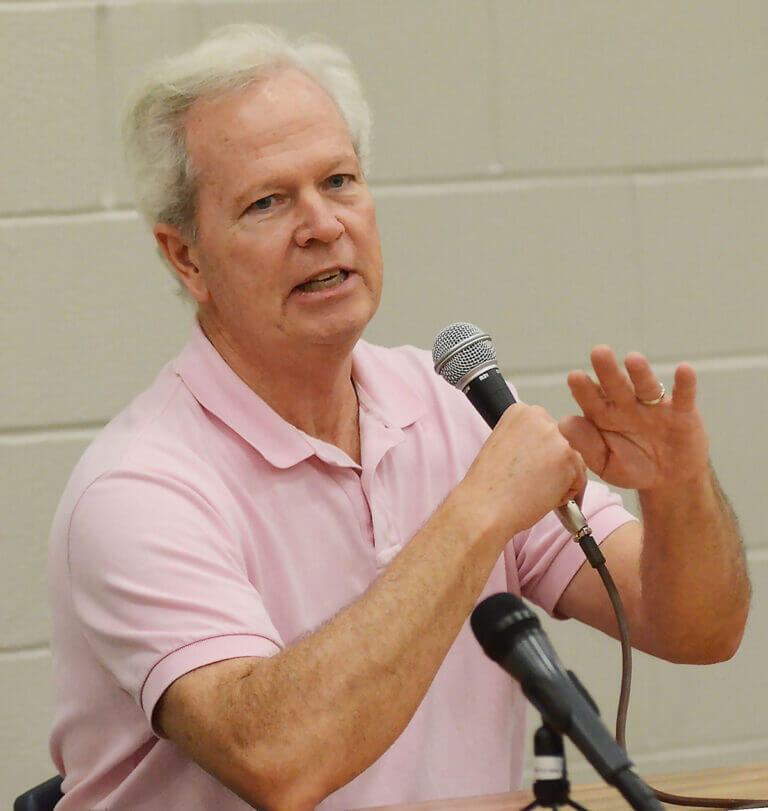
Ron Aldridge

But what will these candidates be able to realistically accomplish if they win? Aldridge told Mississippi Today he knows his ideas do not technically fall under the purview of the city council.

“It doesn’t matter,” Aldridge said. “That’s what I’m gonna do. I’m just telling you. I’m not someone that waits.” 

As a voter, Kelly looks to see if candidates have an accurate understanding of these roles and responsibilities. In Jackson, city council candidates often do not realize the statutory division of power between the city and the mayor. 

A family at the start of the Museum Trail, an attraction in Ward 7, heading out for an afternoon of biking. Credit: Vickie D. King/Mississippi Today

“People make a lot of promises, and they don’t realize there’s really basic functions,” she said. “If you do anything out of the scope, it’s great, but it’s also a part-time job. You have to be realistic about what you can do.” 

Under state statute, the mayor of Jackson is the city’s full-time chief executive office, overseeing city departments, appointing department heads and drafting the city budget. 

The council, on the other hand, works part time and essentially functions as the legislative branch of the city government. Working together, the council has the ability to write and pass ordinances, subject to the mayor’s veto. Likewise, the council can vote down the mayor’s budget. 

For the newcomer, outgoing Ward 7 councilperson Virgi Lindsay’s advice is, “You have to get in there and do it. It is the consummate of on-the-job training.” 

For instance, Lindsay said she is frequently calling the city about abandoned houses in the southern part of Ward 7. But as a council person, she has no power to order any city department to tear down the houses. 

What Lindsay can do, however, is ensure the city is funding the right departments, which she said the council worked to do by increasing solid waste’s budget. 

But in the past, council members have disagreed over the extent of their powers, causing a breakdown in the city’s ability to function. This happened most notably when, during a years-long dispute over entering a new garbage contract, the council and the mayor sued each other, hiring separate attorneys, something a specially appointed judge said should not have happened.  

“So, in effect, we have City of Jackson vs. City of Jackson,” Judge H. David Clark said in 2023. “That raises a few problems in itself. George cannot sue George.” 

Since the council approved the long-term contract with the mayor’s vendor in 2024, city spokesperson Melissa Payne said there’s been “way less contention between the council and the mayor, and I think he appreciates that and wants to keep it that way.”

Kevin Parkinson

Inspired in part by the disagreement, Working Together Jackson, a nonprofit, held a “candidate school” last month about the council’s roles and responsibilities. Two candidates in Ward 7 – Withers and Kevin Parkinson – attended.

Chevon Chatman, a WTJ organizer, said she encourages candidates who win to attend the city’s free legal training on the council’s statutory obligations. 

“People don’t know the council is a legislative body and does not have control over the pothole on your street,” she said. 

When candidates have an accurate understanding of their roles, Kelly said they can provide more detailed campaign goals to voters. 

“When they say education and economic development, I want to squint a little bit because it’s like, where are you going with this,” she asked. “What do you mean by economic development? That’s such a broad term.” 

Turner Martin

Mississippi Today was able to interview four candidates for Ward 7 by press time: Democrats Parkinson, Withers and Turner Martin, as well as independent Aldridge.

Corinthian Sanders, another Democrat, was unable to speak by press time due to a personal matter. Neither Taylor Turcotte, a Republican, nor Burton, a Democrat, returned multiple calls. 

Corinthian Sanders

Martin, an employee in the city’s Department of Human and Cultural Services, said his experience writing resolutions helped him understand how power is divided between the mayor and the council. 

Specifically, Martin authored a resolution related to the maintenance of the Arts Center of Mississippi, a building downtown that he manages. Based on his experience at the Arts Center, Martin said he thinks the city needs to fill some gaps in its services, especially when it comes to maintenance on its property. 

Taylor Turcotte

“There’s literally no one I can call,” he said. 

When trash builds up outside the Arts Center, Martin said it is not technically the responsibility of anyone in the city to pick it up. The custodians work inside the building, while parks and recreation maintains and trims the landscaping. 

“Regardless of how these departments are supposed to work, if it’s not being enforced by the executive branch, there’s very little the council can do,” he said.

Downtown Jackson Partners receives funds through the area’s business improvement district to provide landscaping and other services, but Martin said he does not think they should have to conduct upkeep of city properties. In areas with established improvement districts, property owners pay an extra fee on top of taxes for services aimed at promoting business. The fee is collected by the county and distributed through the city to the district designees, such as Downtown Jackson Partners.

“We have a balcony at Thalia Mara, so if an unhoused individual sleeps on that balcony for weeks because we can’t afford to have full-time security, who’s responsible for that,” he asked. “There’s no one to call except for an organization that already wears so many hats in terms of keeping our downtown beautiful.” 

At the same time, Martin said he would like to see the city doing a better job of advertising the services it does provide, such as its monthly “Roll-Off Dumpster Day” at the Metrocenter Mall. Aldridge mentioned this, too. 

Parkinson, a former principal of Midtown Public Charter School, said people misunderstand the role of the city council in one of two ways.

“They think that the city councilor is the king or queen of their ward and that by some form of strong authoritarianism or maybe a magic wand, whatever the city council person says for their ward will automatically be done, and that is not how that works,” Parkinson said. “The other way that people mess it up, though, is they say, ‘Well, we have a strong mayor system, so as a city council person, there is nothing that I can do.’” 

What the council should do, Parkinson said, is focus on building relationships with each other and with the mayor. But that doesn’t mean going along to get along. 

“Unified doesn’t always mean rubber stamped,” he added.

Withers had a similar opinion. He said the city council needs to compromise for the common good, but he doesn’t see that happening right now.

“The council can probably advocate with the administration and help hold hands with the right people,” Withers said. “That role can exist as long as you can talk to those department heads, but my best understanding now is that they’re siloed.” 

For example, while code enforcement falls under planning and development, the Jackson Police Department has started a neighborhood enhancement team to help tackle some of the city’s blight. 

Parkinson said that it’s great so many Jacksonians are working to fix the blight, but on the bureaucratic side, these efforts are made more complicated by the number of entities involved. 

“Even for something as simple as a house we could all agree needs to be demolished … there’s so many partners,” he said. “I think a lot of people don’t realize that a lot of the blighted property is actually owned by the state through tax forfeiture.”

All four candidates said they had canvassed the ward’s 18 neighborhoods, though Aldridge said he has done that primarily through an outreach ministry, not his campaign, that he’s been involved with over the last two and a half years. 

They’ve seen the blight with their own eyes, and all concur the issues in the southern part of the ward are greater — and more forgotten about, due in part to population loss. 

“There’s an inverse graph of less resources to tackle these things while the issue itself is growing,” Martin said. 

Belhaven Heights Park located in Ward 7. Credit: Vickie D. King/Mississippi Today
Abandoned shopping center near Terry Road in Ward 7. Credit: Eric Shelton/Mississippi Today

Parkinson identified the Savanna Street neighborhood as an area of particular need. The street has burned-out houses, and last year, a tree fell on a man, killing him in his home. 

“Two things can be true,” Parkinson said. “There’s a lot of people working really hard and trying their absolute best and are making some of an impact. … And it is woefully insufficient. It needs to be accelerated. We all need to get on the same page. It has to be a priority of the mayor. That’s just a reality. The city council has to support, and we need the state to step up.” 

Years ago, Aldridge said he was involved with efforts by nonprofit Keep Mississippi Beautiful and local affiliate Keep Jackson Beautiful to clean the green spaces at the High Street and Pearl Street entrances off I-55, which he said are vital to the city as the first things people see when they drive into downtown — home, he said, to some of the state’s greatest museums. 

It was a “total effort,” Aldridge said. The litter was picked up, the weeds were mowed, and the oak tree canopy, which was coming down into the road, was trimmed.

But now, Aldridge said the street looks as if that work never happened. 

The post ‘Be realistic’: Concerned about blight, Jackson’s Ward 7 council candidates learn who’s responsible appeared first on Mississippi Today.

Lt. Gov. Hosemann feigns ignorance on typo that led to tax overhaul passing by mistake, claims victory

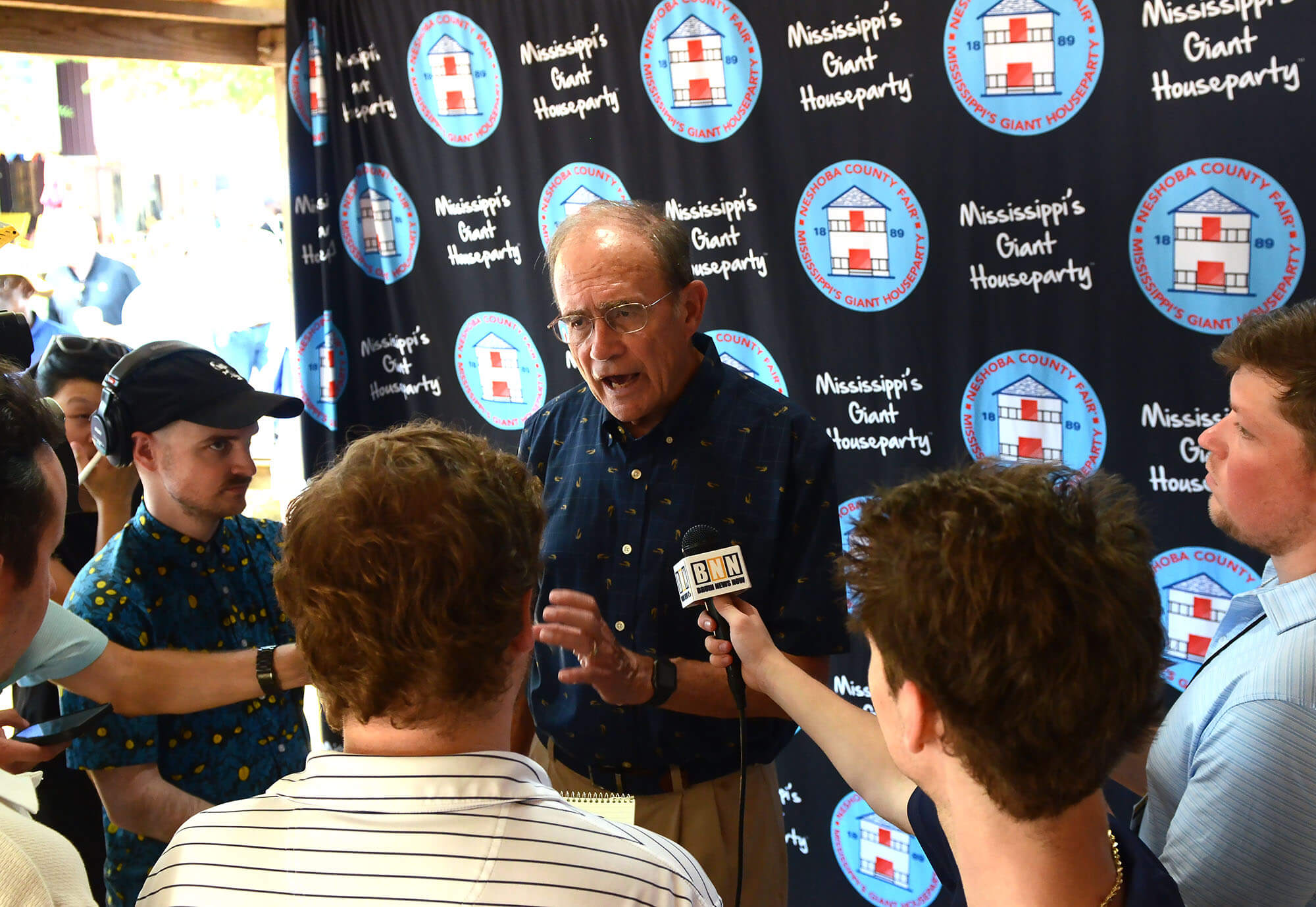
Lt. Gov. Delbert Hosemann’s House counterparts took advantage of typos in a bill his Senate approved — bringing forth the most sweeping tax overhaul in modern Mississippi history.

But after a day’s silence on the issue, Hosemann on Friday acted as though he knew little about the snafu.

Hosemann outlined what he said were victories in the bill headed to Gov. Tate Reeves with the Senate’s typos unfixed. Then he attempted to end a press conference after taking, but not really answering, one question from Mississippi Today about the errors. As statehouse reporters kept pressing, Hosemann said he hadn’t “focused” on the typos and didn’t know whether the House had intentionally passed the bill to back the Senate into a corner.

“I don’t know whether they knew it had a flaw,” Hosemann said. “Nobody told me that.”

Hosemann said his team spent “hundreds of hours” drafting its tax overhaul legislation and “an untold amount of allocations and computations” went into the process. But the thoroughness Hosemann described did not prevent a few errant decimal points from making it into the legislation the Senate ultimately approved by mistake.

The upshot is that a bill eliminating the income tax at a much faster clip than Hosemann and many senators wanted, a position they stuck to for months, is set to be signed into law thanks to a clerical error. The law that will be headed to the governor’s desk would dramatically alter Mississippi’s tax structure.

As confusion swirled throughout the Capitol late Thursday and early Friday, many lawmakers said they were unclear how quickly the income tax elimination would happen. The Senate when it voted on its plan intended it to take many years and hinge on economic growth “triggers” being met. But decimal point typos essentially removed the triggers, meaning hundreds of millions of dollars in income tax revenue will have to be cut even if there is growth of just a few million dollars.

At most, the Senate plan would eliminate the income tax over a little more than a decade — roughly the same timetable as House leaders had proposed. Senate leaders had called that approach unwise, and thought the counteroffer they sent to the House would have taken 20 years or more, dependent on growth.

The House, which along with Gov. Reeves has favored eliminating the income tax at a faster rate, ran with the Senate’s mistake. They approved the bill on Thursday and on Friday disposed of a procedural motion that will send it to the governor’s desk.

Opponents of the changes say the poorest state in the union can’t afford to slash a third of its budget and still provide services to citizens, and that a shift to “regressive” taxation with an increased gasoline tax will hit poor people and those of modest means the hardest. Proponents say the bill will bolster Mississippi’s “consumption-based economy” by drawing corporate investment and letting workers keep more of their money.

House Speaker Jason White on Friday afternoon issued a brief statement but did not address the typos in the Senate bill or the bizarre way his chamber found a way to send the tax plan to the governor.

“As of today, we are Building Up Mississippi by eliminating the income tax to further our state’s competitive advantage and award our workforce! HB 1 has crossed a historic hurdle and is heading to the Governor,” White wrote.

White thanked Reeves and House Ways and Means Chairman Trey Lamar. He did not mention Hosemann.

But Hosemann indicated negotiations might not be over, pointing to another tax reform bill his chamber approved Friday morning. Other Senate leaders said little about the mistake and operated as if everything were normal. They voted to invite conference on a separate Senate tax cut bill that remains alive.

Hosemann said he hadn’t seen the House’s tax bill head to the governor’s office yet, and that he hoped the other Senate-approved bill would be the final product.

“There may be some clarifications needed and these issues have come up this morning. And so we’ve done SB 3095 and sent it back down to the House to take a look at it,” Hosemann said. “Hopefully the governor will sign the amended legislation the Senate sent back to the House.”

But it is doubtful the Senate has any leverage to force the House back to the negotiating table since much of the House’s plan is already headed to Reeves, who vowed on Friday to sign it into law.

White, in his Friday statement, suggested the Legislature could use the Senate’s tax bill as a vehicle for changing the structure of the Public Employees Retirement System, which had been a key wedge issue between the chambers in their negotiations over tax reform.

“I’m encouraged that the Senate has invited conference on SB 3095 to establish a dedicated stream of revenue to fund PERS going forward,” White wrote, referring to his chamber’s preferred approach to fixing the system.

Before taking questions at Friday’s press conference, Hosemann celebrated elements of the bill headed to Reeves, including lowering the sales tax on groceries from 7% to 5%, increasing infrastructure funding and cutting PERS benefits for future employees to help shore up the system financially.

“Today is about the biggest win we have had on these issues in the history of this state,” Hosemann said. “Now, if we need to clarify something, they’ll clarify it. But what’s happened today, both on the grocery tax, the income tax, and PERS … I think we’ve done so many positives. I don’t want to take any of the glow from the House or the Senate on the work that we did for a year.”

The events of the past few days were a “team effort,” Hosemann added.

The post Lt. Gov. Hosemann feigns ignorance on typo that led to tax overhaul passing by mistake, claims victory appeared first on Mississippi Today.

Higher ed reporter Molly Minta moves to Mississippi Today’s new Jackson team

Jackson reporter Molly Minta

Mississippi Today is excited to announce that Molly Minta, who has been covering higher education for the newsroom since 2021, has moved full-time to the newly launched Jackson team.

In her new role, Minta’s reporting will take an expansive view of topics like public safety, such as community-level examinations of housing and code enforcement, public parks and blight, economic and mental health resources across the capital city, as well as policing.

“In building up this new beat, some of my favorite conversations about smart ways to tell Jackson’s untold stories have been with Molly,” said Jackson Editor Anna Wolfe. “In the last four days, she’s already attended four community forums, pounding pavement to meet Jacksonians and talk about the issues that matter most to them. It’s obvious how fired up she is to get to work covering our city.”

READ MOREMississippi Today announces new team of reporters to cover the city of Jackson

Since joining Mississippi Today, Minta has consistently published gripping reporting on higher education policy, governance and equity in Mississippi’s colleges and universities, twice placing in national education reporting awards. Her past work, in partnership with Open Campus, explored secrecy and unfairness in the state’s higher education system, from funding disparities to faculty-administration relationships.

Her investigative focus will continue on the Jackson team, where she will join Wolfe and reporter Maya Miller. The team plans to add another reporter this spring.

“I’ve lived in Jackson since moving to Mississippi four years ago, so I’m approaching this beat with questions you can only get from lived experience in this city,” Minta said. “There’s so much we don’t know about this city, and my goal will be to make information about the way Jackson works more accessible to everybody. Who has power in this city, how did they get it, and are they using it to help Jackson thrive?”

Before her time at Mississippi Today, Minta worked as a fact-checker for outlets like The Nation, The Intercept and Mother Jones. She also ran an alternative magazine in Gainesville, Fla., called The Fine Print. 

Though Minta’s focus has changed, Mississippi Today remains committed to covering higher education and will announce its plans for the role in coming days.

The post Higher ed reporter Molly Minta moves to Mississippi Today’s new Jackson team appeared first on Mississippi Today.

Former elections official explains federal law not needed to keep noncitizens from voting

Editor’s note: This essay is part of Mississippi Today Ideas, a platform for thoughtful Mississippians to share fact-based ideas about our state’s past, present and future. You can read more about the section here.


The Safeguard American Voter Eligibility Act (SAVE Act) has been rolling around the halls of Congress for at least two years now. With the Democrats in control of the Senate and Joe Biden in the White House, it just could not build up enough steam to get over the proverbial hill, but this year is a different matter.

Trudy Berger

So, the question again is what is it and do we really need it? At its most simple level the act would require voters to provide documentary proof of citizenship at the time of registration. Sound simple enough – we don’t want undocumented immigrants voting, right? 

Lend me your eyes for just a few moments and allow me to give you a few comments from the perspective of a retired election administrator (14 years’ experience) from a mid-sized county in Mississippi. Ensuring only citizens can vote is important, but there are more cost-effective ways of doing this. For instance, how many of you have renewed your Mississippi Drivers License for the one that has “Real ID”? You had to produce a certified copy of your birth certificate, didn’t you? Not to get too far into the weeds here, but the Secretary of State’s SEMS (Statewide Election Management System) already communicates electronically with the Department of Public Safety. 

Why burden the voters, who would have to find their birth certificate, and the voter registration staff, who would have to handle and verify yet another document? There’s a high likelihood that the information already resides in a state system, which is where voter registration is designed to be managed – not at the federal level anyway.

It is already a felony to vote if you’re not a citizen. Layering on this requirement will result in an unfunded mandate, when what could be helpful from the federal government is sharing of data.

I spent my first 10 years as an election commissioner acting more like a cop, trying to enforce the law. Once a new commissioner was elected (Republican by the way) and came into the office asking a startling question: why aren’t we encouraging people to register to vote? Why are we only purging voters? At first, I said, well, because that’s our job – purging, voter roll maintenance. But then I went back to the U.S. Constitution – something every American should read at least once a year. Voting is an enumerated right. We need to ask ourselves why we would ever even consider doing anything to make it harder for people to exercise that precious right?

Let’s address the law of unintended consequences for a moment. If people aren’t registered, they can’t vote. The SAVE Act will make it harder for people to register – when you move your aging mother, father, aunt, uncle, across state lines to live with you, think about how difficult it’s going to be to get them registered to vote. For married women whose last name is not the same as is on their birth certificate – it’s no longer a simple matter for them to register to vote if the SAVE Act passes.

So, as we continue to bemoan the low turnout numbers in local elections, just remember everything we do that makes it more difficult will further discourage voters. I could bore you with statistics that show how astonishingly low voting by noncitizens really is. Like so many other issues of the day, people are getting worked up with no real facts on the table to justify the outrage. All I can offer is my opinion based on my experience – the SAVE Act seeks to fix something that just ain’t broke. Do we need the SAVE Act? No, we do not.


Trudy Berger served 14 years on the Pike County Election Commission and six years as a member of the Election Commissioners’ Association of Mississippi.

The post Former elections official explains federal law not needed to keep noncitizens from voting appeared first on Mississippi Today.

Sweeping Mississippi tax overhaul passed … by mistake. Gov. Reeves eager to sign typo tax swap into law

The House on Friday took advantage of Senate typos — a few errant decimal points — in a bill and sent to Gov. Tate Reeves the most sweeping overhaul in taxation in modern Mississippi history.

Despite the Senate and a large number of House members voting for the plan being accidental due to the typos, Reeves has said on social media he’ll sign it into law, and that lawmakers can work bugs out in coming years.

Lt. Gov. Delbert Hosemann, who oversees the Senate, remained mum on Friday, providing no explanation of how the typos got past Senate proofers and lawyers.

The bill would eliminate the state personal income tax and strip about $2.2 billion from the state budget while raising the tax on gasoline by 9 cents a gallon over three years, with later gas tax increases coming automatically.

Opponents of the changes say the poorest state in the union can’t afford to slash a third of its budget and still provide services to citizens, and that a shift to “regressive” taxation with an increased gasoline tax will hit poor people and those of modest means the hardest.

“The rich will continue to get richer and the poor will continue to get poorer,” said Rep. John Hines, D-Greenville, on Friday. On Thursday, he warned his colleagues that voting for the measure “will take your picture off the wall” in the Capitol — cost them reelection.

Because of the Senate’s typos, many lawmakers on Friday were unclear how quickly the income tax elimination will happen. The Senate when it voted on the plan intended it to take many years and hinge on economic growth “triggers” being met. But the decimal point typos essentially removed the triggers, meaning hundreds of millions of dollars in income tax revenue will have to be cut even if there is miniscule growth of a few million dollars.

At most, the Senate plan would eliminate the income tax over a little more than a decade — roughly the same timetable as House leaders had proposed. Senate leaders had called this foolhardy, and thought the counteroffer they sent to the House would have taken more like 20 years, dependent on growth.

Hosemann and the Republican Senate leadership had initially opposed a full elimination of the state’s already low income tax, calling for more cuts instead. They later agreed to elimination, but only over many years with the growth triggers as a safety — or so they thought.

Hosemann did not mention the snafu to senators when he presided over a brief session on Friday before they left for the weekend.

House Speaker Jason White on Friday afternoon issued a brief statement but did not address the typos in the Senate bill or the rope-a-dope way the tax plan got sent to the governor.

“As of today, we are Building Up Mississippi by eliminating the income tax to further our state’s competitive advantage and award our workforce!” White wrote. “HB 1 has crossed a historic hurdle and is heading to the Governor … The Mississippi House of Representatives took the vote to eliminate the tax on work three times, and each time, we picked up more and more votes. I must thank Governor (Reeves), (House Ways and Means Chairman Trey Lamar), my fellow House colleagues, and my staff for making the most significant tax cut in Mississippi history a reality.”

Other Senate leaders on Friday said almost nothing about the mistake and operated as if everything were normal. They voted to invite conference on a separate Senate tax cut bill that remains alive. It would appear that bill is moot at this point.

Hosemann on Friday thanked the Senate for its hard work and “historical actions” this week.

The remarks prompted Sen. Hob Bryan, a Democrat from Amory, to cough loudly in an apparent sarcastic reference to the tax bill.

Senate Finance Chairman Josh Harkins said little about the situation other than he plans to meet with House leaders to “make it clear” what the Senate intended to do with the typo bill.

House Democrats on Friday decried the episode, both on the floor before a procedural “voice vote” to send the bill on to the governor, and at a press conference later. They said House members — including a dozen Democrats — were unaware of what the bill did with the typos just like the GOP controlled Senate was.

“I asked twice, twice, for an explanation of the triggers (before a Thursday House vote),” said Rep. Omeria Scott, D-Laurel, although she voted against the bill.

Before the voice vote, House Minority Leader Robert Johnson, D-Natchez, urged lawmakers not to send the measure on to the governor, but instead send it back for more negotiation. Democrats also unsuccessfully tried to force an actual recorded roll call of the vote.

“There’s a simple way to deal with this issue, they could have sent the bill back to conference for more work,” Johnson said. “But they chose to not give a damn and just sent it straight to the governor and roll the dice and not care what the outcome is. They’re just going to go with this idea that we are going to ‘stop taxing work.’ Well, let me tell you what, there won’t be any work to tax when you cut that much out of the budget.”

The Senate typo riddled bill was something of a rush job. It was presented in committee late Monday afternoon and quickly passed with little debate. It was voted on by the full Senate on Tuesday. In recent years, lawmakers have complained that hurried passage of bills forced by legislative leaders does not provide time to vet — or sometimes even read — bills before they are passed.

Reeves said on Friday that he will sign the bill into law.

“It’s a great day for Mississippi,” he wrote on social media.

The post Sweeping Mississippi tax overhaul passed … by mistake. Gov. Reeves eager to sign typo tax swap into law appeared first on Mississippi Today.

Jackson teens ‘Take the Lead’ and the mic, confronting mayoral hopefuls about youth issues

Javion Shed is nervous about his first time as a moderator. The Murrah High School senior looks the part, dressed in a blue suit with a Murrah pin on his lapel. As he takes to the stage, 11 Jackson mayoral candidates look to him expectantly as they wait for the questions to begin. 

On Thursday, teenagers from high schools across Jackson Public School District gathered in the Forest Hill Auditorium for the “Teens Take the Lead” Mayoral Candidate Forum. The forum was Shed’s idea, something born out of a desire to get his peers more civically engaged.

“We’re the age group that oftentimes, we don’t vote, or sometimes we say, ‘My one vote doesn’t matter, or I’m just the 1%,’ but it does matter,” Shed said. “Voting is an essential power that you have as an individual living right here in our capital city, and your vote can impact so much more than what you think.”  

Students from various public schools attending the “Teens Take the Lead,” mayoral forum, had the opportunity to pose questions to the candidates at Forest Hill High School, Thursday, March 20, 2025. Credit: Vickie D. King/Mississippi Today

Shed coordinated with the school district to host the event, but much of the credit is due to his perseverance. He said he emailed, called and texted with most of the candidates.

“Far too often we don’t get the chance or we don’t have the space to voice our opinions or to say, ‘OK. I want to ask the candidate this question,’” Shed said. “Eighteen is the group where students don’t particularly vote in the municipal elections, because we feel like what they say doesn’t concern me. My vote doesn’t count. I don’t have a voice. It’s not going to impact me, and the truth is it will impact you later and greater down the road.”

Shed prepared his questions based on what his peers were most concerned about: the failing water system, youth crime and changing the narrative that JPS schools are unsafe or of poor quality.

“It gave students a fresh perspective on all candidates, and they got to kind of tune in, ask their own set of questions, and they got to get a different perspective and a different outlook on the Jackson mayoral race,” Shed said.

When student representatives from schools around the city had their chance to ask questions, most were centered around justice and gun violence. Others touched on mental health, infrastructure and creating community spaces for teenagers. 

“What are some thoughts and ideas you have to improve school funding, so we have better environments for our scholars?” one Murrah student asked independent candidate Rodney DePriest.

The contractor and businessman respond with an answer about reducing crime and improving infrastructure, saying, “Without that, we will not have the jobs we need to grow a tax base. We wouldn’t have the job we need for the young people in this room to be able to have an internship, to find out the value of work and the dignity that comes with it.”

JPS Superintendent Errick L. Greene said he’s proud of Shed and his JPS scholars for taking the lead on becoming more engaged with voting and the elections. 

“It wasn’t something that was on our radar, or something that we were intending to do, but when the idea came to me, I jumped on it and said, absolutely. It’s something that I’d support,” Greene said. 

Malaya Tyler, who attends JPS-Tougaloo Early College, said this forum gave her an opportunity to hear from candidates as she makes her decision of who to cast a ballot for in her first election. 

“As a person who is voting on April 1st, it was a great opportunity for me to see each candidate and see their plans and hear what they had to bring to the city,” Tyler said.

She said she was concerned about infrastructure and higher education, as she’s on the cusp of heading to college. 

“Internships are a big thing for me and different job opportunities, just trying to see where I want to go with my future, so I feel like that was a big part for me,” she said.

But one student said he felt some of the candidates didn’t directly respond to the questions.

“I just feel as if you are a potential mayor of the city of Jackson, if you can’t give a straight answer then it’s kind of like hard for me to understand your clear vision for the future for me and for students in Jackson Public Schools and people who plan to stay in Jackson,” said Charles Travis, a student at Callaway High School and Jackson Middle College. 

Travis voted for the first time last year in the presidential elections, but he said that local elections matter just as much.

“My peers should understand a bigger picture of all elections,” Travis said. “It can affect you directly or indirectly. They should think about their family members, their fellow peers in the classroom and their future as citizens in the United States.”

The post Jackson teens ‘Take the Lead’ and the mic, confronting mayoral hopefuls about youth issues appeared first on Mississippi Today.

Domestic violence deaths reflect families’ loss and grief

It was like seeing the writing on the wall and waiting for the worse to happen. 

Family members and friends said they saw signs of physical, mental and other domestic abuse, and searched for ways to keep their loved ones safe: home security, a trip out of town, a firearm. 

Some of the individuals experiencing the abuse turned to the legal system by seeking a protection order. Others looked for a way out of the harmful relationship. 

But despite best efforts, some of those relationships ended in death.

Over 300 Mississippians have died from domestic violence homicides since 2020, according to an analysis by Missisisppi Today of data from the Gun Violence Archive, the Gun Violence Memorial, news articles, court records and obituaries. 

That number includes not just those who experienced the abuse and those who perpetrated it, but also collateral harm to children, other adults and law enforcement caught in the crossfire. But it doesn’t reflect those who bear the pain and loss – children growing up without a parent, parents burying their child.

That has driven some survivors to become advocates and spread awareness about domestic violence. 

It has touched people like Renata Flot-Patterson who lost her daughter and grandson in 2021 in Biloxi, and has gone on to organize domestic violence benefit concerts and helped create a mural that honors them. 

And Tara Gandy who is teaching others about signs of abuse after her daughter’s death in 2022 in Waynesboro. 

And Elisha Webb Coker, who as a teenager watched her mother experience abuse at the hands of partners and die in front of their Jackson home. 

“It’s because the system is just the system,” the Gulfport resident said about the need for change around how domestic violence is addressed in the state. 

“My mother was murdered in 1999,” Webb Coker said. “It’s still the same.”

The Mississippi Coalition Against Domestic Violence, which represents shelters, advocates and other support for survivors and victims, is backing efforts to study domestic violence deaths, with the hopes of building a better network to help people stay safe and prevent future deaths. 

What started out as a pair of bills has come down to one, Senate Bill 2886. Lawmakers will need to agree on a final proposal in conference by the end of the month and then pass both chambers before it can reach the governor’s desk. 

It’s an effort that some families of domestic violence homicide victims believe can lay out patterns of abuse and responses to it and show missed opportunities to step in.

At the Gulf Coast Center for Nonviolence in Biloxi, several women directly impacted by domestic violence homicide spoke to Mississippi Today. The center is supporting the legislation and has support services including a homicide survivors program.

Prince charming turned into a monster

In the wake of her daughter and grandson’s deaths, Flot-Patterson is left with questions: Why didn’t police intervene when her daughter’s former partner had served time for aggravated domestic assault? Why didn’t the hospital hold him for a mental evaluation when he threatened his child’s life?

She would like the state to pass a law that would take threats to a child’s life seriously and require the person who makes the threat – including a parent – to undergo a mental health evaluation. Flot-Patterson would name it “Brixx’s Law.” 

Her daughter Keli Mornay and her 7-month-old grandson, Brixx, were both of her babies: Mornay was the youngest of her four children and at the time Brixx was the youngest grandchild. 

Mornay had a beautiful personality and poured herself into helping others, sometimes putting them before herself, her mother said. She was family-oriented and fiercely proud of her children: Brixx and his older brothers. 

Keli Mornay and her 7-month old son Brixx were among at least 50 Mississippians who died in domestic violence homicides in 2021, a number that includes not just people who experienced abuse and those who perpetrated it, but also children, other adults and law enforcement. Mornay’s former partner, who was also the infant’s father, shot and killed them before turning the gun on himself. Courtesy of Renata Flot-Patterson

It was that nature that drew her into problematic relationships.

Mornay met Byrain Johnson and liked that he was older and had his own children and grandchildren. He was a hard worker who showed signs of being a good man, and Mornay wanted to help him become a better person, Flot-Patterson said. 

Within two months, the relationship began to go downhill and Johnson changed, Flot-Patterson said, noting earlier signs of abuse: the time he broke Mornay’s laptop. Another time  he kicked down her bathroom door and took her clothes. It escalated to threats of violence and physical abuse. 

“He was like the prince charming at first and then he turned into the monster that basically ruined everybody’s lives in my circle,” Flot-Patterson said. 

In February 2020 during the drive home from a trip, Johnson and Mornay argued and he beat her and left bruises, cuts and broken teeth, Flot-Patterson said. But it was her daughter who was charged with domestic violence and spent a night in jail – charges brought by Johnson, according to court records shared with Mississippi Today. 

In a domestic abuse protective order Johnson filed against Mornay, he listed a number of allegations, including violence and how she filed false charges against him. A judge denied the order because Johnson did not prove the allegations. 

Mornay’s charge was dropped after her parents took her to the hospital and additional information was submitted to police, including pictures of Mornay’s injuries, Flot-Patterson said. 

That night in jail, Mornay was given a pregnancy test and learned she was expecting. 

Flot-Patterson remembers telling her that a child would tie her to Johnson for life. Her family and friends already feared for her safety. But Mornay said a child is what she needed to get her life back on track. 

“She said, ‘This baby is going to ground me.’ Those were her words,” Flot-Patterson said. 

Yvonne Del Rio met Mornay in 2018 when she relocated to the Coast after divorcing a partner who she said abused her physically, emotionally and financially for over 20 years. 

She said Mornay’s personality and smile radiated like sunshine, and they became close. Del Rio was also concerned about how Johnson treated her and was scared for Mornay’s safety when her friend shared her pregnancy. 

As threats to Mornay’s safety escalated, her family helped her get security cameras and locks at her home. 

When Brixx was several months old, Mornay went to court and was awarded joint custody with her as the primary, custodial parent. 

A few weeks before their deaths, police came to Mornay’s home where Johnson had showed up uninvited, assaulted her in front of her infant and 10-year-old son and yelled at the boy. 

Johnson then left with Brixx, and police and others had to negotiate with Johnson, who over the phone threatened to kill himself and the infant, before police detained Johnson and returned Brixx to Mornay, court documents state. 

Police took Johnson to the hospital because of the threats he made, but Mornay told Flot-Patterson he was released without a mental evaluation or arrest. 

“Me and my family have had enough and are terrified of what he may do next,” Mornay hand wrote in a May 28, 2021, petition for a domestic abuse protection order in Harrison County. 

“His behavior is extremely violent and out of control.” 

Mornay’s parents helped arrange for her and her sons to leave for Utah. The older boys would stay with their father and Mornay and Brixx would stay with some of her childhood friends. 

The court approved an emergency protective order and within a week, it was served to Johnson. 

Days later on June 6, 2021, Flot-Patterson remembers seeing a missed call from her 14-year-old grandson. She tried to reach him, but didn’t get an answer, so Flot-Patterson tried calling Mornay’s phone. 

Instead of her daughter on the other end, it was Johnson, who had broken into Mornay’s home. He told Flot-Patterson he killed her daughter and that he and the children would be dead. 

Flot-Patterson and her husband raced to Mornay’s Biloxi home. Police found her dead from a gunshot wound and Johnson was dead after turning the gun on himself, but not before shooting Brixx. The baby was still alive and rushed to the hospital but died before he could be transported out of state for more intensive care. 

Mornay’s older sons had run from the home to safety and called 911. 

“When she died, I said, ‘This baby grounded you.’ That’s the first thing that came to mind when the police told me she was dead,” Flot-Patterson recalled. 

In 2021, at least 50 other people died in domestic violence incidents across the state. 

Flot-Patterson learned more about the abuse Mornay endured through pictures on her daughter’s phone, the text messages she sent and journal entries.

Years later Flot-Patterson still has questions about how the situation Mornay was in was allowed to escalate until it was deadly. 

Johnson served nearly six months for aggravated domestic violence against another person, according to Harrison County jail records. Why didn’t police arrest him each time they were called to Mornay’s with that charge on his record? Flot-Patterson asks. 

Why wasn’t Johnson held at the hospital and given a mental health evaluation after making threats to his son’s life and his own, she wonders. 

During grief, Flot-Patterson dove into sharing her daughter’s story and raising the issue of domestic violence, including organizing concerts to benefit the Gulf Coast Center for Nonviolence and establishing a foundation in Mornay’s name. 

She is at the point now that whatever she can do to bring awareness and education about domestic violence, she will do it. Flot-Patterson has had conversations with survivors and met families of other domestic violence homicide victims. 

“This is surreal, and I’m not the only one,” she said about meeting other families who lost someone to domestic violence. “I’m not the only one suffering.”

Memories of her daughter is all she has left

Joslin Napier didn’t want to be treated differently as she lived with sickle cell disease. The condition took a toll on her body when she became pregnant and gave birth to her son in 2019.  

“She wouldn’t let her sickle cell stop her,” her mother, Tara Gandy, said. “The thing I thought was going to hurt her the most was not what hurt her.”

Chance Jones, an ex-partner, faces a capital murder charge for shooting Napier on Oct. 4, 2022, while in commission of a burglary. His indictment came on the year anniversary of her death, according to court records. 

He has also been indicted for aggravated domestic violence for an incident in June 2022, when he pointed a gun at Napier and stomped on her head, according to court records.  An indictment came Oct. 12, 2022 – less than a week after Napier’s death. 

Napier is among the nearly 40 people who died in 2022 in domestic violence incidents in Mississippi. 

Gandy declined to comment about her daughter’s case that is set to go to trial in May.

Prosecutors plan to present to the jury evidence of domestic violence allegations Napier made against Jones to give the jury “a full picture of the circumstances” around her death, according to an August 2024 filing. 

The state noted six times when police were called to Napier’s home about Jones within a span of six months.  

When she ended the relationship in April 2022, Napier told police Jones came to her home in the early hours of the morning, banged on the door and threatened to hurt her. He broke in through the front door, flipped over her nail salon tables and shelves and took her car keys. 

Napier took action, filing for a protective order against him and purchasing a firearm, court records state.

Jones was also arrested twice, in May and August 2022, accused of violating the protection order. 

Gandy said there was a lot of guilt and grief their family had to face, and they continue to navigate her loss. 

Napier, the only girl of her family, was a butterfly who made you feel welcomed, said Gandy. She taught herself how to do makeup and nails professionally and was in the process of getting her nail technician license. 

Napier was also a loyal friend who saw the good in others – something Gandy said she taught her daughter. Like her mother, she also saw potential in others and often fell in love with that potential. 

Gandy has let the pain of her daughter’s death push her into purpose. She has been spreading awareness about domestic violence, joining groups and sharing tools and resources – all of which she wished she had access to earlier to help Napier. 

She’s also a domestic abuse survivor herself and uses that experience to help others. 

“So I keep my daughter’s memories alive, because those are the things that I have left,” Gandy said.

‘I feel like the system failed us’ 

The loss from domestic violence widens with the inclusion of family violence. 

Webb Coker remembers her mother, Patrice, as a smart, strong woman who taught her so much. She was a parent, but also a best friend. 

Patrice Webb worked to support her family while also pursuing her dreams: to become a nurse and help people with mental health issues. 

Patrice Webb pictured at her high school graduation. She had three children and moved from the Coast to Jackson to study nursing at Hinds Community College. She died Sept. 24, 1999, after her partner hit her on the head, pushed her out of the car she was in and ran her over. Her eldest daughter, Elisha Webb Coker, said her mother’s death shattered the lives of her and her siblings, who were separated to live with their fathers or other family members. Courtesy of Elisha Webb Coker

She was killed in Jackson Sept. 24, 1999 by her partner, Gregory Ephfrom, who hit her on the head, pushed her out of his car and ran her over on Powers Avenue. 

Webb Coker said her mother’s death shattered the lives of her and her younger sister and brother, who were spread across the country to live with their fathers and other family members. 

Looking back, she said there were missed opportunities to intervene. Her mother sought help for the domestic abuse and shared with family members, including Webb Coker, that she was scared. 

“I feel like the system failed us,” Webb Coker said. 

Ephrom was initially charged with first degree murder, according to Clarion Ledger stories in 1999, but weeks later that charge was reduced to manslaughter. 

He pleaded guilty to a reduced sentence and received 10 years, with most of it suspended. Webb’s family thought he had served at least a year, but WLBT reported last year that he was in jail for four days. 

Webb Coker was upset, but she wanted to use her grief and anger to advocate for victims of domestic violence and sexual assault, which she has experienced herself in relationships. 

She is studying to become a nurse, following in her mother’s footsteps.

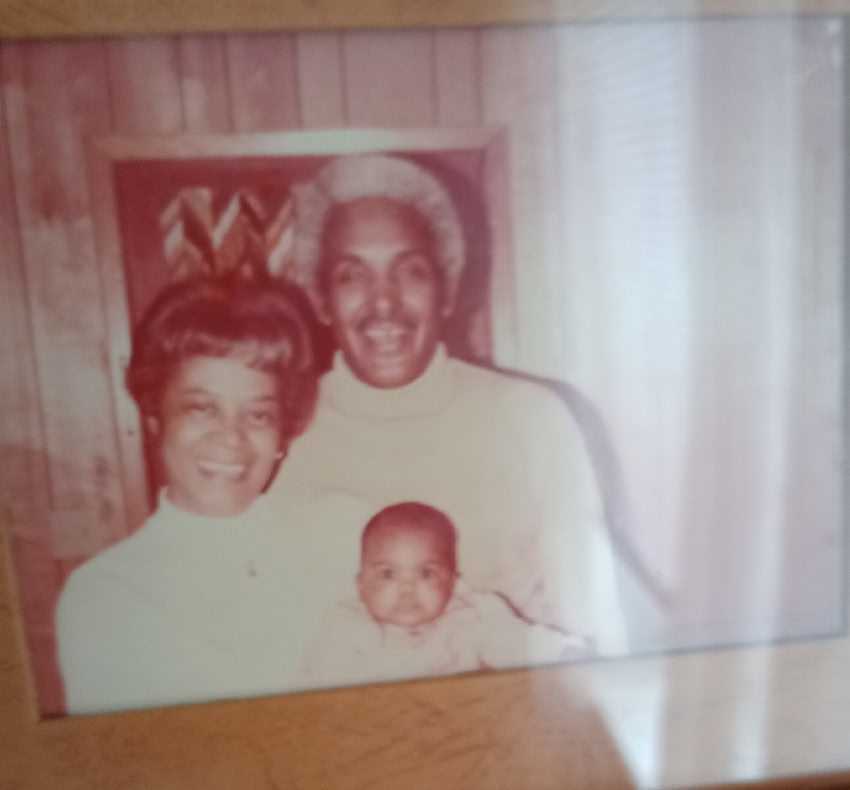
An old family photo shows Patrice Webb with her youngest child, Shani Williams. Webb lived in Jackson with her three children and had been studying to become a nurse when she died Sept. 24, 1999, when her partner hit her on the head, pushed her out of a car and ran her over. Her eldest daughter, Elisha Webb Coker, said her mother’s death and her own experience with domestic violence and sexual assault led her to advocate for others facing similar issues. Courtesy of Elisha Webb Coker

Webb Coker’s children ask about their grandmother and like to hear stories about her. 

But it’s also been an opportunity to teach them about domestic violence and dating violence, especially because she has a 21-year-old son and five girls ranging in age from 8 to 18. Some of the older children witnessed former partners abuse Webb Coker. 

“The red flags: I have to pay attention to this time,” she said. 

‘These people make choices … that impact us’

Domestic violence doesn’t always involve intimate partners. Sometimes it can be between family members.

Van Marske‘s death came at the hands of his son, Noble, in September 2021. Noble, who is now 45, pleaded guilty to second degree murder and tampering with physical evidence in 2023 and is serving a 20-year sentence.

Marsha Schmitt carries around a folded program from Van Marske’s funeral service because she likes the picture of him. It’s a reminder of her younger brother who was a woodworker, carpenter and fisherman. He was someone she depended on. 

He brought his adult son to live with him when Noble was battling addiction and having other troubles, Schmitt said. 

But over the years, Noble Marske began to threaten his father. She knew her brother was scared and was trying to get his son to move out of the house, and he tried to file a restraining order. Schmitt said that was not successful, and her brother was told he could not get one because Noble lived with him. 

In Mississippi, family members related by blood or marriage who currently or previously lived together can apply for a domestic abuse protection order

“(But) my brother never believed up to the end that he would actually do it,” Schmitt said about her nephew’s threats against his father. 

Van Marske went missing after Labor Day, and nearly a week later authorities searched a marsh area in Harrison County – where Noble Marske told police his father went fishing – and found Van Marske buried in a shallow grave. 

In a statement given in court during her nephew’s guilty plea, Schmitt said he does not deserve to be called “Noble” because of what he did. She added, during an interview with Mississippi Today, that Noble was her mother’s name and she doesn’t believe her nephew is worthy of it.

“He chose, and that’s what’s important here,” Schmitt said about her nephew’s actions. 

“These people choose. And we have to remember that their choices impact us.”

The post Domestic violence deaths reflect families’ loss and grief appeared first on Mississippi Today.

Trump moves to eliminate U.S. Department of Education. Right now, Mississippi must figure out what’s next.

Today, after months of campaigning on “giving education back to the states,” President Donald Trump signed an executive order that aims to totally dismantle the U.S. Department of Education.

There are serious questions of constitutionality that will need to be worked out in the courts, and Congress likely needs to sign off on the elimination of a federal agency. Who knows if this, like so much of what Trump and Elon Musk have been cutting, will actually go through. 

Nonetheless, Trump kept another major campaign promise — one that was directly forecasted in the Project 2025 manifesto that Trump’s top advisers helped write. Congratulations to you, I suppose, if you think this is a good idea.

My plea to you now: Play this out a little further and consider the critical, unanswered questions about what this is going to mean for states like Mississippi.

Let’s acknowledge this frankly: Our track record running our own public education system is god-awful. Last time Mississippi managed its own schools system without the federal agency in place, it was failing dramatically:

  • Educational standards set by state leaders were woefully low. How low? Routinely, the Mississippians lucky enough to earn high school diplomas were illiterate when they entered the workforce. That low.
  • Schoolhouses were falling in and barely usable, hungry kids were too ill to return to class, and special education programs for our most vulnerable students literally did not exist.
  • Traditionally overlooked communities were wildly undereducated, with fewer than half of rural Mississippians and fewer than half of Black Mississippians holding high school diplomas.
  • The political power structure set or influenced state’s curricula. Just one example of how this played out: In America’s Blackest state and the heart of the civil rights movement, public school students were only taught one white version of history. Can we really feel OK about that?

In so many ways, the founding of the U.S. Department of Education in 1979 created transformational guardrails for Mississippi that curtailed most of these travesties. Yes, we implemented our own changes at the state level, and yes, nothing is perfect now. But without the critical framework of the federal agency and its funding prowess, we never would have taken those steps. For decades now, only because of the federal agency, we have been assured that:

  • Poor, rural school districts would get the funds they needed — funds they weren’t getting from legislative leaders of America’s poorest state.
  • Critical special education — programs that did not exist because they were not being funded by Mississippi — would be funded with that money being distributed equitably.
  • Annual standardized testing would show us whether we were ahead of, on par with, or falling behind the performance of students in other states. You remember the “Mississippi miracle,” the dramatic reading improvements that were a key point of pride for virtually every 2023 political campaign? We literally wouldn’t know the miracle existed without this critical federal benchmarking.
  • Adequate funds would be distributed to ensure that students of marginalized communities — minorities, migrants, students with disabilities, students experiencing homelessness — got the extra support they needed to succeed, and the white political power structure wouldn’t focus only on students who looked like them.

Look, we have the right to know that our tax dollars are being spent efficiently and appropriately. Looking under the hood is indeed desperately needed across government at every level.

And truly, what better way to spend those dollars than on the education of our children? In so many ways, our state’s future hinges more on this basic function of government than any other spending. Do you want a stronger economy? More jobs and better jobs? Vibrant and well-run towns and cities? Functioning health care and economic systems? There’s no room for debate: All of that starts with providing our children with a quality education.

So call me cynical, liberal or just plain crazy, but as we’re staring down the barrel of one of the most dramatic public policy shifts in American history with this latest move by the White House, we need to get so many questions answered, or Mississippi could be set so far back in time that we’ll never recover. Our kids’ livelihoods are on the line here, and our collective success as a state is at stake.

Here are a few of those critical questions that come to mind.

Can Mississippi really manage up to $1.5 billion in federal funds on our own?

Mississippi, the state that relies more on the federal dollar than any other state, right now ranks 45th in the nation in public education funding. That’s already far too low.

But included in that total is $1.5 billion that the U.S. Department of Education sends Mississippi each year. If you’re counting at home, that represents 30% of the state’s annual spending on public education. That money is split up into grants and other specifically designated programs, so the state has little leeway in deciding how it can be spent. 

Trump and his administration have given virtually no specifics of how this post-DOE iteration of things will work — an extremely concerning reality in itself — but experts suggest that instead of funds being sent to states through the federal agency, Congress would send that money directly to the state in the form of block grants — or grants that have some general parameters on how they can be spent but fewer strings attached by way of accountability. One would assume that the Mississippi  Departments of Education would take on the responsibility of doling this funding out.

This is where Mississippi’s education structure comes into play. Our state Department of Education is run by the Board of Education, a nine-member political board appointed by the governor, lieutenant governor and the speaker of the House. If these Trump-decreed changes go into effect, these nine people seemingly will, overnight, have a $1.5 billion weight on their shoulders.

We have every right to be concerned that these board members would act as if they were beholden to the politicians who appointed them — a long-standing reality across our state government system that has harmed Mississippians in just so many ways. The potential for corruption and misspending here is immense. (In case you’re wondering about Mississippi’s recent track record on doling out federal block grant funding, ask the handful of people who are awaiting federal sentencing in the state’s welfare embezzlement how they’re doing lately.)

A few more money-related questions that no one seems to be asking: How often will the feds send us this money — monthly, quarterly, annually in one lump sum? How quickly might it then make its way to school districts that desperately need it to provide these critical educational services? Who is watching our leaders to ensure the money is being spent how Congress dictates and how Mississippians need? Will Congress or our state Legislature create some sort of guardrails to ensure misspending doesn’t become commonplace? Without federal lobbying that happens on behalf of the U.S. Department of Education each year, will Congress appropriate the same amount of funding for Mississippi? Will anyone in the Mississippi power structure stand up if political influence of this spending becomes a problem?

Can Mississippi really be trusted to spend federal funds appropriately?

Yes, the U.S. Department of Education controls so much of how the federal funding gets spent. Again, in so many cases, that is a necessary and good thing, especially considering Mississippi’s problematic record spending federal dollars effectively.

Here’s just a sampling of what Mississippi receives from the U.S. Department of Education in fiscal year 2024, according to a Legislative Budget Office report that was requested by state Rep. Daryl Porter and shared with Mississippi Today:

$236 million for Title I grants aimed at improving academic achievement and providing a high-quality education to students from low-income families. 

In the 2021-22 school year, 737 of 1,040 schools in Mississippi were eligible for Title I funds. What could go wrong in Mississippi, the state home to the very most children living in poverty, without this funding?

$134 million for special education grants — the vast majority of the state’s overall special education program spending. 

Last year, the federal government deemed Mississippi in need of consecutive years of assistance to meet the goals of the Individuals with Disabilities Education (IDEA) Act, which was passed to create better outcomes and opportunities for people with disabilities.

$56 million to provide vocational services for individuals with disabilities so that they may prepare for and engage in competitive integrated employment or supported employment and achieve economic self-sufficiency.

Again, an area of need in Mississippi that could not be met in any other way than through federal education grants.

$29 million for Effective Instruction State Grants, which aim to reform teacher and principal certification programs, provide support and professional development for teachers and principals. Other aims of this grant include recruiting and retaining effective teachers and principals, providing professional development for teachers and principals, and reducing class size. 

Our state, which has for years been dealing with a critical teacher shortage, has one of the lowest average teacher salaries in the nation. These certification programs provide salary increases to teachers and better prepare them for the challenges they face in the classroom. God knows what it would mean for them if federal assistance disappeared.

$10 million for 21st Century Community Learning Centers, which serves as the only federal funding source dedicated exclusively to afterschool programs.

Getting kids into afterschool programs not only increases their ability to succeed in the classroom, it keeps them entertained and deters them from committing crime.

So, a few more questions: Will anyone — Congress, the state Legislature, the governor, anyone — closely monitor how our Board of Education will spend these important federal funds? Can we trust Mississippi officials to treat every Mississippi child equally in funding schools and education programs? Can we continue our special education programs? Can we sustain support for rural districts and special education? Can we fully support our teachers?

As you can see, there are endless questions and few answers. A concerning reality is that no one, seemingly, has these answers. Perhaps the most concerning reality is no one in Mississippi leadership has tried to find the answers.

We’ve known for months that this was Trump’s play. He’s promised it. Yet to date, the Mississippi Board of Education has not publicly discussed any of this in a public meeting. The state Legislature, too busy fighting over cutting state revenue and spending, has not debated the federal education cut publicly. Congress has obviously not vetted this at all, and the federal courts have yet to weigh in. 

As is the case with so many other things that Trump has done in the past two months, we don’t know what’s happening. That is by design.

But we Mississippians better figure it out. Because of our past failures, the burden on us here is heavier than in most places. The future of Mississippi is on the line here, and we must get this right — and quickly.

The post Trump moves to eliminate U.S. Department of Education. Right now, Mississippi must figure out what’s next. appeared first on Mississippi Today.

OOPS! Senate sent House an income tax bill with typos. House ran with it. What’s next?

Mississippi Senate leaders have said a House plan to eliminate the state income tax over about a decade was foolhardy, and instead proposed a much longer, more cautious approach.

But the Senate had a few typos in the bill — errant decimal points — that instead of drawing out the phase out of the income tax would speed it up, nearly as fast as the House proposal, multiple lawmakers confirmed to Mississippi Today.

The House ran with it. It realized the Senate’s error and passed the measure on Thursday.

Now, if the House leadership wanted, it could send the measure to Gov. Tate Reeves, who could sign it into law. The measure was held on a procedural motion that could allow the House to reconsider and continue negotiations.

Legislative leaders and Gov. Tate Reeves went radio silent after the House unexpectedly concurred with the Senate proposal on Thursday morning. Early Thursday afternoon, House and Senate leaders were meeting behind closed doors, and many lawmakers had no idea about the snafu.

Later Thursday afternoon, Reeves posted on social media that he was looking forward to receiving the bill on Friday and signing it into law and, “Today is a day for celebration!”

Hosemann and White’s offices on Thursday afternoon did not immediately respond to a request for comments about the situation.

The intent of the Senate’s “cautious” plan to eliminate the state individual income tax over many years would only eliminate it if economic growth “triggers” were met. After an initial four-year reduction in the income tax rate, the triggered phase out would require revenue growth to far outpace spending.

READ MORE: House votes to send Senate income tax elimination plan to governor. But is debate really over?

But instead of saying revenue growth over spending reached 85% of the cost of a drop in income tax, the bill accidentally said .85%. This means a very small amount of growth would trigger large income tax cuts, eliminating it far quicker than the Senate had wanted. Similar typos were in other metrics of the trigger language.

Jared Walczak, Vice President of State Projects at the Tax Foundation, said the error could have harmful consequences for Mississippi’s economy.

“If implemented as-is, the law could trigger tax cuts when Mississippi can’t afford them,” Walczak wrote in a social media post. “Twenty-eight states have cut (personal income tax) rates since 2021, including Mississippi. They’ve mostly done so responsibly. With this drafting error, the Mississippi legislation would break from that pattern of responsible tax relief and could put the state in a very rough spot.”

It’s unclear whether the House would really send a bill with obvious unintentional flaws — dealing with a major overhaul in the state’s taxation — to the governor.

Another bill remains alive — the one with the House’s most recent counter offer — before the Senate.

Lawmakers could reconsider passage of the bill with typos, or let it die, and hold more negotiations between the House and Senate. Or, both chambers could unanimously agree to fix the typos and send what the Senate originally intended to the governor.

Or, the largest tax cut in Mississippi history, coupled with one of the largest (gasoline) tax increases, could become the law of the land because of a few typos. If it did become law, lawmakers could come back sometime in the next four years before the growth triggers take effect and change them.

In Reeves’ social media post he said: “I hear there are those who desire future tweaks to this law, and those can certainly be considered in future legislation.” He thanked White and House Ways and Means Chairman Trey Lamar.

The post OOPS! Senate sent House an income tax bill with typos. House ran with it. What’s next? appeared first on Mississippi Today.