In this episode of Mississippi Stories, Marshall Ramsey talks with the owners of two Jackson culinary staples; Campbells Bakery and Hal & Mals.
For more videos, subscribe to Mississippi Today’s YouTube channel.

In this episode of Mississippi Stories, Marshall Ramsey talks with the owners of two Jackson culinary staples; Campbells Bakery and Hal & Mals.
For more videos, subscribe to Mississippi Today’s YouTube channel.

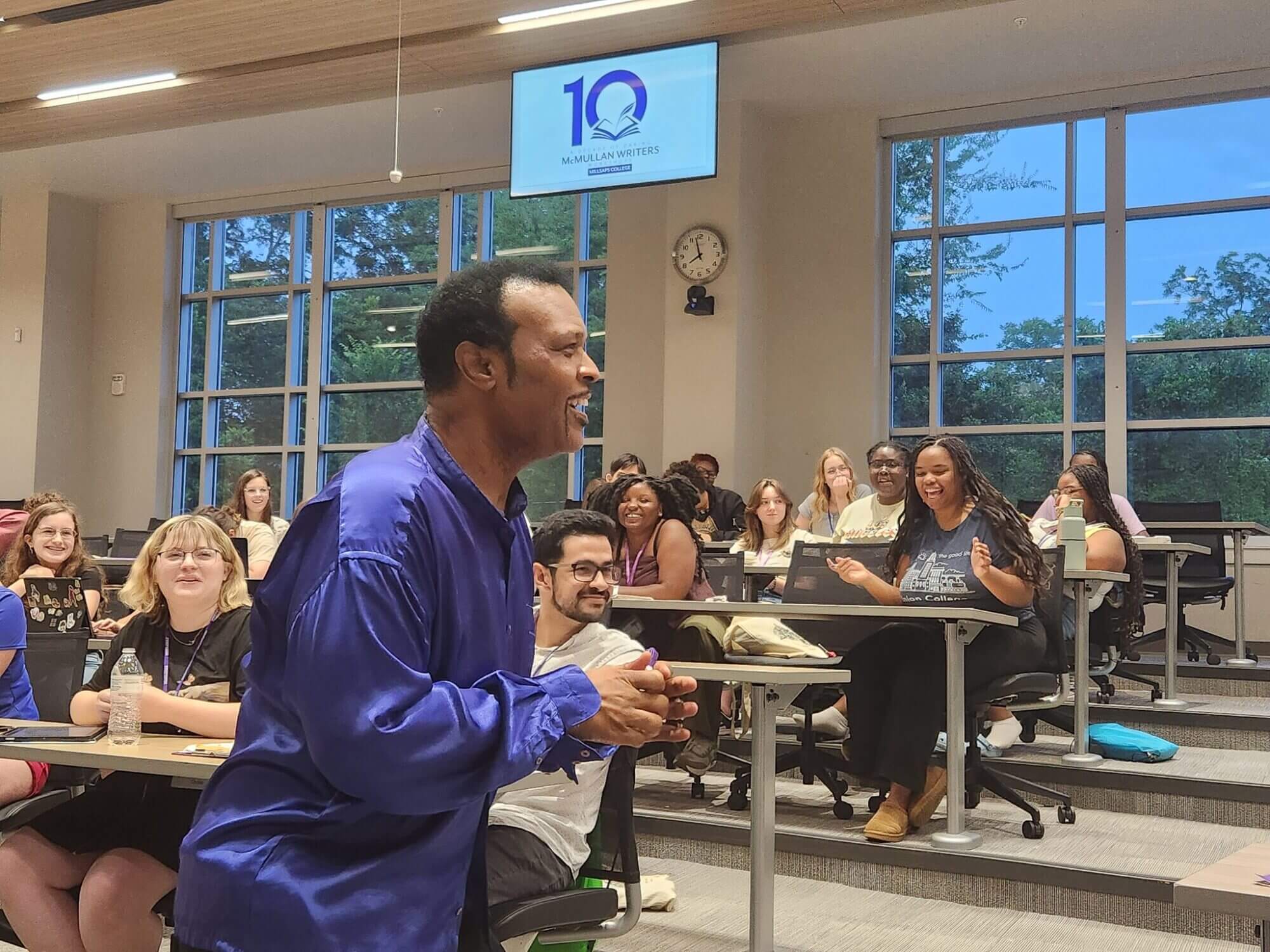
Teenagers sit in inflatable chairs in a dorm lobby, holding cups of fruit punch and trading laptops that are open to short stories and fantasy novels. Before lights out at this summer camp, students co-write haikus, poems limited to 17 syllables.
The McMullan Young Writers Workshop at Millsaps College in Jackson gives aspiring authors a chance to sharpen and share their work.
Fifty high school and 12 middle school students participated in themed workshops taught by published authors. The students submitted short stories, poems and novel excerpts to their instructors and peers for feedback.
Courtlandt Willingham, a Jackson native and rising junior at Mississippi School of the Arts in Brookhaven, described the workshop process as, “listen, ask questions and write.”
Willingham attended a workshop themed around folklore and mythmaking, and that provided inspiration for his poetry.
He said folklore means different things depending on the person.
“Folklore, to me, is a collection of ideas about being a Mississippian — especially a Black Mississippian,” Willingham said.

The residential workshop took place June 9-13. One day, campers attended a private craft talk and keynote speech by Jack Davis, who won the 2018 Pulitzer Prize for history for his book, “The Gulf: The Making of an American Sea.”
Keynote speakers in previous years included acclaimed authors Kiese Laymon, Joyce Carol Oates and Angie Thomas.
“These young people will ask keynote authors questions that are not the standard, boring questions that adults ask,” said Jamie Dickson, a workshop instructor. He said the visiting writers are not condescending to young people.
“Someone who is truly invested in literature really understands that there’s a lot of truth to the cliche: ‘This is the next generation of writers,’” Dickson said.
Students attended lectures on screenwriting techniques, the Afrofuturism genre and the connection between artmaking and political life.
They spent an afternoon touring the Eudora Welty House and Garden.
“I’ve been in the garden before,” said Hannah King, a rising freshman at Belhaven University. “I went into the garden and wrote a poem about it. I hadn’t been able to finish it. But when I went back there, I was able to finish it — because I was touring the house.”
Instructors took students to other Jackson cultural sites, including the Mississippi Museum of Natural Science, the Mississippi Museum of Art, Lemuria book store and the COFO Civil Rights Education Center at Jackson State University.
Campers at Millsaps cheered and drumrolled as their instructors went up to the podium to read in front of a handwritten poster proclaiming “Open Mic Night.”
“I think Open Mic is everyone’s favorite night,” said Syd Clay, a rising sophomore at Northwest Rankin High School.
“It’s just fun being able to have a community that you can share things with,” Clay said. “My class this year was mainly first-years, and they were all really nervous about the Open Mic. But, at the end of the night, they all loved it.”

The majority of students receive merit-based scholarships, funded by donors including Margaret McMullan, a Mississippi native who has published novels, essays and short stories and whose family foundation is a financial supporter of Millsaps. Any student who wins a Gold Key at the Scholastic Art and Writing Awards can attend the camp at no cost, and Silver Key winners and Honorable Mentions receive deeply discounted rates. The camp also gives scholarships based on financial need.
Liz Egan, who heads the Center for Writers at Millsaps, coordinates the McMullan Young Writers Workshop.
“Students who could barely look you in the eye at the beginning of the week are the ones at the stage, at the mic, telling you what they’ve been up to all week,” Egan said. “We’ve helped, but it’s really [the students]. They’ve made this program what it is.”

The Medgar and Myrlie Evers Institute and Mississippi Votes Action Fund today released the full confirmed schedule for the Democracy in Action Convening, a multiday tribute marking the 100th birthday of Medgar Wiley Evers.
The event runs from Thursday through Sunday at the Jackson Convention Complex. Organizers described the event as a “once-in-a-generation celebration [that] will feature national civil rights leaders, cultural icons, veteran journalists, artists, and organizers — all honoring Evers’s legacy and building power for the next century.”
Featured participants include: Stacey Abrams, Joy Reid, Nikole Hannah-Jones, Eddie Glaude Jr., Anna Wolfe, Howard Ballou, Jerry Mitchell, Reena Evers-Everette and descendants of civil rights icons, including Kerry Kennedy, Attallah Shabazz, and Bettie Dahmer.
“My father believed in the power of everyday people to change the world — and he knew that truth, action, and training were essential to that work,” said Reena Evers-Everette, executive director of the Medgar & Myrlie Evers Institute. “This convening will carry forward my father’s conviction that equality and democracy begin with preparation — with giving people the tools to lead, to speak with courage, and to act with purpose.”
“This convening isn’t just about remembering the past — it’s about shaping what comes next,” said Arekia Bennett Scott, executive director of Mississippi Votes Action Fund. “We are equipping the next generation with the tools to lead, organize, and continue the fight for justice in Mississippi and beyond.”
The convening includes a Saturday evening fundraiser concert, “A Night of Legacy and Liberation,” featuring Rita Brent, Tisha Campbell, Leela James, and Q Parker & Friends.
A Night of Legacy and Liberation
Jackson Convention Complex | Doors Open: 6:30 p.m. | Concert: 7:30 p.m.
Tickets on sale.
“This evening is about honoring my father’s legacy with soul, celebration, and a shared commitment to carry his work forward,” said Evers-Everette. “Through music and unity, we are creating space for remembrance, resilience, and the rising voices of a new generation.”
Concert proceeds will support the Medgar & Myrlie Evers Institute’s youth leadership and civic engagement programs.
Featuring Pastor C.J. Rhodes, the Rev. Mark Thompson, and the Jackson Revival Center Choir
Concludes with a community meal
View the full schedule here. For registration information, visit this link.


A new school year will be here before we know it, which represents more than just a return to the classroom. It presents an opportunity to instill essential life skills, like financial literacy. This season is an ideal time for parents to introduce their kids to the fundamentals of money management, including saving, budgeting, and responsible spending.
To help prepare for the year ahead, Chase is hosting a Back-to-School Family Finance event that will feature fun activities, financial health workshops, and more for kids of all ages.
In addition to joining Chase at the June 28 event, here are a few important lessons parents and kids can learn to help on the first day of school and beyond.
Start With Saving
Whether it’s allowance, gifts, or earnings from a summer job, teaching kids to track and save their money is essential in developing good financial habits. Saving toward specific goals and understanding the time it takes to reach those can help children grasp the true value of money.
Chase provides families with the tools and resources to make saving easy, like Autosave, by setting up automatic monthly transfers from your Chase checking account to your savings account. All managed through the Chase Mobile® App, parents can help their child set a savings goal to ensure they build a strong financial foundation.
Next, Begin Budgeting
As you approach the tween and teen years, financial needs and desires for independence will evolve. They might take on part-time jobs, save up for larger goals (like a car), and begin managing more of their own finances. This is a great opportunity for them to learn the basics of budgeting.
Chase’s Monthly Budgeting Worksheets help make this process simple. Start by entering monthly income and expenses to help your teen differentiate “needs” and “wants.” This helps them see where their money is going and is important as they begin cashing and spending their first paychecks.
Then, Grow Their Finances
Transitioning from high school to college or stepping into the real-world post-graduation comes with a new set of responsibilities. Amidst managing studies, jobs, and future planning, young adults need both guidance and practical tools to help.
The Chase Mobile app tracks earnings, savings, and expenses, and makes it easy to send and receive money with Zelle®.
Just as kids progress from one grade to the next, they can grow their understanding and management of money too. Opening their first bank account is a great complement to these financial lessons. Check out Chase First BankingSM, Chase High School CheckingSM, and Chase College CheckingSM, to see which account works best for your student or, learn more at chase.com/StudentBanking.
| Chase First Banking Designed for kids ages 6-12, the parent-owned account with a debit card for kids and no monthly service fee. | High School Checking For teens 13-17, the co-owned account allows students to set up direct deposit and automate savings. |
Chase College Checking For college students 17-24, the account can be managed through the Chase Mobileapp and allows users to send and receive money via Zelle. |
Don’t miss this exciting opportunity to connect, learn, and prepare for the school year. We look forward to seeing you there!
Chase Mobile® app is available for select mobile devices. Message and data rates may apply.
Zelle and Zelle related marks are wholly owned by Early Warning Services, LLC and are used herein under license.
Bank deposit accounts, such as checking and savings, may be subject to approval.
JPMorgan Chase Bank, N.A. Member FDIC.


Lawyers for the American Association of Pro-Life Obstetricians and Gynecologists have filed an appeal asking the state Supreme Court to overrule its 1998 decision and declare Mississippi’s effective ban on abortion constitutional.
In a 1998 ruling in Pro Choice Mississippi v. Fordice, the state high court said the state constitution provides Mississippians a right to abortion.
Late last year, a Hinds County judge ruled members of AAPLOG did not have standing to pursue a lawsuit to overturn the 1998 decision because they have not been harmed by the court ruling. AAPLOG, represented by new public interest law firm American Dream Legal, is appealing that ruling, and asking the state Supreme Court to “clarify whether Mississippi considers elective abortion a crime or a constitutional right,” according to a press release.
Based on another Mississippi case, the U.S. Supreme Court overturned the decades old Roe v. Wade right to abortion via the U.S. Constitution. The Mississippi Legislature has passed laws that prohibit most all abortions in the state and there are no clinics in Mississippi offering abortions.
But the 1998 state Supreme Court decision holding that the state constitution provides a right to abortion has never been overturned and remains on the books.
American Dream Legal in a statement said Mississippi’s criminal ban on abortion conflicts with the Fordice decision, and this has AAPLOG physicians “caught between conflicting legal duties: refer patients and risk prosecution under state law — or refuse to refer and risk professional ruin.”
“The people of Mississippi enacted a law that protected unborn life and took down the U.S. Supreme Court’s abuse of judicial authority in Roe v. Wade,” said Aaron Rice, attorney for AAPLOG and CEO of American Dream Legal. “It is only fitting that we likewise put an end to efforts by the courts in our own state to impose abortion by judicial fiat.”
In the Hinds County case, both the state, through Attorney General Lynn Fitch, and pro-abortion rights supporters argued that the doctors did not have standing. It’s unclear whether the high court will hear the appeal. In recent years, the state Supreme Court has taken a limited view of who has standing in various cases.


Politically connected members of a Mississippi company have fallen out with their Georgia partner in what promised to be a profitable business to snare uninsured motorists with cameras and artificial intelligence.
A company that the three Mississippians formed, QJR LLC, is suing its partner in the uninsured motorist ticketing venture, Georgia-based Securix LLC. QJR represents the first initials of its members: Quinton Dickerson, Josh Gregory and Robert Wilkinson.
Dickerson and Gregory are Republican political operatives in Jackson who have run numerous state and local campaigns and advise many of the state’s top elected officials. Wilkinson, a Coast attorney, has represented local governments and government agencies.
But Judge Neil Harris has sealed the case, leaving the public in the dark about the specifics. Mississippi Today has filed a motion in the case, arguing that the file should be opened to the public.
An attorney representing the three Mississippians said in a document submitted in federal court, where the case was temporarily moved, “The case involves highly sensitive issues implicating local officials, reputational harm, and ongoing injunctive relief.”
The uninsured motorist program that Securix brought to Mississippi proved contentious from the start. In Ocean Springs, some vehicle owners were angry when they learned artificial intelligence had been used to ticket them for driving without insurance.
The Securix program has resulted in several lawsuits, including one in federal court that accuses Securix of deceiving vehicle owners by essentially posing as a law enforcement agency through its mailed citations in Ocean Springs. By April 2023, the city had canceled its contract with Securix LLC.
And there is the secret Chancery Court file. A January 2025 transcript in federal court hints that politics are involved in the chancery case and also describes what that lawsuit is about.
The transcript says the Mississippians, operating as QJR LLC, are suing Securix in Chancery Court for defamation.
“They (QJR) want to stop the defamation from ruining political careers,” an attorney for Securix said. “That’s their argument.”
The chancery lawsuit, the federal transcript says, also seeks to dissolve Securix Mississippi LLC, a 50-50 partnership QJR and Securix formed to spread the program to other cities.
Securix attempted to move the Chancery Court case to federal court, but a federal judge ruled in January that he didn’t have jurisdiction and returned it to Chancery Court.
The federal transcript says Securix Mississippi pulled in $1.3 million in a year through uninsured motorist citations but, at the time of the hearing, had less than $75,000 in assets. The judge also noted that “revenue has fallen off a cliff since August of 2024 for Securix Mississippi LLC.”
August 2024 also happens to be when the Department of Public Safety pulled the plug on the program, DPS records show.
DPS Commissioner Sean Tindell, whose agency oversees uninsured motorist enforcement, had reservations from the start about a private company ticketing motorists. Complaints about how the program was being operated, he said, prompted him to cut off Securix’s access to the data it needed to determine whether a vehicle was insured.
While QJR was successful in getting the chancery case sealed, the company had no such luck when it tried to have the federal transcript closed from public view.
A federal magistrate judge ruled on QJR’s motion to seal the transcript, citing federal court cases that said: “The public’s right of access to judicial proceedings is fundamental,” and, “Judicial records belong to the American people; they are public, not private, documents.”
Securix LLC was incorporated in Delaware in 2018 and signed its first Mississippi contract in May 2021 with Shea Dobson, then the mayor of Ocean Springs, after approval by the Board of Aldermen.
Securix, based in Georgia, uses automatic license plate readers, usually mounted on traffic signals, to capture images of license plates. With the help of artificial intelligence, Securix can extract license plate numbers from the images.
Jonathan Miller, an owner of Securix LLC, initially came to Mississippi and talked to Ocean Springs Police Chief Mark Dunston about the program, said Dunston, who has since retired. Dunston presented the program to the Board of Aldermen, he said, and was later paid by Securix to present the program in other cities during off hours and after his retirement.
It is unclear when Miller met Josh Gregory and Quinton Dickerson, who did not want to comment for the story because the Chancery Court case is sealed. Miller, the chairman of Securix LLC, is also a named defendant in QJR’s lawsuit. He also declined to comment about matters involving the litigation.
Gregory and Dickerson both worked on former Gov. Haley Barbour’s 2003 political campaign, then formed Ridgeland-based Frontier Strategies. Gregory was a top political adviser to former Gov. Phil Bryant.
Billed as a full-service advertising agency, Frontier landed a lucrative state contract shortly after Barbour took office in 2004, within six months of the company’s formation. The company has gone on to contract with other state agencies and work on state and local political campaigns.
The third member of QJR, Robert Wilkinson, was serving as city attorney for Ocean Springs when Dobson signed its Securix contract. Wilkinson said he met Miller at that time but they did not have a business relationship until six to 10 months after Ocean Springs signed on with Miller’s company.
Wilkinson said he was impressed with the Securix program because it added cameras in the city that could also alert law enforcement officers to crimes, such as kidnappings or wanted suspects on the loose.
“That’s why everyone was fired up,” he said.
Another reason some welcomed the program is because Mississippi has a high rate of uninsured drivers, according to the nonprofit Insurance Research Council. In 2023, the latest year for which statistics were available, the institute reported that Mississippi had the highest rate of uninsured drivers in the nation at 28.2%.
“Unisured motorists in Mississippi is a big problem and I think we need to do more to solve that issue,” DPS Commissioner Tindell said.
“It does create a situation where everybody has to pay more for insurance because there are so many people without it.”
Securix used its program to identify and ticket the owners of uninsured vehicles, federal court records show. Data on insured motorists was essential to the program.
Under state law, Tindell’s office maintains the Mississippi Vehicle Insurance Verification System — bulk data on the state’s insured motorists that is regularly updated. DPS operates and maintains the system through third-party vendor HDI Solutions Inc.
Law enforcement officers use the system all the time. When they run a license plate, the system lets an officer know if the vehicle is insured. But agencies generally do not have access to HDI’s bulk data.
Initially, Commissioner Tindell was unwilling to commit his agency — and its HDI data — to the Securix program.
“I don’t know that it’s necessarily the best policy to privatize our court system with diversion programs,” Tindell said. “I think those are government functions.”
Tindell also questioned whether a camera could be used to issue a ticket to an uninsured driver. State law says law enforcement agencies can access the system only during traffic stops and accident investigations. And state law forbids using the system’s insurance information as the only reason for a traffic stop.
He also was unsure whether a city could set up a diversion program through a private company.
For its initial foray into Mississippi with the city of Ocean Springs, Securix reached a data-sharing agreement directly with HDI, a letter from an HDI attorney shows.
“We basically said we’re not going to object to it,” Tindell said, “but that’s something y’all need to work out yourselves.”
With access to insured driver data, Securix began sending out citations from its Ocean Springs cameras.
If a vehicle was not listed as being insured, a ticket went to the owner. The system did not identify the person driving the vehicle.
On their face, the citations claimed to be uniform traffic tickets that, at first glance, appeared to be from the police department.
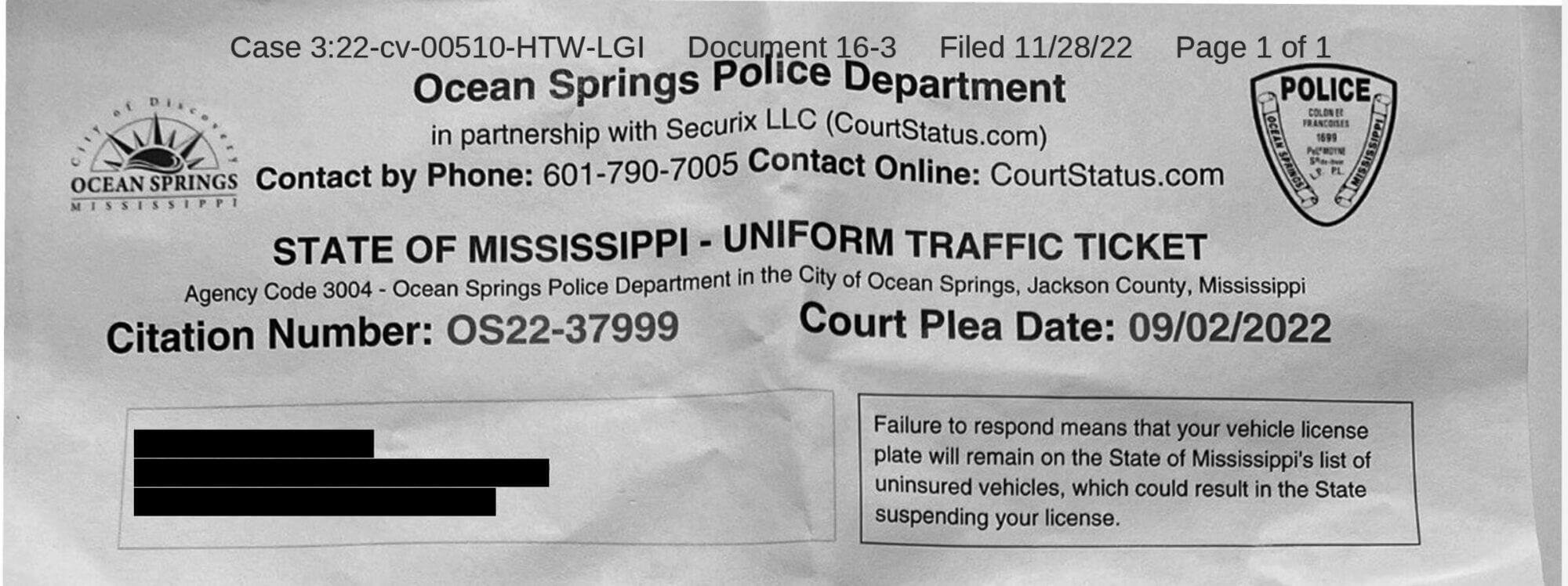
Soon enough, Securix faced a federal lawsuit filed by three Mississippi residents ticketed as uninsured motorists.
They are seeking class-action status to represent thousands of individuals who they believe received citations from Securix. In just a few months, the lawsuit says, 6,000 people were ticketed in Ocean Springs alone.
“Pretending to be law enforcement,” the lawsuit says,”defendant (Securix LLC) has made millions of dollars collecting fees from individuals who allegedly violated state uninsured vehicle laws.”
In a response filed in federal court, Securix denies any wrongdoing, saying the company “at all times acted in good faith” and followed state law.
The Ocean Springs citation offered three options: Call a toll-free number and provide proof of insurance, enter a diversion program that charges a $300 fee and includes a short online course and requires agreement that the vehicle will not be driven uninsured on public roadways, or contest the ticket in court and risk $510 in fines and fees, plus the potential of a one-year driver’s license suspension.
After signing the contract in Ocean Springs, Securix LLC began working with Josh Gregory and Robert Wilkinson to sign up other cities.
Company leaders convinced Pearl, Biloxi and Senatobia to join the program.
Josh Gregory and Robert Wilkinson pitched the program in Senatobia, March 2022 minutes from the Board of Aldermen’s meeting show. Gregory told aldermen that 70% of the public response to the program was positive in Ocean Springs.
Senatobia even took the Department of Public Safety to Circuit Court, filing a lawsuit in Tate County that demanded access to the state agency’s insured driver data.
By the time the city and DPS reached a settlement agreement in August of 2023, HDI had cut off Securix’s access to insured driver data.
An HDI attorney sent Securix LLC a default notice in December 2022. An HDI review showed Securix personnel issued citations in Ocean Springs without first having a police officer run the license plate information through the insurance verification system, a contract requirement, the notice said.
The notice required Securix LLC to submit a corrective action plan and document the company’s future contract compliance.
In March 2023, HDI terminated its agreement with Securix LLC. The termination letter said Securix had failed to respond to the notice of termination or submit a corrective action plan. Securix, through chairman Jonathan Miller, later maintained that an Ocean Springs police officer, not the company, authorized each citation.
Months later, the Securix settlement agreement with DPS stipulated that HDI would be authorized to once again provide Securix access to the insurance verification system.
Senatobia came to count on the revenue, board meeting minutes show. But the program would not last — in Senatobia or any other Mississippi city.
In early August 2024, Tindell received a letter from Jonathan Miller of Securix LLC that raised questions about the way the program was operating, Tindell said.
“Based upon his letter, we had concerns that there wasn’t a proper law enforcement control system in place,” he said.
Tindell sent HDI a letter at the end of the same month that mentioned questions had been raised about the Securix program. Tindell asked HDI to “immediately discontinue sharing or providing data relating to any programs involving Securix or QJR.”
QJR filed its lawsuit to dissolve the company less than a month later. In the civil litigation, QJR is also alleging Miller has defamed the Mississippi business partners, which Miller has denied.
Although the chancery case is sealed, Securix and Securix Mississippi have been unable to avoid publicity. E. Brian Rose, managing editor of the website GCWire and a former congressional candidate, has written numerous pieces about Securix’s business deals.
But access to the Chancery Court file could give the public more information about the automatic license plate reading business.

In its motion to unseal the file, Mississippi Today attorney Henry Laird asks Harris to hold a hearing that gives the news outlet a chance to argue the file should be opened, as case law has established.
At the hearing, Harris would also need to consider alternatives to closing the file.
“Even if the on-the record-evidence would be so compelling so as to allow the court to redact specific documents or place them under seal,” Laird argues in his motion, quoting a pertinent case, that ‘does not warrant sealing the entire case from public view’.”
This article was produced in partnership between the Sun Herald and Mississippi Today.


A federal judge is greenlighting the execution of Richard Jordan, limiting options to avoid execution by the death row inmate.
On Friday, U.S. District Court Judge Henry Wingate denied a stay for the 79-year-old Jordan, who is one of the lead plaintiffs in a lawsuit challenging the use of certain lethal injection drugs. Jordan’s execution is set for Wednesday at the Mississippi State Penitentiary at Parchman.
Jordan was first convicted in 1976 for kidnapping and killing Edwina Marter in Harrison County, and it took four trials until a death sentence stuck in 1998. He is the state’s oldest and longest serving death row inmate.
Jordan’s attorneys argued that Mississippi’s lethal injection protocol might constitute “cruel and unusual punishment,” under the 8th Amendment, arguing the sedative administered doesn’t prevent the inmate from feeling pain, suffocation and cardiac arrest.
“Mr. Jordan and all the other people on death row were sentenced to death to have their lives extinguished,” said Jim Craig of the MacArthur Justice Center at a June 14 hearing for a preliminary injunction to halt the execution.
“They were not sentenced to be tortured before they die.”
But Wingate ruled that Jordan failed to prove the method of execution was “sure or very likely to cause serious illness and needless suffering.”
He referred to a previous Supreme Court ruling which stated that “the Eighth Amendment does not guarantee the prisoner a painless death.”
READ ALSO: Death row spiritual adviser bears witness in execution chamber
A main point of contention in the hearing was the protocol the state would have to follow if the sedative failed to render Jordan unconscious.
Mississippi Department of Corrections lethal injection protocol requires execution staff to ensure inmates are completely unconscious before proceeding. The “proposed consciousness check” is a mandated wait time of three minutes between administering the sedative and the lethal drugs, according to court records.
But the latest two executions in Mississippi – David Neal Cox on Nov. 17, 2021, and Thomas Loden on Dec. 14, 2022 – did not follow this protocol. Instead, execution staff waited one to two minutes before injecting the other drugs.
At the June 14 hearing, citing a deposition from Corrections Commissioner Burl Cain, the Attorney General’s Office assured Wingate that protocol would be followed with Jordan. It also promised to perform a “sternum rub” to check Jordan’s reaction to the painful stimuli.
“Ultimately, the record contains no evidence that either David Cox or Thomas Loden needlessly suffered prior to death by the same method of execution at issue here, and the Court finds that to be persuasive evidence against the issuance of a stay,” Wingate wrote on Friday.
However, he issued a provision: the state has to stop Jordan’s execution if he shows signs of consciousness.
Although the clock is ticking, Jordan is not entirely out of options yet.
READ ALSO: ‘I don’t want him to get what he wants,’ says murder victim’s son of killer
A petition for clemency was submitted to Gov. Tate Reeves’ counsel on Monday by Frank Rosenblatt, professor at Mississippi College school of Law. The petition highlights Jordan’s diagnosed post-traumatic stress disorder from his two years of combat service in Vietnam. It cited a 2019 Missisisppi statute that asks courts to consider veterans’ PTSD during criminal sentencing.
“Prolonged exposure to machine gun fire is its own contributor to brain trauma in ways that alter brain behavior,” Rosenblatt explained.
Reeves has never granted a petition for clemency before.
The U.S. Supreme Court also discussed on Wednesday whether to issue an emergency stay of execution, but has not released an opinion. A petition for an emergency stay has also been filed in the U.S. 5th Circuit Court of Appeals.
Today, the U.S. Supreme Court denied a petition for writ of certiorari Jordan filed in March. His attorneys filed another one Friday that is awaiting a decision.
Updated 6/23/24: This story has been updated to reflect the U.S. Supreme Court ruled today on Jordan’s petition.
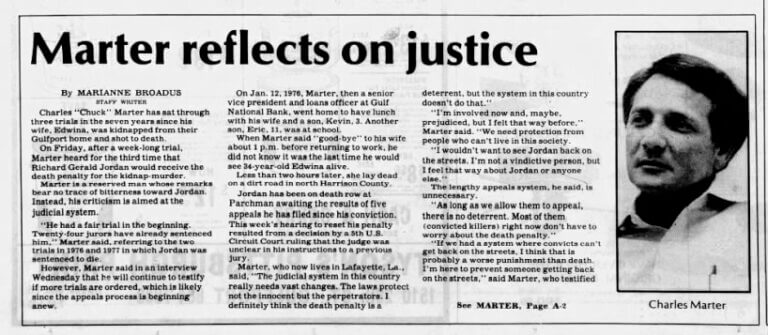
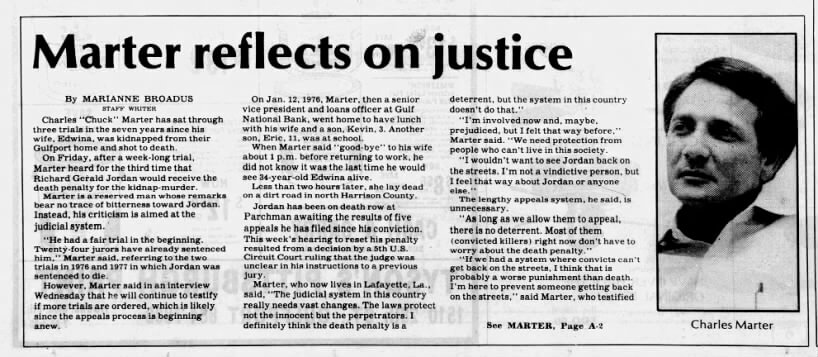
Eric Marter doesn’t remember much about his mother but her loss is one his family has felt for decades.
On Jan. 13, 1976, he said it felt like any other day when he left for his Catholic school in Gulfport and his younger brother Kevin stayed home with their mother Edwina. Then he remembers he and his brother staying with family friends and being told his parents had to go out of town.
Days later, his father and a priest told them their mother was dead.
When Marter was older, he learned details about his mother’s murder and some about the man responsible for her death: Richard Jordan.
Jordan, 79, the state’s oldest and longest serving death row inmate, has had multiple trials and execution dates set that have come and gone. He has continued to fight his death sentence through appeals and a lawsuit challenging the state’s use of lethal injection drugs. Each time, Edwina Marter’s family has testified in court and endured hearing about details of her death again.
Marter said he hasn’t made Jordan’s legal process a major focus in his life. He doesn’t have interest in witnessing his execution set for June 25 at Parchman, and neither does his father or brother. Instead, Marter’s uncle is expected to attend with his family.
But he still wants to see the sentence carried out and believes it should have happened sooner, not almost 50 years after the fact. He also believes Jordan’s execution would guarantee that he has no chance of leaving prison.
“I don’t want him to get what he wants,” said Marter, who is 59 and lives in Lafayette, Louisiana.
“If you want to spend the rest of your life in jail, then I would rather you not get that, and if that means you get executed, you get executed.”

Edwina Marter grew up in Metairie, Louisiana, with two sisters and a brother. She went to college at Louisiana State University in Baton Rouge, where she met her husband Charles.
They started their family in Louisiana and later relocated to Gulfport, where Charles Marter worked as a banker. Their next son, Kevin, was born on the Coast.
In 1976, Jordan, a Vietnam veteran whose attorneys say suffers from PTSD, was desperate for money and thought of kidnapping someone and demanding money. He called the bank where Charles Marter was the commercial loan agent, and found the man’s address in the phonebook. Jordan went to their home, impersonating an electric company worker to get 34-year-old Edwina Marter to open the door.
Once she did, Jordan took her and left her younger son unarmed. He had her drive to the DeSoto National Forest where he shot her in the head when she tried to run away. Afterward, Jordan called Edwina’s husband to demand $25,000 in ransom money. He was not successful in getting it and was arrested.
Marter said his family moved back to Louisiana after his mother’s death and did not live in Mississippi again. His father did not mention his mother’s death.
“He did the best he could and the way he knew how to raise two boys by himself was to make sure we didn’t get in trouble,” Marter said.
Milestones like graduations, marriage and children came along. Marter became a banker like his father, and his brother joined the Army. Somewhere along the way, Marter said he wondered what it would be like if his mother were around for them.
“I don’t really try to dwell on it too much,” he said.
In 1976, Jordan went to trial and received a death sentence, only for it to be overturned multiple times due to questions about the legality of Mississippi’s death penalty law. It wasn’t until 1998 and four trials later that the sentence stuck.
Charles Marter, who is now 88, testified in several of the trials. Neither of the Marter sons attended the early trials, and the adults didn’t share much details with them. Once Eric Marter was older, he said he asked for more information about his mother’s death from his aunts and uncle.
With his own sons, Marter told them that their grandmother died when he was young. When they had questions as they were older, Marter shared some basics about what happened.
Over the years, Mississippi and Louisiana reporters have spoken with Edwina’s family members about Jordan’s multiple trials and death sentences, appeals and executions that have not been carried out.
In reflecting after Jordan’s 1998 conviction, Charles Marter told the Sun Herald that his family was elated about the first conviction, only to become less confident after multiple trials.
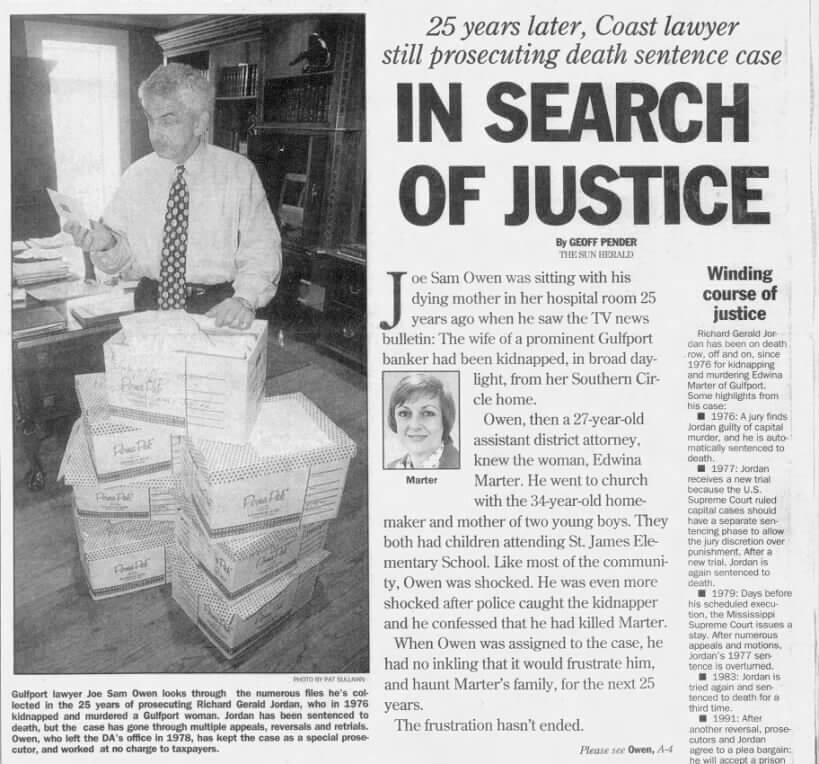
Mary deGruy, Edwina’s older sister, praised the work of then-special prosecutor Joe Sam Owen, who worked on Jordan’s case for over 25 years.
“This is just something that stays on your mind forever,” she told the Sun Herald in 2001. “We just hope and pray that one day (Jordan) will die in prison. They just need to follow through with the death penalty.”
DeGruy, a distant relation to Andre deGruy, director of Capital Defense Counsel, died in 2022 at the age of 86.
Le secteur des jeux d’argent s’est métamorphosé au cours de la dernière décennie : les plateformes de casino en ligne attirent chaque jour des millions de joueurs français grâce à l’accès instantané depuis un smartphone ou un ordinateur. Cette explosion s’explique par la combinaison d’une offre ludique toujours plus diversifiée, de technologies de streaming haute définition et de réglementations européennes qui rassurent le public. En conséquence, le choix d’un site fiable n’est plus anodin ; il doit être guidé par des critères précis afin d’éviter les arnaques et les mauvaises surprises fiscales.
Basketnews.Net s’est imposé comme le comparateur indépendant le plus complet pour identifier le nouveau casino en ligne qui correspond à chaque profil de joueur. Le site teste les licences, analyse les bonus et vérifie la fluidité des paiements avant de publier ses classements mensuels. Grâce à cette expertise reconnue, les joueurs peuvent consulter des avis impartiaux et sélectionner rapidement le meilleur casino en ligne 2026 sans perdre de temps dans des essais hasardeux.
Dans cet article nous décortiquons les points essentiels : la législation et les licences applicables en France et à l’étranger, la variété des jeux disponibles (slots, tables, live dealer), les mécanismes des bonus et leurs conditions de mise, la sécurité des transactions ainsi que l’expérience client et mobile. Vous disposerez ainsi d’un guide pas à pas pour jouer sereinement tout en maximisant vos chances de gains.
Les autorités de jeu délivrent des licences qui garantissent que le casino opère dans un cadre légal strict ; elles protègent le joueur contre les fraudes et assurent l’équité du RNG (Random Number Generator). En France, l’ANJ supervise toutes les plateformes autorisées à proposer leurs services aux résidents français ; hors territoire hexagonal, des juridictions comme la Malta Gaming Authority (MGA), la UK Gambling Commission ou Curaçao eGaming offrent également une surveillance reconnue à l’international.
Pour vérifier qu’un site est légitime, il faut d’abord repérer son numéro de licence affiché au bas de chaque page – souvent sous forme d’un code alphanumérique – puis consulter les conditions générales où sont détaillés les droits du joueur et les obligations du prestataire. Les audits indépendants tels qu’eCOGRA ou iTech Labs publient régulièrement leurs rapports d’inspection ; leur présence sur le site est un bon indicateur de transparence et de conformité technique.
Une licence française impose aux opérateurs un taux fiscal réduit sur les gains des joueurs français mais exige que tous les serveurs soient hébergés sur le territoire européen afin d’assurer un contrôle direct par l’ANJ. En revanche, une licence offshore comme celle de Curaçao offre davantage de flexibilité tarifaire aux casinos mais limite souvent le nombre de méthodes bancaires locales disponibles pour les Français (par exemple moins d’options Visa ou prélèvements SEPA).
Ces laboratoires certifient que le RNG produit réellement une distribution aléatoire conforme aux standards internationaux ; ils testent également la volatilité des machines à sous pour garantir que le RTP annoncé est respecté sur le long terme. Les certifications eCOGRA « Safe & Fair », iTech Labs « RNG Certified » ou Gaming Laboratories International sont généralement visibles sous forme d’icônes cliquables menant à un rapport détaillé accessible au public.
| Juridiction | Taux fiscal moyen | Exigences serveur | Méthodes paiement courantes | Supervision |
|---|---|---|---|---|
| ANJ (France) | 0 % sur gains joueurs | Europe uniquement | Carte bancaire FR, PayPal, Skrill | Contrôle national quotidien |
| MGA (Malte) | 5 % sur revenus opérateur | Europe + certains pays hors UE | Visa/MasterCard, Neteller, crypto | Audits trimestriels |
| UKGC (Royaume‑Uni) | 15 % sur bénéfices nets | Serveurs UK ou UE | Paysafecard, Trustly, crypto limité | Rapports publics mensuels |
| Curaçao eGaming | <2 % sur revenus brut | Aucun localisation requise | Bitcoin, cartes prépayées internationales | Inspection annuelle minimale |
Les machines à sous restent la vitrine du casino en ligne ; on distingue trois familles principales : les slots classiques à trois rouleaux avec peu de lignes payantes, les vidéos slots comportant cinq rouleaux et jusqu’à 1024 lignes ainsi que des fonctionnalités bonus interactives, puis les jackpots progressifs où le gain augmente tant qu’il n’est pas remporté (exemple : Mega Moolah avec un jackpot dépassant parfois 20 M€). Pour choisir judicieusement on regarde le RTP moyen (généralement entre 94 % et 98 %) et la volatilité qui détermine la fréquence mais aussi l’amplitude des gains éventuels.
Les jeux de table offrent quant à eux une dimension stratégique plus marquée : blackjack classique avec règle « dealer stands on soft 17 », variantes comme Blackjack Switch ou Spanish 21 ; roulette européenne avec zéro simple versus roulette américaine ajoutant double zéro ; baccarat punto banco où chaque main possède un léger avantage maison que l’on peut compenser par une gestion stricte du capital. Chaque variante possède ses propres tableaux de paiement qui influencent directement votre espérance mathématique.
L’expérience live dealer combine l’interaction directe avec un croupier réel via streaming HD et la sécurité d’un jeu contrôlé par une autorité officielle grâce aux caméras multiples utilisées par Evolution Gaming ou NetEnt Live . Les tables populaires incluent le Lightning Roulette où chaque spin peut déclencher un multiplicateur jusqu’à ×500 , ainsi que le Blackjack Infinite Bet permettant aux high rollers d’enchérir sans plafond prédéfini – idéal pour ceux qui cherchent l’immersion totale sans quitter leur salon.
Certains nouveaux casinos en ligne proposent aussi une plateforme sportsbook intégrée où vous pouvez parier sur football Ligue 1 ou e‑sport comme Counter‑Strike pendant que vous jouez aux slots traditionnels ; cela crée une synergie intéressante pour ceux qui veulent diversifier leurs sources de revenu tout en restant sur un seul compte bancaire sécurisé fourni par Basketnews.Net lors du processus d’évaluation comparative.
En gérant votre bankroll selon votre profil (« amateur », « intermédiaire », « high roller ») vous éviterez l’écueil fréquent du chase loss qui conduit rapidement à une perte totale même sur un jeu au RTP élevé.
Le bonus de bienvenue constitue généralement la première incitation proposée par tout nouveau casino : il combine souvent un dépôt matché allant jusqu’à 200 % + 100 tours gratuits sur une machine populaire comme Starburst ou Gonzo’s Quest . Cependant chaque offre comporte ses propres exigences telles qu’une mise minimum (€10) avant toute activation ainsi qu’une sélection restreinte de jeux éligibles (souvent uniquement les slots).
Les promotions récurrentes maintiennent l’engagement du joueur : cashback quotidien pouvant atteindre 10 % du volume perdu net pendant la journée précédente ; programmes VIP où chaque euro misé rapporte des points échangeables contre des retraits sans wagering ; tournois exclusifs mettant en jeu jusqu’à 50 000 € au total répartis entre plusieurs gagnants selon leur rang dans le leaderboard hebdomadaire . Ces initiatives sont régulièrement mises à jour par les opérateurs afin d’attirer tant les novices que les joueurs confirmés recherchant du contenu frais chaque semaine.
Le wagering indique combien fois il faut miser le montant du bonus avant pouvoir retirer ses gains associés ; typiquement on retrouve un ratio entre 20x et 40x selon la politique interne du casino . Par exemple un bonus cash‑in of €100 avec exigence “30x” signifie devoir placer €3 000 en mises admissibles avant toute demande de retrait – ce calcul doit inclure uniquement les jeux spécifiés dans les termes & conditions afin d’éviter toute mauvaise surprise lors du traitement final du paiement .
Certains sites limitent sévèrement la période pendant laquelle vous devez remplir ces exigences — parfois seulement 7 jours — ce qui rend difficile atteindre le seuil requis si vous jouez modérément . D’autres imposent un plafond maximal sur les gains issus du bonus gratuit : même si vous remportez €5 000 lors d’une session avec tours gratuits limités à €20 chacun , vous ne pourrez encaisser que jusqu’à €200 supplémentaires selon cette restriction . Enfin certaines offres ne sont valables que sur quelques titres sélectionnés dont le RTP moyen est inférieur à celui habituel , réduisant ainsi votre marge théorique globale .
1️⃣ Choisir une promotion dont le ratio mise/bénéfice est inférieur à 30x afin d’alléger rapidement l’effort requis tout en conservant une marge nette intéressante après retrait.
2️⃣ Prioriser les programmes fidélité offrant cashback sans condition supplémentaire – ils permettent récupérer directement une partie perdue sans passer par un processus complexe.
3️⃣ Utiliser systématiquement la FAQ fournie par Basketnews.Net pour comparer chaque offre disponible chez différents opérateurs avant votre inscription ; cela évite bien souvent d’accepter un bonus attrayant mais peu rentable lorsqu’on considère toutes ses contraintes cachées.
La protection SSL/TLS constitue aujourd’hui le socle indispensable pour chiffrer toutes vos communications entre votre navigateur et le serveur du casino ; elle empêche toute interception malveillante lors du transfert d’informations personnelles ou financières grâce au protocole HTTPS certifié par des autorités reconnues telles que DigiCert ou GlobalSign . Une absence totale ce protocole doit immédiatement déclencher une alerte chez tout joueur avisé suivant nos recommandations publiées régulièrement sur Basketnews.Net .
Les cartes Visa/MasterCard restent largement acceptées partout en Europe ; elles offrent généralement un délai standardisé entre 24 heures et 48 heures pour valider un dépôt tandis que les retraits peuvent prendre jusqu’à 5 jours ouvrés selon la banque émettrice française concernée – parfois accompagnés frais minimes autour de 0·90 €.
Les virements bancaires SEPA assurent quant à eux zéro frais supplémentaires mais demandent souvent 3‑4 jours ouvrés avant créditation complète tant côté émetteur que récepteur — pratique surtout pour déposer plusieurs milliers d’euros sécuritairement sans passer par intermédiaires.
Skrill & Neteller permettent quant à eux presque instantanément (moins d’une minute) tant au dépôt qu’au retrait grâce à leur réseau dédié aux jeux en ligne ; ils offrent également une couche supplémentaire d’anonymat partiel puisqu’ils ne révèlent pas directement vos coordonnées bancaires au casino.
PayPal a intégré récemment son service “PayPal Casino” dédié aux marchés européens : il combine rapidité (15 minutes) avec protection buyer‑seller adaptée notamment aux litiges liés aux paiements non reçus.
Bitcoin & altcoins comme Ethereum ou Litecoin représentent aujourd’hui une option émergente très prisée parmi ceux qui recherchent instantanéité absolue (quelques secondes) ainsi qu’une confidentialité accrue grâce aux adresses publiques non traçables directement vers votre identité réelle . Néanmoins ces monnaies restent soumises à une volatilité élevée pouvant impacter fortement votre solde si vous ne convertissez pas rapidement vos gains — risque supplémentaire rappelé dans nos guides détaillés chez Basketnews.Net concernant nouveaux casinos en ligne acceptant ces moyens numériques.
Le KYC devient obligatoire dès que vous souhaitez retirer plus que €1 000 ou activer certains bonus spécifiques ; il consiste généralement à fournir :
Ces documents permettent au casino – sous contrôle strict des autorités compétentes – d’empêcher blanchiment d’argent et fraude identitaire tout en accélérant ultérieurement vos retraits lorsque votre dossier est déjà complet.
Un service client efficace se mesure surtout via trois critères clés : temps moyen réponse (<2 minutes via chat live), niveau linguistique adapté au public francophone (« bonjour », « merci » inclus) ainsi que capacité réelle à résoudre rapidement disputes relatives aux paiements ou aux conditions bonus.
Les meilleurs sites listés par Basketnews.Net proposent désormais :
En testant personnellement plusieurs plateformes classées parmi nos top‑10 « meilleur casino en ligne 2026 », nous avons observé qu’un temps moyen global était compris entre 45 secondes (chat) et 4 minutes (email), tandis que seules deux plateformes présentaient plus d’un jour complet avant résolution complète — critère éliminatoire automatique selon notre grille méthodologique stricte.
L’ergonomie joue ici un rôle décisif : tableau bord clair affichant solde actuel, historique transactions filtrable par date/jeu/montant permet au joueur avancé comme au novice naviguer sans effort.
Sur mobile , nous privilégions aujourd’hui deux approches :
Nous recommandons toujours envoyer dès votre première visite une question simple via chat (« Quel est mon délai moyen retrait ? ») afin :
1️⃣ Mesurer rapidité rédactionnelle.
2️⃣ Vérifier pertinence réponse vis-à-vis des conditions affichées.
3️⃣ S’assurer qu’une FAQ exhaustive couvre déjà ce point — sinon privilégier autrement plateforme mieux documentée.
En résumé, choisir judicieusement son casino repose avant tout sur quatre piliers fondamentaux : disposer d’une licence valide délivrée soit par l’ANJ soit par une autorité reconnue internationalement ; aligner sa sélection ludique avec son budget personnel afin qu’elle corresponde réellement à son style—que ce soit low‑stake slots ultra‑volatiles ou high‑roller tables premium ; décrypter minutieusement chaque offre promotionnelle pour éviter pièges cachés tels quotas temporels courts ou plafonds restrictifs ; sécuriser chacune des transactions via SSL/TLS combiné aux méthodes fiables listées ci‑dessus tout en préparant préalablement son dossier KYC afin fluidifier retraits futurs.
Enfin veillez scrupuleusement au niveau du support client ainsi qu’à l’expérience utilisateur globale—un service réactif garantit résolution rapide face aux problèmes éventuels.
En suivant ce guide détaillé publié par Basketnews.Net, chaque lecteur pourra sélectionner le nouveau casino en ligne qui correspond parfaitement à ses attentes tout en jouant dans un cadre sûr et transparent.
Bonne chance et bons gains !