Ole Miss Men’s Golf during Round 4 of The NCAA Division 1 Men’s Golf Championship Tournament at The Omni La Costa Golf Course in Carlsbad, Calif., on May 26, 2025.
Mississippi’s most successful collegiate athletic program in the 2024-25 school year? It’s not close.
That honor goes to the Ole Miss men’s golf team, and the story could get even better at this week’s U.S. Open.
Rick Cleveland
Start with National Coach of the Year. Chris Malloy, a former Rebel golfer himself, who earned that honor (bestowed by Golfweek Magazine). Malloy has enjoyed much success in Oxford, but his 12th season at the helm was his best. The Rebels were ranked No. 1 for much of the season and advanced to the semifinals of the NCAA Championships before being edged 3-2 by eventual national champion Oklahoma State.
But it doesn’t end there. When the U.S. Open begins Thursday morning at famed Oakmont Country Club, near Pittsburgh, two current Ole Miss Rebels will be in the field. LaSasso qualified by winning the NCAA Championship. Cameron Tankersley, another junior from Dickson, Tennessee, qualified the hard way, by shooting 8-under-par during a 36-hole qualifier at Bent Tree in Dallas, beating out many PGA Tour pros and international players to earn the Open berth.
Ole Miss golf coach Chris Malloy congratulates Michael La Sasso at the NCAA Championships at the Omni La Costa Golf Course in Carlsbad, Calif., on May 26, 2025. (Ole Miss athletics)
Just qualifying for the U.S. Open Championship is a feat. More than 10,000 elite golfers from around the globe attempted to qualify. The final field consists of 156.
Reached via cellphone Monday morning, Malloy was driving from Oxford to the Memphis airport, via a three-hour stopover in Senatobia. Senatobia, you ask? “Yeah, I just finished caddying for my 10-year-old son Cash in a junior tournament,” Malloy answered, chuckling. “These last couple weeks have been a whirlwind. That was something I needed and wanted to do.”
Malloy was to arrive in Pittsburgh later Monday, then spend Tuesday and Wednesday at Oakmont helping prepare LaSasso and Tankersley for what will be the most difficult task they have faced in their young golfing lives.
Oakmont is a brute. The late Henry C. Fownes, the founder and designer of Oakmont Country Club, famously said in 1904, “A shot poorly played should be a shot irrevocably lost.” At Oakmont, all these 121 years later, those words ring true. The course offers a 293-yard par 3, a 515-yard par-4 and a 663-yard par-5. But the length of the course is by no means what makes it so challenging. The rough – a thick mix of rye, fescue and bluegrass – will be five to six inches high. If not for for caddies, golfers would almost have to step on their golf balls to find them.
What’s more, the Oakmont greens are devilishly sloped and remarkably fast. Golf legend Slammin’ Sammy Snead once said, “At Oakmont once, I put a dime down to mark my ball and the dime slid away.”
“I’ve not seen it yet, except on TV, but that’s all everybody talks about is how difficult it is,” Malloy said of the greens. “Our guys pride themselves on being tough, handing difficult situations. Golf is way more about how you handle your bad shots and tough situations than it is anything else. But this will be a real challenge.”
No doubt about that. It also will provide valuable experience for two guys expected to return to Oxford and make Ole Miss almost surely the No. 1 team in college golf polls to begin the 2025-26 school year. The Rebels lose only one player from a deep roster and have two highly rated recruits coming in.
Asked what would be considered a successful U.S. Open for the two Ole Miss players, Malloy paused for a couple seconds before answering. “The obvious answer would be for them to make the (36-hole) cut,” he said. “And that would be an unbelievable accomplishment, competing on that golf course against the best players in the world. But I don’t want to sell either of them short. If one of them gets on a roll, plays to the best of his ability, they could be a factor. These guys can really play. They’ve shown that.”
Mississippi Today is pleased to announce an expansion of its newsroom and a series of leadership promotions, reflecting the nonprofit newsroom’s deepening commitment to providing public interest journalism in Mississippi.
The largest newsroom in the state, Mississippi Today will be home to at least 35 full-time journalists by the end of this summer. It will have five fully-staffed teams of editors and reporters covering health, justice, education, politics, and the city of Jackson. The newsroom’s reporters will also be supported by two photojournalists, a multimedia director and a new video team, which will put reporting in front of a broader audience.
“We’re proud to have the opportunity to grow our newsroom and do more of what we do best: provide the highest quality accountability, investigative journalism to Mississippians,” said Adam Ganucheau, Mississippi Today’s editor-in-chief. “As ever, we feel a deep responsibility to deliver the best reporting we can. Through strategic alignment of our newsroom’s talent, we know we can meet this moment.”
Among the leadership changes:
Kate Royals has been promoted to Managing Editor, where she will lead Mississippi Today’s editorial team leaders and newsroom-wide collaborations. Royals, one of the organization’s longest-serving journalists, built the newsroom’s Health Team from scratch and has led some of the newsroom’s most impactful reporting.
Michael Guidry is our Editorial Director of Multimedia, a role in which he will focus on growing Mississippi Today’s audio storytelling. In this new role, Guidry will manage relationships with national newsroom partners, lead new editorial efforts across podcast and video platforms and be the point person for creative projects.
Richard Lake is stepping into the new role of Video Editor, overseeing the launch of Mississippi Today’s first full video team. Lake’s work in vertical video has already helped the newsroom dramatically expand its audience and reach, and he will lead a new team focused on accelerating the output of our video content.
Alyssa Bass returns to the Mississippi Today team to take over social media and newsletter strategy. She will work closely with the Deep South Today team to continue growing the organization’s audience and impact, and deepening our relationship with readers. Mississippi Today is part of Deep South Today, a nonprofit network of local newsrooms that also includes Verite News in New Orleans.
To support this growth, the newsroom is hiring for several new positions:
A Health Editor to lead the Health Team.
A Video Producer to join the new video team.
An Education Editor and an additional Education Reporter to form Mississippi Today’s new Education Team, which will include the newsroom’s two current education reporters.
This strategic growth follows an unprecedented period of support and investment in the newsroom’s mission.
“Mississippi Today journalists show up everyday with passion, energy and dedication to serving Mississippians with top-notch reporting on the most important issues facing our state,” said Mary Margaret White, Mississippi Today’s CEO & Executive Director. “We are grateful to our readers and supporters who recognize the impact of our reporting and stand with us through their financial contributions to ensure a vibrant, growing press in Mississippi. It is an honor and privilege to continue serving our readers with this expansion, which is made possible only through the generous support of our community.”
For the next few weeks, Robert Gibbs’ job won’t be unlike that of a journalist.
As the chair of Mayor-elect John Horhn’s transition team, Gibbs, a downtown Jackson attorney and developer, will be seeking to learn as much as he can about how City Hall works. His goal is to help Horhn, who handily won Jackson’s general election last week, hit the ground running on July 1.
“We want to learn as much about the city and the city operations as possible,” Gibbs said. “We want the mayor-elect to go into the office fully aware of all of the administrative departments, of the budget, the personnel, and so we’re trying to gather as much information as we can so it will be a smooth transition.”
Gibbs, who had been working behind the scenes for years to secure a new mayor, will be joined on the transition team by fellow Horhn campaign supporters and staffers. Willie Bozeman, a lobbyist and former state representative who worked as Horhn’s campaign manager, will serve as Horhn’s interim chief of staff, according to a press release.
Kane Ditto, a former mayor of Jackson who leads a real estate development company and was recently involved in efforts to raise money to revitalize the city’s planetarium, will serve as a co-chair of the transition team, along with Bishop Ronnie Crudup Sr. of New Horizon Church International.
But like journalists, whether or not Gibbs and company will succeed depends largely on access — in this case, to outgoing Mayor Chokwe Antar Lumumba’s administration.
“We will be requesting information, but we realize we are not privy to that without the permission of the current administration,” he said. “We are hoping and expecting that they will cooperate but we realize they don’t have to, so we are gonna utilize our good will and our ability to communicate to try to get as much as we can.”
At a candidate forum earlier this year, Lumumba said that if he lost reelection, he would work with whoever went on to be mayor. He cited as an example the time he stood with former mayor Tony Yarber, who beat him in 2014, to defend the city’s ownership of its airport.
The transition team does not yet have specific tasks, Gibbs said, so he doesn’t know if they will be asked to help Horhn hire department heads or recommend members of his administrative team.
“We’re just getting started with our work, and I don’t know just how much the mayor is going to instruct us to do,” he said, “whether that’s going to be helping him put together his administrative team or will it be to just advise him on how you move into the mayor’s office with as much information as possible.”
America lost a gentle giant in journalism when Stanley Nelson, who investigated some of the nation’s most notorious racially motivated slayings in Mississippi and Louisiana, died unexpectedly last week. He was 69.
CBC reporter David Ridgen, an award-winning documentary filmmaker and podcast host, worked with the reporter for years.“Stanley Nelson is the best of us,” he said. “A doer. Not a reminiscer. A teller. Not someone to leave anyone behind. A brotherly guy who you’d trust anything to.”
In 2008, Ridgen and I joined forces with Nelson and fellow journalists John Fleming, Ben Greenberg, Pete Nicks, Robert Rosenthal, Hank Klibanoff, Ronnie Agnew, Melvin Claxton, Peter Klein and others to form the Civil Rights Cold Cases Project. Our dream was to create a documentary that would capture our continuing work on these cases.
The big picture documentary never happened, but many other projects emerged for radio, print and film. Nelson never missed a beat, writing hundreds of stories for the 5,000-circulation Concordia Sentinel, where he served as editor.
In 2012, he became a Pulitzer Prize finalist for his stories on the 1964 killing of Frank Morris in Ferriday, Louisiana, by Klansmen who belonged to the violent wing, the “Silver Dollar Group.”
Best-selling author Greg Iles depicted the journalist as the character Henry Sexton in his novel, “Natchez Burning.” Nelson chuckled to me about the portrayal, saying his alter ego lived a much more adventurous life: “He is a musician, has a girlfriend and is tech savvy — that’s something I don’t know a damn thing about.”
Iles said the most important writing he’s ever done “would not exist were it not for the inspiration and selfless collaboration of Stanley Nelson. I never knew another man who always did the right thing regardless of fear or favor, not motivated by hope for profit or fame. Stanley eventually gained a wide reputation for excellence, but not because he sought it. Because he earned it. And God knows the world is a better place because he lived and worked in it.”
First case: Frank Morris
On the last day of February in 2007, Nelson heard the name of Frank Morris for the first time. He learned that the Justice Department would be taking a second look at the 1964 killing of Morris.
That surprised Nelson because he thought he knew almost everything about this small town and had never heard the name.
He reached out to the Southern Poverty Law Center, which shared about 150 pages of redacted FBI reports on the Morris case, and he wrote his first article.
He didn’t see how he could advance the story anymore until he received a call from Morris’ granddaughter, Rosa Williams, and began to learn more about the man and the killing.
On a cold December morning in 1964, the 51-year-old Morris was asleep in the back of his shoe repair store when he heard glass breaking. He bolted to the front of the store and saw one man pouring gasoline and another holding a shotgun, who yelled, “Get back in there, n—–!”
By the time Morris escaped, his feet were bleeding, and nearly all his clothing had been burned from his body. He survived long enough to tell FBI agents that he didn’t know his attackers, but friends wondered if he had been afraid to say.
Stanley Nelson is seen here near the spot where Klansmen killed farmworker Ben Chester White in an effort to lure Martin Luther King Jr. to Mississippi. Credit: Courtesy of David Ridgen
‘His curiosity never waned’
In 2011, Nelson reported that family members of Arthur Leonard Spencer said he had confessed to them years earlier, but Spencer denied that claim to Nelson. A federal grand jury met on the matter, but no one was ever arrested.
Klibanoff, who works with Emory University students on civil rights cold cases and hosts the Peabody-winning podcast “Buried Truths,” helped Nelson edit those stories. “We were going over them till 9, 10 or 11 at night, because we both had full-time jobs,” he recalled. “Stanley was busy covering police juries, the city council and other things during the day.”
Nelson remained rock solid in his reporting, Klibanoff said. “I admired him immensely, and his curiosity never waned.”
The journalist moved beyond the Morris killing to document other violence by the Silver Dollar Group, depicted as the “Double Eagles” in “Natchez Burning.” The group, which included some law enforcement officers, was suspected of planting bombs in the vehicles of two NAACP leaders in Natchez, George Metcalfe and Wharlest Jackson. Metcalfe was injured in the blast, and Jackson was killed.
Nelson also reported on possible involvement of the Silver Dollar Group in the 1964 disappearance of a 21-year-old Black man, Joseph Edwards. His white and green Buick was found abandoned near a local bowling alley in Vidalia, Louisiana.
Ridgen said Nelson has been telling him for years that he believed he had found where Edwards’ body was buried.
When Ridgen worked with Nelson, he would stay with him on his Cash Bayou farm near the Tensas River. At night, they would drink together, Nelson sipping a glass of Old Charter.
“I shared and pored over thousands of pages of FBI files with him over the years. Confronted Klansmen, and visited the families so awfully affected by them,” he said. “Stanley’s passion was writing and local reporting but also investigation and uncovering the history that surrounded him and that he grew up with.”
He collected old investigative documents, FBI interviews and local police reports. “Saw them as treasures that contained just the beginnings of the actual story,” Ridgen said. “He reported all the ends of the story, all the shades of gray. Always with an eye for the restorative power of the work.”
Ridgen believes that Nelson’s work, which includes two books on the Klan, should be required reading for Americans and the rest of the world. He “will be missed dearly by the state and country,” Ridgen said. “I wish we could travel those roads together forever.”
In 2009, the Louisiana State University Cold Case Project began helping Nelson with his research, and a decade later, Nelson began sharing tips and techniques with students on how he worked on these civil rights cases.
Christopher Drew leads LSU’s Manship School’s experiential journalism curriculum, which includes the project. Under Nelson’s tutelage, “our students proved that Robert Fuller, a businessman who later became a top Klan leader, killed four of his Black workers in 1960, not in self-defense, as the local authorities had allowed him to claim, but in an ambush following a dispute over back pay,” Drew said.
In 2022, a series by LSU students on the 1972 killings of two students at Southern University in Baton Rouge won a national award from Investigative Reporters and Editors as the best investigative series by students at a large university.
“Stanley was always low-key, humble and determined to hear people out –– the model of what a reporter should be,” Drew said. “But the students were always leaning forward in their seats when he talked about how he got old Klan leaders to talk. ‘Most of them (Klansmen) lived on dirt roads at dead ends,’ he’d say, ‘with barbed wire fences and signs on the gate saying, ‘No Trespassing’ and ‘Trespassers Will Be Shot.’ Sometimes he’d send them letters saying he’d be coming at a certain date and time to mitigate those odds.
“But his heroism did not just come at those moments. It was his courage, the students could see, to dig up the dark facts in these communities for the sake of justice–and to take personal risks to hear what the suspects and perpetrators had to say–that make him such an exceptional journalist.”
LSU students plan to continue Nelson’s work on the Edwards’ case with a forensics team, Drew said. “We know where Stanley thinks the body might be, and we will continue to pursue that story.”Many of the stories written by Nelson and LSU students can be found at lsucoldcaseproject.com.
JXN Water confirmed Friday afternoon that it stopped a sanitary sewer overflow into the Pearl River it discovered nine days prior. However, an expanded state water contact advisory for the river from elevated bacteria levels, issued on Thursday, remains in effect.
The new warning extends an already-existing advisory for the Pearl River — which since 2019 has ranged from the northern tip of Hinds County to Byram — to the Na Sandifer Memorial Highway Bridge just north of Monticello, in total stretching over 60 miles. The Mississippi Department of Environmental Quality cautions against contact with the river — such as swimming, wading and fishing — in the affected areas until further notice.
“This expansion of the advisory is based on test results showing the potential for human health risk well beyond the original advisory zone,” said MDEQ Executive Director Chris Wells in a Thursday press release. “We continue monitoring the situation and conducting additional testing to determine the full extent of the impact.”
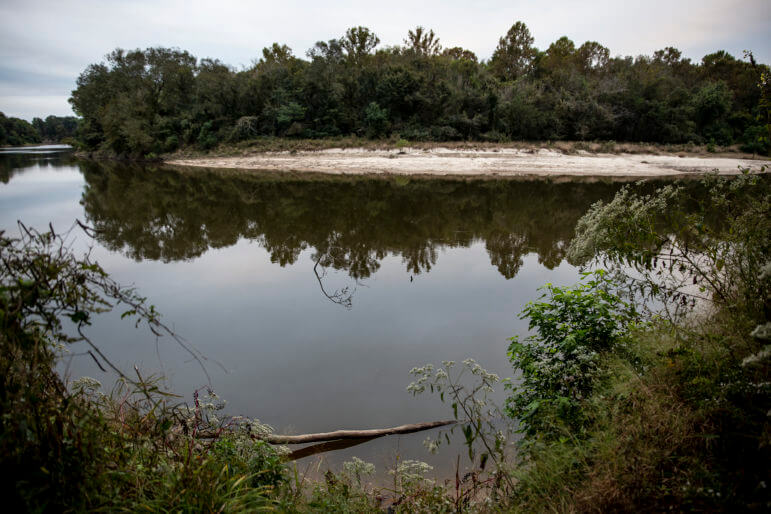
The Pearl River is seen Wednesday, October 17, 2018 near Mayes Lake Campground in Jackson. Credit: Eric J. Shelton, Mississippi Today/ Report for America
MDEQ told Mississippi Today on Friday that, based on JXN Water’s information, between 10 millionto 20 million gallons of untreated sewage entered the Pearl River per day during the malfunction. Over nine days, that would equal 90 millionto 180 million gallons total. For reference, there were 41 sanitary sewer overflows (or SSOs) at the West Bank Interceptor between the start of the year and March 31, according to JXN Water’s quarterly report, totaling around 5 million gallons.
“While this is one of the most extensive water contact advisories we’ve issued in recent years, we do not anticipate that the expanded advisory will remain in place long-term,” said MDEQ Communications Director Jan Schaefer. “The release has been stopped, and we expect bacteria levels to begin to normalize through natural biological processes and dilution.”
According to JXN Water, the city’s third-party utility in charge of its sewer and drinking water infrastructure, its contractors discovered a “catastrophic failure” at the West Bank Interceptor where it crosses Hanging Moss Creek on May 28. The city has long struggled with that facility, which is the main transmission line to the Savanna Street Wastewater Treatment Plant, dating back at least to its 2012 consent decree with the Environmental Protection Agency. JXN Water also attributed the recent issue in part to “severe and rapid erosion” along the river’s banks near the interceptor because of heavy rain this spring.
As a temporary fix, the utility’s contracted crews put in four bypass pumps to redirect wastewater through nearly 4,000 feet of piping. JXN Water said the long term fix requires repairs to two damaged interceptors, estimating a cost of over $7.5 million. The cost of the temporary measures, including diesel for the pumps and rental equipment, will be around $300,000 a month, the utility said.
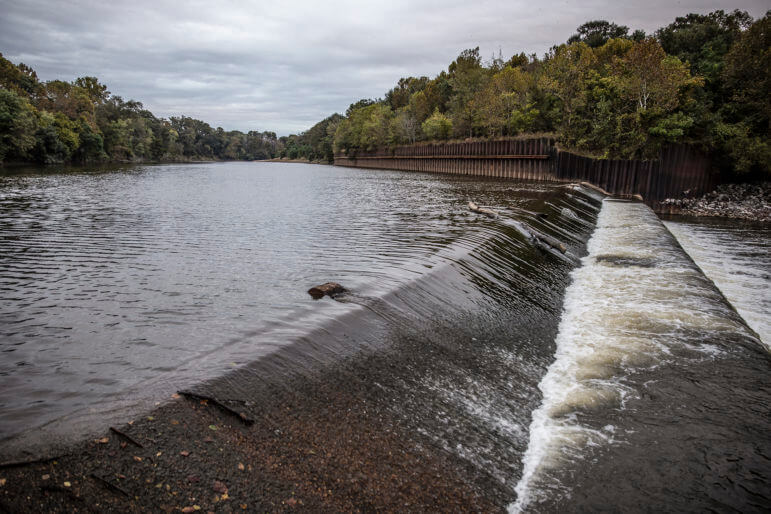
Water flows through the low head dam at waterworks curve on the Pearl River Wednesday, October 17, 2018 near Mayes Lake Campground in Jackson. Credit: Eric J. Shelton, Mississippi Today/ Report for America
JXN Water spokesperson Aisha Carson said the utility will use its operations budget to pay those costs, as the large infusion of federal funding it received is largely reserved for drinking water repairs. The utility is working with the EPA to secure emergency funding, Carson added.
U.S. District Court Judge Henry Wingate placed control of the sewer system under JXN Water in 2023. One of the priority projects included in the order is to rehabilitate the West Bank Interceptor. JXN Water’s last quarterly report projects “substantial completion” by Aug. 30, 2026.
Jackson State University alums are blowing up Mississippi lawmakers and the state’s college board inboxes with one clear message: Give us a fair and transparent president search.
Thee 1877 Project launched an email campaign “For a Better JSU” this week asking faculty, students and supporters of the historically Black university to send e-letters to hold the Institutions of Higher Learning board responsible for the school’s last three picks for president and what it calls its failure to create an open and inclusive search for school leadership. The group is not affiliated with the JSU National Alumni Association.
The effort comes after the announcement of former president Marcus Thompson’s resignation with no explanation. The news was a disappointment to many state lawmakers and alumni last month who felt whiplash from his departure, a familiar situation experienced with his predecessor, Thomas Hudson, who also resigned without explanation. Thompson’s resignation marked the university’s third leadership turnover in less than a decade. Hudson’s predecessor, William Bynum, also resigned following his arrest on a prostitution solicitation charge.
“For too long the leadership selection process at JSU has failed the institution and its stakeholders. It has bred instability, eroded public trust, damaged our university’s reputation and squandered taxpayer dollars,” the campaign’s website states. “These are not minor missteps— they are systemic failures. The process has lacked transparency, inclusivity and consistency that any respected academic institution should demand.”
In a personalized email sent to IHL Commissioner Al Rankins and board members, Mississippi Gov. Tate Reeves and several state House and Senate lawmakers including Chris Bell, Greg Holloway, Sollie Norwood, Grace Butler Washington, Rob Roberson and Dennis DeBar, the group urges the following:
A public acknowledgement and statement from board members addressing its failures of previous president search processes and lessons they have learned before the next national search
A national search of the university leadership of the “highest caliber”
A transparent president search and process that includes input from students, faculty, alumni and community members
The group said its goal is to get 1,000 individuals to participate in the campaign before IHL’s next board meeting, June 19. As of Friday, 500 emails have been sent according to Mark Dawson, a spokesperson for the group. He said the group plans to expand its campaign in the coming weeks to include additional emails to officials such as State Auditor Shad White and Lt. Gov. Delbert Hosemann.
“We need to let them know this process they have in place is not good,” Dawson said.
The campaign is also filling a void for alumni who are frustrated by JSUNAA’s silence and inaction. Many have begun to question the association’s role and its leadership when it comes to advocating for the university’s future.
Last month, JSUNAA President Patrease Edwards, shared a statement asking alumni to refrain from public comment and speak positively about the university after Thompson’s departure.
When rumors circulated that IHL had selected a new president and Edwards was asked to send a letter to alumni on the selection and reasons the board did not open up a candidate search this week, Edwards responded to those claims on social media. Her response was the first time alumni had heard from since her statement. She subsequently deleted her comment.
“Processes and procedures can be challenging for JSUNAA right now. It is not for us,” Dawson said. “We don’t want to brush things under the rug, you can’t fix anything that way. Now is the time to raise our voice, organize and partner with IHL to have an open dialogue so we can get this right.”
Edwards told Mississippi Today the role of JSUNAA is to support the university and its students. She said she does not speak on personnel issues because that is beyond the association’s purview.
When asked if the association had considered expanding its mission to acknowledge the questions alumni have posed of her leadership and inaction, Edwards said the association does advocate but alumni should join the national group as a way to support the university. By joining the association, it shows a true representation of the school’s alumni base “and speaks more volume than anything.”
“We can be vocal on social media all we want but if we are not showing our financial support of our university through active membership in the National Alumni Association through ongoing consistent gifts to the university and to students and student programs, we will never be able to have a voice,” Edwards said.
Despite what he described as the “aggressive silence and inaction” from the national association, Dawson said the group doesn’t see itself as overstepping. Rather it’s providing a true account to the history of the university and a platform for alumni and supporters’ demands.
“[Jackson State] was founded twelve years after bondage. We have weathered through a long and troubled history of people trying to knock us down and we have survived despite the odds ,” he said. “Being quiet is not in our DNA. We’re rising up yet again.”
By the final day of “100 Days of Peace” in Jackson Friday, the city once called America’s deadliest had recorded a marked decline in violent offenses — 35% fewer homicides and nearly half of shootings — compared to last year.
The reduction in violence was one goal of 100 Days of Peace, also known as 100 Days of Action, an initiative launched earlier this year by the Office of Violence Prevention and Trauma Recovery.
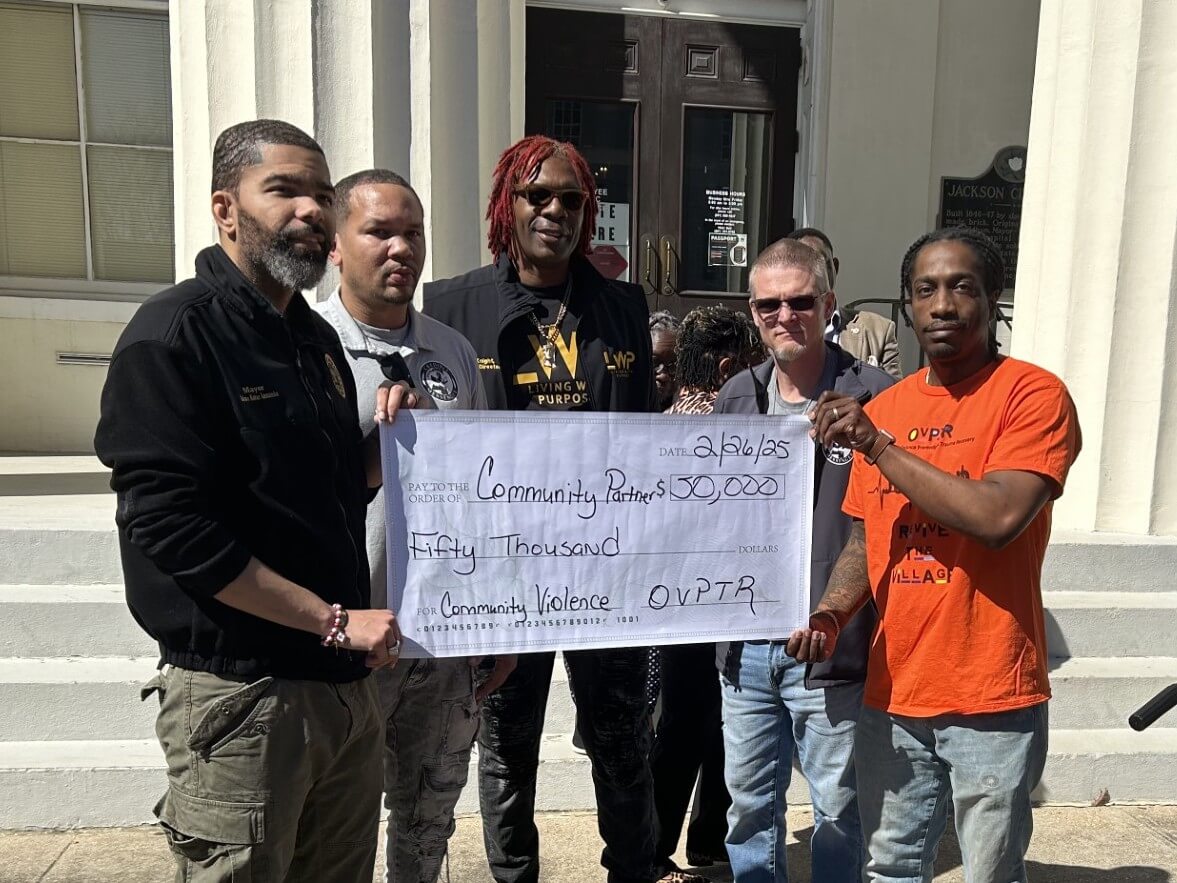
From Feb. 27 to Friday, the office planned to host events to raise awareness and loosely create an atmosphere of peace in Jackson. It also announced $150,000 in grants, which began in January, to three community violence intervention organizations, Strong Arms of Mississippi, Living With Purpose and Operation Good.
The plan was to collect data to document how their work reduced violence outside of police involvement or incarceration. It was a fitting opportunity for the office, which was only launched in 2022 with a $700,000 grant from the National League of Cities, to justify why the city should allocate its own resources to these efforts, instead of simply increasing the police budget.
But before that could happen, the city fired Keisha Coleman, the director of the office who was spearheading these data collection efforts.
“We didn’t make it there,” Coleman said. “And I would like to get that information because I still can look at it from a violence standpoint. We know homicides are down, but we can’t say with 100% accuracy what’s contributing to that.”
Jackson Mayor Chokwe Lumumba awarded grants from the Office of Violence Prevention and Trauma Recovery to three community organizations outside of City Hall Wednesday, Feb. 26, 2025. From left to right: Mayor Lumumba, Terun Moore of Strong Arms of Mississippi, John Knight of Living With Purpose, Bennie Ivey of Strong Arms of Mississippi, and OVPTR Community Outreach Specialist Kuwasi Omari. Credit: Courtesy City of Jackson
In other words, Coleman said she’d hoped to “prove that because of the 100 Days of Action and the initiatives that came from the office, it was a critical piece to keeping peace in the city.”
To do that, Coleman said she had asked the three organizations to submit reports to her describing the number of people served, including their age and city zip code, what service they received, and how long they had been in each organization’s program.
With Coleman gone, it’s unclear if the city of Jackson is hip to what data has been collected or if it plans to analyze it to determine what programs are most effective moving forward. When the city fulfilled Mississippi Today’s requests for data analysis after Coleman was fired, it only provided one report that Living With Purpose completed in February, before 100 Days of Peace began.
But the city should have possession of more data than that. Benny Ivey, a co-lead of Strong Arms, told Mississippi Today his organization had submitted reports to Coleman detailing the work they were doing.
“We’re constantly in the community working with kids,” he said. “We’ve got a bunch of parents that reach out to us weekly wanting to get their boys enrolled in their program. We pick them up, they play ball, we have group sessions.”
Ivey did not seem to know that data analysis had been a goal of 100 Days of Peace.
“100 Days of Peace was something that Keisha and the Office of Violence Prevention came up with just to bring awareness,” he said. “But events and barbecues and cookouts and waterslides, all that’s fun, but we’re out there on the ground with our boots trying to make real change.”
Fredrick Womack, executive director of Operation Good, said his organization is working to make Jackson safer whether or not the city is able to collect data.
“We work every day to have peace,” Womack said. “We want 365 days of peace.”
In some cities, the impact of solutions to violence that do not involve police has been straightforward to qualify: The mayor meets with rival gang members, and they agree to a ceasefire, in exchange for job training.
But in Jackson, a variety of organizations are working to reduce violence outside of the police, and they employ different methods. In general, it can be difficult to show through crime data reported by the police how these organizations are impacting violence in the city — precisely because their work is intended to prevent people from becoming a statistic.
Operation Good uses a variety of models, including an approach called “it takes a village,” to prevent interpersonal conflicts from turning violent and reduce the social conditions that lead to such conflicts. Strong Arms and Living With Purpose primarily work with credible messengers, folks in the community who have been involved in the criminal justice system, to encourage youth to take a less violent path in life.
When the city launched the Office of Violence Prevention and Trauma Recovery more than two years ago, the goal was to help these organizations grow by offering support through additional grant funding and technical assistance, such as how to collect data.
Coleman said, when she showed Ivey the data she intended to collect earlier this year, he was ecstatic because he had not yet figured out how to do that.
“Their passion exceeds their administrative duties,” she said. “They were doing the work, but they just hadn’t conditioned themselves to record it.”
The first monthly deadline to submit data came and went with nothing submitted, she said. As part of the memorandum of understanding with the city, these three organizations were supposed to be submitting data to Coleman.
Strong Arms ended up submitting a quarterly report, Coleman said. She also met with Womack at Operation Good’s office to talk to him about the data she was needing, leading Womack to show her that he collected more data than she was asking for.
“When she saw our spreadsheet and saw that it was more detailed and so forth, she just said that would be sufficient,” Womack said.
When Mississippi Today requested this information, the city only provided one report from Living With Purpose.Titled “OVPTR performance management meeting report,”the form shows that between Jan. 1, 2025, and Feb. 28, 2025 — the start of 100 Days of Peace — the organization reported 11 individuals had received a “ceasefire communication” outside of custody.
The organization also conducted 19 mediations. While this term is not defined in the document, the spreadsheet notes that 80% were conflict mediations, with “two sides,” as opposed to “conflict intervention conversations,” which only had “one side.” (In Womack’s case, a mediation occurs after an Operation Good staff member intervenes in a potentially violent situation and helps the people involved leave with mutual understanding.)
The form does not include location data, so it is not clear in which areas of the city these mediations took place in.
Keisha Coleman, executive director of the City of Jackson’s Office of Violence Prevention and Trauma Recovery, shows the t-shirt for Denim Day, an event raising awareness and supporting survivors of sexual assault, held at City Hall Wednesday, April 30, 2025 in Jackson. Credit: Vickie D. King/Mississippi Today
Multiple statistics show that violence and crime have fallen in Jackson. The Jackson Police Department recorded 17 homicides from Feb. 27 to June 6, compared with 26 in the same time frame last year.
The Gun Violence Archive, a national nonprofit, documented 33 shootings in Jackson, compared to 61 last year.
But JPD was not an official arm of 100 Days of Peace, and the department has its own explanation for why the city’s violent crime rate plummeted this year.
“Well, crime is down because a lot of people are still in jail,” Deputy Chief Sequerna Banks said.
That’s because many people are receiving high bonds they cannot pay, preventing them from returning to the community.
“We’ve had some low bonds, something we’re not happy with, but that’s out of our control as far as setting bonds,” Banks said. “But most definitely the high bonds play a part. People are in jail on high bonds and not having to worry about them getting out and that plays a very high part in crime being down.”
Ask Operation Good, Living With Purpose or Strong Arms why crime is down, they will say it’s because they are working to prevent people from committing crimes.
For instance, Womack noted that Operation Good has actually intercepted more violent incidents this year compared to last, because Operation Good’s area has grown beyond south Jackson, and Womack has been able to hire more mediators.
To support Womack’s point, Coleman said she had envisioned creating a series of heat maps of Jackson. She wanted to look at crimes committed in previous years and compare that to the past 100 days in Jackson to see if there was a reduction in the areas of the city served by the three organizations.
“I explained that was going to be the role of the Office of Violence Prevention, that once they collected their information or recorded their data, we would take it and synthesize it collectively, and we would create the stories and the narratives that go along with the data to show how the credible messengers and violence interruption organizations are real drivers of crime reduction in Jackson,” she said.
Coleman never got that far, and confusion persists among city officials about what data can actually be provided to the public.
“I don’t know if your public records request would account for all of their work,” outgoing Mayor Chokwe Antar Lumumba said Tuesday after the city council meeting, when asked if the city had any data on 100 Days of Peace. “It wouldn’t account for everything that they – you would only have access to the public information of us giving to them.”
“I’m talking about communicating with them and understanding where they were engaged and what their engagements yielded,” he continued. “None of that would be recovered by a public records request, which is the meat of that type of work. The meat of actual violence interruption, you don’t go talk to gang members and say, ‘OK, I need you to sign this document.’ It is actually about the connections, so that would never be connected by a public records request.”
Safiya Omari, the mayor’s chief of staff, said a number of offices around the country have been working to prove the efficacy of non-police approaches to violence.
“There’s a lot of information that we collect,” she said. “What we have is a disconnect between data and actual work and now we are trying to bridge that disconnect.”
Omari noted one example of data the city has obtained to support the office’s work.
“For example, we know the six zip codes that have the highest amount of gun violence in the city,” she said. “The work is supposed to center around programmatically addressing what’s happening in the community. Events are good in terms of raising awareness, but you actually have to have some boots on the ground kind of work taking place.”
A document analyzing those six zip codes was never provided in response to Mississippi Today’s records request for data.
Other details are missing. Coleman said she distributed gun safety locks at the Westside Community Center as part of 100 Days of Peace, but that handout was not documented in the records provided to Mississippi Today. The public records request instead yielded flyers for two events — a grief art party and a sexual assault awareness demonstration called Denim Day — but no information on participants was included.
Coleman described several planned events, such as a sneaker ball to cap off the initiative, that never took place.
If done right, Womack said events like the ones associated with 100 Days of Peace can improve community dynamics, but it was not clear to him if that was the main thrust of the city’s recent initiative.
“If the 100 Days of Peace was about events, then that’s the data,” he said. “Events.”
Murray State’s Racers celebrate one of NCAA Tournament’s many surprises. (Photo courtesy David Eaton, Murray State athletics)
College baseball legend Ron Polk has told us again and again through the years: “There is no such thing as an upset in baseball.”
Polk is right, of course. Baseball contains so many variables: bad hops, sore arms, sudden wind gusts, line drives that find gloves, weakly hit ground balls that find holes, capricious umpiring, etc. All that contributes to the fact that anything can happen on any given day in baseball. But if we don’t call them upsets, then what to call what we have seen happen again and again in the NCAA Baseball Tournament that continues today at sites other than Mississippi?
Rick Cleveland
Keep in mind, we are watching college baseball in a new era when the richer schools in the elite power conferences can simply buy the best players from the smaller schools in lesser leagues. You would think the pay-for-play and the transfer portal would make it doubly hard for the Murray States, the UTSAs and the Wright States of the college baseball world to compete with the SEC and other power conferences.
But, yet, here we are. Samples:
Closest to home, Murray State, a 4-seed from the Missouri Valley Conference, comes to Oxford, knocks off Ole Miss twice and wins a regional, probably playing in front of more fans in two games than they played before in their entire regular season. Get this: The Murray State head coach Dan Skirka reportedly makes $68,000 a year. Many power conference players make that much and more. Mississippi State just signed Brian O’Connor to a contract that will pay him $2.9 million a year. Nevertheless, the Murray State Racers came off the bus in Oxford hitting line drives and never quit. They will play a Super Regional at Duke beginning Saturday. I would not bet against them.
No. 1 seed Vanderbilt was eliminated by Wright State of the Horizon League. Wright State eliminated the Commodores before eventually losing to Louisville in the championship game. For those who don’t know, Wright State is located in Dayton, Ohio. The Horizon League includes such name brands as Youngstown State, Robert Morris and Northern Kentucky. Vandy probably spends more money on one player than Wright State has in its entire NIL budget. Yet, here we are.
UTSA of the American Athletic Conference stunned mighty Texas, the No. 2 seed overall, beating the Longhorns not once, but twice, in the Austin Regional. Want to know the beauty of this? UTSA lost its best pitcher and its best everyday player to the portal last year. The shortstop went to Arizona State. The pitcher went to – you guessed it – Texas. UTSA coach Pat Hallmark, asked about the players who left said this: “We’re not here if those players are still here. We’re here because they left. … If they want to get in the portal, get in the portal. We’ll go after the next guy.”
A record 13 SEC teams made the tournament. Only four advanced. And one of those, LSU, had to rally from behind to beat Little Rock in the championship game after losing to Little Rock the day before. Little Rock of the Ohio Valley Conference entered the tournament with a losing record and an RPI of 243.
The guess here is that legions of college baseball fans, disgusted with what the transfer portal and NIL have done to college athletics, will find themselves pulling for teams such as Murray State and UTSA as the tournament continues.
More than likely the eventual champion will come from the Big Boy leagues. Such powers as Arkansas, LSU, Tennessee and Florida State still remain. They all host Super Regionals. They have all the advantages.
After nearly a year closed, Thalia Mara Hall has been cleared for reopening after a follow-up inspection from the State Fire Marshal’s Office on June 3.
Thalia Mara Hall was closed last August due to mold remediation, to replace the heating and cooling systems and perform updates to the fire system. The building had previously failed an inspection in late January.
State Fire Marshal and Insurance Commissioner Mike Chaney issued the following statement on June 6:
“The State Fire Marshals Office (SFMO) conducted a follow-up inspection of Thalia Mara Hall on Tuesday, June 3, 2025, and determined that the building met standards to reopen. A Certificate of Occupancy will be issued to the City of Jackson (COJ). A hydrostatic test was conducted on Monday, June 2, 2025, to determine the integrity of pipes and valves in the building. The test was successful. The building elevators and escalators remain out of service pending repair and inspection. The COJ has scheduled a new fire curtain to be installed in July.
A condition of the reopening is that a third-party fire watch must be in place until the fire curtain is installed and passes inspection. A fire watch involves having someone monitor the building during events for fire hazards and to alert occupants and emergency services if a fire breaks out.
My office remains committed to working with Jackson officials to protect the health and safety of the public and important cultural structures like Thalia Mara Hall.”
Thalia Mara Hall’s closure brought with it a slew of scheduling issues for performing arts groups such as Ballet Mississippi and Mississippi Symphony Orchestra, who had to move performances to Madison Central High School Auditorium and Jackson Academy Performing Arts Center.
The city has spent nearly $3 million in repairs, with the bulk of the funding going to Guarantee Restoration Services, which was in charge of mold remediation, encapsulation and HVAC cleaning.
The city of Jackson was unable to provide a comment on when Thalia Mara Hall will reopen.
State Sen. David Parker, a Republican from Olive Branch, announced on Thursday that he will not run in an upcoming special election, creating an open Senate seat in DeSoto County and making him the second incumbent to forgo the special election.
Parker, who has served 13 years in the Legislature, wrote on social media that the recent death of his childhood friend and the founding surgeon in Parker’s eye-care practice weighed heavily on his decision to leave public office.
“Their loss has served as a powerful reminder of how precious our time is, and it reaffirmed my desire to devote more intentional time to my family and to the next chapter of life,” Parker said.
Even though Parker was elected to a new four-year term in 2023, a federal three-judge panel ruled last year that the state’s current legislative maps didn’t comply with federal voting laws and diluted Black voting power.
The federal panel then approved a new state legislative map that redrew five House districts and nine Senate districts, one of which was Parker’s.
Parker did not cite this as a reason for his retirement, but state officials also changed his district to a slightly majority-Black district. If the DeSoto County lawmaker drew an opponent, he likely would have spent this year facing a competitive election cycle.
Sen. John Polk, a Republican from Hattiesburg, also announced earlier this year that he will not run in the special election because of health reasons. The redistricting plan placed Polk in the same Senate district as state Sen. Chris Johnson, a fellow Hattiesburg Republican.
The two departures come at a time when Republican Lt. Gov. Delbert Hosemann, the Senate’s presiding officer, has clashed politically with House Speaker Jason White and, at times, with Gov. Tate Reeves. The Republicans have battled over Medicaid expansion, the state’s public pension system, school choice legislation and crafting a state budget.
Polk and Parker were two of Hosemann’s most loyal lieutenants in the 52-member chamber, so the two departures could create more political challenges for the lieutenant governor as he faces pressure from his fellow state leaders.
The last day candidates can qualify for the redistricting special elections is Monday, June 9. Party primaries will take place on August 5 and the general election is on November 4.
Three more special elections in the Legislature will also take place soon, though they will happen on a different timeline, set by the governor, than the 14 special elections to account for redistricting:
Sen. John Horhn, a Democrat from Jackson, will soon resign after he was elected the new mayor of Jackson
Rep. Orlando Paden, a Democrat from Clarksdale, will soon resign because he was elected as the new mayor of Clarksdale.
Sen. David Jordan, a Democrat from Greenwood, recently announced he was retiring from the Legislature.