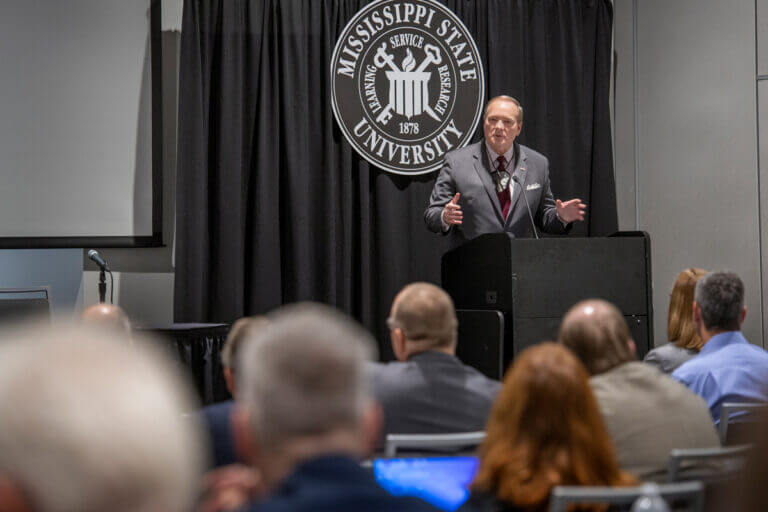
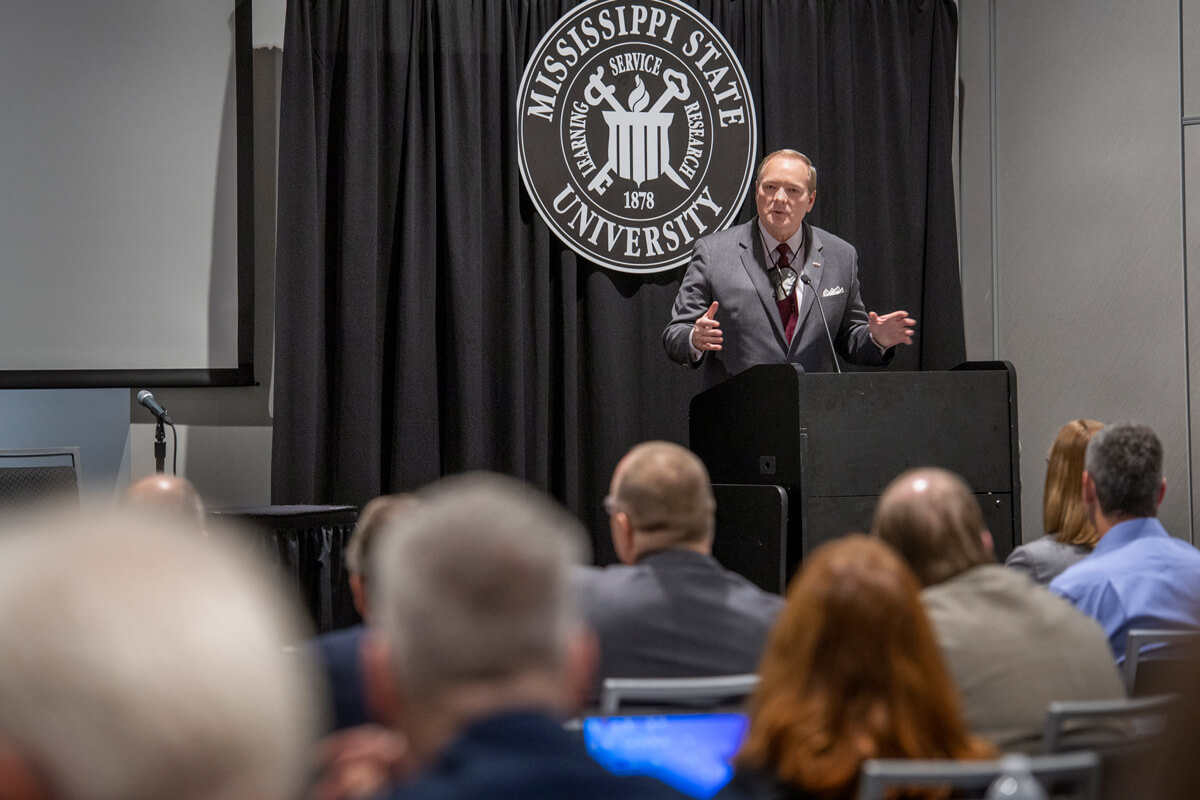
Mark Keenum, the president of Mississippi State University, addressed the turmoil caused by the Trump Administration’s numerous changes to higher education funding over diversity, equity and inclusion efforts, in an unusual letter for the state’s conservative higher education system.
Keenum, a former under secretary of the U.S. Department of Agriculture and former chief of staff to the late Sen. Thad Cochran, wrote to the campus community Friday that Mississippi State was working to comply with a sweeping memo the U.S. Department of Education issued earlier this month declaring virtually all race-based programming and admissions policies illegal.
If universities did not comply by Feb. 28, the department threatened to investigate and withhold federal funding that supports research, student financial aid and other institutional operations, the loss of which would be “catastrophic to our university,” Keenum wrote.
Though Keenum wrote that Mississippi State was working to not “over- or under” interpret the letter, “making us an outlier,” his letter is notable because it was also sent to the media as a press release.
While some universities in Mississippi have issued internal statements to faculty and staff about the Trump administration’s attempts to reshape higher education, MSU appears to be the only four-year institution in the state that has commented on the department’s “Dear Colleague” letter in a detailed, proactive way.
To comply, Keenum wrote that Mississippi State has changed website language, nomenclature on campus and policies concerning student organizations, though the letter did not state which policies. The university is also initiating a process to rename the Holmes Cultural Diversity Center to the Holmes Center for Student Success, subject to the approval of the Institutions of Higher Learning Board of Trustees.
The center is named after Richard Holmes, the first Black student to enroll at Mississippi State in 1965, and once supported 11 student organizations that promoted diversity and inclusion.
“We are committed to working with government at all levels as an effective partner,” Keenum wrote. “At the same time, we are equally committed to providing a safe and welcoming learning environment on our campus.”
Throughout the years, Keenum has repeatedly offered his support for diversity, equity and inclusion policies at Mississippi State. This past school year, the university rechristened its diversity office; most other four-year institutions in the state followed suit.
Perhaps the strongest words in Keenum’s letter were for changes the Trump administration is contemplating to federal research funding, particularly a planned reduction in funding that can be used for research facilities, lab equipment and capital improvements.
This plan was recently halted by a federal judge, but Mississippi State is “developing contingency plans” in the event the reduction goes through, Keenum wrote.
The land-grant university has the state’s highest amount of federal research funding, which Keenum called “an incredible success story.” It also means the potential changes have “high stakes — $162 million, according to the press release.”
“We are extremely concerned about announcements from Washington that pause or interrupt the research of our faculty, staff and students,” he wrote, adding that “we will work hard to do all that we can do to protect our most valuable assets – our people.”
A Jackson attorney suspended from the practice last year for taking contraband into a jail could face further Mississippi Bar disciplinary action for how he allegedly represented plaintiffs in a multimillion-dollar, wrongful death class action federal lawsuit, leading to its dismissal.
A March 25 investigative hearing is scheduled before the Bar on Reggie Ruffin’s complaint against attorney Guy N. Rogers Jr.
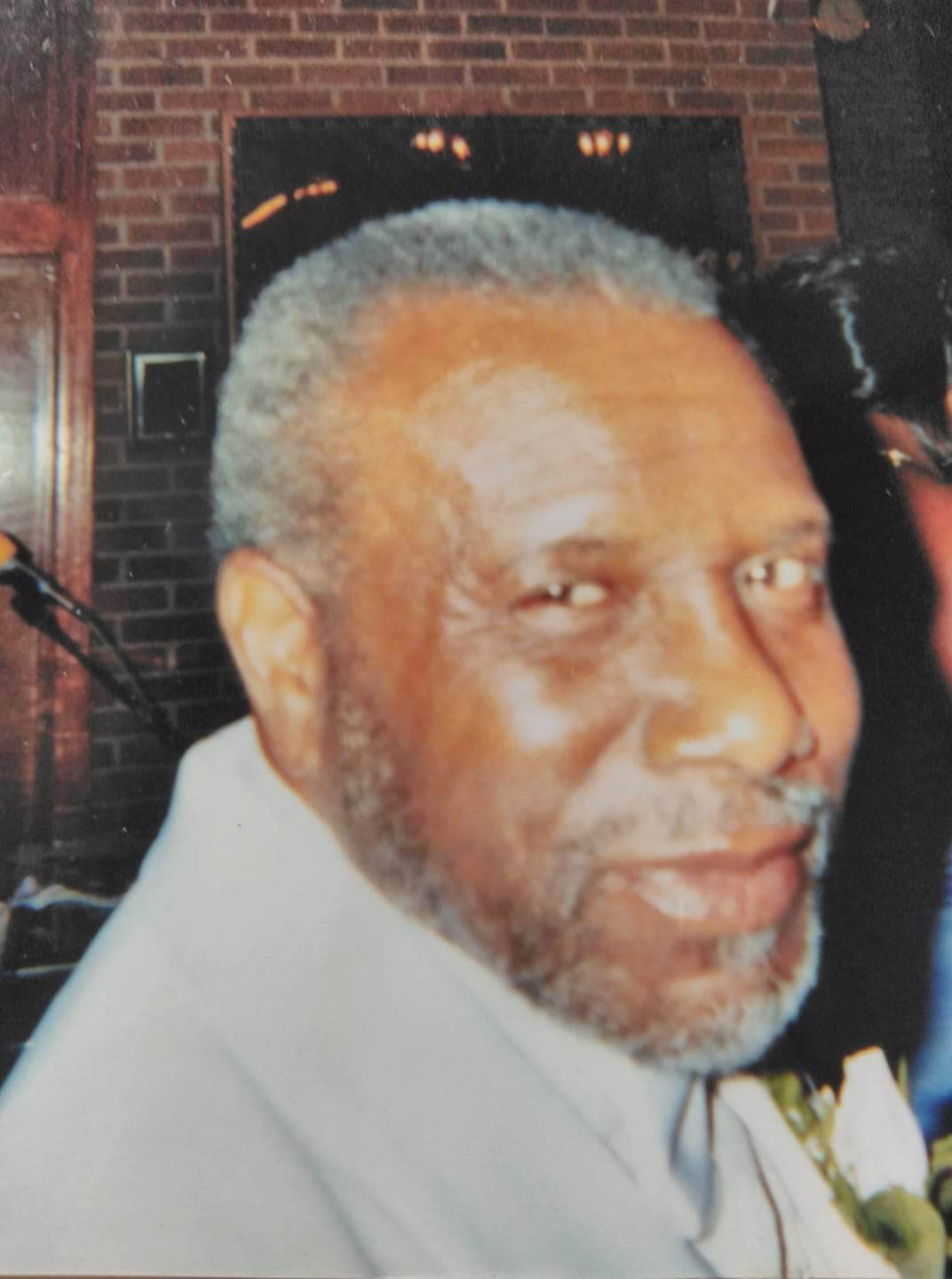
Jimmie Lee Ruffins, a machine operator and pest control worker at the now-closed Frito-Lay plant on Boling Street in Jackson, died in 2010 from lung cancer his son alleged was caused by hazardous substances at the old plant. Credit: Courtesy of Reggin Ruffin
Reggie Ruffin of Dallas initially filed a federal lawsuit in 2020 in Texas alleging his father, Jimmie Lee Ruffins, was exposed to asbestos while working as a machine operator and pest control worker at the Frito-Lay plant in Jackson, causing him to develop lung cancer and ultimately die on July 4, 2010, at the age of 69. However, the case was dismissed in Texas, citing statute of limitations
Ruffin then filed a class action lawsuit in Mississippi in 2021 against Frito-Lay North America and its parent company, PepsiCo, on behalf of his father and other workers at the Jackson plant.
In addition to Ruffin’s father, the lawsuit alleged three others died from cancer related to their employment at the Frito-Lay plant, and others were being treated. All the employees worked for more than 20 years at the Frito-Lay plant, which was located at 1325 Boling St. in Jackson, according to the lawsuit. The plant closed in 1999.
The lawsuit said the workers suffered injury, damages and death from serious illnesses such as lung cancer, brain cancer, mesothelioma, Parkinson’s Disease, leukemia, ovarian cancer and other neurological disorders. “The direct and proximate cause of these injuries was plaintiffs’ exposure to unreasonably dangerous, disease-causing, hazardous, and toxic substances which were in use each day at the facility and in the structure/physical plant,” according to the lawsuit.
PepsiCo said in a statement for this story: “The safety, health, and well-being of our associates is one of our top priorities as a company. We have established policies and systems to provide and maintain a safe and healthy workplace, and we are dedicated to engaging with our employees to continually improve.”
U.S. District Judge Dan Jordan dismissed the lawsuit in December 2022 on a motion by Frito Lay North America Inc. and PepsiCo, citing the lawsuit was barred by Mississippi’s three-year statute of limitations clause in wrongful death cases.
But Jordan said in court papers the reason for dismissing the lawsuit was because plaintiffs didn’t respond to Frito Lay’s motion to dismiss the lawsuit in the timeframe set, which Ruffin lays squarely on Rogers.
Jordan said Frito-Lay and PepsiCo sought dismissal with prejudice in the motion, but the plaintiffs did not respond. He then entered a show cause order giving plaintiffs a second chance to respond and warning the motion would be granted if they did not.
“The court therefore concludes that defendants’ motion to dismiss with prejudice should be granted on the merits, for failure to prosecute, and for failure to obey a court order,” he ruled.
Now almost three years later, Ruffin’s Bar complaint blames Rogers, who represented him and the other plaintiffs in the lawsuit, for dismissal. Ruffin said Rogers refused to serve Frito-Lay and file documents in the case. He cited other factors as well. But Ruffin said in a phone interview that had he known documents weren’t being filed; he would have driven from his home in Dallas to Jackson to file them in court.
Repeated efforts to reach Rogers regarding Ruffin’s allegations failed. Phone numbers and emails associated with Rogers when he was a practicing attorney are no longer in service.
Since Rogers is already on suspension, it’s uncertain what disciplinary action he could face if Ruffin’s complaint is deemed credible.
Without mentioning Rogers’ case, Mississippi Bar General Counsel Melissa Scott said a suspended attorney can face additional disciplinary action in a separate case.
Scott said each case is different, but an investigatory hearing generally involves a notice for the respondent attorney to appear at a set date and time. She said an attorney in her office will question the respondent attorney about the allegations in the informal Bar complaint.
The Office of General Counsel then reports its findings back to the Committee on Professional Responsibility, which will make the decision on whether to recommend disciplinary action to the Mississippi Supreme Court.
Retired Texas attorney Kevin Kurtz said in Ruffin’s complaint to the Mississippi Bar that Rogers was given contact information for the process server to serve summons to Frito-Lay at the company’s national headquarters in Dallas, but it didn’t occur.
“Who files a $100 million civil suit and fails to serve the defendants?” Kurtz said in Ruffin’s Bar complaint.
Kurtz said the lawsuit against Frito Lay was dismissed because Rogers disgraced himself, his profession and worst of all his clients who counted on him to seek justice.
Although Jordan dismissed the lawsuit based on the failure to respond to the motion to dismiss, he cast doubt on it being successful, saying the federal claims were meritless, and the current claims as written would not survive the statute of limitations.
Ruffin said he and other plaintiffs knew about the statute of limitations, but argued they didn’t learn until 2018 that workers may have been exposed to contamination. Also, he said some workers, who suffered long-term medical conditions were alive when the class action lawsuit and some are alive today.
In August of last year, the Mississippi Supreme Court suspended Rogers after he entered a plea to a felony charge in Warren County of possessing contraband in a jail facility. The Mississippi State Bar called for Rogers’ disbarment and opted for suspension.
Rogers entered a best-interest plea, which is technically a guilty plea. The Warren County Circuit Court withheld the plea subject to a 36-month probationary period, which could lead to the charge being dismissed if Rogers doesn’t violate the terms of the probation.
Rogers argued in court papers he shouldn’t be disbarred for accidentally taking a cellphone wire into the Warren County Jail. He said at the most, he should be subjected to some type of disciplinary action, but not the drastic sanction of disbarment.
Rogers said at the time that he only entered the Alford plea to avoid trial, even though the state could not prove their case. He said prosecutors wouldn’t offer a misdemeanor plea or anything less than a felony plea because he used profanity towards a plain-clothes deputy of the Warren County Sheriff Department.
The indictment against Rogers said he attempted to furnish or assist In furnishing two black Android cellphone cords to an inmate at the Warren County Jail.
The state high court struck Rogers’ name from the Bar roll and immediately suspended him from the practice of law, but denied the Bar’s request for disbarment, saying disbarments are reserved for final convictions. If Rogers successfully completes his 36-month probation and has the charge against him dismissed, he can petition for reinstatement to the Bar.
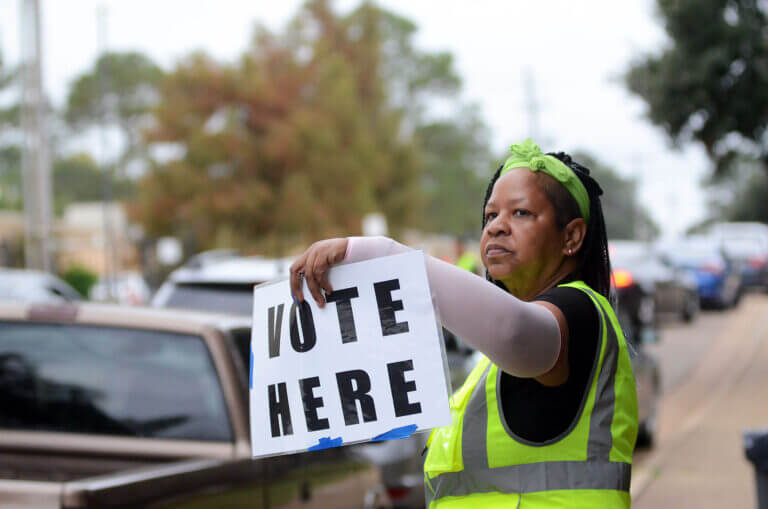
Elections Committee Chairman Noah Sanford has successfully pushed some House members to scrap a Senate proposal to establish early voting in Mississippi and expand the state’s absentee voting program instead.
Sanford, a Republican from Collins, last week got the committee to adopt a plan clarifying voters who anticipate their employers might require them to work on Election Day and adding that people who care for children or disabled adults can vote by absentee.
“I’m the poster child for this,” Sanford said. “I’ve got a 5-year-old, a 2-year-old and a 9-month-old. I can promise you, you don’t want me bringing them into the polling place. They’d be knocking something over, and it would be a bad experience for all of us.”
The plan passed the Elections Committee with no audible opposition, and it can now go before the full House for consideration.
Sanford’s proposal also establishes an early voting task force, although Sanford held a hearing over the summer to study the issue. It also allows election workers to process absentee ballot forms leading to Election Day.
To vote by absentee, a voter must meet one of around a dozen legal excuses, such as temporarily living outside of their county or being over 65. Mississippi law doesn’t allow people to vote by absentee purely out of convenience or choice.
The Senate passed a proposal, authored by Republican Sen. Jeremy Englad of Vancleave, that would have established 15 days of no-excuse, in-person early voting and required voters to present a valid photo ID to an elections worker.
Sanford told committee members that the Senate proposal does not have enough support from House members needed for it to pass. If the House passes Sanford’s proposal, it would return it to the Senate for consideration.
Mississippi is one of only three states that do not have no-excuse early voting or no-excuse absentee voting.
When the Republican-majority Senate last week voted on a tax cut package that cuts the income tax, reduces the grocery tax and increases the gasoline tax, it found an unlikely group who helped save the bill from failing: four Democrats.
The measure passed by only a 5-vote margin. This would portend that the Republican-majority Senate likely does not have the appetite to eliminate the income tax, as House Speaker Jason White and the GOP-controlled House want.
To explain, here’s some quick math:
The Mississippi Constitution requires that tax bills receive a three-fifths majority vote to pass.
Currently, 51 senators are serving, and one senator, Republican Jeff Tate of Meridian, was absent during the Monday vote. Democratic Sen. David Jordan of Greenwood was present earlier in the day but didn’t participate in the tax cut vote.
This leaves 49 senators who participated and voted. The measure needed the approval of at least 30 senators to pass.
The Senate currently has 35 Republicans and 16 Democrats.
Of those 35 Republicans, four crossed over with 12 Democrats to oppose the measure.
The four Republicans are Kathy Chism of New Albany, Chad McMahan of Guntown, Mike Seymour of Vancleave and Angela Burks Hill of Picayune.
Chism, Seymour and Hill are some of the more conservative members of the Republican caucus who likely opposed the measure because of the gas tax increase and won’t vote for a final package that includes any tax increase.
“An increase in the gas tax is going to hurt rural residents more than anybody else,” Hill told Mississippi Today.
McMahan said he opposed the measure because he promised his constituents he would not vote for a tax increase unless another type of tax, such as the income tax, were abolished.
Then, four Democrats joined 30 Republicans in supporting the plan. The four Democratic senators were Sarita Simmons of Cleveland, Bradford Blackmon of Canton, Gary Brumfield of Magnolia and Juan Barnett of Heidelberg.
These four senators supported the plan, in part, because it increased the gas tax, which would provide more money for road and bridge infrastructure. However, all of them would likely oppose a drastic plan to abolish the income tax.
“I’m not in favor of full income tax elimination because we have to get our money to fund public education and other government services somewhere,” Blackmon told Mississippi Today.
Now that the House and Senate have passed their own tax cut/increase plans, the hard work of negotiating begins. Republican Gov. Tate Reeves and Speaker White have said income tax elimination is their number one legislative priority.
Capitol insiders have continued to speculate whether Reeves would use his constitutional power to call lawmakers into a special session to debate tax cuts and whether Speaker White is willing to kill any major Senate bills to achieve that goal.
Of course, lawmakers can always change their minds if the proper pressure is applied. But last week’s Senate vote showed a fragile coalition on its tax plan.
In short, Senate leaders can choose one of two paths: acquiesce to the House and Reeves and accept an elimination plan, or continue to advocate for the more moderate Senate plan.
The former route is unlikely. Although they might gain back those four Republican votes who initially opposed it, they would lose all the Democratic support and likely some of the core Republican caucus.
The latter approach is more pragmatic. However, in negotiations, Senate leaders must closely monitor votes and bring Democrats to the table because one absent senator could derail the entire plan.
This is clear: Reeves and House leaders must decide whether to risk their cherished policy by bullying the Senate and still getting nothing from them or do what they’ve done in the past, which is settle for another more modest tax cut.
WATCH: House Democrats outline their opposition to proposed tax cuts
Quote of the Week
“If you keep on living, you’re going to get old.” — Jimmy “Duck” Holmes, bluesman and proprietor of the Blue Front Cafe in Bentonia. Holmes, owner of the oldest juke joint in Mississippi and last of the “Bentonia bluesmen,” performed for the House last week.
In Brief
Democrats urge people request suffrage restoration
The deadline for legislators to submit bills restoring voting rights to people who have been convicted of some crimes is March 3.
Democrats highlighted the deadline at a legislative press conference last week. Earlier this month, the House let two measures die that would have restored suffrage to people convicted of nonviolent disenfranchising felony offenses.
The only way for someone to regain voting rights is to receive a pardon from the governor or convince two-thirds of the legislators in both chambers to restore it. The last gubernatorial pardon was granted in 2011, Democrats said. Legislators do not restore suffrage to people convicted of violent felonies and only restore suffrage to a few people yearly. — Michael Goldberg
Incentives considered for TV series produced in Mississippi
Lawmakers are considering tax credits to incentivize production of television series in Mississippi.
HB 1880, authored by House Ways and Means Chairman Trey Lamar, and SB 3167, authored by Senate Finance Chairman Josh Harkins, would provide tax credits for production companies that spend at least $4 million and produce the bulk of their shows in Mississippi, as well as credits for employees and expenses. The state has long offered similar incentives for movie productions in Mississippi.
During discussions before passing the measures, several lawmakers mentioned the series “Home Town,” a popular HGTV series based in Laurel. — Geoff Pender
Polk leaving Senate, will not run in special election
Republican Sen. John Polk of Hattiesburg announced on the Senate floor last week that he will not run again for his Senate seat in a November special election and that this will be his last session.
Polk, halfway through his fourth term, received a standing ovation from his Senate colleagues. He said in his floor announcement that his health has “not been as robust” as he would like, and he believes he soon won’t be able to adequately serve his constituents.
This has been my greatest honor of my life — serving with each and every one of you,” Polk said.
To continue serving, Polk would have to run in a special election because lawmakers voted to redraw portions of his district to comply with a federal-court order that required the Legislature to redraw some of the Senate’s districts. Lawmakers voted to put Polk in the same Senate district as fellow Republican Sen. Chris Johnson of Hattiesburg.
Johnson told Mississippi Today he has known his fellow Lamar County lawmaker before the two of them served in the Senate together, and he’s been grateful for his friendship.
“Sen. Polk with be missed up here because he brings a different perspective than most other people,” Johnson said. “Politics aside, I’ll just miss him personally.” — Taylor Vance
Mississippi-Israel Legislative Caucus formed
Democratic and Republican House and Senate lawmakers, joined by Israeli Consul General Anat Sultan-Dadon, last week announced the formation of the Mississippi-Israel Legislative Caucus.
Leaders of the new caucus said it can help improve already burgeoning trade between Mississippi and Israel, and help foster research in artificial intelligence, cybersecurity and medicine.
Co-chairs of the caucus are Sens. Juan Barnett and Jeremy England, and Reps. Otis Anthony and Hank Zuber.
Several pro-Palestinian protesters also attended the Capitol press conference last week announcing the caucus. — Geoff Pender
Poll workers honored for 50-plus years of service
Secretary of State Michael Watson and lawmakers paid tribute to eight poll workers who have served Mississippi for over 50 years during a special presentation at the Capitol on Thursday.
Watson said poll workers are often “overlooked,” but “these men and women are the backbone of the state’s elections.”
The Mississippi poll workers honored for their many years of service included:
Jean Sturgis – 51.5 years (Warren County)
Colene Cain – 61 years (George County)
Freddie Byrd Farmer – 60 years (Holmes County)
Rosie Howze – 57 years (Holmes County)
Lelia Peters – 55 years (Walthall County)
Sarah Ratliff – 55 years (Walthall County)
Della Rose Gilmer – 53 years (Neshoba County)
Gyrone Kenniel – 52 years (Tallahatchie County) — Geoff Pender
Gov. Reeves signs direct wine shipment bill into law
Republican Gov. Tate Reeves on Thursday signed a bill into law that legalizes direct shipment of some wines to Mississippians’ homes.
Senate Bill 2145 will allow Mississippians to order specialty or rare wines that cannot be purchased at Mississippi package stores beginning on July 1.
Mississippi is one of only a handful of states that doesn’t allow direct shipment. House State Affairs Chairman Hank Zuber, R-Ocean Springs, told House members earlier in the session that some Mississippians circumvent state law by ordering wine from other states or countries, having it shipped to a friend’s house in another state and driving over to pick it up.
The legislation enacts a 15.5% tax on direct wine shipments and put a cap of 12 cases per year that a person can order. To ship wine directly to a Mississippian, a person must purchase a direct wine manufacturer’s permit from the Mississippi Department of Revenue.— Taylor Vance
By the Numbers
706
The number of bills remaining alive in the Legislature after a Wednesday deadline, out of 3,188 that were filed this session, according to the StateWatch legislative tracking service. That’s a 22% survival rate.
Full Legislative Coverage
Senate passes its income tax cut plan
The Senate voted Monday evening to pass a tax cut that reduces the state income tax and the sales tax on groceries while raising the gasoline tax, setting up negotiations with the House. Read the story.
Is a standoff/shutdown brewing in the Mississippi Legislature over taxes?
A main topic of conversation around the state Capitol last week was the specter of a special session, a session-within a session or some other permutation of lawmakers being so tangled up over taxes that they linger in Jackson for extra weeks or are forced to return in the spring or summer to finish business. Read the story.
If Tate Reeves calls a tax cut special session, Senate has the option to do nothing
Speculation is rampant that Gov. Tate Reeves will call a special session if the Senate does not acquiesce to his and the House leadership’s wishes to eliminate the state personal income tax. Read the story.
Senate passes redistricting that puts DeSoto Republican, Tunica Democrat in same district, calls for 10 new elections
Voters from 10 Senate districts will have to re-decide in November special elections who should represent them in Jackson, pending court approval, under a resolution the Senate approved on Wednesday. Read the story.
House Chairman kills bill aimed at building Jackson casino, says votes weren’t there
A House chairman killed a proposal aimed at attracting developers to build a resort and casino in the city of Jackson moments before the full chamber was set to vote on it. Read the story.
As Congress moves toward potential Medicaid cuts, expansion grows more unlikely in Mississippi
Although President Donald Trump has vowed Medicaid won’t be “touched,” the U.S. House of Representatives passed a budget resolution Tuesday that instructs the committee that oversees Medicaid and Medicare to cut $880 billion over 10 years. The cuts will help pay for Trump’s agenda on tax cuts and border reform. Read the story.
House panel approves casino tax increase, a shot over bow on blockage of online sports betting
In an obvious shot at the Senate and at least part of the casino lobby for the state not legalizing online gambling, the House Ways and Means Committee on Tuesday approved a tax increase on casinos. Read the story.
House Democrats say they have been shut out of legislative discussions
The Mississippi House Democratic Caucus has been shut out of discussions over consequential bills as the agenda of their Republican colleagues has been shaped by President Donald Trump, Democratic lawmakers said at a Tuesday press conference. Read the story.
City of Clarksdale asks judge to dismiss restraining order against newspaper over editorial
The city of Clarksdale on Monday filed a motion to voluntarily dismiss its lawsuit against the Clarksdale Press Register and a judge’s order that required the newspaper to remove an editorial from its website, a court action that stunned free press advocates. Read the story.
Prenatal care for poor women may be a casualty of political infighting
House advances proposals to increase tax credits for private schools
The Mississippi House has once again passed legislation to increase the size of a program that already sends millions in state dollars to private schools. Read the story.
Independent pharmacists urge legislators to pass pharmacy benefit manager reform bill
A group of independent pharmacists from across Mississippi gathered at the Capitol Thursday to urge lawmakers to increase regulation and transparency of pharmacy benefit managers, who they say are threatening their survival. Read the story.
Podcast: Retired educator, PERS board member McCoy warns of proposed changes to state employee retirement system
Dr. Randy McCoy, a retired longtime public school superintendent and member of the state employee retirement system board, says a plan passed by the Senate aimed at financially stabilizing PERS would cause long-term problems in hiring and retaining teachers and other state employees. He says the system can be shored up with less drastic reductions in benefits for future employees. Listen to the podcast.
Mississippi Today, the state’s flagship nonprofit newsroom, is moving its offices to downtown Jackson from Ridgeland.
For us, this move is more than just a change of address — it’s a reflection of our belief in Jackson’s promise. In late February, we announced the launch of a team of reporters focused on covering the city of Jackson. We believe strongly that the success of the entire state of Mississippi relies on the success of Jackson.
Downtown Jackson, in particular, is Mississippi’s heartbeat. The values represented in this neighborhood are the values that define the people of the entire state: creativity, determination, perseverance, and a tangible sense of community. By investing in this space, we’re investing in the people, businesses, and leaders who are already shaping the city and state every day. And we hope to be representative of a proud next chapter that breathes life into this important place.
Our new home will be in the historic Lamar Life Building, one of Mississippi’s most iconic landmarks. Opened and dedicated in 1925 — exactly 100 years ago — it was the state of Mississippi’s first skyscraper and remains a symbol of Jackson’s growth and resilience.
This building boasts an important literary and media history. A young Eudora Welty, working for her father’s life insurance company, began her lifelong pursuit of storytelling and photography in the building. It was also home to Mississippi’s first network radio station, WJDX, and it also once housed Lamar Broadcasting Television, now known as WLBT. We are proud to build upon these legacies.
Our office, which is currently being renovated, will not only provide a comfortable home for the largest newsroom staff in the state that is already doing so much work downtown at the state Capitol and at City Hall. It will double as a community gathering place and venue for the live programming that Mississippi Today does so well. We want our space to regularly bring people downtown, and we will work to host events that every Mississippian will find engaging.
Stay tuned for more updates as we settle into our new home. We couldn’t be more excited to continue our work from the heart of Mississippi.
Dr. Randy McCoy, a retired longtime public school superintendent and member of the state employee retirement system board, says a plan passed by the Senate aimed at financially stabilizing PERS would cause long-term problems in hiring and retaining teachers and other state employees. He says the system can be shored up with less drastic reductions in benefits for future employees.
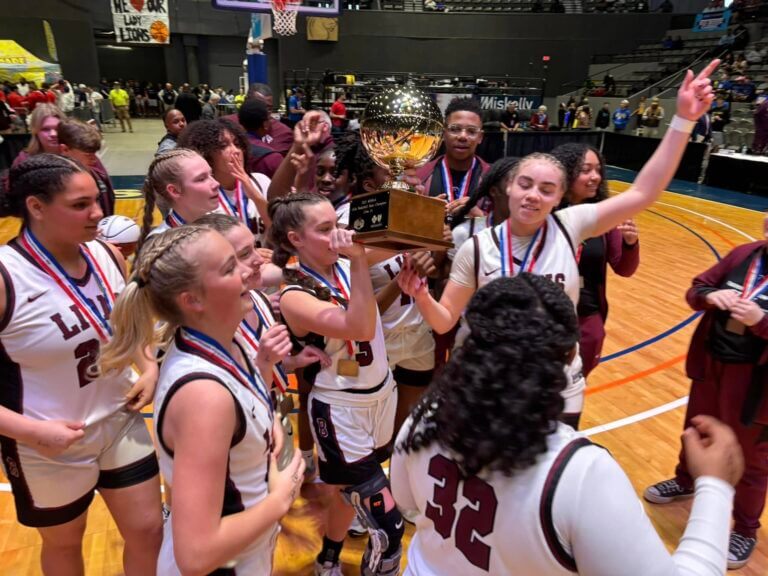
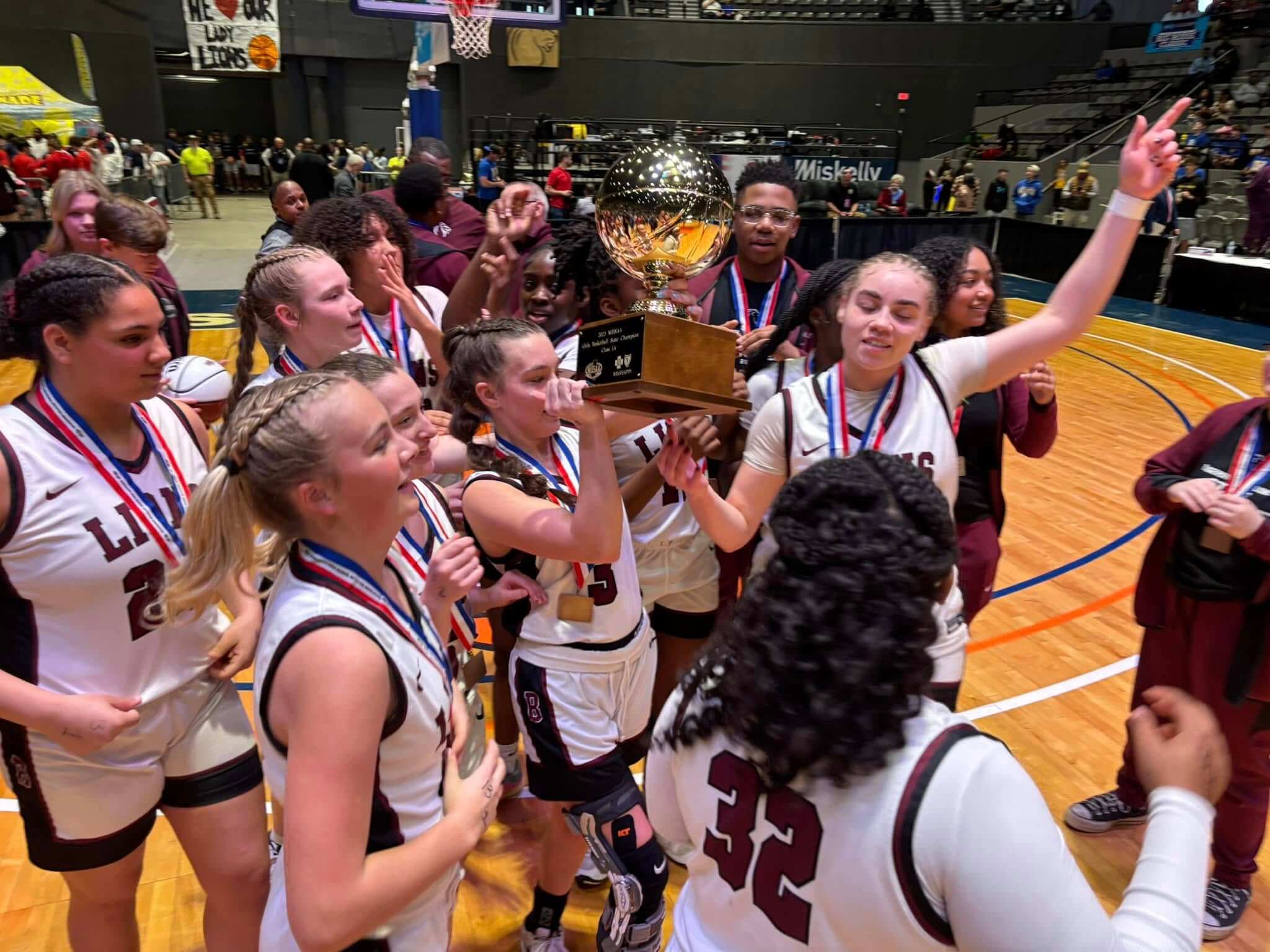
Lainey Jackson Little, 3, holds Biggersville’s state championship trophy Friday morning Mississippi Coliseum while her teammates celebrate. (Photo by Brad locke)
To borrow from the Southeastern Conference: Basketball just means more in extreme northeast Mississippi, more commonly known as Hill Country. Never was that more evident than Friday morning at Mississippi Coliseum. In a battle of tiny town titans, the Biggersville girls came from behind to defeat Thrasher 54-47 for the Class 1A state championship in a fiercely contested, well-coached and well-played game.
When the final horn sounded, the basketball court became a sea of emotion, tears flowing seemingly everywhere: tears of joy, tears of despair. As much as the outcome meant – one way or the other to so many folks – it just had to mean more to one family. They would be the Littles of Biggersville.
Cliff Little is the Biggersville head coach. Jana Little, his wife, is an assistant coach. Lainey Jackson Little, their daughter, is a junior guard on the team. Eighteen years ago Cliff and Jana were a young married couple teaching at East Webster in Maben. Cliff was an assistant basketball coach, Jana the team’s scorekeeper. The team qualified for the State Tournament in Jackson, but Jana, six months pregnant, was diagnosed with toxemia (pregnancy-induced hypertension) and stayed home.
On March 1, 2007, Jana gave birth to a daughter, who weighed one pound, 15 ounces. “She would have fit in the palm of my hand,” Cliff Little says.
They named her Lainey Jackson, the middle name from the name of the place they had planned to be the night Lainey Jack, as they call her, was born. The initial prognosis was grim: She might make it, she might not. Lainey Jack spent the first six weeks of her life in the hospital, mostly in an incubator. The tiny girl showed then what the folks in Biggersville have come to know – that she was a fighter.
Let’s move ahead 17 years to this time last year. The Biggersville girls with Lainey Jack as their second leading scorer and playmaker made it to the State championship semifinals against Lumberton, only to lose by a single point on two late free throws.
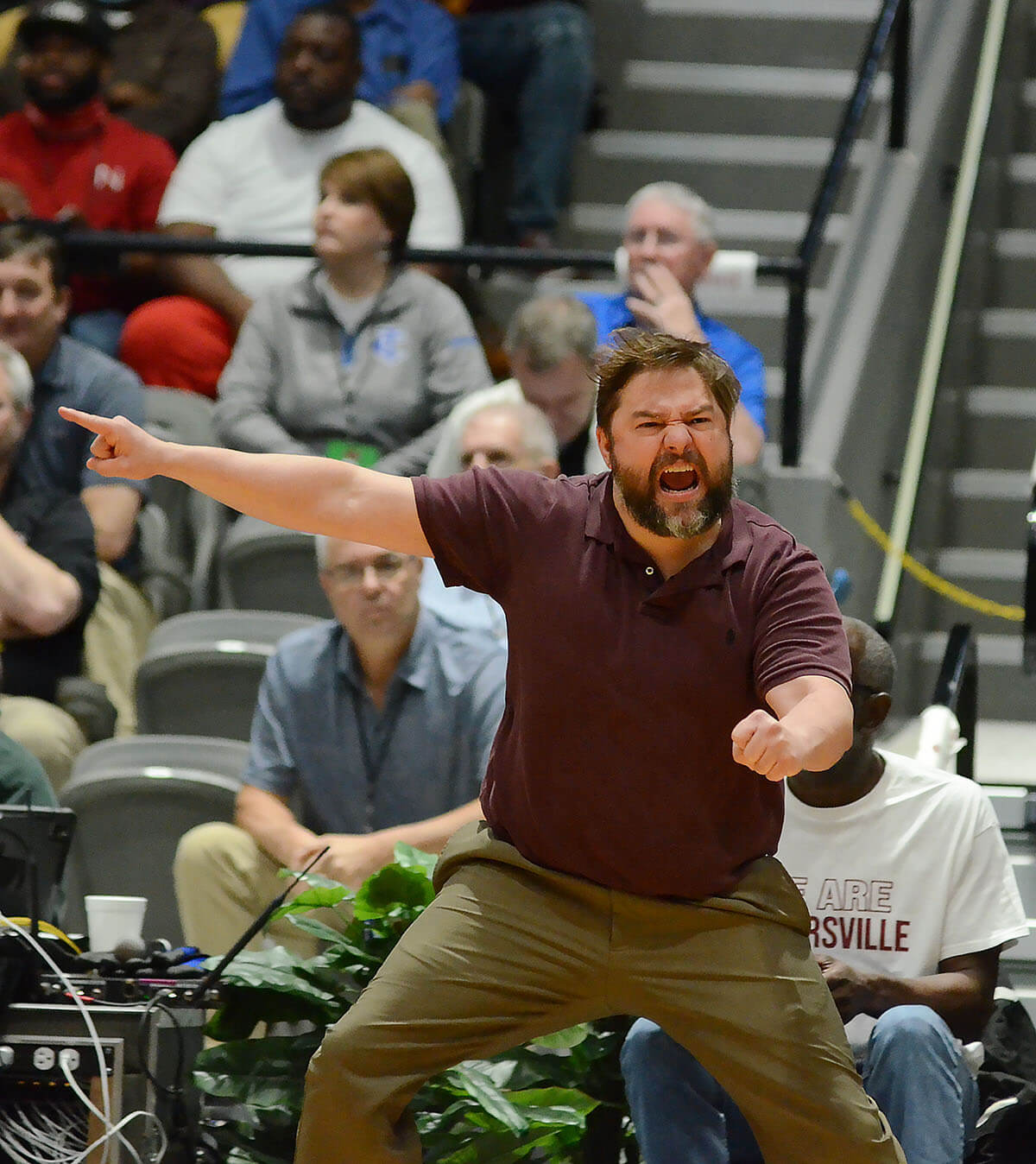
Biggersville head basketball coach Cliff Little encourages his team to hurry down court and play defense in a tight game against McEvans in the Class 1A finals at the Mississippi Coliseum, Thursday, Mar. 3, 2022. Credit: Vickie D. King/Mississippi Today
Cliff Little also coaches the Biggersville boys, who went on to win the 2024 state championship. So he wasn’t back in Biggersville the day after his girls were eliminated. He wasn’t in the Biggersville gym when his girls took the floor for their first practice in preparation for what occurred Friday morning at Mississippi Coliseum.. The family have rarely missed a day together since.
They certainly didn’t miss on the eighth day of May last year when, during a players-only practice, Lainey Jack went down with a horrible injury to her right knee. A torn ACL that required surgery and months and months of strenuous rehab.
How strenuous? When his daughter first began her rehab at home, Cliff would make sure a garbage can was nearby for when she would need to vomit, which was all too often. But she was determined and kept at it, day after day. We may assume that when you come into this world weighing 31 ounces, such grit comes naturally.
Said Cliff Little, “I told her back during all that rehab that when we won the state championship I was going to have the date – May 8th – inscribed on her ring.”
Lainey Jack was released to play again in December, just seven months after surgery. She is still working to recover the quickness and cutting ability she possessed prior to the injury, but it’s coming.
She was in the starting lineup Friday, a heavy brace on that right knee.. One minute into the game, she swished a 22-foot three-pointer to give Biggersville its first lead. That would be her only basket, but she scrapped and battled throughout. And, afterward, she was in the middle of the celebration, holding the cherished Gold Ball trophy.
“I worked really hard to come back, and that’s what makes this so special,” she said, before deflecting praise to her teammates, 15-year-old Sadiya Hill in particular. Hill scored 24 points to lead the Lions, while Jaylee Stafford scored 19 and pulled down 11 rebounds despite playing much of the fourth quarter with four fouls.
Stafford and Little are juniors. The gifted Hill is just a sophomore and her talented older sister, K’yana Hill is another junior. So there’s a good chance Biggersville will be back again next year. No telling how many championships the 46-year-old Cliff Little will win before he’s done. This makes seven state championships – five boys, two girls – in all for Little.
“They are all special,” Little said when asked where this latest championship ranks. “They’re all special, but this one, considering the circumstances… this one’s extra special.”
Put it this way: There will be an 18th birthday party, combined with a state championship celebration, in Biggersville Saturday.
Sheldon Bray of Blue Springs said he took his wife and two sons to the “March to Save America” rally in Washington, D.C., on Jan. 6, 2021, because he wanted to show his boys the importance of making their voices heard.
“I don’t like people that complain about what’s going on, but you don’t participate and let your representative know,” Bray told Mississippi Today. Instead of “sending somebody up there to read your mind,” Bray said, people should “get involved.”
He said that in months before Jan. 6, he had worriedly watched the imposition of mask mandates and the rapid expansion of absentee voting since the beginning of the COVID-19 pandemic.
“Politicians on both sides of the aisle had told us for years that our elections are being messed with and our elections aren’t secure,” he said. “And then we get to 2020, and all of a sudden, this election was perfect.” But he “just kept getting the feeling like an investigation was off the table.”
Four years after the breach of the U.S. Capitol on Jan. 6, 2021, Bray and others among the 13 Mississippians charged in connection with the events of that day – even those who pleaded guilty – defend their actions, which they maintain were misconstrued by the media and misunderstood by a broad swath of the public. As some Mississippians served sentences over the past three years, a community emerged around them, hailing them as patriots and political prisoners. That community now considers the pardons a sign of victory.
In all, Trump granted sweeping clemency to all of the nearly 1,600 people charged in the attack on the Capitol.
State Rep. Daryl Porter, Jr., D-Summit, called the pardons “a slap in the face to law enforcement.”
“I think it is a slap in the face to the Constitution. I think it’s a slap in the face to this country,” Porter said. “It sends a really poor message, that if something cannot go your way, you can thus break the law and then be let go, and not face any consequences for what you’ve done.”
A Hero’s Welcome in Oxford
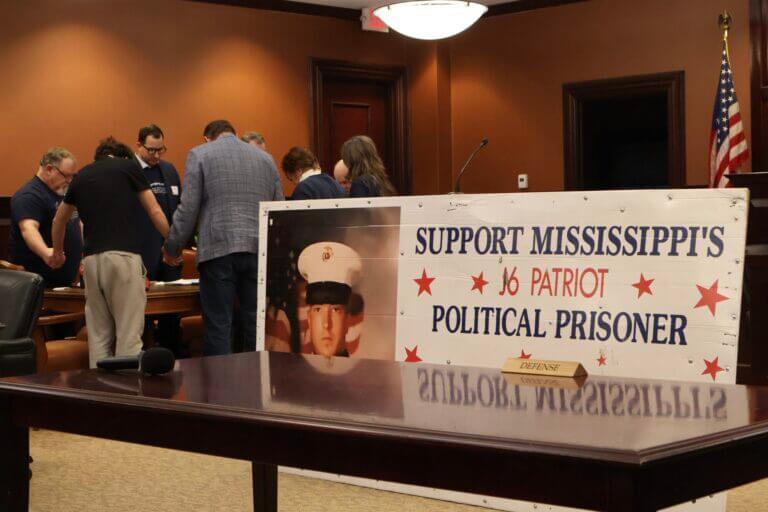
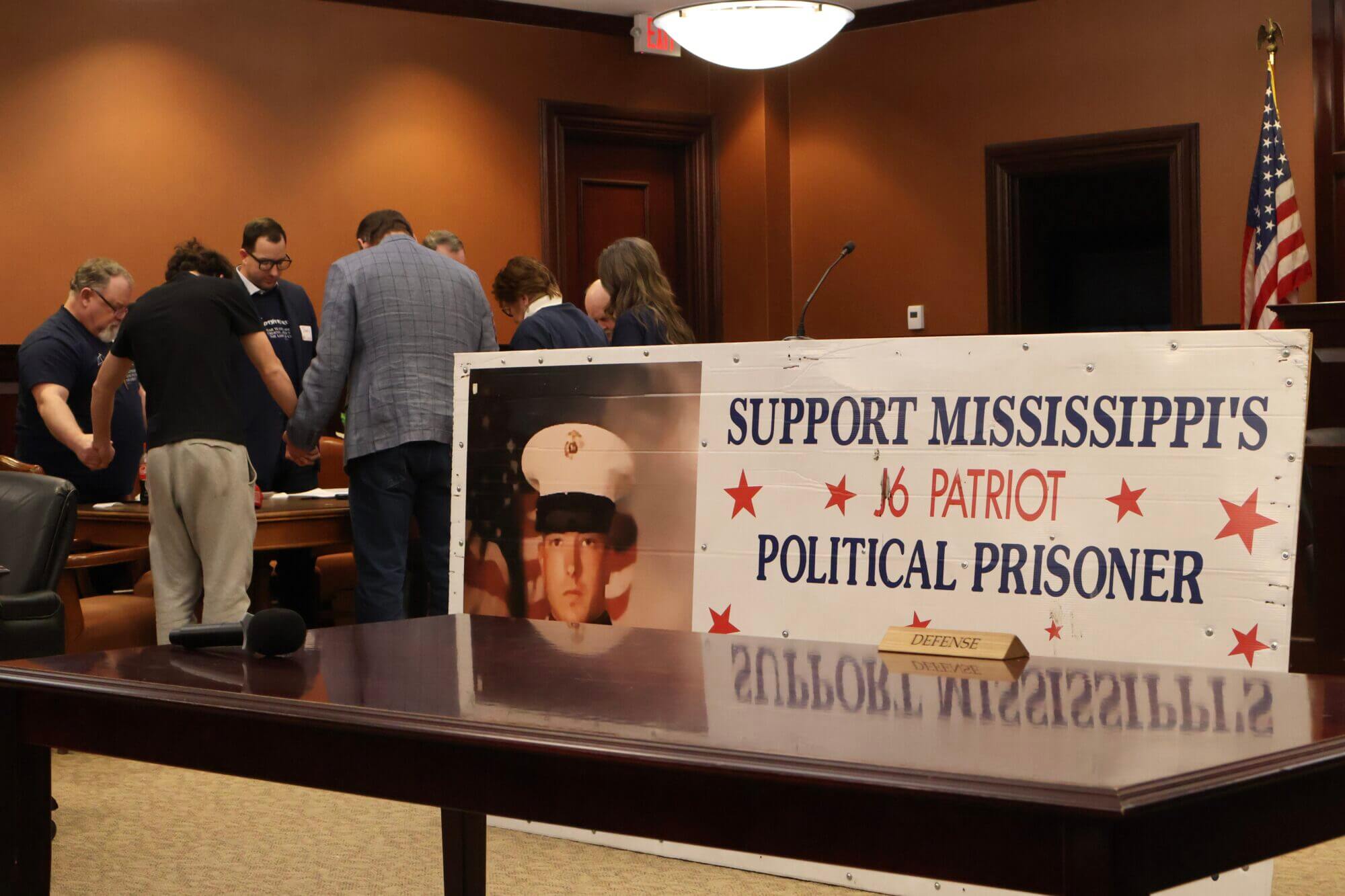
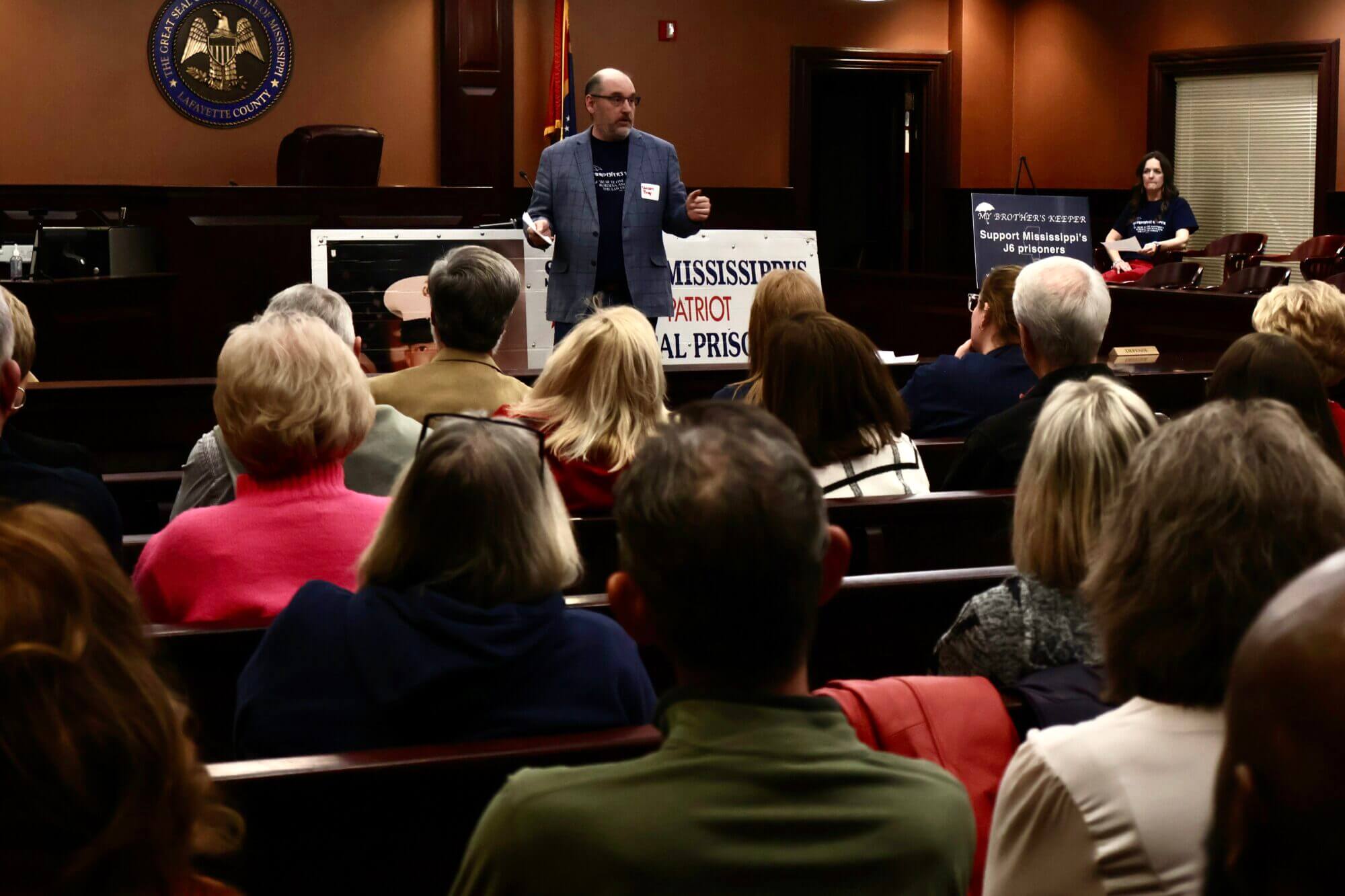
Bray and five other Jan. 6 defendants spoke to about 50 people in a Lafayette County chancery courtroom in Oxford on Feb. 21.
Bray told the group there had been many times when he had to tell the stories of incarcerated Jan. 6 participants on their behalf, “but through the grace of God, I don’t have to do that tonight.”
Sheldon Bray speaks in a Lafayette County Chancery courtroom on Feb. 21, 2025, as an audience of approximately 50 listen with rapt attention, and Lori Cyree of My Brother’s Keeper–Oxford looks on Credit: Mukta Joshi/Mississippi Today
The meeting was hosted by the Union County Republican Women’s Club, the Mississippi Conservative Coalition and My Brother’s Keeper-Oxford, a group founded in 2022 to organize letters and donations for Mississippians charged in connection with the Capitol breach. The Oxford-based group is unrelated to a nonprofit of the same name that works to reduce health disparities, as well as an Obama Foundation program that supports boys and young men of color.
Lori Richmond Cyree, the founder of My Brother’s Keeper-Oxford and lead organizer of the event, described the community that formed around Jan. 6 defendants as “the heart and soul of this country.”
Cyree said she hoped the event would foster understanding by allowing people to hear from Jan. 6 defendants in person. “I just believe that if you get people together and they can have honest conversations, wonderful things can happen,” Cyree said.
Several speakers described their actions on Jan. 6 as part of a sea change that had shifted the country off a path they said was corrupt and authoritarian.
Mike Brock of Walls told the audience he never intended to partake in an insurrection – just to pressure Pence to delay lawmakers’ certification of the electoral vote count. Brock said he told federal agents that he felt he had no choice but to travel to Washington in January 2021.
“It’s disgraceful to all the people that have shed their blood for this country to not do nothing, not stand up and even raise a hand, to say, ‘Hey, I’m against this,’” Brock remembered telling the agents.
Brock, who was charged with obstructing and attacking law enforcement, violence on Capitol grounds and disorderly conduct, said he was pushed into a police line by “a whole football team” of running protesters after making his way from the rally to the Capitol. He was awaiting the announcement of his trial date when Trump pardoned him.
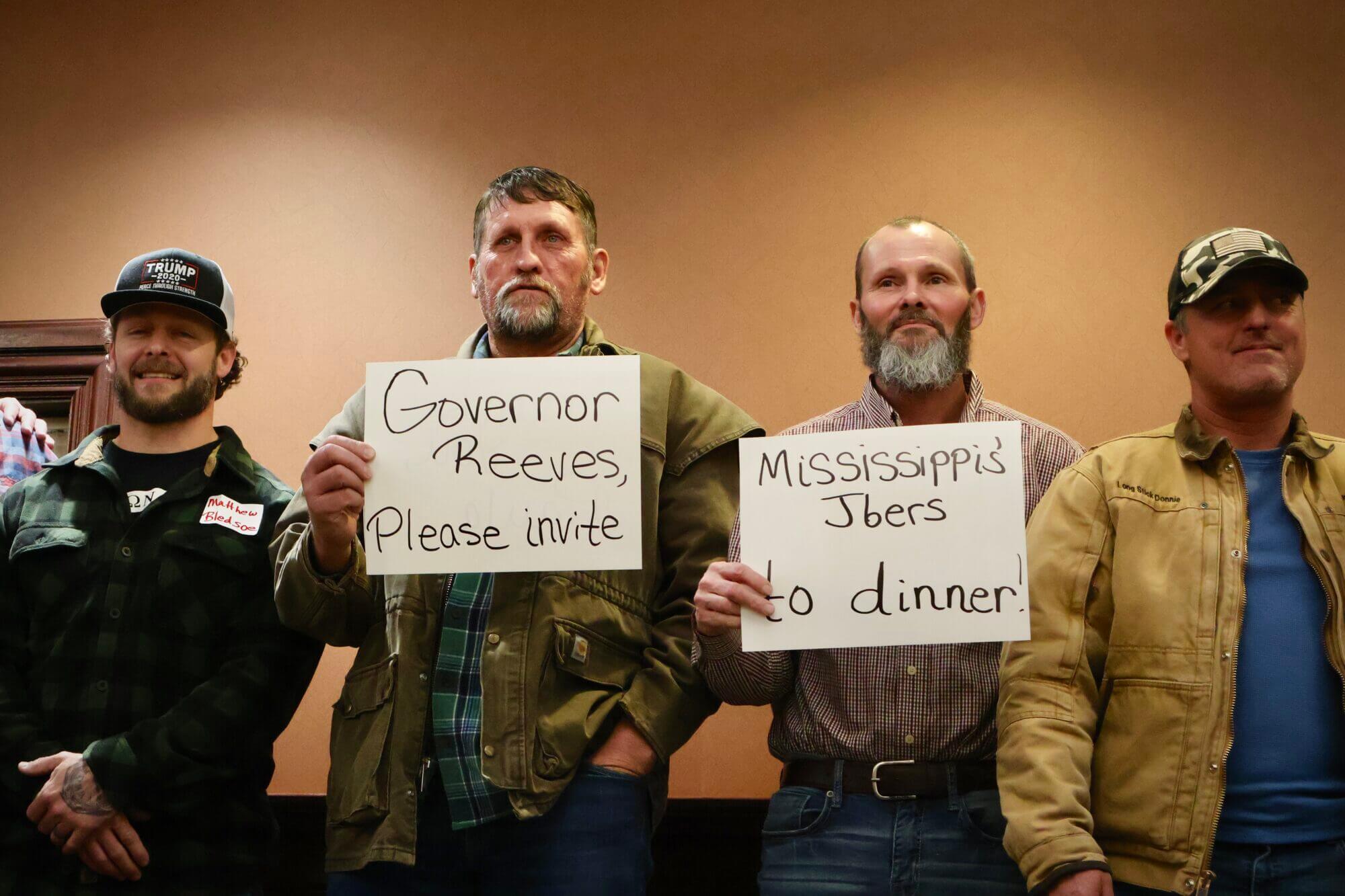
Two Mississippi Jan. 6 defendants, Mike Brock and Thomas Harlen Smith, hold up signs Feb. 21, 2025, in Oxford requesting Gov. Tate Reeves to “invite Mississippi’s J6ers to dinner.” Credit: Mukta Joshi/Mississippi Today
Thomas Webster of Oxford suggested that “deep state actors” used the public’s fear of the COVID-19 virus to make way for fraudulent election practices.
“Do you believe COVID was an accident?” Thomas Webster asked the attendees, some of whom responded, “No!”
“The timing of that was just unbelievable. And I believe it was intentional, designed to create that atmosphere to make everybody so afraid.”
Webster, a retired New York City police officer and Marine Corps veteran, was convicted of charges including assaulting a police officer with a dangerous weapon, a flagpole bearing the Marine Corps flag. He said that law enforcement officers outside the Capitol failed to use proper de-escalation methods and that he acted in self-defense after an officer provoked him. He was serving a 10-year prison sentence at the time of his pardon.
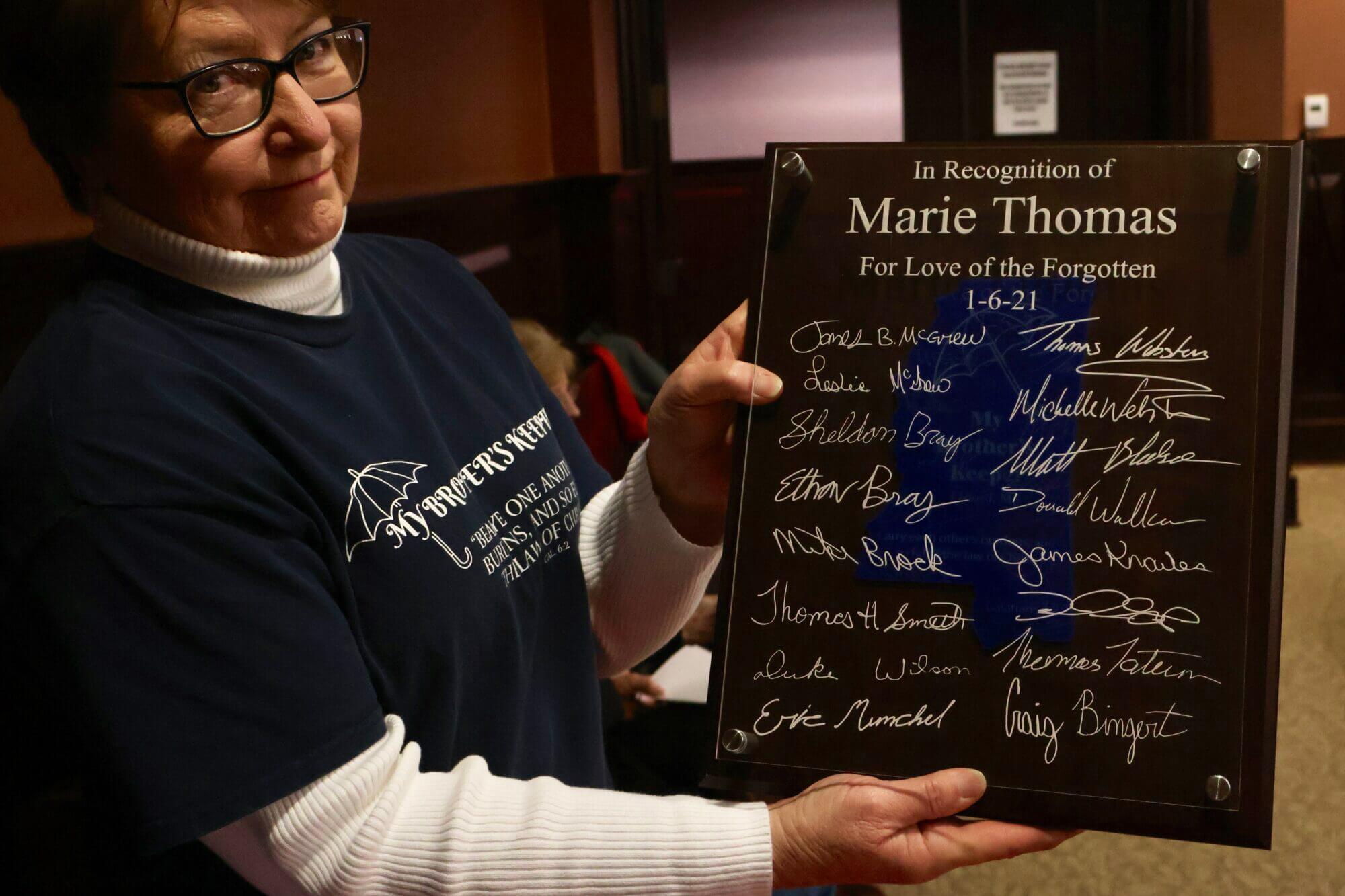
At the end of the event, the pardoned speakers gave Cyree and Marie Thomas, who also works with My Brother’s Keeper-Oxford, plaques engraved with Mississippi Jan. 6 defendants’ signatures. “For Love of the Forgotten,” the plaques read.
On Feb. 21, 2025, Marie Thomas, who works with My Brother’s Keeper–Oxford, holds a commemorative plaque bearing the autographs of Mississippians who were charged for their involvement in the Jan. 6, 2021, Capitol insurrection. Credit: Mukta Joshi/Mississippi Today
Nancy Frohn, of the Union County Republican Women’s Club, cast Trump’s second term as a new beginning for the country.
“I think God let Joe Biden go into office to let us see how bad things could really get,” said Nancy Frohn of that group.
“We have to thank God every day that he has given our country a second chance.”
‘Every background you can think of’
The Jan. 6 defendants interviewed by Mississippi Today had a wide range of reasons why they were supporters of Trump and part of the broader “Trump community,” as Bray put it.
Thomas Harlen Smith of Mathiston said he never voted in a presidential election until 2020, and he didn’t like Trump until he ran for president. “I thought, he’s a rich guy, you know? I’m just a poor Mississippi guy.”
But Trump “stuck to what he said,” said Smith, and put the country’s economy first.
Smith said Trump’s policies before the COVID pandemic benefited small businesses like his excavation and construction company. “We owe it all to Trump, whether people like that or not,” he said.
“Even during COVID,” said Smith, “I still did fine.”
Smith was convicted of 11 charges in 2023, including assaulting a police officer with a dangerous weapon and obstructing an official proceeding. Smith said he accidentally grabbed a police officer as he tried to pull protesters out of a clash with law enforcement on the West Terrace of the Capitol. He was serving a nine-month prison sentence when Trump issued the pardons.
James McGrew of Biloxi, who served in Iraq and suffered injuries and substance dependency as a result, said he began supporting Trump because of his positions on veterans affairs and in particular, the Veteran’s Choice program, which allowed veterans to choose their healthcare providers.
“All the VA did for me up until about 2016 was give me pills,” he said. It wasn’t until “the middle of 2016, 2017, that the VA started changing.”
The Trump administration expanded eligibility for the program in 2017, though it was first passed in 2014 during the Obama administration.
“I supported Donald Trump just for that reason alone – that he supported me.”
McGrew pleaded guilty in 2022 to “assaulting, resisting or impeding” law enforcement officers and was sentenced to 78 months in prison.
Some of the Jan. 6 defendants made it clear they did not consider themselves uncritical supporters of Trump. Brock said that he’s a Trump supporter at the end of the day. But “I got a lot of stuff that I could say against Trump,” he said, “that I wish he’d have done different, or would do different.”
Brock said that although Trump is “the man of the hour,” he thinks the president doesn’t “admit any of his mistakes” and pushed COVID restrictions and vaccines too hard during his first term.
As general principles, he believes in small government and worries about the role of money in politics.
“We don’t need the federal government to do nothing for us,” Brock said. “What we need, worse than anything, is somebody to get the federal government out of our business.”
And Brock said something needs to be done about corrupt politicians.
“They call bribing lobbying,” he said. “To me, that’s become the same thing.”
Bray said he had a distrust of billionaires, and Trump being a part of that club made him wonder whether one could really believe that he was for the people.
He also took issue with people seeing Trump as a savior. “There’s a lot of Trump voters that are like, ‘This will fix everything. We just gotta elect Trump, and everything’s fixed.’”
Bray was convicted in 2024 of obstructing law enforcement, and of disorderly and disruptive conduct in a restricted building. He said he used a police riot shield to part crowds in the Capitol rotunda as he and his son were trying to leave, but he denied interfering with law enforcement. He recalled complying with officers’ instructions and offering his first aid kit to an officer who appeared injured. Before the Justice Department dropped his case last month, his sentencing was scheduled for February.
Bray spoke about the importance of engaging with politics, learning about representatives, tracking how they vote, and speaking up. “You can’t just flip on the TV for one hour each day and watch whatever your favorite brand of news is, and just take that and say, ‘Okay, I’m informed’,” Bray said.
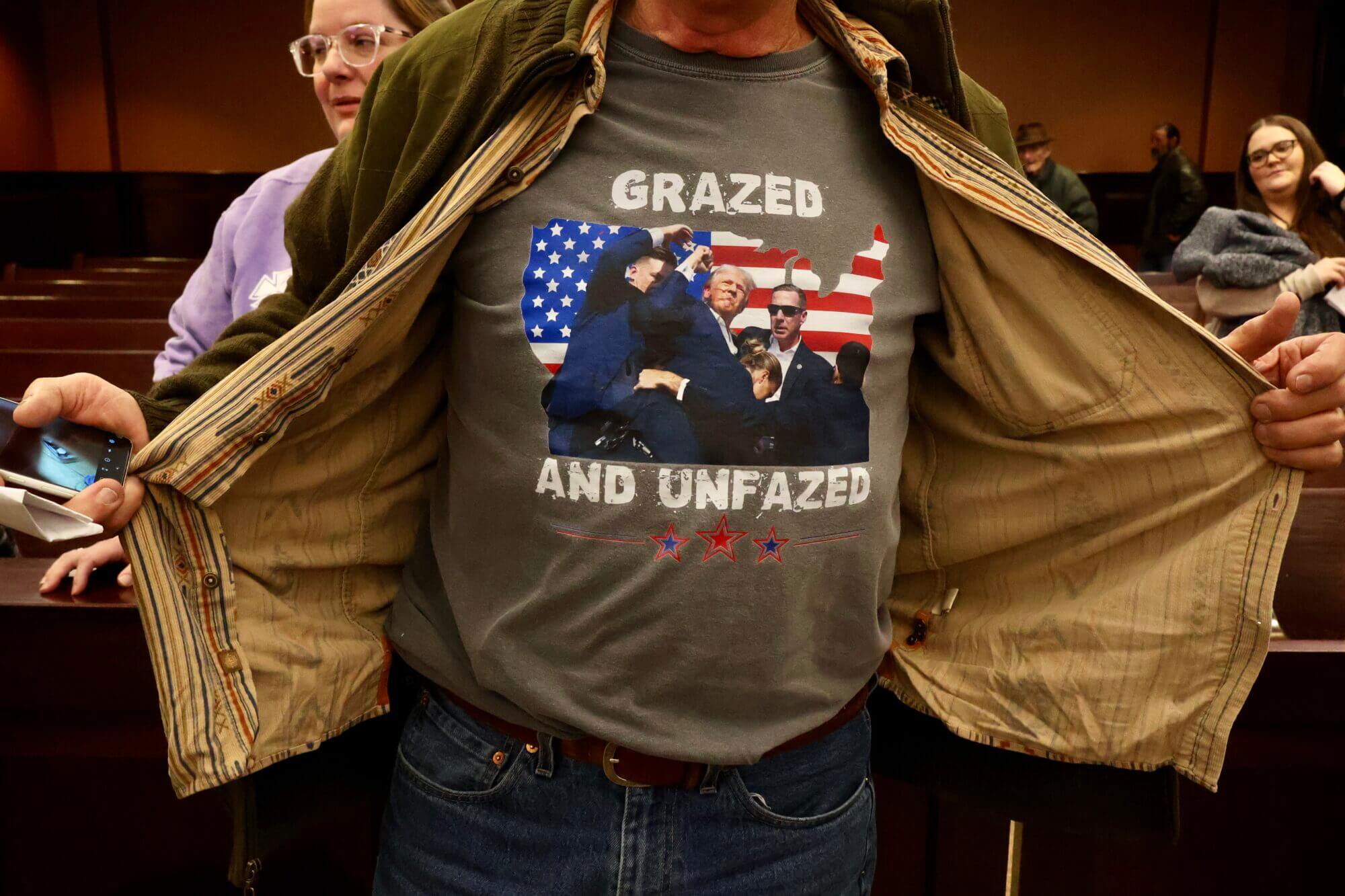
An attendee of the Feb. 21, 2025, event in Oxford proudly shows his T-shirt. Credit: Mukta Joshi/Mississippi Today
“All the nationwide media, the legacy media companies, they portrayed us as terrorists, extremists, conspiracy theorists,” McGrew said. To a lot of people, he said, “we were monsters.” But he wants people to know that the people who participated in Jan. 6 aren’t a monolith. “We’ve had every background you can think of as part of this movement.”
Cyree believes that the way to make progress is for individuals to talk to each other directly.
“We’ve got this groupthink that needs to stop,” Cyree said. “Groupthink sometimes goes to group hate and group misunderstanding. If you can get one person to talk to another person, they can find out they have a lot more in common that unites them, than separates them.”
Mid-South Food Bank has shuttered 12 of its mobile food banks in Mississippi as well as dozens of others in Arkansas and Tennessee with the ending of federal COVID-19 rescue funding.
Under the America Rescue Fund Act, the Department of Human Services, Office of Economic Opportunity, awarded $4.3 million to food banks across the country. Mid-South Food Bank added more sites to its mobile food program to reach more people during the COVID lockdowns in 2020.
Interim President and CEO Scott Fortin explained that the cuts are part of the nonprofit’s efforts to spend their donations and funding better. He said some of these sites were redundant as there were brick-and-mortar locations close by.
“We are doing our best to continue to distribute food through the programs that we’ve always had, and while looking at those programs we expanded during COVID to see how they can continue to run but more efficiently” he said.
In all, 49 mobile sites were closed. The food bank’s website has a schedule of all the current mobile pantry locations and times.
The Mid-South Food Bank distributes over 2.5 million meals annually to parts of Arkansas, Tennessee, and Mississippi with 186,550 of them in Mississippi.
Memphis-based Mid-South Food Bank serves 440,000 meals a year. It saw a huge spike in demand during the pandemic. Fortin said that has since decreased. But in general, food banks across the country are reporting increased demand, according to a 2023 survey by Feeding America.
Food insecurity went up after the COVID pandemic, according to a 2023 report from the U.S. Department of Agriculture, the latest available. The U.S. House resolution budget bill passed this week and endorsed by President Trump includes $230 billion in cuts to the Supplemental Nutrition and Assistance Program (SNAP). If it passes, food banks could be impacted even more.
While nationally one in 10 Americans are food insecure, in Mississippi the number is one in four and the state has the highest rate of food insecurity in the country, according to Uproot Mississippi.
Extra Table, founded in 2009, is a statewide
nonprofit food bank with a mission to fundraises to purchase new healthy and shelf stable foods that are delivered to 60 food pantry and soup kitchen partners for free monthly. Credit: Josh McCoy/City of Oxford
Executive director Martha Allen Price of Hattiesburg-based Extra Table, which receives no federal funding, said she’s seen an increase in demand for food since the pandemic, especially with rising grocery prices. She noted that “13.4% of Mississippians are working and still not making a living wage, and so they’re using the food pantry as an emergency source of food.”
Extra Table partners with food pantries to fundraise on their behalf for healthy and shelf-stable foods. Their funding comes entirely through private donations. They work with food pantries in 51 Mississippi counties.
“We provided 1.3 million pounds of food last year to our food pantry and soup kitchen partners,” Megan Burkes with Extra Table said.