Audio recording is automated for accessibility. Humans wrote and edited the story.
Mississippi educators are preparing for new financial literacy, computer science and civics requirements under Senate Bill 2294, a wide-ranging education law that took effect July 1.
Many of the classroom requirements of the Mississippi Math Act will be phased in over the next several years. The bill incorporates the J.P. Wilemon Jr. Financial Literacy Act, which failed to pass as a standalone measure in previous legislative sessions.
Beginning with the 2027-28 school year, Mississippi public schools will be required to provide financial literacy instruction for students in grades 6-8. The curriculum will cover topics including income, budgeting, financial services, postsecondary education financing and consumer rights. The law also establishes new computer science and civics education requirements that will be implemented on separate timelines.
The Canton Public Schools district office will work throughout the year to prepare for the curriculum change during the 2027-28 school year. Credit: Allyson Cole/RHCJC
At Canton Public School District, financial literacy has traditionally been taught through partnerships with community organizations. Candra Nelson-Scott, assistant superintendent of curriculum and instruction, said outside educators provide students with practical lessons on managing money.
“They talk about banking, savings accounts, investment accounts, budgeting, as well as informing (students) about loans, interest rates and principals,” she said.
Nelson-Scott said the new law will establish consistent statewide expectations while giving districts flexibility in how the curriculum is delivered. She said district leaders and teachers will help determine whether financial literacy is offered as a standalone course or integrated into an existing class.
Teacher training is expected to begin in summer 2027 as districts prepare for implementation.
Heather Morrison says the Department of Education is working with educators to prepare them for the new curriculum. She hopes parents will take the initiative and have open conversations with their students about financial literacy. Credit: Mississippi Department of Education
Heather Morrison, director of P-20 Partnerships for the Mississippi Department of Education and the Mississippi Institutions of Higher Learning, said the department is working with partners across the state to prepare educators.
“For the high schools, the teachers are going to have to earn an endorsement,” Morrison said. “For middle school, there’s no technical endorsement (requirement) yet.”
Morrison said any educator may add a personal finance endorsement to a teaching license by completing a Mississippi Council-approved economics education course.
She also said students entering seventh grade in the 2026-27 school year — the graduating Class of 2032 — will be the first required to earn a personal finance credit before graduating from high school.
“Kids who take (College and Career Readiness courses) meet that personal finance requirement,” Morrison said. “If they don’t take that class, then they have to take the personal finance class.”
Morrison said financial literacy is a life skill that should extend beyond the classroom and encouraged parents to reinforce those lessons at home.
Canton High School will incorporate financial literacy as a graduation requirement in future years. Credit: Allyson Cole/RHCJC
“I would hope parents are having these conversations with their students at home and make it a real-life conversation … having these conversations at home about budgeting, student loans, student debt,” Morrison said. “I definitely think it’s a positive (way) to spur conversation.”
Nelson-Scott agreed, saying early exposure to financial concepts can better prepare students for adulthood.
“I’m speaking from personal experience,” she said. “I can’t remember having that conversation (about financial literacy). Giving students this information early… gives them an early start.”
Students and parents can expect financial literacy instruction to begin in Mississippi middle schools during the 2027-28 school year as districts implement the new requirements.
Audio recording is automated for accessibility. Humans wrote and edited the story.
CARROLLTON – What if Emmett Till had made it safely back to his home in Chicago?
That’s the question best-selling author Sarah Lewis seeks to answer in her new book, “If Emmett Till Lived,” a collection of essays and photographs meant to illustrate possibilities of the life of Till, who would have recently celebrated his 85th birthday.
Up to 100,000 attended his funeral at Roberts Temple Church of God in Christ in Chicago on Sept. 6, 1955. His mother, Mamie Till-Mobley, left open the casket of her 14-year-old son. “I wanted the world to see what they did to my boy,” she said.
The photograph of Till’s brutalized body appeared in newspapers around the world.
One reporter described his mother’s decision as opening the casket and opening the nation’s eyes, Lewis said. “Mamie Till-Mobley had the prophetic wisdom to understand that central for American democracy is the act of witnessing together what many want to not see — the crucible of this country.”
She understood that the work of the Civil Rights Movement “could not continue without the importance of images,” Lewis said.
Before a month had passed after the kidnapping and lynching, an all-white jury acquitted two of Till’s murderers, Roy Bryant and J.W. Milam, who later shared their lie-filled story of killing Till with Look magazine in exchange for cash.
Emmett Till
The injustice helped propel the movement. Four days after hearing a talk about what happened to Till, Rosa Parks refused to give up her bus seat in Montgomery, Alabama. She was later quoted as saying she was thinking about Till the whole time.
The injustice inspired so many young people to join the movement that they became known as “the Till generation.”
Lewis, an art and cultural historian serving as the John L. Loeb associate professor of the humanities and associate professor of African and African American Studies at Harvard University, decided to do her new book after visiting Graball Landing, the place where Till’s body was found three days after he had been brutally beaten, shot, weighted down with a cotton gin fan and thrown in the Tallahatchie River.
On her flight back to Boston, Lewis said she wondered, “How different would this country be if everyone knew how hard-won it has been to honor the humanity of this child, of this Black child, for all that has been done?”
Now, on the anniversary of Till’s 85th birthday, the question remains, has society “made good on the sacrifice of his life?” she asked. “I thought, ‘I have to do my part.’”
She went through 18,000 photographs in the Museum of Contemporary Photography at Columbia College Chicago’s collection and “found images that I’m not afraid to say felt were inspired by a kind of a divination,” she said. “I was praying to Emmett Till, asking how he wanted his life to unfurl. And the images in the book represent the answers.”
She chose about 180 pictures taken by Gordon Parks, Henri Cartier-Bresson, Dorothea Lange and other photographers for the project.
Best-selling author Sarah Lewis, an art and cultural historian at Harvard University, has written “If Emmett Till Lived,” a collection of essays and photographs meant to illustrate possibilities of the life of Till might have had. Credit: Photograph by S. Rosner, courtesy of Sarah Lewis
She pointed to the cover photograph of a father tossing his son in the air. “Is Emmett Till the father throwing up his son?” she asked. “He should’ve been able to have had that option in his life. Or is he the young child who looks so secure in that love, knowing that his father’s gonna catch him when he comes down?”
The titled horizon on the cover points to the work that still needs to be done, she said. “ Emmett Till is all of our stories. It’s a book that opens with a call to the celestial, to the divine.”
She pointed to the inside cover page featuring a flock of birds. Exactly 55. The year Till was killed.
“It seems to be one of these winks that keeps happening,” she said, “Emmett Till making his presence known.”
These images — such as the photo of a distinguished looking painter with his brushes — begin to converge around the story, she said. “This is a way to imagine one of the pathways he could have chosen. He could have been an artist.”
The book includes essays from Secretary of the Smithsonian Institution
Lonnie G. Bunch III; Sherrilyn Ifill, the Vernon E. Jordan Jr. Endowed Chair in Civil Rights at Howard University; and Patrick Weems, who runs the Emmett Till Interpretive Center in Sumner. Others, such as film director Ava DuVernay, comment on the images.
Harvard University professor and author Sarah Lewis points out photos from her new book, “If Emmett Till Lived,” on Friday, July 17, 2026, in Carrollton. Credit: Claudia Amendoeira/Mississippi Today
An exhibition of these pictures will open Sept. 10 at the Museum of Contemporary Photography in coordination with the book’s publication by the museum and DelMonico Books • Distributed Art Publishers.
Most historical figures fade as time passes, but Till continues to grow as a symbol, Lewis said. “Emmett Till’s life didn’t end in the casket. It really continues with all that happened in its wake.”
Some have responded to monuments that remember Till’s life and death with violence. The Graball Landing marker was shot 317 times.
Those in charge of these markers erected a bulletproof replacement. “Every act of resistance, every roadblock to honoring Emmett Till only underscores, not only the importance of Emmett Till’s legacy,” Lewis said, “but the importance of the very thing we often take for granted, which is the power of monuments and markers.”
This bullet-riddled “river sign” marked the area where the mutilated body of 14-year-old Emmett Till, the victim of a notorious lynching, was discovered. The sign had to be removed after being repeatedly vandalized. A bullet-proof marker has replaced it. Credit: Photos courtesy of the Emmett Till Memorial Commission
Last month, Illinois designated July 25, Till’s birthday, as an annual day of reflection and remembrance to honor him and his mother.
Lewis said she has been stunned by the response to her book, “mainly because independently so many mention that they are moved to tears.”
The brutal killing of Till and the injustices that followed became a collective trauma, she said. “Every generation has needed a way to grieve.”
She called the book “almost a reverse wake, a reverse funeral. The images take you chronologically through the unlived life of Emmett Till.” This ascension honors Till’s life, “with all of the beauty that could have come with it,” she said.
She has already heard from educators interested in using the book for classes, she said. “The question, ‘What if Emmett Till lived?’ inspires so many: what would have life required of us all, foremost among them, that one can easily teach entire units on American history from it.”
This book project, she said, never would have happened without the help of Till’s cousin and best friend, the Rev. Wheeler Parker, the last surviving witness to his abduction.
Emmett Till’s cousin, Wheeler Parker, tours Cotesworth, the former home of Confederate leader and U.S. Sen. J.Z. George in Carroll County on July 17, 2026. He was invited by George’s great-great-great grandson, Charles Sims. Credit: Richard Lake/Mississippi Today
Lewis and Parker visited Mississippi in July at the invitation of Charles Sims, whose great-great-great grandfather was a Confederate veteran and U.S. senator for Missisisippi, J.Z. George, who led the fight to disenfranchise Black Mississippians through the state’s 1890 constitution.
Sims, who spoke on Memorial Day at Parker’s church in Chicago, led the pair on a tour through George’s Cotesworth. “He and I connected through history,” he said. “That bonded us.”
He recalled the words of the Rev. Martin Luther King Jr., who talked of his dream that one day “the sons of former slaves and the sons of former slaveowners will be able to sit down together at a table of brotherhood.”
Having Parker and others come to Cotesworth was “more important than coming to a plantation. It was about Mamie Till-Mobley. It was about Simeon Wright. It was about Wheeler Parker,” Sims said. “We’re putting the right foot forward for the future.”
Parker said he is pleased with what Lewis has done with the book. For too many years, articles were filled with lies about Till, he said. “You feel so helpless because you are not in control of the narrative, but then if you live long enough, you come to something like this where everything comes out.”
Lewis said she and Parker selected all the images together for the book. “When you watch him look at a photograph and envision Emmett Till’s life, envision the life he should have had alongside him, I mean, it’s profound beyond description,” she said. “Nothing has moved me ever to my soul the way that working on this alongside Rev. Wheeler Parker has.”
Federal authorities have arrested a California man accused of sending a bomb and death threat to a Mississippi Gulf Coast judge, the parent of a friend who went with Nolan Xavier Wells on the Fourth of July to Horn Island, where the Black teenager’s body was found two days later.
Joseph Alfredo Vasquez Dumarce, 27, of Sacramento, faces a federal charge of interstate transmission of threatening communication. Conviction on that felony carries a maximum sentence of five years, a maximum $250,000 fine and up to three years of post-release supervision.
On July 11, a Facebook user “yaeyae962” sent a direct message to a Jackson County chancery judge who is not named in the criminal complaint and only identified by the initials “A.C.” in an indictment, which were both unsealed Thursday.
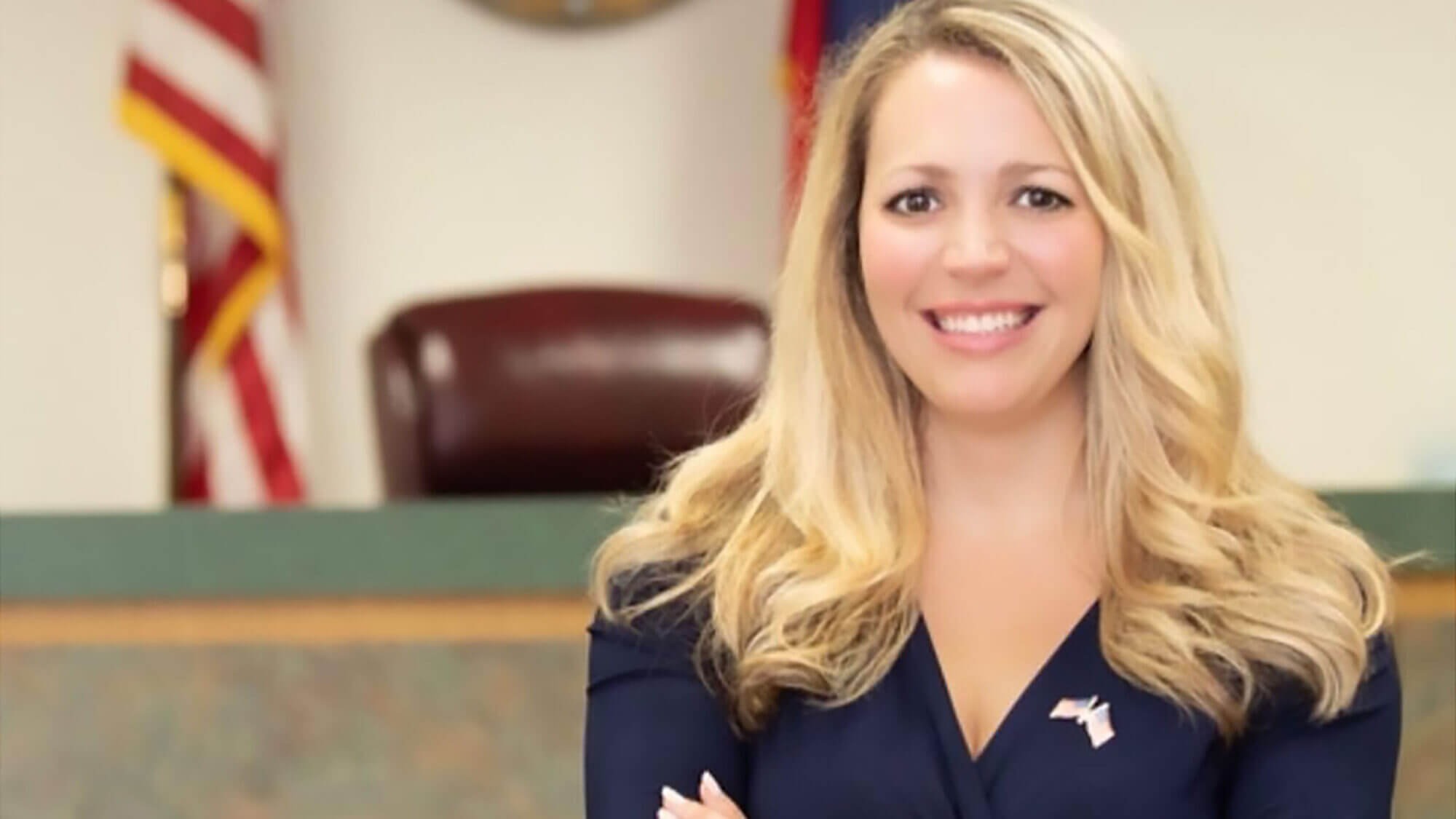
That judge, Ashlee Cole, posted online about receiving the threat and others from the user. Cole is the stepmother of Warren Hudson, who was part of the friend group with Wells who traveled by boat to Horn Island on July 4.
Wells did not return to Ocean Springs with Hudson and other friends. Instead, the friends told investigators that Wells wanted to stay on the island and would get a ride back to the mainland. On July 6, a National Parks Service ranger found Wells’ body off the northwest tip of Horn Island.
Investigators linked the Facebook account to Dumarce by tracing an email, IP addresses and a phone number to a Sacramento address. The complaint states records from the number show the phone number called office numbers for the Jackson County Chancery Court on July 11 around 1:30 a.m.
The screenshot of the message included in the complaint shows a string of nearly a dozen messages sent together telling the judge that a bomb would arrive at her office and “blow you away when you see it.”
The sender wrote that the explosive would leave blood everywhere and lead to a quick death, and told the judge to “ask god for forgiveness.”
Dumarce was booked into the Sacramento County Jail on Wednesday on a federal hold, according to jail records. It is unclear whether he will be transported to Mississippi.
He is listed on the California sex offender’s registry for a 2019 conviction of annoying or molesting a child and a 2020 conviction of harmful matter sent with intent of seduction of a minor. Dumarce was released from prison on the recent charge in 2023, according to the registry.
Cole posted a statement July 7 to deny that her family was not hindering Wells’ death investigation.
The judge also posted about threats she had received on social media with screenshots of some allegedly sent by Dumarce under the username “yaeyae962.” That includes the messages cited in the court records and comments on photos on Instagram.
The Jackson County Sheriff’s Department is investigating Wells’ death, and the sheriff reached out to the FBI to help investigate interstate threats that have been received by friends of Wells, their families, Wells’ parents and public officials working on the case.
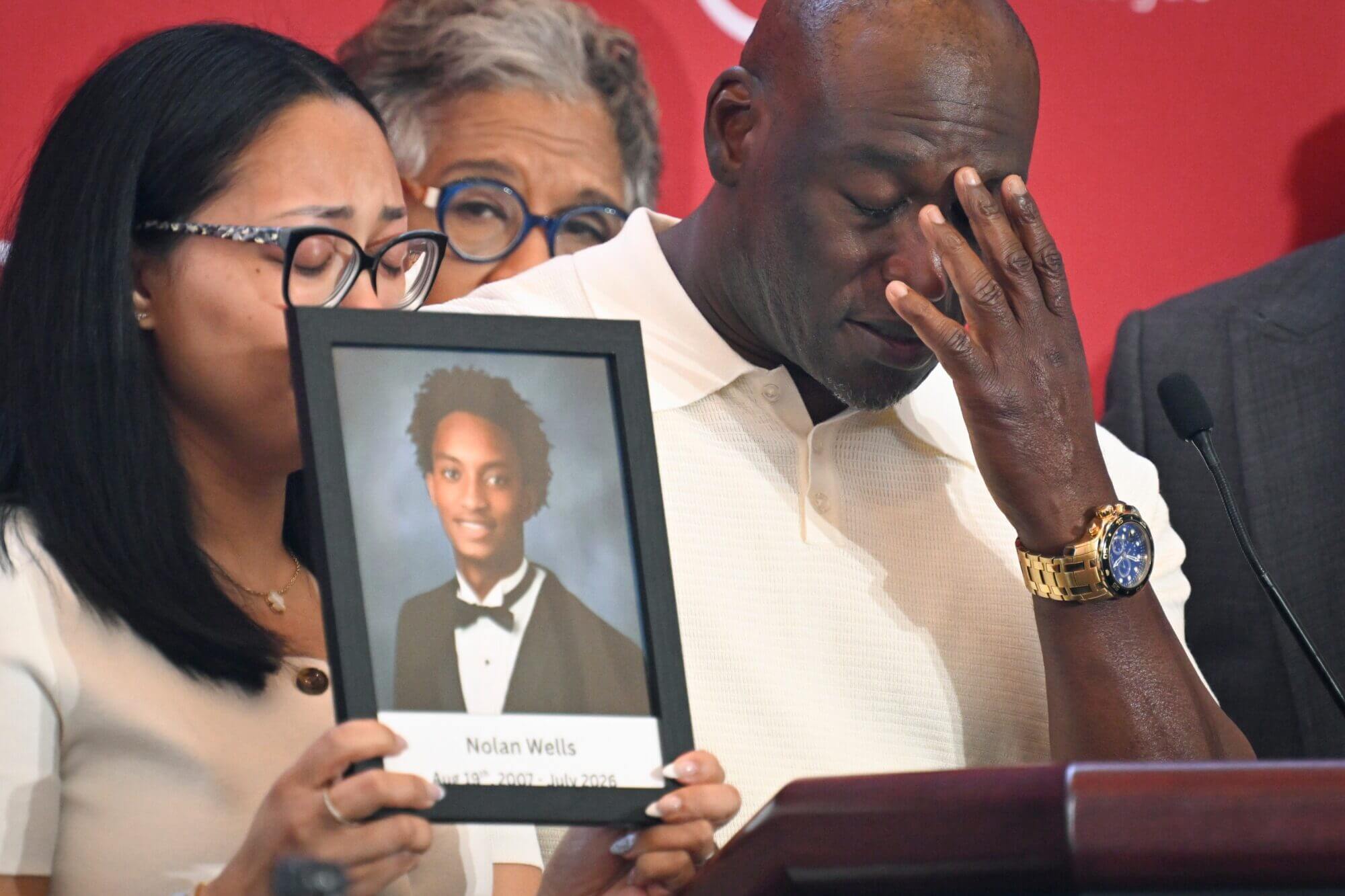
Elmore Wonsley, right, pauses from speaking as wife Christine Wonsley holds a photo of their deceased son, Nolan Wells, as they appear at the National Urban League’s annual conference, Thursday, July 30, 2026, in Nashville, Tenn. Credit: AP Photo/John Amis
The day of Wells’ funeral, his estate began sending letters giving notice of an anticipated civil lawsuit. Recipients were directed to immediately preserve all evidence, including communications, photos, video, audio recordings, metadata and other types of records.
Cole is one of the letter recipients, according to a copy of the letter addressed to her that was published by the Sun Herald.
Wells’ parents, Christine and Elmore Wonsley, hired national civil rights attorney Ben Crump shortly after their son’s death. Crump has called for an impartial investigation and has helped the family get an independent autopsy.
On Thursday, the Wonsleys said the threats and character attacks against them will not stop them from advocating for Wells.
The family of another friend who traveled to Horn Island with Wells is pursuing a defamation lawsuit against those spreading misinformation implicating Bart Edmiston Jr. in Wells’ death, which have come with safety threats, including death threats.
Audio recording is automated for accessibility. Humans wrote and edited the story.
Mukta Joshi is an investigative reporter at Mississippi Today. She is spending a year as a New York Times Local Investigations fellow examining immigration and criminal justice issues. She can be reached at mukta.joshi@nytimes.com.
Amid a national surge in arrests by U.S. Immigration and Customs Enforcement, one of the largest ICE facilities in the country has become so crowded that people have been sleeping on makeshift beds on the floor, according to detainees there.
Several detainees said that officials at the facility, the Adams County Correctional Center in Natchez recently began placing three people in cells designed for two. Each cell is roughly 8 by 10 feet and contains the beds, plus a toilet, a sink, and shelves and containers for storage, according to detainees.
Andrei Zykov, who came to the United States from Russia, expressed frustration at the crowding in his cell.
“The confinement of a person in one cell is terrible, complete discomfort, little space, nothing to breathe, unsanitary conditions, possible conflicts, restless sleep,” he said.
Zykov is one of several detainees who filed complaints to staff on their facility-issued tablets. He wrote that his cell smelled and was too small for three people, that the air-conditioner didn’t work and the toilet would not properly flush.
“This is a violation of human rights,” he wrote. “Please be understanding.”
A response sent to Zykov shows that the staff ruled his complaint unfounded, stating “the matter is temporary in nature and respectfully request your patience during this period.”
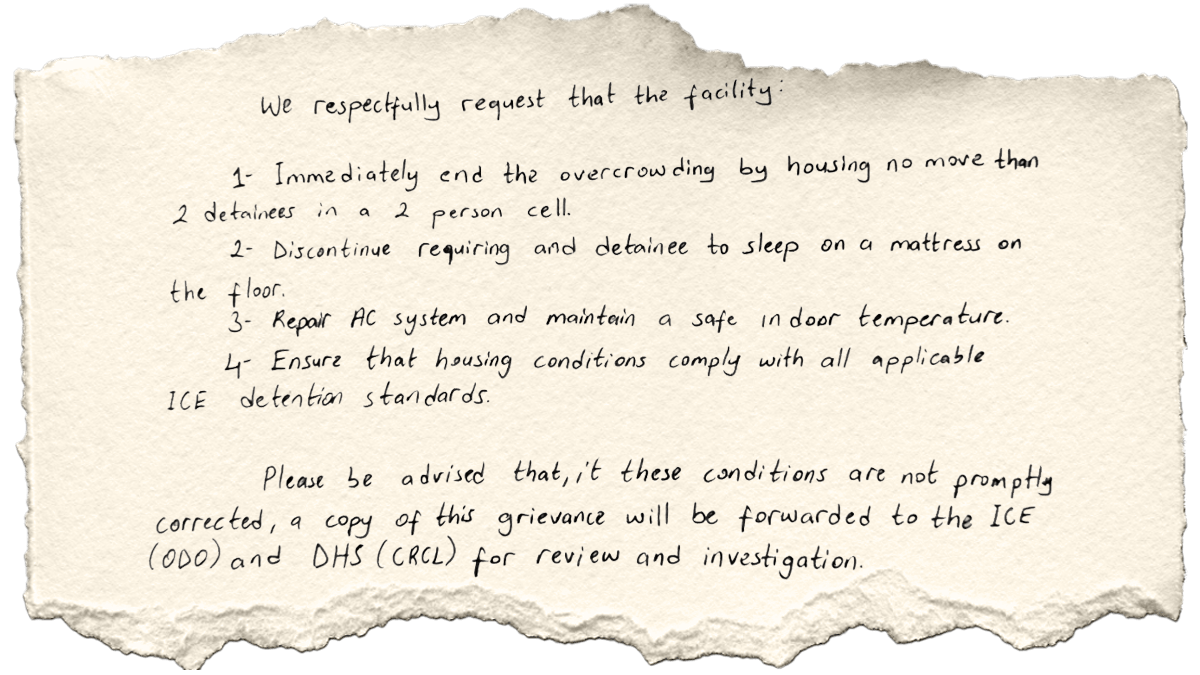
Zykov and others began collecting signatures for a complaint letter they submitted to the facility’s warden. Nearly 70 detainees signed it, according to a copy reviewed by Mississippi Today.
“Because of the limited space,” the letter says, “the third detainee must sleep with his head very close to the toilet, exposing him to unsanitary conditions, unpleasant odors, and an increased risk to his health and dignity.”
An excerpt from the handwritten complaint nearly 70 Adams County detainees signed and submitted to the warden.
An excerpt from the handwritten complaint nearly 70 Adams County detainees signed and submitted to the warden.
Although the number of people being held at Adams has varied over time, it has for years been one of the largest ICE facilities in the nation.
Numbers published by ICE in early July show that the facility’s average population this fiscal year has been 1,878. In late April, the number of detainees held in Adams County hovered between 1,400 and 1,200, according to those held there and a congressman who visited the facility. Detainees now estimate that the population has now crossed 2,000 in recent weeks, based on the number of meals detainees have been asked to help prepare — indicating a steep rise in a matter of months.
The facility capacity is 2,232, according to the website of CoreCivic, the prison company that runs the Natchez facility.
Nationally, the number of people booked into detention by ICE in June hit a high, according to Transactional Records Access Clearinghouse, a data research center based in Syracuse University whose dataset begins in October 2018.
In Natchez, one detainee, Melvin Funez, said 18 people were sleeping on makeshift cots and mattresses on the floor last week in his unit, one of many at the facility. Funez gets paid to help deliver commissary items to fellow detainees. During his rounds, he said he saw at least seven extra mattresses in each unit. Most of them were in “boats,” the bathtub-shaped plastic platforms that hold the mattresses, though some were directly on the floor, Funez said.
On Wednesday, Zykov said 15 detainees were in boats in his unit alone.
Ryan Gustin, a spokesman for CoreCivic, said every detainee was provided with a bed. He did not respond to additional questions about the facility’s headcount or sleeping arrangements.
Update, 7/3/2026: This article has been updated to more accurately reflect the limitations of data from ICE.
Audio recording is automated for accessibility. Humans wrote and edited the story.
The Mississippi Department of Environmental Quality on Thursday announced a schedule to retire the 69 controversial, temporary gas generators in Southaven that xAI is using to power its data centers. Yet the agency is allowing some of the turbines to run past their original deadline by as much as five months.
In the order, the Elon Musk-owned data center company agreed to begin retiring the units on Aug 18.
Since August 2025, xAI — through a subsidiary, MZX Tech — has run trailer-mounted natural gas turbines to power its centers just across the state line in Memphis. The company is also planning a new center in Southaven as part of its vision to create the world’s largest “integrated supercomputer.”
XAI, though, has no air permit to run any of the 69 turbines. For the past year, Southaven residents have repeatedly raised alarms over unchecked, toxic releases from the facility, including chemicals such as nitrogen oxides that can cause respiratory issues. Neighbors have also complained about a constant humming noise coming from the power plant.
When the company first arrived to Southaven last year, MDEQ told xAI that it wouldn’t need a permit because the generators were “mobile” — they’re attached to trailers — and because they’re “temporary,” meaning they would run for less than 12 months. The permit exemption was “contingent” on those two factors, the agency wrote.
But in the July 30 order, the state agency said it would allow 13 of the generators to keep running past the original 12-month deadline. Under the newly agreed retirement schedule, three of those turbines can remain active up to five months longer.
The site of a planned xAI facility at 2400 Stateline Road in Southaven, Tuesday, Feb. 17. 2026. Credit: Eric Shelton/Mississippi Today
The company requested the extension because of supply chain issues delaying 41 permanent turbines, which will have air permits, xAI is planning to bring to Southaven, the order said.
Mississippi Today asked MDEQ why the it chose to extend the deadline, but the agency declined to expand on what was in the order.
The most recently added temporary turbines, which came online earlier this month, will have to cease functions by July 14, 2027. A majority of the units will have to retire by next April.
Originally, xAI brought 18 generators to the Southaven facility last August. But the company slowly added more and more turbines, and did so without giving prior notice to the state. In May, after the number of units grew to 46, MDEQ told Mississippi Today that xAI didn’t have to notify the agency when it added more “temporary-mobile” turbines. When asked about any limit on the number of generators xAI could have without a permit, MDEQ said it was “evaluating the situation.”
Civil rights groups, environmental attorneys and Southaven residents have all contested MDEQ’s assertion that the xAI units do not need air permits. The NAACP filed a federal complaint over the matter in April, and locals near the facility followed suit in June.
Shannon Samsa gives her comments during a Mississippi Department of Environmental Quality public hearing on an xAI permit application at Northwest Mississippi Community College in Southaven on Tuesday, Feb. 17, 2026. Credit: Eric Shelton/Mississippi Today
Lawyers with the Southern Environmental Law Center, on behalf of the NAACP, argued MDEQ is misinterpreting a federal exemption that allows “portable” “nonroad engines” to run without a permit. That distinction is reserved for much smaller generators, they argued. Moreover, the Clean Air Act defines “stationary” turbines as “not self-propelled or intended to be propelled,” adding that they can be “mounted on a vehicle,” such as a trailer.
In a Thursday statement on its website, the company detailed efforts to address community concerns.
“We are rapidly removing these mobile turbines as we bring online permanent power from a 1.2 (gigawatt) power plant we are constructing under our Clean Air Act permit,” the statement said, adding that xAI was investing in new emission control technology to equip the mobile units with.
The company also said it was “investing millions of dollars in sound walls, silencers, and next-generation turbines with advanced quieting technologies through partnerships with the surrounding community.”
“We care deeply about being good neighbors and we regularly reconfigure power operations to reduce noise from the facility and minimize our impact on the local Southaven community,” xAI wrote.
Audio recording is automated for accessibility. Humans wrote and edited the story.
Attorney General Lynn Fitch said she and other Mississippi officials are joining the Trump administration to fight fraud and “protect American taxpayers from … grift”
“With the support of the U.S. Department of Justice, my office is standing up Joint Task Force Vigilance with our two U.S. attorneys and the FBI to surge resources and personnel to make Mississippi safer, protect Mississippi taxpayers and restore law and order,” Fitch said in a press release. “This first-of-its-kind task force will bring the full authority of our office to bear on con artists, grifters, fraudsters and scammers.”
Fitch said her office has been awarded over $2.5 million in federal money to form the task force. Anti-fraud efforts pushed by the White House will also include the Mississippi secretary of state, state auditor, state treasurer, U.S. attorneys and FBI offices. This is part of a new Southeast Regional Fraud Enforcement Partnership that includes officials from Alabama, Florida, Georgia, Louisiana, North Carolina and South Carolina.
This is part of a “war on fraud” that President Donald Trump announced earlier this year, which included the creation of a new anti-fraud division in the DOJ and a “fraud czar” position that the administration at one point said would be run out of the White House.
Critics of the administration’s push said it appears to be aimed at targeting political foes of the White House, including blue state officials, ahead of this year’s midterm elections.
Audio recording is automated for accessibility. Humans wrote and edited the story.
Mississippi Today Ideas is a platform for thoughtful Mississippians to share their ideas about our state’s past, present and future. Opinions expressed in guest essays are the author’s own and do not necessarily represent those of Mississippi Today. You can read more about the section here.
The age-old expression “Money doesn’t grow on trees” applies in most cases with the exception of a branch on my family tree, the one grown by my father, Jim Money Vardaman.
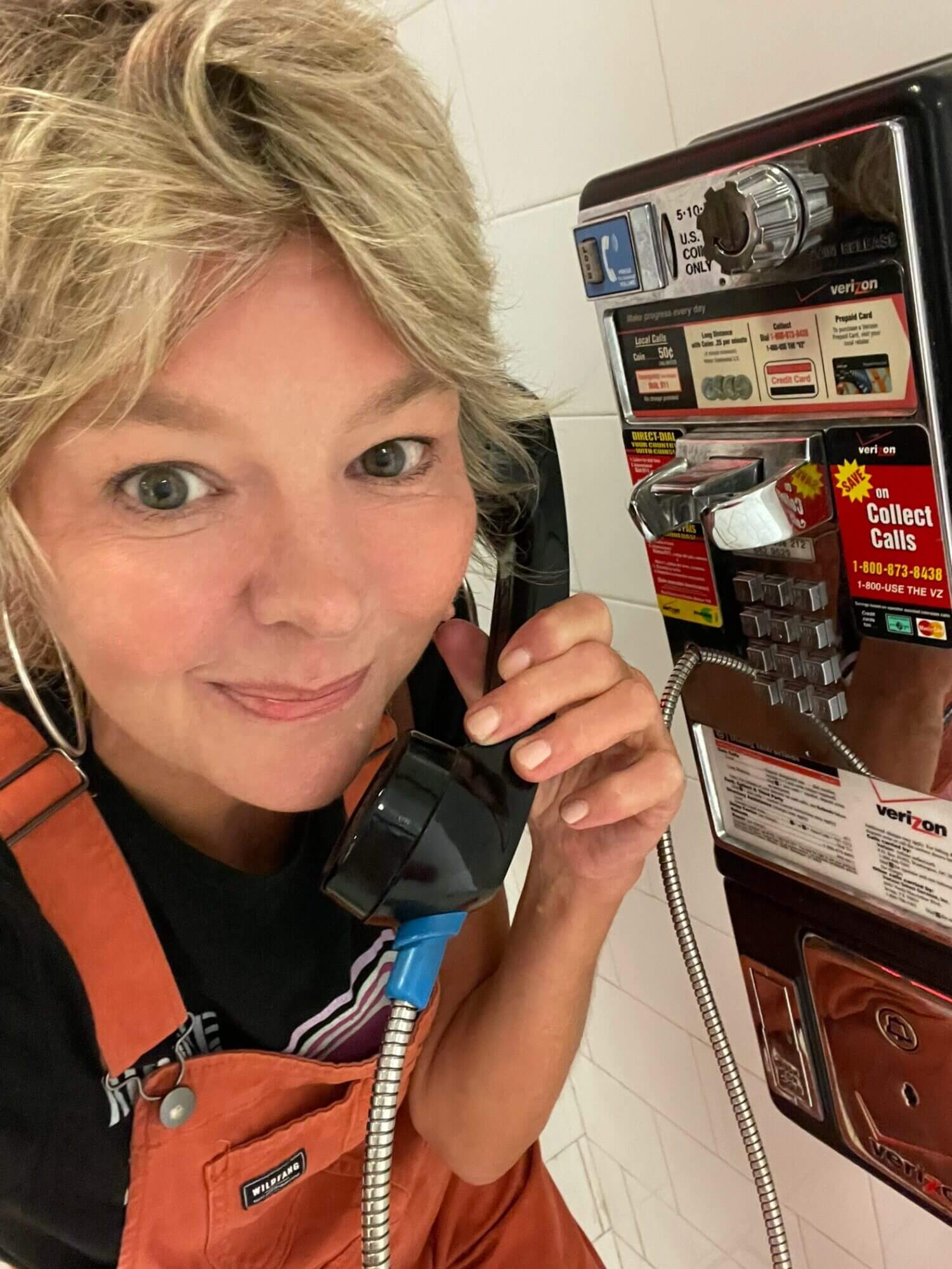
The idiom reminds us that money is a limited resource that must be earned and spent carefully. As it happens, my father wrote a book on the subject of trees and money entitled “How To Make Money Growing Trees.” You can find my dad’s contributions to sustainable tree farming alongside his Big Year birdwatching memoir entitled “Call Collect, Ask For Birdman” in the U.S. Library of Congress, where there is also a pile of nonfiction titles that recognize his grandfather, James Kimble Vardaman, as one of the most racist figures in American political history.
Jim Money Vardman’s life was not defined by his grandfather, racist Mississippi Gov. James K. Vardaman. The grandson was a renowned forester, birdwatcher and father, his daughter writes.
I have a wish that history and people who respect it will also one day recognize his grandson, my father – a World War II combat hero, a pioneer of forestry science and the visionary behind what has become the modern sport of birdwatching.
Money is also my middle name. It was given to me by my dad, and I suppose my mother, Virginia, liked the sound of it, too. For over 40 years, my father carried his folded USD in a 14-karat gold money clip engraved with the initials MIMMN – which stood for Money Is My Middle Name. He was clever, and he had a lot of fun with the audacity of the word over the years. He never minded explaining to people where the name came from – and neither have I.
It’s a family surname rooted in the Mississippi Delta and an ancestor named Hernando Money, a cousin and political ally of my great-grandfather, a former Mississippi governor and staunch segregationist recognized in history books as “The Great White Chief.”
Gov. Vardaman and Sen. Money are also the reason why Money – a small community outside of Greenwood where white men kidnapped 14-year-old Emmett Till before torturing him to death – also has the same name.
Both Vardaman and Money were long dead by the time Till’s murder occurred in 1955, but the evil that men do lives long after them, to loosely quote both Shakespeare and journalist Ralph McGill, who was awarded a Pulitzer Prize for his work on the subject on the segregated South.
In 1958, McGill wrote, “Let’s face the facts. This is a harvest. It’s the crop of things sown.” In his book “The South and the Southerner” first published in 1963, McGill described Gov. Vardaman as a “twig bender” who used populist rage to twist minds into limbs that grew history in the wrong direction. In1963, the Rev. Martin Luther King Jr. also published his open “Letter From Birmingham Jail” in which he recognized McGill as a rare white ally who “had written about our struggle in eloquent and prophetic terms.”
My father also sent a letter commending McGill in April 1963 on the 15th – a day before King’s dispatch from a jailhouse in the Jim Crow South. His own letter was postmarked from my hometown of Jackson, a city that was harvesting so many seeds of racial violence that it claimed the life of civil rights activist Medgar Evers in June of the same year. The letter my father wrote McGill on the subject of the South and Southerners, like the grandfather he never knew, was short and to the point:
Dear Mr. McGill:
I enjoyed every word of The South and the Southerner and heartily agree with you, even if you did spend three pages taking the hide off my grandfather.
From your studies of the origins of Southern traditions and attitudes, do you think it logical that a twig-bender produced a forester in two generations?
Sincerely Yours,
James M. Vardaman
Mr. McGill never responded nor published his letter, but thanks to a series of journalistic lucky breaks nearly 30 years later, my father came to find out that Ralph McGill not only read his letter, he kept it in his pocket while he attended the American Society of Newspaper Editors convention in Washington. The convention, which was held April 17–20, 1963, was a pivotal event in the timeline of the Civil Rights Movement, and while my father was not at the Statler-Hilton in person, his letter was.
Jim Money Vardaman pictured with his son, Jimmy, the eldest of seven children. Credit: Courtesy photo
The reason I have a copy of my father’s sentiments on segregation in 1963 is that he sent them to me in another letter that I have treasured since I received it in October of 1989. The next year, I graduated from the University of Southern Mississippi and moved to midtown Atlanta, where I learned a lot about why its citizens changed a street named Forrest Avenue to Ralph McGill Boulevard in 1980.
When my own father graduated from the University of Michigan in 1942, he had no choice but to go Camp Shelby in south Mississippi and be trained by the United States Army for combat as a field artillery specialist.
The birdwatching student of forestry spent the next three years applying himself in the interest of ending World War II, and he also wrote his mother diligently, with loving detail and penmanship, about the birds he saw as he fought his way across Europe to eventually earn a Silver Star for gallantry in action during the Ardennes Offensive, also known as the “Battle of the Bulge.”
After he satisfied his combat obligation, he attended the “Big Three” Allied conference in Potsdam, Germany, as an assistant to his uncle, J.K. Vardaman, who was serving in the capacity of naval aide to President Harry Truman. My father, then a lieutenant, continued to write a flurry of elegantly detailed letters which is why he referred to the ones he sent my grandmother between July 17 and Aug. 2, 1945, as his “Diary of Potsdam.”
I celebrated what would have been his 105th birthday this year by taking a copy of it to Independence, Missouri, to ask a scholar at the Truman Research Library if he thought my father represented an excellent example of an evolutionary branch in the history of a family tree, and I was told I should “write a book” on the subject. I thanked him for the interest and time and left him a copy of my father’s 1980 memoir “Call Collect, Ask For Birdman” for his personal library of great history books.
It is easy to find “twig benders” like Gov. James K. Vardaman recognized in history, and I am writing this in the hope that his grandson, Jim Money Vardaman, will one day be recognized as the branch-building champion of trees and birdwatching.
Emily Money Vardaman was raised in Mississippi, educated by Jackson Public Schools and is a graduate of the University of Southern Mississippi. She has spent most of her professional life selling things, including seven years of carrying Electrolux vacuum cleaners door-to-door in the Atlanta Metro Area. A lifelong music enthusiast, in 2023 she launched an amateur podcast devoted to musical instrument history called “The Lipstick Pickup.” Since 2005, she and her husband Kevin, a fellow Mississippian, have lived in Nashville, Tennessee.
Audio recording is automated for accessibility. Humans wrote and edited the story.
Mississippi students seeking short-term workforce training can now qualify for thousands in federal financial aid to help cover their program costs. But, only a dozen programs are expected to be eligible by 2027, despite hundreds of courses being offered at community colleges across the state.
Congress expanded the federal Pell Grant program, which helps low-income students pay for higher education, last year to cover certain short-term workforce training programs. The new Workforce Pell Grant program change took effect July 1.
But, before institutions can offer aid to students, the state must approve eligible programs to qualify for the federal Pell Grant program. State officials finalized the formal program approval process at the end of June. The first programs may be available as early as January 2027, said Courtney Taylor, executive director of AccelerateMS, the state’s workforce development agency.
Courtney Taylor, executive director of AccelerateMS, speaks during an announcement about an Amazon data center in Ridgeland on Thursday, April 9, 2026. Credit: Eric Shelton/Mississippi Today
Instead, the state’s workforce board is beginning with a group of high-demand fields such as construction, advanced manufacturing and healthcare to qualify for the federal aid. Job training programs such as line work and commercial truck driving could be options for students in the future.
The state’s community and technical colleges will likely offer these programs that are in fields with available jobs employers want to fill immediately, Taylor said.
Job training programs have to meet federal requirements to receive Workforce Pell at least a year before seeking approval from the state, Taylor said. The agency expects very few applications to be submitted for programs this year, she said.
“While we’ve had these programs for some time, it may take us a year before we can start offering it,” Taylor said. “The most important thing is not creating duplicate programs and ensuring they are viable and lead to a job and livable wage for individuals.”
If students want to enroll in a short-term job training course today, about 250 to 300 programs at the state’s community colleges are immediately available to them, Taylor said. Students can request career training program information through their local community college or find options on AccelerateMS’s website. Programs such as emergency medical technicians, plumbing, welding and HVAC are all immediate options for students, Taylor added.
Public and private colleges, trade schools and proprietary institutions that want to get federal money must identify eligible job training programs that demonstrate they meet federal employment and earnings benchmarks. These schools must obtain approval through the state’s new three-step approval process, said Rachel Partrick, deputy executive director of programs at the Mississippi Community College Board.
“Are we excited? Absolutely! Will we have a lot of programs ready? No,” Partrick said.
Institutions will have to submit formal applications to the state’s Workforce Investment Board. The board will consult with Gov. Tate Reeves to ensure short-term programs are “high skill, high wage” and meet current employer demands, according to Mississippi’s Workforce Pell Program Approval Policy Process manual. AccelerateMS will be responsible for accepting applications and annually reviewing and monitoring job programs that meet federal guidelines.
Schools will also need to work with the state and federal government to prove that at least 70% of job training program graduates are employed and that their wages are higher than 150% of the federal poverty line, according to federal guidelines. By 2029-30, states must begin reporting on job program completers who find work in fields related to their training.
Sen. Nicole Boyd, R-Oxford, speaks during the Mississippi Opioid Settlement Fund Advisory Council meeting at the Carroll Gartin Justice Building in Jackson, Monday, Nov. 3, 2025.
The state’s existing workforce data system gives Mississippi an advantage when it comes to tracking metrics such as job program graduates and median earnings, Taylor said. But officials expect new measures for data collection to expand as colleges seek approval for eligible programs.
The expansion of the federal aid program could also be an opportunity for Mississippi to address its workforce shortages and increase the number of residents who complete job training or higher education by 2030. As of 2026, 48.8% of Mississippians ages 25 to 64 had a degree, credential or industry certification beyond high school, slightly higher than the national average of 43.6%, according to the Lumina Foundation.
Workforce Pell also fits into the state’s broader push to tie education to employment. Senate Universities and Colleges Committee Chairwoman Nicole Boyd, a Republican from Oxford, has spearheaded the effort. She said she sees the new federal program as a possible way to help residents achieve a quality life.
“This is a great opportunity to strengthen our state’s workforce, economy and put families on a path to prosperity,” Boyd said. “The Legislature has worked to strengthen Mississippi’s workforce by supporting policies that connect education to employment. As Mississippi implements Workforce Pell, we are laying the foundation for eligible training providers to expand access to high-value programs that lead to meaningful careers and support our state’s continued economic growth.”
Audio recording is automated for accessibility. Humans wrote and edited the story.
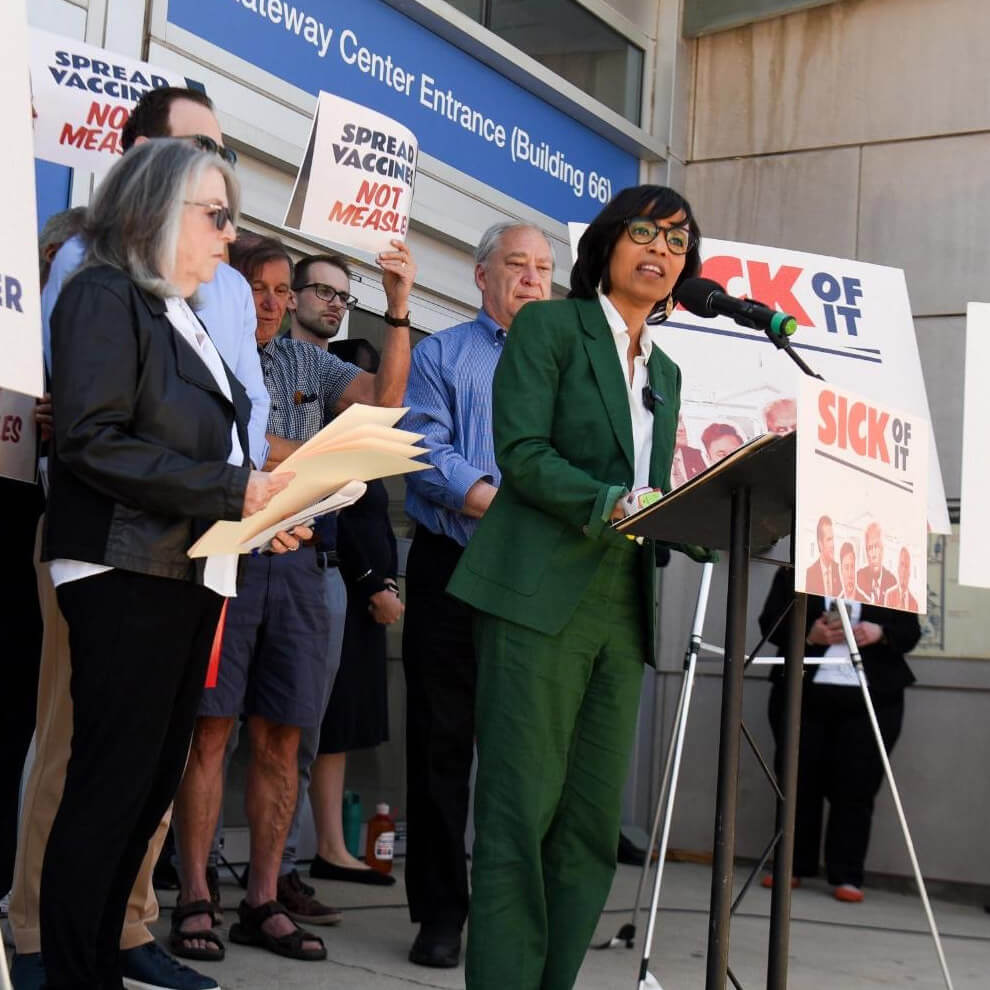
Scott Colom, the Democratic nominee for U.S. Senate in Mississippi, will campaign with Sen. Angela Alsobrooks of Maryland in Jackson on Saturday.
Alsobrooks, who was first elected in 2024, will participate in a maternal health panel discussion with Colom on Saturday morning in downtown Jackson. The two will later participate in a voting rights town hall with Mississippi Congressman Bennie Thompson and Mississippi NAACP Director Charles Taylor on Saturday evening.
Alsobrooks is the third Black woman elected to the U.S. Senate and is the first Black person to represent Maryland in the Senate.
The Maryland senator will be the first Democrat from outside the Magnolia State to campaign for Colom in his home state. In April, U.S. Sen. John Kennedy, a Republican from Louisiana, came to Mississippi for a fundraiser for Colom’s opponent, Republican incumbent Sen. Cindy Hyde-Smith.
Hyde-Smith, Colom and independent candidate Ty Pinkins will compete in the general election on Nov. 3.
Audio recording is automated for accessibility. Humans wrote and edited the story.
Mississippi and the U.S. are experiencing the steepest drop-off of participation in the nation’s largest anti-hunger program in nearly 30 years following federal cuts made last summer by Congress and President Donald Trump, experts say.
In April, 43,000 fewer Mississippians had access to the Supplemental Nutrition Assistance Program than nine months earlier. Mississippi’s decline of 12% in the program previously known as food stamps is slightly higher than the national average of 11%, according to recent data from the U.S. Department of Agriculture.
“And it’s not because the need is any lower,” said Ty Jones Cox, vice president for food assistance at the Center on Budget and Policy Priorities, during a July 22 press conference.
President Donald Trump speaks at the Raymond F. Kravis Center for the Performing Arts in West Palm Beach Fla., Friday, May 1, 2026. Credit: AP Photo/Matt Rourke
In fact, food insecurity in the U.S. is the highest it’s been in a decade, according to the most recent data.
Regulations that Congress passed through the One Big Beautiful Bill Act and that Trump signed into law last July have changed the face of SNAP. Stricter work requirements subjected previously-exempt older adults and caregivers to more paperwork. An already burdened system became more strained, at a time when the same federal law posed new fines for states with high error rates in eligibility determinations.
A payment error rate measures how accurately each state determines the number of SNAP dollars an eligible person receives. In May, Republican Gov. Tate Reeves praised the Mississippi Department of Human Services for lowering the state’s error rate and qualifying for a lower penalty.
MDHS Communications Director Mark Jones previously told Mississippi Today the department was able to achieve this by providing more training for staff who determine if people are eligible to receive SNAP and by reminding recipients about the importance of updating income changes to ensure their paperwork is accurate.
However, experts say it’s problematic that delaying or denying benefits to an eligible family does not count as an error.
“That creates an enormous incentive for states to slash their error rates by any means necessary,” Jones Cox said. “And that’s what we’re seeing.”
The decline is outpacing even the government’s predictions. Shortly after Congress passed Trump’s megabill last year, the Congressional Budget Office predicted SNAP enrollment would decrease by 2.4 million people nationwide. To date, enrollment has decreased by 4.5 million people.
Dr. Patricia Tibbs.
At least a third of those people are children, according to data from 19 states. Mississippi does not track data on children.
Dr. Patricia Tibbs, president of the Mississippi chapter of the American Academy of Pediatrics, said she worries about the effect that the decrease in enrollment will have on the next generation. Nutrition is one of the most influential determinants of health – and children are the most vulnerable.
“It’s children we’re talking about,” Tibbs told Mississippi Today. “They don’t choose their families’ income.”
Politicians should look at SNAP as a return on investment, Tibbs said. Access to healthy foods helps Mississippi children grow into productive citizens, saving the state millions of dollars on more complex issues that arise from inadequate nutrition. Tibbs also said increased investment in SNAP could boost the state’s workforce participation rate, currently the second-lowest in the country.
“Hospitalizations, developmental services, special education, mental care, chronic disease treatment – those are all down the road, if we don’t focus on nutrition,” Tibbs said.
‘It’s a lose-lose situation’
In 2019, Debra Expose of Jackson, a single mother of five children ages 2 through 12, began facing severe financial hardship after divorcing the father of hereldest daughter. Expose said she doesn’t receive child support for any of her children, despite being their primary caregiver and picking up most of the costs of child rearing.
Over the years, Expose has worked at Walmart, Kroger, Xerox and for the city of Jackson as a crossing guard. Most recently, she worked for the United States Postal Service. She resigned last year due to the lack of family leave, flexible hours and affordable childcare.
SNAP has been a lifeline for Expose as she looks for a more family-friendly job. Now, she said she worries that federal cuts and pressure on states to lower error rates will mean increased red tape that could put food out of reach for her family.
Expose said paperwork delays are already commonplace. Every six months at her recertification appointments, she routinely gets kicked off the program for one to three months, she said. Even when she submits her paperwork early, caseworkers do not get to her case in time to prevent her from losing coverage, she said. That has meant making difficult decisions, such as whether to put food on the table or keep the lights on.
And sometimes, losing one means losing the other.
“Am I gonna lose my power that’s gonna help me keep the food fresh and able to be eaten? It’s a lose-lose situation,” Expose said.
Food is stored on pantry shelves at Johnson Elementary School in Jackson on Wednesday, Oct. 5, 2025. Credit: Eric Shelton/Mississippi Today
Safia Malin is policy director for the nonprofit One Voice, a Jackson-based civic engagement group. She said hearing from people such as Expose should be a central part of how lawmakers develop public policies. In Mississippi, it’s not. Formal opportunities for constituents to provide testimony do not exist in the state Legislature.
“There is so much we can learn from data and numbers, but also from real live human beings who are withstanding the impacts and figuring out how to make ends meet,” Malin said. “We know that the unfortunate reality for so many folks is that a reduction in benefits for them just means they’ll be forced to go without.”
Although the Mississippi Legislature doesn’t have the power to reverse or delay federal cuts to social safety net programs, Malin urged the Mississippi Department of Human Services to make sure it is not lowering its error rate by cutting eligible people.
Malin also recommended the Legislature adopt a system called “simplified reporting,” as every other state has done, to administer SNAP. Malin believes it would reduce the number of errors – without cutting eligible families – and save the state money that could go back into the program.
As situations such as Expose’s become more common, repercussions will be felt for decades, said Dr. Andrew Racine, president of the American Academy of Pediatrics.
He said that includes not only the long-term health conditions resulting from inadequate nutrition but also the effects of chronic stress on children living in food-insecure homes. Studies show that toxic stress, including prolonged and extreme economic hardship, can impair cognitive development and leave children more vulnerable to physical disorders such as cardiovascular diseases and diabetes, as well as mental health issues such as depression and alcoholism.
“To the extent that we are making policy decisions today about foregoing the opportunity to feed hungry children, we are having consequences that will haunt us going forward a generation from now,” Racine said. “And it’s entirely avoidable.”