Audio recording is automated for accessibility. Humans wrote and edited the story.
Lawmakers sent a bill to Gov. Tate Reeves for signature Wednesday to fund clinical trials related to the psychedelic drug ibogaine, action that could add $5 million of Mississippi’s opioid settlement money to study the drug.
The bill, which passed the House and Senate with bipartisan support, instructs the Mississippi State Department of Health to create a state partnership to research ibogaine’s ability to treat mental health disorders like addiction, depression and traumatic brain injuries. No state funding is attached to the bill, although legislators have said they expect to soon appropriate the opioid settlement funds for the effort.
Bryan Hubbard, the executive director of the nonprofit Americans for Ibogaine, has gone from state to state in recent years encouraging legislatures to pool funds for ibogaine clinical trials. Because the federal government isn’t funding studies testing the drug’s potential therapeutic effects, he has been pushing for states — including Mississippi — to support research.
He has close ties to former Kentucky Attorney General Daniel Cameron, who a 2023 Daily Beast investigation found had received over $1 million in campaign funding from a super PAC backed by an ibogaine industry investor. Almost all of the PAC’s 2023 fundraising came from a billionaire who stood to benefit from ibogaine’s development as a commercial medication, according to the newsroom.
Cameron appointed Hubbard to lead much of Kentucky’s opioid settlement distribution process, a role in which Hubbard tried to direct $42 million of the state’s lawsuit money for ibogaine research. He has publicly said he personally would not financially benefit from ibogaine’s development as a medication.
Hubbard frequently cites a 2024 Stanford study that some veterans’ negative symptoms related to traumatic brain injuries and other mental disorders decreased a month after ibogaine treatment, and taking the drug with magnesium mitigated additional cardiac risks. The paper didn’t compare people who received the treatment to those who didn’t, which is essential for determining whether new medications are effective.
Existing drugs approved for opioid use disorder, the deadliest addiction, are effective at treating the condition. Hubbard has criticized these existing medications in the past as unviable solutions for addressing an addiction epidemic that’s killed over a million Americans since 1999.
While some who’ve traveled out of the country to be treated with ibogaine say it’s helped treat their opioid addictions, an academic review of studies that looked at ibogaine’s addiction treatment potential said most had “high risk of bias.”
As part of his lobbying efforts, Hubbard helped host a meeting in Aspen, Colorado, with state legislators across the country last spring. Its goal, according to the summit’s website, was to encourage states to research the drug and its impact on addiction.
Among those who attended the Aspen summit were Mississippi’s House Public Health and Human Services Committee Chair Sam Creekmore and Department of Mental Health Medical Director Dr. Tom Recore. In the following months, Creekmore started writing editorials encouraging the Legislature to join lawmakers in states such as Texas and Arizona that are using state funds for ibogaine trials.
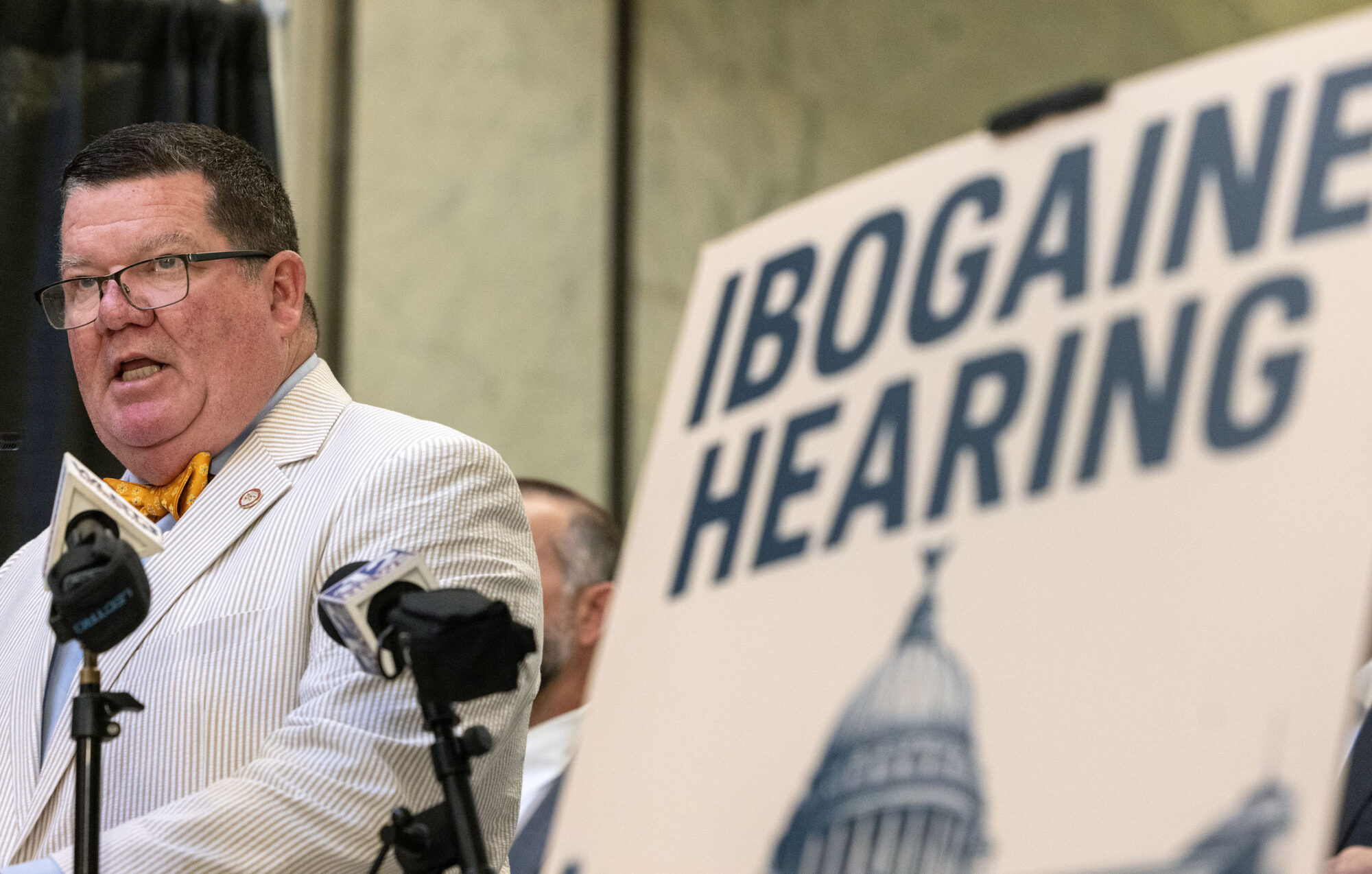
In August, Creekmore hosted Hubbard and other ibogaine advocates at the Mississippi Capitol, where many spoke about how the drug had personally helped them overcome mental disorders. At that event, Creekmore said he would not financially benefit from ibogaine’s development as an approved medication.
The event was the first time Creekmore publicly said he wanted the Legislature to appropriate $5 million for this effort from the state’s nonabatement opioid settlement fund, money he and other lawmakers allow to be used on nonaddiction purposes. He told Mississippi Today that was still the plan Tuesday after the bill’s final House passage.
Opioid settlement funds the Legislature controls are expected to be appropriated through the attorney general budget bill.
Correction, 3/19/2026: This headline and article were corrected to reflect that legislators sent a bill for Gov. Tate Reeves signature. At the time of publication, Reeves had not yet signed the bill into law.
Audio recording is automated for accessibility. Humans wrote and edited the story.
In February, Kenychi Badue of Laurel found out she was pregnant. At 22, she had no health insurance and could not afford to pay out of pocket for doctor’s visits as she awaits the birth of her first child. But thanks to a new Mississippi law, Badue didn’t have to forgo prenatal care.
Kenychi Badue, 22, of Laurel, is one of about 300 low-income pregnant Mississippians who have received prenatal care earlier than they likely would have without the policy, called Presumptive Eligibility for Pregnant Women. Photo courtesy of Kenychi Badue
Badue is one of about 300 low-income pregnant Mississippians who received prenatal care earlier than they would have without the policy, called Presumptive Eligibility for Pregnant Women, which lawmakers passed last year, according to the Mississippi Division of Medicaid.
The law went into effect in July of last year and allows pregnant women to be presumed eligible for Medicaid while their applications are pending. The change brings Mississippi in line with 29 other states.
The American College of Obstetricians and Gynecologists credits this form of Medicaid coverage with improved maternal health outcomes, especially in states that have not expanded Medicaid such as Mississippi. The state’s strict eligibility requirements exclude many poor people from health care. Women in states that have expanded Medicaid are more than twice as likely to be enrolled in Medicaid before pregnancy, compared to those in non-expansion states, according to a report by KFF, a national, nonprofit health policy research and polling organization.
“It makes me feel safer about my pregnancy,” Badue said about the routine check-ups she now receives at Family Health Center in Laurel as a result of the policy.
Who qualifies for presumptive eligibility under Medicaid?
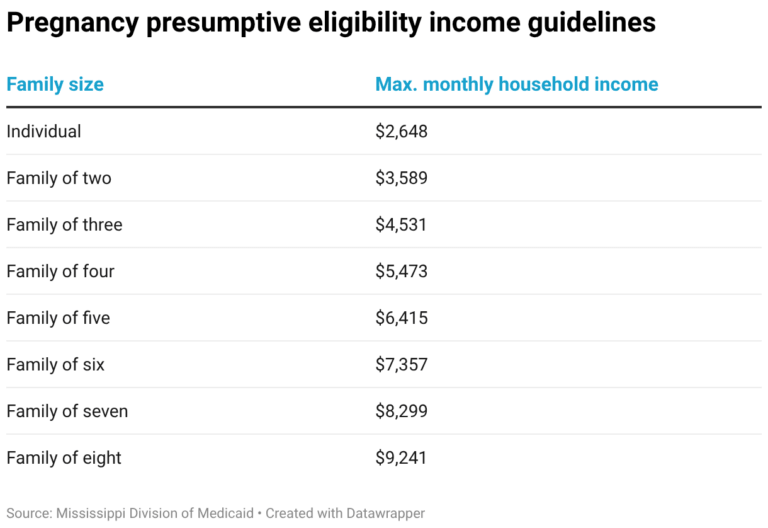
Eligible women must be pregnant and have a household income up to 194% of the federal poverty level, or about $31,000 annually for an individual. They do not need to show proof of income to receive care at a participating provider. The temporary coverage lasts until Medicaid approves the patient’s official application, however long that takes. But the patient must submit a Medicaid application before the end of her second month of presumptive eligibility coverage. Once enrolled in Medicaid, a pregnant patient is guaranteed coverage through 12 months postpartum, according to state law.
Many low-income women are ineligible for Medicaid in Mississippi until they become pregnant. That’s because Mississippi Medicaid doesn’t insure childless adults and has much stricter income requirements for caretakers who aren’t pregnant. Since officials can take months to process and approve a Medicaid application, eligible pregnant women sometimes end up missing prenatal care in their first and second trimester.
Presumptive eligibility is designed to remove red tape that stands in the way of care, explained Usha Ranji, the associate director of women’s policy at KFF.
“Medicaid eligibility has a good amount of paperwork, and that can take time,” Ranji said. “Presumptive eligibility allows somebody to get access to care while that verification of income and paperwork documentation is happening.”
In August, state officials declared a public health emergency over Mississippi’s rising infant mortality rate. A recent report from Centers for Disease Control and Prevention also shows that Mississippi is one of 36 states that showed a significant increase in late or no prenatal care between 2021 and 2024. That lack of care can lead to more complicated interventions and costlier medical bills once an issue is identified. It also can hold life-threatening consequences.
Health care providers told Mississippi Today presumptive eligibility, which costs the state a total of about $567,000 a year across all patients to administer, is a minimal investment that will cut down on the number of premature infants who end up in intensive care units. Prenatal care has been shown to mitigate preterm birth, in which Mississippi leads the nation.
Staying in the neonatal intensive care unit can lead to traumatic experiences for infants and parents, but it also costs the state millions, said Dr. Susan Buttross, former chief of the Division of Child Development and Behavioral Pediatrics at the University of Mississippi Medical Center.
“Mississippi would save so much money if we would intervene early,” Buttross said. “I have no doubt that this will ultimately help Mississippians.”
While 300 Mississippians is “a good start,” Buttross said it is not enough. Early prenatal care can help diagnose and manage complications that are pervasive in Mississippi, such as diabetes and high blood pressure, she said, as well as infections that lead to preterm birth.
“If every clinic would take a few patients who have this presumptive eligibility, it would make a huge difference in our state,” said Buttross.
The majority of women using presumptive eligibility are receiving care at county health departments, according to the Division of Medicaid. Thirteen other clinics and federally qualified health centers are signed up to participate, but only five of them have served women under the new program.
Room to grow
At Family Health Center in Laurel, Badue receives her prenatal care. Staff at the facility are serving about 12% of the women who are using this policy statewide, according to the Division of Medicaid. Nurse Mia Walker supervises the clinic’s obstetrics unit and said she is surprised to hear that.
“It’s exciting to know that out of 300 registered women in the state of Mississippi, Family Health OB-GYN clinic has 35 and is leading the pack,” Walker said.
Walker said that her clinic serves women who are on the Medicaid family planning waiver, which allows women to access Medicaid for family planning purposes such as birth control – even if they don’t qualify for general Medicaid coverage. Walker said she informs those women of presumptive eligibility, so they can come back to receive prenatal care if they become pregnant.
But many Mississippians are not aware they are eligible for Medicaid once pregnant and without filling out a Medicaid application. And women who don’t think they have Medicaid coverage stay home from the doctor, said Khaylah Scott, program manager for the Mississippi Health Advocacy Program, a consumer advocacy organization aimed at improving access to health care in the state. In order to reach those Mississippians, clinics will need the help of statewide agencies, she said.
“If there’s anything that the Division of Medicaid can do to really ramp up communications around this program, they should definitely consider it,” said Scott.
To spread awareness, Scott recommended that state and local public health officials place flyers in public spaces with information about the program and advertise on billboards and across social media.
In the meantime, clinics interested in participating in the program can follow instructions online to submit a provider application.
There is no risk for clinics if they offer Medicaid coverage through presumptive eligibility, said Tricia Brooks, a Medicaid expert and research professor at the Center for Children and Families at Georgetown University. Regardless of whether the patient is approved for Medicaid, providers are reimbursed by Medicaid for the services they offer pregnant women under presumptive eligibility.
“Even if the individual doesn’t file an application, or if they file an application and are determined ineligible, the payment for the service is still federally matched and the provider gets paid,” Brooks said. “There is no kind of penalty.”
Guide complet du casino en ligne – Tout ce que vous devez savoir
Le monde du jeu s’est radicalement transformé depuis l’avènement d’Internet haut débit. Aujourd’hui, un joueur peut accéder à des centaines de tables virtuelles depuis son smartphone ou son ordinateur portable, sans se déplacer dans un établissement physique. Cette accessibilité a entraîné une explosion de la popularité des casinos en ligne, qui enregistrent chaque année des milliards d’euros de mises dans le monde entier. En France, les autorités ont rapidement réagi pour encadrer cette activité et protéger les usagers contre les dérives éventuelles.
Les plateformes françaises sont soumises à une législation stricte qui impose le respect de critères de sécurité très élevés et la mise à disposition d’outils de jeu responsable. Le choix d’un opérateur fiable devient alors crucial : il faut vérifier la licence délivrée par l’ANJ, s’assurer que les données personnelles sont chiffrées et que les bonus proposés ne cachent pas de conditions abusives. Un guide détaillé aide le joueur à naviguer entre ces exigences tout en profitant pleinement des avantages offerts par le numérique : rapidité des dépôts, variété infinie de jeux et promotions exclusives réservées aux nouveaux inscrits.
Introduction
Le phénomène des casinos en ligne n’a jamais été aussi visible qu’en ce moment ; la combinaison d’offres promotionnelles alléchantes et d’une technologie toujours plus performante attire chaque jour davantage de joueurs français curieux d’essayer leur chance depuis leur salon. Découvrez le nouveau casino en ligne recommandé par les experts de Basketnews.Net pour profiter d’une expérience sécurisée et ludique.
Pourquoi publier un guide complet est indispensable ? Premièrement parce que la législation française impose des normes spécifiques aux opérateurs agréés : protection du portefeuille joueur, contrôle anti‑blanchiment et obligations relatives au jeu responsable sont scrupuleusement surveillés par l’Autorité Nationale des Jeux (ANJ). Deuxièmement parce que la cybersécurité évolue constamment ; connaître les bonnes pratiques pour choisir un mot de passe robuste ou activer l’authentification à deux facteurs évite bien des désagréments futurs. Enfin, un tel dossier permet au public débutant comme confirmé d’évaluer objectivement chaque offre grâce aux critères établis par Basketnews.Net, site indépendant spécialisé dans le classement impartial des nouveaux casinos en ligne.
Section 1 – Les bases du jeu en ligne
Un casino en ligne reproduit virtuellement l’ensemble des services proposés par une salle physique : machines à sous digitales, tables de roulette live avec croupier réel ou encore salons de poker multijoueurs simultanés partout dans le monde. La différence majeure réside dans l’infrastructure logicielle : chaque partie s’appuie sur un générateur aléatoire certifié (RNG) garantissant un taux de retour au joueur (RTP) conforme aux standards internationaux.
Parmi les catégories les plus répandues on retrouve :
Slots vidéo avec volatilité variable – exemples : Starburst (NetEnt) ou Mega Joker (Novomatic).
Roulette européenne à zéro unique offrant un avantage maison réduit à 2 %.
Blackjack S17 où le croupier doit rester sur un soft‑17. Ces jeux possèdent tous leurs propres lignes de paiement (« paylines ») et jackpots progressifs qui peuvent dépasser plusieurs dizaines de millions d’euros.
Créer un compte est simple : il suffit de saisir son adresse e‑mail, choisir un nom d’utilisateur sécurisé puis confirmer via un lien envoyé par courrier électronique. Ensuite vient l’étape cruciale de vérification d’identité – upload d’une pièce officielle et parfois une facture récente afin de lutter contre la fraude financière. Une fois validée, le premier dépôt peut être réalisé instantanément grâce aux portefeuilles électroniques ou aux cartes bancaires autorisées par l’ANJ.
Les bonus de bienvenue varient considérablement ; certains sites proposent jusqu’à 100 % sur le premier dépôt jusqu’à 200 €, accompagnés souvent 30 tours gratuits sur une machine sélectionnée. Pour comparer efficacement ces offres il faut regarder trois paramètres clés :
Critère
Pourquoi c’est important
Bonus %
Indique immédiatement combien votre dépôt sera majoré
Conditions wagering
Nombre minimum fois que vous devez jouer avant retrait
Plafond max
Limite maximale pouvant être retirée après avoir rempli les exigences
En évaluant ces éléments avec rigueur vous évitez les surprises désagréables lors du cash‑out.
Section 2 – La législation française et la licence ARJEL/ANJ
La régulation du jeu internet français débute officiellement avec la création d’ARJEL (Autorité Réglementaire des Jeux En Ligne) fin 2010 ; elle devient ANJ (Autorité Nationale des Jeux) dès 2020 afin d’élargir ses compétences aux paris sportifs et paris hippiques numériques. L’objectif principal était —et reste—de garantir transparence financière ainsi qu’une protection efficace contre l’addiction au gambling.
L’ANJ attribue uniquement aux opérateurs répondant à trois exigences majeures :
Détention d’un capital minimal suffisant pour couvrir toutes les mises potentielles ;
Mise en place systématique d’un système anti‑blanchiment certifié ISO 27001 ;
Adoption obligatoire du dispositif “self‑exclusion” permettant aux joueurs souscrivant une interdiction volontaire pendant jusqu’à cinq ans.
Pour le public cela se traduit concrètement par plusieurs bénéfices : vos fonds sont stockés séparément dans des comptes dédiés (« trust accounts »), toute contestation juridique bénéficie alors d’un médiateur nommé par l’État français et chaque opération bancaire est auditée régulièrement afin d’éviter toute irrégularité fiscale.
Basketnews.Net utilise une grille stricte lorsqu’il évalue si un site respecte pleinement la législation française :
Licence valide délivrée par l’ANJ affichée clairement sur la page « À propos ».
Procédure KYC totalement automatisée mais respectueuse du RGPD français.
Présence visible « outil auto‑exclusion » accessible depuis le tableau utilisateur sans devoir contacter le support client.
Seuls les établissements remplissant ces critères peuvent être présentés comme recommandés sur notre plateforme indépendente.
Section 3 – Sécurité et confidentialité des données
Les technologies anti‑fraude constituent aujourd’hui le socle fondamental sur lequel repose toute confiance entre joueur et opérateur.\nTous les sites sérieux utilisent aujourd’hui le protocole SSL/TLS avec chiffrement AES‑256 bits afin que chaque échange entre votre navigateur et les serveurs soit illisible pour tout tiers.\nDes audits externes menés chaque trimestre permettent également de certifier conformité aux standards eCOGRA ou iTech Labs.\n\nGestionnaire quotidiennement recommandé — la création d’un mot de passe long (>12 caractères), mêlant majuscules/minuscules/symboles — est complété idéalement par une authentification à deux facteurs envoyée via SMS ou application dédiée comme Google Authenticator.\n\n| Méthodes de paiement sécurisées | Description |\n|———————————|————-|\n| Cartes bancaires Visa/MasterCard | Traitement immédiat via serveur PCI DSS compliant |\n| Portefeuilles électroniques PayPal & Skrill | Authentification supplémentaire avant transaction |\n| Crypto‑monnaies approuvées (BTC/EUR) | Transactions anonymes mais traçables via blockchain |\n\nLa politique de confidentialité doit préciser quels renseignements personnels sont collectés ‑ notamment nom complet, date naissance pour vérification âge ‑ ainsi que leurs usages possibles : prévention fraude, amélioration UX ou communication marketing ciblée après consentement explicite.\n\nPour protéger votre compte contre phishing il suffit souvent d’observer quelques bonnes pratiques simples : ne jamais cliquer sur un lien contenu dans un mail non sollicité prétendant provenir du support client ; toujours vérifier l’adresse URL commençant bien par « https://» ; limiter accès au compte depuis appareils publics ou réseaux Wi‑Fi non protégés.\n\nEn suivant ces recommandations vous réduisez drastiquement vos risques tout en profitant sereinement des offres proposées par nos partenaires évalués chez Basketnews.Net.
Section 4 – Choisir le meilleur nouveau casino en ligne selon ses besoins
Le profil du joueur influence fortement son choix final.\nUn casual cherche avant tout une interface intuitive et des bonus modestes tandis qu’un high‑roller privilégie limites élevées sur dépôts ainsi qu’un service VIP dédié disponible jour/nuit.\nVoici quelques critères décisifs classés selon trois axes principaux:\n\n- Profil : budget mensuel moyen <100 €, entre 100 €–1000 € ou >1000 €.
– Catalogue : présence privilégiée éditeurs reconnus tels que NetEnt (Gonzo’s Quest) ou Microgaming (Mega Moolah) offrant respectivement RTP moyen autour de 96 % vs jackpot progressif dépassant parfois 30 M € .
– Promotions : comparaison rapide entre deux sites populaires — CasinoA propose +150 % up to €300 +50 tours vs CasinoB donne +200 % up to €500 +100 tours mais condition wagering x35 vs x30.\n\nL’importance capitale revient également au support client multilingue accessible via chat live instantané disponible24/7 ainsi qu’envoi email garanti sous deux heures ouvrées.\nCes éléments combinés permettent au consommateur éclairé —comme ceux consultés régulièrement sur Basketnews.Net—de sélectionner le nouveau site de casino en ligne qui correspond précisément à ses attentes sans sacrifier sécurité ni qualité service.
Section 5 – Stratégies gagnantes aux principaux jeux de table
Blackjack Le comptage simplifié consiste à attribuer +1 aux cartes faibles (2–6), -1 aux fortes (10–As) puis suivre la somme courante («running count»). Sur tables virtuelles où aucun mélange manuel n’intervient cette technique reste valable tant que vous jouez plusieurs mains consécutives ; viser un compte positif supérieur à +4 indique généralement avantage statistique supérieur à +0,5 %. Conjuguez cela avec gestion stricte du bankroll — mise maximale ne dépassant jamais 2 % du capital total.\n\nRoulette Sur roue européenne choisissez systématiquement la mise «Voisins Zéro», couvrant douze numéros adjacents dont la probabilité collective est supérieure grâce au placement équilibré parmi hauts/bas pairs/impairs. Statistiques historiques montrent qu’environ 45 % des tirages tombent parmi ces cases lors d’une série courte (<25 spins).\n\nPoker online Sélectionnez une salle disposant déjà licencée ANJ afin que vos fonds soient sécurisés ; commencez toujours avec stratégie préflop basique – jouer uniquement AA‐KK‐QQ‐JJ‐AKs/AKo quand position tardive permet minimiser risque. Post‑flop privilégiez lecture dynamique basée sur taille pot versus bet sizing adverse pour identifier bluff possible.\n\nUtiliser les versions “démo” gratuites permet enfin affiner vos tactiques sans risquer votre argent réel ; pratiquez jusqu’à atteindre constance avant passer au cash game officiel.
Section 6 – Le jeu responsable & ressources d’aide
L’autodiscipline commence dès l’inscription grâce aux outils mis à disposition par tous les casinos titulaires licence ANJ.\nVous pouvez déclencher directement une procédure auto‑exclusion via votre tableau personnel ; celle-ci bloque toute connexion pendant six mois renouvelables ensuite si besoin.*\nDans la même logique chaque plateforme propose désormais limites personnalisées concernant montant journalier maximal déposé ainsi que temps quotidien passé devant les écrans numériques.\nCes seuils sont ajustables librement depuis votre espace client sans aucune justification requise,\net ils sont strictement appliqués même si vous tentez plusieurs sessions distinctes.\n\nReconnaître tôt les signes classiques—jouer sous influence émotionnelle forte , augmenter progressivement montants misés pour compenser pertes précédentes , négliger obligations familiales —peut éviter escalation vers addiction grave.\nEn France plusieurs associations offrent soutien professionnel telque S.O.S Joueurs accessible via hotline nationale gratuite (09 69 39 00 00) ou forum dédié où témoignages anonymes circulent librement.\nEnfin Basketnews.Net intègre dans chacune ses revues un score RSE (“Responsabilité Sociale & Éthique”) qui mesure concrètement engagement social du site évalué — transparence politique data protection , programmes prévention gambling problématique & initiatives caritatives liées au secteur gaming numérique.
Conclusion
Ce guide a passé au crible tous les aspects essentiels liés aux casinos digitaux : définition précise vs salles traditionnelles, cadre légal français imposé par l’ANJ,
techniques modernes assurant sécurité optimale,
critères pointus permettant choisir LE nouveau site adéquat,
stratégies éprouvées pour maximiser vos chances aux tables classiques,
et enfin outils indispensables favorisant jeu responsable.
En adoptant ces bonnes pratiques vous serez parfaitement armé·e pour explorer sereinement l’univers riche proposé aujourd’hui par nos partenaires sélectionnés.
N’attendez plus pour tester dès maintenant le nouveau casino en ligne présenté dans cet article ; profitez immédiatement
d’offres attractives fiables,
d’une assistance multilingue disponible jour/nuit,
et surtout… jouez intelligemment tout-en-respectant vos limites personnelles grâce aux conseils fournis ici même!
Audio recording is automated for accessibility. Humans wrote and edited the story.
Attorneys defending Ted “Teddy” DiBiase Jr., the only person to face trial in a welfare fraud scandal that has rocked Mississippi over the last six years, kept their case succinct.
They began Tuesday and rested Wednesday afternoon, the 18th day of trial, after calling just four witnesses. DiBiase opted not to take the stand. On Thursday, the judge will deliver the jury’s instructions, both sides will present closing arguments and jurors will begin deliberating.
DiBiase, an ex-WWE wrestler turned influencer, is on trial on federal charges of conspiracy, wire fraud, theft and money laundering. From 2017 to 2019, he accepted $3 million in federal funds earmarked to fight poverty after striking up a close friendship with John Davis, who was then the director of the Mississippi Department of Human Services. Davis had privatized a portion of the agency by pushing tens of millions in grants to two private nonprofits that used the money to pay DiBiase and other athletes.
The defense argued that DiBiase never solicited the money from Davis, but rather that Davis offered it freely. The lawyers sought to show DiBiase did carry out work under his agreements with the nonprofits – no matter how meager the agreed upon deliverables – and that any shortfalls were the result of interference from Davis and unresponsiveness from the nonprofit directors.
According to testimony, two of the defense’s witnesses were in that same boat. Nicholas Coughlin, a business consultant, and Jesse Pierce, a client success manager, were both introduced to opportunities in the welfare arena by DiBiase’s brother, Brett DiBiase.
Both said they signed on to work for the nonprofits believing their skills – Coughlin’s relationships with industry leaders and Pierce’s passion for fitness and nutrition – would help the nonprofits in their mission to help families reach self-sufficiency. But both testified that the nonprofit directors were hard to reach, impeding them from seeing their vision actualized, despite the fact that they still got paid.
The defense also called businessman Kevin McClendon, who was working with DiBiase to pitch an idea for a phone app to the welfare agency, and New Orleans-based consultant Matthew Theriot, who helped DiBiase form one of his LLCs.
The prosecution, on the other hand, spent many days over the last several weeks questioning nearly 20 witnesses – including Davis, former DHS employees, nonprofit directors Nancy New and Christi Webb and their former employees, bank executives, federal officials, an assistant attorney general and a forensic auditor with the FBI.
DiBiase’s role with the welfare agency was that of a celebrity promoter. He’d amassed a large following on social media during his time with the WWE. This was the same reason he and Coughlin began working together prior to their welfare dealings. “It quite literally opened any door we needed to get into,” Coughlin said.
But Coughlin also said during questioning by the defense that he wouldn’t have let DiBiase handle the more sophisticated matters of their businesses, such as submitting incorporating paperwork.
Later, the prosecution tried to rebut this testimony with a text message in which DiBiase told Davis he’d only pretended not to know how to form an LLC or make powerpoints and that he pitied Coughlin.
U.S. District Judge Carlton Reeves allowed the prosecution to read the long, frenzied text to jurors – the last piece of evidence they heard before the parties rested – to the dismay of defense attorney Scott Gilbert, who said the tactic was a blatant violation of DiBiase’s rights.
The prosecution asked for three hours for closing arguments, which amused Gilbert, who indicated the defense wouldn’t need nearly that long. The trial began in January and experienced several delays, with the jury preserved throughout. Despite the trial lasting longer than expected, jurors heard from just a fraction of the roughly 80 potential witnesses named at the outset. State Auditor Shad White, whose office investigated the case, and former Gov. Phil Bryant, Davis’ boss, never appeared on the stand.
Audio recording is automated for accessibility. Humans wrote and edited the story.
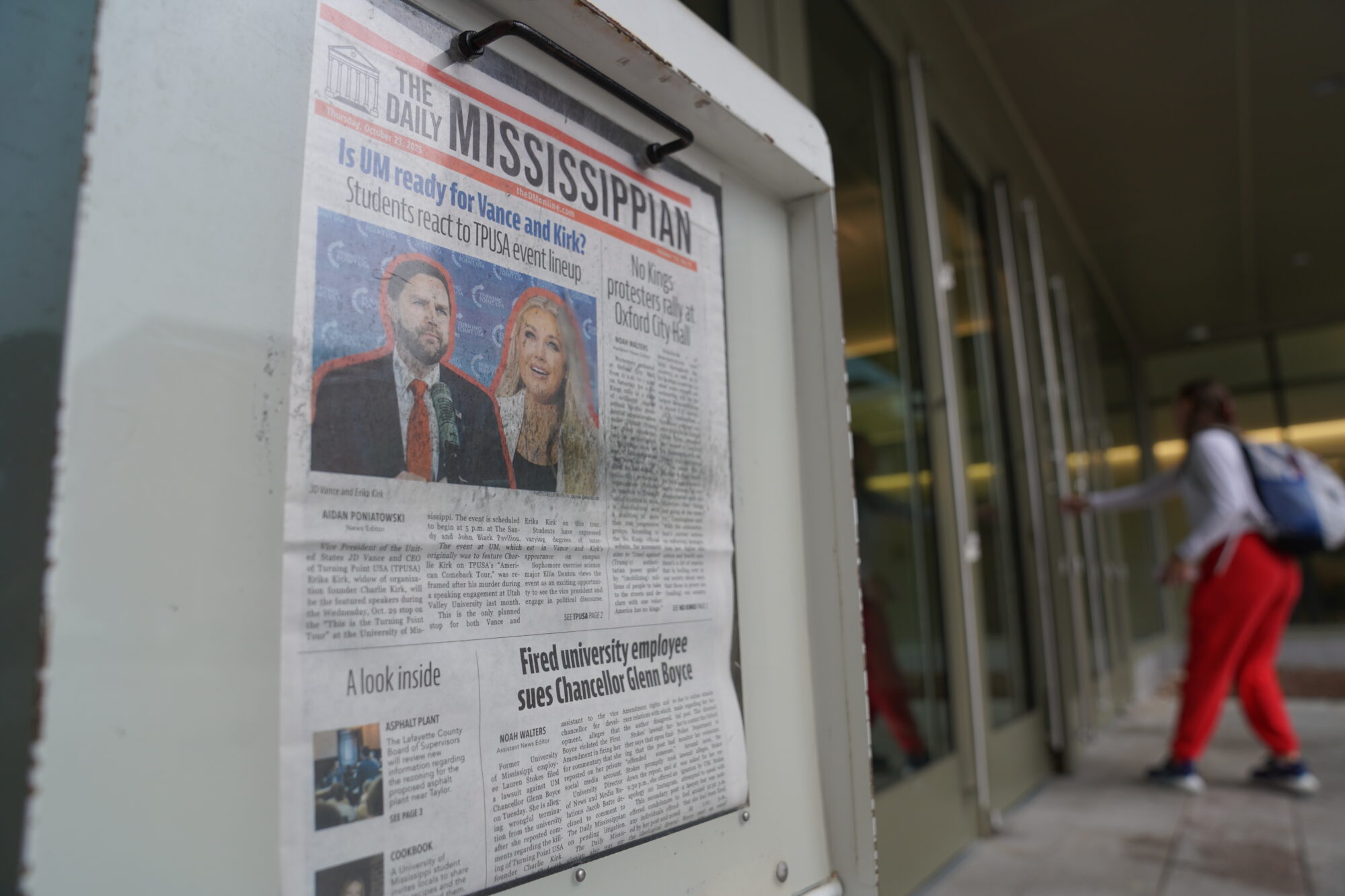
A federal judge dismissed a former University of Mississippi employee’s lawsuit against Chancellor Glenn Boyce, which claims he violated her First Amendment rights by firing her for comments she shared on social media after the assassination of Charlie Kirk, criticizing the politically far right activist’s stances on issues including gun rights and women’s rights.
U.S. District Judge Glen Davidson ruled Monday in favor of a motion Boyce had filed to dismiss the lawsuit. Davidson determined that Lauren Stokes, a former executive assistant in the university’s development office, failed to prove that the chancellor violated her constitutional rights. Davidson also ruled that Boyce, in his role as chancellor, is entitled to qualified immunity.
Stokes sued seeking damages, legal fees, and a declaration that Boyce violated her First Amendment rights.
Kirk was shot and killed on Sept. 10. In a statement issued the next day on behalf of the university, Boyce did not name Stokes, but described the comments she shared as “hurtful” and “insensitive,” and that they “run completely counter” to the university’s values of “civility, fairness, and respecting the dignity of each person.”
Davidson wrote in his ruling that Stokes, the plaintiff, “cannot rebut the Defendant’s qualified immunity defense because she cannot show her interest in her social media post outweighed the Defendant’s interest in the University’s efficient operation.”
The Turning Point Tour stop at the University of Mississippi is the only joint appearance of Vice President JD Vance and Erika Kirk, the widow of conservative activist Charlie Kirk. Credit: Richard Lake / Mississippi Today
United Campus Workers, which represents higher education employees in Mississippi, raised concerns about Davidson’s ruling and its implications for free speech within the context of ”modern online discourse.”
In a statement, the union said Davidson also did not adequately consider the merits of Stokes’ claim that Boyce engaged in viewpoint discrimination when, after firing her, he attended a political rally honoring Kirk, the statement read. The “ruling will enable the mob to trump an individual’s right to hold and express contrary political opinions.”
An Ole Miss spokesman did not immediately respond to a request for comment.
Alysson Mills, Stokes’ attorney, said they plan to appeal the ruling.
“This is not the law as we understand it,” Mills said Wednesday. “This is the heckler’s veto. We intend to appeal to defend the rights of employees at the University of Mississippi.”
Audio recording is automated for accessibility. Humans wrote and edited the story.
The fate of a pilot program to provide public defenders in rural counties — called “a model for the nation” — is now in the hands of a legislative conference committee.
The Mississippi Senate has approved an amended version of House Bill 1930 that includes second-year funding for the three-year pilot program that provides resources for rural counties that lack a robust public defender program. On Wednesday, the House declined to concur on the changes, seeking final negotiations with the Senate.
Wednesday also marked the 63rd anniversary of the U.S. Supreme Court’s decision that established the right to counsel for people charged with serious crimes who can’t afford a lawyer.
That 1963 case involved Clarence Gideon, who was convicted after he was forced to represent himself in court. As a result of the ruling, he received a new trial, this time with a court-appointed lawyer. He was acquitted.
The pilot program is taking place in Mississippi’s Fifth Circuit Court District. In Attala, Winston, Montgomery and Grenada counties, these new public defenders are tackling a third of the felony cases. In Carroll, Choctaw and Webster counties, the new defenders are handling cases where conflicts arise.
If the pilot program works, it could be expanded to rural counties across the state. “This is a new program,” State Public Defender André de Gruy said. “We’ve never done anything like this at the local level. Not every county is big enough for a public defender, so this is designed for the 67 counties that are less than 50,000 in population.”
He said the year two request in the original bill is $838,000 to fully fund four lawyers, an investigator and two support staff members. The Senate’s recommendation is to provide $778,677 in funding.
Pamela Metzger, executive director for the Deason Criminal Justice Reform Center at Southern Methodist University’s law school, called the program “a model for the nation.”
Metzger, whose center collaborated with de Gruy to design the project, called the pilot program “a cut above” what she’s seen in other states. “The pilot office lawyers are working seven days a week to provide Day One representation in seven counties,” she said.
What makes the program different, she said, is these lawyers are getting involved in cases within 24 hours of an arrest and staying involved, “providing continuous representation rather than stop-start representation — a problem in Mississippi and other states.”
In its first five months, Mississippi’s pilot program has represented 84 clients facing felony charges. Because the public defenders became involved early in their clients’ cases, 31 of the case arrests were resolved without a felony conviction, Metzger said.
In another case, the judge originally set a $1 million bond, but after a preliminary hearing, the judge concluded the prosecution’s case was “very, very weak” and reduced the bond to $50,000, she said.
Such legal help creates a “smaller, smarter and fairer system of justice,” she said. “The quality of justice improves.”
The public defenders have also helped 16 clients obtain substance use and mental health treatment.
Only a handful of Mississippi counties currently have a full-time public defender’s office. In counties where boards of supervisors don’t establish a public defender office, the maximum amount an attorney can be paid for a single felony case is $3,000, plus expenses.
The Public Defender Task Force concluded in 2018 that Mississippi “has no permanent institutionalized oversight mechanism to ensure that its constitutional obligation to provide effective counsel to the indigent accused is met in noncapital cases in many of its trial courts.”
According to a 2018 report by the Sixth Amendment Center, Mississippi is the only state in the Southeast that doesn’t have either a statewide public defender system like Arkansas or state oversight like Louisiana. As far as de Gruy said he knows, that is still true.
The report also noted that lawyers hired as public defenders “consistently carry excessive caseloads that prevent the rendering of effective representation.”
Metzger said the pilot program’s success is enabling existing public defenders, who have been overburdened by caseloads, to do their jobs even better.
The Deason Center is gathering data on the pilot program so that lawmakers and others can see how well it works, she said. “Nothing I’ve done in the past has made me more proud than to be associated with the pilot program now going on in Mississippi.”
Audio recording is automated for accessibility. Humans wrote and edited the story.
CLARKSDALE – A large crowd of residents gathered Monday evening at Clarksdale’s Civic Auditorium to ask questions about or voice their thoughts on a proposed data center development.
Many were excited about the economic benefits that such a large project could bring to the small, financially struggling Delta community.
“We’ve been praying for Clarksdale’s economic turnaround for a long time. And this is a godsend that can turn around Clarksdale,” said business owner Bob Wright.
Few details have been provided about the proposal, including who the developer is and the size of potential investment. Officials said this is due to the preliminary nature of negotiations.
The town hall came ahead of next week’s Clarksdale Board of Commissioners meeting, when the board will consider a rezoning application for the proposed 648-acre site.
Officials from the city have stressed that while there have been conversations with a developer, there are currently no agreements in place, and that even if the property is rezoned, the project is not guaranteed.
“Does approving a zoning ordinance mean that the project is absolutely going to happen and that the company is absolutely going to make the investment? No,” said Tray Hairston, a lawyer from Butler Snow hired by the city as a consultant on the project.
Clarksdale is a historic town known for its contributions to the Civil Rights Movement and as the birthplace of blues music. However, it has struggled economically and experienced a steady population decline, like many other farming towns in the Mississippi Delta.
In 2000, its population was around 20,000; now it is about 14,000. The poverty rate is about 40%, over double the statewide rate. The tax base has eroded with the loss of people.
In Clinton, a different data center project is estimated to bring in a minimum of $5 million a year in taxes to the city and its school district. Other cities with data center projects have projected tens of millions of dollars a year in new tax revenue. In 2021, Clarksdale’s annual general revenue is $12.5 million.
“We need to be able to pay our teachers. We need to be able to improve our facilities. And I think this data center could provide tax revenue that would do that,” said Jason Matthews, a retired public school educator.
However, some residents raised concerns about noise, energy and water consumption, customer utility rate increases, health risks, or other potential impact from such a project.
“My concern is about how it will affect the babies, the ears, and the local animals that we have here,” said Patricia White, a retired nurse and lifelong Clarksdale resident. “Money is good. I love money. But I’m concerned about the health of the residents. Why was it chosen? Why was it chosen to be where it is? It’s going to affect us?”
The city did not make any decisions at the meeting and said that it would work to address the public’s questions and publish its responses. The board is expected to vote on the rezoning of the site at its Monday, March 23 meeting.
“I think those are legitimate and real and earnest questions that we have to answer,” said Hairston.
Editor’s note: Tray Hairston, an attorney with Butler Snow, serves on the Board of Directors of Deep South Today, the parent company of Mississippi Today.
Audio recording is automated for accessibility. Humans wrote and edited the story.
Though school choice talks have stalled this session, bills regarding a state tax program that incentivizes Mississippians to donate to private schools have now passed both chambers of the Legislature and head to final negotiations.
Since 2020, private schools and foster care organizations have been receiving money through the Children’s Promise Act, which gives donors a dollar-for-dollar tax credits for up to 50% of the donor’s state tax liability.
The program, passed in 2019, was originally billed by House Ways and Means Chairman Trey Lamar, a Republican from Senatobia, as a way to give money to nonprofit organizations that care for foster children. But a provision to give tax credits to private school donors was quietly included in the bill.
Half of the program’s tax-credits are earmarked for people and organizations that donate to foster care service organizations. The other tax credits are available to donors to private or special purpose schools that have any students in the foster care system, students with chronic illnesses or disabilities or students who are eligible for free or reduced-price meals.
Lamar has unsuccessfully tried for years to raise the cap on the program, which is currently set at $18 million a year in total. This year’s attempt — a provision in House Bill 1944 that would’ve increased the program’s cap to $40 million by 2028 — has failed thus far.
The Senate on Tuesday passed an amended version of House Bill 1944, Lamar’s bill, that removed the provision that would have raised the cap on the tax credit program. However, the amended bill would still add money to the program by creating a separate category and allowing more tax credits for the state’s special purpose schools.
The amendment would separate schools in the second category, creating three buckets of eligible organizations — nonprofit foster care organizations, special purpose schools and private schools — and creating an additional $6 million in tax credits for special purpose schools.
That means next year nonprofit foster care organizations would be eligible for $8 million, private schools would be eligible for $8 million and special purpose schools would be eligible for $6 million.
An amendment offered by Democratic Sen. David Blount of Jackson would have removed private schools from the program, but kept nonprofits that serve foster youth and kept special purpose schools that serve students with disabilities.
“By setting up a separate bucket for the special purpose schools, the effect of that is you are giving more tax credits to private schools because they’ve got their own bucket,” he said. “What the amendment would do is it would protect and completely hold harmless the nonprofit groups in your community that you care about.”
Blount’s amendment failed by a thin margin. House Bill 1944 will now head to negotiations between the two chambers, where it can still be amended — a concern longtime Sen. Hob Bryan, a Democrat from Amory, voiced on the floor.
“I’m very confused about the finances of the state,” he said. “We’ve got to be careful about how much money we send to school teachers now because the budget’s real tight and we can’t afford that, but now we’re back on another tax credit to send money to private schools and suddenly we’ve got enough money to do that. You can understand why I’m confused.”
The bill’s passage comes at the tail end of a legislative session headlined by education policy. School choice proposals that would allow parents to spend state tax dollars on private schools have died, but teacher pay raise bills in both chambers have been hotly contested and remain alive.
And another bill passed by the Senate on Tuesday appears to include language pertaining to the Children’s Promise Act.
House Bill 4067, a bond bill that would potentially fund millions of dollars in projects across the state, includes the section of state law about the Children’s Promise Act. That means it could also be amended during negotiations between the chambers.
Additionally, an amendment that would have added language pertaining to the Children’s Promise Act was rejected on the House floor last week.
Lamar on Tuesday couldn’t recall where else he had filed that language, but told Mississippi Today that he has filed the bill in multiple ways because there’s a great need for the program across the state.
“If you’ve been around this process a while, it’s the same reason a diaper tax just got put in the tractor tax,” he said, referring to amendments on the House floor on Tuesday that included an exemption on sales taxes for diaper purchases. “It just happens … I don’t know what to tell you.”
Lamar tried similar tactics in 2025, when he inserted the Children’s Promise Act in various Senate bills after the original bill was killed.
“It’s just a great piece of legislation that does a lot of good and hurts no one,” he said. “It defies common sense and logic for anybody to be against the bill.”
Audio recording is automated for accessibility. Humans wrote and edited the story.
What would help solve generational poverty in Mississippi?
Phone apps, according to a witness who testified Tuesday in the ongoing trial of former WWE wrestler Ted “Teddy” DiBiase, who is charged in a welfare misspending case.
On the 17th day of the trial, which has had several pauses since it began in early January, the prosecution rested its case after it finished questioning a forensic accountant for the FBI. The defense called its first witness, Kevin McClendon, co-founder and former CEO of Birmingham-based marketing agency Telegraph Creative.
McClendon testified that he met DiBiase more than a decade ago and not long afterward, he was introduced to John Davis, the then-director of Mississippi Department of Human Services.
In 2017, Davis brought DiBiase into the fold of the welfare agency, helping the ex-wrestler secure a $3 million windfall of federal public assistance funds. Prosecutors say DiBiase was paid under sham agreements while the defense argues he was a legitimate contractor.
Davis pleaded guilty to fraud and conspiracy charges in 2022 and DiBiase is on trial for charges of conspiracy, wire fraud, theft and money laundering.
Former Mississippi Department of Human Services director John Davis heads to the Thad Cochran United States Courthouse on Monday, Feb. 23, 2026, in Jackson. Credit: Vickie D. King/Mississippi Today
Davis and DiBiase bonded over God, fitness and a number of pie-in-the-sky supposed anti-poverty initiatives – such as the idea for two phone apps. They wanted to develop one of the apps to encourage better fitness and nutrition among welfare recipients and another to reach troubled teens with Bible verses.
These projects represent just a sliver of the overall welfare scandal, which occurred when DHS outsourced tens of millions of its functions to two nonprofit organizations running an initiative called Families First for Mississippi. Those entities then squandered the money on the pet projects of politicians and celebrities.
McClendon said DiBiase approached him with the idea of developing the first app called Get Fit and that they spent six months developing a pitch deck. Part of DiBiase’s defense strategy is to show that DiBiase attempted to conduct work under his agreements with the nonprofits.
DiBiase was instrumental with the app, McClendon said, not because he had any tech development capabilities but because he would convince Mississippi celebrities to sign onto the project and film video content – guided workout plans and cooking lessons – that would be used within the app.
“The purpose of this application was to gamify the work that MDHS was doing, you know, essentially to break the cycle of poverty within the state,” McClendon said.
McClendon said the state’s goal was also to collect data on residents, such as where they purchase food.
The pitch deck included plans to feature DiBiase, Archie Manning, Cat Cora and Jerry Rice inside the app, though McClendon admitted he didn’t know if DiBiase had received commitments from any of them. To unlock the content, users would complete “challenges” such as the “forget fried challenge,” McClendon explained, with an explainer of how to bake okra instead of frying it.
“Let me just say, baked okra sounds terrible,” Assistant U.S. Attorney Dave Fulcher said on cross examination.
The prosecution presented evidence of payments between companies controlled by McClendon and DiBiase. Telegraph paid one of DiBiase’s companies, Priceless Ventures, more than $7,000 in 2017. In 2018, Priceless paid one of McClendon’s companies, Nonfiction, $25,000. On that check, the “for” line read “INFLCR.” McClendon said he couldn’t remember the reason behind either of those payments.
Priceless wrote another check for $50,000 to a separate company, INFLCR LLC, for “investment.” McClendon said he had nothing to do with that payment.
INFLCR was an app developed primarily to help athletes post content to promote themselves on social media. Both Mississippi State University and University of Southern Mississippi partnered with that company.
Additionally, Mississippi Today’s review of a forensic audit shows Mississippi’s welfare agency directly paid Telegraph $57,500 in 2017-2018 for a “6-week audit of the external and internal marketing and communications strategy for MDHS.” Forensic auditors found the payment was allowable but the agency should have used funds other than welfare dollars to pay for it.
Beyond DiBiase’s contracts with the nonprofits, the welfare agency also provided subgrants to DiBiase’s father’s Christian ministry called Heart of David. The ministry, which pitched the app for teens in partnership with Families First, also paid Telegraph $110,000 for web design and maintenance. On Heart of David’s pitch deck, the organization said it planned to leverage the INFLCR platform to help its mentors elevate their personal brand to expand reach.
At one point, McClendon said his company made a pitch to MDHS for nearly $2 million to develop the app. It was not accepted and the project never materialized. McClendon left Telegraph Creative in February 2020.
The prosecution’s last witness was FBI forensic accountant Matthew Auckerman, who analyzed DiBiase’s personal bank accounts as well as the accounts for his companies, Priceless Ventures and Familiae Orientem. Auckerman also analyzed the accounts of the welfare-funded nonprofits who paid DiBiase – Family Resource Center and Mississippi Community Education Center. These nonprofits had received tens of millions of dollars, mostly from a federal program called Temporary Assistance for Needy Families and a smaller amount from the Temporary Emergency Food Assistance Program.
Auckerman described shell companies as “hollow inside” – absent of expenses or employees and often used to shield unlawful activity.
“It is my expert opinion that Priceless Ventures and Familiae Orientem were shell companies,” he said.
Auckerman testified about his analysis of records from bank accounts controlled by the nonprofits and DiBiase. He outlined how nearly $3 million flowed from the two nonprofits to accounts associated with DiBiase’s LLCs. From those accounts, Auckerman said he found purchases of a $55,000 pontoon boat, a $40,000 truck, and nearly $31,000 worth of country club fees and golf equipment.
But Auckerman said the majority of the money doled out to the LLCs – $2.7 million – was transferred to other personal bank accounts controlled by DiBiase. From there, Auckerman’s analysis showed the money flowed toward the purchase of a 6,000-foot home in Madison and into a high-dollar investment account.
Auckerman also analyzed DiBiase’s personal income and expenses prior to his work with the welfare agency.
Auckerman’s analysis showed that in the three and a half years prior to DiBiase contracting with the nonprofits, the bank accounts controlled by him and his wife saw average monthly deposits of around $10,000. In 2018, his biggest year with the welfare agency, that amount rose to about $200,000 a month.
Auckerman said he did not observe a great difference in the types of expenses in those two time periods, such as new office rentals and supplies associated with his LLCs. He said he did see large increases to retail shopping and entertainment and recreation purchases, such as luxury vacations.
From the outset of the welfare scandal breaking in 2020, defendants highlighted what they saw as a problem with the case: The nonprofits had commingled their federal grant funds with other operating revenue, making it hard to know to which purchases federal rules actually applied.
At one point in Auckerman’s analysis of Family Resource Center’s bank account, for example, he identified that less than half of the money in there was from federal sources.
When DiBiase’s lawyer Sidney Lampton questioned Auckerman on cross-examination, she focused on whether the forensic accountant could confirm whether the federal government was the original source of the money associated with the payments from the nonprofits to DiBiase. In several instances, Auckerman said the payments were traced back to other sources. The prosecution retorted that an intent to use federal funds outweighed whether every dollar was traceable to federal funds.
The defense on Wednesday called its second witness, New Orleans-based consultant Matt Theriot, who helped DiBiase form one of his LLCs. He testified that it is commonplace for people with multiple businesses to form LLCs, which have no employees, to protect against liability.
Audio recording is automated for accessibility. Humans wrote and edited the story.
World Series Game Seven winner Jay Powell, the former Mississippi State great, joins the podcast to talk Mississippi college baseball, the World Baseball Classic and Konnor Griffin.