
Multiple phone calls. A car pool to the Madison County Circuit Clerk’s Office, where Zemaryiah Johnson had cast an affidavit ballot. And then instructions that she had to go somewhere else entirely, in an adjoining Mississippi county.
All that to ensure that Johnson, an 18-year-old freshman at the historically Black Tougaloo College, would have her vote counted — for Scott Colom, the state’s Democratic candidate for Senate.
“It’s like going back in time,” Johnson said.
The long, slow count in the tight race between Colom and the Republican incumbent, Sen. Cindy Hyde-Smith, reached a critical deadline on Tuesday, the last day that affidavit ballots could be fixed — a process known as curing — and that mail-in ballots postmarked on Election Day could arrive. Recent days have highlighted the problems and frustrations that Mississippi’s strict election laws can cause in such a tight contest.
Organizers, community leaders and lawyers spent Tuesday scrambling to ensure the final tranche of ballots were in order. By the end of the day, Colom, who would be the first Black senator elected from Mississippi since Reconstruction, led Hyde-Smith by just over 2,600 votes, but an unknown number of affidavit ballots and 2,578 still uncounted absentee-by-mail ballots could still determine the winner.
“Votes should be counted, and that’s all we’re concentrating on today,” Hyde-Smith told reporters on Capitol Hill on Tuesday.
She added: “We’re just looking for the conclusion of our race.”
In Jackson, Colom and his allies have been calling on Mississippi to expand its voting process, by among other things, setting up an early voting period that many other states share. He also questioned whether “there may be some disadvantages to our potential to lead in D.C.,” given that he couldn’t join new lawmakers in orientation on Capitol Hill.
Michael Watson, Mississippi’s secretary of state, had “created chaos” with the affidavit rules and should apologize for the delay, Colom said on Tuesday, during a visit to the Hinds County Sheriff’s Office.
Watson said that as of 5 p.m. Monday more than 15,500 affidavit ballots had been processed. Just over three-quarters of them had been accepted, he said. He did not say how many ballots were left.
Mississippi and Alaska are the only states yet to declare a winner in their Senate contests, but Mississippi is drawing closer. State law does not allow for a recount of votes in a statewide election, nor will there be a runoff.
The tussles over affidavit ballots have also drawn attention to a decision from July 2025, when Watson’s office announced a partnership where data from Experian, the credit reporting agency, would be used as part of the agency’s maintenance of the state’s voter rolls.
Under the partnership, some registered voters identified as having a new address were labeled “inactive,” meaning they had to fill out an affidavit ballot if they showed up to vote. On Election Day, some voters — though it was unclear how many — found themselves mistakenly marked as having moved or inactive.
Scott Anderson, an Experian spokesman, said the agency hadn’t worked with Mississippi since early last year, and that the sharing of “supplemental address information” at the time “was not designed or intended to validate voter records.”
Watson defended the affidavit ballot process in a statement on social media last week as “a safety net for errors” during voter roll maintenance that would result in “more accurate voter rolls” and “decrease opportunities for voter fraud.”
Over the last week, affidavit ballots have been processed by hand, as election commissioners checked to see whether each voter was in the system, or if someone had arrived to “cure” a ballot with proper identification. That has created considerable friction.
“Seeing people genuinely have to call every day and have to go up there every day and exhaust their finances with gas and their energy to do things like this — it’s almost like they want people to get tired,” Johnson said.
The process proved especially confounding for many Mississippi college students, including at Tougaloo, which straddles Hinds and Madison counties, two of the state’s largest. The geographic positioning had sowed confusion, since some students lived in one county but tried to vote in the other.
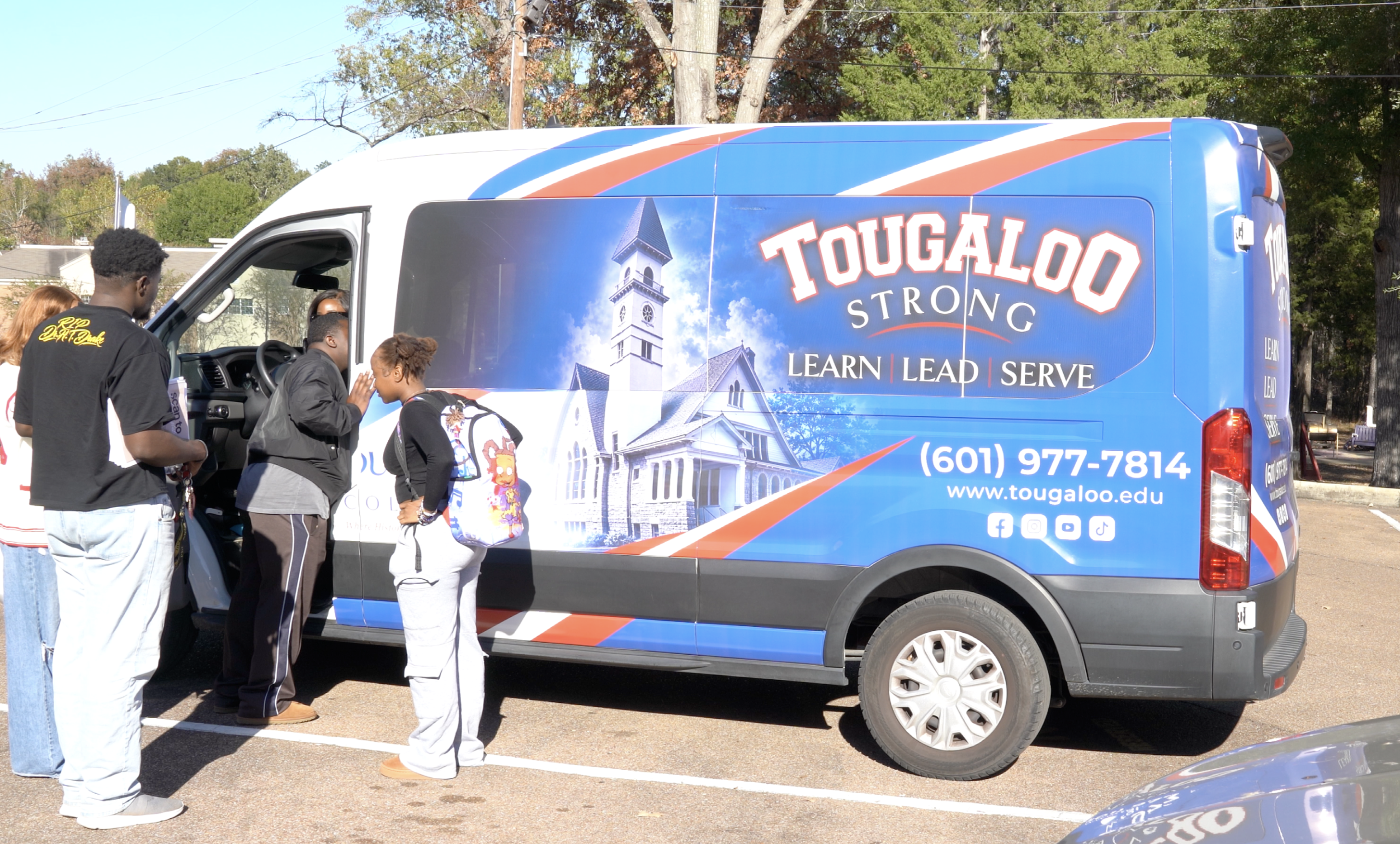
Terry Rogers II, 21, a senior studying political science, drove students in a college van between the two counties, as he wrestled with each student’s particular instructions on where to go to check a ballot.
“Think about how many others did not have the opportunity and have advocates like that,” Rogers said.
Lyric Wise, 18, a freshman at Tougaloo, said elections officials were sending students around in circles. Wise has already made two trips to the Madison County Circuit Clerk and was set to board Rogers’s shuttle to the Hinds County Circuit Clerk on Tuesday afternoon.
Cortorian Keeton, 22, a Tougaloo senior who managed to resolve his ballot problem, said he had never seen friends and peers so engaged in the political process: “A lot of people mad, a lot of people happy, a lot of people want Mississippi to stay the same and a lot of people want Mississippi to be different,” he said.
But even some organizers who lamented the hurdles for voters basked in the attention of the nation and the pride they said they felt in Mississippi’s civic engagement.
“People are actually looking at Mississippi right now,” said Jada Barnes, the field director for Mississippi Votes Action Fund. Over wings and pizza in the organization’s Jackson office, volunteers spent Monday evening calling voters, checking to see if they had voted using an affidavit ballot or fielding questions about the process.
The state’s voters, she said, “really beat the odds.”
One of those voters, Heather Holland, 28, said that since she got married in 2022, she had cast her ballot several times in Jackson County, a Republican stronghold on the Gulf Coast. But last Tuesday, when she showed up to vote, her registration turned up under her maiden name, requiring her to file an affidavit ballot.
“It could make a difference,” Holland, a Democrat, said on Tuesday. She reached out to volunteers to make sure that her vote had been counted.
On Tougaloo’s campus on Tuesday, Rogers printed off fliers with a QR code that directed students to a state website that allows people to check the status of their ballots. With about 40 fliers in hand, Rogers joined other students who had gathered steps away from the Woodworth Chapel, a haven of the Civil Rights movement where leaders like Medgar Evers and Fannie Lou Hamer had spoken, and opened the driver-side door for the final trip on Tuesday.
His next destination: Jackson State University, another historically Black college where students had reported problems filling out affidavit ballots. More ballots needed curing.

- Voters struggle as ballot deadlines pass in Mississippi Senate race - November 10, 2026
- Colom leads Hyde-Smith by 2,604 votes in Mississippi Senate race as final Hinds County tally looms - November 10, 2026
- Ole Miss students and parents call for accountability after viral racist incident - November 10, 2026