
Home Blog Page 206

Rhodes Scholar enjoys big city lifestyle, but lure of Mississippi and family remains strong

Editor’s note: This Mississippi Today Ideas essay is published as part of our Brain Drain project, which seeks answers to Mississippi’s brain drain problem. To read more about the project, click here.


When I think about my relationship to Mississippi, the first thing that comes to mind is a song by the Chicago rapper, Chance the Rapper, called “Together.” 

If you keep the house in the family, you can keep the family in the house

If you on the run, you got family in the South

Chance’s lyrics go on to pay tribute to the women who, week after week, cooked for big family gatherings while he was a child, playing blissfully with his cousins until the meal was ready. The chorus brings his feelings into sharper focus: he’s reflecting because his family doesn’t gather the way they once did, and he longs for those old times. He repeats this wish, line after line in the chorus, urging his loved ones to “get together” more — not just for holidays, but simply to share presence, love and support.

The home that stands out in my memory is my maternal grandparents’ house in Vicksburg. Nearly every Sunday of my first 18 years was spent there with my cousins — more than 30 of us on just that side of the family — alongside my 12 aunts and uncles, and whoever else happened to drop by.

After church, we all came over ready to eat. The main course normally featured chicken fried or baked, but it wasn’t a shock to have some coon or possum either. Classic side dishes included rice and gravy, macaroni and cheese, black-eyed peas, collard greens and corn bread — sometimes rolls if my grandma had the time and energy to make some from scratch. We topped it all off with desserts that people barely eat anymore — jelly cake and tea cakes — and we’d watch whatever football or basketball game was on, depending on the time of year, joke and laugh about whatever happened last week and share our hopes for the next ones. 

I didn’t realize how spoiled I was back then. It was so much love I could bathe in it. Hugs from everybody, Grandma telling me to eat more, and aunts and uncles celebrating me for making good grades — all a boy could ask for. 

When I left for Mississippi State University at age 18, I never imagined I might never live in the state again upon graduation in 2014. Now, after more than a decade away, that possibility feels surprisingly real. When I started college as a wide-eyed freshman in 2010, I had no idea what direction my future might take.

During my first semester, I still dreamed of becoming a sports journalist — maybe even working for ESPN sounded appealing — but, truthfully, I had little sense of what I would actually do after graduation. Most of my family remained rooted in Mississippi, and I always assumed I would do the same.

But during college, I fell in love with literature and became remarkably disciplined. I earned almost all A’s, received recognition for a few essays and landed some reputable summer fellowships at Stanford and the University of Iowa. Before long, the Honors College noticed my efforts and encouraged me to apply for the most renowned international fellowship in the world, the Rhodes Scholarship.

I didn’t know what it was at the time, but they told me presidents and prime ministers, game changing lawyers and doctors, world-class writers and famous national news anchors had all won it in the past. If I happened to get it, an entirely new world of possibilities would open up before me.

Miraculously, I was awarded the scholarship. The only condition was that I would have to move to England and study at the University of Oxford, with all expenses covered by the Rhodes.

After graduating from MSU in 2014 and leaving for Oxford, England, I eventually found my way to Cambridge, Massachusetts, where I began a PhD at Harvard in 2016. It was there that I met my wife, and, as they say, the rest is history. Since that time, I haven’t returned to live in Mississippi. The Boston area has been my home for nearly a decade.

It wasn’t a deliberate choice to not return, but I’ve grown accustomed to a different way of living. While New Yorkers may shrug at Boston’s dining and cultural offerings, to someone who grew up in rural Mississippi, the abundance feels limitless. Sadly, I don’t throw down on collard greens and ham hocks as often as I once did, but whenever I crave a taste of home, I can always head to Roxbury for some Slade’s. 

Donald Kizza-Brown Credit: Courtesy photo

If I choose, I can join my wife at a Beyoncé concert at Gillette Stadium, though, I prefer to just let her go with friends or plan a night out with my friends to watch the Celtics, or catch live concerts from artists I love, like Bryson Tiller or Rylo Rodriguez, who frequently perform in the city. At least three days a week, I run along the Charles River Esplanade. After, I normally grab a quick, healthy meal at one of my two staples Sweetgreen or DIG — two options that simply don’t exist back in Mississippi. 

As much as it pains me to admit, I’ve embraced this urban yuppy lifestyle and I like it. Mississippi just doesn’t offer the same experiences I’ve come to take for granted, and I’m reminded of that every time I return home for a visit.

Yet, I can’t say with certainty that I’ll never return. After all, at Harvard, I wrote a 500-page dissertation critiquing Isabel Wilkerson, who argues in The Warmth of Other Suns that Black Southerners who left Mississippi and other Southern states were the most ambitious of the Black South—and that they ultimately found better lives elsewhere. Leaving, people like her and others suggest, requires special determination and courage. 

But leaving, in and of itself, requires no more determination and ambition than staying. One of my favorite musicians, David Banner—himself a Jackson native—opens his 2003 album, Mississippi: The Album, by suggesting that those who depart the state might be avoiding the real, difficult work of making a difference when things get hard.

According to Banner, calling what Black Mississippians, in particular, did when they departed Mississippi during Jim Crow times simply “leaving” or “migrating” is generous and not neutral. According to Banner, they were “running away scared” while others stayed, fought and died for civil rights. 

And maybe I am running away from the real work, too. Consider another Rhodes Scholar from Mississippi, state Auditor Shad White. After degrees from the University of Oxford and Harvard, he returned to Mississippi.

In 2023, he authored a study, Plugging the Brain Drain: Investing in College Majors that Actually Work, proposing that Mississippi taxpayer dollars should not fund degree programs in African American Studies, among others, because they often result in graduates seeking opportunities outside the state for work.

In a particularly controversial Sept. 15 post of the same year, he declared that “degrees in garbage fields” are “bad for the economy,” insisting they “offer no real skills.” He took aim at universities who love their “cheap professors who specialize in sexual identity or urban stand-up comedy.” His parting shot: “By all means, go take that Latinx Environmental Justice class in Urban Studies. Just don’t ask taxpayers to pay for it.”

One can love or hate Shad White — and many Mississippians do either love or hate Shad White because he takes strong stances — but all can agree he isn’t running away scared. Instead, he’s actively shaping an environment where people like me, who have taught courses in African American Studies and other subjects he deems “garbage fields” at institutions like Harvard and Brown, don’t feel welcome back home. In my opinion, from the outside looking in, it seems to be exactly what he wants and is another reason I am less likely to return.

But it’s also the best reason to return. From my vantage point, there is urgent work to be done. My grandaddy — a preacher and civil rights leader in the 1960s — spent his life pushing Mississippi to recognize its Black citizens as full Americans, fighting for the right to vote and the right to see themselves reflected with dignity in classrooms and curricula. He never faltered, not even in the face of bomb threats. My grandad remains one of the most courageous and ambitious people I’ve ever known — and he didn’t leave Mississippi for the North. 

I should be doing more to create a better future for children living in Mississippi now — so when the next generation of Mississippi’s children attend schools like MSU or Alcorn they won’t have to depend on private donors just to study subjects I believe are vital to a college education.

Someone who is doing the real work is a cousin of mine, TJ Mayfield, who serves as an alderman in Vicksburg and is like a brother to me. We text all the time, and I feel like I’m still plugged in to the city through him. He’s launched some promising programs and initiatives recently to provide more jobs, more educational opportunities, and more role models of what success in Vicksburg — not elsewhere — looks like. 

He didn’t run away scared. In fact, he never left. He went to Alcorn for college and then returned as a teacher in the public high schools and then became alderman. 

In the summer of 2022, he came to visit me in Boston, just a month after I’d graduated from my PhD program. I took him to see the Isabella Stewart Gardner Museum — one of the city’s most celebrated arts museums, and we caught a Red Sox Game, too. 

But most memorably, we went to Game 6 of the NBA finals together, with Golden State holding a 3-2 lead over the Boston Celtics. That was the classic game where Steph Curry finally got the monkey off his back and secured his first and only Finals MVP. The energy in the arena was electric, but it was bittersweet for Boston fans (I don’t consider myself one). We watched as Steph Curry hit clutch three after clutch three, lifting Golden State whenever they needed it most, and ultimately celebrated his championship right there on Boston’s home court.

TJ and I stayed for the ceremony and reminisced on old times back in Mississippi. We used to watch the finals together at grandma’s house. Who would’ve thought — back then — that we would now be watching it live in person?

The next day, we went out for Thai food and Jamaican food, walked down Boylston and Newbury streets, through Beacon Hill, and crossed the Longfellow Bridge with the Charles River gleaming beneath us. It reminded us of home, growing up along the banks of the Mississippi River. 

And if every other detail of that week should fade from memory, I will always remember us striding across that bridge, the city at our feet, when he stopped, looked at the skyline, and said, “Man, I get it now. I see why you like Boston. I see why you been up here for so long.” 

I don’t know what I said in response—something casual like, “Yeah, man, it’s nice up here.” But I know what I should have said. 

I should have said that, despite all of the accolades, I wish I was more like him because he’s home fighting for the people I care about most: folks back in Vicksburg, a majority-Black, working-class town that, like many American towns, has fallen on hard times. He’s the one following in our grandaddy’s tradition, and he’s the one that’s still a 10-minute drive from grandma’s house.

Though many of us have left, and Grandma and Grandaddy are both gone — the house is still in the family, and the house is where the love is as abundant as the greens and cornbread and everyone knows our name.


Donald Kizza-Brown was born and raised in Vicksburg. After graduating from Mississippi State University, he pursued graduate studies abroad in Oxford, England, and later in Boston. Currently, he holds a postdoctoral fellowship at Brown University, where he is working on a biography of the renowned Mississippi author Richard Wright. 

Auditor: Mississippi gives teachers classroom supply money too late. Ed officials say issue is already fixed

A card that pays for classroom supplies for Mississippi teachers is activated too late to be useful, a new report from the auditor’s office says. 

The Education Enhancement Fund, or EEF, procurement card program, which was established in 2012, gives every teacher $748 — over $27 million in total across the state — to buy supplies for their classrooms. But because the cards aren’t activated until August 1, $17.8 million of that money is locked when “teachers need it most,” the report concludes. 

According to State Auditor Shad White’s office, three out of four classrooms will have already started school this year before teachers have access to the cards. That means teachers will have to dip into their own pockets to purchase the supplies or start the year without supplies they need. 

“The ‘Mississippi Miracle’ in public education is a national success story, but sustaining that momentum requires classrooms to be equipped from the first day of class,” the report reads. “Activating cards by July 15th each year would eliminate this burden, put public dollars to work as intended, and ensure students walk into classrooms ready to learn.”

However, the state education department says it typically releases funds in July — information that agency officials say the auditor’s office omitted in its report. 

Because the state changed vendors and new cards had to be issued, fiscal years 2025 and 2026 were exceptions, according to the education department. In fiscal year 2027, it will be possible to activate the cards anytime after July 1. 

“It is always MDE’s intention to provide teachers with all available resources as expeditiously as possible,” a statement from the agency reads. 

The August 1 activation date is sooner than in years past. For 10 years, the Mississippi Department of Education activated the cards by September 1. In 2022, legislation changed the cards’ activation date to help teachers access the money earlier. 

“We’re glad that MDE is making the needed change of activating EEF cards before the school year starts in coming years,” White said in an emailed statement. “This will help ensure that teachers don’t have to go out-of-pocket for classroom supplies and have the classroom ready to help students succeed.”

No action taken on state-funded project to pave Jackson road by lawmaker’s house

No action has taken place on a state-funded project to upgrade an already relatively well-paved northeast Jackson cul-de-sac that runs by a house owned by a Mississippi lawmaker, though officials overseeing the project say they still plan on completing the task. 

Rebekah Staples, the chair of the Capitol Complex Improvement District’s Project Advisory Committee, told Mississippi Today after the group’s meeting on Thursday that the project to repave the road will eventually move forward, even though not much progress has been made on it. 

READ MORE: ‘Trey Way’: Millions in taxpayer funds flow to powerful lawmaker’s country club and Jackson neighborhoods

“This is a project in which the Legislature has provided funding, and we intend to follow the law,” Staples said. 

A 2024 Mississippi Today investigation revealed that House Ways and Means Chairman Trey Lamar, a Republican from Senatobia, helped steer $400,000 in state taxpayer funds to repave Simwood Place in Jackson, where he owns a house.

Simwood Place, located in the relatively affluent LoHo neighborhood of northeast Jackson, is roughly one-tenth of a mile long, with only 14 single-family homes.

State lawmakers and the Jackson City Council member who previously represented the area told Mississippi Today they did not ask state leaders to allocate money for the Simwood Place project. 

Lamar did not return a request for comment and has previously declined to answer specific questions about the Simwood project.

A spreadsheet detailing the status of various CCID projects showed the Simwood project was still in the preplanning phase, and the comment on the project status simply said, “N/A,” meaning not applicable. 

A spending bill passed by the Legislature and signed into law by Gov. Tate Reeves routed several projects through the CCID committee. The advisory committee is housed in the Department of Finance and Administration.

DFA is the primary agency responsible for state government financial and administrative operations, including employee payroll, employee insurance and maintaining state buildings. However, the Legislature has also tasked the agency with overseeing some operations of the CCID.

The peak time for asphalt projects in Mississippi typically runs from late spring to early fall. The Legislature in 2024 routed five projects, including the Simwood project, through the CCID committee.  

It’s been one year since lawmakers appropriated the money for these projects, and most of them have either been completed or are ongoing, except for the Simwood project and infrastructure improvements to Jackson State University. 

For the JSU project, the spreadsheet says the organization is waiting on an update from the university, while there’s virtually no update or comments on the Simwood project. 

Liz Welch, the DFA director, told Mississippi Today that the agency is still planning on completing the Simwood project, but the organization has other infrastructure priorities that it’s currently tackling. 

Ex-corrections official alleges widespread medical neglect and mismanagement in Mississippi’s prison system

Editor’s note: This article contains a photo that some readers may find disturbing.

On an August afternoon in 2023, three inmates at the Central Mississippi Correctional Facility evaded the notice of guards and slipped away from their housing unit. 

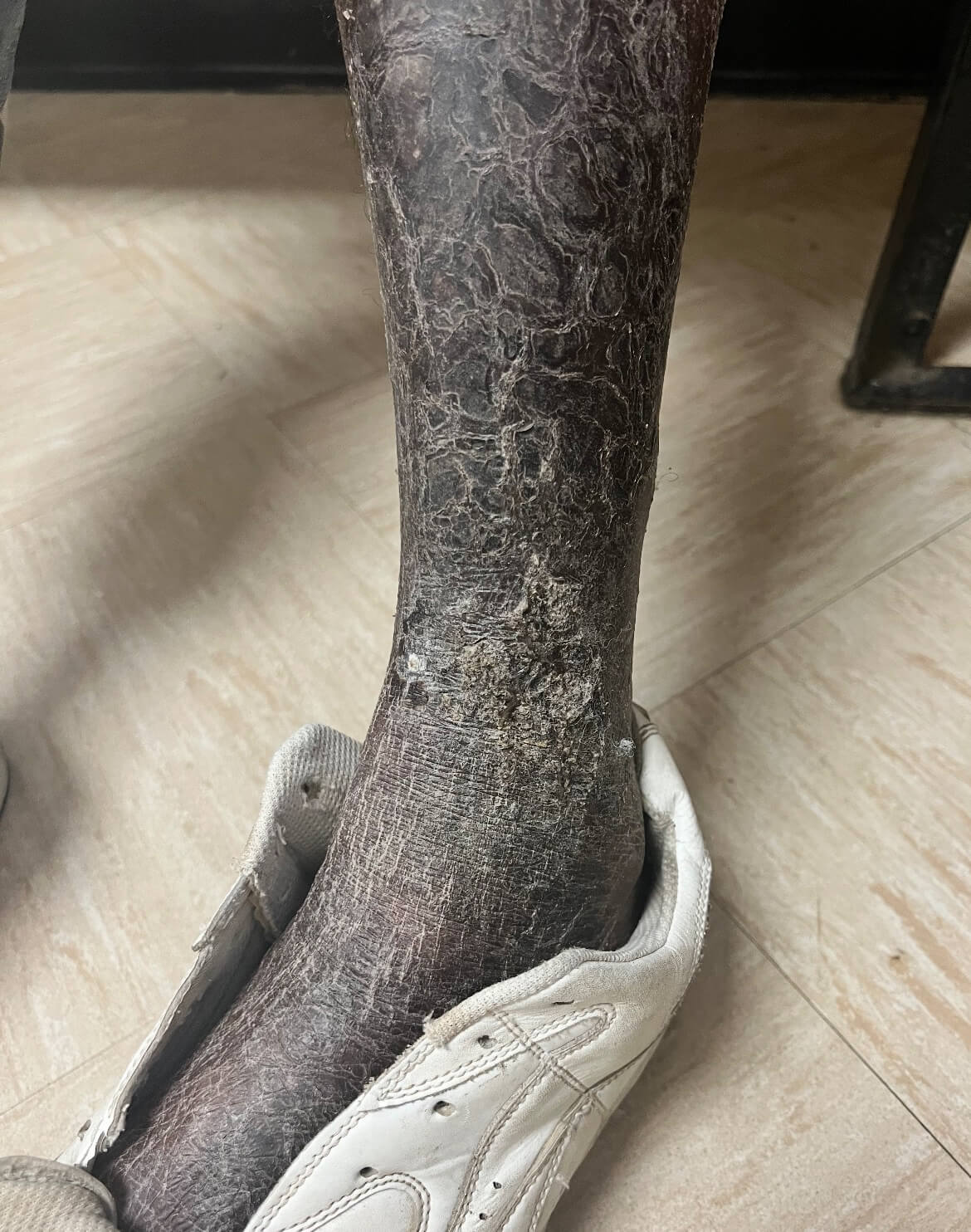
They weren’t plotting to escape the Rankin County prison. Instead, they were on a rescue mission. On their shoulders, they carried a man whose legs seemed to be rotting from the inside out, his flesh cracking like leather left to shrivel in the sun. 

The prisoners decided to take matters into their own hands. They headed for the office of corrections officials to find help and, without a guard stationed on the facility’s watchtower, made their way across the grounds. 

When they reached the outside of a multipurpose building, they spotted Stephanie Nowlin and shouted her name. 

“Think of it like a scarecrow, almost,” Nowlin said, recounting the episode in an interview with Mississippi Today. “It’s how they were carrying him, one on either side, and his arms were just off their shoulders.”  

The image embedded itself in Nowlin’s mind, but it was only one moment among many that charted her course from high-ranking prison official to public critic of the system she once served.

For almost two years, Nowlin was one of Mississippi Department of Corrections Commissioner Burl Cain’s top lieutenants. Cain hired Nowlin after she had served time in prison herself and made her his government affairs coordinator. The pair developed such a close bond that she came to view him like a grandfather. Now, she is speaking out about what she said is widespread medical neglect and mismanagement inside the agency and its facilities. 

An inmate’s leg at the Central Mississippi Correctional Facility on Aug. 17, 2023. Credit: Stephanie Nowlin

Nowlin provided Mississippi Today with internal messages between current and former department officials showing officials criticizing VitalCore Health Strategies, the company contracted to provide medical care to Mississippi prisoners. The messages show that in private, officials lamented the quality of VitalCore’s health care services even as the company raked in hundreds of millions in public dollars — a money pot that has been growing larger for years.

Nowlin came forward after Mississippi Today reported on the House Corrections chairwoman’s allegations that MDOC is running a financial deficit for its medical program at the same time sick prisoners languish without proper care. 

In response to Mississippi Today’s questions for that article, MDOC spokesperson Kate Head said the conditions inside Mississippi prisons exceed “constitutional standards” and denied any allegation that inmates receive care below such standards. 

The statement compelled Nowlin to reveal what she said she and other prison officials have seen — neglect and mismanagement that contradicts MDOC’s claims that it provides inmates with proper medical care. 

“It affected me tremendously. I could not sleep,” Nowlin said of the statement. “There are just so many things that are wrong with that.”

In a statement, Head did not respond to a detailed list of questions about the specific episode Nowlin mentioned, the internal communications obtained by Mississippi Today or the department’s provision of health care. 

READ MORE: Behind Bars, Beyond Care: A Mississippi Today investigation

“The Mississippi Department of Corrections is restricted by federal law from disclosing or commenting on the medical condition and/or treatment of the inmate population,” Head wrote.

A VitalCore spokesperson did not respond to multiple emails and phone calls requesting comment. The company has previously said it provides “comprehensive and competent” health care services to Mississippi inmates.

Nowlin has filed state and federal lawsuits against MDOC related to a personal matter involving her former parole officer — a matter that predated her work at the department. 

In interviews, Nowlin pointed to systemic problems, such as a backlogged and dysfunctional system for getting inmates critical medical services and assigning them to housing units. 

The result, Nowlin said, is that sick inmates get lost in the correctional system — behind bars, beyond care. 

“There are major damages being done. Not just to tax dollars but to real humans. People just like me who made mistakes and who shouldn’t suffer at the hands of egos, politics, laziness, hypocrites and more,” Nowlin said. “I’m ashamed of this system.”

From prisoner to prison official

Nowlin had first been inside the walls of the Central Mississippi Correctional Facility as a prisoner. She was incarcerated between January 2017 and July 2019 for aggravated DUI and served part of her sentence at CMCF. 

After her release, Nowlin worked as an events director for a hotel. Outside of work, she attended church services and began sharing her perspective as a former inmate on how the state could better rehabilitate the people inside its prisons. One woman she met at church was a friend of Cain and, following a recommendation, Nowlin got in touch with him. 

The two spoke for hours over the phone, and following an in-person meeting, Cain invited her to accompany him on a trip to the Angola State Prison in Louisiana, where he had been the warden. The pair attended Angola’s prison rodeo, a program Cain created that attracted national attention for the spectacle of events like bull riding and “convict poker.” 

Cain touted the rodeo as a way to generate revenue for prisons and drive “moral rehabilitation” among inmates – an approach that often saw Cain push to incorporate religious teachings into prison programs. 

Nowlin said she was hesitant to work in a system whose shortcomings she experienced firsthand, but Nowlin was swayed by the affection with which Cain interacted with inmates: “When I saw it firsthand, you see these people in the striped jumpsuits like I was and the way he treated these humans, I can’t even put it into words. I wanted to be a part of that.”

In the fall of 2022, she accepted a job as MDOC’s government affairs coordinator, a position that tasked her with supporting the agency’s interests at the Capitol and working onsite at prisons to develop reforms.      

“Five years ago I was on much different grounds with MDOC. I am here to tell you, do not give up or lose hope,” Nowlin wrote in a Facebook post announcing her new job. “I’m so honored to be a part of Mr. Burl Cain’s team. Seeing the way these men respect him and what he has done for the forgotten inspired me more than I honestly think I have ever seen. I’m thankful and ready for the opportunity that I have been blessed with.”  

Nowlin began working to alleviate what she said was a lengthy backlog for reclassification, the processes for updating an inmate’s custody level throughout their incarceration. Reclassification is supposed to ensure inmates are placed in the least restrictive environment possible while maintaining prison security. But Nowlin said MDOC didn’t employ enough case workers, and inmates would frequently get stuck in restrictive housing assignments for far longer than necessary.  

That is what made CMCF a central focus of her work, and it is what brought her to the prison on Aug. 17, 2023. 

‘He’s fine and noncompliant’

Nowlin said she had been tapped as a potential replacement for Cathy Fontenot, who worked as a consultant for MDOC, focusing in part on inmate classification and reclassification. 

Fontenot previously worked under Cain at Angola as an assistant warden, and for a time handled public relations. Some credit Fontenot with helping to cultivate “the legend of Cain,” a narrative which casts Cain as a near-miracle worker who curbed the violence at what had been one of the South’s bloodiest prisons.

Fontenot is among a cohort of allies who followed Cain to MDOC after he resigned from his post at Angola in 2015 following allegations that he misused public funds. Cain denied wrongdoing and was never charged with a crime. 

Nowlin began working with a team of case workers to help manage the department’s backlogged inmate reclassification system — a task she found intractable. 

On that August day in 2023, Nowlin had been trudging through inmate reclassifications when she stepped outside to take a call. That is when, to her horror, she encountered the inmates carrying the man whose leg flesh appeared to be rotting. Mississippi Today is declining to publish the man’s name to protect his medical privacy. 

The man’s fellow inmates carried him from “quickbed” — a unit for newly arrived inmates undergoing initial classification. It is comprised of inmate “zones” where inmates sleep on bunk beds in dormitory-style housing. 

After seeing the man’s legs, Nowlin took photos and she called John Hunt, then the superintendent of CMCF, who has since become the corrections department’s deputy commissioner of institutions. 

Hunt arrived, and he and Nowlin transported the sick inmate to the prison infirmary on a golf cart. 

Once at the infirmary, Nowlin said, nurses declared the man “noncompliant” because he allegedly had not been taking his diabetes medication. The next day, Nowlin went to check on him and saw that medical staff had rubbed some sort of ointment on his leg and sent him back to his zone. 

“That’s all they did,” Nowlin said. “They didn’t send him to the hospital. They didn’t do anything other than that.”

Nowlin also texted the photos to Jay Mallet, then MDOC’s deputy commissioner of institutions.  Mallet, after seeing the man’s legs, said prison medical staff frequently declare sick prisoners “noncompliant” and send them back to their cells. 

A transcript of texts about the inmate reads:

Mallet: Wait is that real

Mallet: What is that and how long has it been like that

Nowlin: Yes Jay! It’s his legs

Nowlin: I don’t know how long it’s been like that. The nurses keep trying to say he’s noncompliant with his meds, etc. they were going to just send him back. Hunt and I just drove him over on a cart and are having quickbed nurses clean him up. I don’t have any authority to ask any other questions but it’s so fking bad

Mallet: That is what medical does a lot of

Over the next few days, the pair engaged in another text exchange about the incident where Mallet, who was a member of MDOC’s executive leadership and one of the highest-ranking officials in the department, said VitalCore, which he referred to as VC, “sucks” – a statement he made the same year the state agreed to pay VitalCore about $100 million in taxpayer funds. 

Nowlin: I honestly have no idea if they even cleaned up his legs

Mallet: VC sucks 

Mallet also criticized medical staff for allegedly saying the man’s dire condition was partially due to his diet.

Mallet: What is medical saying

Nowlin: Pshhhh he’s fine and noncompliant … Bc he won’t eat right, like are you fking kidding me…

Mallet: What the hell is eating other than what’s served

Nowlin: Exactly. The main clinic was just about to send him back. Jay he couldn’t hold his eyes open

When discussing the man’s condition when he had allegedly fallen into a coma, Mallet also seemed to suggest people would lose their jobs.

Mallet: How is he

Nowlin: Still in quickbed and was in a coma on the bed

Mallet: Damn everybody gonna get run off smh

Mallet: Let me polish off this resume

A screenshot of a text message between between Stephanie Nowlin and former Mississippi Department of Corrections Deputy Commissioner of Institutions Jeworski “Jay” Mallett. Credit: Stephanie Nowlin

Mallet did not respond to multiple requests for comment. Nowlin was not able to confirm what happened to the inmate. Prison records do not show a man who meets his description as currently incarcerated, and parole records don’t show someone with his name as having been released over the past two years. 

In interviews, Nowlin said the episode was not a gruesome exception to the routine process for evaluating and treating sick inmates in Mississippi’s prisons, but emblematic of a systemic problem.

The backlog

The sprawling CMCF was built on 171 acres in Pearl in Rankin County. It can house a little over 4,100 offenders, according to the corrections department. The prison is the first stop for people sentenced to serve time in Mississippi, and as such, conducts initial orientation and classification.

Inmates are classified and assigned to facilities based on a variety of factors, including “level of care designations,” which refer to their health care needs. MDOC says inmates are placed based on their needs and the space and security needs of the department, but the department doesn’t follow its own policies, Nowlin said.

Inmates are supposed to get reclassified on a continuing basis in order to evaluate their condition and behavior, but there aren’t enough case managers to stay on top of the process. As a result, inmates often get stuck in restrictive housing or in facilities that can’t accommodate their health care needs, Nowlin said.  

As the classification backlog grew and the medical ailments of many inmates went untreated, VitalCore failed to keep its promises to expand prison health care services, text messages obtained by Mississippi Today allege.

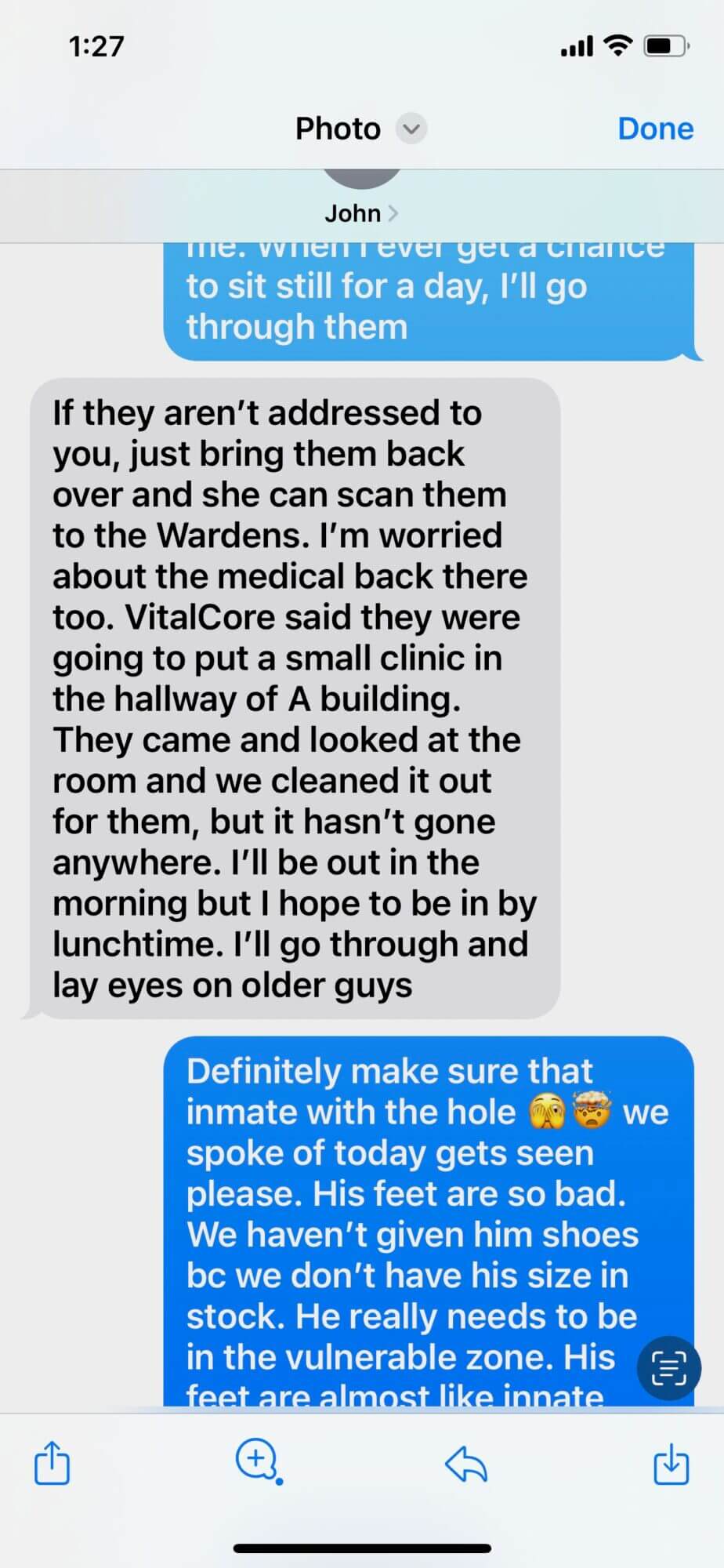
Hunt, the current deputy commissioner of institutions, texted Nowlin that he was concerned about the care VitalCore was providing and said they promised to build a medical clinic in one of the prison buildings at CMCF, but never did. 

“I’m worried about the medical back there too,” Hunt wrote. “VitalCore said they were going to put a small clinic in the hallway of A Building. They came and looked at the room and we cleaned it out for them, but it hasn’t gone anywhere.”

A screenshot of a text message between between Stephanie Nowlin and John Hunt, deputy commissioner of institutions for the Mississippi Department of Corrections. Hunt previously served as superintendent of the Central Mississippi Correctional Facility. Credit: Stephanie Nowlin

In the next fiscal year, Mississippi is set to spend over $121 million on prison medical services, a number that has been climbing for years. Republican Rep. Becky Currie, the House Corrections chairwoman responsible for conducting oversight of MDOC’s budget, said there is little evidence that the money is being spent on providing quality care. 

VitalCore officials “do nothing but pull these fat salaries from the contract and do absolutely nothing for the inmates,” Nowlin said. 

More than one person at the top

Nowlin left MDOC in May of 2024 and now works as a legal administrative assistant at a law firm. 

Cain, who plucked her from obscurity and elevated her to a powerful position helping to manage the system under which she was once jailed, is overseeing some problems that predated his tenure, Nowlin believes. The problems, she added, are system-wide. 

“He disappointed me tremendously, but I think he wanted to clear his name from Angola and come over here,” she said.

“The way that this system is set up in the state of Mississippi, when you’ve got 20,000 inmates spread out all around, all of this corruption. It’s almost set up for anyone to fail, unless these legislators, along with many others, wake up and get on board and realize that it’s more than just one person at the top.”

One legislator, Currie, embarked on several tours inside Mississippi’s prisons. Once inside the grounds of these facilities, the lawmaker says she witnessed widespread suffering — suffering she believes is preventable.

Currie said she saw Hepatitis C and HIV patients denied lifesaving medication. She saw diabetics go untreated and cancer patients dying from lack of care. These are human costs, she said, of a state prison system where silence and secrecy conceal suffering: “It’s a kingdom, and they do not want you looking in.”

Guide complet du casino en ligne – Tout ce que vous devez savoir

Guide complet du casino en ligne – Tout ce que vous devez savoir

Le monde du jeu s’est radicalement transformé depuis l’avènement d’Internet haut débit. Aujourd’hui, un joueur peut accéder à des centaines de tables virtuelles depuis son smartphone ou son ordinateur portable, sans se déplacer dans un établissement physique. Cette accessibilité a entraîné une explosion de la popularité des casinos en ligne, qui enregistrent chaque année des milliards d’euros de mises dans le monde entier. En France, les autorités ont rapidement réagi pour encadrer cette activité et protéger les usagers contre les dérives éventuelles.

Les plateformes françaises sont soumises à une législation stricte qui impose le respect de critères de sécurité très élevés et la mise à disposition d’outils de jeu responsable. Le choix d’un opérateur fiable devient alors crucial : il faut vérifier la licence délivrée par l’ANJ, s’assurer que les données personnelles sont chiffrées et que les bonus proposés ne cachent pas de conditions abusives. Un guide détaillé aide le joueur à naviguer entre ces exigences tout en profitant pleinement des avantages offerts par le numérique : rapidité des dépôts, variété infinie de jeux et promotions exclusives réservées aux nouveaux inscrits.

Introduction

Le phénomène des casinos en ligne n’a jamais été aussi visible qu’en ce moment ; la combinaison d’offres promotionnelles alléchantes et d’une technologie toujours plus performante attire chaque jour davantage de joueurs français curieux d’essayer leur chance depuis leur salon. Découvrez le nouveau casino en ligne recommandé par les experts de Basketnews.Net pour profiter d’une expérience sécurisée et ludique.

Pourquoi publier un guide complet est indispensable ? Premièrement parce que la législation française impose des normes spécifiques aux opérateurs agréés : protection du portefeuille joueur, contrôle anti‑blanchiment et obligations relatives au jeu responsable sont scrupuleusement surveillés par l’Autorité Nationale des Jeux (ANJ). Deuxièmement parce que la cybersécurité évolue constamment ; connaître les bonnes pratiques pour choisir un mot de passe robuste ou activer l’authentification à deux facteurs évite bien des désagréments futurs. Enfin, un tel dossier permet au public débutant comme confirmé d’évaluer objectivement chaque offre grâce aux critères établis par Basketnews.Net, site indépendant spécialisé dans le classement impartial des nouveaux casinos en ligne.

Section 1 – Les bases du jeu en ligne

Un casino en ligne reproduit virtuellement l’ensemble des services proposés par une salle physique : machines à sous digitales, tables de roulette live avec croupier réel ou encore salons de poker multijoueurs simultanés partout dans le monde.
La différence majeure réside dans l’infrastructure logicielle : chaque partie s’appuie sur un générateur aléatoire certifié (RNG) garantissant un taux de retour au joueur (RTP) conforme aux standards internationaux.

Parmi les catégories les plus répandues on retrouve :

  • Slots vidéo avec volatilité variable – exemples : Starburst (NetEnt) ou Mega Joker (Novomatic).
  • Roulette européenne à zéro unique offrant un avantage maison réduit à 2 %.
  • Blackjack S17 où le croupier doit rester sur un soft‑17.
    Ces jeux possèdent tous leurs propres lignes de paiement (« paylines ») et jackpots progressifs qui peuvent dépasser plusieurs dizaines de millions d’euros.

    Créer un compte est simple : il suffit de saisir son adresse e‑mail, choisir un nom d’utilisateur sécurisé puis confirmer via un lien envoyé par courrier électronique.
    Ensuite vient l’étape cruciale de vérification d’identité – upload d’une pièce officielle et parfois une facture récente afin de lutter contre la fraude financière.
    Une fois validée, le premier dépôt peut être réalisé instantanément grâce aux portefeuilles électroniques ou aux cartes bancaires autorisées par l’ANJ.

    Les bonus de bienvenue varient considérablement ; certains sites proposent jusqu’à 100 % sur le premier dépôt jusqu’à 200 €, accompagnés souvent 30 tours gratuits sur une machine sélectionnée.
    Pour comparer efficacement ces offres il faut regarder trois paramètres clés :

Critère Pourquoi c’est important
Bonus % Indique immédiatement combien votre dépôt sera majoré
Conditions wagering Nombre minimum fois que vous devez jouer avant retrait
Plafond max Limite maximale pouvant être retirée après avoir rempli les exigences

En évaluant ces éléments avec rigueur vous évitez les surprises désagréables lors du cash‑out.

Section 2 – La législation française et la licence ARJEL/ANJ

La régulation du jeu internet français débute officiellement avec la création d’ARJEL (Autorité Réglementaire des Jeux En Ligne) fin 2010 ; elle devient ANJ (Autorité Nationale des Jeux) dès 2020 afin d’élargir ses compétences aux paris sportifs et paris hippiques numériques.
L’objectif principal était —et reste—de garantir transparence financière ainsi qu’une protection efficace contre l’addiction au gambling.

L’ANJ attribue uniquement aux opérateurs répondant à trois exigences majeures :

  • Détention d’un capital minimal suffisant pour couvrir toutes les mises potentielles ;
  • Mise en place systématique d’un système anti‑blanchiment certifié ISO 27001 ;
  • Adoption obligatoire du dispositif “self‑exclusion” permettant aux joueurs souscrivant une interdiction volontaire pendant jusqu’à cinq ans.

    Pour le public cela se traduit concrètement par plusieurs bénéfices : vos fonds sont stockés séparément dans des comptes dédiés (« trust accounts »), toute contestation juridique bénéficie alors d’un médiateur nommé par l’État français et chaque opération bancaire est auditée régulièrement afin d’éviter toute irrégularité fiscale.

    Basketnews.Net utilise une grille stricte lorsqu’il évalue si un site respecte pleinement la législation française :

  • Licence valide délivrée par l’ANJ affichée clairement sur la page « À propos ».

  • Procédure KYC totalement automatisée mais respectueuse du RGPD français.
  • Présence visible « outil auto‑exclusion » accessible depuis le tableau utilisateur sans devoir contacter le support client.

Seuls les établissements remplissant ces critères peuvent être présentés comme recommandés sur notre plateforme indépendente.

Section 3 – Sécurité et confidentialité des données

Les technologies anti‑fraude constituent aujourd’hui le socle fondamental sur lequel repose toute confiance entre joueur et opérateur.\nTous les sites sérieux utilisent aujourd’hui le protocole SSL/TLS avec chiffrement AES‑256 bits afin que chaque échange entre votre navigateur et les serveurs soit illisible pour tout tiers.\nDes audits externes menés chaque trimestre permettent également de certifier conformité aux standards eCOGRA ou iTech Labs.\n\nGestionnaire quotidiennement recommandé — la création d’un mot de passe long (>12 caractères), mêlant majuscules/minuscules/symboles — est complété idéalement par une authentification à deux facteurs envoyée via SMS ou application dédiée comme Google Authenticator.\n\n| Méthodes de paiement sécurisées | Description |\n|———————————|————-|\n| Cartes bancaires Visa/MasterCard | Traitement immédiat via serveur PCI DSS compliant |\n| Portefeuilles électroniques PayPal & Skrill | Authentification supplémentaire avant transaction |\n| Crypto‑monnaies approuvées (BTC/EUR) | Transactions anonymes mais traçables via blockchain |\n\nLa politique de confidentialité doit préciser quels renseignements personnels sont collectés ‑ notamment nom complet, date naissance pour vérification âge ‑ ainsi que leurs usages possibles : prévention fraude, amélioration UX ou communication marketing ciblée après consentement explicite.\n\nPour protéger votre compte contre phishing il suffit souvent d’observer quelques bonnes pratiques simples : ne jamais cliquer sur un lien contenu dans un mail non sollicité prétendant provenir du support client ; toujours vérifier l’adresse URL commençant bien par « https://» ; limiter accès au compte depuis appareils publics ou réseaux Wi‑Fi non protégés.\n\nEn suivant ces recommandations vous réduisez drastiquement vos risques tout en profitant sereinement des offres proposées par nos partenaires évalués chez Basketnews.Net.

Section 4 – Choisir le meilleur nouveau casino en ligne selon ses besoins

Le profil du joueur influence fortement son choix final.\nUn casual cherche avant tout une interface intuitive et des bonus modestes tandis qu’un high‑roller privilégie limites élevées sur dépôts ainsi qu’un service VIP dédié disponible jour/nuit.\nVoici quelques critères décisifs classés selon trois axes principaux:\n\n- Profil : budget mensuel moyen <100 €, entre 100 €–1000 € ou >1000 €.
– Catalogue : présence privilégiée éditeurs reconnus tels que NetEnt (Gonzo’s Quest) ou Microgaming (Mega Moolah) offrant respectivement RTP moyen autour de 96 % vs jackpot progressif dépassant parfois 30 M € .
– Promotions : comparaison rapide entre deux sites populaires — CasinoA propose +150 % up to €300 +50 tours vs CasinoB donne +200 % up to €500 +100 tours mais condition wagering x35 vs x30.\n\nL’importance capitale revient également au support client multilingue accessible via chat live instantané disponible24/7 ainsi qu’envoi email garanti sous deux heures ouvrées.\nCes éléments combinés permettent au consommateur éclairé —comme ceux consultés régulièrement sur Basketnews.Net—de sélectionner le nouveau site de casino en ligne qui correspond précisément à ses attentes sans sacrifier sécurité ni qualité service.

Section 5 – Stratégies gagnantes aux principaux jeux de table

Blackjack Le comptage simplifié consiste à attribuer +1 aux cartes faibles (2–6), -1 aux fortes (10–As) puis suivre la somme courante («​running count​»). Sur tables virtuelles où aucun mélange manuel n’intervient cette technique reste valable tant que vous jouez plusieurs mains consécutives ; viser un compte positif supérieur à +4 indique généralement avantage statistique supérieur à +0,5 %. Conjuguez cela avec gestion stricte du bankroll — mise maximale ne dépassant jamais 2 % du capital total.\n\nRoulette Sur roue européenne choisissez systématiquement la mise «​Voisins Zéro​», couvrant douze numéros adjacents dont la probabilité collective est supérieure grâce au placement équilibré parmi hauts/bas pairs/impairs. Statistiques historiques montrent qu’environ 45 % des tirages tombent parmi ces cases lors d’une série courte (<25 spins).\n\nPoker online Sélectionnez une salle disposant déjà licencée ANJ afin que vos fonds soient sécurisés ; commencez toujours avec stratégie préflop basique ­– jouer uniquement AA‐KK‐QQ‐JJ‐AKs/AKo quand position tardive permet minimiser risque. Post‑flop privilégiez lecture dynamique basée sur taille pot versus bet sizing adverse pour identifier bluff possible.\n\nUtiliser les versions “démo” gratuites permet enfin affiner vos tactiques sans risquer votre argent réel ; pratiquez jusqu’à atteindre constance avant passer au cash game officiel.

Section 6 – Le jeu responsable & ressources d’aide

L’autodiscipline commence dès l’inscription grâce aux outils mis à disposition par tous les casinos titulaires licence ANJ.\nVous pouvez déclencher directement une procédure auto‑exclusion via votre tableau personnel ; celle-ci bloque toute connexion pendant six mois renouvelables ensuite si besoin.*\nDans la même logique chaque plateforme propose désormais limites personnalisées concernant montant journalier maximal déposé ainsi que temps quotidien passé devant les écrans numériques.\nCes seuils sont ajustables librement depuis votre espace client sans aucune justification requise,\net ils sont strictement appliqués même si vous tentez plusieurs sessions distinctes.\n\nReconnaître tôt les signes classiques—jouer sous influence émotionnelle forte , augmenter progressivement montants misés pour compenser pertes précédentes , négliger obligations familiales —peut éviter escalation vers addiction grave.\nEn France plusieurs associations offrent soutien professionnel telque S.O.S Joueurs accessible via hotline nationale gratuite (09 69 39 00 00) ou forum dédié où témoignages anonymes circulent librement.\nEnfin Basketnews.Net intègre dans chacune ses revues un score RSE (“Responsabilité Sociale & Éthique”) qui mesure concrètement engagement social du site évalué — transparence politique data protection , programmes prévention gambling problématique & initiatives caritatives liées au secteur gaming numérique.

Conclusion

Ce guide a passé au crible tous les aspects essentiels liés aux casinos digitaux : définition précise vs salles traditionnelles, cadre légal français imposé par l’ANJ,
techniques modernes assurant sécurité optimale,
critères pointus permettant choisir LE nouveau site adéquat,
stratégies éprouvées pour maximiser vos chances aux tables classiques,
et enfin outils indispensables favorisant jeu responsable.​

En adoptant ces bonnes pratiques vous serez parfaitement armé·e pour explorer sereinement l’univers riche proposé aujourd’hui par nos partenaires sélectionnés.
N’attendez plus pour tester dès maintenant le nouveau casino en ligne présenté dans cet article ; profitez immédiatement
d’offres attractives fiables,
d’une assistance multilingue disponible jour/nuit,
et surtout… jouez intelligemment tout-en-respectant vos limites personnelles grâce aux conseils fournis ici même!

Ex-Ole Miss student may face second attempted murder trial

Double jeopardy does not apply, the state’s Court of Appeals narrowly said, when it ruled a former Ole Miss student acquitted by a judge should be tried again for the near fatal stabbing of a Tennessee man in 2019. 

Union County Circuit Judge Kent Smith had ruled in 2023  that the prosecution violated Lane Mitchell’s constitutional right to compulsory process – specifically to command the victim to testify as a defense witness –  in issuing an order of acquittal of attempted murder. The appeals court ruled the acquittal was not based on the evidence.

The 5-4 ruling sent the case back to the trial court. Appeals Court Judge John Weddle, formerly the district attorney of counties in northeast Mississippi, recused himself. 

Mitchell’s attorneys did not respond to a request for comment about whether he will appeal to the Mississippi Supreme Court.

District Attorney Ben Creekmore recused himself from the case in 2021, which led the attorney general’s office to appoint two of its attorneys to prosecute the case. A spokesperson from the attorney general’s office confirmed the office would appoint prosecutors for a new trial.

In 2019, the then-18-year-old Mitchell stabbed Collierville resident Nathan Russell Rogers at the Tallahatchie Gourmet – a restaurant where Rogers had been a regular customer and visited after hiking in the area. 

Mitchell said during trial and in court records that he believed Rogers had a weapon and he feared for the safety of a female waitress and his father who was working as a bartender. However, Rogers was unarmed. 

Video footage from the restaurant also captured the leadup, stabbing and its aftermath. Stills from the video showed how Mitchell grabbed a knife from the bar and held it behind his back and watched for a few moments. As his father and Rogers began to struggle, Mitchell came up from behind Rogers and stabbed him three times in the neck. 

Rogers nearly bled out and needed immediate surgery. As a result of the stabbing, he was diagnosed with post-traumatic stress disorder and was placed under his father’s conservatorship, according to court records. 

Mississippi Today reported that Mitchell went on to attend another college in Tennessee and would have attended graduation  before his trial. 

Four days before trial, the defense tried to subpoena Rogers to testify. But when trial began and a jury had been impaneled, he did not show up. The defense filed a summons with a Tennessee court for him to be taken into custody and delivered to Union County, but the summons was never served.  

The Shelby County probate court in Tennessee, which oversees Rogers’ conservatorship, quashed the request to bring Rogers to court in Mississippi, ruling that he was a disabled person who is incapable of testifying in any legal proceeding, including the one in which he almost died. 

The Court of Appeal’s order notes that the defense did not attempt to appeal the probate court’s decision or ask for a continuance to appeal – ways to get Rogers to testify. 

The appellate court’s majority opinion written by Judge John Emfinger focused on whether the court had the ability to hear the case and whether state law provided a valid way for the state to appeal. 

Section 99-35-103(a) provides a way for appeals when an indictment is dismissed before a decision is made on the merits of the indictment.

“We find that subsection 99-35-103(a) does not contain any such limitation,” Emfinger wrote in the majority opinion. “Instead, it plainly and unambiguously applies to all efforts to dismiss a charging instrument, for any reason, at whatever time it may be filed.”

The majority also found that dismissing the indictment doesn’t prevent subsequent prosecution for the same offense. In appeal documents, Mitchell’s attorneys have said retrying him would violate his protection against double jeopardy. 

Judges Jack Wilson, Anthony Lawrence III, David Neil McCarty and Amy Lassitter St. Pé joined the majority order. 

Another focus of the decision was whether Judge Smith was correct to dismiss Mitchell’s charge and acquit him. 

Smith identified the conservator, Bob Rogers, who is also the victim’s father, and his attorney as members of the prosecution team. During trial the judge bemoaned some of those actions, including how Bob Rogers was an impediment to the case and helped his son avoid testifying. 

The Court of Appeals disagreed, saying Bob Rogers and his attorney were not part of the prosecution team, noting the state Supreme Court has determined that team consists of the investigative and prosecutorial personnel. The court also noted that Bob Rogers, as the conservator, was acting in his son’s best interest.

In a dissent joined by Judges Virginia Carlton, Deborah McDonald and Latrice Westbrooks, Chief Judge Donna Barnes argues the court does not have authority to hear the state’s appeal, so it must be dismissed. 

The statute in which the state appealed has limited exceptions, and interpreting it as the majority does disregards plain reading of the statute and Mitchell’s constitutional rights, according to the dissent. 

Timing of when an indictment can be dismissed matters because it can bring up concerns about double jeopardy – the protection of being tried twice for the same offense. Jeopardy attaches when a jury is impaneled or a trial begins where guilt may be imposed, which is what happened in Mitchell’s case. 

In a separate dissent, Judge Latrice Westbrooks agreed with Barnes and emphasized the trial court’s constitutional and procedural rationales to enter a judgment of acquittal for Mitchell. 

Westbrook said that it’s the state’s responsibility to ensure its primary witness is available and present to testify, and allowing the ruling would be a “double standard.” This is in contrast with how a trial may proceed if a defendant fails to appeal, she wrote. 

Like Barnes, she disagreed with the majority of justices that the state had a legal means to appeal, including potential concerns of double jeopardy. 

“The majority’s refusal to properly recognize the limits of our jurisdiction over an acquittal turns decades of constitutional law and criminal procedure on its head.” 

Board green lights second charter high school for Mississippi

Ambition Preparatory Charter School will expand to become the second charter high school in the state. 

The Mississippi Charter School Authorizer Board approved the expansion at its Monday meeting, while a handful of Ambition Prep students and administrators watched in the audience. 

The school, which was opened by executive director DeArchie Scott in August 2019, currently serves kindergarten through eighth grade. The expansion will make Ambition Prep Jackson’s only charter high school.

Clarksdale Collegiate Public Charter School in the Delta will start expanding into high school grades next year to become the state’s first charter high school, and while the board authorized RePublic Charter Schools to open a high school in 2018, the charter network did not ultimately open one.

DeArchie Scott, founder of Ambition Preparatory Charter School, speaks to students and educators from across the state during the Mississippi School Choice Rally held Wednesday, Jan. 25, 2023, at the the State Capitol. Credit: Vickie D. King/Mississippi Today

The board’s move is one that parents have been asking for since the school opened, Scott said. 

“We are excited about the decision,” he said after the meeting. “It’s going to have a huge impact on our students. We’ve been telling our families who have been asking for this since kindergarten that we just have to see how we’re doing, and given our results, this is the right time.”

According to the charter authorizer board’s annual evaluation of the school’s performance, Ambition met expectations in the vast majority of categories during the 2023-2024 school year, though it did fall short in at least one instance of employee credentialing and had a high chronic absenteeism rate at 24%.

Lisa Karmacharya, executive director of the authorizer board, said she “couldn’t be more happy” that the charter’s expansion was approved. It’s the first school to take advantage of the board’s new expansion framework — Karmacharya said that Ambition put forward a strong plan and has set an example for other charters. 

“Expanding grades will provide educational opportunities for students in communities that have been traditionally underserved and allow for students to continue their education in a structured and high performing school as evidenced by results on annual performance reports,” their expansion report reads. “Ambition Prep is committed to character development, leadership, and college readiness for all scholars now and in the future.”

Kyson Bailey, a rising 7th grader at Ambition, was one of the students in attendance at the Monday meeting. He said he’s looking forward to attending high school at Ambition in a couple of years. 

“It’s a good opportunity, just them building on what we have,” he said. 

The high school will open in fall 2027, and construction on new classrooms will start in January.

Mississippi’s U.S. Rep. Michael Guest is in the running for Homeland Security chair 

U.S. Rep. Michael Guest of Mississippi is campaigning to lead the House Homeland Security Committee, according to the congressional news website Punchbowl News. 

Guest, a Republican who has represented the state’s 3rd Congressional District since 2019, is one of four GOP members competing to lead the influential committee, according to the news outlet. 

The House Republican Steering Committee will meet on Monday night to pick the next Homeland Security Committee. 

The committee chairmanship opened up because the committee’s previous chairman, U.S. Rep. Mark Green of Tennessee, announced he would resign from Congress as soon as the House passed President Donald Trump’s latest spending bill, which he signed into law on July 4. 

“I look forward to the possible opportunity to work alongside President Trump as Chairman of the Committee on Homeland Security,” Guest told Mississippi Today in a statement. “As the former Vice Chairman of the Committee and the current Chairman of the Subcommittee on Border Security and Enforcement, I have unique leadership experience to bring to this role.”

The Mississippi Republican currently leads the House Ethics Committee. During his time chairing the bipartisan committee, he has successfully authored and pushed for a resolution to expel former New York Congressman George Santos from the House chamber. 

He also led the Ethics Committee during its investigation and subsequent report into the alleged misconduct of former U.S. Rep. Matt Gaetz of Florida. Gaetz resigned from Congress before the committee’s work concluded on Gaetz, which meant the committee no longer had jurisdiction to investigate the Florida Republican.  

President Donald Trump in 2024 nominated Gaetz to become attorney general, which prompted bipartisan pressure for the committee to release its report on the Florida congressman, even though Gaetz was no longer a member of Congress. Trump eventually withdrew Gaetz’s nomination. 

The committee eventually voted to release the report, but Guest objected to the decision and wrote that it deviated from the committee’s longstanding traditions.  

Should Guest become the new House Homeland Security Chairman, it would mean two Mississippians would become the top party leaders on the committee. U.S. Rep. Bennie Thompson is currently the top Democrat on the committee. 

Thompson served as chairman of the committee from 2007 to 2011, and from 2019 to 2023.

Before Guest became a member of Congress, he was a district attorney in Madison and Rankin counties.

Federal judge temporarily blocks Mississippi’s new DEI ban

A federal judge has temporarily paused enforcement of the state law that prohibits diversity, equity and inclusion programs from Mississippi public schools and universities.

U.S. District Judge Henry Wingate on Sunday approved the request for a temporary restraining order sought by a coalition of civil rights and legal organizations on behalf of students, parents and educators.

The American Civil Liberties Union and the Mississippi Center for Justice are representing the plaintiffs, who filed the lawsuit alongside other groups on June 9 against the state’s education boards. Wingate heard arguments on June 24 from top lawyers from both organizations, as well as Special Assistant Attorney General Rex Shannon, who represented the state-agency defendants. 

Shannon objected to the temporary restraining order in court and argued the plaintiffs didn’t have legal standing to file the lawsuit. He also admitted his office was limited in the arguments it could make because of the litigation’s compressed schedule.

The order is in effect for 14 days, and allows Wingate to extend it for an additional 14 days. Next, the plaintiffs plan to seek a preliminary injunction — a longer-lasting court order that would continue to freeze the state law. 

The state could appeal Wingate’s decision to the U.S. 5th Circuit Court of Appeals, though it’s unclear if they will do so.

“In this Court’s eye, these accounts appear to reflect a broad, chilling effect across public institutions and community organizations,” Wingate wrote in his order, of individual reports about the impact of the bill. “The evidence, at this stage, demonstrates a clear and ongoing deprivation of constitutional rights in a manner not compensable by money damages — thus warranting injunctive relief.”

In April, legislators passed House Bill 1193, which prevents public schools from creating diversity, equity and inclusion offices, engaging in “divisive” concepts and hiring people based on their race, sex, color or national origin. The State Board of Education and the Institutions of Higher Learning recently approved policies that create a complaint and investigation process for violations to the law. 

Local school boards have to create their own policies, too, which MCJ attorney Rob McDuff argued in court would be a lengthy and arduous process. 

“This statute would throw our schools into chaos if it’s allowed to go forward,” he said. “As we approach the fall semester, teachers are preparing their lesson plans … people need to know that at least for the moment, enforcement of this law is going to stop while the court further considers the issues.”

Joshua Tom, ACLU of Mississippi’s legal director, said the law’s vagueness was unconstitutional. 

“‘Engage’ is not defined,” he said. “How does a teacher or student ‘engage’? Do a mandatory reading? Talk about it in class? What if they go on a field trip and one of the concepts is introduced. Is that engaging? It’s not clear.”

He also noted that the statute was already making an impact — in an effort to comply with the law, the University of Mississippi withdrew its funding from Oxford’s annual Pride Parade a few weeks ago and prohibited university departments from marching in their capacity as professors, he said. 

Professors and school officials have publicly criticized the bill and asked for clarification about its enforcement. One top Jackson Public Schools official submitted questions asking if celebrating Black History Month or if one of the district’s core values, “equity,” would lead to compliance violations.

Both parties will be back in federal court on August 5 to make their cases about a preliminary injunction.

Does Jason White deserve to be cursed or praised? Depends on the issue.

The dichotomy that is Jason White was on full display during a speech he delivered during a recent lunch meeting of the Mississippi State University Stennis Institute of Government.

Some at the meeting most likely cursed House Speaker Jason White because of his work to eliminate the Mississippi income tax and because of his unapologetic support of sending public funds to private schools.

Darn that Jason White.

But many of the same people would praise the first-term Republican speaker for his past support of expanding Medicaid to provide health insurance for primarily the working poor and for his support of restoring voting rights for people convicted of felonies.

Thanks, Jason White, some might say, perhaps begrudgingly.

But those people should give White some credit. It was no small feat for White to publicly voice support for Medicaid expansion as he campaigned in 2023 to gather the votes to win the speakership. Before then it was rare for a Republican politician in Mississippi to even utter the words “Medicaid expansion.” Theoretically, White could have been putting his political future on the line.

But in 2024 after being elected speaker by his Republican caucus, White made a good faith but ultimately unsuccessful effort to pass an expansion bill. The proposal was defeated for multiple reasons.

But White has not ruled out the possibility of Medicaid expansion being revisited.

He said the state still needs to help struggling rural hospitals and to work to increase the number of Mississippians who have health coverage. And to achieve those goals, Medicaid expansion, despite changes made to the program in the so-called federal “Big Beautiful Bill,” appears to still be the best mechanism to help struggling hospitals and to ensure health care coverage for poor, working Mississippians.

Another proposal that many Republican leaders, including Gov. Tate Reeves, have opposed that White has embraced is restoring voting rights for people who have been convicted of felonies. In Mississippi people convicted of some crimes, even some relatively minor ones, lose their voting rights for life.

White recently said that he supports “addressing barriers to suffrage for those … who have served their time … paid their debt to society, paid all fines and fees. We are looking for a way to remove barriers for those folks to reengage with the community and be able to vote.”

But many of the same people who would support White’s efforts in health care and in expanding voting rights would curse the considerable political capital he spent to pass a bill that is intended to phase out Mississippi’s income tax, which accounts for about 30% of the state’s general fund revenue.

While White has stepped outside of the Mississippi Republican policy boundaries on some issues, he is right in line with many of his Republican colleagues on the issues of tax cuts and even of providing public funds to private schools. As a matter of fact, White admits he is more of an advocate on the private school voucher issue than many of his fellow House Republicans.

White’s background might help explain his diverse political philosophy.

White was elected as a Democrat in 2011 from a rural district where it would have been difficult for a Republican to win. The district was held by a Democrat — Mary Ann Stevens — who was voting with the burgeoning House Republican caucus. White ran as the candidate of the Democrats, who were desperately trying to maintain their House majority. He won, but the Democrats lost.

After that pivotal election, White saw the handwriting on the wall and changed parties. With that party switch, the Republican majority redrew House boundaries to create a district where White could win as a Republican.

But it is reasonable to assume that in many ways, White is still the person he was when he ran as a rural Democrat.

He is still from a poor, rural area where health care is at the top of mind — and where, often, health care is nearly non-existent.

And in his day-to-day activities, White, an attorney, crosses paths with people convicted of felonies who have paid for their mistake and want a chance to reenter society. That reentry for many includes voting.

And yes, there are struggling schools in the rural area where White lives in Holmes County.

Rightfully or wrongfully, White sees private school vouchers as a way for students trapped in struggling schools to have a better chance.

Many believe that it is wrong-headed thinking to take money from the struggling public schools that need all the help they can get, and that may be a reason to curse White. For others, though, his support of Medicaid expansion is a reason to praise him.