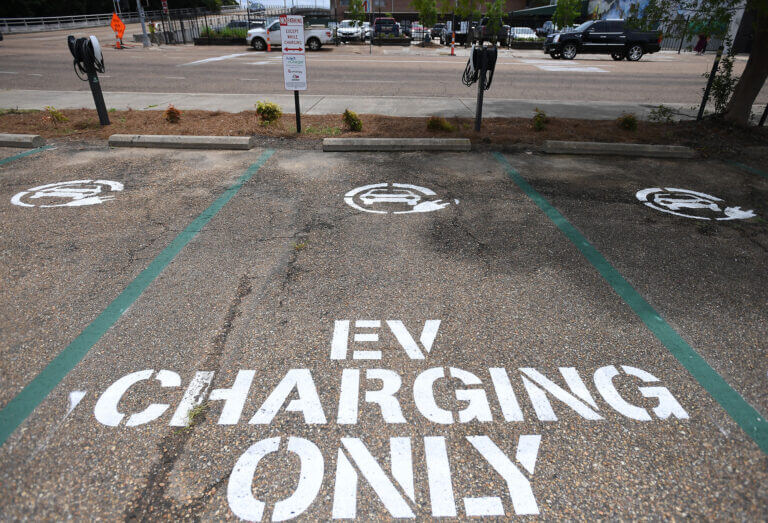
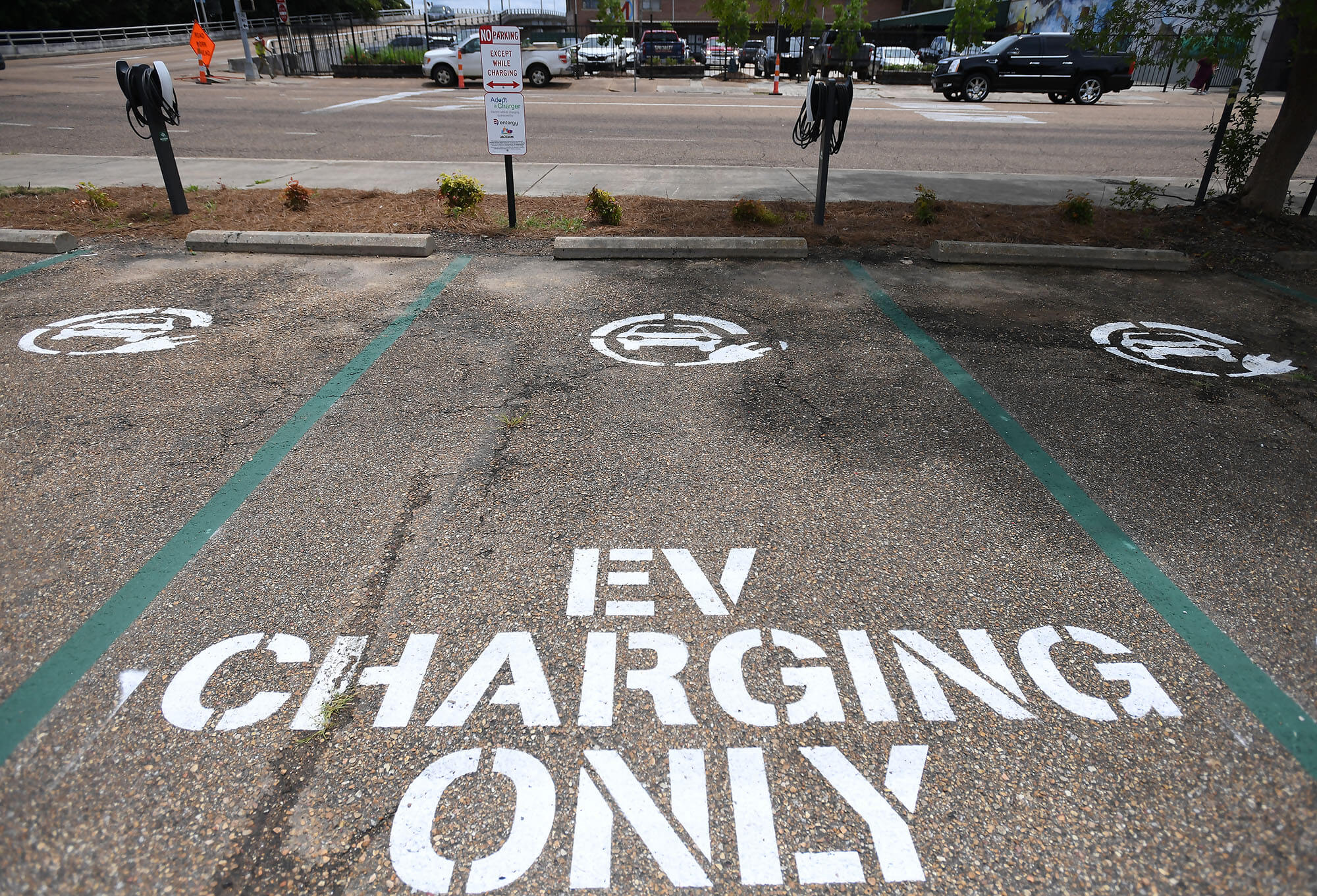
The city of Jackson announced 10 new chargers for electric vehicle owners on Thursday thanks to a $160,000 donation from Entergy.
City officials said the public chargers — located at stations at the Warren Hood Building parking lot on the corner of Pearl Street and State Street, as well as Thalia Mara Hall and Union Station — are free to use for now but didn’t know for how long that would stay the case.
As of 2023, Mississippi had the fewest number of electric vehicles on the road per capita, based on registration data from the U.S. Department of Energy. DOE numbers also show Mississippi has the second fewest public charging stations per capita after Louisiana.
In 2018, state lawmakers passed an annual fee of $150 for electric car owners and $75 for hybrid vehicles owners as a way of compensating for lost gas tax revenue.
Below is a map of public charging stations in Jackson listed on the DOE’s website. Electric vehicle owners elsewhere in the state can use the agency’s online tool to find stations near them.
Entergy bought the chargers from Tesla, and the nonprofit Adopt a Charger installed the units through local contractor Lavallee, which will also maintain them for the city. Jackson’s Planning and Development Director Jhai Keeton said the city is paying just $600 a year for the chargers.
Adopt a Charger partners with private companies, in this case Entergy, who want to sponsor charging stations for public use. The nonprofit, according to its website, has also partnered on stations at the Mississippi Children’s Museum and at Hinds Community College in Raymond.
While there were already several charging stations in Jackson, the ones unveiled Thursday are the first owned by the city. Prior to then, Tupelo had the most charging stations of any Mississippi city with 13, according to DOE data. Hattiesburg and Jackson, not including the new stations, each have 12, and there are 10 in both Biloxi and Gulfport.
The Mississippi Department of Transportation is using $50 million in federal funds to develop electric vehicle corridors with 30 new stations throughout the state, but those projects are likely one to two years away.
Less than two weeks from the scheduled execution of Richard Jordan, the Mississippi Supreme Court said it will not reconsider the death row inmate’s appeal, but the federal high court is expected to discuss his case next week.
Jordan, at 79 the state’s oldest and longest serving death row inmate, was first convicted in 1976 for kidnapping and killing Edwina Marter in Harrison County. He had four trials until a death sentence stuck in 1998.
On Thursday, eight of the nine justices of the Mississippi Supreme Court declined to rehear an order to set Jordan’s execution date. Justice Leslie King was the lone person who wanted to grant a rehearing.
This decision comes about a week after Jordan’s attorney, Krissy Nobile of the Office of Capital Post-Conviction Counsel, wrote to the court to emphasize that her client has not yet exhausted federal remedies and an execution could not be set.
The U.S. Supreme Court distributed Jordan’s petition for a writ of certiorari at a May 29 conference and is expected to discuss it again at a June 18 conference – a week before the execution.
Meanwhile, Jordan’s attorneys filed an emergency application for a stay of execution with Justice Samuel Alito Jr. pending the court’s disposition on the case.
They argue there is a reasonable prospect that the court will grant certiorari and reverse the Mississippi Supreme Court’s decision, and that Jordan will suffer irreparable harm if a stay is not ordered.
In its response, the state argues Jordan has been trying to avoid his death sentence for almost 50 years and that he is repeating baseless arguments in his pending petition for certiorari.
His attorneys argue Jordan’s death sentence is not valid because in 1976, when the murder was committed and Jordan was sentenced, Mississippi and all other states had ceased executions based on a 1972 U.S. Supreme Court decision in Furman v. Georgia that capital punishment was unconstitutional.
The three-person team behind a growing network of gardens and community spaces in Jackson’s Midtown neighborhood received word in February that they had been chosen to receive $10,000 from the U.S. Department of Agriculture’s Natural Resources Conservation Service.
In April, that group – the Farm to Community team of the Jackson nonprofit Midtown Partners – was notified that they would not receive the funding. The team lost the federal money after the USDA terminated a $157,827 grant slated to help a dozen groups throughout Mississippi establish or sustain community gardens in underserved communities. The USDA canceled the grant, the notice said, because the nonprofit that had won the grant and chosen garden projects in Mississippi to receive the money, engaged in “diversity, equity and inclusion initiatives.”
That nonprofit, Community Resources Connection in South Carolina, declined to comment about the USDA decision but updated its website this week to say that “the Community Garden contract between USDA and CRC has been terminated because of the current administration’s change in priorities” and that no funds are available for the Community Garden program at this time.
Executive orders President Donald Trump issued in January kicked off a sweeping review of grants by the USDA, as the department sought to root out support for DEI programs Trump described as “radical and wasteful” and climate initiatives he said hindered the administration’s priority of “unleashing American energy.”
Though USDA Secretary Brooke Rollins has defended the department’s grant terminations as reducing waste, leaders of community garden projects throughout Mississippi said that past federal funding has enabled them to cultivate food self-sufficiency and community cohesion. Now lost grant opportunities are forcing them to adjust plans and look for alternative funding.
Linda Fondren, founder and executive director of Shape Up Mississippi in Vicksburg, said her organization lost $10,000 in federal funding due to the USDA’s cancellation of the same grant. Due to that loss, the nonprofit will postpone its fifth annual Youth Agriculture and Health Extravaganza Day, which has featured nutrition and agriculture classes, cooking demonstrations and a petting zoo in past years.
Norma Michael at her garden, located in the Georgetown neighborhood in Jackson, Thursday, May 29, 2025. Michael grows a variety of vegetables, from tomatoes and corn to peas and carrots, that she shares with members of the community. Credit: Vickie D. King/Mississippi Today
Norma Michael, founder of the Sharing is Caring Neighborhood Block Garden in Jackson’s Georgetown neighborhood, had planned to install a drip irrigation system using $1,000 from the same USDA-canceled grant. Though she was able to obtain the funding elsewhere, Michael said, the USDA’s decision on the grant was disappointing.
“I think that it’s disheartening that programs that help people that are underserved are being cut,” Michael said. “That just makes us even more underserved.”
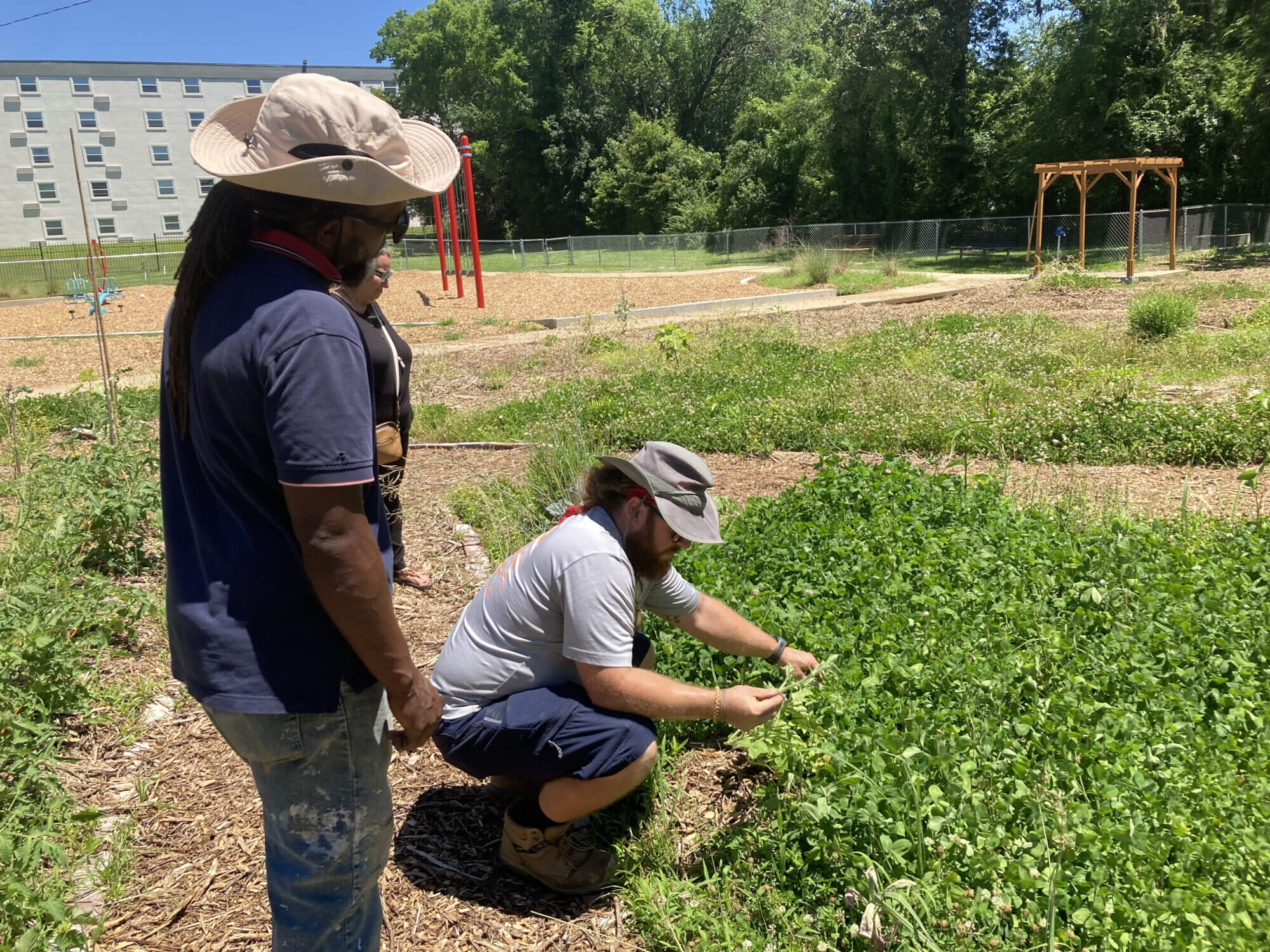
Matt Casteel, farm consultant for Midtown Partners’ Farm to Community team, said past federal funding has helped the group to establish relationships and infrastructure to pursue its broader vision of a walkable network of community spaces across Midtown.
“That’s something that we’re building as our bigger vision, is to be the resource and the mycelium, if you will, that connects and keeps that structure together,” Casteel said.
The team used a two-year, $98,041 Patrick Leahy Farm to School Grant to establish a teaching garden on the campus of Midtown Public Charter’s primary school and purchase hydroponic towers for the primary and middle schools.
Dewaskii Davis, Jina Daniels and Matt Casteel survey native plants in Midtown Public Charter’s primary school campus. Credit: Steph Quinn / Mississippi Today
Since the fall, the group has also hired lifelong Midtown resident Dewaskii Davis as farm coordinator.
Davis said he is passionate about empowering others in Midtown to participate in Farm to Community events, as well as start their own rain barrels and plant their own gardens.
“No cheat codes, no chemicals, just hard labor,” Davis said. “But it’s worthy and worth it at the end.”
Congress approved the Farm to School program as part of the 2010 Healthy, Hunger-Free Kids Act, which mandated a minimum of $5 million to farm-to-school competitive grants annually to address hunger and improve children’s nutrition – a vital issue in Mississippi, where the childhood poverty rate is 23%. The USDA announced the cancellation of $10 million in fiscal year 2025 funding for that program in late March with no explanation.
Though Midtown Partners’ 2024 grant was unaffected, the group had hoped to re-apply in a future funding cycle.
“I’ve applied for over $2.3 million in grants, and we’ve received about 250,000,” said Jina Daniels, Midtown Partners’ creative economy coordinator. “We keep at it. Every little bit helps.”
Prophetess Robinson, principal of the private K-12 Ron’s Brothers Academy in Picayune, said it’s difficult for her and her staff to find time to apply for grants on top of their teaching and administrative duties.
Robinson applied for a Patrick Leahy Farm to School grant to replace the school’s garden, which was destroyed this winter in a fire that began on a neighboring lot. But she was notified that that program had been canceled before she received feedback on the school’s application.
“One of the kids just asked me, ‘Miss Robinson, are we going to do the gardening? What are we going to do?”
Robinson said the school has put its plans for a new, bigger garden on pause.
“There was no way we’d be able to do it just on our resources alone.”
Fondren highlighted the importance of Shape Up Mississippi’s robust network of volunteers and partner organizations in Vicksburg.
Although the loss of USDA funding was a blow, she said,Shape Up Mississippi will continue to hold public “U-Pick Days” at the group’s community garden – the result of a partnership with Alcorn State University and the city of Vicksburg – throughout the summer. Those harvests are split between local shelters and for families to take home.
“If you could see the children, the families that come out and pick,” Fondren said, “it’s a social gathering. They are so excited about what is happening there.”
Fondren said she and Shape Up Mississippi’s partner organizations in Vicksburg have spent the past few months looking at the loss of grant funding as an opportunity for growth.
“You become resilient,” she said. “How do you keep this going? And so that is what our thought process is. Let’s turn this into something positive.”
Editor’s note: This essay is part of Mississippi Today Ideas, a platform for thoughtful Mississippians to share fact-based ideas about our state’s past, present and future. You can read more about the section here.
The Mississippi Board of Education will soon decide whether to end the U.S. history assessment that our students must pass before receiving a high school diploma.
Today, Mississippi students take four subject matter tests before graduating. Three are federally mandated: algebra, biology, and English. U.S. history is not, so it has landed on the chopping block. Some students would undoubtedly welcome the change, but we believe it would do them a disservice.
One of us is a member of the Board of Education — and the only one to vote in April against this proposal to eliminate the American history test. The other is a concerned citizen and statewide elected official. We both share a deep interest in giving Mississippi’s students everything they need for success in our rapidly changing world.
When our students cross the graduation stage, they reach out to receive their diploma. The hand-off is more than a picture-perfect moment. It is a symbol of one generation bestowing the responsibilities of citizenship onto next. In Mississippi, those duties come quickly. We hold elections every single year. Within one or two cycles, all the graduates will have had a chance to exercise their fundamental right to vote. It would be reassuring to know they are equipped with the civics and history knowledge they will need to choose wisely in the ballot box.
The current U.S. history assessment helps us prepare them for a life of citizenship. Students field questions about historic American political parties and the views these groups espoused. They are quizzed about the effects of landmark legislation and asked to place significant national events in chronological order. By the end, students have demonstrated familiarity with technical political science terms. Graduates walk the stage having handled such topics as tariffs, the Federal Reserve, income tax, and the Monroe Doctrine – each a timely issue.
Members of the Board of Education have been weighing the pros and cons of keeping the test, such as: Each assessment eats into student and staff time. Administering the test is not free. Teachers could use extra time to give students practical career skills. Removing the history exam can make way for workforce training. A U.S. history course will remain a graduation requirement, so eliminating the test frees educators from “teaching to the test.”
We are sympathetic to each of these important considerations. Education is a complicated endeavor, full of trade-offs. But the test has two primary benefits, and they are worth the costs. The first goes to the students, who leave the test room more conversant in American history than many of their fellow citizens. They understand the forces that have shaped our nation, and they can develop informed opinions about political candidates and current events. The second benefit reaches the students who will come next. Every assessment gives us valuable insights by which we can hone curriculum and teaching strategies.
Our state has been making remarkable strides in education, and this progress is equipping the very Mississippians who will lead our state into the 21st century. As they take on our future, we believe they should be as knowledgeable as possible about our past.
U.S. Sen. Roger Wicker, a Republican from Tupelo, is chair of the Senate’s Armed Services Committee. Wicker has served in the U.S. Senate since late 2007 and previously served in the U.S. House and in the Mississippi Senate, where he was a member of the Education Committee.
Mary Werner was appointed to the Mississippi Board of Education by former House Speaker Philip Gunn. She is a former business owner in the Lee County area and is active in the community, including previously serving on the North Mississippi Health Services Board and currently is on the North Mississippi Medical Center Clinics Board. She previously was a high school English teacher.
Marcus Taylor has been incarcerated for 10 years, serving a sentence that should have ended five years ago.
In 2015, a judge sentenced the husband and father to 15 years in prison for conspiring to sell an opioid combination pain-relief medication – a schedule III controlled substance. But he spent eight years in jail before anyone realized the maximum sentence for his crime by law was five years. In May, the Mississippi Court of Appeals recognized that Taylor was serving a sentence 10 years longer than the legal maximum, but refused to order his release despite making note of the mistake, arguing that the issue was raised too late.
Taylor, now 43, was indicted in 2014 on two counts of conspiracy to sell controlled substances, and one count of business burglary for breaking and entering a drugstore to steal them. In February 2015, he took what he thought was an advantageous deal: he pleaded guilty to the first count, and the two others were dismissed. But the plea petition was riddled with mistakes. It erroneously said the maximum sentence for conspiracy to sell schedule III controlled substances was 20 years – not five years. And no one in the court, including his lawyer, realized his sentence was 10 years longer than the legal maximum.
It’s only after he challenged his sentence in 2023, demanding eligibility for parole, that the problem surfaced. The Choctaw County Circuit Court denied Taylor’s motion for post-conviction relief, because he filed it past the three-year deadline of his conviction.
After investigating the issue for over a year, the appellate court ruled on May 6 this year that Taylor was indeed serving a sentence 10 years longer than authorized by law – meaning he should have been released in 2020. Yet, in a five-five decision, the court of appeals decided Taylor should still serve the rest of his wrongful sentence – because he didn’t file his request in time.
The court invoked a 2023 ruling by the Mississippi Supreme Court in Howell v. State of Mississippi, which put an end to the fundamental rights exception – an exemption to the three-year time limit to file a post-conviction relief claim, made to ensure individuals don’t stay unconstitutionally incarcerated.
The Mississippi Court of Appeals is obligated to follow the Supreme Court precedent, said Matthew Steffey, professor at the Mississippi College School of Law.
“This is the expected outcome of Howell, that there are going to be meritorious claims that are shut down for these technical limits,” he said. “That’s why many people, including dissenters on the Court of Appeals, believe it’s wrong.”
Indeed, despite this Supreme Court ruling, half the judges were ready to grant Taylor relief.
“All Mississippians have the right to be free from cruel and unusual punishment, and to incarcerate Taylor beyond the time authorized by law infringes upon that fundamental right,” Judge David Neil McCarty wrote in a dissenting opinion.
But if the result is tied in a Court of Appeals, common practice calls for the court to confirm the original decision, Steffey said.
On June 2, Taylor filed a motion for rehearing, asking the Court of Appeals to reconsider its application of Howell, saying his incarceration is a deprivation of his constitutional rights. But the Court of Appeals could still refuse to rehear the case.
In case of an unfavorable ruling, Taylor’s lawyer, Damon Stevenson, said they were ready to take the case to the Mississippi Supreme Court. If it agrees to examine Taylor’s case, the Supreme Court could clarify how the law should be applied in cases like Taylor’s.
“I do think one has to reinterpret Mississippi Supreme Court precedent to give Mr. Taylor relief, and that’s more a job for the Supreme Court than the court of appeals,” Steffey said.
Many hope Taylor’s case and potential release could set a precedent and protect others in the same situation. Mississippi courts have refused to grant relief to incarcerated people serving expired sentences in the past, even before Howell.
“We could get a clear law in the state of Mississippi that says there are certain rights that are not abridged by time: at any point that injustice is recognized, the court can step in and right it,” Stevenson said.
The escalation of the case has led the Capital Post-Conviction Counsel to step in. On June 4, it filed an amicus brief – additional information and legal arguments given to the court to assist them in their decision, in support of Taylor’s motion for rehearing. Although the state office normally assists individuals sentenced to death in Mississippi, it has expertise in helping people file post-conviction petitions, just like Taylor.
The attorney general’s office, which represents the state of Mississippi in the case, rapidly opposed the counsel’s intervention, demanding that the Court reject its brief. The AG’s office argued that the Capital Post-Conviction Counsel’s involvement was “neither necessary nor appropriate,” and that it had filed the brief too late.
To Stevenson, the attorney general’s office’s immediate opposition shows a broader pattern of combativeness against defendants, at the expense of fairness and justice.
“At this point, it’s our position that Mr. Taylor has actually moved from being a defendant to a victim,” Stevenson said. “The attorney general’s office has to take an honest look at this case and say, ‘Do we really want to be on the side of fighting for people to stay incarcerated who legally do not belong in a prison cell?’”
Defendants’ rights are often overlooked although they are an essential part of a fair judicial process, because severity sells electorally, and ultimately, judges are elected public officials, Steffey said.
“Judges campaign promising to be fair, or to be tough and fair, or to be tough, all of which sends a signal that they are part of the crime fighting community,” Steffey said. “You hear a lot about justice for victims, very little about justice for the accused.”
While the Court of Appeals still hasn’t decided whether to rehear Taylor’s case or not, his children are growing up without him. And his wife, Kimberly Brown Taylor, is raising them alone.
When she started dating Taylor in 2008, Brown Taylor already had a baby, Joshua, who is 19 now. Taylor treated him like his own, she said. They still write each other letters. With Taylor, she had another son, Blakeland, who is 13 and has not seen his father since he got incarcerated when he was just a baby.
“It has been kind of hard on me as a single parent,” Brown Taylor said. “ I haven’t slept at night at all since he’s been gone.”
When Taylor was incarcerated, Brown Taylor found herself having to assume the financial and personal charge of raising two kids. She went back to college and studied accounting. She worked two jobs until she became an accountant. Just like everyone else, she had no idea his sentence was above the legal maximum. She’s angry about the time lost and worried about Taylor’s mental health.
“For someone to sit in there past that time, I guess the extra five years, that can mess with someone mentally,” she said. “He could have been there, being that father to my son, giving me relief, giving my son the loving that he needed.”
Brown Taylor says she keeps Blakeland and Joshua informed about their dad’s case everyday, but they still don’t understand why he can’t come home. Blakeland feels like a part of his childhood was stripped away. He said he wishes his father could watch his basketball games and participate in school father-son events with him.
“I just feel like my dad should be at home. It’s eating me alive,” Blakeland said.
Taylor might very well serve the five remaining years of his original sentence, if the Court of Appeals or the Mississippi Supreme Court don’t rule in his favor. His lawyer argues he has far served his time, and should be brought back into the community.
“When people make mistakes, it is totally acceptable to ask them to pay their debt to society,” Stevenson said. “However, their debt should not be greater than what is allowed by law.”
Time passes and incomprehension grows in the Taylor family. It gets a little harder everyday to understand why Taylor remains incarcerated.
“God gives all of us chances after chances after chances. So why can’t they or whomever allow Marcus to have a chance?” Brown Taylor said.
Mississippi Agriculture Commissioner Andy Gipson on Wednesday evening threw his cowboy hat into the ring for governor in 2027.
“Gipson for Governor!” he posted on social media. “Mississippi knows Andy Gipson won’t back down from our conservative principles, because when it comes to getting things done, Andy Gipson is Mississippi’s proven conservative leader.”
Republican Gipson, 48, is a former state lawmaker, a lawyer, Baptist minister and, coming in July with the release of his first album, “Songs of Faith,” recording artist. He served 10 years in the Mississippi state House District 77 seat representing Simpson and Rankin counties. He has served as commissioner of agriculture and commerce since 2018, and since then has been known for his ever-present cowboy hat.
As chairman of the Judiciary B Committee in the state House, Gipson was known for shepherding numerous gun-rights bills through the Legislature, making Mississippi one of the most permissive states for owning and carrying a gun and earning him recognition and awards from the National Rifle Association and other groups.
“Whether leading the charge for Life in protecting the unborn, in standing for our Second Amendment rights, or in defending our freedoms against Joe Biden’s oppressive federal mandates, Andy Gipson was always there in the fight,” Gipson wrote Wednesday evening. “He’s always been in the fight with President Donald J. Trump, and he’s still in the fight for the Future of Mississippi.”
Gipson is an early avowed entrant into what could become a crowded Republican primary for governor in 2027, with current Gov. Tate Reeves term limited in his second and final term. Jockeying and fundraising for Mississippi’s 2027 statewide elections is entering full swing, with politicians eyeing open seats for governor, lieutenant governor and potentially others through a domino effect.
Besides Gipson, other Republicans considering a run for governor in bright-red Mississippi include Lt. Gov. Delbert Hosemann, State Auditor Shad White, Attorney General Lynn Fitch, former U.S. Rep. Gregg Harper, former House Speaker Philip Gunn and billionaire businessman Tommy Duff.
Gipson in his post wrote: “Born, raised and educated 100 percent right here in Mississippi, Andy Gipson loves our Magnolia State. He’s visited all 82 counties and has traveled the United States — and the World — to promote our beloved State and our People … As we look to the future there’s no doubt Andy Gipson is Mississippi’s Proven Conservative Leader, and Mississippi’s best choice for Governor in 2027.”
A week after Pentagon leaders announced their intention to possibly rename the USNS Medgar Evers, christened for the World War II veteran and civil rights leader, his family urged the Department of Defense and the Navy to reverse their position.
The ship is one of eight vessels named after activists – among them Cesar Chavez, Harvey Milk, Ruth Bader Ginsburg and Harriet Tubman – that Defense Secretary Pete Hegseth wants to rebrand in a large offensive against “wokeness” and diversity, equity and inclusion in the military to reestablish the “warrior ethos.”
This could be the second time Evers’ name is erased. Although President Donald Trump called Medgar Evers a “great American hero” at the 2017 opening of the Mississippi Civil Rights Museum, his name was removed last March from a site on the Arlington National Cemetery Website, which featured a section honoring Black Americans who fought in the nation’s wars.
“Renaming the USNS Medgar Evers is not only malicious — it is despicable,” said Evers’ daughter, Reena Evers-Everette. “As my mother said, ‘This is an injustice to a man who fought for his country both at home and abroad.’”
Evers was among the continuing wave of U.S. soldiers who arrived on the beaches of Normandy after the D-Day invasion in 1944. He enlisted in the U.S. Army at 17 and served in the Red Ball Express, a convoy run largely by African-American soldiers that transported equipment from Normandy beaches to Allied forces in inland France. He earned several military medals for his service.
After fighting the Nazis in World War II, he returned home to fight racism again in the form of Jim Crow, which barred Black Mississippians from restaurants, restrooms and voting booths.
In 1954, he became the Mississippi NAACP’s first field secretary and played a major part in the development of the organization. He led protests and boycotts for voting rights and desegregation of public schools, parks and Mississippi beaches. A target of white supremacists in Mississippi, he was murdered in 1963 by a member of the segregationist White Citizen’s Council and Ku Klux Klan.
In 2009, Navy Secretary Ray Mabus – a former Mississippi governor – announced the naming of a dry cargo ship after Evers. On Nov. 12, 2011, the USNS Medgar Evers was christened by Evers’ widow, Myrlie Evers.
“I will not have to go to bed again wondering whether anyone will remember who Medgar Evers is,” she said at the ceremony.
Mabus said he named the ship after Evers because the Lewis and Clark ships are named for pioneers and explorers, “those who have pushed past boundaries, and Medgar Evers was just such a civil rights pioneer.”
Since its launch, the ship has traveled around the world and has taken part in NATO exercises.
By attempting to remove the names of activists who fought with courage and honor for the citizens of their country, the secretary of Defense sacrifices military values to a revisionist definition of patriotism, Evers-Everette said.
“The USNS Medgar Evers was not named to make a political statement,” she said. “It was named to reflect a deeper truth: that freedom is not free — and some Americans have paid dearly for it.”
7 Strategie Vincente per Massimizzare i Bonus su Gioca Gile Casino
Fondato nel 2020, Gioca Gile Casino casinò IT è un sito autorizzato dall’AAMS e dal Malta Gaming Authority. Con oltre 3 000 giochi, il Gioca Gile Casino casinò ufficiale si è guadagnato una reputazione di affidabilità e rapidità nei pagamenti. In questo articolo scoprirai come sfruttare al meglio i bonus offerti dalla piattaforma, evitando gli errori più comuni dei giocatori.
1. Sfrutta il Bonus di Benvenuto
Il bonus di benvenuto è il primo incentivo che il Gioca Gile Casino riserva ai nuovi iscritti. Di solito consiste in una percentuale aggiuntiva sul primo deposito più alcuni giri gratuiti. Per attivarlo basta completare la registrazione, verificare l’identità e depositare l’importo minimo richiesto.
Passi per richiedere il bonus:
Registrati sul sito inserendo dati reali.
Conferma il tuo indirizzo email cliccando sul link di verifica.
Effettua il primo deposito (minimo €20).
Inserisci il codice promozionale, se richiesto.
Il bonus verrà accreditato automaticamente sul tuo conto.
Una volta attivato, il bonus può essere usato su una vasta gamma di slot e giochi da tavolo. Ricorda che i requisiti di scommessa (wagering) sono di solito 30x l’importo del bonus, quindi pianifica le tue puntate per soddisfarli senza sprecare il bankroll.
2. Usa i Giri Gratuiti nei Slot più Popolari
I giri gratuiti sono un altro strumento potente per aumentare le vincite senza rischiare denaro proprio. Gioca Gile Casino offre regolarmente pacchetti di free spin su slot di fornitori come NetEnt, Microgaming e Play’n GO. Questi giri possono trasformarsi in premi reali se ottieni combinazioni vincenti.
Ecco alcune slot dove i giri gratuiti hanno il più alto potenziale:
Starburst (NetEnt) – alta volatilità e frequenti piccoli payout.
Book of Dead (Play’n GO) – jackpot progressivo e simboli scatter.
Mega Moolah (Microgaming) – famosa per i jackpot milionari.
Gonzo’s Quest (NetEnt) – meccanica a cascata che aumenta le vincite.
Quando utilizzi i free spin, controlla sempre i termini: alcuni bonus limitano il valore massimo della vincita o richiedono ulteriori scommesse prima del prelievo. Leggere le piccole stampe ti evita sorprese sgradevoli.
3. Partecipa ai Programmi VIP e Cashback
Il Gioca Gile Casino premia la fedeltà con un programma VIP a più livelli. Ogni volta che giochi, accumuli punti che ti avvicinano a benefici esclusivi: bonus personalizzati, limiti di prelievo più alti, e un cashback settimanale sul volume di gioco.
Benefici principali del programma VIP:
Livello 1 – Silver: 5 % di cashback settimanale e giri gratuiti mensili.
Livello 2 – Gold: 10 % di cashback, assistenza personale 24/7 e inviti a tornei privati.
Livello 3 – Platinum: 15 % di cashback, limiti di deposito illimitati e bonus di ricarica giornalieri.
Per accedere al programma basta giocare regolarmente e non è necessario fare richieste separate. Il sito tiene traccia automaticamente dei punti, quindi concentrati sul divertimento e lascia che i premi arrivino da soli.
4. Gestisci i Requisiti di Scommessa in Modo Intelligente
I requisiti di scommessa (wagering) sono la parte più delicata dei bonus. Se non li gestisci correttamente, potresti perdere il bonus e le eventuali vincite associate. Ecco alcuni consigli pratici per affrontarli senza stress:
Scegli giochi a bassa volatilità per completare i requisiti più velocemente (es. slot con RTP alto).
Distribuisci le puntate: evita di puntare tutto su una singola mano; piccole puntate aumentano la durata del gioco.
Monitora il progresso nella sezione “Bonus” del tuo account; il sito mostra il % completato.
Imposta limiti di perdita per non superare il budget mentre soddisfi il wagering.
Ricorda sempre di giocare responsabilmente. Imposta limiti di deposito e tempo di gioco, e se senti di perdere il controllo, utilizza gli strumenti di autoesclusione messi a disposizione dal Gioca Gile Casino.
5. Gioca in Mobilità e Ottieni Bonus Esclusivi
Il mercato mobile è in rapida crescita e Gioca Gile Casino ha sviluppato un’app intuitiva per Android e iOS. Giocare dal cellulare non solo è comodo, ma ti permette di accedere a promozioni riservate solo agli utenti mobile, come bonus di ricarica extra e giri gratuiti settimanali.
Caratteristiche principali dell’app mobile:
Interfaccia ottimizzata per schermi piccoli, con caricamento rapido dei giochi.
Depositi e prelievi istantanei tramite carte, portafogli elettronici e criptovalute.
Notifiche push per promozioni flash e tornei live.
Supporto live chat 24/7, disponibile direttamente dall’app.
Per sfruttare al massimo le offerte mobile, scarica l’app, effettua il login e controlla la sezione “Promozioni Mobile”. Troverai bonus di benvenuto aggiuntivi, giri gratuiti su slot selezionate e un cashback esclusivo per le scommesse effettuate dal telefono.
Con queste 7 strategie potrai trasformare i bonus di Gioca Gile Casino in vere opportunità di vincita, mantenendo sempre un approccio responsabile e consapevole. Ricorda di leggere attentamente i termini di ogni offerta, di gestire il bankroll con disciplina e di goderti l’esperienza di gioco in tutta sicurezza. Buona fortuna e buon divertimento!
Editor’s note: This essay is part of Mississippi Today Ideas, a platform for thoughtful Mississippians to share fact-based ideas about our state’s past, present and future. You can read more about the section here.
In America, the military does not enforce our domestic laws. America does not use the military to suppress peaceful protests, even if we disagree with the protests. We have always known that tyrants use the military against their own people.
The use and misuse of federal military forces to enforce laws and basic order are deeply, and darkly, rooted in Mississippi and Southern history. The deployment of California National Guard troops by President Trump to “address the lawlessness” in Los Angeles is redolent of another century.
In fact, the last time such a deployment occurred, bypassing the state governor, was last century, in 1965, when President Lyndon Johnson activated the Alabama National Guard without the cooperation of Alabama’s segregationist governor, George Wallace. LBJ did so with good reason. Not only were state law enforcement officers not protecting peaceful protesters, they were the ones inflicting horrendous violence on the 600 protesters crossing the Edmund Pettus Bridge at Selma, resulting in a massive number of injuries and four deaths.
Jamie Barnett Credit: Courtesy photo
In America, federal troops, including “federalized” troops, are not used in domestic law enforcement by law (with very few exceptions). This dates back to the post-Civil War era in the South, when federal troops were used to enforce the Equal Protection Clause of the 14th Amendment because local sheriffs and police officers would not protect the newly freed African Americans.
Even though 1878 is when the prohibition of the use of U.S. military to enforce civilian laws was codified, it is an American principle that echoed through history back to the Founders. Why? The Founders had direct experience of British troops enforcing oppressive laws without mercy or appeal.
In a conversation with ABC News, Steven Levitsky, one of the authors of “How Democracies Die,” has stated that in the large majority of cases, autocrats justify appropriating military power to use against citizens by claiming “there’s an enemy within that’s more dangerous than our external enemies and that justifies the use of extra-constitutional measures.”
There are limited, narrow exceptions to the prohibition of the use of military forces for law enforcement. A law from 1807, the Insurrection Act, allows the president to use military and National Guard forces to stop an invasion, threat of invasion or a rebellion. But the U.S. has not been invaded despite the Trump administration’s attempt to characterize illegal immigration as an invasion. Federal judges, including judges appointed by President Trump, have stated the U.S. is not being invaded. No invasion means that the president may not invoke the Insurrection Act.
As recounted so well in the book An American Insurrection: The Battle for Oxford, Mississippi, 1962 by William Doyle, President Kennedy federalized the Mississippi National Guard in response to violence occasioned by the enrollment of James Meredith, an African American, in the University of Mississippi. Kennedy ultimately deployed the Army’s 503rd Military Police battalion, the 82d Airborne and the Oxford-based National Guard Troop E to quell a riot that resulted when Mississippi Gov. Ross Barnett and state leaders pointedly withdrew state and local police and abandoned the Ole Miss campus to rioters. That riot resulted in two deaths and injuries to over 160 federal officers, including 28 federal marshals who sustained gunshot wounds. Kennedy was justified in using the military.
There is no invasion, no rebellion in California. Legal, peaceful protests are not reasons for the deployment of federal troops. If law enforcement in the state of California is being overwhelmed, the state can send in reinforcements from other cities, from the state Highway Patrol, or the governor can decide to use California National Guard. None of this was warranted.
The reason this must matter to Mississippians, and all Americans, is that our Founders had a reason to fear presidents who deploy federal troops against American citizens. If a president can wield military force against U.S. citizens on a flimsy or politicized excuse, he can suppress speech, lawful assembly and a host of other constitutional rights with impunity. Every dictator, every authoritarian, has not become so until he has gained control of the citizenry with the military.
Some people might like the outcome in California, the suppression of the protesters, some of whom became violent. If that is so, you might consider how you would feel if a different president were using the military in Mississippi in a similar way, say perhaps Obama, Biden, Clinton, even George W. Bush. It should not matter which party is in power; in America, we don’t allow the military to enforce the law against citizens, even citizens with whom we disagree.
From a national and homeland security standpoint, there is another argument against using the National Guard for political reasons. The National Guard is made up of men and women who have day jobs, own their own businesses or punch a time clock, and they work to keep food on the table for their families. You can think of this valuable resource like a gas tank. Once you use it up, it is gone.
We need our National Guard for natural disasters and emergencies. California needs its National Guard for major fires, earthquakes and other emergencies. It should not be wasted on deployments that can be and were being handled locally. And the Marine Corps is needed to protect us from China and Russia. It is a misuse of the Marine Corps to have them on the streets of Los Angeles.
But the compelling argument is that presidents cannot and should not be trusted with the power of deploying the military against its citizenry without real constitutional justification. My wife is a retired school teacher who taught her students George Orwell’s Animal Farm, an incisive parody of Stalinist Russia. She would ask her students “at which point did the farm animals irreversibly lose control of the farm?” The answer? When the autocratic pigs grew the puppies into attack dogs to control the farm animals.
Jamie Barnett is a native Mississippian and a retired rear admiral in the U.S. Navy, having served 32 years. He served as chief of the Public Safety and Homeland Security Bureau of the Federal Communications Bureau. He is currently an adjunct professor of national security in the Center for Intelligence and Security Studies at the University of Mississippi. The opinions expressed in this article are the author’s alone and are not expressions of the views of any of the organizations with which he is associated.
Az ünnepi jackpot és a villámgyors kifizetések titka az NV Casino‑ban
A legtöbb online játékos számára a kifizetés sebessége döntő tényező. Egy izgalmas nyeremény után mindenki azt szeretné, hogy a pénz azonnal a bankszámlájára vagy e‑walletjére érkezzen. Különösen a karácsonyi szezonban, amikor a jutalmakat ajándékként szeretnénk felhasználni, a gyors tranzakciók még fontosabbak.
Sok kaszinó ígéri a „pörgős” kifizetéseket, de a valóság gyakran más. Hosszú ellenőrzési folyamatok, lassú banki átutalások és ügyfélszolgálati késedelmek csapdába ejtik a játékosokat. Ez a frusztráció elriaszthatja a potenciális ügyfeleket, és rossz hírnevet generál a platformnak.
Az NV Casino a piacon az egyik legmegbízhatóbb választás, hiszen a gyors kifizetések mellett egy erős licencelés és átlátható szabályzat áll mögötte. Ha szeretnél egy olyan kaszinót, ahol a nyereményed perceken belül a tiéd, akkor a következő részben részletesen bemutatjuk, miért érdemes az NV Casino‑t választani.
NV Casino előnyei: licenc, biztonság és játékválaszték
Az NV Casino licencelt a Curacao-i hatóság által, ami garantálja a játék tisztaságát és a pénzügyi tranzakciók biztonságát. A platform NV Casino kaszinó hivatalos oldalán minden szükséges információ megtalálható, így könnyen ellenőrizheted a szabályozást.
A játékpaletta széles: több mint 3000 NV Casino kaszinó játék közül választhatsz, beleértve a legújabb nyerőgépeket, asztali játékokat és élő osztós játékokat. A szoftverfejlesztők közül a NetEnt, Microgaming és Evolution Gaming a legnépszerűbbek, így a RTP (visszatérítési arány) mindig versenyképes.
A kaszinó egyik legnagyobb vonzereje a villámgyors kifizetés. A legtöbb befizetési mód – például Skrill, Neteller, Trustly és Visa – néhány percen belül feldolgozásra kerül. A nyeremények átutalása pedig akár 15 percen belül megtörténik, ha a játékos a megfelelő azonosítási folyamatot teljesítette.
Ezen felül a NV Casino mobilbarát felületet kínál, amely minden okostelefonra és tabletre optimalizált. Így a nyeremények kezelése útközben is egyszerű, és a játékélmény nem szenved csorbát.
Ha érdekel a részletes ajánlat, már most felfedezheted a NV Casino bónusz befizetés nélkül lehetőséget, amely extra jutalmakat biztosít anélkül, hogy először betétet kellene tenned.
Hogyan működik a gyors kifizetés? Lépésről lépésre
A gyors kifizetés titka a megfelelő előkészítésben rejlik. Íme egy egyszerű útmutató, amely megmutatja, hogyan veheted igénybe a percek alatt történő pénzkifizetést az NV Casino‑ban:
Regisztráció és azonosítás – Töltsd ki a személyes adatokat, majd töltsd fel a szükséges dokumentumokat (személyi igazolvány, számlakivonat). Az NV Casino csak néhány órán belül ellenőrzi ezeket.
Befizetés – Válaszd a kedvenc fizetési módod (pl. Trustly vagy Skrill). A befizetés azonnal megjelenik a számládon.
Játék és nyeremény – Játssz a kedvenc géped vagy asztali játékod. Ha nyersz, a nyeremény automatikusan a számládra kerül.
Kifizetés kérelme – A nyereményt a “Kifizetés” menüpontban igényelheted. Válassz ki egy támogatott kivételi módot, majd erősítsd meg a tranzakciót.
Gyors feldolgozás – Az NV Casino rendszer automatikusan ellenőrzi a kifizetést, és ha minden rendben van, a pénz 10–15 perc alatt megérkezik a kiválasztott pénztárcába vagy bankszámlára.
Ez a folyamat egyszerű és átlátható, így a játékosoknak nincs szükségük hosszú várakozási időre vagy bonyolult ügyfélszolgálati hívásokra.
Tippek a kifizetések optimalizálásához – felelősségteljes játék
A gyors kifizetés élvezete mellett fontos, hogy a játék mindig felelősségteljes keretek között maradjon. Íme néhány praktikus tanács, amely segít a nyeremények gyors és biztonságos kezelésében:
Állíts be befizetési limitet – A legtöbb kaszinó, köztük az NV Casino, lehetővé teszi, hogy napi vagy havi befizetési határokat állíts be. Így elkerülheted a túlzott költést.
Használj megbízható pénztárcákat – A Skrill és a Neteller gyors kifizetéseket biztosít, de fontos, hogy a fiókodat megfelelően védett legyen.
Vedd igénybe a VIP programot – Az NV Casino hűségprogramja extra gyorsítót biztosít a magasabb szintű játékosok számára.
Győződj meg a személyazonosságodról – A hitelesítési folyamat befejezése után a kifizetés automatikusan felgyorsul.
Fontos: Mindig tartsd szem előtt, hogy a játék egy szórakozás, nem pedig jövedelemforrás. Állíts be önkorlátozást, és ha úgy érzed, hogy a játék befolyásolja a mindennapi életed, keresd fel a kaszinó felelős játék szekcióját.
Mobil és élő kaszinó élmény – bárhol, bármikor
Az NV Casino mobilplatformja teljes körűen támogatja a gyors kifizetéseket. A mobilalkalmazás (iOS és Android) ugyanazt a kifizetési infrastruktúrát használja, mint a webes verzió, így a nyeremények azonnal elérhetők.
Az élő kaszinó szekcióban, ahol valódi osztók vezetik a játékot, a kifizetések szintén perceken belül megtörténnek. A játékosok élvezhetik a Jackpot nyereményeket, miközben a tranzakciók gyorsan és biztonságosan zajlanak.
A platform emellett kattints ide funkcióval rendelkezik, amely egyetlen gombnyomással átirányít a befizetési vagy kifizetési oldalra, megkönnyítve ezzel a pénzmozgást.
Gyakori hibák és hogyan kerüld el őket
Még a legjobb kaszinók esetében is előfordulhatnak hibák, amelyek lelassíthatják a kifizetéseket. Íme egy rövid lista a leggyakoribb problémákról és a megoldásukról:
Hiányos azonosítás – Győződj meg róla, hogy minden szükséges dokumentumot feltöltöttél a regisztráció után.
Nem támogatott fizetési mód – Válassz olyan kifizetési módot, amelyet a kaszinó kifejezetten támogat (pl. Trustly vagy Skrill).
Korlátozott számla – Ellenőrizd, hogy nincs-e nyitott vitás tranzakció a fiókodban, ami megállíthatja a kifizetést.
Elhanyagolt felelősségteljes játék beállítások – Állíts be önkorlátozást, hogy elkerüld a túlzott játékot és a későbbi problémákat.
Ezeknek a pontoknak a figyelembe vétele segít, hogy a villámgyors kifizetések zökkenőmentesen működjenek.
Összegzés és a következő lépés
Az NV Casino egy olyan platform, amely a gyors kifizetéseket, a széles játékválasztékot és a megbízható licencelést egyesíti. A megfelelő előkészítéssel és a felelősségteljes játék alapelveinek betartásával a nyereményed perceken belül a tiéd lehet.
Ha szeretnél saját tapasztalatot szerezni, és élvezni a karácsonyi jackpot izgalmát, ne habozz! NV Casino bónusz befizetés nélkül most elérhető, és a regisztráció után azonnal hozzáférhetsz a legjobb ajánlatokhoz és a villámgyors kifizetésekhez.
Vágj bele ma, és élvezd a gyors, biztonságos és szórakoztató online kaszinó élményt az NV Casino‑ban!