We are bringing you the latest COVID-19 Mississippi trends with daily case, death and hospitalization updates, as well as testing data charts and other helpful interactive maps and graphs.
This page was last updated Tuesday, December 22:
New cases: 2,191| New Deaths: 79
Total Hospitalizations: 1,307
Total cases: 197,691|Total Deaths: 4,490
Mask Mandates | On Sept. 30, Gov. Tate Reeves ended the statewide mask mandate order, originally issued Aug. 4. Since then, he has added a total of 78 individual county mask mandates, covering half of the state. State health officials encourage widespread masking and credit the original mandate with helping cases improve after a steep summer spike. View the full list of COVID-19 orders here.
On Tuesday Mississippi hit a new record with the seven-day average for cases, reaching 2,196. After going nine months without reporting 2,000 cases in a day, the state has reached that point nine times in just the 16 days of December so far.
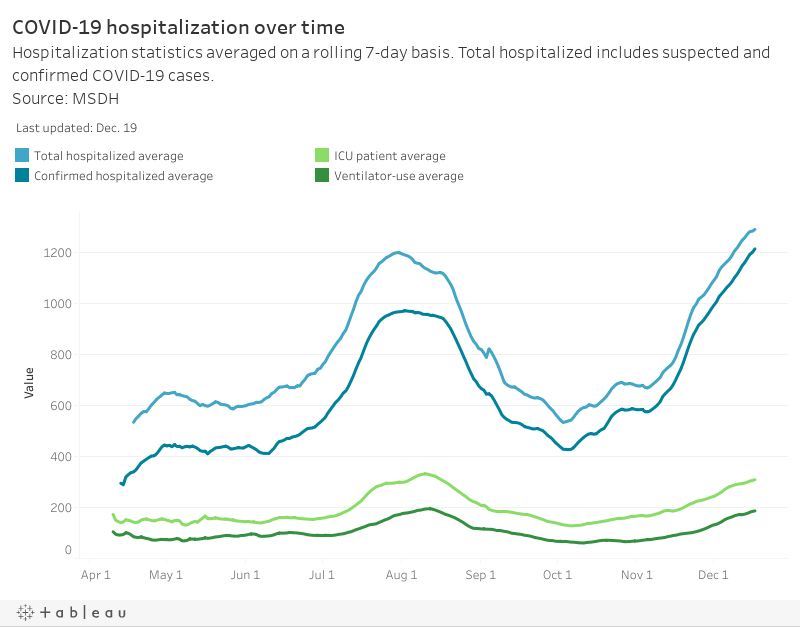
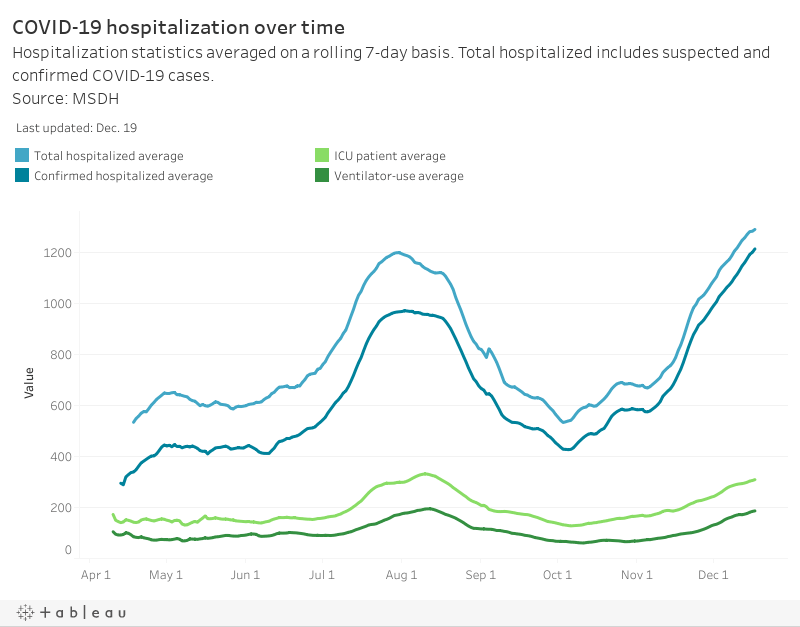
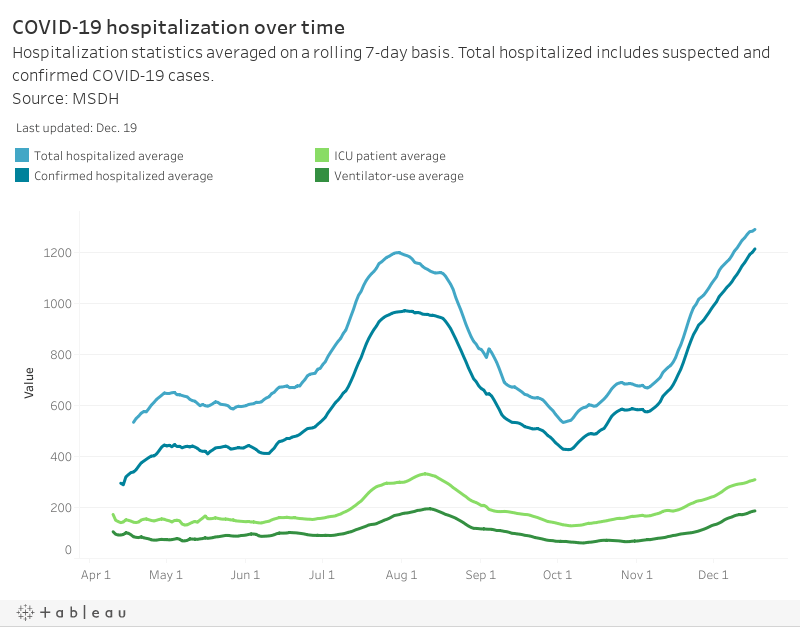
On Dec. 9, Mississippi also hit a new high for total hospitalizations on the rolling average, surpassing the summer peak. The state had already reached a new high for confirmed hospitalizations at the end of November, but hadn’t yet for the total tally, which includes suspected cases as well.
As seen in MSDH’s illness onset chart, the record for most illnesses in a day — Dec. 11, with 2,442 — is within the last two-week period, meaning those numbers could still go up.
Mississippi’s present rise in cases mirrors the national surge, as the state currently has the 26th most new cases per capita. According to the Harvard Global Health Institute tracker, every state except Vermont is now in the “red zone” (recording over 25 daily new cases per 100,000 people).
The health department reports that 148,466 people are presumed covered as of Dec. 13.
Click through the links below to view our interactive charts describing the trends around the coronavirus in Mississippi:
Eric J. Shelton/Mississippi Today, Report For America
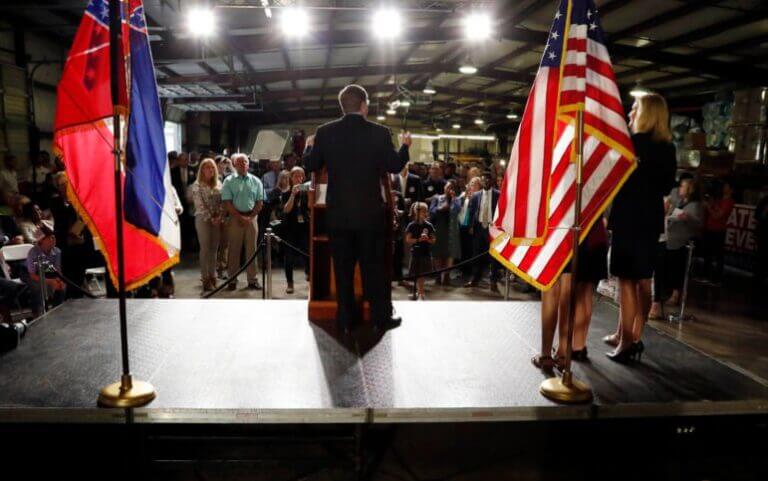
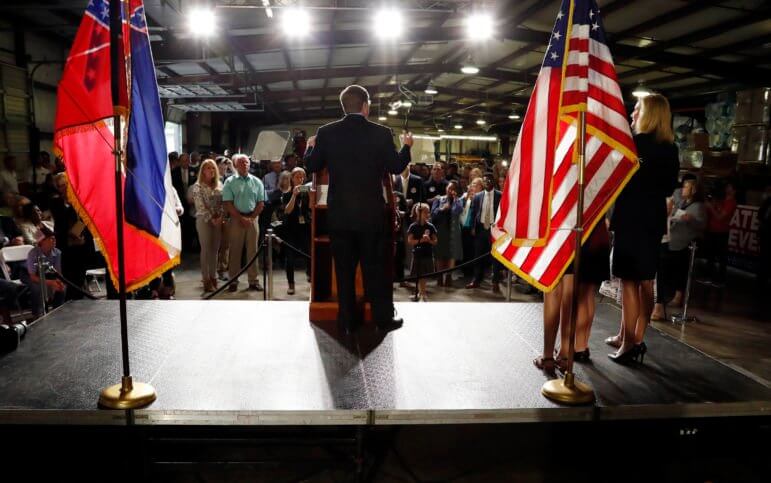
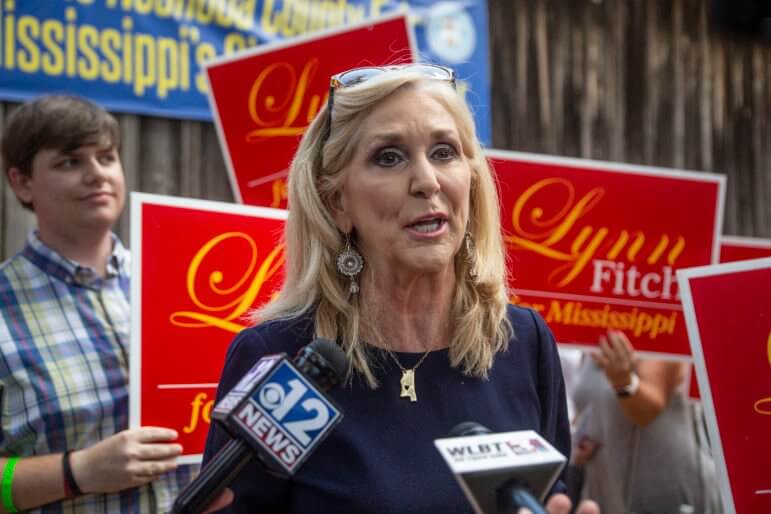
Republican state treasurer Lynn Fitch, a candidate for attorney general, speaks during the Neshoba County Fair in Philadelphia, Miss., Thursday, Aug. 1, 2019. Fitz was elected attorney general in November 2019.
Attorney General Lynn Fitch plans to ask the U.S. Supreme Court to rule against a lawsuit that attempts to ensure Mississippi adheres to language put into the state’s 1868 Constitution guaranteeing a uniform school system for all students.
That language mandating a uniform school system was replaced in the 1890s by the creation of separate schools for Black and white students.
While the language creating the separate school systems has been removed, the lawsuit filed by the Southern Poverty Law Center maintains the current language in the Mississippi Constitution expressing the state’s commitment to public education is a violation of federal law because it still falls short of the 1868 language, which says the state should operate a uniform school system.
What is at issue in the unique case is whether the state is in violation of the Mississippi Readmission Act of 1870 that was passed by the United States Congress after the Civil War. As a condition of readmission, the federal act, in part, prohibited Mississippi from making changes to its laws that lessened the guarantee of an equal or uniform school system, the lawsuit contends.
The lawsuit was filed by Will Bardwell of the Southern Poverty Law Center and others on behalf of a group of African American women who contend their children receive inferior education in majority African American schools than do students in other schools in the state.
Bardwell said the goal of the lawsuit is “to re-establish Mississippi’s obligation to maintaining a uniform school system and to hold the state accountable for not upholding that obligation.”
The lawsuit by the SLPC cited what it said were numerous examples where African American students still receive an inferior education in Mississippi. For instance, in the 2015-16 school year, of the 19 F rate school districts, 13 had a Black enrollment of more than 95% and all had enrollment of African Americans of at least 85%.
Colby Jordan, a spokesperson for Fitch, confirmed the attorney general intends to file “a writ of certiorari” asking the Supreme Court to review the case. Fitch and other state officials are asking the nation’s highest court to throw out the case after the full 5th U.S. Circuit Court of Appeals, by a 9-8 vote, said earlier this month the case should be heard in federal court in the Southern District of Mississippi. District Judge William Barbour had earlier dismissed the case. When the case was first filed by the SPLC in 2017, the state moved to have it dismissed.
“At the end of the day, it should go without saying that education is of the utmost importance to all of the state defendants and the state’s citizenry,” the dismissal motion read. “And, of course there is always room for improvement in this area in the state of Mississippi. But the tactics utilized by the SPLC in this lawsuit are not, and could not be, the answer.
“Indeed, it is hard to imagine a more perverse request for intervention by the federal judiciary as the relief requested would serve to hold captive not only a sovereign state’s constitution, but also profound notions of federalism.”
Officials worry that if successful the lawsuit could result in the judiciary mandating the state provide more funds for education.
Court of Appeals Judge Edith Jones writing in the minority that the case should be dismissed, said what the SLPC “sought for judgment, in essence, would tell Mississippi what its state Constitution meant then and means now and would pave the way for federal court orders to effect a major restructuring of state school funding.”
Nearly all states have language in their constitutions expressing their responsibility to provide a public school system. The education language adopted by Mississippi in place of the 1868 language is a sort of roadmap detailing the state’s long struggle with the issue of race.
The 1868 Constitution states “As the stability of a republican form of government depends mainly upon the intelligence and virtue of the people, it shall be the duty of the Legislature to encourage, by all suitable means, the promotion of intellectual, scientific, moral, and agricultural improvement, by establishing a uniform system of free public schools, by taxation or otherwise, for all children between the ages of five and twenty-one years, and shall, as soon as practicable, establish schools of higher grade.”
The state’s current Constitution, enacted in 1890, weakened that commitment by among other things removing the word uniform and adding a new section, mandating separate schools for “children of the white and colored races.”
That language establishing separate education system based on race was not removed from the Constitution until 1978.
Before then, there were amendments passed in the 1930s and famously, or infamously, in 1960, to continue to weaken the education commitment in the Constitution. With the state facing the forced integration of the schools by the federal government, the Legislature in 1960 passed a resolution that was approved by voters to proclaim that “the Legislature, may in its discretion, provide for the maintenance and establishment of free public schools for all children between the ages of six and 21 years , by taxation, or otherwise, and with such grades as the Legislature may prescribe.”
The language giving legislators “the discretion” to operate a public school system was removed in 1987. The language now says the Legislature shall provide for a free public school system “upon such conditions and limitations as the Legislature may prescribe.”
Tate Reeves speaks during his kickoff event for his race for governor on April 8, 2019. (AP Photo/Rogelio V. Solis)
Gov. Tate Reeves has been one of the shrewdest politicians on High Street, and in his eight years as lieutenant governor, he was known for hardball politics and running the Senate with an iron grip.
He was not often accused of indecisiveness or fence straddling, and he wasn’t overly prone to pandering. He was known for his penchant to hack people off — even his fellow Republican leaders — which Reeves has repeatedly chalked up to, “I know how to say no to my friends.”
But in his first year as governor, Reeves has straddled the fence on several major issues, shown indecisiveness and foot dragging and frequently put pandering ahead of policy. He’s also upped the ante on drawing ire from … well, all quarters.
As one political social media poster recently put it: “He has managed the difficult task of upsetting his base, upsetting his detractors, and even upsetting people who don’t normally care.”
Take, for instance, the issue of changing the state flag, removing the Confederate symbol. Reeves, likely fearing fallout from the more right-wing of the GOP base, was loath to join many of his fellow Republican leaders in the (successful) push to change it.
But, perhaps not wanting to wind up on the wrong side of history, Reeves signed the Legislature’s flag removal into law, despite having said voters should decide. His explanation for this included, “For economic prosperity and for a better future for my kids and yours, we must find a way to come together … No matter where you are, I love you, Mississippi.”
Eric J. Shelton/Mississippi Today, Report For America
Gov. Tate Reeves speaks to media about his COVID-19 orders on March 31, 2020.
Reeves managed to draw scorn from both sides on the flag. Those supporting reinstating the old flag have excoriated him on social media for not blocking the change, using the hashtags “TraitorTate” and “OneTermTate.” His main response has been a vow that he’ll not let the “cancel culture” go ‘round removing other Confederate symbolism or statues around Mississippi.
Reeves has also managed to catch fire from all quarters on his COVID-19 pandemic responses, or lack thereof. With piecemeal, hang-fire orders on mask wearing and other measures, he’s been criticized by both those wanting stringent public health regulations and those who believe government should be hands-off.
Reeves has mostly attempted to issue COVID-19 orders on a county-by-county basis — despite pandemics not recognizing county borders. But he also has, as the state’s infections wax, issued statewide orders … but then rescinded them … then reinstated some because cases grew again.
He’s decried the “heavy hand of government,” defending criticism that he should have done more, sooner, but managed to issue enough pandemic edicts to also rile up the more libertarian wing of his base. Along the way, he’s also managed to insult state medical leaders.
While eschewing state health leaders’ pleas for a statewide mask mandate, he’s — slowly — issued mask-wearing executive orders for a majority of the state in dribs and drabs over weeks as infections in Mississippi continue to set records.
And, as a real crowd pleaser, he’s shown up in crowds not wearing a mask and hosted Christmas parties and fundraisers. This as he’s issued executive orders for Mississippians to wear masks and limit gatherings — or as people have accused him on social media, “Rules for thee, but not for me.”
Heck, he likely even has drawn the ire of his teenaged daughter. In an inexplicable defense of having Christmas parties at the Governor’s Mansion during a surge in the pandemic, he noted he has cancelled some events, including his daughter’s 16th birthday party. But he continued to hold receptions for political leaders and campaign donors, saying they can be held safely.
Reeves, through some surgical vetoes, has angered both sides of the aisle in the Legislature, and drawn litigation from fellow Republicans.
With a veto aimed at preventing loss of a teacher merit pay program, he still managed to tick off many educators because he also vetoed large swaths of other school funding. And despite vowing to push for large teacher pay raises when he campaigned for governor, Reeves recently released his budget proposal sans any teacher pay raise.
Former Republican state Rep. Robert Foster challenged Reeves in last year’s GOP gubernatorial primary. The little-known, underfunded Foster made a surprisingly strong showing, pulling 18% of the vote from mainly the ultra-conservative wing of the state Republican base.
Foster, who has built a substantial social media following, is critical of Reeves’ showing as governor so far.
“He’s riding the fence on everything,” Foster said. “He’s pulling the typical career politician move, licking his finger, sticking it in the wind and seeing which way the politics are blowing. He doesn’t have the courage to do what he thinks is right.”
Foster has been very vocally against COVID-19 restrictions on businesses and mask-wearing or other mandates and has criticized Reeves’ orders and policies.
“The pandemic is a true test of his lack of leadership abilities — a very high stress situation, worldwide pandemic with a lot of death, suffering and economic loss,” Foster said. “The main thing I think is it has shown his unwillingness to stick to principle — obviously he doesn’t have any principles. He’s a politician at heart, going to go with the way the loudest group screams. He obviously doesn’t believe in masking because he’s been caught at numerous events not wearing one … but he doesn’t have the backbone to stand up to (those wanting mask mandates).”
“On the flag, he campaigned over and over again that people should have a vote on whether the flag should be replaced, but then he went back on his word,” Foster said.
Longtime former Mississippi State University political science professor and politico Marty Wiseman notes some of the blowback Reeves receives “may just be because of his personality.”
“He’s built a pretty good history over eight years in the lieutenant governor’s office of creating resentment even from the people who want to help him,” Wiseman said. “There’s even those folks that would tend to vote the way he wanted them to vote, who would resent his abrasive-type approach … He seems never to miss an opportunity to get crossed up with one side or another … It’s also well known that he holds a grudge, from then on.
“He’s one of those people that, whether you’re ‘fer him or agin’ him, you tend to take a ‘What the hell has he said now’ attitude with him with some skepticism,” Wiseman said.
Some of the political blowback Reeves has received thus far in his first term has had many state politicos wondering if he’ll garner a major challenger in the next gubernatorial GOP primary in 2023.
But Millsaps College government and politics professor Nathan Shrader said he doesn’t believe Reeves has suffered any major political damage so far, and his pandering to President Trump’s supporters insulates him.
“From a public administrator standpoint, I think he has handled the crisis, the pandemic, as poorly as any administrator or person in leadership could,” Shrader said. “… Rank and file (Mississippi) Republican voters — 756,000 of them — voted for Donald Trump for president, and the governor has shown an almost cult-like loyalty to him. He has pushed every single button on the Trump menu, and Trump is likely to still be the figurehead of the Republican Party in 2023 … Tate Reeves will benefit from that.”
As for the flag, COVID-19 policy and other issues, Shrader said he’s reminded of the words of a colleague he knew years ago.
“He said, ‘Remember, issues don’t matter,’” Shrader said. “I think we’ve learned in the Trump era, he was right. Those issues matter less and less. It’s about the branding and the marketing … I’m just not seeing weakness on the governor’s part with Republicans. People on the right are upset, but (2023 is) a long time away, and there are enough other issues where they are in concert with him — he’s going to be the Republican nominee, he’s a fundraising machine, and it’s hard to beat an incumbent.”
Marvin King, professor of political science and African American studies at Ole Miss, said Reeves has suffered from some political shift in Mississippi politics since he ascended from lieutenant governor to governor.
“The ground has shifted,” King said. “Things were probably simpler — what Republicans stood for, what Democrats stood for. There were less internecine battles between Republicans. Things like coronavirus is a different beast than any of us has had to deal with before … Coronavirus might be one of those wedge issues — older voters are definitely more Republican than not, but they also stand to suffer most from this disease.
“Business owners need businesses to stay open, but plenty of Republicans are in health care, too, and they are like, ‘Hey, mask up,’” King said. “It’s dividing the party, so that might explain why he’s doing things county by county … He can’t win. So much of his constituency relies on businesses being open, but it’s not good business if the only people doing well are morticians. He’s in a pickle.”
King said Reeves was on similar shaky political ground with the flag issue.
“The national mood had changed and even Mississippi can only ignore national moods so much,” King said. “It’s pretty clear that had the Legislature not acted, big businesses would do things in response that Mississippi might not be able to recover from.
“… I think if you were sitting in Reeves’ shoes at that moment in time, there were no ideal political solutions for him,” King said. “It was, ‘How can I get this out of the news cycle as quickly as possible? I’ll sign it. It’s the summer. I can go back to talking about coronavirus.’”
King said there’s a lot of time before Reeves stands for reelection in 2023 and he has a lot of time to mend political fences.
“By then from his perspective, knock on wood, coronavirus will be over, people will have gotten used to the new flag and he’ll be able to point to some accomplishments, especially if the economy comes back,” King said.
Eric J. Shelton, Mississippi Today/Report For America
Center Hill High School economics teacher Toni Coleman, left, talks with senior Jasmine Ellis after class in Olive Branch on Tuesday, May 7, 2019.
A legislative watchdog committee is warning lawmakers that they do not have up-to-date information to make funding decisions for a teacher merit pay program, and the law as it exists is unclear about the state Department of Education’s responsibility in administering it.
In a report released this week, the Joint Legislative Committee on Performance Evaluation and Expenditure Review (PEER) committee highlighted problems with the controversial Mississippi School Recognition Program and offered suggestions for how lawmakers could improve it.
The Mississippi Legislature in 2014 created the School Recognition Program, which provides financial rewards for educators in school districts with an A rating or districts that move up a letter grade. Since its inception, the Legislature has appropriated $98.6 million for the program, according to the report.
The legislation that created the program “… did not mandate that MDE develop the processes and procedures for implementation of the program, which was a novel financial incentive program that had never been administered by the department,” the report said.
In July, Mississippi Today published a story outlining issues with the merit pay program. While many teachers Mississippi Today spoke with said they were grateful for the money, critics say it causes confusion and in some cases actually decreases morale for educators.
Additionally, the program’s intent to incentivize teachers based on accountability ratings has caused problems, including infighting at the district level about how the money is distributed and who is eligible to receive the funds, according to school officials, lawmakers and education advocates.
The legislative report highlighted examples of how the money has been disbursed in years past. Until recently, the money was distributed by teacher committees which chose who received funds and how much. The report cites examples of schools where teacher committees gave some people as much as $2,200 while others at the same school received just $300. The Mississippi Department of Education changed this last year to require that schools give this money out equally, though Mississippi Today’s analysis found not all schools seem to be doing this.
Earlier this year, Gov. Tate Reeves vetoed parts of the $2.2 billion education budget because it did not contain funding for the program, which he supports. The Legislature did ultimately fund the program, setting aside $28 million for the current fiscal year.
How exactly to disburse those funds to schools is complicated, this weeks’ report said. When the coronavirus pandemic forced Mississippi public schools to close their doors in March and cancel state testing, that meant there were no test results to base that year’s accountability ratings on. As a result, the state Board of Education allowed all school districts to retain whatever rating they had from the previous school year. This “presents the Legislature with a conundrum,” the report said, because districts are awarded funds for the program based on accountability ratings.
“Basing a FY 2022 appropriation for the School Recognition Program on ratings that are not up-to-date through assessment testing could result in the Legislature appropriating more or less funds for the program than necessary,” the report said. “For example, allowing districts and schools to retain their previous accountability ratings does not take into account the fact that some districts might have improved in their academic performance while others might have declined—i.e., districts and schools could be overpaid or underpaid due to awards being based on a prior school year’s performance rather than the most recent school year’s performance.”
The PEER report recommends:
The Mississippi Legislature should amend the law to officially require the Mississippi Department of Education to enforce the program’s rules and regulations.
To avoid confusion about who is eligible to receive the funds, the Legislature should change the word “staff” in the law to “certified employees” if the intent of the law is for certified employees specifically to receive these funds.
If the Legislature intends to appropriate funds for the program in the upcoming 2021 legislative session, Mississippi Department of Education staff should present the House and Senate appropriations committees with specific recommendations about how to determine how much funding is necessary, since accountability ratings (which are used to determine funding for the program) for the most recent school year were affected when the pandemic disrupted state testing last school year.
The MDE’s rules and regulations should require school districts to post on their websites the total amount of money received by certified employees, and the reason why the district received the money.
We are bringing you the latest COVID-19 Mississippi trends with daily case, death and hospitalization updates, as well as testing data charts and other helpful interactive maps and graphs.
This page was last updated Monday, December 21:
New cases: 1,167| New Deaths: 2
Total Hospitalizations: 1,319
Total cases: 195,500|Total Deaths: 4,411
Mask Mandates | On Sept. 30, Gov. Tate Reeves ended the statewide mask mandate order, originally issued Aug. 4. Since then, he has added a total of 61 individual county mask mandates, covering half of the state. State health officials encourage widespread masking and credit the original mandate with helping cases improve after a steep summer spike. View the full list of COVID-19 orders here.
On Tuesday Mississippi hit a new record with the seven-day average for cases, reaching 2,196. After going nine months without reporting 2,000 cases in a day, the state has reached that point nine times in just the 16 days of December so far.
On Dec. 9, Mississippi also hit a new high for total hospitalizations on the rolling average, surpassing the summer peak. The state had already reached a new high for confirmed hospitalizations at the end of November, but hadn’t yet for the total tally, which includes suspected cases as well.
As seen in MSDH’s illness onset chart, the record for most illnesses in a day — Dec. 11, with 2,442 — is within the last two-week period, meaning those numbers could still go up.
Mississippi’s present rise in cases mirrors the national surge, as the state currently has the 26th most new cases per capita. According to the Harvard Global Health Institute tracker, every state except Vermont is now in the “red zone” (recording over 25 daily new cases per 100,000 people).
The health department reports that 148,466 people are presumed covered as of Dec. 13.
Click through the links below to view our interactive charts describing the trends around the coronavirus in Mississippi:
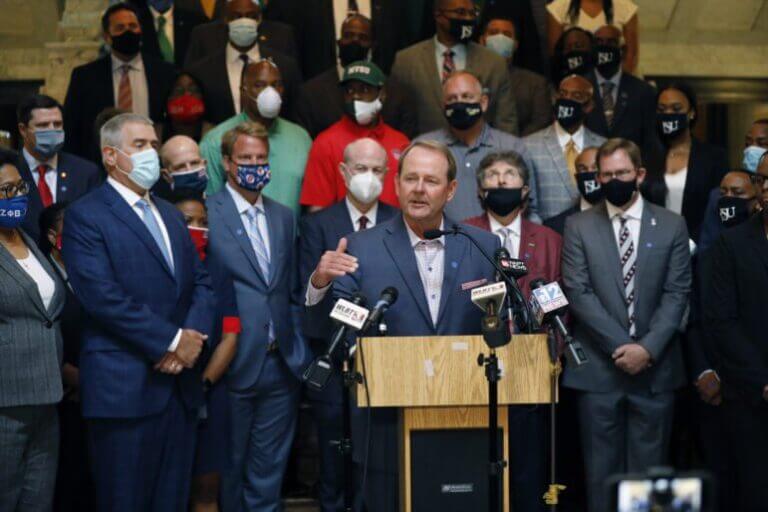
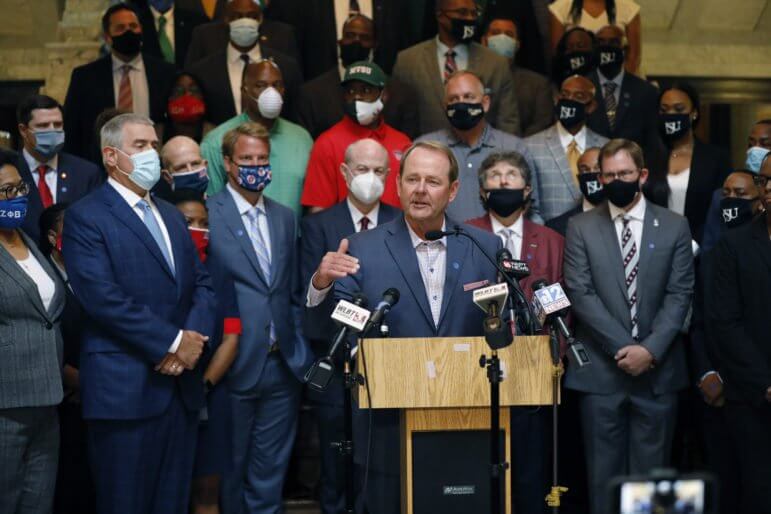
Mississippi basketball coach, Kermit Davis, center, joins other athletic staff from the state’s public universities calling for a change in the Mississippi state flag on June 25,2020. (AP Photo/Rogelio V. Solis)
The pandemic took sports from us and then changed everything about them. There were monumental coaching changes that turned the eyes of the nation to Mississippi. Athletes and coaches influenced the historic state flag change. Legendary sportswriter Rick Cleveland, a columnist for Mississippi Today, discusses the unforgettable year for Mississippi sports.
We are bringing you the latest COVID-19 Mississippi trends with daily case, death and hospitalization updates, as well as testing data charts and other helpful interactive maps and graphs.
This page was last updated Sunday, December 20:
New cases: 2,222| New Deaths: 19
Total Hospitalizations: 1,319
Total cases: 194,333|Total Deaths: 4,409
Mask Mandates | On Sept. 30, Gov. Tate Reeves ended the statewide mask mandate order, originally issued Aug. 4. Since then, he has added a total of 61 individual county mask mandates, covering half of the state. State health officials encourage widespread masking and credit the original mandate with helping cases improve after a steep summer spike. View the full list of COVID-19 orders here.
On Tuesday Mississippi hit a new record with the seven-day average for cases, reaching 2,196. After going nine months without reporting 2,000 cases in a day, the state has reached that point nine times in just the 16 days of December so far.
On Dec. 9, Mississippi also hit a new high for total hospitalizations on the rolling average, surpassing the summer peak. The state had already reached a new high for confirmed hospitalizations at the end of November, but hadn’t yet for the total tally, which includes suspected cases as well.
As seen in MSDH’s illness onset chart, the record for most illnesses in a day — Dec. 11, with 2,442 — is within the last two-week period, meaning those numbers could still go up.
Mississippi’s present rise in cases mirrors the national surge, as the state currently has the 26th most new cases per capita. According to the Harvard Global Health Institute tracker, every state except Vermont is now in the “red zone” (recording over 25 daily new cases per 100,000 people).
The health department reports that 148,466 people are presumed covered as of Dec. 13.
Click through the links below to view our interactive charts describing the trends around the coronavirus in Mississippi:
Eric J. Shelton/Mississippi Today, Report For America
Republican Attorney General Lynn Fitch sued several states for enacting changes to election procedure without garnering legislative approval. That exact reality also occurred in Mississippi.
Perhaps Mississippi Attorney General Lynn Fitch should sue Secretary of State Michael Watson.
After all, Watson essentially did what Fitch and 18 other Republican state attorneys general sued four states for doing: enacting changes to election procedure without garnering legislative approval.
That high-profile lawsuit, filed by Texas Attorney General Ken Paxton and joined by Fitch, sought to have about 20 million ballots invalidated in Georgia, Michigan, Pennsylvania and Wisconsin. Instead, the plaintiffs wanted those states’ Republican legislatures to select the winner. Presumably, they would have selected President Donald Trump instead of former Vice President Joe Biden, who won those four states on the way to capturing the presidency.
The lawsuit, of course, was rejected by the U.S. Supreme Court. The suit alleged that because state election officials (the executive branch) and the judiciary made those changes, they were invalid since state constitutions and the U.S. Constitution vest the legislative branch with the authority to make and change laws.
But even in Mississippi this year, election changes were made without legislative approval. Attorneys for the Lawyers Committee on Civil Rights and the Southern Poverty Law Center announced in October they were dropping a lawsuit filed against Mississippi because of voter safety issues related to the COVID-19 pandemic after Watson agreed to make changes to the procedure for processing absentee ballots received by mail.
Under the change, local election officials were required to provide notice to people voting by mail if their ballots were being rejected because of signature verification issues and allow voters “to cure” or correct the problem.
When asked how what he did was any different than what election officials did in those pivotal swing states, Watson argued it was much different because he was acting within his regulatory authority given to him by the Mississippi Legislature to establish guidelines to carry out the election.
Essentially, that is what election officials said they were doing in Georgia, Michigan, Pennsylvania and Wisconsin, based on their responses to the Paxton/Fitch lawsuit. And multiple court jurisdictions — conservative and liberal judges — have affirmed their position.
Election officials in those four swing states sued by the attorneys general said they were working to ensure voter safety and to expand opportunities for voters to correct any problems with their ballots, just as Watson maintained he was doing here in Mississippi.
Most states, and not just those four swing states, made changes to address safety concerns related to COVID-19. In Texas, home of Paxton, Republican Gov. Greg Abbott through emergency orders made several changes, including establishing secure drop boxes where people could drop off ballots instead of relying on the U.S. Postal Service. Perhaps if Biden had won Texas, Fitch would have filed a lawsuit against the Lone Star state.
Despite the multiple court rulings, some Mississippi officials including Watson, Fitch and Gov. Tate Reeves continue to question the validity of the election. They argue that Mississippi voters might have been harmed because officials in other states relaxed voting laws, thus making the ballots cast by Mississippians less meaningful.
On social media Reeves said, “a safe and fair election here in Mississippi — not upended by last minute schemes to radically alter voting methods. Election integrity is vital.”
Both Reeves and Watson spoke last week of officials in other states “flooding” their states with unsolicited mail-in ballots. In reality, that did not occur in any of those four swing states. In some of the states, voters were sent unsolicited applications for absentee ballots. That practice was challenged in court and approved as being within the framework of the law.
Other non-swing states like Republican-dominated Utah and Democratic-controlled Washington have been conducting mail-in voting for years and sending ballots to all registered voters.
Most states, though not Mississippi, have some version of no-excuse early voting both in person and by mail. In those states, safeguards, such as requiring signature verification and requiring a voter identification number on the ballot, help to ensure election security.
Besides arguing what Watson did was different than the election changes made in the four swing states, Fitch contends he did not make the changes in processing absentee ballots because of the lawsuit.
“The secretary of state used the regulatory authority the Legislature gave him… and the plaintiffs lost their legal basis for bringing a suit. It’s misleading to call that a settlement,” said Colby Jordan, a spokesperson at Fitch’s office. “It’s the legislative and regulatory process working the way they were intended.”
Yet the motion dismissing the lawsuit, signed by U.S. Judge Daniel Jordan, references “the agreement of the parties” as a reason for the dismissal. And when the plaintiffs said they were dropping the lawsuit because of the changes, Fitch and Watson did not dispute those reports, though they have been busy disputing election results.
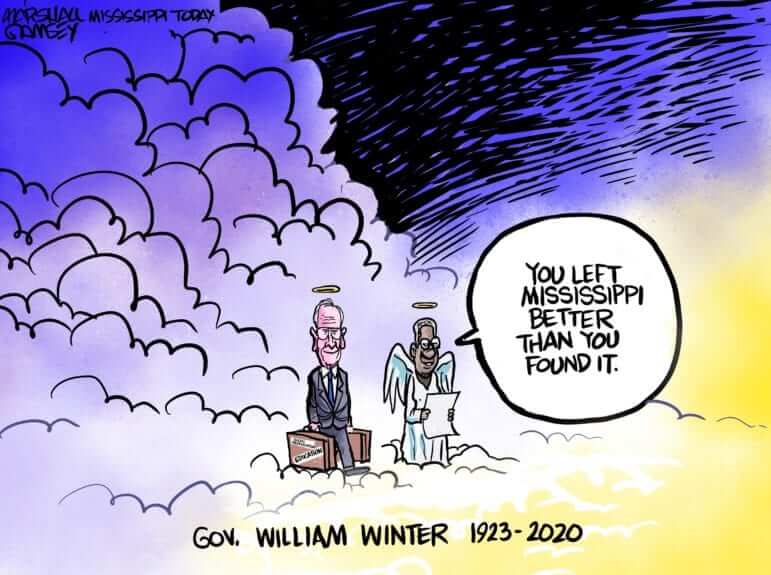
If you pass at 97 and people think you’ve left the world too soon, you’ve lived a powerful and meaningful life. I am grateful I got to spend a little of time with Governor Winter (he wrote the forward for one of my books) and will miss his leadership and kindness.